Memory Monday: That Time a Classmate Said That Having Diabetes Means You’re Screwed

One Monday per month, I’ll take a trip down memory lane and reflect on how much my diabetes thoughts, feelings, and experiences have unfolded over the years. Today, I remember…

…that one time in college when some random kid sitting near me in class said that having diabetes means “you’re screwed”. In other words, you can’t live with it, it’s a death sentence.

Before I talk about how I responded to that, I’ll provide some context. It was my freshman or sophomore year of college. I was in a discussion group for my Nutrition 101 seminar. It was early enough in my college career that I still felt painfully shy around most of my classmates, unless they happened to live in my dorm or I had known them in high school (even though I went to a college with an undergraduate population of more than 20,000, I’d still occasionally encounter a high school classmate – it’s a small world after all).

But when it comes to diabetes…well, I have a reputation for not being able to shut up about it. So when it inevitably came up over the course of the Nutrition class, and the teacher’s assistant asked us to define it, I felt a natural impulse to say everything I knew about it. I had to suppress it, though, because my fear of raising my hand in class was stronger than my desire to spew out an overly in-depth definition of diabetes.

So I let someone else answer the question, noting what was right and wrong about the response. As the T.A. launched into her notes on diabetes and nutrition, I overheard a muttered, ignorant comment from the kid next to me:

If you have diabetes, that means you’re screwed!

Your art is yours
As you might imagine, I didn’t take too kindly to his words.

While the dude sitting next to him laughed, I felt instant rage surge throughout my body. Without even thinking, I blurted out loud, just audibly enough for him to hear, “No, having diabetes does not mean you’re screwed. Whether you have type 1 or type 2, you can live a perfectly normal life with it. I would know, I have type 1.” I felt my face flush as I turned my attention back to the oblivious T.A. in the front of the room. In the corner of my eye, I saw that the kid was sitting there, mouth slightly agape, probably surprised that the quiet girl in discussion group spoke up to shut down his idiotic way of thinking.

It’s been several years since I was in this particular class, and I don’t remember much of the materials that were taught in it. But I do remember this exchange. It stands out to me because it’s a reminder of how far we’ve got to go as a society to defeat diabetes stigma and prove that you can do more than survive with diabetes – you can thrive with it.


Leadership in the T1D Community

This blog post is a response to a prompt provided by my friends at the College Diabetes Network, who are celebrating College Diabetes Week from November 12-16. Even though I’m no longer in college, I like to participate in CDW activities as much as possible to show my support for the CDN!

Screen Shot 2018-11-04 at 7.53.18 PM

Recently, I’ve asked myself, “Am I doing enough?”

I want to make meaningful contributions to the diabetes community. I think that I make a slight ripple by writing this blog, but to me, a ripple isn’t enough. I want to do more.

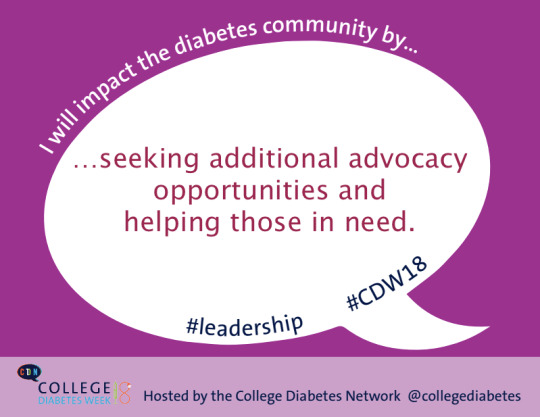
That’s why I want to put more effort into seeking additional advocacy opportunities. I haven’t defined those yet, but I know that there has to be more ways in which I can make my voice heard in a way that has a greater impact. Perhaps I can do more to further the #Insulin4All initiative, which, if you’re unfamiliar with, is explained on the Insulin Nation site in the following terms:

T1International is a global nonprofit that works to improve life-saving access to insulin, supplies, and healthcare for individuals with Type 1 diabetes around the world. Their mission is to support local communities by giving them the tools they need to stand up for their rights so that access to insulin and diabetes supplies becomes a reality for all. The organization helped to launch the #insulin4all hashtag and campaign, which has recently gained a lot of traction in the United States, where diabetes costs have grown especially exorbitant. Note: T1International is not limited to #insulin4all and vice versa, although both are discussed here.

I admit that it’s an effort that I’m only vaguely acquainted with, and I’d like to change that because it’s massively important. It goes without saying, but diabetes is difficult enough. Anyone who lives with it or cares for someone with it should be able to afford the insulin they need to survive, or to help a loved one survive.

If you’re someone who’s worked on this campaign, or if you know a way that I can step up and do more as a leader in the T1D community, please feel free to let me know. We’re in this together, and the more people we’ve got chipping in on various efforts, the more impact we’ll make.

No More Fingerpricks Campaign

Diabetes Awareness Month may have only started a few days ago, but boy, has it been jam-packed with advocacy and awareness efforts so far! In fact, I think this is the most active year yet for most social media platforms. I’ve seen tons of different campaigns, hashtags, and posts that were all created especially for this month, and it’s absolutely wonderful to see such inspired content as well as high participation rates.

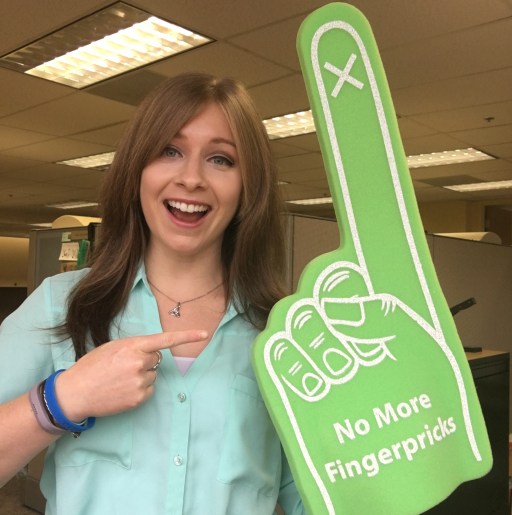
And I hope to keep the ball rolling on this! That’s why I’m sharing my #NoMoreFingerpricks post today. This campaign was launched by Dexcom and Beyond Type 1. Participants are encouraged to take a picture or video wearing the foam finger from Dexcom, or to draw an “X” on an actual finger (if they don’t have a foam finger). For every photo or video posted on Facebook/Instagram with an @Dexcom and #NoMoreFingerpricks, Dexcom will donate $1 to Beyond Type 1.

FDA2CBBD-C531-48F6-8357-01562F3C4383
Here’s my #NoMoreFingerpricks campaign photo! And yes, I deliberately wore blue – the color of diabetes awareness.

Yup, it’s that easy to do! And it’s exactly the kind of social media campaign that can catch on quickly. Recruit your family and friends to take photos and get posting! And be sure to teach them a couple of diabetes facts and what the whole #NoMoreFingerpricks hashtag is all about. For instance, you could mention that:

  • 34% of people with T1D know nothing or little about CGM
  • 80% of people with T1D still prick their fingers more than 3 times a day
  • 96% of CGM users would recommend CGM

You could even direct inquiring minds to visit nomorefingerpricks.com to learn more about continuous glucose monitoring technology and this campaign.

So…what are you waiting for?! Draw an “X” or grab that foam finger and post your photo to educate, advocate, and celebrate living beyond!

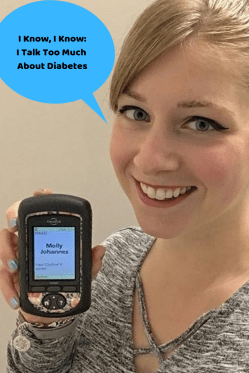
I Know, I Know: I Talk Too Much About Diabetes

Diabetes is never far from my thoughts.

I write a blog about it. I vent to family about it. I almost always casually mention it to new people that I meet.

I have multiple social media profiles dedicated to it. I own several t-shirts that identify me as a person with diabetes.

It’s the first thing I think about in the morning when I wake up, and the last thing I think about before I fall asleep at night.

And yet, sometimes people complain – jokingly and seriously – that I talk about it too much.

Of course I do! I totally own up to that fact. But think about it…

Doesn’t it make sense that I talk about it so much?

Untitled design
…but there’s a reason for it.

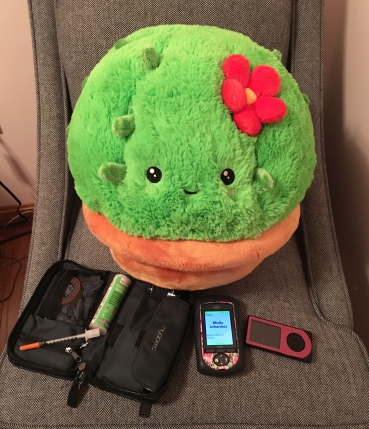
It affects the most mundane decisions that I make on a daily basis. It affects my mood. It affects my body. It affects the foods I consume. It affects what I carry in my purse each day and what I pack in my luggage on vacations. It affects my finances and my gym routine and the doctors I have to see.

If someone thinks I talk too much about my diabetes, then I’d like them to understand this:

Talking about diabetes spreads awareness and saves lives.

Bold, italicized, and underlined so the message and its significance is clear. Too many people in this world just don’t understand type 1 diabetes. They don’t realize how dangerous it can be, or how it is managed. In my personal experience, being open with others, answering their questions, and dispelling diabetes myths has resulted in nothing but positive outcomes.

It’s even helped people I know save a life, because they knew what to do when a T1D close to them was experiencing a hypoglycemic event.

All because I “talked too much” about diabetes.

With that in mind…you can bet that I won’t be shutting up about it any time soon.

I’m Right, You’re Wrong: Debating with T1D

I found the diabetes online community (DOC) a few years ago – or perhaps it found me – and to this day, I’m incredibly grateful for it. It’s introduced me to new friends and it’s always been a reliable source of information. Whether I’m lamenting a low blood sugar at 2 A.M. or asking if anyone has advice on a pod problem at 2 P.M., odds are I’ll have someone reaching out to me within minutes in some form or fashion. That kind of on-the-fly support is invaluable.

That being said…the DOC is not always a perfect safe haven.

A9C03A36-6350-4D4F-A23F-E76A67DE4AFA
When it comes to diabetes, there shouldn’t be a “right” or a “wrong” side. T1D is hard enough.

In fact, if there was one thing I could change about it, it would be to make it a judgment-free space: because all too often, people are unfairly judged for how they choose to manage their own diabetes.

I’m not saying that people aren’t entitled to opinions. Of course they are! But what happened to respectfully disagreeing with people?

I’ve seen situations like the following across different social media platforms:

  • People getting attacked for following low/medium/high-carb diets
  • People getting criticized for sharing “good” and “bad” blood sugars/A1cs
  • People getting judged for dealing with diabetes burnout – as well as people getting judged for sharing their diabetes triumphs
  • People getting discouraged from posting only the pretty parts of diabetes

We can’t keep doing this to each other. Just because a certain diet or T1D management strategy works out well for one person, doesn’t mean that it will work the same for another. That’s because diabetes is not a one-size-fits-all condition.

And we shouldn’t be judging one another for our differences. In fact, our differences can teach us so much more than our similarities can. We should celebrate one another for living with diabetes: doing the best we can, day after day, whether it yields “ideal” or “not ideal” results. Because it’s damn difficult to manage, and anyone who says otherwise is being judgmental.

We can learn and grow from one another, which is pretty powerful, as long as we refrain from this “I’m right, you’re wrong” attitude.


Why Word Choice Matters to a Person with Diabetes

Read the following five sentences. Can you tell what’s wrong with them?

  1. She’s a diabetic.
  2. He’s testing his blood sugar right now.
  3. Her diabetes is out of control!
  4. Isn’t that a really bad blood sugar?
  5. He suffers from diabetes.

Have you figured it out?

The language in those five sentences is extremely negative. “Bad,” “out of control,” and “suffers” are obviously gloomy and cynical words to use when referring to diabetes – you don’t need to be a wordsmith make that connection immediately. But what’s wrong with “diabetic” or “testing”? It’s the connotations around those words. Calling someone with diabetes a “diabetic” is labeling them with the disease and removing the actual person from the equation. Saying that a person with diabetes is “testing” their blood sugar makes it sound so…clinical. It also implies that the person could pass or fail the so-called test, adding pressure and guilt to the situation.

fba8e1c6-8607-43d5-9ad5-2b4fc3f24246.jpeg
Choose your words wisely.

In my real-world, full-time job, I’m an editor, so it gives me great pleasure to amend those above sentences into more positive, empowering language:

  1. She has diabetes.
  2. He’s checking his blood sugar right now.
  3. She’s having a tough time managing her diabetes.
  4. How do you handle high or low blood sugar?
  5. He lives with diabetes. (Or even better: He THRIVES with diabetes.)

Ah, much better. Never underestimate the power of words.

Advocacy is not “One Size Fits All”

Not too long ago, someone told me that my blog wasn’t really a form of diabetes advocacy, a point that I strongly refuted.

Advocacy looks different to everyone, and people can be advocates in countless ways. I think it depends largely on 1) what someone is trying to advocate and 2) their personality. For instance, maybe someone is really good at fundraising and wants to raise money to donate to a particular charity. Perhaps someone thrives from advocating at the group level, whereas another person prefers to do it individually. Maybe political advocacy for a cause like diabetes is right up one person’s alley, and another person is more comfortable with using social media to raise awareness and interact with others in an environment like the diabetes online community.

IMG_5153
My blog is my diabetes advocacy outlet.

If you haven’t guessed it by now, my preferred way to partake in diabetes advocacy is blogging. I feel that writing down my story, whether it’s lessons I’ve learned over the years or mundane anecdotes about life with diabetes, is the form of advocacy that makes the most sense for me. It allows me to open up to a large, eclectic audience (i.e., the entire Internet) and show them what it’s like, to some degree, to live with diabetes. I keep things real in my posts and write about the good, the bad, and the ugly when it comes to T1D, and to me, that is advocacy.

Bike Beyond, the Documentary: An Emotional Cinematic Experience

Last summer, a team of 20 international riders embarked on the journey of a lifetime. They spent 10 weeks cycling from New York City to San Francisco – east coast to west coast. As if this feat weren’t incredible enough, this team was comprised of individuals with type 1 diabetes.

This ride was risky enough, but throw diabetes into the mix, and it seemed impossible. Blood sugars would be a constant concern. Diabetes technology could fail. Careful watch of blood sugars could clash with the focus on cycling. Diabetes burnout could affect the riders physically and mentally.

But – spoiler alert – neither fear nor diabetes would prevent these riders from completing their arduous trip.

When Team Bike Beyond officially started their trek last summer, I remember following along as best as I could through various social media channels. I felt connected to the team: not just because of diabetes, but because I personally befriended a couple of the riders a few years ago at one of the College Diabetes Network’s Annual Student Retreats. I attended as a volunteer, and Jesse and Meagan were there as students. It’s funny how quickly friendships can form over the course of five days, but as anyone who’s gone to one of these retreats can tell you, there’s something about being immersed for a few days with a group of people who just get it. So it’s natural that we bonded over our mutually dysfunctional pancreases.

Anyways, as neat as it was to read those updates from Jesse, Meagan, and the team, there’s no way that words could capture what they were actually experiencing out on the road. I think that’s why watching the documentary was so emotionally captivating to me: Within the first few minutes, tears were rolling down my cheeks as the bikers explained the nervous energy they felt in the days leading up to the ride kickoff. In fact, my facial expressions changed so frequently throughout the film that I’m sure it was comical. One moment I’d be beaming, and in the next my jaw would drop open. I’d laugh when the riders were being goofy together on camera, and marvel with them as they took in stunning scenery across the country.

Overall, the documentary was incredibly well done. Victor Garber’s narration was fantastic – smooth and clear without taking attention away from what was happening onscreen – and the visuals were beautiful. I liked how footage from the riders’ GoPro cameras was incorporated so viewers could get an accurate representation of their perspectives from the bikes. It made me appreciate the physical intensity of the ride that much more, because diabetes aside, cycling such a long distance filled with rocky roads and steep inclines is extremely demanding on the body.

My recommendation? Check out the trailer. I included it above. I guarantee it’ll pique your interest and stir your emotions. You’ll want to watch the full documentary, which you can get here. After watching it, I think you’d agree with me that Team Bike Beyond crushed their goals of raising T1D awareness and eliminating stereotypes by completing this journey.

Diabetes and the Blame Game: Why it’s Harmful to Judge People with T1D

Here’s a little disclaimer: This post is highly personal. I’m going to dive deep here and talk about a few things that bother me when it comes to how others perceive T1D. My opinions are strong, but I’m entitled to them – just like you are.

“I can’t believe his blood sugar got that low. He really needs to have better control over his diabetes.”

“Why wasn’t she carrying a snack with her? That’s so irresponsible, she should know better!”

“They’re unhealthy. The way they manage their diabetes isn’t okay and it’s no wonder they go to the doctor so much.”

These are words that others have spoken about people with diabetes in my presence. While these thoughts and feelings aren’t necessarily about me, it doesn’t mean that I don’t take them personally.

Why do they bother me? Because they’re dripping with judgment.

It’s easy for someone who simply doesn’t understand diabetes to make assumptions based on a couple of observations they make about someone with diabetes. But just because it’s easy to assume things, it doesn’t make it okay.

Just because you see someone have a tough diabetes day, it doesn’t mean that’s what it’s like all the time.

Just because someone forgot to carry a low blood sugar remedy on them, it doesn’t mean that they always forget one.

Just because you know of someone who frequently visits the doctor, it doesn’t mean their diabetes is “out of control.”

Just because you blame someone for not taking “proper care” of themselves, it doesn’t mean that they don’t try their damnedest.

28276753_2470934019799402_3452392286696220057_n
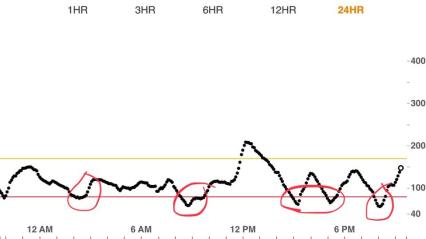
I can do all the right things for my diabetes over the course of a day, and still have it go wrong. Blaming and shaming me for being a bad diabetic only makes matters worse.

That’s what’s so wrong about making assumptions about how someone manages his/her/their diabetes: It’s impossible for anyone to know the full story about that individual’s diabetes, because they are the one solely in charge of it. They know how it behaves 24/7/365. They know it better than their doctor, spouse, family, friends, and coworkers. And the funny (and by funny, I mean really shitty) thing about diabetes is that sometimes, you can’t predict what it’s going to do next. So you have to be prepared to roll with the punches at a moment’s notice. And you’ve got to be that prepared all the damn time: when you’re awake, asleep, traveling, exercising, working, and just plain living.

Sounds exhausting, doesn’t it?

So that’s why I think the blame game is especially cruel when it’s played to cast judgment on people with diabetes. We have the incredibly difficult task of taking care of something that most other people never have to worry about, and blaming someone for not “doing what they should be doing” is heartless and does nothing to help them.

I challenge anyone reading this to think twice before they jump to conclusions about how a person with diabetes takes care of themselves. Remember that just because you may have witnessed them going through a difficult diabetes experience, it doesn’t mean that it’s like that for them all the time, or that they aren’t doing everything they can to take the best possible care of themselves. The world is occupied by enough critics – do your part to be supportive, not shameful.

Memory Monday: That Time I Created a Diabetes Lesson Plan for Middle School Students (Part 2)

One Monday per month, I’ll take a trip down memory lane and reflect on how much diabetes technology, education, and stigma has changed over the years. Remember when…

This is a continuation of last month’s Memory Monday, in which I reflected on what it was like to work on a diabetes-oriented community action project when I was a freshman in high school. There were two main components to my project: running a School Walk for Diabetes, and educating a group of middle school students on type one diabetes.

Ugh, the thought of presenting to a group of middle school kids horrifies me now, but I guess I wasn’t so afraid at the time – you know, because I was a cooler, older, more sophisticated 14 year old lecturing the immature 12-year-old children.

*I’ll pause to allow you a moment (or several) to laugh at that mildly ludicrous notion.*

The easiest part of prepping to talk to the students was devising a lesson plan. My project partner and I put together a beautiful slideshow (complete with Comic Sans font, how professional) that we would use in the first half of the presentation. During the second half, I would show the students all of my medical equipment and demonstrate things like priming an insulin pen and testing my blood sugar. We also provided students with examples of healthy snacks for a person with diabetes and when to eat them. The formal presentation would end with us giving students the chance to ask questions.

Sounds pretty neatly put together for just a couple of freshmen, right?

Turns out, it really did go over well with the students! There were a couple technical difficulties (blast those LCD projectors), but my partner and I knew our presentation like the back of our hands, so nothing deterred us from accomplishing the goal of our lesson plan: for the students to have a greater knowledge of diabetes.

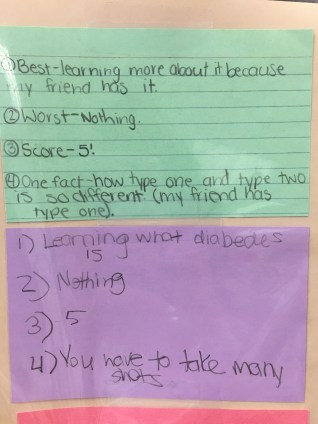
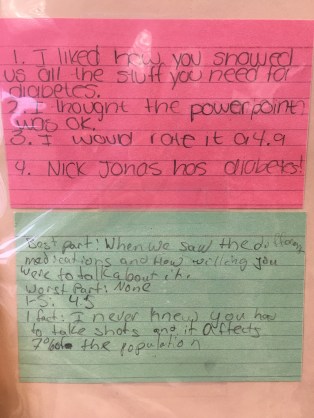
We felt like our hard work was worth it when we received completed evaluation cards from the students. We’d asked them to tell us: 1) The best part of our lesson, 2) The worst part, 3) Rate it on a scale of 1-5 (1 being worst; 5 best), and 4) Write one fact about diabetes they learned. Our average rating wound up being 4.2, which made us feel like rock stars! All these years later, I still have some of the best comment cards preserved in a binder about my project:

12

Personally, I really love how one student thought that diabetes is spelled “diabedes”. And I’m amused by how another student didn’t seem overly crazy about the PowerPoint (it must’ve been that damn Comic Sans font that ruined it).

But joking aside, this whole project still resonates with me ten years later because I think it marked the beginning of my passion for diabetes advocacy. It was one of the first times that I willingly shared my diabetes with others and let a real conversation take place about it with no holds barred.