Diabetes: Where’s the Off Button on This Thing?!

So many things in this world come with an “off” button or switch – just about all electronic devices, that obnoxious toy that your child loves playing with, and pretty much anything else that could be considered loud, disruptive, or downright annoying.

I wish diabetes was one of those things that came with an “off” button.

I suppose that technically would be a cure, but since we’re already talking about things that are purely imaginary at this point in time…
Think about it, though. Diabetes is 24/7/365. Even when I’m sleeping, it sure as hell is not, and despite my Omnipod 5 making it so that my overnight blood sugars are more stable than ever, it’s still disheartening to wake up to a low or high blood sugar alarm that I have to immediately do something about. So having an “off” button for my diabetes throughout the night, at the very least, would do so much for me.

But it’s also during times of interaction with others – in the workplace, at a bar/restaurant, in my pole classes, and so forth – that I find myself sometimes really longing for a diabetes “off” button. It’s not so much when my devices are alarming in those settings, because I’ve found that most people don’t even notice them. It’s more so when I’m having a low or a high that’s preventing me from being fully present in the moment.

Take, for example, the time that I was in my office and experiencing the symptoms of an oncoming low. This just so happened to coincide with lunchtime, but that was also when my coworkers decided to get up for an afternoon stretch/walk. They invited me to join them but I had to turn them down, as I knew that walking would only drive my blood sugar lower and potentially create a situation that I definitely didn’t want to subject my colleagues to. I hated having to say no on a particularly beautiful mid-September afternoon; alas, I don’t have an “off” button for my diabetes so I couldn’t just ignore what I needed to do at that moment in time.

Before I get too caught up in pessimism here, I’ve got to remind myself that it’s not like diabetes makes every social situation difficult or awkward for me. Far from it. There are even some occasions in which diabetes enhances the quality of interaction I have with others.

But this knowledge isn’t enough to make me stop wanting (yearning) for a diabetes “off” button, even if it only means that I get to utilize it for a short stint of time.

Molly and the Terrible, Horrible, No Good, Very Bad Diabetes Day

(Gotta give credit where credit is due on inspo for this blog post’s title – Judith Viorst authored the children’s book Alexander and the Terrible, Horrible, No Good, Very Bad Day in 1972 and a movie that was loosely based on it came out in 2014. I admit that I’ve seen neither but as someone who has appreciation for books and movies, I can at least claim an awareness of both and a deep appreciation for such a memorable title.)

At the end of July, I had my worst 24 hours of diabetes in literal years.

I’m being a little dramatic, but really, everything that could go wrong pretty much did. And what made it that much worse is that it just happened to coincide with my girls’ weekend with my college friends.

It all started after dinnertime. I had flatbread from a local restaurant that I frequent, and I substituted traditional crust in favor of cauliflower crust – my hope being that this would have less of an impact on my blood sugar levels.

No such luck. In the 3-4 hours post-dinner, my blood sugar steadily climbed, reaching a peak of the low 300s at its highest. It just didn’t make sense! I had 4 pieces of flatbread. They weren’t massive. Veggies were the only topping. Maybe it was my pod? When I went to check my PDM to see how much insulin I had on board for what felt like the fiftieth time that evening, I discovered that I’d been burning through so much insulin that I only had a few units left in the pod, meaning that I’d definitely have to change it before I went to bed to ensure I didn’t run out of insulin overnight.

I was super annoyed as a result of my hyperglycemic state and the need to do a premature pod change, but apparently also exhausted by the ordeal as I lapsed into an early sleep in my armchair while my friends stayed up. By the time I snapped out of my slumber, I was groggy, thirsty, and upset that my diabetes was affecting my ability to hang out. When we all turned in for the evening around midnight, I went to bed hoping that my mood and blood sugars would be turned around by the time I woke up in the morning.

Except they didn’t. I woke up in the middle of the night with not one, but two separate low blood sugars. My broken sleep combined with the wild oscillations of my blood sugar caused me to roll out of bed with a stinging pain in my eyes and a defeated spirit that I tried my best to hide from my friends, but to no avail. In fact, I ended up in a heap on the floor, crying to them as I apologized for my grumpy mood and attempted to explain to them what had gone wrong in the last 12 hours. They were all very understanding and supportive, but I felt horrible for being so temperamental and curt with them; after all, none of this was their fault. I promised them that I’d cry it out, wash my face, get dressed, and spend the rest of my time with them with an adjusted attitude.

This mostly worked – we were able to enjoy bagels and lattes for breakfast, as well as a long walk in the first truly gorgeous morning of weather we’ve had since May. My attention was absolutely still partially focused on my diabetes, especially since bagels are notoriously tricky to bolus for, but my resulting spike from indulging in one wasn’t too bad since it was offset by the walk.

By the time my friends departed, my blood sugar was mostly back under control. This must be when things started turning around for me, right? Wrong! As I cleaned up my condo, I ripped my pod – the one that I had just applied the previous evening – clean off my leg. Cursing, I tried to calm myself down because this was something I could easily fix. I decided to call my boyfriend while I did the pod change routine, which was yet another mistake on my part as I accidentally deployed the cannula before the pod was even on my body.

It was like a comedy of errors. I shouted – yes, legitimately yelled – to my bemused boyfriend that I had to go. I needed to get this pod change done and over with, distraction-free. So I repeated the process, only to find that pod #2 was unusable because the cannula was poking out.

Was the universe laughing at me at this point? It sure felt like it.

Third time’s the charm, I told myself as I audibly sighed out of frustration. And thank goodness that it really, truly was – the third attempt at putting a new pod on was the one that did the trick. I remember falling back in my chair after the pod was securely attached on my body. The rollercoaster blood sugars and the unpredictable technology demands truly drained me, and this was just one 24-hour window of dealing with diabetes.

Thank goodness most days aren’t like this terrible, horrible, no good, very bad diabetes day!

Overly Aware

Well, we’re (somehow) officially one week into National Diabetes Awareness Month (NDAM) 2022 and I’ve got to say…I’m feeling particularly aware this year.

Aware of the sheer scope of people affected by diabetes.

Aware about the amount of work that still needs to be done to defeat diabetes stigma.

Acutely aware that insulin and other necessary diabetes medications and supplies are too expensive and need to be more affordable/accessible to all.

Aware of how all the work (including but not limited to advocacy, peer support, and individual management of the condition itself) is done 24/7, 365 – not just during the span of one month.

You could say this makes me overly aware of the weight and significance of NDAM; and while this is certainly true, it’s also totally accurate that NDAM – and life with diabetes itself – is a marathon, not a sprint.

NDAM/life with diabetes is a marathon that requires proper pacing.

Thank you to a tweet by Mike Durbin that I saw on the first of the month for reminding me of this.

I agree with Mike’s advice to pace myself throughout NDAM, to get involved as I see fit, and to take a break if and when I need it. To an outsider, these words of wisdom may seem obvious, but to someone like me who lives with diabetes, works in diabetes, and immerses herself in the diabetes community, they ring particularly loudly and clearly during this chaotic period that has no shortage of spirit, heart, and good intentions.

So for the next 21 days, I’m excited about plugging away on my marathon’s path, and happy to take breaks here and there for myself so I can cheer on and support everyone else who’s on this journey with me.

I Don’t Have Time to Wait for Diabetes!

“Your estimated wait time is less than 3 hours and 58 minutes.”

The dulcet female voice reported, before the recording transitioned to obnoxious elevator music.

A four-hour wait time? Surely, that couldn’t be true. I decided to stick on the phone for a little while longer in the hopes that a customer support representative would pick up in the next few minutes as opposed to the next few hours.

The elevator music faded and that same female voice said: “Your estimated wait time is less than 4 hours and 16 minutes.”

What the heck?! How did my wait time increase? I pulled my phone away from my ear and looked at it in utter disgust, before deciding I’d hang up because I simply didn’t have the patience to wait any longer – whether or not that meant 4 more minutes or 4 more hours.

Diabetes doesn’t care that I don’t have time to wait for anything that has to do with it.

This is just one example of the many phone calls I have to make in order to get doctors appointments scheduled, supplies reordered, and issues troubleshooted…and some days, I’ve got more resolve to wait than others. This just so happened to be a day where waiting felt unfathomable to me, but like it or not, diabetes doesn’t wait. It’s far more impatient and needy than I am. And this is a side of diabetes that I’m not sure other people really understand – the sheer amount of time it requires to be managed. It doesn’t care that I’d rather spend that time doing literally almost anything else (even cleaning the bathrooms sounds more enjoyable than waiting for 4 hours on the phone). Nope. I don’t have time to not have time when it comes to diabetes, which can be a frustrating truth to tolerate at times.

Am I Tired or Experiencing Diabetes Burnout?

“I’m just…tired. Maybe I’ve been going through burnout these last couple of months and I didn’t even realize it until just now,” I said, sinking back into my chair.

I was at a virtual appointment with my therapist when I uttered these words, surprising myself because the thought that I’ve been experiencing burnout hadn’t occurred to me previously. But the moment I said it out loud, I knew it was true.

I didn’t think that I was experiencing diabetes burnout until I considered the possibility out loud.

It just makes sense. It explains some of my more turbulent blood sugar levels as of late. It explains my frustration, lack of interest, and utter annoyance that I feel every time I check my blood sugar levels or calculate carbohydrates for yet another dose of insulin. And it definitely explains why yes, I have indeed been tired lately – more often than I’d like to admit, I’ve had to get up in the middle of the night to treat a low or correct a high, so naturally, my sleep is presently fitful at best.

I guess I didn’t connect the dots right away because I was in denial. I still talk about my diabetes all the time. I’m still able to show up and perform at my full-time job at a diabetes non-profit. I still take insulin for all of my meals, just maybe not the right amounts all the time. So because I was “still doing” all the normal aspects of my diabetes management routine, I assumed that I wouldn’t fall victim to another round of burnout.

But this is when I remind myself that burnout doesn’t always look the same. Burnout can mean wanting/choosing not to take insulin, paying less attention to blood sugars (if any at all), feeling cranky about all things related to diabetes, or even being depressed or flat-out tired when just thinking about diabetes. And there’s probably other ways that burnout can manifest itself that I haven’t even experienced yet, even though I’ve lived with diabetes for 24 years.

With that last point in mind, in particular – the length of time I’ve lived with diabetes – it’s no damn wonder that I’m tired. And it’s okay for me to feel this way. I’ll just ride the burnout wave as long as it happens to last this time around, and check in with myself (and absolutely my therapist) as often as needed.

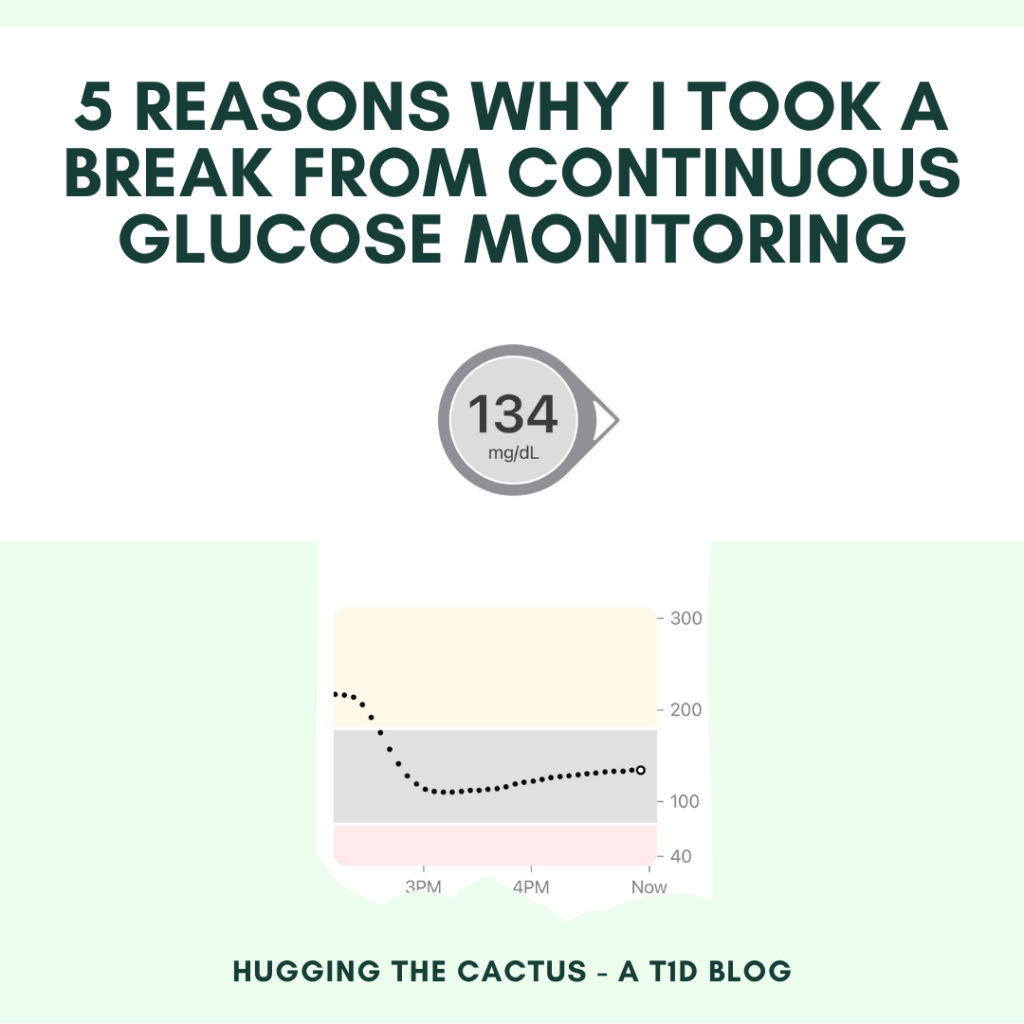
5 Reasons Why I Took a Break from Continuous Glucose Monitoring

today because it’s a great reminder that diabetes isn’t a static condition – what works for a person with diabetes one day might not work the same way the next. So when I decided to take a Dexcom break, it was a much-needed change in my diabetes care routine that worked wonders for my mental and physical health. I just might take another one after reading this post again…read on for the full story.

I’ve decided to take a break from continuous glucose monitoring. This means that for an undefined period of time – maybe 3-4 days, a week, or a few weeks – I’m not going to wear my Dexcom G6 CGM.

Initially, I wanted to give myself a break because I was just burnt out from wearing it all the time and feeling so dependent on it. But as I started thinking about more, I realized that there were some other really great reasons for me to take a break from my CGM:

1 – I wanted to wear one less device. It can be tough to wear two medical devices 24/7. Sometimes I get super self-conscious of them. Other times they just aren’t comfortable to wear, such as when I roll over one the wrong way when I’m sleeping at night. So it’s nice to feel a little more free with one less device stuck to my body at all times.

2 – I was sick of the constant data feed. All those alarms going off whenever I cross my high or low threshold are straight up annoying!!! I know I could just turn them off on my CGM receivers, but the point of them (for me) is to try to maintain as tight of a control on my numbers as possible. But now that I’m intentionally not wearing my CGM, I’m realizing how much I appreciate the reprieve from all that buzzing and beeping. There’s lots of reasons to take a break from continuous glucose monitoring, but sometimes one is enough.

Taking a break from my Dexcom was a much-needed change in my daily diabetes care routine.

3 – I have some new blood glucose meters to try. The only way that I can really put my new meters to the *test* (lol) is to use them – and goodness knows that I have very little desire to do manual finger stick checks when I’m wearing my CGM.

4 – I’d like to hold myself more accountable. I rely on my Dexcom heavily at all times. I look to it before I start exercising, before I eat something, before I do anything, really. I bolus using the data it provides and trust it implicitly. But I’ve recognized that by developing this habit, I’ve become lazy. I don’t measure out food as much because I figure that if I bolus too much or too little for it, I can just watch what my Dexcom tells me and treat from there. It’s kinda sloppy, in my humble opinion, so I’m trying to put more of the trust back in myself for my diabetes monitoring.

5 – I’m trying to reacquaint myself with my body’s cues. Before CGM technology, I was really good at recognizing high and low blood sugar symptoms…but then I started using a CGM and found myself reacting to highs and lows (e.g., treating them prematurely), even if I didn’t feel those high/low symptoms. So I want to retrain myself so I can make sure I never lose that ability, because I think it’s important to know exactly how my body alerts me to various blood sugars, rather than depending solely on a piece of technology to do it for me.

T1D and Guilt

So many emotions accompany living with type 1 diabetes: occasional sadness, some anger, a bit of bitterness, flares of acceptance, and a whole lot of frustration.

But another emotion that comes with it that I recently found myself thinking about (and feeling) is guilt. Not guilt over the fact that I have diabetes, per se – because my diagnosis was out of my control – but guilt over the ways that it affects those around me.

Life with diabetes is so much more than blood sugar checks and insulin injections – it’s also about learning how to navigate emotions like guilt.

I feel guilty for all the times my devices’ alerts and alarms disrupt my partner’s sleep.

I feel guilty for complaining to family and friends about my diabetes because they don’t deserve to be burdened by it.

I feel guilty when I have to leave a social event early because I forgot to bring back-up supplies with me or because I experienced a device failure.

I feel guilty when a high blood sugar makes me lash out at my loved ones…and when a low blood sugar causes them to be worried about me.

This guilt weighs heavy on my shoulders, and when coupled with the guilt I carry around when I have a bad diabetes day or let my emotions about diabetes get to the best of me, it can sometimes feel like I’ll collapse at any second because I’m simply not strong enough to handle it. Of course, I don’t feel crushed by the weight of guilt all the time; in fact, it’s only occasional. But when it does rear its ugly head, it’s not fun, and it makes it that much harder to deal with the day-to-day of diabetes.

The reason why I chose to write this blog post about guilt and diabetes is to bring awareness that living with diabetes is so much more than daily insulin injections and blood sugar checks. It also means coming to terms with the fact that it’ll cause a lot of discomfort, both physically and emotionally – and finding out ways to overcome that discomfort, and the emotions of diabetes (guilt included), is what makes people who live with diabetes absolute warriors in my eyes.

What to Do When a Loved One with Diabetes is Struggling

This blog post was originally published on Hugging the Cactus on March 20, 2019. I’m sharing it again today because as tough as diabetes can be for me, it can be even harder on my loved ones who can’t do anything about it – especially when diabetes struggles turn into emotional struggles. Read on for my opinion on how you can help your loved one with diabetes overcome difficulties.

If you have a partner/spouse, relative, or friend with type one diabetes, it can be difficult to know how to best support that person when they’re experiencing struggles related to diabetes. You might try to offer a shoulder for your loved one to lean on, but that might not always work. Your loved one might push you away or continue to internalize their issues. It can create turbulence in your relationship with one another, and it’s frustrating all around.

So what can you do?

Emotional support is incredibly important when it comes to helping a loved one with diabetes get through a difficult time.

As someone who both has T1D and loves others with T1D (my mom, my aunt, many good friends), I believe that the best way to react is to just listen. Whenever I’ve faced serious struggles or emotional turmoil due to diabetes, nothing has helped me quite like a person who spares time for me to listen to me. Whether I just need to spew out an angry diatribe (LOL at the pun), cry about my problems, talk through issues, or seek advice, it’s worked wonders on me to know that I have individuals in my life who are willing to listen to me. Let me emphasize the listen part once again – listen, not tell me that I’m right or wrong, or offer advice (unless I specifically ask for it).

I get it; sometimes, it’s easier said than done to just listen. A few people I know are so determined to help me fix the problem that they can’t help but react emotionally along with me when I’m dealing with diabetes drama. But trust me, that usually heightens (rather than alleviates) the tension.

It’s all about teamwork. Give and take is involved. Often, enormous amounts of patience are required. Sometimes, it takes awhile for the struggles to subside. But one thing that is certain is that your loved one with diabetes will always thank you and be grateful for your support in their time of need. It’ll strengthen your relationship as well as function as proof that diabetes can’t break your bond, no matter how hard it might try.

How I Realized I’m Experiencing a Bout of Diabetes Burnout

Diabetes burnout is the generic term used to describe a state in which a person with diabetes becomes tired of managing it and may become neglectful of one or more aspect of diabetes care.

I say “generic term” because diabetes burnout doesn’t look the same for every person, though, so it can be tough to recognize it when it’s happening. I know this from personal experience: I’m going through a bout of diabetes burnout right now.

Diabetes burnout is just a part of having T1D.

It took me weeks to realize it, but I finally came to the conclusion that I was burnt out because several things dawned on me at once:

  • It was taking me longer to respond to CGM alarms. I would hear them going off, but I didn’t necessarily care to even look at them, let alone correct them. As a result, I let a lot of high blood sugars linger much longer than I should have, which made me feel frustrated and bad about myself for causing harm to my body.
  • I wasn’t eating healthy foods. The Easter holiday brought an abundance of chocolates and sweets into my kitchen, so instead of choosing fruits or veggies to snack on, I was going for high-carb items with zero nutritional value…and I didn’t bother bolusing for them, which of course, wreaked havoc on my blood sugar.
  • I did the bare minimum to keep my blood sugars in check. I was still bolusing for all my meals, but the snacks in between? The little desserts I’d have? The alcoholic beverages I’d enjoy? Nope, certainly wasn’t taking those into account when I took mealtime boluses.
  • I got lazy with carb counting. I kept gravitating toward bottomless bags of snacks when I did my weekly grocery store trips, even though I knew that I have no restraint when it comes to highly addictive, faux-healthy foods like Annie’s cheddar snack mix or cute little teddy graham cookies. Whenever I’d crack open a fresh box or bag, I’d dig in and wouldn’t stop digging in, going way over the recommended serving sizes and not bothering to slow down and count out my carbs.
  • I was allowing my emotions to influence my diabetes care (or lack thereof). I’m a self-professed emotional eater. That, coupled with excess stress/anxiety levels, shifted my attention away from my diabetes.

So, yeah, there’s no question that I’m in a period of diabetes burnout. Joy.

As tired as I am of taking care of my diabetes, though, it doesn’t compare to how exhausted it makes me to beat myself up over my burnout day after day.

I’ve been through burnout before. I know I’ll make it through, just like I have in the past, and I am also aware that I’m likely to experience it again in the future. And rather than come up with a super-specific action plan to conquer it, or give myself a timeline to overcome it, I’m just going to ride it out knowing that I’m trying my best each and every day, and that’s what matters most.

I Said Something Very Messed Up About My Diabetes…

You’re looking at the title of this blog post and thinking…”ugh, clickbait!”

I assure you that I’m not trying to present this as clickbait; in reality, I did recently say something extremely messed up about my diabetes.

I didn’t 100% mean what I said…

In a dramatic outburst spurred by three days of frustratingly high blood sugars, I said to my parents, “I’m going to die of diabetes.

Look…we all say things that we don’t mean sometimes. But when I said this, there was a teensy-weensy piece of me that really believed there was an ounce of truth in that statement. That’s how fed-up I was with my diabetes.

It’s because I was going through insulin like crazy in the first half of that week. I couldn’t figure out why my numbers were running so high and tried what seemed like everything to cope with it: eating low carb, running temp basal increases, doubling my mealtime insulin, staying as hydrated as possible, checking ketones…and I was still contending with high numbers. The longer I stayed above my high threshold on my CGM, the more I convinced myself I was doing damage to my body, and that was an incredibly awful feeling. So I made that horrid exclamation out of sheer exasperation and fear.

I was letting my diabetes win that day.

I was letting my diabetes control the narrative.

I was letting my diabetes make me think that I was doing everything wrong, when in reality I was trying like hell to do everything right.

And…I was letting myself down. That defeatist attitude is not how I approach life with diabetes.

But I said what I said, and I can’t take it back…but I absolutely can change my thinking so that when something like this happens again, and I’m just feeling incredibly burnt out from it all, I have a new thing to say that is far from messed up:

I’m going to LIVE WITH diabetes.

Not just live…I’m going to live well with diabetes.