5 Questions (and Answers) About the Dexcom G6

This post was originally published on Hugging the Cactus on November 19, 2018. I decided to update it, since some of my thoughts and observations on the Dexcom G6 have changed over time due to more experience with it. Updated answers will be in parentheses and/or italics just below (and in some cases, next to) the original answers…

I’ve been lucky enough to have the Dexcom G6 CGM in my life for just over six months now. (It’s actually been about 2 years at this point!) In that time, many people in my life – both T1Ds and non-T1Ds – have asked me countless questions about my experience with the device. I thought it’d make sense to address some of the most commonly asked questions here, in the hopes that I can provide some insight to those who are curious about the Dexcom G6.

Question: Can the Dexcom G6 be restarted?

Answer: In my experience, no. I cannot get the G6 to restart like I could get my G5 to restart. But take my “no” with a grain of salt, here, because I know of other people who HAVE had success restarting their G6 sensor, making its life extend much longer than the 10 days guaranteed by Dexcom. I have only tried to restart the G6 once, with absolutely zero success, following the process outlined here. My advice to those who want to try to restart their G6 is to do so cautiously, and make sure you’re not trying to do so with the last sensor in your stockpile.

Since I initially wrote this, I WAS able to restart the G6 and did so “successfully” a handful of times. But in my opinion, it wasn’t worth it because 1) the sensor would stop reading blood sugars 2-3 days after restarting and 2) I can’t be sure that restarting doesn’t wear out my transmitter faster, which wouldn’t work to my benefit since I don’t know how to reactivate transmitters. My two cents is that while reactivating old Dexcom models like the G4 or G5 often worked well, the technology within the G6 simply isn’t meant for accurate restarting.

Question: Is it actually safe to take acetaminophen (Tylenol) on the Dexcom G6?

Answer: Yes! I’ve noticed that acetaminophen can be taken safely on the G6. I did not anticipate for it to be unsafe, seeing as it was advertised as one of the big improvements Dexcom made from the G5 to the G6. I’ve taken Tylenol a handful of times without noticing any issues with my CGM readings, but as always, be sure to monitor your blood sugar carefully and perform a manual finger stick check if your symptoms don’t match up with your CGM.

This is still absolutely true! I’ve yet to observe Tylenol, or any other drug really, having an impact on my CGM’s readings.

Question: I can’t get my Dexcom G6 sensor to stay put for the full ten days. How do you make it last?

Answer: There’s tons of ways you can help ensure your G6 sensor stays stuck on for the entire ten-day duration. I always make sure that my skin is completely dry before the sensor makes any contact with the site. Avoiding any excess moisture is key in helping it stay put. If I notice the sensor starting to peel around the edges after a few days of wear, then I use a Pump Peelz CGM adhesive to keep it in place. Those tend to work really well for me. In times of serious adhesive doubt, I also use Skin Tac wipes, which basically glue that sucker down. One last tip I recommend is to avoid sites that come into contact with a wide variety of surfaces. In other words, a sensor that’s placed on the abdomen may fare better than a sensor on the leg, because the odds of the sensor getting accidentally knocked off due to contact with clothing or other objects are lesser. You know your own body better than anyone, though, so trust your own judgment when it comes to CGM placement.

So at the time of publication, I hadn’t tried my leg as a site for the CGM. Now that I have, my answer changes a little regarding the “usability” of this site: I’ve had great success keeping the CGM sensor on my leg for the full 10 days without a single peel in the adhesive. Another tip I’ve picked up along the way is to contact Dexcom and ask for their free “overlay patches”, which they produce and that work just like any medical adhesive that Pump Peelz or GrifGrips manufacture especially for Dexcom products.

I just want you to know...
Oh hey, it’s me! In my purple cast showing off the G6. Fun fact: I don’t own an Apple watch – the one I’m wearing here was provided to me to wear just for the G6 promotional materials.


Question: Is sensor insertion truly painless?

Answer: For me, G6 insertion has been pain-free approximately 85% of the time. It’s stung slightly a handful of times, but I’ve found that it only hurts when I choose a site that’s not particularly fatty. That’s why I generally stick with my abdomen – either side of my navel – or the back of my arms for G6 insertion.

I stand by this estimate – once in a while, I get a site that’s a little more sensitive and there’s a slight sting, but nothing like it used to be for the G4 or G5. And now that I’ve added my thighs as sites into the mix, I’ve got more site rotation going on, which can help.

Question: Is the G6 really that much more accurate compared to the G5, or any other CGM on the market?

Answer: Yes and no. That may not be a very satisfactory answer, but I’ll explain why that’s my belief. Overall, the G6 seems to be more accurate for me than the previous Dexcom CGM models I’ve worn. Are the number always on point compared to what appears on my meter? No. Do I wear the Dexcom CGM to have an accurate picture of what my exact number is at a given moment in time? Kind of, but I also know that this isn’t totally realistic. After all, users of the Dexcom CGMs know that it measures blood sugar levels in five-minute intervals. It can’t give me a clearer picture of what my blood sugar changes are minute-to-minute. So with that in mind, I find that the G6 is really excellent for monitoring trends – seeing how rapidly my blood sugar is falling or rising, or seeing how it changes gradually over time. The patterns are more important to me than the precise numbers; at least, that’s how I feel in my current stage of diabetes management.

I can’t really speak to other CGMs on the market, such as the Freestyle Libre or Medtronic’s CGM. But what I can say is that I’ve heard less-than-stellar reviews about both. It’s important to remember, though, that they’re not meant to be the exact same as the Dexcom CGM. The Libre itself isn’t really continuous and can’t provide users with information until they chose to wave the receiver over the sensor. And as far as I’m aware, the Medtronic CGM communicates directly with Medtronic pumps, and I’m not sure how seamlessly the systems work together.

Bear in mind that when it all comes down to it, I’m answering these questions with my experience, and my experience alone, in mind. Dexcom is and will always be the number one resource to go to with any questions regarding their CGM devices. But hopefully, the information I’ve shared here will at least help someone who is curious about the G6 feel more motivated to seek additional information. I stand by the fact that it has revolutionized my own diabetes care and management, and though it’s far from being flawless, it’s still an invaluable tool to have incorporated into my daily routine.

I still have not tried any CGM model out on the market except for Dexcom CGMs. To this day, it’s what I know and what I’m most comfortable with, so I don’t anticipate that changing any time soon (though it’d be kind of cool to try another and compare it to my G6). The one thing that has changed is that I rely on my G6 readings a lot more heavily these days. I use a blood sugar meter to check my blood sugar only once or twice a day now, whereas a year and a half ago, I was using it at least four times a day. I’ve put greater trust into my G6, but I do remain cautious against the technology and always check with my meter when I’m not fully believing my G6’s readings.

My Favorite Blood Sugar

I have a favorite blood sugar reading. Can you guess what it is?

…Probably not. So I’ll just tell you. My favorite blood sugar reading of all time is…

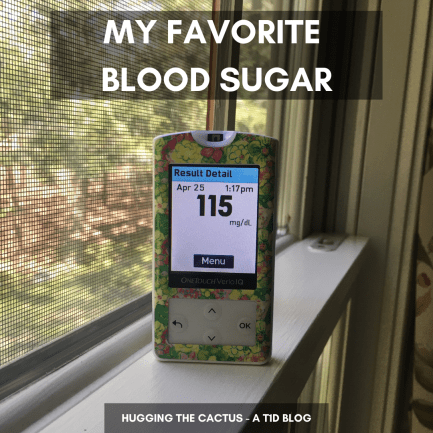
115 mg/dL.

My Favorite Blood Sugar
Apparently the last time (on record) that my blood sugar was my favorite number was on April 25th – I’m sure I had an especially good day because of that.

I can justify my favoritism for this seemingly random reading, too. For starters, 115 literally contains my favorite number ever, 5. (I think it’s my favorite number because I was born in the fifth month, May, and it’s so easy to count in multiples of 5.)

115 also represents “perfect” stability to me. I’m guaranteed not to feel the shakiness of a low or the grumpiness of a high at this level. At 115, I can most likely even have a small snack (no more than 15 carbs, but still) and not have to take a single drop of insulin for it (given that I’m exercising for at least 15 minutes post-snack-consumption, of course).

Hmm…there’s definitely a pattern going on there with that trifecta of fifteens, but I digress.

A blood sugar of 115 makes me feel…invincible. Almost like I’m the proud owner of a functioning pancreas.


How to Hit Your Step (and Blood Sugar) Goals When You’re Stuck at Home

My diabetes has never liked it very much when I’ve stayed idle for too long.

Unfortunately, my diabetes and I don’t really have much of a choice these days other than to stay put – and I know that just about everyone else in the world is in the same boat.

So how do you hit your daily step goals when you can’t leave the house?

You get creative.

hugging the cactus - a t1d blog
With a little creativity, you can find tons of ways to stay active when you’re stuck at home – which will make your blood sugar and body happy.

And, in turn, your blood sugars will generally respond positively to any extra movement you get throughout the day…plus, with endorphins spiking (instead of bg levels), you can see a huge improvement in your mood. And who doesn’t need a mood booster right now?!

Here are the ways in which I’ve been getting 10,000 steps or more each day:

Taking spontaneous dance breaks. My mom and I are both working from home and sitting in front of our computers for long stretches of time Monday through Friday. To combat this, we’ve come up with a ridiculous but fun game called “DJ Dance Party”. It’s simple: Every couple of hours, one of us cues up music and we just dance around for the duration of the song. DJ Dance Party is a welcome reprieve from work, especially when it happens right after long conference calls!

Playing with pets. Our animals can get just as stir-crazy as we can, so by helping them combat boredom, we’re also doing ourselves a favor by getting off our butts. I play with my parents’ dog, Clarence, by chasing him around the house, throwing his toys at him, taking him for neighborhood walks, and kicking the soccer ball around in the backyard (weather permitting).

Dust off those old fitness videos. Do you have old Jane Fonda/Windsor Pilates/Jazzercise tapes or DVDs just laying around, untouched for years? Dig ’em out from wherever you’ve got them and give them a spin. It might feel silly, but then again you might also get a good laugh in addition to some exercise. I’ve done a few Zumba routines in the last couple of weeks because we have some old DVDs, and they’ve been surprisingly fun.

Hit up YouTube and other fitness platforms for free workouts. Personally, I pay for a subscription to Beachbody, which gives me access to countless workouts lead by professional personal trainers. I’ve used Beachbody workouts in lieu of going to the gym for about a year now and it has worked really well for me, but if I didn’t have the service, I know I could rely on YouTube – in fact, one search of the word “workout” on that platform brought up tons of results that vary in length and intensity. It’s a treasure trove!

Pace around when on conference calls. When I’m not attending a virtual meeting with a video chat component, I’m constantly walking around while I talk on the phone. And it honestly helps me become a more active participant in meetings, sometimes, because I don’t have the distraction of my computer monitors in front of me. I imagine this is the closest I’ll get to having a fancy-schmancy treadmill desk, but I don’t knock it because it works!

March in place while watching TV. Binge on all the TV shows and movies you want guilt-free and challenge yourself by marching in place in 15-minute intervals or at every commercial break. Steps rack up quickly this way, and it’s a go-to for me when I can’t get a walk in during the day.

So even though I’ve barely left the house, doing one, two, or a combination of these above exercises have guaranteed that I’ll meet my step goal each day. And they’ve also really come in handy after meals and long stretches of sitting, when my blood sugars are most prone to going up.

Staying at home has disrupted routines for most people, but it’s good to know that we can still control how much exercise we get in a day.

How I Handle “Roller Coaster” Blood Sugar Days

“Roller coaster” blood sugar days happen to the best of us. Wild fluctuations from high to low and back again are sometimes just part of life with diabetes, but that doesn’t make them any less frustrating. So how can they be handled without losing your mind?

The answer is simple, and probably a bit unsatisfying: I just take the highs and lows as they happen. Rather than dwelling on the literal big picture of ups and downs that my CGM displays, I decide to treat each instance uniquely and have faith in the fact that everything will stabilize eventually.

How I Handle _Roller Coaster_ Blood Sugar Days
Honestly, give me high and low blood sugars over the twists and turns of a real roller coaster any day of the week.

For example, a recent weekday started off wicked badly for me when I had a low blood sugar at around 4 A.M. I did the thing that you’re not supposed to do and totally over-treated it (whoops), resulting in me having to take insulin to counteract the carbs. Well, I didn’t take quite enough insulin, because I was pretty high still when I woke up again a couple hours later. I took an aggressive bolus for the high and did my morning exercise routine…

…which backfired on me because soon after completing my workout and eating a quick breakfast, I was dropping like crazy. I’m almost certain that most other T1Ds would agree with me when I say that having a low blood sugar right after eating (and taking insulin for said meal) is SO obnoxious. I knew my carbs would kick in eventually, though, so I opted to suspend my insulin and went about getting ready for work…

…only to be sky-high again when I arrived to the office. I took another big bolus, knowingly stacking my insulin but not caring because I just wanted to get my blood sugar down…

…and that absolutely worked like a charm! By lunchtime, I was low again and literally eating frosting out of a Tupperware container (don’t @ me). Usually, I have zero restraint when it comes to sweet things like frosting and I was worried that I’d gone overboard with my spoonfuls of it. But magically, the low/high roller coaster stopped for the rest of the day after that! In fact, I was level between 90 and 110 for THE REST OF THE NIGHT.

I’m not saying it was worth it to deal with the incessant ups and downs all morning and part of the afternoon; rather, I’m trying to point out that I just did what I could in order to get off the roller coaster ride and it paid off  by the day’s end.

Sometimes, with diabetes, it’s more important to focus on blood sugar in the moment rather than stress about what it did or what it’s going to do. That way, I find that I can help treat my diabetes the way it needs me to treat it then and there rather than trying to anticipate what it might do later on. It’s all about perspective and remembering to keep it simple, even if it doesn’t always yield the fastest results.

Why I Care Less About My Blood Sugar When Practicing Self-Care

Do you ever let your blood sugar run high on purpose?

I do. But only when I feel it’s necessary. One such occasion is when I’m treating myself to a spa day.

I don’t do that often (because it’s hella expensive), but I looooove unwinding by getting an hour-long massage or a facial. And the last thing that I want to worry about when I’m pampering myself is my blood sugar.

I don’t want to hear any alarms going off, I don’t want to check my blood sugar, I don’t want to bolus, and I certainly don’t want to dwell on diabetes during a period of time in which I’m supposed to relax. Because diabetes is the opposite of relaxing, and anyone who lives with it in any capacity deserves to have a mental break from it as often as possible.

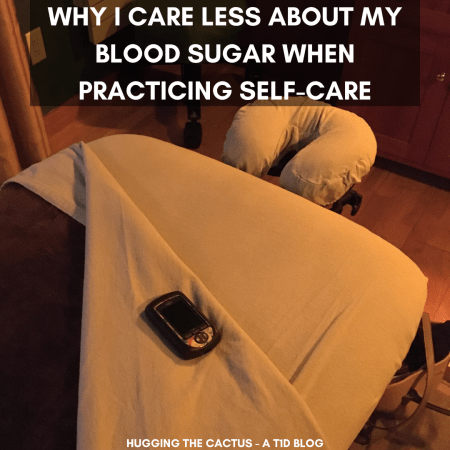
I also never, ever want a low blood sugar to happen when I’m practicing self-care. Talk about a total buzzkill! In my imagination, nothing could be more disruptive to a moment of zen than hearing a low alarm go off and having to roll off a massage table to grab a tube of glucose tabs, all while being mostly naked. NO THANKS.

Red Valentine Countdown Social Media Post
Right after this picture, the PDM, Dexcom, and phone were all tucked away for an hour that flew by too fast.

So I will purposely let my blood sugar run high when I’m practicing self-care because for that window of time, it’s super important to me to forget about diabetes, the biggest source of stress in my life, and focus on enjoying a mini vacation from it. And it’s not like I’m ever letting myself climb dangerously high (because dealing with a 250+ blood sugar during self-care sounds almost as awful as having a low) – I usually aim for 150-180.

For me, it’s incredibly worth it to just let it go and embrace being slightly out of range for a blissful (but all too short) period of time.

One Night with Diabetes

You settle into bed, ready to fall asleep after another long day.

But first, you check your blood sugar, just like you do multiple times every day.

Your glucometer reads 201.

Suddenly,  you’re a little nervous to drift off to dreamland, because you just changed your insulin pod an hour earlier and you’re not quite sure if it’s the reason behind the high blood sugar.

You wonder: Could my blood sugar be high due to a miscalculation with insulin or carbs at dinner? Is it because of my stress levels? Is it because I’m dehydrated, or because I’m starting to get sick, or because my new pod’s site is on scar tissue, or because…?

Before long, you feel incredibly exhausted because you’re cycling through what seems like an endless list of reasons why you might have an elevated blood sugar and it has zapped you mentally.

You feel your eyelids grow heavy, and just before you go to sleep, you give yourself an insulin dose that should bring your blood sugar back down before long.

You experience a broken night of sleep.

One Night with Diabetes
When you read this, put yourself in the shoes of a person with diabetes…and this is just one night with the damn thing.

Since your Dexcom app is programmed to alert you when you’re over your high threshold for an extended period of time, it goes off, practically every hour, from 10 P.M. to 1 A.M.

Every time it happens, you wake up to the sound of your Dexcom alarm blaring in your ear.

You worry about waking up others in the household before you even begin to worry about your blood sugar.

You’re pretty sure it’s not a pod problem, since your blood sugar would probably be higher if that were the culprit, but you’re too damn tired to care about the cause at this time of night.

You bolus, go back to sleep, hear a high alarm, wake up, and repeat until finally your sleep stops getting interrupted by your Dexcom.

You get a few hours of broken rest.

You wake up at 6 A.M. and realize that, after all that, your blood sugar levels are still slightly elevated.

You’re pissed that your Dexcom was off by 40+ points, as confirmed by a fingerstick check.

You take more insulin, and force yourself to get up and out of bed because it’s time to start the day: Your diabetes is waiting for nothing, least of all you.

Just another night of not enough sleep and too much worry, thanks to diabetes.

Two Different Lists Lead to the Same Conclusion

I like lists. I like them so much because I like to pretend to be an organized person who always has tasks to complete (the former is definitely false, while the latter is pretty much absolutely true). I also like lists because making one feels like an accomplishment in itself, and who doesn’t like feeling accomplished?

Freedom is the atmosphere in which humanity thrives. Breathe it in.
What can I say, I’m a list girl. (But not a hand model; that’s definitely not my perfectly manicured hand in the above photo.)

So I must admit that I felt pretty damn good about myself after making these two diabetes-related lists, because not only do they pull weight as blog post material, but they also help me understand something about me and my diabetes. So here they are:

List of things I should do on a daily basis for my diabetes:

  • Check my blood sugar using my meter 6-8 times per day (upon waking up, before I go to sleep, before I eat a meal, and in-between meals to make sure I’m on track)
  • Change my lancet (LOL)
  • Look up carb counts for every meal using apps and/or nutritional facts
  • Monitor my Dexcom carefully and do fingerstick checks when I disagree with it
  • Take a correction bolus for every blood sugar that’s over 150 mg/dL
  • Eat plenty of fruits and veggies AND drink plenty of water

List of things that I actually do on a daily basis for my diabetes:

  • Check my blood sugar whenever the heck I feel like it; after all, my Dexcom is usually accurate
  • Change my lancet only when I remember, which is like…once or twice a month
  • Eyeball my plates of food and make “educated guesses” on carb counts
  • Monitor my Dexcom OBSESSIVELY – sometimes even every 5 minutes, depending on the situation – and freak out when it doesn’t match my fingerstick checks
  • Take a correction bolus for blood sugars that are 200+ only
  • Eat what I’d like (which, in addition to fruits and veggies, is a wide variety of things) and drink probably not quite enough fluids

When I compare these two lists, I come to the same conclusion: I am lazily in control of my diabetes. I know exactly what my current routines are and just because they aren’t the “right” ones, it doesn’t necessarily mean I’m doing anything “wrong” in terms of my diabetes care and management. Sure, I’m not doing anything the textbook way, and I admit that I’ve gotten a little lazy with things like carb counting and correction bolusing, but so what? The important thing here is that I can recognize the areas where I need and want to improve.

For starters, I’d like to stop depending so much on my Dexcom. I want to learn to check it less – maybe take it out half as often as I do now – so I can strengthen my ability to recognize low and high symptoms. I’m also hoping to use measuring cups and nutritional information more often to make better informed decisions when it comes to how much insulin I give myself at mealtimes. It’ll add a few extra steps to my day, but these are habits that I followed for a long time and that are worth reintroducing to my routine.

As far as everything else goes, I’m not going to sweat them too much…of course, it will be nice if I remember to change my lancet more frequently and be more proactive about correcting high blood sugars, but really, these are matters of minor concern. I think I make my best diabetes progress when I take things one step at a time, so that’s just what I’m going to do.

The Holy Grail of Glucose Tabs

I feel a desire to share with the world that I’ve found it.

Erm…what is “it” though?

Why, glucose tablets, of course. Not just any old glucose tabs. I’m talking about glucose tabs that are actually delicious. The kind that are obviously effective and can quickly raise low blood sugar, but that are also so tasty that I sort of want to eat them by the handful out of the jar.

I’ve got your curiosity piqued now, don’t I?

Well, then, I’ll let you in on the secret “holy grail” glucose tabs that I’ve been enjoying…

The holy grail of glucose tabs.png
I never thought I’d do a mini photo shoot for glucose gummies, but then again, I never thought I’d do a lot of the weird things I’ve done in my life so far.

Spoiler alert: They’re not technically tabs; in fact, they’re gummies.

I’ve written about glucose gummies in the past and it’s safe to say I was fairly underwhelmed by them. They had flavor and texture issues, and ultimately, they were pretty disappointing. I’d counted on them to change the glucose game, but this rendition of Walgreens-brand glucose gummies totally failed to do that.

So a few months ago, when I noticed that Walgreens had given their glucose gummies a makeover, I figured I’d give them one last chance to impress me.

And SWEET SUCCESS, THEY DID IT!

There are some similarities between the old and new gummies; namely, three gummies has 10 carbs…just under the amount of carbs that are usually in three standard glucose tabs. The old and new gummies are both also covered in sugar crystals (I’m not sure if that’s intended to make them look appetizing?). Otherwise, they couldn’t be more different from one another in terms of color, shape (old gummies were ring-shaped, new gummies are kind of gumdrop-shaped), and obviously, palatability.

What’s different about the gummies this time is that they improved on every major complaint I had about the previous version. The best, biggest improvement had to do with texture. Previously, the gummies were stale and difficult to chew quickly. These new gummies are very soft and don’t leave you with that sticky teeth feeling that’s typical of most gummy candies.

The flavors are also much better. Before, the gummy flavors were super artificial tasting. The grape, orange, and apple flavors were almost medicinal and hardly tasted like their genuine counterparts. Now, the gummies still come in three different flavors, but they’re all of the same variety: blueberry, raspberry, and strawberry. The mixed berry combination just works here. There’s no odd after taste and, when eaten together, a three or four gummies at once just tastes like a small handful of conventional gummy candy. Not my personal favorite kind of confection, but it definitely is much more appealing than regular old glucose tablets.

Maybe I’m overselling Walgreens’ glucose gummies version 2.0, but really, after 22 years of diabetes, there are just some things that are worth getting excited about…even if they seem insignificant in the grand scheme of things.

The Expired Test Strip Experiment

Nearly every diabetes supply I own comes with an expiration date. Insulin vials, pods, ketones testing strips, and Dexcom sensor/transmitters are among the items that I’m always closely monitoring to ensure they’re still fresh and usable, but test strips? They’re basically the last thing that I worry about.

So I was curious when I recently noticed that my current test strip vial has an expiration date of 12/31/19. Would these strips still measure my blood sugar accurately, or was the New Year’s Eve expiration hard and fast?

I wanted to find out.

The Expired Test Strip Experiment
An introductory blog post to a potentially ongoing experiment.

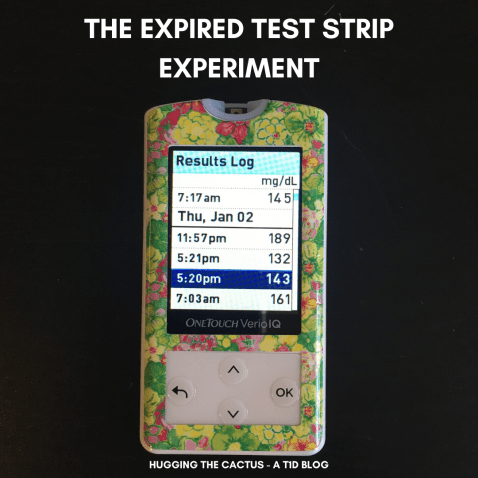
My experiment design was rudimentary: I’d simply continue to use the 12/31/19 test strips until the vial was empty. I’d check any blood sugar results that I was unsure about against my Dexcom readings, and in cases that I deemed necessary, I’d use test strips with a far-off expiration (July 2020) to see how they matched up with the expired strips.

To my slight surprise, though it’s only been about a week since the old strips expired, it doesn’t seem to affect things much at all. They’re just as accurate as newer strips and my Dexcom.

In fact, in many cases, the old strips were only off (according to my measurements) by no more than 9 points. Not bad. I’ve had a wider spread in results between strips from the exact same vial, so the fact that the old strips were so close to new ones was interesting to me. And four days after the strips expired, I checked my blood sugar (I was 263) and used a new strip to double check that (it read 262). A single point difference is pretty impressive.

So now I know that I’m safe if I use test strips a week after they’ve expired…which is great! But now I’m sort of curious to see just how far out from the expiration date I can use them. I might hang onto this vial of test strips for a few more weeks and continue to test them against newer test strips. I might not (because really, when it comes to diabetes, there are just more important things to be worried about…and I might not want to push my luck and end up wasting strips). We’ll see what I end up doing.

I think that the more compelling questions to stem from this experiment are 1) how many other diabetes supplies are safe (up to a certain limit) to use after expiring and 2) why are supplies labeled with expiration dates if, in the grand scheme of things, they seem to function just fine after expiring? Could it just be a nasty trick played on people with diabetes by prescription drug companies…?

Those are the kinds of questions that really make me wonder.

The Emotions of a Low Blood Sugar

This post was originally published on Hugging the Cactus on October 8, 2018. I decided to re-up it today because I think we could all use a little reminder that diabetes is different for everyone. Remember…your diabetes may (almost always will) vary.

Previously, I’ve written about what it feels like to have low blood sugar. While many people with T1D feel the same symptoms as me when they experience a low, there are even more who experience a wider variety of emotions and sensations.

Renza, a T1D Twitter friend of mine, did a little investigating into how others would describe what it’s like to have a low blood sugar. She sent a tweet that read:

friends. I’m crowdsourcing (again). If you had to use ONE WORD to describe how hypos/lows feel to you, what would it be. Go!! #Hypoglycaemia

She received nearly 100 responses, which I’ve compiled into the below graphic.

Capture

Looking at this word collage is a bit startling because it represents the vast array of feelings associated with low blood sugar. Most of them are negative. A handful of them start with the prefix “dis”, which describes something with an opposing force. A couple of them relate to feelings associated with eating. And just about all of them can be summed up as sensations that I wouldn’t wish on anyone.

To me, this graphic serves as a stark reminder that diabetes is more than just a chronic illness that affects the body: It affects the mind, too.