The Strangest Things I’ve Eaten in the Middle of the Night for a Low Blood Sugar

The thought occurred to me that I should write a blog post on this subject sometime around 3 A.M. after I shoveled a slice of cheddar cheese into my mouth.

Low blood sugars combined with odd hours of the night aren’t foreign to most people with diabetes, but they can be…interesting when you aren’t prepared to handle them with low snacks stashed away in or on your nightstand.

To elaborate, I almost always have a box of raisins or a bottle of glucose tablets sitting on top of the nightstand next to my bed – but there are those times that I run out and forget to replace them.

In those situations, I really have no choice but to eat everything in the kitchen head downstairs and scavenge in the kitchen for something that will bring up my low blood sugar.
I love how sassy this cartoon person is as they shamelessly reach into the fridge for a midnight snack or seven (check out that popped knee).

Usually, I consume things that make sense – a handful of cereal, a glass of juice, a few marshmallows…whatever the kitchen is stocked with that will work fast. And this is absolutely the best tactic when dealing with a middle-of-the-night low because it helps ensure that I will be able to get back into bed (and hopefully fall asleep) as soon as possible.

But every so often, I go absolutely apeshit in the kitchen and EAT ALL THE THINGS!!!!!!!!!!

Okay, not ALL the things, but definitely way too many things.

I blame it on the fact that my body is in that savage, must-eat-food now mode: Hungry and full cues aren’t a “thing” in that state. So I kind of mindlessly eat junk until the symptoms of my low blood sugar go away. This can take at least 15 minutes, so as you may be able to imagine, I can go overboard with food consumption.

And my choices can get more than a little weird.

Here are the most bizarre food items that I’ve eaten when dealing with a middle-of-the-night low blood sugar. I classify them as “strange” because either 1) they don’t do anything to help low blood sugar because they’re low carb, 2) they’re kind of disgusting, 3) the quantity is odd, or 4) a mix of all of those qualities:

  • A slice of cheddar cheese (mentioned in this post’s introductory sentence)
  • About one-third of a Nutella jar (that was so yummy but damn I shudder to think about the calories and fat in that serving)
  • Too much peanut butter to quantify (please see above comment RE: Nutella)
  • SUGAR-FREE syrup (emphasis on the sugar-free because WTF was I thinking when I straight up drank two swigs from the bottle)
  • Exactly three frosted mini wheats (I don’t even LIKE this cereal but I guess in this situation I thought that consuming no more, no less than three was a brilliant idea)
  • Pickles (not weird at any other time of the day because I love pickles but maybe not the best snack in the early morning hours)

Welp, now my stomach is churning slightly as I think about all the junk I’ve eaten at ungodly hours of the night…if you don’t mind me, I’m off to go restock my low snack supply on my nightstand so I don’t have to make any early-A.M. hour trips to the kitchen any time soon!
How Keeping Constantly Busy Helps (and Hurts) My Diabetes

I don’t fare well when I have too much idle time.

I’m the type of person who needs to stay as busy as possible: I like being productive and having the satisfaction of saying that I’ve accomplished something each day. That doesn’t always mean that I’m successful, but I do my damnedest to make sure that I check off at least one item from my to-do list on a daily basis.

And I don’t like saying “no” to others, so whenever someone asks for my help, I’m on it. It doesn’t matter if it’s a family member, close friend, or an acquaintance – I do what I can when I’m called on for help, and as you might be able to imagine, this is both good and bad for me.

How Keeping Constantly Busy Helps (and Hurts) My Diabetes
Who DOESN’T love the satisfying feeling of checking items off from a to-do list?!

In terms of diabetes management, it’s great because when I am particularly busy, this means that I’m probably not sitting around a whole lot – the constant go-go-go makes my blood sugars pretty happy. Plus, having a packed schedule keeps my mind occupied when I need to think about something – anything, really – other than my diabetes. If I’m having a tough diabetes day, I don’t have to dwell on it; instead, I have tasks X, Y, and Z to do. If I’m waiting for a stubborn high blood sugar to come back down, then I can start working on a project rather than stare at my CGM for the next hour. 

So in this way, keeping myself busy is a fabulous way to take my attention away from diabetes when I desperately need the mental break from it…but it’s also harmful at times, because let’s face it, there are many times in life where I really do need to concentrate on my diabetes care and management.

Whether it’s a big or small task that I’m working on, I put 110% of myself into it, which means that I really don’t have extra thinking room for my diabetes. Some examples of times that I’ve been far too lost in what I was doing to give diabetes a second thought are when I’ve been in the middle of a knitting project and my Dexcom is went off but I actively ignored it in order to keep my focus on whatever row I was working on (and my blood sugar stayed higher for longer than it should have), or when I should’ve taken a break from writing social media posts for my friend to eat something because my blood sugar needed it, but I just wanted to finish the job first.

Now that I’ve figured out how my diabetes is helped and hurt by my jam-packed days, will I continue to stay constantly busy? The answer is definitely. But I will also try to remember the importance of balance in order to keep my diabetes at the forefront of my mind in a healthy manner.

Why I Decided to Get Baqsimi (and How I Got It)

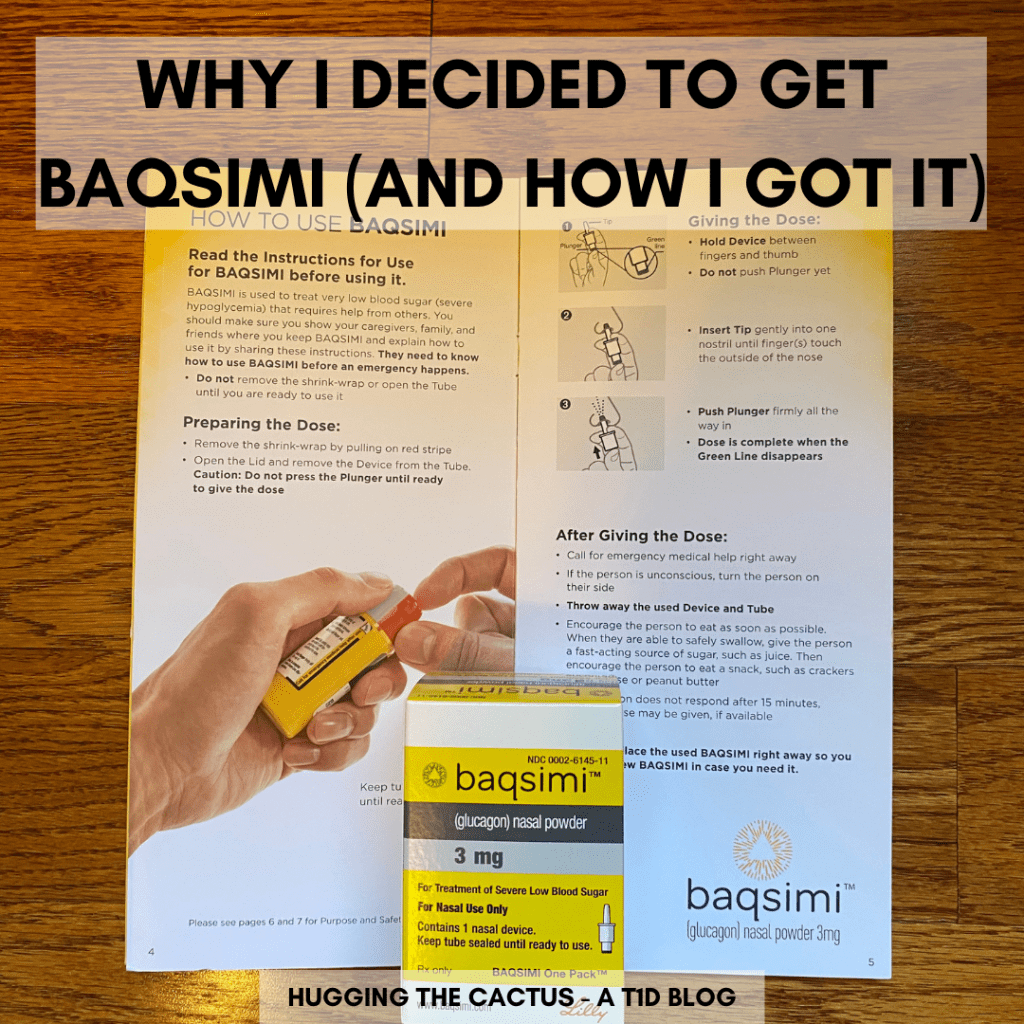
Say hello to my new little friend…Baqsimi!

For anyone who may be unfamiliar with Baqsimi, it’s a relatively new form of glucagon that comes as a nasal spray. I haven’t had to use it yet (and I hope that I don’t ever have to, really), but there’s a lot of pros to Baqsimi when comparing it to a traditional glucagon kit:

  • It’s shelf-stable – it doesn’t have to be refrigerated.
  • It doesn’t expire until 2.5 years from now.
  • It’s completely ready to go as-is, no mixing or measuring needed.
  • It’s compact and totally portable.
  • It’s easy to use (and understand how to use!).
Baqsimi is incredibly easy to use: remove shrink wrap, insert into nostril, and push plunger all the way in to dose. That’s it!

All of those factors contributed to my decision to finally pull the trigger and ask my endocrinologist about writing a prescription for me. It’s not that I’m suddenly worried that I’ll need Baqsimi; for me, it’s more of a peace-of-mind situation. I always thought that my glucagon kit was next to impossible. Sure, I know how to use it, but I have to refresh my memory every so often because there are so many steps involved in the process: inject the syringe into the vial, mix the contents, wait for the glucagon to turn clear, stick the syringe back into the vial, withdraw the liquid, and then finally do the injection…there’s a lot going on there. And if I actually did need glucagon one day due to a severe hypo, I wouldn’t exactly be able to easily walk whoever I was with through the process because I’m sure I’d be totally incapable of doing so (depending on how bad my symptoms were).

It’s just a lot to ask of every single one of my family members and friends to know exactly how to inject glucagon into me in the event I ever needed one of them to do that, so having Baqsimi on hand takes so much of that fear and anxiety away.

And the icing on top of the cake is that it was super easy for me to get Baqsimi…like, it only took a few hours, which is amazing. All I did was reach out to my endocrinologist’s office using their online messaging system, ask my doctor for a script, and…bam. It was sent into my local pharmacy, and before long, I was cruising through the drive-thru with my dog to pick it up. I’m lucky, too, because all I had to pay was $25, thanks to my insurance (sometimes, it’s not as bad as I think it is).

Twenty-five bucks for peace of mind and a life-saving medication…that’s something I can get behind. I’m glad Baqsimi has finally joined my diabetes toolkit.

Diabetes Detective Work: Solving the Mystery of Prolonged High Blood Sugar

When it comes to solving the mystery of why I recently experienced high blood sugar for a prolonged period of time, let’s just say I was a wannabe Sherlock Holmes.

I’m going with “wannabe” here because I lacked the satisfaction of deducing the exact culprit, but at least I had my wits about me enough to come up with a few reasonable explanations.

Diabetes Detective Work_ Solving the Mystery of Prolonged High Blood Sugar
I wish that a magnifying glass was all it took to figure out the “why” situations in life with diabetes.

The scenario: I was riding between 200 and 250 for hours. I did a temporary increase of my insulin for a bit, took 2-3 micro-doses of insulin (in order to avoid stacking), and did my best to stay hydrated while avoiding carbs. And I barely budged, much to my frustration. All throughout dinner that night, I was anxiously eyeing my Dexcom and hoping to level out before long. It was only after I went on a 45-minute after-dinner walk that I started to drop, and it took me quite a while longer than usual for me to be totally back within range.

The questions: Did my mid-afternoon pod change throw something off? Was my carb counting wrong? Was it something I ate? Was my pod working the way it should’ve been? Did I get enough exercise throughout the day? Too much? Was it due to anxiety or stress? Some other factor that never even crossed my mind?

The clues: A couple of clues helped me eliminate the cause of the high blood sugar. For starters, it couldn’t have been the insulin – it’d been refrigerated and I’d been using the same vial for a couple of weeks without any issue. It also likely wasn’t either of my pods, because the one I’d worn for the full 3 days had worked fine, and the new one that I applied mid-afternoon did work for the full 3 days…even though it seemed to take some time to adjust to my body. I definitely didn’t eat the healthiest meal (my entree may have been a green salad, but I also ordered a sugary cocktail and had fried pickles as an appetizer). And I was dealing with slightly higher levels of stress than usual.

The case cracked (sorta): All of those aforementioned conditions combined could have contributed to the high blood sugar. Unfortunately, I can’t quite say with certainty that they did, because on paper, I did everything right in order to combat the highs. That’s just the thing with diabetes, though: You can do everything “perfectly”, and the way it “should” be done, but sometimes you can’t prevent these little mysteries from popping up and keeping life with diabetes…ah, well, “interesting”.

Is the Livongo Blood Sugar Meter Accurate?

It occurred to me the other day that even though I wrote a couple of blog posts and even made a video about it, I still haven’t addressed one major component of my new Livongo blood sugar meter: its accuracy.

How does it stack up to my Verio meter? More importantly, do I think it’s accurate?

Well…the answer isn’t cut-and-dry because I think it can be accurate…as long as my blood sugar isn’t above 200.

How did I arrive at this conclusion?

I conducted a little experiment.

Bear in mind here, I’m no expert in experimental design, so I established a simple setup for this. During the period of approximately two weeks, whenever I checked my blood sugar, I used the same drop of blood on test strips for two different meters: my Livongo and my Verio.

And the results were interesting, to say the least.

Whenever I was about 80-180, my results from the Livongo meter and the Verio meter were within about 10 points from one another. One instance, I was 86 on the Livongo and 92 on the Verio. Another time, I was 105 on the Verio and 113 on the Livongo. The meters never reported the exact same number at any point during my experiment, but I was happy whenever they showed similar results.

Things got dicey, though, any time I entered the hyperglycemic range.

Add a heading (1)
That 163 and 165 show how at times, the two meters were in agreement with one another…but then there’s that 231 and 262. Those are just a little too different for my liking.

It was weird and I can’t explain it, but the Livongo would report that I was anywhere from 20-50 points higher than what was on my Verio at a given point in time when my levels were 200+. This really surprised me, because I’d suspected that my Verio skewed a little higher compared to most other meters, so I never thought that the Livongo would prove me wrong about that. At times, it was truly maddening: On one occasion, the Livongo said I was 251 and my Verio said I was 204. That’s the difference of at least 1-2 units of insulin for me in order to correct that high! Even more frustratingly, because I didn’t trust the result from either machine, I checked my blood sugar again immediately and the Verio said 242, while the Livongo said 228.

WTF?!

That particular example was extremely confusing because I didn’t know which piece of technology to trust. And that’s the big thing for me: I need to know that I can depend on whichever blood sugar meter I’m using to deliver accurate results.

So again, remember that I’m no good with numbers, and that this is simply an estimation…but if I had to guess how many times the Livongo agreed with the Verio, I’d say it was no more than 7 out of 10 times. And I’m super bummed about that, because I’d genuinely hoped that I could trust my Livongo meter and use it full-time whenever I was taking a break from my CGM. Given the fact that it seems to be accurate when my blood sugar is in range, though, I suppose I could use that as motivation to work harder to prevent hyperglycemic readings…but I’m not perfect and I know that they will still happen from time to time. And I deserve a piece of technology that will accurately report them to me so I can make the best possible treatment decisions.

In theory, I still like the Livongo: It has a great design and some of its features (e.g., test strip reordering) are totally unique. But in practice? It leaves a bit to be desired.

T1D, A1c, and Time in Range

Time in range versus A1c…which measurement matters more when it comes to T1D care and management?

Well, I’m not exactly in a position to answer that, because I think the answer is unique to all people with diabetes. But I can explain what exactly both of these numbers are and how I view them.

A1c: Also known as Hb1c or hemoglobin A1c, this is a test that is conducted every 3 months (or as requested) by an endocrinologist. A patient gets blood drawn to determine the average amount of glucose concentration in the blood during that 3 month period. The result of this test is a percentage amount, with 5% being an average result for a non-diabetic individual. I consider the A1c result to be highly personal, so I don’t often share mine with others; however, I do refer to it when describing ways in which I want to improve my diabetes care and management.

Time in range: This value describes the literal amount of time that a person’s blood sugar is in “range” for a given period of time (e.g., one day, one week, one month, etc.). “Range” refers to above a person’s low threshold and below a person’s high threshold. One person’s defined range may vary greatly from another person’s, but for me, I have my low set at 80 and my high set at 180 on my Dexcom. In a perfect world, my range would be more like 80-120, but I have a higher threshold set to minimize the number of alarms that go off.

Add a heading
Diabetes…the chronic conditions with like, way too many acronyms.

So really, both are just two different ways of measuring blood sugar performance over the course of certain time frames. And while I try to bear in mind that these are both simply numbers that help me see part of the diabetes picture, and not sole indicators of how “well controlled” I am or am not, I do pay special attention to them and have certain goals for myself. (I strive for an A1c of under 7 and I like my time in range to be at least 75%: These are goals I came up with independently, without my endocrinologist’s feedback, because it’s what I feel comfortable with when it comes to my diabetes…other T1Ds feel differently, and that’s totally okay!)

It’s important to me that I remember that my “success” as a person with T1D is not defined by either of these numbers. In fact, I know many other T1D individuals feel the same way that they should be viewed as signposts along the road to achieving desired diabetes results. It can be hard to do, though, because of how much weight is placed on these numbers by medical professionals and from people across the Internet.

The bottom line? I try to tune out the background noise and focus on taking it one day at a time. By no means am I perfect, but nobody is, and I know better than to put pressure on myself to strive for perfection. Instead, I do the best that I can to maintain my A1c and time in range goals, while doing everything I can to keep the bigger picture in mind instead of individual numbers.

When it Comes to Dexcom Alarms…Never Assume

I may have had diabetes for more than three-quarters of my life, but that doesn’t mean that I don’t make silly mistakes with it from time to time.

But I must admit, I still surprise myself on the occasions that I make a slip-up that’s incredibly stupid…and incredibly avoidable.

When it Comes to Dexcom Alarms...Never Assume
In life with diabetes (and in general), mistakes are bound to happen…

For example, one morning my Dexcom started alarming, and I thought that I knew exactly why it was sounding off: It sounded like the signature triple buzz of a high alert, so I did what anyone else would do when it’s very early in the morning and not quite time to wake up yet…I ignored it and fell back asleep.

But true to typical Dexcom alarm nature, my sleep was interrupted again by continued buzzing. Rather than pick up my phone to dismiss the alarm, though, I decided to bolus for a couple of units without ever verifying that I was, indeed, high.

Yikes. Can you say rookie mistake?

Fortunately for me, I really did have to get up and start my day within a couple of hours of taking that bolus. Thank goodness I did, because when I got up, I immediately glanced at my Dexcom and was taken aback to see that my blood sugar had not ticked up past my high threshold in the last several hours…it had actually lost reception completely.

Ahh…so that’s what it was trying to tell me. Oops.

Furthermore, my blood sugar was inching below my low threshold – the two units I’d carelessly taken had kicked in, and all I could feel in that moment was relief that I hadn’t taken more insulin.

This story could’ve had a very different ending. I’m still kind of in disbelief that I didn’t just roll over to check my Dexcom and confirm the reason why it was alarming in the first place. I mean, that’s what I do any other time it goes off, regardless of the time of day. I suppose that I was just overly confident in what kind of alarm it was. Coupled with the fact that I was barely awake when this all went down, then it really isn’t all that crazy that this happened…but it doesn’t make me feel any less dumb.

Lesson learned. When it comes to Dexcom alarms, always check them, and never make assumptions.


4 Cocktails That Have Little or No Impact on My Blood Sugar

YAY, it’s FRIDAY! *Does happy dance*

In order to “cheers” the weekend’s arrival, I might indulge in an alcoholic bevvy or two tonight.

And if you’re like most people who are curious about my diabetes, you may be wondering…how does alcohol affect my blood sugar?

Remember that it’s different for everyone, but personally, alcohol itself (hard liquor/spirits) doesn’t really impact my blood sugars too much. More often than not, it’s the sugary juices, syrups, and sodas that are found in mixed drinks that are wreaking havoc on my levels. That doesn’t mean I don’t allow myself to have a carb-o-licious margarita or a frozen cocktail (a local bar makes them with ice cream and they’re incredible) from time to time, but I definitely don’t do it frequently because the inevitable blood sugar spike just isn’t worth it.

So what do I stick to instead? I have a few go-to cocktails that play nice with my diabetes:

1 – Gin and tonic. Did you know that diet tonic water is a thing? It is, and it can be purchased by the bottle from just about any grocery store. I love having diet tonic water as an option because it eliminates the carbohydrates that are found in regular tonic water. This means that any carbs in this cocktail are coming from the gin, and it’s such a trace amount that I don’t need to factor it into a bolus (again, this is just what works for me). All I do is pour my gin and diet tonic water over a tall glass of ice, add a squeeze of lime juice, and enjoy knowing that I’ve created a nearly carb-free cocktail.

2 – Rum and Diet Coke. People always seem surprised when they see me drinking rum because of the connotation that it’s a sugary spirit. But I’ve never noticed rum impacting my blood sugar more than any other spirit such as bourbon, scotch, tequila, or gin. So when I’m leaning towards something that’s on the sweeter side in terms of taste but not heavy on carbs, I’ll go with a rum and diet coke.

4 Cocktails That Have Little or No Impact on My Blood Sugar
Raise a glass to the weekend…and to drinking *safely* with diabetes!

3 – Whiskey on the rocks (or mixed with diet soda). This is pretty bare-bones in terms of mixology, but I’ve found that I can’t go wrong with this simple combination when I’m in the mood for something to sip slowly and enjoy. Whiskey purists might disagree with how “on the rocks” I tend to get, but I like whiskey best when it’s as cold as possible and, truthfully, a little watered down. But ice or no ice, I know that whiskey won’t make my blood sugar budge, which makes it a-okay in my book.

4 – A glass of wine. Okay, so this isn’t technically a cocktail, but it’d be very remiss of me to exclude wine from this roundup. Not only am I a big fan of whites, reds, and bubbly alike, but it just so happens that wine gets along very well with my blood sugar. The only time that I run into real trouble is if I’m drinking something super sweet like Moscato (which is rarely, if ever, because it’s waaaaay to saccharine for my tastes) or mixing the wine with something (such as Prosecco and orange juice for a mimosa). Otherwise, I know that a glass (or two) of most wines is the perfect way for me to unwind without it having a negative impact on my blood sugar.

To wrap up this particular post, I’m including a few links from Beyond Type 1 below about drinking and diabetes. I’ve found that this topic in general invites a lot of questions, so the resources on their website can help address some of the trickier ones. Remember that if you have diabetes, make sure that you go about it safely if and when you decide to drink alcohol (and if you don’t, that’s perfectly okay, too)!

How much alcohol and what type is best with diabetes?

Why doesn’t glucagon work with alcohol?

Why and how to adjust your basal rate when drinking

The Alcohol and Diabetes Guide


A Full Vlog Review of my Livongo Meter

As promised, here’s my vlog showcasing my thoughts on the Livongo meter! (Yes, I know it’s 10 minutes long, but I couldn’t help going into detail and really tried to showcase all of its features. Hopefully, my rainbow nails and peppy personality keep you engaged.) Like I say in the video, be sure to ask me any questions you may have about the meter – as I use it more, I discover additional details that I will cover in a follow-up post in the future. But for now, ENJOY the video and know that all opinions are my own: I am not being compensated in any way, shape, or form for creating this video and sharing my views.

5 Reasons Why I Took a Break from Continuous Glucose Monitoring

I’ve decided to take a break from continuous glucose monitoring. This means that for an undefined period of time – maybe 3-4 days, a week, or a few weeks – I’m not going to wear my Dexcom G6 CGM.

Initially, I wanted to give myself a break because I was just burnt out from wearing it all the time and feeling so dependent on it. But as I started thinking about more, I realized that there were some other really great reasons for me to take a break from my CGM:

1 – I wanted to wear one less device. It can be tough to wear two medical devices 24/7. Sometimes I get super self-conscious of them. Other times they just aren’t comfortable to wear, such as when I roll over one the wrong way when I’m sleeping at night. So it’s nice to feel a little more free with one less device stuck to my body at all times.

2 – I was sick of the constant data feed. All those alarms going off whenever I cross my high or low threshold are straight up annoying!!! I know I could just turn them off on my CGM receivers, but the point of them (for me) is to try to maintain as tight of a control on my numbers as possible. But now that I’m intentionally not wearing my CGM, I’m realizing how much I appreciate the reprieve from all that buzzing and beeping.

Pink Minimalist Kindness Quote Instagram Post
There’s lots of reasons to take a break from continuous glucose monitoring, but sometimes one is enough.

3 – I have some new blood glucose meters to try. The only way that I can really put my new meters to the *test* (lol) is to use them – and goodness knows that I have very little desire to do manual finger stick checks when I’m wearing my CGM.

4 – I’d like to hold myself more accountable. I rely on my Dexcom heavily at all times. I look to it before I start exercising, before I eat something, before I do anything, really. I bolus using the data it provides and trust it implicitly. But I’ve recognized that by developing this habit, I’ve become lazy. I don’t measure out food as much because I figure that if I bolus too much or too little for it, I can just watch what my Dexcom tells me and treat from there. It’s kinda sloppy, in my humble opinion, so I’m trying to put more of the trust back in myself for my diabetes monitoring.

5 – I’m trying to reacquaint myself with my body’s cues. Before CGM technology, I was really good at recognizing high and low blood sugar symptoms…but then I started using a CGM and found myself reacting to highs and lows (e.g., treating them prematurely), even if I didn’t feel those high/low symptoms. So I want to retrain myself so I can make sure I never lose that ability, because I think it’s important to know exactly how my body alerts me to various blood sugars, rather than depending solely on a piece of technology to do it for me.