When people notice my OmniPod insulin pump, the first question that I’m asked is “what IS that?”
After I explain that it’s my insulin pump, and it’s called a pod, the second question I’m asked is some variation of “how long does it last?”
The canned answer that I provide is something about having to change it every three days, because that’s how the OmniPod is advertised.
But I’ve used this pump for years now and never bothered to really test this three-day limit. I’ve known for a long time that my pod works a handful of hours after the expiration alarm starts chiming, but I wasn’t sure about exactly how many hours I had before a pod expired for good.
So, the other day, I decided to find out.
Have you ever made your pod last longer than 3 days? If so…are you a wizard???
My pod expired at 10:22 A.M. Since I prefer to change my pods in the evening, I figured it was the perfect time for this little experiment, assuming that the pod really would last me for the majority of the day.
And, well, it did! At 10:22 on the dot, the pod beeped at me to notify me that it was expired. And in the six hours after that, it would alarm every hour (on the 22nd minute) to remind me, time and time again, that it was expired. In the seventh hour – beginning at 5:22 P.M. – my PDM started chirping at me on and off every 15 minutes or so. First it was because I was running out of insulin, but then it was to really get the point across that my pod was expired!
I was determined to use every last drop of insulin in the pod, though, so I bolused for my dinner around 5:45 and I was pleased to discover that I got my full dose of insulin without any issues. As I was cleaning up after dinner, that’s when the signature OmniPod BEEEEEEEEEEEEEEEEEP went off as one blaring, unceasing alarm. I checked the time: 6:22 P.M.
So there was my answer. An OmniPod can last precisely 80 hours after you initially activate it for the first time (or in other words, 8 hours after you receive the first expiration message)…as long as it still has insulin in it. It’s definitely something good to know for sure now, because in the future, it might come in handy and help me avoid wasting precious insulin.
So you want to try your first continuous glucose monitor. Or maybe you’re ready to leave behind multiple daily injections and switch to insulin pump therapy. Whichever diabetes device you’re looking to start using, there are some questions you’ll probably want to have answers to before decide that now’s the time to introduce new diabetes technology into your daily routine.
The following is a compilation of the questions that I thought long and hard about (literally for years) and that I wish I’d thought long and hard about before I made the transition to the OmniPod insulin pump.
Am I ready for it? It took me 17 years before I decided that I was ready to try an insulin pump. 17 freakin’ years!!! I spent most of that time being too afraid of introducing such a drastic change to a routine I’d had down pat for such a long period of my life. There are times when I wish I’d gone onto my insulin pump sooner, but ultimately, I’m glad that I wasn’t swayed by my family or doctors to go on it before I truly felt ready. By the time I started using my OmniPod, I had the maturity, responsibility, and emotional intelligence that I felt that I needed for an insulin pump.
Will I be able to afford it? Obviously, this isn’t a question that I wondered about when I was younger, but it’s one of the first things that comes to mind as an adult on her own health care plan. We all know that diabetes supplies are expensive, and it seems that the more technologically advanced something is, the more money that has to be forked over in order to obtain it. This isn’t right or fair, but it’s a simple truth and an important one to think about before choosing one pump or continuous glucose monitor over another.
Why do I want to start using it? I wanted to start using my OmniPod because my mom experienced great success when she started using it. And I decided to get a Dexcom CGM because I fell in love with the technology after undergoing a trial period with my endocrinologist. In both situations, I felt very much in control of my decision to start using these devices and I didn’t really listen to anyone else’s opinions. But I am very aware of the fact that social media and real-life friendships with other people with diabetes can often sway people in different directions. After all, if I saw a post on Instagram from a dia-influencer who was singing the praises of a Tandem T:slim pump, then I might seriously start thinking about switching to it (this has actually happened to me). But the bottom line is to think about the why – will this device enhance quality of life for me? Will diabetes be easier to manage with it? Will it help me achieve my A1c and/or blood sugar goals? Do I need to add something new to my routine because I’m feeling burnt out by doing things the same way all the time? Knowing why I wanted to use an OmniPod or a Dexcom CGM made me feel that much better during the whole process of learning how to use them – I felt like I had clear goals that would help me navigate the integration of these new technologies into my daily routine.
Me, being a goofball with my two favorite diabetes devices.
Will I be comfortable wearing it 24/7? This is a big one! Pods, pumps, and CGMs are very visible, and it can be jarring to go from being “naked” to having bumps and lumps underneath clothes that can get caught on doorknobs, chairs, and the like. Personally, the benefits of my OmniPod and Dexcom outweigh something like this which is a bit superficial, but that doesn’t mean it’s not something to think about. But it’s also worth thinking about comfort and what is least painful when it comes to insulin delivery, so that’s why this is an important question to ask.
Do I know anyone else using it who can provide feedback from a patient’s perspective? I’ve talked about this before, but I’m not sure when, if ever, I would have seriously considered using the OmniPod if my mother hadn’t tried it first. The fact that we both have diabetes has probably made us a little closer and strengthened our bond, so if there’s anyone’s opinion that I’m going to trust when it comes to something like this, then it’s hers. I can actually remember her first few weeks on the OmniPod – in which she learned a lot of valuable lessons – and how pleased she was with it once a few months with it elapsed. She taught me the ins and outs of the OmniPod when I started to use it, and I’d argue that her advice was more helpful than that of my diabetes educator. So I’d advocate gathering opinions from family and friends (if either is applicable) or the diabetes online community before going on a new diabetes device, in addition to the research component below…
Have I done enough research on it? …Like any smart shopper, it’s crucial to really consider all options and research them thoroughly, especially when it comes to the top contender. I definitely did not complete sufficient research before going onto the OmniPod or Dexcom; rather, I trusted that they were just right for me. If I were to switch to something else tomorrow, though, you can bet that’d I’d spend a lot of time scouring the web for every last bit of information on the device so I could make the most informed decision possible.
New diabetes technology can be both scary and exciting. But more than anything else, it can really make life with diabetes much more carefree, and I’m glad that in this day and age there are so many options available to people with diabetes that continue to be technologically impressive.
Like many other people with diabetes, I wear two devices on my body at all times: my insulin pump (my pod) and my continuous glucose monitor (CGM). And I’m often asked whether or not these little gadgets are painful.
Fortunately, the answer is that most of the time, they aren’t. I rarely feel it when my CGM sensor or my insulin pod’s cannula pierce my skin, which makes the whole experience of wearing them a lot more comfortable – and much less dreadful when it’s time to rotate sites.
Speaking of sites and pain, though, I admit that there are some sites that, for me, tend to work better than others. The following are the different locations I use for my pod and CGM sensors, in order of what tends to be best to the worst.
My stomach is my preferred spot for my pod AND my sensor.
Stomach: This is the site at which I have the best insulin absorption, so it’s a clear winner for me when it comes to my pod placement. I also find that it almost never hurts when I press up against the pod (e.g., when I roll over in bed in the middle of the night) when it’s on my belly. The same is true for my CGM sensors, which also seem to be the most accurate when they’re placed on my abdomen. I guess there’s a reason why the stomach site is the only one recommended by the FDA for the Dexcom CGM (which is what I use)!
Lower back: I have yet to try my CGM here, but I often place my pod on my lower back without issue. This site can be trickier to navigate because if I forget that my pod’s there when I’m getting dressed in the morning, I can come precariously close to accidentally knocking it off – and I have in the past. Plus, the pod can rub up against me in an unpleasant way when I’m working out; specifically, doing any sort of abdominal exercise on the ground. But it’s not something I can’t tolerate, and the insulin absorption in this location is just too good in general for me to pass over it altogether.
Upper arm: I wear my pod and CGM on my upper arms sometimes, but they don’t always adhere well for some reason. Getting dressed can be even more problematic for me if I forget that my sites are on my arms – I’ve totally ripped off pods and sensors when I’ve been taking off and putting on clothing. And for a long time, my CGM sensors would make me bleed when I inserted them in my upper arm. I never figured out why, and the problem seems to have gone away, but it definitely made me a little more wary about using my arms as a site (PLUS any devices I wear on my arms are highly visible, and I don’t always like it when people stare at them).
Thigh: Hands-down, the worst site for my pods are my thighs. For starters, wearing denim jeans – especially if they’re skinny jeans – are such a feat when wearing a thigh pod. The fabric pushes up against the pod in such a way that I prefer wearing dresses, skirts, or leggings for the three days that I have a thigh pod just so I can be more comfortable. And speaking of comfort, it’s tough for me to get into a cozy sleeping position when I have a thigh pod because I like sleeping on my stomach sometimes, and there’s just too much pressure up against my pod when it’s on my thigh. And for me, it seems that insulin absorption just isn’t great on my thighs (maybe because they’re on the muscular side). BUT, I will say…I recently tried a CGM sensor on my thigh for the first time and I didn’t hate it! The accuracy was good and it wasn’t in the way as much as a thigh pod (I keep wanting to type “tide pod”) would be. I’ve only had it on my leg for a few days now so I don’t know yet how the adhesive will hold up, but I’ll find out.
Spots I haven’t tried yet (but want to): On social media, I’ve seen people wear Dexcom sensors on their forearms (eek), upper butt cheek (tee-hee), and even on their calves. And pod placement can get even wilder with spots in the center of the back (HOW can people reach back there) and, um, the upper-breast area (one word: ouch). While I don’t think I’ll ever work up the courage to try some of those spots, I am curious about others.
The bottom line is, though, that the sites that work best for me might not work as well for you. (The same thing can be said for my worst sites.) But it is important to remember, above all, the importance of rotating sites…even though I’m clearly not a huge fan of pods on my legs, I’ll still suck it up and place them there because I know that I should be careful of scar tissue buildup.
It just makes the pod-and-sensor-change days that much more pleasant when I can move them from a disliked site to a favorite site, anyways.
Choosing an insulin pump therapy can be stressful and overwhelming, especially if you’ve never pumped before.
Factors like tubed vs. tubeless, whether or not your insurance will cover a given pump, ease of use, reservoir capacity, and many others all play into the big pump decision…
…if you’re like most (logical) people.
But if you’re me, then you count on pretty much one thing when making the choice: familiarity. I solely relied on the fact that someone I knew and trusted used the OmniPod and had a positive experience with it, and that person is my mother. On top of that, I waited a solid 2-3 years after she started to use it before it was my turn, because I wasn’t willing to even think about trying it until I could feel fairly confident that I would even like it myself.
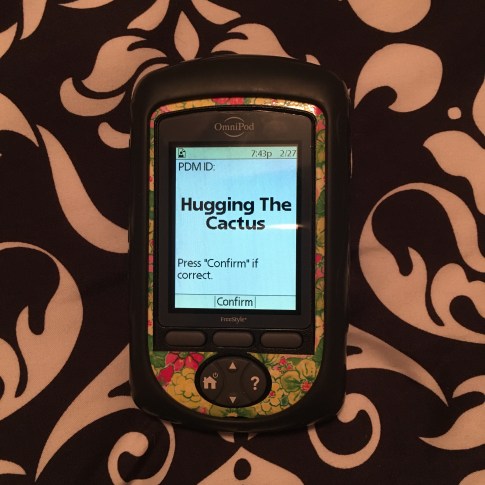
I may or may not have changed my PDM’s display screen for the sake of this picture.
Luckily, I’ve been on it for just over five years now without any major issues. While I do love it more than I ever liked multiple daily injections, I do wish I had thought it over some more before just going with it…especially now that there are other insulin pumps out there with some amazing features. I know that the manufacturer of the OmniPod, Insulet, has some great upgrades in the works, but it can be hard to wait for them.
If I could go back in time, I’d definitely do more research before semi-idly deciding that the OmniPod is right for me. Of course, I could make the switch to a new insulin pump in the future…but if and when I do decide to try something else down the road, I know I’ll make much more of an effort to really learn everything I can about my options before committing to a new piece of diabetes technology.
Here’s another previously published blog post from October 5, 2018. What nugget of useful information can you find here? Well, it all has to do with trusting your gut when it comes to an insulin pod that’s dangling precariously off your body and the subsequent paranoia that happens when you’re not sure whether it’ll still work properly…
I’d only been wearing my new pod for about an hour when my arm brushed up in exactly the wrong way against a chair. Riiiiiiiip!
My pod tore right off – not from my arm, but it lifted up from the adhesive that it was glued to and dangled precariously from the still-intact adhesive stuck to my arm.
Would you have kept the pod on, or changed it?
After cursing loudly, I asked my mother for her opinion. I wanted to know if she could see the cannula, because that was the component that made me most concerned. As long as the cannula was still stuck under my skin and delivering insulin, it shouldn’t matter that my pod was a little loose – right?
She tried to peek under and around my site, but it was virtually impossible to tell whether the cannula was where it should be. I thought about it for a few moments, and decided that it would be wise to just change out the pod. The notion of tossing one that had only been in use for an hour was unappealing to me, but I know myself pretty well, and I know for damn sure that I would’ve been super paranoid about the pod functioning properly for the following 72 hours. I also figured that it couldn’t hurt to try calling Insulet to see if they would replace the kaput pod. The odds were slim, but why not try?
So after I changed my pod, I dialed up Insulet and described the situation to the customer support representative. And…I got a replacement! I was pleasantly surprised by the rep’s empathy towards the situation and how easy it was to get my replacement. She reaffirmed that I did the right thing, noting that if she’d been in my shoes, she would have called it in, too. It goes to show that when in doubt, change the pod – and don’t hesitate to call for a replacement.
12:55 A.M. I wake up from a deep sleep to the sound of my CGM going off: My blood sugar had just gone above my high threshold. I silence the alert and reach for my PDM so I can give myself a small correction bolus. But it’s not in its usual spot on my nightstand.
12:56 A.M. I tumble out of bed and wander into the living room. Surely, I left my PDM somewhere out here. I dig through my backpack, check the coffee table, and look for it on the counter tops in the kitchen. I can’t find it in any of those locations.
12:57 – 1:00 A.M. I’m searching all over the apartment, like a mad woman now. I’m checking in between couch cushions, inside cabinets, and underneath furniture at a lightning-fast pace. My heart is beating rapidly as I wonder where the actual eff my PDM could be. I shake my sleep and bemused partner awake, fill him in on the situation, and enlist his help in the search. He only has a vague idea of what the PDM looks like (I have too many devices for him to be able to distinguish the difference between them) and isn’t much help, but he does offer a tip: Check the car.
1:00 – 1:03 A.M. I run down four flights of stairs and into the parking garage where my boyfriend’s car is parked. Maybe it fell out of my backpack on our way to trivia at a restaurant earlier that evening? I rifled through the passenger seat, checking underneath it and even in the backseat, but no luck.
A post all about a terrifying 20-minute period in which my PDM was…MIA.
1:04 – 1:07 A.M. I practically break out in a cold, panicked sweat as I contemplate the possibility that I took my PDM out at the restaurant and it’s still there. I knew for a fact that I hadn’t used my PDM for anything since I’d eaten dinner hours before at the apartment, but it was worth calling the restaurant to see if they’d found anything. I called, knowing the odds of anyone answering at this hour were slim…only to be proven wrong! I was relieved when a man picked up, and I hastily explained to him the situation. I provided a description of my PDM and waited with bated breath while he searched the area in which my team had sat to play trivia.
1:08 – 1:11 A.M. Crushing disappointment crashes over me like stormy ocean waves as the man tells me, after a prolonged search, that he couldn’t find my PDM. I felt like I’d been punched in the gut. Numbly, I recited my contact information over the phone, thanked him for his time, and hung up. I was beyond panicked now. My boyfriend was asking me about a contingency plan and all I wanted to do was scream at him, my OmniPod IS my contingency plan!!!!!!!! I start formulating a plan to drive to the restaurant first thing in the morning to search the premises myself, as well as call Insulet and beg them to overnight a new PDM. Maybe I would just have to stick to manual injections the entire next day, though I had no idea what I’d do about long-acting insulin since the Lantus sitting in the fridge expired months ago.
1:12 – 1:14 A.M. My mind was in overdrive and I refused to give up right then and there. I was absolutely certain that I hadn’t taken my PDM out since my dinnertime bolus. But since I did go out that night, there were really only one of three places it could be: the apartment, the car, or the restaurant. It definitely wasn’t in the apartment, which I’d searched so thoroughly that it looked like a tornado had whipped through it, but it was worth searching the car one more time…just to be positive.
1:15 A.M. I make my way back down to the parking garage. I turn my cell phone’s flashlight feature on and scan the seats carefully, peeking under and over and around every possible surface…I didn’t see a damn thing. Defeated, I turned to close the passenger side door when, out of the corner of my eye, I saw a gray object wedged between the door would be when it was slammed shut and the seat. It was practically camouflaged, that’s how well it blended with its surroundings. It was…MY PDM!!!
“Relieved” doesn’t begin to describe how I felt. “Elated”, “victorious”, and “exhausted” are all better descriptors. I ran back up to the apartment, told my boyfriend, and breathed a deep sigh, glad that the entire episode had a happy ending. We settled back into bed, though I lay there staring at the ceiling for a long time afterwards. If I hadn’t double checked the car, my boyfriend would’ve just driven off to work the next day, both of us oblivious to the fact that my PDM was there. I would’ve wasted time trying to track it down at the restaurant and calling Insulet, and there probably would’ve been a lot more frustration felt and tears shed.
But thank goodness it didn’t come down to that.
The end results of the missing PDM episode was 1) losing a decent night of sleep, 2) feeling an urgent need to establish a better contingency plan, and 3) feeling an even more pressing need to install a tracking device in that damn PDM, stat…because that thing is just too easy to lose.
The other day, I nearly LOST IT on the phone with an Insulet representative.
I’m not proud of it, but I also was not sure why this particular phone call was taking so long.
I was calling in regards to a pod failure – something I’ve had to call and report many times before, so I’ve become very familiar with how the usual phone call goes:
Me: Hi, I’m calling to report a pod failure.
Insulet Representative: Okay, could I have your first and last name, date of birth, and shipping address?
*I provide the information.*
Insulet Rep.: Thank you for verifying your information. Could you please tell me about the pod failure incident?
*I explain what happened with the pod failure. The rep will ask me a series of follow-up questions, such as where was I wearing the pod? How long was I wearing it before the failure? Did I notice anything unusual about the pod activation? Did I need to seek medical assistance for the pod failure? Typically, this is the list of questions I’m asked, and then I finish my call with the rep.*
Insulet Rep.: We’ll be sending you a replacement pod. We will send it via standard shipping, meaning it will arrive in 7-10 business days. Is that okay with you?
Me: Yes, thank you.
*And then after exchanging pleasantries, the call is over. Standard running time on the phone is about 6-7 minutes. No big deal at all.*
So imagine my surprise, and growing ire, when a phone call that should’ve only lasted a few minutes stretched just beyond 20 minutes.
I’m sure that all T1Ds can commiserate with me on this one…how many hours, and how much patience, have you lost due to customer support?
I still don’t really know why it lasted so long. The agent I spoke with was asking me WAYYYY to many follow-up questions regarding the pod failure, and what made it especially irritating was that I’d already explained every single detail surrounding the whole incident. It was like she was questioning my reporting abilities. Either that or she was really slow with taking notes, and maybe I was talking too fast for her? Who knows. All I knew was that I was calling in the middle of my workday, and I had to get this wrapped up ASAP so I could turn my full attention back to my work.
That said, it was difficult to stay patient, and I probably slipped up toward the end of the call. Actually, I totally slipped up, because my answers to her questions became very curt in my attempt to expedite the call…which didn’t work, by the way.
I felt a tinge of guilt for my brusqueness. After all, I used to be a customer service representative who spoke with her fair share of irate customers. I knew it would be appreciated if I at least said a sincere thank you before hanging up. So I did, and even though I wasn’t exactly proud of myself for losing my cool, I was glad that I could turn my attitude around in the end.
It’s kind of a metaphor for how I’m trying to handle my diabetes these days…allow myself to feel how I want to feel, but then go about handling whatever situation is in my way using a level head. Because that’s how to make things happen, IMHO.
The morning of my cousin’s wedding, I woke up to a blood sugar of 237 after a night of fighting elevated levels. There was no rhyme or reason for the high blood sugar – I hadn’t eaten a single thing for 16 hours at that point, but I had changed my pod an hour or two before going to bed.
When you’re the MOH and you also happen to have diabetes, you worry about a lot more than just your speech or your makeup.
WTF was wrong? Was the pod’s cannula bent? Was I high due to wedding day jitters? Would the highs persist all day?
These were the thoughts racing through my mind almost as soon as I woke up the morning of my cousin’s wedding.
I didn’t have time to worry about my MOH speech, or whether my hair would turn out the way I wanted to, or even to drink a celebratory mimosa while I got ready with the rest of the bridal party – I was too preoccupied by my elevated blood sugar.
All I could bother to think about was a potential solution before we all walked down the aisle.
Somewhere between applying my eyeshadow and having the 111th bobby pin secured in my hair (yes, it truly took 111 bobby pins to make my intricate braided up-do possible), I remembered “The Incident” from last year. I’d slept through a high blood sugar that, the following morning, refused to come down. As my frustration grew, so did the pain in my belly that lead me to the bathroom, where I came very close to passing out. One ambulance trip and ER visit later, I discovered that my pod’s cannula was bent, leaving me with no doubt that a pod malfunction was responsible for the whole ordeal.
With that memory vividly replaying in my mind, I made the executive decision to change my pod a couple hours before we were due at the wedding venue. And I can’t even begin to explain how happy I am that I listened to my intuition to do so. Upon removing it, I noticed blood at the site – not as bad of a sign as a bent cannula is, but a possible indicator of a problem. By the time we were in the venue’s bridal suite, my blood sugar was sitting pretty at 90 and I was finally able to focus on the beautiful, meaningful afternoon.
Sure, it was a stressful morning and far from an ideal situation, but I am extremely proud of myself for how I handled it. I didn’t panic the way I normally do. I didn’t shed any anxiety tears. I kept the issue pretty well-concealed from the bride, who shouldn’t have to worry about her MOH’s health on her special day. My calm approach paid off, and though it sucked to waste almost two days’ worth of insulin when I disposed the wonky pod, I knew I should pay closer attention to the fact that I did what needed to be done.
And even better was that my diabetes mostly cooperated with me the rest of the day. It didn’t stop me from delivering a fantastic speech with the matron of honor. It didn’t prevent me from enjoying some tasty wedding food, cake and all. It certainly didn’t keep me from tearing up the dance floor with my enthusiastic family. And it didn’t end my night early as I went out with my boyfriend, the newlyweds, and the matron of honor and her husband to a bar to shoot some pool and continue our celebrations.
Turns out that dealing with diabetes when you’re the maid of honor has a lot to do with keeping a cool head and living in the moment, two things that are so important to do in a variety of situations.
A long, unfaltering, high-pitched beep was emitting from something in the pharmacy. I saw heads turn in the vicinity as fellow customers, as well as myself, tried to identify the source of the noise.
I gulped. Could it be coming from me? Did my OmniPod fail right then and there as I was picking up my prescription?
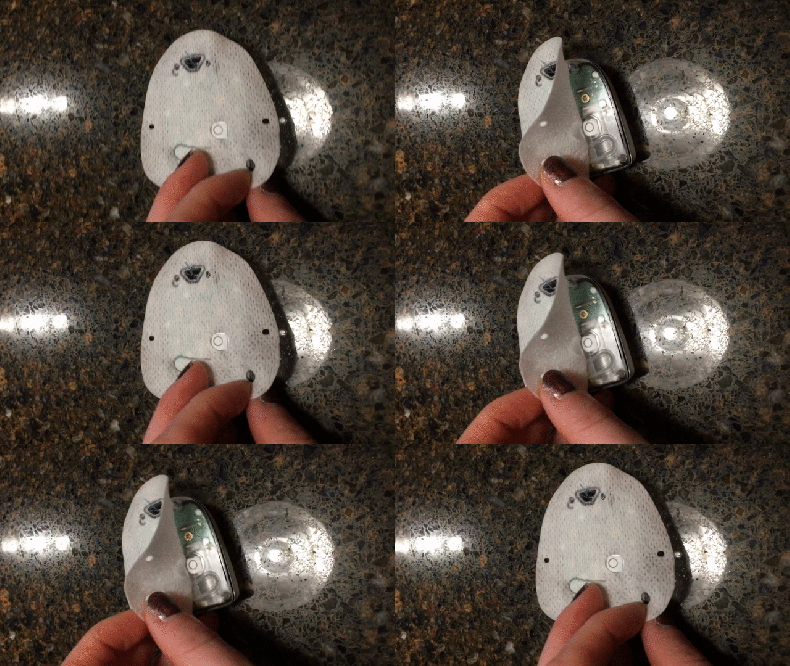
I wish an image could accurately portray just how annoying the beeping sound can be.
I anxiously dug through my backpack, my fingers searching for my PDM, until they met it. I pulled it out and prayed that all was well, that my pod was working as it should be.
A quick press of a button, and…I confirmed that my PDM and pod were, indeed, working properly. Simultaneously relieved yet still bemused by the noise, I put my PDM away while I scanned the area around me, determined to find out what was making a sound so similar to my OmniPod.
What was the culprit? Well, you know those little plastic boxes that drugstores encase things like razor blades in, to prevent theft? That was the thing emitting a blaring beep, in this situation. And like I’d initially assumed, it was coming from me: I was holding one of those boxes in my hand (because I was about to purchase razor blade replacement cartridges), and I’d unintentionally obscured the sensor that triggers the alarm to go off.
Whoops.
While it was nice to know that my insulin pump hadn’t failed on me, it was still somewhat embarrassing to discover that I was the cause of the ruckus, anyways.
Lesson learned: Keep those protective plastic cases in plain sight so I won’t have to misidentify what the beep is coming from.
Which is why I didn’t think twice before writing “ye olde insulin pump” on my pod before attending a renaissance faire last week.
Me, wearing a flower crown and showing off my ye olde insulin pump…just living my best life.
Yep, there I am, with my pod in full view, my Myabetic backpack slung on my shoulders, and turkey leg in hand. This is pretty much me in my full glory.
I could’ve let my diabetes get in the way of me enjoying the faire, especially because it’s been somewhat unpredictable lately, but I didn’t.
I ate what I wanted, drank some raspberry wine (much tastier than mead, IMHO), and socialized with friends.
I anticipated some people to notice or comment on my pod, which I actually wouldn’t have minded because maybe it would’ve been from another T1D or someone who is familiar with insulin pumps. But all day long, the only remark came from someone within my group, and we all had a chuckle over it…and that was it.
Which is perfectly fine by me, because even though my ye olde insulin pump and I weren’t trying to hide diabetes at the renaissance faire, it did give me a mental vacation from it for part of the day.








 Hugging the Cactus