It’s interesting how my thoughts and feelings about life with diabetes have changed over the years.
Take, for instance, this blog post I wrote three years ago in which I wrote about my strange, strained relationship with food. I blamed my diabetes for significantly impacting how I feel about food because I have to be so careful every time I eat and make sure I carb count accurately so I don’t experience blood sugar swings while also trying to maintain a healthy, balanced diet…yeah, it’s a lot to think about every single time that I eat a snack or a meal.
So when I revisited that post in question and was reminded of my complex thoughts on food, I couldn’t help but wonder…has my diabetes really ruined my relationship with it?
My answer to this question now is a definitive no.
Do I get annoyed having to carb count everything that I eat? Sometimes, I do, that’s for damn sure. But for the vast majority of the time, it’s honestly more of a reflex for me than anything else – I’ve gotten very used to this practice in my 25+ years with diabetes, and it has become second nature over that span of time.
Plus, it’s not as though my diabetes has prevented me from enjoying the foods that I like eating, or the ones that I want to try for the first time. It can definitely mess with the timing of when I eat certain foods due to factors like glycemic index or overall carbohydrate content, but this is something that I can typically work around. Even if I don’t nail my carb count for each and every thing that I eat (which trust me, I can mess this up several times in a given week if I’m eating a wider variety of foods), I can still learn from it and apply it to the next time that I eat whatever it was that threw me off my carbohydrate game.
I’m not saying that my relationship with food is easy – it can be far from it. But I am recognizing that perhaps I’ve been a bit harsh in my previous evaluations of how I feel about food from a diabetes perspective. Maybe now that I’m taking some time to think about it more and realizing that I’m able to enjoy a nutritious and delicious menu of food, despite my diabetes, I can begin to look at my relationship with food from other angles and find ways to gain a greater appreciation for how it fuels me to live a full life – pun intended.
I guess I’m hopping on the “what I eat in a day” bandwagon.
This trend has existed long before the TikTok videos and Instagram reels in which vloggers share what they typically eat on any given day of the week – it’s also been something that tons of celebrities have been asked to share in interviews. And while I’m far from a celeb (especially Gwyneth Paltrow, who allegedly is sustained by a cup of coffee, bone broth, and steamed veggies on a day-to-day basis), I do have a certain meal routine that’s centered around my diabetes. Nobody asked me about it, but I figured, why not share it on the blog? After all, so many of the “what I eat in a day” videos and articles I’ve viewed sound a little too perfect. I often wonder how realistic folks are when they’re covering this topic, so I’m going to be pretty matter-of-fact when going through my “meal plan”, and cover how it varies on a weekday versus a weekend. So here we go:
Breakfast on a weekday: I am usually eating breakfast between 7:30 A.M. and 8:30 A.M. I love all breakfast foods, but lately my go-to has been a baked oatmeal. I prep this myself on Sundays and it makes enough servings for 6, so I’m covered for breakfast for the week. I add a couple of scoops of protein powder to it and top it with berries so that I make sure I’m getting a nice balance of carbs, fruits, and protein. One serving is roughly 30-35 grams of carbs, and I’ve found that my blood sugar fares well whenever I eat this meal, maybe spiking a bit in the hour after consuming it but settling back down nicely in no time.
Breakfast on a weekend: Anything goes! My wake-up time could be as early as 8 or as late as 10:30 or even 11 (though I don’t like sleeping my mornings away). Depending on when I wake up, I might want a breakfast sandwich or a protein smoothie, but there are other times that my partner will make me a breakfast consisting of something like hash browns, eggs, bacon, and salsa – no matter what we do, I try to keep breakfast no more than 30-40 carbs because that feels like a sweet spot for my blood sugar levels, whether I’ll be exercising in the hours after eating or even if I’m just lounging around until the afternoon.
Lunch on a weekday: I almost always have a salad or a sandwich. I like to load up my salads with lots of extras – tons of veggies, feta, bacon bits, croutons – and always top them with a protein like hardboiled eggs or chicken. If I’m having a sandwich, I’ll almost always eat it with a side of baby carrots or veggie straws (and if I’m in the office, I might indulge in a buffalo chicken wrap which comes with house-made chips – so yummy but much higher carb compared to what I’d make at home). I will eat an apple or any other fruit I have on hand for something sweet. My blood sugar is usually good after lunch, but if I see it going up too quickly or if it stays higher than I’d like it to for an extended period of time, I’ll combat that with a walk in my neighborhood or around my office suite.
Lunch on a weekend: Admittedly, it’s almost non-existent. If I have leftovers from the night before, I’ll eat that, or maybe my partner and I will split a box of frozen samosas or share a cheese plate so we’re not totally starving by dinnertime. It’s just what works best for me since all of my weekends are totally different in terms of our plans.
Dinner on a weeknight: I like to either meal prep on a Sunday night and have whatever I make carry me through the first few days of the week, or I’ll make something on a Monday evening that will produce my dinners for the next few nights. I’m a semi-lazy cook, so I like tossing veggies, starches, and proteins on a sheet pan and roast everything up (I love recipes from this website). And I have a sweet tooth, so dinner is often followed by a single serving of ice cream or a chocolate-covered frozen banana. My carb intake at dinner hovers around 45-60 grams of carbs, which I find works well because I get busy in the evenings catching up on chores around the house or running errands. The extra carbs help me stay level (and full).
Dinner on a weekend: I enjoy whenever my partner and I have a chance to make food together, because he’s a great cook and very conscientious of my diabetes when making something to eat. He helps me carb count and if we’re going out somewhere to eat/ordering takeout, he’ll offer to split higher-carb dishes with me so I can still have them without totally wrecking my blood sugar. I don’t really place limits on my carb intake for meals out because I love getting sushi, flatbread, and other high-carb menu items – I just try to keep an eye on my blood sugar levels in the hours after a meal out so I can stay on top of highs.
Snacks: I’m a grazer through and through, meaning that it’s hard for me to resist the temptation to snack on foods in my pantry throughout any given day. So I try not to keep bottomless bags of anything in my home, though I do keep things like bags of light kettle corn and single-serving snack bars on hand. But I’m also a sucker for a bowl filled with chocolates like Reese’s or Ghirardelli squares which I will shamelessly help myself to, never having more than a couple in one day because ~*balance*~ matters. Grazing can really screw up my blood sugar, though, so I try to be smart and time it so any snacks coincide with periods of higher activity (such as before I vacuum or head out to run errands).
Drinks: I try to stay hydrated on a daily basis. Besides plain water, I drink Powerade Zero to get in extra electrolytes and I’m an absolute sucker for fizzy and carbonated drinks as long as they are carb-free. I do drink beer/wine/cocktails from time to time that definitely have extra carbs, but I have learned over the years how my blood sugar will respond to a given alcohol and plan accordingly around that.
So, that’s it – an honest explanation of what I eat in a day as a person with diabetes. Some days I am more balanced and “healthy” than others, and some days I just go to town and whatever I like. My relationship with food will never be perfect because my diabetes undoubtedly influenced it, but that’s a post for a different day. For now, I’m off to have a snack to keep my blood sugar (which is 113 mg/dL as I write this) steady throughout my evening workout routine.
As an ardent lover of all types of carbohydrate-packed foods, I can say with almost 100% certainty that I could never commit to a keto diet.
Before I dare to delve even deeper into that train of thought, let me just say that I know plenty of people with diabetes who do follow a keto diet successfully. It’s what works for them. And that’s wonderful! Truly, I know firsthand how difficult it can be to find a nutrition plan that cooperates with diabetes, and that just because one plan works well for one individual does not mean that it will work the same for others. In a nutshell? You do you, and I support that.
Okay, now that I’ve got that out of the way – let’s get to the root of the matter.
It’s not just my utter adoration of carbs that would cause me to struggle on a keto diet. Absolutely not. In my years of relatively light research on the keto diet (which consists of many conversations I’ve had with strict followers of it, as well as my social media lurking on pages plugging keto), I’ve learned that just about all carbs can be replaced by a keto version: You just have to get creative and have keto-friendly ingredients in your kitchen cabinets. So I’d find solace in knowing that I could always bake low-carb muffins, bagels, pizzas, cakes, and the like as long as I had a good recipe and the proper ingredients on hand.
The real reason that I’d totally fail at a keto diet is that I have a hard time with self-control when it comes to 0 or minimal-carb treats. I actually go to town on them. Since I know that I don’t have to bolus for something with low or no carbohydrates, it’s like they become “free” foods to me, meaning that I can eat as much as I want without having to worry about the consequences…which may or may not impact my blood sugar, but which definitely could affect my waistline.
In other words, I have a difficult time remembering that just because something has 0 carbs, it doesn’t mean it has 0 calories.
During the short-lived (think 3 days at a time) keto phases of my life, I found myself eating more and more. Since I was deprived of carbs, I felt entitled to consume more keto foods than I actually needed. My blood sugar may have benefited overall, but it was not at all necessary to be mowing down on all the keto-friendly treats (think keto ice cream, keto cookies, keto bread) that are out there and available to me. I didn’t recognize it right away, but when I did, I realized it came down to my lack of ability to exercise restraint as well as acknowledge the difference between carbs and calories as both a person with diabetes and a person who aims to maintain a particular caloric intake.
So when it comes to keto, it’s a no-go because I finally understand how it impacts my relationship with carbs and calories. I’ll stick to what has generally worked best for me in my 25 years of diabetes, which is a classic: everything in moderation.
There’s no cutesy lead-in to this post…I’m going with a very straightforward statement here:
Diabetes has caused me to have a very weird and strained relationship with food.
How? Oh, let me count the ways…
Diabetes has positively impacted my relationship with food because it has helped me understand the importance of nutrition. I’ve had to learn how carbohydrates, proteins, and fats affect my levels, as well as the role that the glycemic index of foods play into the picture. I’m also grateful that diabetes has caused me to realize there are limits – I can’t mindlessly eat huge quantities of food (though on occasion I do, more on that in a minute). I must measure everything out, and I believe that this forced sense of portion control has helped me maintain a (mostly) healthy weight.
But diabetes has also, absolutely, negatively impacted my relationship with food.
Here’s pretend cartoon me, being absolutely adorable as she calmly whips up a feast in the kitchen (LOL there’s so much wrong about that sentence)!!!
For starters, I can get so fed-up with having to account for every single morsel I consume in a given day – I resent having to take insulin for foods I’d otherwise find enjoyable. Plus, there’s a lot of guilt associated with my regular food consumption. “Should you eat that?” is question I hear not just from others, but from myself as I have to think about whether certain foods are worth not just the calories, but also the amount of insulin that I have to dose for it. And don’t even get me started on how literally unsavory it is to have to eat food when I’m already full but dealing with a low blood sugar…
In a word, my relationship with food is complicated…and I don’t hesitate to blame my diabetes for that. Don’t get me wrong: At the end of the day, I loooooooove food. Really, there’s very few things that I don’t (or won’t) eat or at least try. I enjoy consuming a large variety of foods and I like to eat veggies almost as much as I like eating chocolate (that may be a bit of a stretch, but I think you get my point).
It’s just unfortunate that my diabetes forces me to overthink every food choice that I make. So I’m that much more hopeful for the day which I can eat food without having to think twice about it, without having to feel guilt, shame, doubt, anger, sadness…nothing but pure enjoyment.
It’s November 11th which means that it’s Day 11 of the Happy Diabetic Challenge! Today’s prompt is about go-to meals. What’s the best meal for my diabetes? The answer might surprise you…
I don’t have a go-to meal for my diabetes. Does that surprise you?
I know plenty of people from the DOC who eat virtually the same things each day for breakfast, lunch, and dinner. That seems to work well for those people, so more power to ’em!
On the other hand, I do my diabetes best when I eat a wide variety of foods. My ideal day of food will consist of a medium amount of carbohydrates, a good mix of fruits, veggies, and proteins, and probably a little something “naughty” – a square of dark chocolate or a cookie for dessert. I eat around 20-40 carbs at breakfast and lunch, and anywhere between 30-60 carbs for dinner. It really just depends on what I have on hand in the kitchen and how well-behaved my blood sugars are on a given day.
I suppose that, if I had to describe my go-to diabetes meals, it would look a little something like this:
Breakfast – Either a smoothie with protein powder, almond milk, and frozen fruit; eggs with toast/an English muffin and veggies; or plain oatmeal made with water, cinnamon, and sugar-free syrup
Lunch – Either a salad with tofu/deli meat and a piece of fruit (sometimes with peanut butter spread on it) or a sandwich with cut-up veggies and hummus with a piece of fruit
Dinner – This one varies the most, but my usual is a protein like chicken or turkey with a large serving of veggies and maybe a scoop of brown rice, quinoa, or a bread on the side, with a little something sweet to end the meal
Want to know what dish is pictured? See below for details, including the recipe!
I’ll share my current dinner obsession with you: roasted vegetables with sweet Italian sausage. I cut up a carnival squash (the yummiest variety out there – you can find it at local produce stands), bell peppers, a yellow onion, and a few baby potatoes, toss it all in olive oil, salt, pepper, and thyme, and spread it on a sheet pan. I add whole sweet Italian sausages on top and roast it all for 30 minutes at 425. Then I tear up some kale, toss it with olive oil and just a dash of salt, and throw that on top of the veggies and sausage and cook everything for an additional 15 minutes, turning over the sausages before sliding the pan back into the oven. And that’s it. It’s so tasty and easy to make, and very gentle on my blood sugars – which usually allows me to indulge a bit more on a sweet at the end of the meal.
What’s the go-to meal that works best for you and your diabetes?
One Monday per month, I’ll take a trip down memory lane and reflect on how much my diabetes thoughts, feelings, and experiences have unfolded over the years. Today, I remember…
…discussing carb counting and the role of The Calorie King with a nutritionist.
I’ve met with a nutritionist as part of my diabetes care a few times in my life. During my last visit, maybe six or seven years ago, the nutritionist gifted me with a book entitled The Calorie King. “It’s really going to help you with your carb counting,” she told me.
I remember staring at the book dubiously. It was a compact little thing adorned with bright, bold colors. A bearded man wearing a crown was the cover image, and I couldn’t help but think that it looked totally dorky. I was skeptical: How was a book about calorie counting supposed to help me with my carb counting?
Have you ever heard of The Calorie King or used it yourself for dietary or nutritional purposes?
As it turned out, it could help me a lot.
The Calorie King wasn’t just a list of the calorie content of different foods – it was a comprehensive guide that told me everything about the nutritional content of food. It was like having a manual of nutritional labels, except it was in an easier-to-digest format. And it gave me something that I’d never had access to before: Carbohydrate counts of food that you can get at fast food places, sit-down restaurants, and the like. It gave me a better sense of just how ridiculous some restaurants’ portions can be, as well as how serving size is one of the most critical factors in determining a food’s carb count. My mind marveled at that silly little book’s treasure trove of information, which would be key in helping me determine how much insulin I should take for food in just about any situation.
These days, I use apps on my phone whenever I’m unsure about a given meal or food item. They’re far more convenient than lugging around a copy of The Calorie King. But it turns out my nutritionist kinda knew what she was talking about when she told me that it would open my eyes up to the world of more precise carb counting. And for that, I’m grateful.
One Monday per month, I’ll take a trip down memory lane and reflect on how much my diabetes thoughts, feelings, and experiences have unfolded over the years. Today, I remember…
…that one time in college when some random kid sitting near me in class said that having diabetes means “you’re screwed”. In other words, you can’t live with it, it’s a death sentence.
Before I talk about how I responded to that, I’ll provide some context. It was my freshman or sophomore year of college. I was in a discussion group for my Nutrition 101 seminar. It was early enough in my college career that I still felt painfully shy around most of my classmates, unless they happened to live in my dorm or I had known them in high school (even though I went to a college with an undergraduate population of more than 20,000, I’d still occasionally encounter a high school classmate – it’s a small world after all).
But when it comes to diabetes…well, I have a reputation for not being able to shut up about it. So when it inevitably came up over the course of the Nutrition class, and the teacher’s assistant asked us to define it, I felt a natural impulse to say everything I knew about it. I had to suppress it, though, because my fear of raising my hand in class was stronger than my desire to spew out an overly in-depth definition of diabetes.
So I let someone else answer the question, noting what was right and wrong about the response. As the T.A. launched into her notes on diabetes and nutrition, I overheard a muttered, ignorant comment from the kid next to me:
If you have diabetes, that means you’re screwed!
As you might imagine, I didn’t take too kindly to his words.
While the dude sitting next to him laughed, I felt instant rage surge throughout my body. Without even thinking, I blurted out loud, just audibly enough for him to hear, “No, having diabetes does not mean you’re screwed. Whether you have type 1 or type 2, you can live a perfectly normal life with it. I would know, I have type 1.” I felt my face flush as I turned my attention back to the oblivious T.A. in the front of the room. In the corner of my eye, I saw that the kid was sitting there, mouth slightly agape, probably surprised that the quiet girl in discussion group spoke up to shut down his idiotic way of thinking.
It’s been several years since I was in this particular class, and I don’t remember much of the materials that were taught in it. But I do remember this exchange. It stands out to me because it’s a reminder of how far we’ve got to go as a society to defeat diabetes stigma and prove that you can do more than survive with diabetes – you can thrive with it.
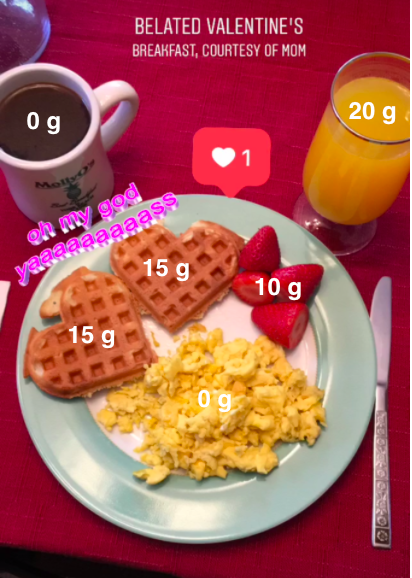
Look at the following image: What do you see? Breakfast, or a plateful of carbohydrates?
Breakfast, or a plateful of carbs? Trick question, it’s both.
Trick question, it’s both.
I seldom enjoy large breakfasts like this, but when I’m treated to them, it’s more than just a savory, delicious meal. It’s also a math problem. So besides looking at a plate full of yum, I’m also looking at this:
Looks like I’m having approximately 60 grams of tasty carbohydrates.
I can’t help it, I HAVE to look at my food this way because it helps me determine how much insulin I have to take. Once I add it up, I take the total amount (60) and divide it by 8, because that’s my morning insulin-to-carb ratio. From there, I take about 7.5 units of insulin to cover my breakfast. Of course, I’m not doing the division by myself – my pump is programmed to know all my mealtime ratios, so the only steps I’m responsible for is adding up my carbs and entering that information into my PDM.
You might think it’s a lot of work, but it’s what I’m used to, along with my fellow T1Ds. It all comes with practice, and before long, calculating carbs becomes part of the normal daily routine.
So this example is both breakfast and a plateful of carbohydrates, but that doesn’t make it any less enjoyable. After all, I’m used to crunching numbers along with my food.
Recently, a random person on the Internet criticized my choice to incorporate carbohydrates in my daily diet. Thanks for the unnecessary judgment, stranger!!!
I’m not really upset about the comment, though, because it prompted me to reflect on why I consume carbs.
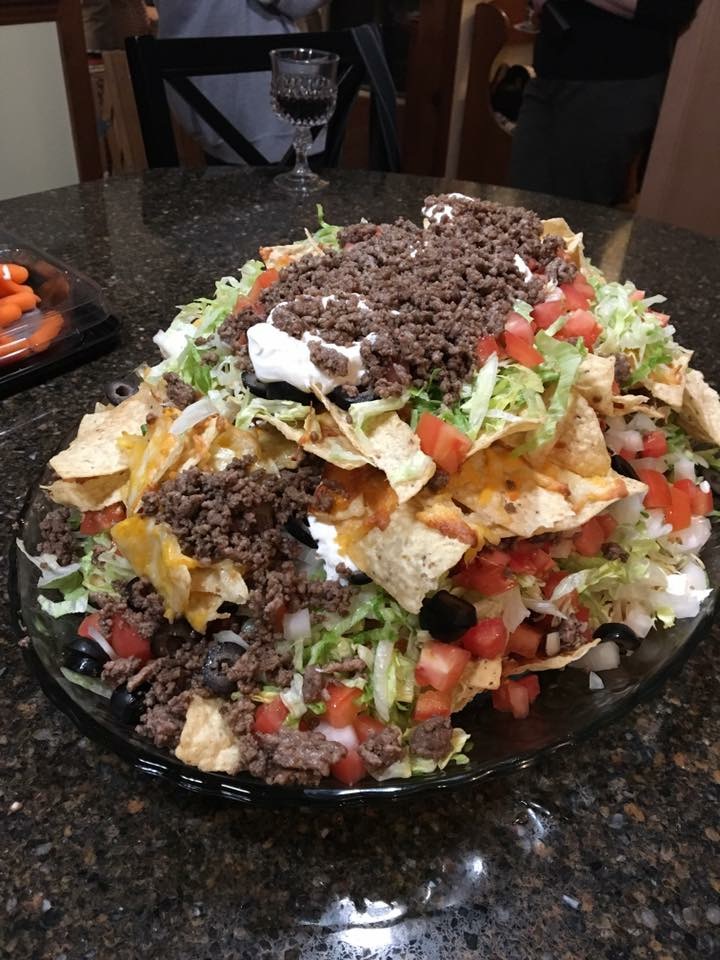
I LOVE CARBS. But of course, everything in moderation! So as much as I’d like to eat this mountain of nachos – a serving will do just fine & works better for me.
For me, it’s about more than just enjoying (relishing, adoring) the taste of carb-heavy substances both starchy and sweet. Carbs also help me achieve balance in my blood sugars. For instance, I find that consuming a serving of carbohydrates at dinnertime keeps me steady as I move through the evening hours. Say that I’m eating grilled chicken with a side salad for dinner. That’s a good meal by itself, but I like to complement it with a carb like half a cup of mashed potatoes or brown rice. I’ve noticed that the carbs kick in more slowly when they’re consumed with minimal or zero-carb foods, thanks to the power of the glycemic index.
The glycemic index is, in short, a measure of how quickly the carbohydrate content of foods will affect blood sugar levels. Since learning about it in college and subsequently researching the glycemic indices of various foods I eat, it’s been an immensely useful tool in determining the makeup of my meals throughout the day. Knowing the glycemic index of a wide array of foods also helps me figure out the timing of my insulin doses; in turn, preventing crazy spikes or crashes after eating.
I can’t shortchange carbs for the fact that they literally save my butt sometimes, too. When I’m experiencing a low blood sugar, nothing BUT carbs will bring me back up to a normal level. Whether it’s carbohydrates from healthy fruits or straight-up candy, it’s giving my blood sugar the surge it needs to keep me going. Like many things in life, it’s a matter of moderation – making sure I don’t consume TOO many carbs when I’m experiencing a low.
If you’re someone who thrives on low carb, high fat diets, that’s great! I know that many people find this to be a successful method in achieving target blood sugars. But for me, my tried-and-true technique of balancing carbs, fats, and proteins is always going to be my ideal strategy. Just because that’s what works for me doesn’t give anyone a right to criticize me for it. I’m here to live my best life, as we all should try to do. Shouldn’t we encourage one another to thrive, instead of judging?








 Hugging the Cactus