
There are few word pairs I loathe more than “controlled” and “diabetes”.
How the hell can diabetes be “controlled”? It’s not a video game to be played with a controller. There’s no character selection or “start” button. And it most definitely can’t be shut off with the flick of a switch.
On the contrary, it’s my opinion that diabetes is a bit of a wild beast that can’t simply be tamed. It doesn’t care if you follow the same routine every single day – it’ll act up for no damn reason whenever it pleases, much to the dismay of a person dealing with it.
Diabetes will do what it wants, when it wants. It will wake you up in the middle of the night because of a low blood sugar. It can throw your whole day off track because you make your plans around it. Diabetes itself comes with so many variables, between the devices and the effectiveness of medication, that it can oscillate no matter how hard you try to keep it steady. How can something like that possibly be under control? People with diabetes, like me, are given tools that are intended to help manage diabetes, certainly, but we have yet to receive something that allows us to influence it completely.

If I had to take a stab at guessing what people thought “in control” diabetes looked at, it would be more than just the “perfect” flat-lined CGM graph. It would be more than going to bed each night and waking up every morning, having just enjoyed an uninterrupted, sound night of sleep. It would be more than having the freedom to make spur-of-the-moment choices regarding a daily routine or diet.
But for now, I’ve accepted that my diabetes is something I manage rather than control…but I also accept my refusal to let it control me.
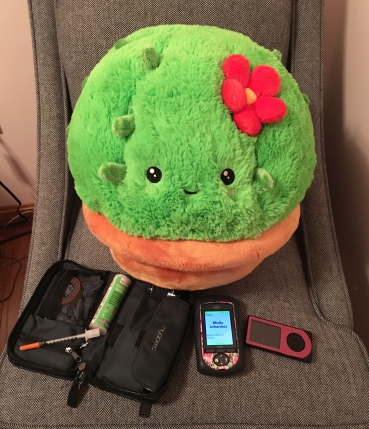
 Hugging the Cactus