
Do We Take Medical Technology for Granted?

This was originally published on Hugging the Cactus on December 4, 2019. I’m sharing it again today because there have been many diabetes tech outages since then – and I’m certain there will be more in the future – but my question still remains: Do we take medical technology for granted? I ponder the answer to that below…

Alright, now that I’ve got THAT out of the way…

For the last several days, the DOC has been in a bit of a panic. And when I say “bit” I mean “a helluva lot”. That’s because the day after Thanksgiving, Dexcom Follow stopped working. This means that parents/caretakers who rely on the technology to monitor their child’s/loved one’s blood sugar levels were left in the dark. It sparked confusion, outrage, and downright fear, all of which only seemed to intensify over the weekend and into this week when the problem was only partially solved for most users.

Rather than coming together to support one another, the DOC swiftly divided into two camps: The first consisted of individuals who sought to gently remind others that this technology is still pretty new. It hasn’t even been around for two decades. That meant that for many years before then, people with diabetes were doing things the “old school” way, and getting by just fine. Doesn’t this mean that we should all be able to make it through unexpected technology blackouts, knowing that we have our blood sugar meters to fall back on?

The second camp was in a greater fury over the issue. This camp relied on the Dexcom G6 system because those within it simply didn’t know a life without the continuous glucose monitoring technology. For them, the outage was a bit like asking them to Google something without access to the Internet – it’s pretty much impossible, unless you’ve got an Encyclopedia handy. Oh, and it’s MUCH higher stakes, because people who don’t recognize symptoms of low or high blood sugar need this technology to work in order to stay on top of fluctuating blood sugar levels. Let’s not even get into how much is PAID for this expensive piece of medical equipment…one would argue that the high cost of supplies means that the technology should work at all times, no matter what.

If you’re like me, you can see that both of these groups have perfectly valid points. I’ve had diabetes long enough that I didn’t even use – and didn’t see the point in using – continuous glucose monitoring or insulin pumps until a few years ago. I took care of my diabetes the old fashioned way growing up: doing fingerstick checks multiple times per day, treating low blood sugars with 15 carbs then waiting 15 minutes, checking blood sugar levels about an hour after injecting insulin to make sure highs were coming down the way they should. This way of handling diabetes worked for me for a long, long time…throughout elementary, middle, and high school, right up to college.

Then I got a continuous glucose monitor (I believe it was the Dexcom G4) just before starting my freshman year of college. And I haven’t really been without a CGM device since then. It’s changed my life and helped me navigate adulthood with diabetes. Whenever I do experience periods of the technology not working the way it should, it’s infuriating because I feel like it’s not worth throwing away buckets of cash on it in those periods of inconsistency and inaccuracy.

But here’s what I’m wondering, as a result of this Great Dexcom G6 Outage of 2019…do we take this technology for granted?

Do we truly appreciate the times that it works the way it should?

Do we expect too much from something that, technologically speaking, still has a long way to go in terms of working perfectly?

Do we rely too heavily on continuous glucose monitors to provide us peace of mind when, in reality, they simply provide us with real-time updates of our blood sugar levels (i.e., it’s a stream of data)?

I don’t have answers to these questions. I can reflect on my own answers to them; furthermore, I can ponder how and why the DOC gets so divisive in these times where we should try to come together, listen to (and learn from) differing perspectives, and figure out what we can do to best support one another during trying times.
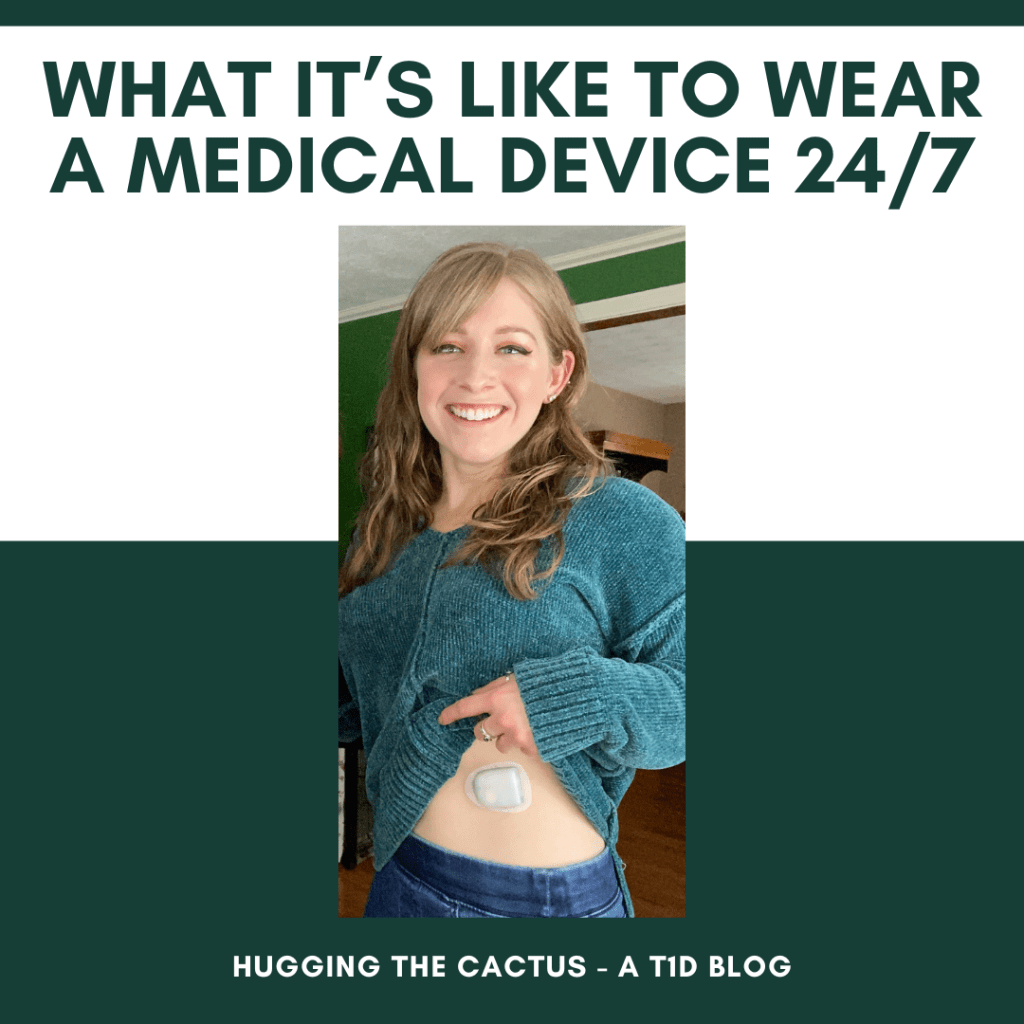
What It’s Like to Wear a Medical Device 24/7

This was originally published on Hugging the Cactus on May 7, 2018. I’m sharing it again today because for as long as I continue to wear an insulin pump and CGM, I know that this is a question that I’ll be asked. Wearing these pieces of medical technology almost all the time has certainly changed how I feel about my body and my body image, and I elaborate on that below…

A question I’m often asked is: “Can you feel your CGM or insulin pump on your body?”

The simple answer to that is: usually, no. It’s something that you just get used to. You grow accustomed to seeing a lump underneath your clothing. You adjust to putting clothes on (and taking them off) carefully to avoid accidentally ripping a site out. You acclimate to showering without being completely naked.

And, of course, you get used to the questions from strangers asking about that device stuck to you.

But the more honest answer to that question would be that there are times that I feel it more than others. For example, sometimes I forget where I’m wearing my pump until I hit it against something (I’m a major klutz who constantly runs into doorways and trip over things, almost always managing to catch my pod on whatever it is), resulting in pain at the site and a curse word or two to fly out of my mouth.

I feel it the most, though, when people stare. Whether unconsciously or purposely, people do ogle at it in very not subtle manners. Which makes me feel extremely uncomfortable. It’s worse when they don’t even ask me what it is – I’d rather have a chance to use it as a teaching moment than to have someone walk away not knowing what the device does. This tends to make swimsuit season a little less welcome for me. Nothing will stop me from donning a bathing suit at the beach or by the pool, and I do so as much as possible in the summertime. But it’s just not as fun when I’ve got to cope with lingering looks, especially when I’m an admittedly insecure person in the first place.

So it’s a more complex question to answer than you might realize. Wearing a medical device 24/7 is humbling. It keeps me alive. I’m privileged to have access to it. I’m grateful for the ways it’s improved my life. I’m always wearing it, but it’s not at the forefront of my mind – unless it chooses to make its presence known by alarming, or I’ve got people blatantly checking it out. It’s kind of like diabetes itself. It can make you feel a gamut of emotions, but no matter what, it’s always there. It’s just a part of me, and I can deal with that.

Restarting the Dexcom G6: Attempt #2

“If there’s a will, there’s a way.” This statement totally describes the Diabetes Online Community (DOC) and its collective determination to find workarounds when it comes to extending the life of certain diabetes devices.

In November, I briefly wrote about my first stab at restarting my Dexcom G6, which was completely unsuccessful. So why bother going through with a second attempt at it? Two reasons: 1) I know that other T1Ds have been able to triumphantly restart the G6, and 2) I know that there are multiple methods out there that people have used in order to do so.

I wasn’t necessarily on the hunt for a method I hadn’t tried yet, but I stumbled across one when I was scrolling through my Instagram feed a few weeks ago. Shout-out to Leah (Instagram handle: @the.insulin.type) for sharing her technique, which you can view for yourself by clicking this link.

You’re probably wondering whether it worked for me, so let me cut to the chase and give you a super annoying answer: yes and no. I restarted the G6 according to Leah’s process, but received the “Sensor Error: Temporary issue. Wait up to 3 hours.” message, which resulted in graphs with sporadic gaps created by a lack of readings. That message popped up at least three or four times over the next 48 hours, before the “sensor failed” message notified me that I had to put a brand new sensor on and finally get rid of the restarted one.

This means that attempt #2 went better than my first try at restarting a sensor, but it was far from the flawless restarts that I know other people have experienced.

I haven’t given up hope, though. I do think that I’ll achieve success, eventually, after some more trial-and-error. I do have my theories that might explain why this didn’t go as well as I wanted it to, and it has to do with the following factors:

  • I restarted my sensor on day eight of wear
  • The sensor error message was on my receiver when I began the restart process

Next time I try this method, I want to see if it makes any difference to let the sensor expire naturally on the tenth day of wear. And if that doesn’t work, I want to at least give it another shot when the sensor and receiver are communicating properly and there are no error messages causing interference.

All in all, the experiment wasn’t a total failure. I did manage to extend the sensor’s life by about six hours – it was due to expire at 2 o’clock in the afternoon on the tenth day of wear, but the sensor didn’t fail completely until about eight o’clock that night. So TECHNICALLY speaking, I got a bit more usage out of it…but then again, those six hours (and probably slightly more than that) got wiped out by those stretches of time that I was dealing with sensor errors.

As I work through more restart attempts, rest assured that I’ll post about them so hopefully someone else will learn a method that works for them, too. But remember…restart your Dexcom G6 at your own risk. It’s not guaranteed to restart or, even if it does, to be accurate.