How to Make Medical Adhesive for CGMs and Pumps Last Longer

Something that all people with diabetes that I know – myself included – struggle with from time to time is the adhesive that keeps our diabetes devices stuck to our bodies.

Real talk? Both the adhesives for my pods and my Dexcom sensors can be lackluster. About half the time, the adhesives that secure them to my body begin to peel around the edges when I’m only partway through the wear time of both devices. And another (much smaller, though far more infuriating) part of the time, the adhesives lose their stickiness entirely, causing the device to fall off my body.

When the adhesive is the reason why a sensor or a pod doesn’t last the full 10 and 7 days, respectively, it’s practically like experiencing a slap in the face because at least a technology error or failure feels more out of my control…the adhesive, though, feels like something that should never be a real issue, and I can’t help but blame myself for not making a pod or sensor more secure when the glue completely fades.

On the bright side, my experience with less-than-sticky pods and sensors forced me to think of ways to get them to last their full lifecycles on my body. Here’s how I make them last as long as possible:

Protective barrier wipes: I use these wipes each time I do a pod change. When my new pod is priming, I wipe whichever site I’m about to place it on with a protective barrier wipe. (I use an alcohol wipe earlier on in my pod change process.) These seem to help with adhesion without adding a ton of stickiness like regular SkinTac wipes tend to do. They literally do what they say they’ll do, which is make a protective barrier for a piece of medical equipment to stick to easily.

Dry my skin: This seems incredibly obvious, but I make sure that new pod and sensor sites are as dry as possible before I apply a device. This is much more of a problem for me in the summertime when weather causes me to sweat more, but I’ve been able to navigate that by wiping my skin with a clean towel and making sure air is circulating well in the room in which I’m applying the pod or sensor so any excess moisture evaporates off my skin.
I may or may not have tried using Scotch tape in the past to get my devices to stick better…(Spoiler alert: It did not work and I do not recommend.)

Specially designed stickers: Both Dexcom and OmniPod produce stickers that customers can request for free. I get them mailed straight to me and I find that they are most useful when a pod or a sensor is hanging precariously off my body. The stickers are shaped exactly to fit around both, so I never have to worry about missing a spot, and they’ve definitely helped me save more than one pod and sensor in the past. I don’t like wearing them unless I have to, though, because sometimes the extra adhesive seems to make the underlying adhesive weaker (not sure how that’s possible, but I’ve always had more luck waiting to add a sticker on top of a loose pod/sensor that’s in its last couple days of wear than adding the sticker on top in the beginning).

The “circle and press” technique: Most people probably already do this, but I actively have to remind myself that when I apply a new pod or sensor, I need to take my finger and circle it around the adhesive firmly three times in order to make sure it’s pressing up against my skin as securely as possible. This method also sort of irons out any wrinkles that might have appeared when the pod or sensor was initially stuck on, so it’s a simple yet effective thing to do…which is absolutely something we could all use more of when it comes to handling diabetes.
3 Moments When Diabetes Surprised Me

Despite the best of efforts to “control” all aspects of life with diabetes, the bottom line is that it can still be totally unpredictable from time to time.

Usually, these unexpected diabetes experiences aren’t exactly welcome…but sometimes, diabetes surprises me in wonderfully delightful ways.

Have you ever been pleasantly surprised by diabetes?

Here’s three of ’em that have occurred in semi-recent memory:

1 – That time I was able to eat an entire homemade blueberry muffin WITHOUT BOLUSING FOR IT. Um, that’s crazy, right?! I had planned on eating half of said muffin in order to bring up a low blood sugar, but, well, it just tasted so damn good that before I knew it OOPS the whole thing was gone. I hemmed and hawed for a long time over whether I should bolus for the excess carb intake, and finally decided that I would just monitor my blood sugar and correct it as needed. But, weirdly enough…I saw my BG slowly rise and settle into the mid-150s and STAY there. Absolutely amazing, right? Maybe blueberry muffins are the new cinnamon cure for diabetes…

2 – When a pod change coincided with said pod running on its very last unit of insulin. Talk about using insulin to the very last drop, right? I still don’t know how I managed to pull this one off, but all I know is that I wore a pod for the maximum amount of time (80 hours) and had just one unit of insulin left inside it by the time it expired for good. I wish I could make this happen with every pod change, but then again, it is a little nerve-wracking to go down to the wire like that on a pod…

3 – That one instance when I drank one cocktail too many and my blood sugar behaved perfectly. This was a total freak incident and let me say upfront: I condone drinking with diabetes as long as it is done by individuals 21 and over in a safe, educated manner!!! Okay, now that I have that out of the way…like other grown-ass adults, sometimes I like to unwind with an adult beverage…and like OTHER grown-ass adults, once in a blue moon (please acknowledge the pun) I go a little overboard. Now, normally when I go a little too hard, I pay for it the next day with a hangover and high blood sugar, but on New Year’s Eve? When I drank Prosecco and a beer and a frozen Irish cream cocktail that was insanely good but carb-o-licious? I wound up with stellar blood sugars (and only a slightly hangover that was likely me just being overtired thanks to my puppy)…a head-scratching occurrence that was an absolute pleasant surprise.

And these are just three happy diabetes accidents that I can think of – I’ve absolutely had others over the years. Dumb luck? Total coincidences? Events that happened because I actually do kind of know what I’m doing? Whatever you want to call them, I can for sure classify these moments as the good kind of diabetes surprises.

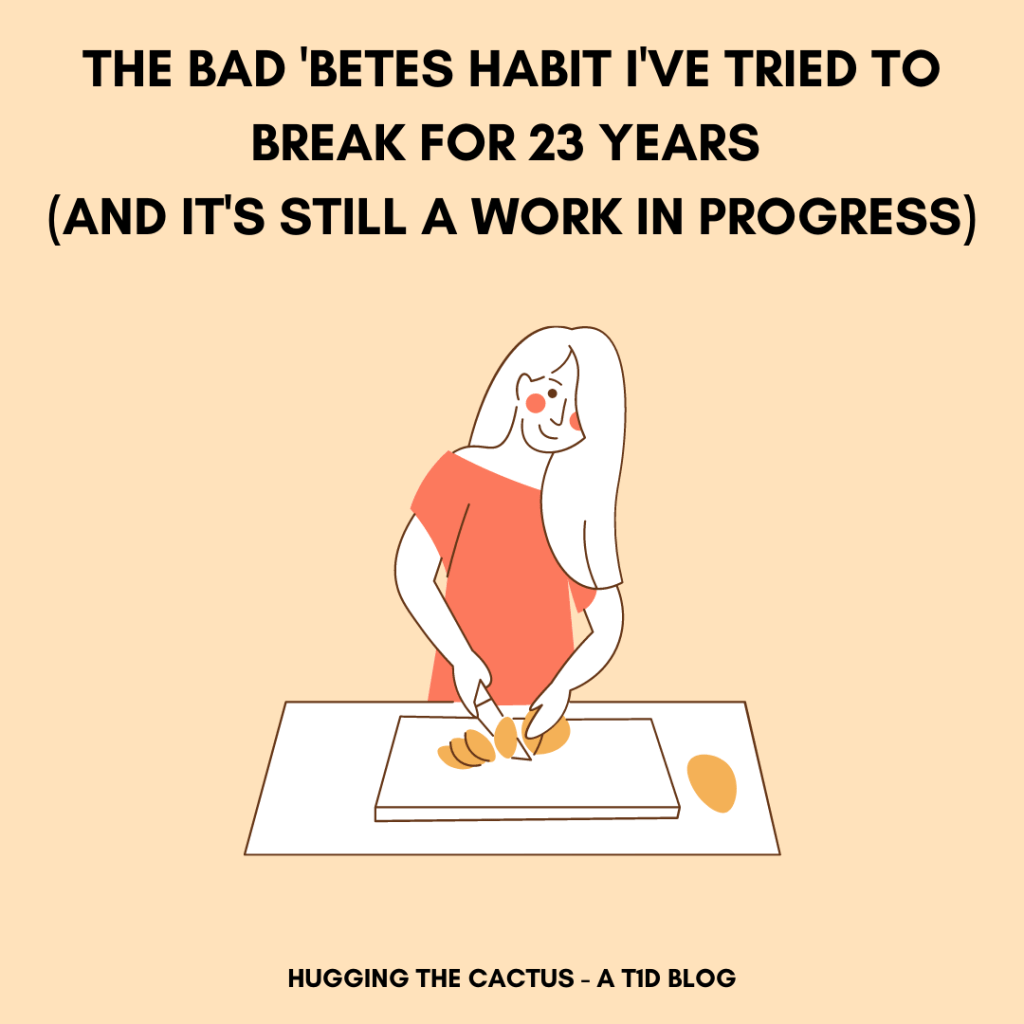
The Bad ‘Betes Habit I’ve Tried to Break for 23 Years (and It’s Still a Work in Progress)

Bad habits are notoriously difficult to break.

Nail-biting. Forgetting to floss. A social media addiction. Swearing. Luckily, I only struggle with two out of the four of those (I’ll let you figure out which ones are a big fuckin’ problem for me while I go check my Instagram account real quick).

When it comes to diabetes-specific bad habits, though, well let’s just say that in more than two decades of life with diabetes, there’s a biiiiiig bad (Buffy the Vampire Slayer fans, think Big Bad like Evil Willow or Glorificus) habit that feels impossible to break.

And for me, that’s snacking freely without bolusing.

When I’m snacking throughout the day, I am not nearly as adorable about it as this cartoon girl (and I am almost never snacking on something as healthy as the piece of fruit she’s cutting up).

When I say “snacking freely”, I think it’s more accurate to call it grazing…I’m not eating large quantities of food or anything particularly carb-heavy, but it is usually enough to impact my blood sugar, at least moderately.

I’ve acknowledged this as a bad habit in a previous blog post, but for the first time, I’m really taking a step back and thinking about how if I stop doing this, I might see a tangible change in not just my blood sugar levels, but my A1c.

Don’t get me wrong, my A1c reading isn’t the most important thing to me (I’d rather focus on time in range, or the amount of time I spend each day below my high limit and above my low limit). But it is something that does come up, and will always come up, during appointments with all of my healthcare professionals. It’s definitely not something that they will be ignoring any time soon, and this year, I’d like to have an A1c that I’m a little more proud to own.

So I’m going to actively try and break this bad habit.

Whenever the desire to snack/graze strikes, I’m going to do what the pros recommend: Have a glass of water. Walk outside for a few minutes. Play with my puppy. Find a task around the house to focus on instead. Actively seek something else that will consume my time instead of me consuming something that will ultimately have a negative impact on my blood sugar as well as my mood. Be more careful about portion control when treating low blood sugars, because I can really spiral and eat half the damn kitchen when correcting a low, and it ain’t cute. And when all else fails and I need a snack (no shame in that game) actually take a freaking bolus for it because it’s okay to eat something extra throughout the day, I just need to stop being lazy and measure out whatever it is so I know exactly how much insulin I need to cover for it. That part isn’t rocket science, so I should stop treating it as such.

All bad habits are difficult to break, and I know one that’s been around for most of my life will make it particularly challenging…but it’s a new year, a great excuse for making a positive change with my eating habits and blood sugar levels, so I say bring on the challenge.

Why I Wouldn’t Change the Age at which I Was Diagnosed with Diabetes

If I could cure diabetes for myself, my mom, my aunt, and all other people living with it, I would in a heartbeat, no question.

Unfortunately, I don’t have that capability, so I can’t change the fact that diabetes exists. Another thing I can’t change is that I was only four years old when I was diagnosed with it.

But let’s talk in hypotheticals here for a moment: If I could change the age that I was diagnosed, would I? Why or why not?

The answer is a resounding no, and here’s why.

I grew up with my diabetes. I don’t remember life before it. I don’t recall a time in my life in which I was finger-prick free or able to eat whichever foods whenever I wanted.

That might sound sort of depressing, but for me, it’s better that way.

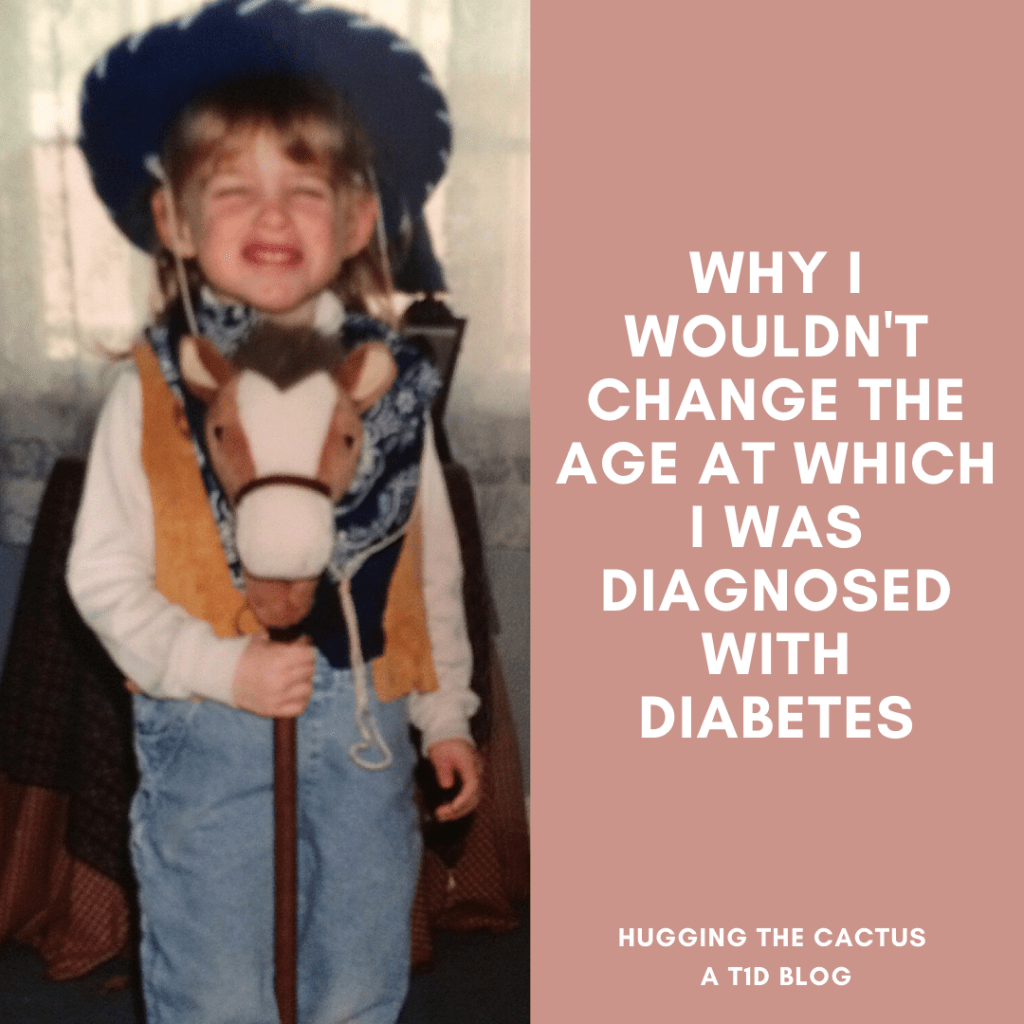
See, little Molly clearly didn’t care about having diabetes – I was way too into my horsey to care about that!

I never have to long for the “before times”. I never have to look back on a time in my life that was hard because diabetes rudely interrupted it, causing a swift, drastic change to my daily routine. By the time I was old enough to start really recalling specific events, I already had diabetes. As far as I’m concerned, it’s always just been a part of me.

Some might argue that it’s “better” (imagine that I’m air-quoting that because it’s never better to have diabetes) to be diagnosed with something as life-altering as diabetes in adulthood, or at least in the teenage years, because comprehension of what it is, exactly, is stronger. I’d imagine that the adaptation of new technologies is easier, too, seeing as teenagers/older individuals tend to pick up on these things faster than, say, a toddler that is needing to learn how to safely use an insulin pump.

But for me, it’s been good to learn about diabetes as I’ve matured. As a kid, I just knew it was the thing that prevented me from eating certain foods at certain times, and that I needed my parents’ help at mealtimes in order to calculate carb intake and bolus amounts. As a teen, I started to actually learn the science behind diabetes in various classes I took throughout high school, and expanded on that knowledge in college by taking a nutrition course that taught me all about the glycemic index and how that impacts blood sugar. And as an adult, I’ve been able to make informed choices regarding the use of insulin pumps, CGMs, and other matters of that nature that require some research and understanding.

And more important than anything else…being diagnosed with diabetes at 4 years old had zero impact on my quality of life. I had a wonderful childhood and all the credit goes to my parents, who made sure that I was raised knowing that diabetes couldn’t stop me from doing anything. I know they would’ve handled a potential diabetes diagnosis later on in my life with an equal amount of grace and strength, but the fact that I grew up with it meant that we all, as a family, grew up with it as a normal part of our lives.

So even though I’ll never be okay in the traditional sense of the word that I have diabetes, I am okay with getting diagnosed as a little kid.

How Raising a Puppy is Similar to Dealing with Diabetes, Part 2

Just about three years ago, I was helping my parents raise their puppy, Clarence. And naturally, with me being who I am, I found that raising him was a lot like dealing with diabetes – and wrote about it in this blog post.

Now that I’m a puppy parent, I revisited that post and found that there are even more similarities between the two.

For starters, one of the biggest parts of diabetes management is the constant monitoring involved in it. As it turns out, the same can be said about raising a puppy! Much like my blood sugar, I am watching her like a hawk during all waking hours. I’m prepared to pounce on her if she’s chewing up a puppy pad or squatting down to her business indoors, just like I’m prepared to act when my blood sugar is going higher or lower than I’d like.

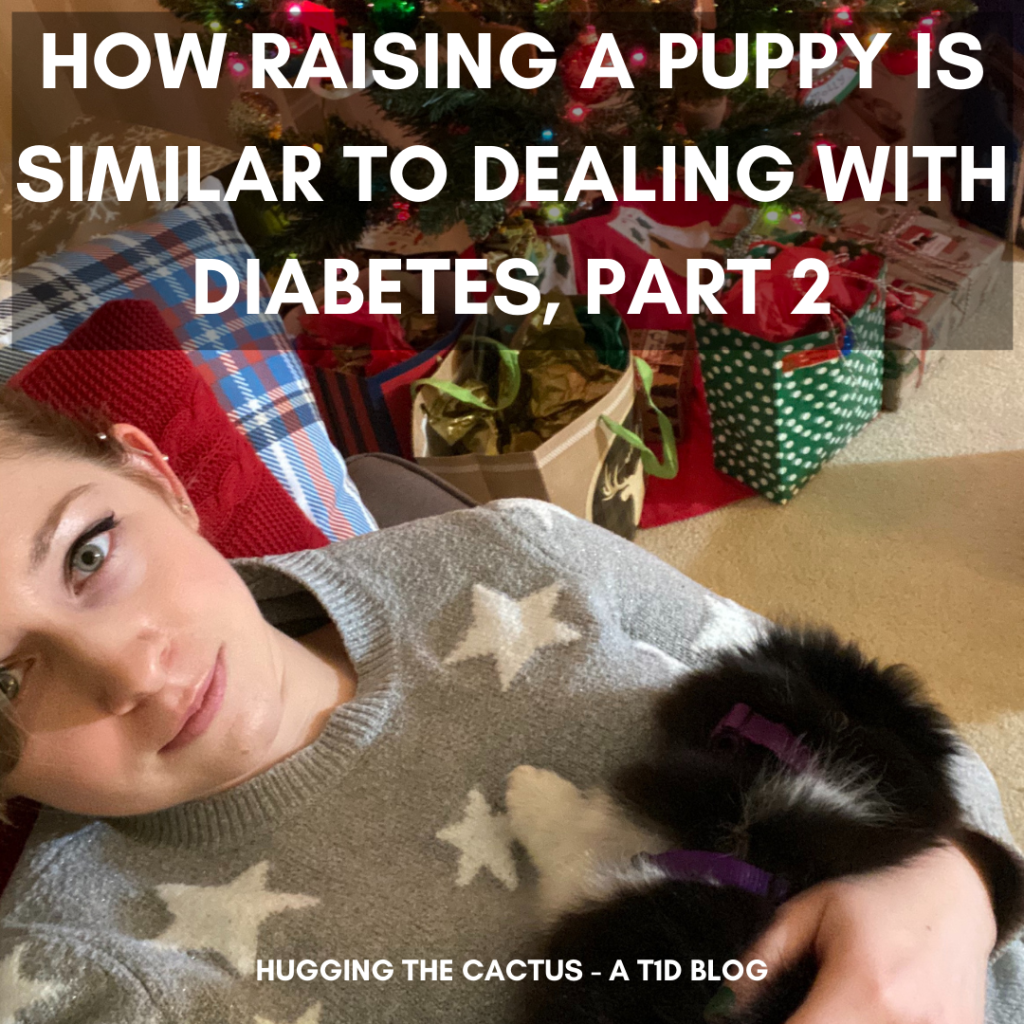
Raising a puppy is only this cute and sweet about 2% of the time. (Okay, total exaggeration here, but I’m writing this after Violet decided to do her business in her playpen just after I had her outside.)

Also, as it turns out – shocker – having a puppy around is exhausting. My sleep has been interrupted several times over the last few weeks by Violet’s whimpers. Before, I used to only have to worry about a Dexcom alarm waking me in the middle of the night, but now I have to respond to her cries, too. Fortunately, having a puppy isn’t totally like having diabetes in this regard, because at least I can nap when she’s napping! (We all know that diabetes never sleeps…)

Another similarity, one that I don’t mind so much, is the frequent exercise that Violet needs. Just like my diabetes tends to be “better controlled” when I exercise each day, Violet also responds really well to playtime. The best part is that after a nice, long session of fetch or tug-of-war, she tends to zonk out afterwards, which I see as the puppy equivalent of having the coveted 100 mg/dL blood sugar.

However, there are tons of obvious differences between raising a puppy and managing diabetes. But the best, perhaps biggest one of all? Violet improves (well, when she doesn’t have an accident indoors) my overall mood and mental health. I know that her ability to do this will only increase over time as she matures. And I know that having her around will help me through the tough diabetes days that I’m bound to face in the future, and for that and so much more, I’m thankful for my little pup.

Meet Violet

Cactus Huggers, I have someone I would like for you to meet.

This is Violet:

Violet enjoys playing with her many toys as well as using them as pillows. Here she is laying on top of a puppy of her own.

Violet is a 10-week-old tri-color Shetland Sheepdog puppy. And for those of you who are familiar with my parents’ dog, Clarence (I’ve written about him on the blog before), Violet is actually Clarence’s niece by blood – his sister is Violet’s mommy.

And I’m Violet’s human mommy.

For as long as I can remember, I’ve always wanted a dog of my own. I considered Clarence to be “my” dog in the last few years because we lived under the same roof most of that time, but I knew that when I eventually moved out, Clarence wouldn’t be coming with me. I also knew that my desire for a dog would only increase if I ever found myself living on my own. So I felt that the stars aligned when I discovered – soon after I moved out towards the end of 2020 – that Clarence’s sister was expecting a litter of puppies, and that one of those puppies would be mine.

This isn’t how I expected it to happen. I never wanted to raise a puppy on my own; after all, puppies are a lot of work. Clarence was a tough puppy to deal with and he had three humans taking care of him!

But I feel as though maybe this is how it was supposed to happen. This tiny creature relies on me for everything. I have quickly become her whole world, and she has become mine. That’s a privilege that I don’t take lightly, and though I know we will have our highs and lows – much like the ones I have with my diabetes – I know that we will live and thrive together happily.

Just like I do with my diabetes.

Happy New Year!

It is officially January 1, 2021.

When I think of January, the color gray comes to mind. This time of year is notorious for being a bit of a dull lull – a period in which everything abruptly slows down. The cold weather feels even colder and it can feel a bit like being trapped inside sometimes.

But we’re all pretty familiar with how that feels by now…

Anyways, that’s what I used to think of January. Now, I’m trying to shift my thinking and find the color and vibrancy in this month. After all, a new mindset – sort of like the one I touched on in Wednesday’s blog post but am still struggling to identify clearly – seems like it should just go together with a new year. If I keep the old mindset, I’ll get old results, and I don’t think I necessarily want old results (unless they pertain to the stretches of time in which my blood sugar levels have been spot-on, then I definitely want those results).

I’m rambling, I know. But this is my way of encouraging myself – and you – to do something that makes you happy today. Need some inspiration? I’ll share my plans: I’ll have a lovely homemade lasagna made by my mother, hang out at my parents’ house with our dogs, and text all of my loved ones to wish them a happy new year. If the weather cooperates, I’ll take a walk at some point to get some fresh air and a change of scenery. Maybe I’ll even get to totally veg out for a few hours and shirk the responsibilities of adulthood, pretending that a new workweek isn’t just around the corner.

All that sounds like a pretty great way to ring in a new year, don’t you think?

Here’s to a new year, your good health, hope, and of course, fabulous blood sugar levels.

A T1D Christmas Craft

I love Christmas, crafting, and some might argue that I love T1D (that’s mostly false, but when you’ve got a chronic illness, you’ve got to learn how to love some aspects of it…otherwise, you’ll be miserable).

So I recently *attempted* to combine all three of these things and do a little DIY project with an empty insulin vial.

And I learned a few things along the way…

  1. I do not recommend messing with a glass vial without safety glasses, gloves, and a trash can nearby. I was lucky enough to avoid any major glass breakage, but some did happen, and I could totally see this craft getting wicked messy and potentially ouchie without taking the proper precautions.
  2. Insulin vials are stable AF…they are not meant to be tampered with.
  3. Glitter cannot be directly injected into an insulin vial. Period, bottom line, don’t even try it.

Okay, so now that I’ve got my disclaimers/lessons learned out of the way, let me tell you why I decided to fill an empty insulin vial with gold glitter.

For years, I’ve seen DIY projects floating around online involving old diabetes supplies. They range in the level commitment and skill involved, but there’s no questioning the creativity of our community when it comes to recycling supplies we’d normally throw away after using.

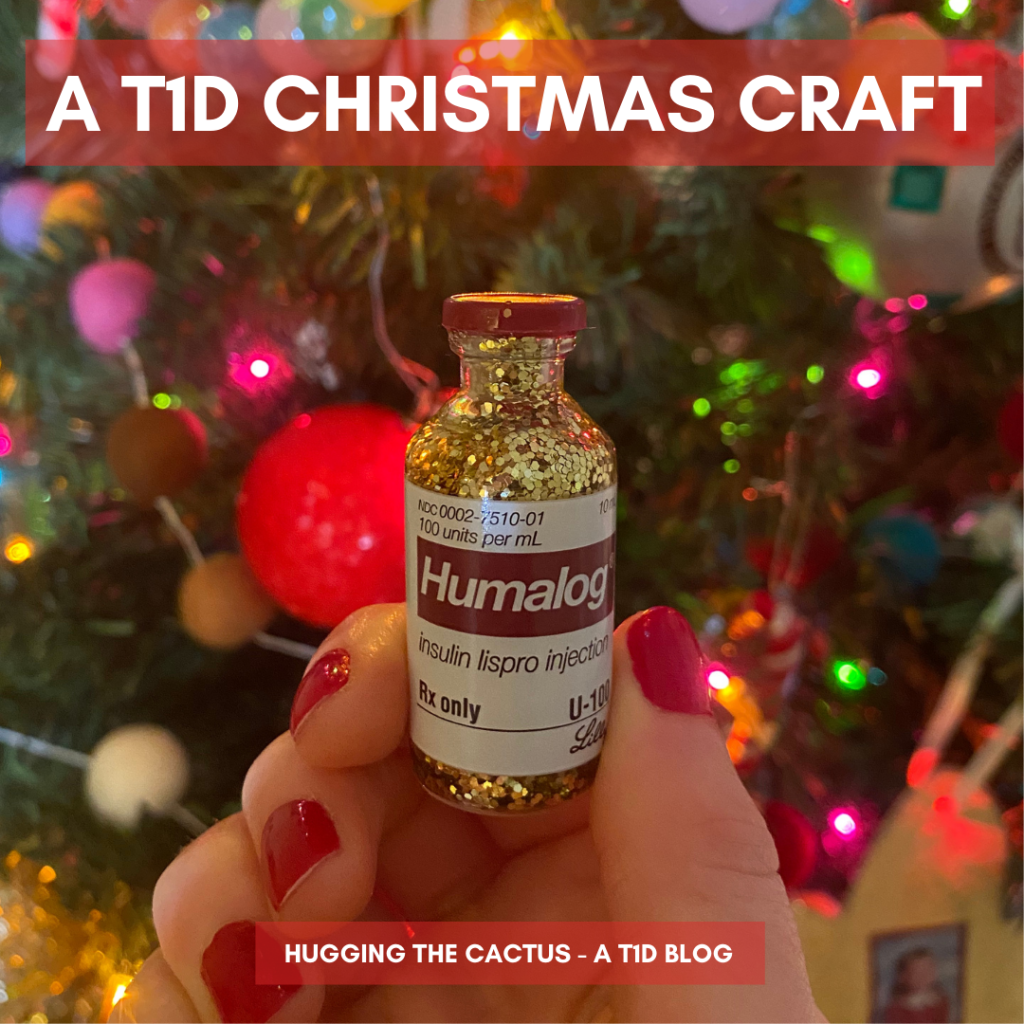
One project that I’ve seen over and over again is transforming an empty insulin vial into a Christmas ornament: Simply stick an ornament hook into the insulin vial’s rubber top, hang it on a Christmas tree branch, and bask in its beauty. I decided to take this concept to the next level by putting gold glitter into the vial because insulin is often referred to as “liquid gold” within the diabetes online community. What better way to represent that than to make it appear as though the contents of a vial were truly liquid gold?

In order to do this, I set aside a vial once I was finished with it/sucked every last drop of insulin out of it. Then, I made a sad attempt at combining glitter with water and using an old syringe to transfer it to the vial (needless to say, I had no luck). So I came up with a new strategy: Pierce the rubber stopper and try to funnel glitter in…and that didn’t work. It became evident that I’d have to remove the top entirely, so using my nifty new toolkit that my father just purchased for me (thanks, dad), I set about the task. I used a razor to carve the rubber stopper up and out, and then pliers to get the metal maroon covering off completely. I broke off a small piece of glass in the process – whoops – but using those tools did the trick for me…all I did after that was take the cap from a new vial of insulin and glued it to the top of the glitter vial to ensure most of its sparkly contents would remain inside.

And voila, here’s the end result:

Despite the glass breaking off, this DIY came out better than I expected.

As I held the glittery vial in front of my Christmas tree for a few photos (if I didn’t take pictures, then it didn’t happen), it occurred to me that there’s a strong likelihood that many families will have to make a difficult choice this holiday season: Give a special gift to a loved one, or use that money to pay for insulin instead. Or even more seriously, to have to choose between making this month’s mortgage/utilities payments, or getting life-saving medication.

The thought shook me, as nobody should have to make a choice like that ever.

And so I thought of something to add to my Christmas wishlist: affordable insulin for all.

Diabetes and Gratitude: A Thanksgiving Post

Most years since I’ve been a diabetes blogger, I’ve tried to write some sort of blog post in which I reflect on the things that I’m grateful for.

My Thanksgiving gratitude list hasn’t really changed year after year…I’ll always be thankful for my family and friends, the roof over my head, and the food on my plate.

But what’s changed this year is that there are some new additions to the list:

Diabetes and gratitude aren’t two words that many people would probably put together in a sentence, but I do…keep reading to learn why.

My job. Given the record unemployment numbers this year, I feel especially grateful that I have a job that keeps me safe at home.

Access to insulin. I’ve always taken my insulin accessibility for granted. I don’t struggle to afford my 90-day supply (though it would certainly make my life easier if it was cheaper) and I am fortunate enough to have a solid supply on hand at all times. I know that other people with diabetes can’t say the same: an awful reality, but one that opens my eyes to something I should never take for granted.

Video chat programs. I used Skype in college to keep in touch with my high school friends and hadn’t really given it a second thought since then…until this year, of course. Between Zoom, FaceTime, and Skype, I’m so glad that this technology exists and helps me stay connected to my friends and family members.

Essential employees. There are a number of people who I consider heroes, and those who are essential employees are among them. It’s not just nurses, doctors, or first responders – it’s also the individuals who must risk exposure on a daily basis in order to support themselves and their families. I hope they know that their sacrifices don’t go unnoticed, and that they’re beyond appreciated for what they do to help the general public in so many ways.

Diabetes itself. Yes, I am thankful for diabetes. Here’s why: I could spend all my time resenting it for (occasionally) making my life miserable. A long time ago, though, I chose to embrace diabetes for what it is. In turn, I’ve learned to be grateful for diabetes because of all it has brought and taught me…friendship, independence, discipline, and so much more. After nearly 23 years with it, how could I not find gratitude in life with diabetes? And in a year of what’s felt like perpetual change (both for me personally and for the world), I’m thankful that diabetes remains a constant that actually helps keep me grounded by being a part of my routine. I’m always going to want and fight for a cure, but for now, I actively accept my diabetes and find the positives in my life with it.

It’s true that my Thanksgiving celebrations tomorrow will be a little different than what I’m used to, but I know that one thing that will stay the same is my gratitude for it, my diabetes, and all that life has to offer.