I Don’t Care Why I Have Diabetes

I saw a post on Instagram recently that infuriated me (I hope you can get a sense of the vitriol I’m about to spew out).

An Instagram user (who shall remain nameless because it’s not cool to put people on blast) was exploring the reasons why they thought they developed diabetes in a series of Insta stories. Several questions were asked:

Was it because of an sedentary lifestyle?

Did it have something to do with being breastfed versus bottle-fed?

Does it have to do with diet?

Was it because of exposure to a certain set of germs?

Did it have something to do with a family history of diabetes?

And the list goes on…and on.

Why did it make me angry?

It’s because, well, personally, I don’t care WHY I have diabetes. I don’t think that exploring the reason(s) why I have it is a healthy way to spend my time.

A35CAD3E-0A7B-43F3-8283-AD329AEA25D7
*Shrug emoji* I just think there are more important conversations to be had when it comes to life with diabetes.

All I know is that my pancreas doesn’t produce insulin – rather than trying to narrow down the reason why that is, I’d much rather put that energy into taking the best possible care of my diabetes.

Am I crazy? Doesn’t that make sense? It’s just that wondering about the why won’t do a damn thing to change the fact that I have diabetes.

I don’t want to make anyone feel badly if they’ve spent a lot of time thinking about the “why” – I’m sure that when I was younger, I asked myself that question a lot – but I’m merely just trying to change the direction and the focus of the conversation.

Let’s not talk about why – let’s talk about how.

How we can live incredible, full lives with diabetes.

How fortunate we are to have access to tools and technology that help us manage it.

How, despite diabetes sucking a lot of the time, it’s actually brought about a lot of positive change and influence in many peoples’ lives.

Now that’s the kind of productive discussions I’d like to see on social media…not the ones that are all doom, gloom, and pure speculation.

The Curious Case of Rotten Insulin

I spent half of the month of August high.

NOT THAT KIND OF HIGH.

I’m talking about blood sugar here, people.

And I’m not talking about scary-high levels. I’m just referring to levels that are higher than I’d like – between 160 and 200. And I’d stay stuck right in that range, even after bolusing quite aggressively.

I chalked it up to stress – life has been a little unkind to me this summer. I also blamed it on making less-than-healthy food choices, and questioned whether I needed to seriously start thinking about taking Metformin again (even though I had a shitty experience on it).

In other words, I took the brunt of responsibility for my highs. I was angry with myself for letting my diabetes get out of my control, and was just starting to accept responsibility when it hit me that it might be something other than my body rebelling against me at play here.

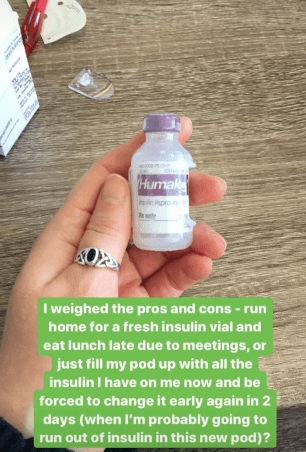
As it turns out, I should’ve suspected an outside factor from the beginning. That’s because my insulin had, somehow, gone bad.

673AC5CE-F0DD-4086-B977-054EFA9FA935
The vial in question…it caused me a boatload of stress.

I’m still very confused about how or why it happened. My insulin had an expiration date that was like, 2 years from now. The contents within the vial were totally clear – discoloration would’ve indicated an issue – and everything about this vial of insulin looked completely fine.

It was, and still is, an utter mystery to me as to how or why the insulin spoiled.

If nothing else, the case of the rotten insulin made me wonder…why hasn’t anyone developed strips that can check the effectiveness of insulin yet?

Can somebody please get on that (and give me partial credit for helping to spark this genius idea)?

Yoga with Goats (and T1D)

It seems like a new fitness trend is “going viral” every week: between aerial silks, SoulCycle, and at-home fitness mirrors (in which a real trainer appears in your mirror and you get to watch yourself while they talk you through the workout – whoa FUTURISTIC right?), there is a plethora of ways to get physical that don’t involve standard, boring weights or treadmills.

I recently had the opportunity to try one of the most random, and possibly cutest, fitness craze…goat yoga. Yep. Yoga, but with goats.

69602409_10157635237561823_7234210886364168192_n
All downward dogs should be called downward goats when doing a goat yoga class.

It’s exactly what it sounds like. You move through a series of yoga poses, but there just happens to be adorable baby goats roaming around the class. They aren’t shy about making their presence known, either. When they aren’t bleating or searching for goat treats under your yoga mat, they’re actually JUMPING ON TOP OF YOU. It doesn’t matter if you’re in a tabletop pose (see my photo, above), downward dog, child’s pose…they’ll find a way to climb on you and turn you into their personal jungle gym.

It was a little disconcerting at first, and it was damn difficult to focus on flowing through yoga poses because you didn’t know if or when a goat would hop on your back or accidentally brush up against you with its horns.

And it was virtually IMPOSSIBLE when my blood sugar went low halfway through the class.

I knew that I was starting to feel off after I completed a short series of bird-dog crunches. I felt oddly exhausted after doing five on each side, so I went to go check my CGM data on my phone when I realized I didn’t have access to any, because I’d just inserted a new sensor that morning and the warm-up period wouldn’t be complete until the end of the goat yoga class.

Great timing on that one, Molly.

I decided to give it a few minutes before I took any corrective measures. So I just sat there, watching people struggle to get bendy with goats running amok. It was really pretty funny, but my sense of humor was shot, thanks to my low blood sugar.

I’m a little embarrassed to admit that the goat factor also prevented me from correcting my low right away, but…well, those things were germy. They’re farm animals, of course they will be messy and smelly. But they were literally peeing and pooping on our yoga mats, and precariously closely to our clothes/bodies. Forget feeling like I needed to sanitize my mat when the class was over – I felt like I needed to power wash MYSELF, at max intensity, just so I could feel totally clean again. So the prospect of checking my blood sugar in the middle of everything seemed absolutely unsanitary and virtually impossible.

But…like, I had to suck it up. After all, I didn’t want to do that thing that goats do, which is faint. Except they do it in a semi-cute way, and because they’re born with a condition that causes muscles to seize up when they’re startled. And there was no way I was about to faint due to a stinkin’ low blood sugar in front of a bunch of strangers and goats.

So I forced myself to navigate to the clean, protected patch of land that my backpack was perched on, dodging poop balls on the way over, and immediately grabbed my hand sanitizer so I could cleanse myself before reaching into my backpack and consuming a small box of yogurt-covered raisins. I still felt gross about it, but I did the right thing and took care of myself.

And I’m happy to report that by the end of the class, my blood sugar was on an upswing and not one goat had peed or pooed directly on me. Sweet success!


French Fries Are (Still) Evil

In Hugging the Cactus’s infancy, I wrote a blog post called French Fries Are Evil. In this post, I came to the conclusion that french fries are evil because they’re fatty, slow-releasing but high carb little jerks.

I’m here today, almost two years after that post, to let you know that these feelings toward french fries have not changed one bit.

Yep, they’re still evil.

5AAAA8B0-FFAC-4A77-AE61-327D89B16DB5
French fries…a.k.a. little sh*ts.

They straight-up tricked me into thinking that I was bound for a night of beautiful blood sugars not too long ago, despite the less-than-healthy decisions I was making regarding food and drink.

Why did I (naively) think that french fries would play nice with my blood sugars?

Well, for starters, I was doing my best to cut carbs the rest of the carbs I’d be consuming for this particular meal, which was a pulled pork sandwich with a side of fries. I ate less than half of the bun and I certainly didn’t finish the heaping portion of fries. But I did eat a lot more than I normally would (and savored every single one), making sure to bolus semi-aggressively for the indulgence.

And I was literally coasting for hours afterward – I didn’t budge above 130 for at least three hours post-meal. I was confused, but elated! Did I finally figure french fries out? Did I master the correct portion of carbs/protein/fat to eat with them? Or maybe my pancreas decided to resuscitate itself for a narrow window of time that particular evening?

I’m gonna go with the latter.

Because a bit after midnight – a witching hour, indeed – that’s when the crazy corrections, and excessive cursing on my part, started. The french fries had made a proper fool of me again, and I couldn’t believe I’d really fallen for their conniving ways again.

Needless to say, I won’t be ordering french fries with my meal again any time soon. Some foods just aren’t worth it when it comes to figuring out how to make them play nice with my diabetes, and french fries don’t quite cut the mustard.

Oh, and YOU’RE WELCOME for the really silly pun.

I’m Jealous of Your Working Pancreas

Sometimes, I look at my friends and family members and think, I’m jealous of your working pancreas(es). 

It’s not their faults for having perfectly functioning organs – and believe me, I’m glad that they do work the way they should. I’d never wish diabetes on anyone, especially the ones that I care about and love.

But I can’t help but think to myself, it must be nice to not have to worry about any of the crap that I’m constantly thinking about. 

C6BFB925-7352-4793-B831-DAC492177AEB

How lovely it must be to order whatever the heck you want at any restaurant you walk into, without having to worry about how many carbs it contains or how much to bolus for it.

How freeing it must be to live spontaneously, to go out and about wherever you desire without having to lug around a bunch of supplies and snacks, because you never know what you might need to have on hand.

The last time I had these thoughts was when my best friend visited me a few weeks ago in Washington, D.C. We had an absolutely wonderful weekend together that was filled with excellent culinary experiences and lots of walking (we logged 30,000 steps in a single day). Even though we had a blast, I was having a difficult time with my diabetes all weekend long, probably due to all the unfamiliar foods we were eating and the amount of movement we incorporated into each day.

I remember being in the Museum of Natural History when I checked my blood sugar and it was sky high, no thanks to the falafel wrap and soft-serve ice cream I’d consumed for lunch. I felt so defeated – not only was my blood sugar high, but my feet were aching and I felt icky after walking around in 95-degree heat for most of the morning and afternoon. But as an eager-to-please host to my guest, I felt like I still had to paste a smile on my face and show her and her boyfriend a good time.

That’s when the thought came – I’m jealous of your working pancreas – and went….because I knew that I shouldn’t waste any more time or energy begrudging my bestie of her healthy, insulin-producing pancreas. I’m so grateful that hers works – along with many other beloved family and friends – and that she doesn’t have to worry about all the crap that I’m constantly thinking about.

Isn’t it funny – funny interesting, not funny ha-ha – how perspective can change from one moment to the next? How jealousy can turn into gratitude? It’s kind of awesome.

Do Dexcom G6 Readings Become Less Accurate as Transmitters Age?

In my unofficial opinion: Yes, Dexcom G6 transmitters lose accuracy as they approach their expiration dates. And I’m not quite sure if I’m the only one who has noticed this, or if others have also experienced this frustrating phenomenon.

Let us help you find your center www.reallygreatsite.com.png
In my unprofessional opinion, yes!

I’m writing this after dealing with a dying transmitter that was showing its signs of decay by 1) losing connectivity with my receiver and 2) reporting inaccurate blood sugar readings. I’ve definitely narrowed the problem down to my aging transmitter, which (allegedly) had one session left before it was set to expire – everything else about this particular sensor session was standard procedure. And guess what else, everything about the entire 10-day session was obnoxious, because it was rare for me to have a single day with both accurate and consistent readings. Ugh!!!

I don’t know what’s more irritating – the signal loss or the inaccuracies. Actually, I DO know what irritates me more than anything else, and that’s the fact that the transmitters don’t seem to last for as long as they’re advertised. It’s just ludicrous, especially when you take into account how much these devices cost.

Many people with diabetes rely on this, and other forms of technology, to effectively manage diabetes. And when the technology can’t be relied on to do its job, we can’t perform our jobs as well. Diabetes is draining enough – is it too much to ask for technology to be trustworthy?

What Every Parent of a T1D Child Needs to Know

I may not be the parent of a T1D child, but I am the T1D child of my parents. So I have a unique perspective on the concerns and fears that a parent of a T1D child might have.

I also have a little more insight on these concerns and fears through my interactions with many parents of T1D children over the years. These parents had children of all ages: from toddler to teenager. Their children ranged from newly diagnosed with diabetes to multi-year veteran of T1D. Despite these differences in ages and years with diabetes, they’ve all had something major in common: An intense fear over the day when their child would make the transition from living under their roof to living independently, on a college campus or in another living situation.

You are a rare gem. (1).png

The mere thought of their beloved son or daughter going through this was enough to make some of these parents on the verge of tears. It was heartbreaking, but also somewhat confusing to me. I understand the unconditional love that parents have for their children, so naturally, they were terrified at the thought of their children feeling alone as they made the transition to young adulthood, or frightened by the prospect of their children suddenly not wanting to take care of their diabetes anymore. But what I didn’t get was why they automatically assumed the worst.

What if their child thrived in this transition? What if their child found a wonderful group of people, such as the College Diabetes Network, that helped them through this period in life (like I did)? What if their child was ready to manage everything on his or her own? Certainly, it would be a source of pride for a parent to witness his or her child do well and embrace independence.

On the flip side, if a young adult with T1D struggled to make the transition smooth…well, I told many of these parents that it’s okay. Because I struggled. A lot, actually. But I made it through. The longer I spent away from home, the more I realized that it was time for me to hold myself accountable in terms of diabetes management. There was never really any big “aha” moment for me. It was more of a slow-and-steady recognition of the fact that the shitty blood sugars I was constantly dealing with could only be changed by me, and me alone. So I took the steps I needed to; naturally, with the support of my parents.

I guess that’s kind of the two-fold message I’m trying to convey here to worried parents of T1D children: 1) Have faith in your child’s ability to adapt to change, and 2) Never underestimate how your support, in any form, can mean the world to your child. Don’t be afraid to have conversations with him/her so you can get on the same page and understand how you’re both feeling about this new life stage. That way, you can find out exactly what kind of support you can offer to your child that he/she will find most helpful.

The bottom line: Parents with T1D children, it’ll be okay. Just like people with diabetes know they’re not alone in their struggle against it, you should also know that there are many other parents out there who probably feel the same as you.

In that way, we’re never truly alone when dealing with new challenges or changes in our lives. Once that’s realized, it becomes a million times easier to figure out the best way to tackle them with your support system by your side.

Dia-Feated.

I feel defeated when it comes to just about every aspect of my life with diabetes as of late.

I feel defeated in terms of my blood sugars lately: I’ve experienced too many highs due to an ever-present fear of low blood sugars.

I feel defeated in terms of what my A1c reading might be at my endocrinologist appointment next month: I don’t even have a clue as to what the value might be right now, but my intuition is telling me that it’s higher than I want it to be, which sucks because I’ve tried hard to keep it down.

B80D7D9B-0596-4E9B-8D08-34F3EE1078FE

I feel defeated in terms of my diabetes supplies: I’ve had to pay a lot more money than I ever anticipated for them. I turned 26 less than 6 months ago and I’m having trouble imagining paying so much money for my supplies for the rest of my life, let alone the rest of the year. I know I’m not alone, but knowing that others are struggling (in very different and similar ways) makes me feel worse.

I feel defeated in terms of this blog: I feel like nobody else really cares about it except me. This is fine in some ways because one of the reasons why I write this blog is because it’s a form of therapy for me. But in other ways, this makes me sad because another reason why I started Hugging the Cactus was to make a positive impact, somehow, on the diabetes community that I love so much. But it’s hard. There’s many bigger, louder, more important voices in the online space that simply have a better reach than me. These people know how to connect with their audience in a way that makes a more profound impact than I ever could. Lately, I’m asking myself, “why bother” a lot more than I’m saying to myself “keep it up”.

I’m not writing about my diabetes-related feelings of defeat – my dia-feat – to garner sympathy or attention. I’m just trying to keep it real. It’s a little different than what I would consider conventional “diabetes burnout” to be, because I do still have that desire to thrive and do well with my diabetes management…but things just aren’t quite going my way.

I know that other people like me feel this way sometimes.

And I know that the dia-feat won’t last forever.

But it is important for me to acknowledge it now, so I can start figuring out how to dust myself off and pick myself back up soon.


3 Things That Make Low Blood Sugars Tolerable

Okay, to be TOTALLY honest, low blood sugars aren’t – and won’t ever be – fun. Nine times out of ten, they can be inconvenient, upsetting, and even scary (depending on how low it is). But like most things associated with diabetes, I try to look at the bright side every now and then to remind myself that it could be worse. So even though I don’t welcome low blood sugars in just about any circumstance, I decided to look at them, and their less-than-pleasant side effects, from another perspective. Hence, this three-item list that explains what makes low blood sugars slightly more tolerable to me.

8

  1. The sweat.
    I detest sweating. I don’t care if sweat is the result of a good workout or a day spent at the beach – it’s gross either way. And it’s definitely not an attractive low blood sugar symptom. But…on the other side…I tend to sweat a LOT when my blood sugar is low and it makes me feel like I’ve just had an excellent workout without any effort or exertion on my part. So I guess it’s kinda like gleaning the health benefits that you’d get from sitting in a sauna for a bit? IDK…it’s a bit convoluted but just agree with me on this one.
  2. The excuses.
    I’ve made it a personal mission to try to avoid using my diabetes as a scapegoat. There are times, though, that it really does prevent me from doing something in a timely manner/when I’m asked. For example, if I’m experiencing a low blood sugar at work and a colleague comes by to talk to me and ask me for something, I do find it’s best to let them know that I can’t attend to it right away because of the blood sugar. Nine times out of ten, people understand, and they let me treat it accordingly. And it gives me time to just relax and deal with it, taking the stress away from a situation by simply being honest about it (so I guess it isn’t really an excuse, but sometimes I feel a little guilty about using a low as an out on something. Low guilt is real, people!).
  3. The cake. (Or really any food when you’re low. Because it all tastes delicious. But nothing is quite as satisfying as cake.)
    I think the inspiration for this blog post came when I was enjoying a big, fat slice of cake in order to bring my blood sugar back up. My goodness, some foods just taste beyond amazing when I’m using them to treat a low. The sweeter it is, the more satisfying it is to both my taste buds and blood sugar levels. And anyone who has experienced a low blood sugar before (people with and without diabetes) can attest to the fact that food is simply a million times better when it’s being consumed at a time that your body is URGENTLY telling you to feed it.

Alright…now that I’m looking back at these three things, I’m kind of laughing at myself. Because I can TRY to make low blood sugars a more positive thing, but let’s be real, they still kind of suck. But I guess there’s no harm in trying to be upbeat about them.