Diabetes is Tough…Right?

Over the years, I’ve seen many online debates (and participated in a few in-person) about the language of diabetes: the power of it, the meaning behind pairing certain words and phrases together, the connotations that can be unintentional or intentional…or even both at the same time.

As someone who writes as part of my full-time job (and, obviously, as a side hobby on this blog), I try to be very deliberate about my word choice. I may not always be 100% correct in my spelling or grammar – I am human, after all – but I’d like to think that I’m thoughtful in both my writing and my speaking. Specifically, when it comes to talking about diabetes, I’m careful to phrase things in a way that doesn’t discriminate or dehumanize people who live with diabetes, and generally avoid pessimistic undertones. I wrote about this before in a blog post from August 2018 – here’s an excerpt from that post that features some clear examples:

Read the following five sentences. Can you tell what’s wrong with them?

  1. She’s a diabetic.
  2. He’s testing his blood sugar right now.
  3. Her diabetes is out of control!
  4. Isn’t that a really bad blood sugar?
  5. He suffers from diabetes.

Have you figured it out?

The language in those five sentences is extremely negative. “Bad,” “out of control,” and “suffers” are obviously gloomy and cynical words to use when referring to diabetes – you don’t need to be a wordsmith make that connection immediately. But what’s wrong with “diabetic” or “testing”? It’s the connotations around those words. Calling someone with diabetes a “diabetic” is labeling them with the disease and removing the actual person from the equation. Saying that a person with diabetes is “testing” their blood sugar makes it sound so…clinical. It also implies that the person could pass or fail the so-called test, adding pressure and guilt to the situation.

The Language of Diabetes, Hugging the Cactus, August 2018

So those are just a few sample sentences in which the language of diabetes is definitively negative, in turn, making it more difficult to have conversations about it that are productive. But what about the case of this blog post’s title?

Diabetes is tough.

Or is it…diabetes can be tough?

I think both are true.

I’ve read through a few different social media threads recently in which the phrase “diabetes can be tough” is ripped to shreds. The argument is that people living with it know for a fact that it IS tough, period, bottom line, end of story. There isn’t a gray area where that “can be” belongs, so it simply shouldn’t be the way that folks characterize life with diabetes.

I’m not saying that I disagree with people who are pro-diabetes-is-tough: I absolutely have my days where it’s virtually impossible to live with and I think that nothing in my life is more difficult than my diabetes. Fortunately for me, though, those days are outnumbered by the days in which diabetes and I coexist – not always peacefully, but at least side-by-side with little fanfare. Those are the days that I can say with confidence that I’m fully aware that diabetes can be seriously sucky, but it’s not like that’s always the case for me.

So to me, both phrases – diabetes CAN BE tough and diabetes IS tough – can be true at the same time because it just depends on how easy or challenging it is for me on a given day to manage it. That’s just my truth. Plus, as someone who tends to avoid negative words when it comes to describing my life with diabetes, I like the power that I can find from the “diabetes can be tough” phrasing. In my mind, it perfectly captures and acknowledges that diabetes isn’t easy, but that it isn’t the worst thing in the world, nor does it stop me from living a full life. That’s just my take on the debate. I know folks will both agree and disagree with me, and that’s totally acceptable.

If there’s one thing we can all agree on, at least, it’s that the language of diabetes is a complex matter filled with many nuances.

The Unexpected Blood Sugar Buster

Spring cleaning is more than a practice of tidying one’s home. It’s also a great way to keep blood sugar levels down, as I was reminded when I decided to take on the long overdue task of cleaning out my closet.

Ever since I moved into my home (nearly 3 years ago), the clothing and random other junk taking up space in my decently sized walk-in closet has largely remained untouched. Not in the sense that I don’t take things in and out of my closet every day, because I do. Rather, I haven’t sorted through anything in my closet since I decided what would go in there and what order it would stay in. Forget clearing out clothing with seasonal changes or refolding items as they got jostled out of place, no way! It’s really no wonder that over time, my closet grew more and more cluttered until finally I couldn’t take it anymore and devoted a few hours to cleaning it out.

It was an exhausting exercise – and yes, the word exercise really applies here because I was sweaty, huffing, and puffing in no time. I had to take everything out, lay it in heaps on my floor, go through each pile individually to see what I wanted to keep and toss, and either refold or rehang garments as I filed stuff back into place to my liking. I’m not sure how many pounds worth of clothing I actually sorted through, but it was definitely a sizeable amount as my arms ached from pulling clothes down from shelves and my hanger bar. And it definitely made sense that I was getting overheated, as I kept walking back and forth between my closet and my bedroom floor with my arms weighted down and in a space that was overly warm due to insufficient air conditioning.

So when my blood sugar levels started tanking 30 minutes into my organizing process, I shouldn’t have been particularly surprised. But in hindsight, it makes perfect sense as the cleaning was basically an extended moderate-intensity cardio AND strength session. What I should’ve been was more prepared for the possibility of going low by enabling activity mode on my Omnipod so that my blood sugar target could be increased from 100 to 150 for the duration of my cleaning, but instead I was crashing and cursing that I had to interrupt my workflow with a fruit snack break.

Maybe next time I’ll do better and coincide my spring cleaning with a high blood sugar so I could reap the benefits of the extra exercise, thereby turning the unexpected blood sugar buster into a welcome one.

12 Years of Continuous Glucose Monitoring

2011 was a big year for me.

I graduated high school, started college at UMass Amherst, met my college friend group who I’m still close with today, and learned what it’s like to be an independent “adult” (I put that word in quotes because at the time, I thought I knew what it meant to be a responsible grownup. Boy, was I wrong).

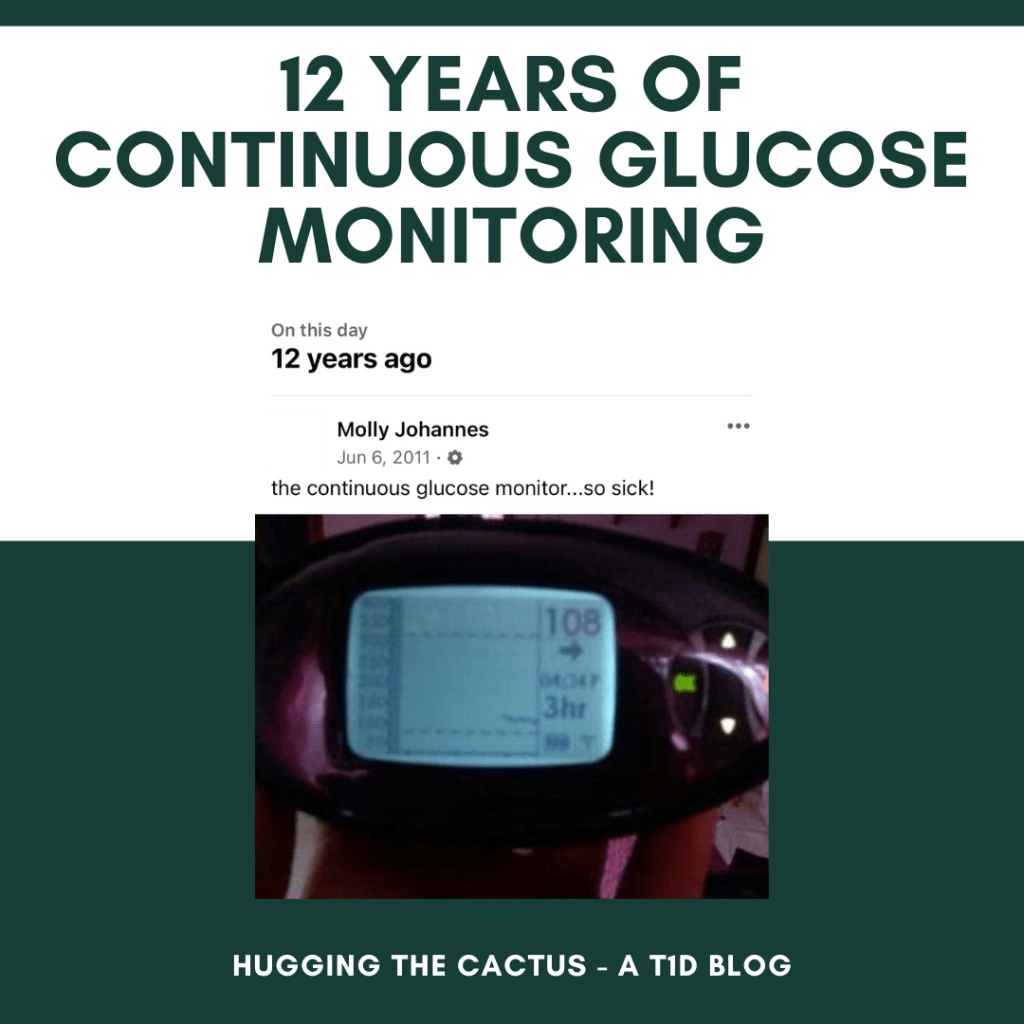
But 2011 was also the year I hit another important milestone: It was the year that I started continuous glucose monitoring. Shout-out to my scarcely-used Facebook page for reminding me of that!

In addition to getting a kick out of how I just had to tell the word that my new device was “so sick!”, I’m glad that this reminder popped up the other day because it marks the point along my diabetes journey in which I finally decided to give technology a try. From roughly 1997-2011, I was firmly against any and all diabetes technology. I’m not sure why, other than I was terrified to try something new and surrender control to someone (let alone something) that wasn’t me or my mom. I also can’t quite remember why I decided that moment in time was right for me to try a CGM – perhaps it was motivated by my transition to college, or maybe I was just intrigued by the technology? – but I am so, so glad that I did.

I’m grateful to my 18-year-old self for making this choice because it opened the door to diabetes technology for me. Until the first time I put a CGM sensor on, I had no idea what I was missing out on in terms of access to data (meaning my blood sugar levels). I didn’t realize how powerful this information would be or how it would be a helpful little sidekick conveying information to me about my diabetes every day and night. I don’t think I can quantify the number of times this thing – and we’re talking the Dexcom G4, which had a long way to go compared to today’s G7 in terms of reliability and wear – truly saved my butt and improved my overall time in range by alerting me to highs and lows.

All that said, I don’t regret not trying technology sooner. I do believe that it was important for me to introduce myself to it when I truly felt ready. If anything, I’m proud of myself for trying a CGM, and then eventually an insulin pump, in my own time. It just means that I appreciate both of these tools and what they do for me on a daily basis that much more, because I remember all too well what life was like before them. And there was a serious difference! I can’t say that I love having two devices on my body at all times, but I can 100% attest to the fact that they’ve improved my quality of life with diabetes, hands down.

So better late than never, but today, I’m giving myself a little pat on the back for being brave 12 years ago and taking that initial first step in changing up the components in my diabetes care toolkit.

Diabetes Disconnections

Even a tubeless insulin pump isn’t immune to unexpected detachment.

I’ve fallen victim to this phenomenon a handful of times over the years, and it struck me yet again earlier this month.

I’d been complaining to my partner that my pod was beginning to itch; specifically, right around the cannula. I’d also noticed that the adhesive was sticking up around most of the edge and assumed that perhaps the lack of full contact was creating the itching sensation. Writing that just now, let alone thinking it, doesn’t make much sense. But I was looking for some sort of explanation as to why my skin was itching underneath my pod, and this was the one I settled for. I decided to apply a Pod Pal (the Omnipod-provided medical tape that fits perfectly around a pod) and just deal with any lingering itchiness for the remaining 12-ish hours that my pod would be on.

Surprisingly, the itchiness faded only an hour or two after I initially noticed it, which was great! What was less-than-ideal, though, was that the itchiness likely went away because something – maybe a certain way I had moved my body, or it could’ve been me jostling my pod somehow in just the wrong manner and not noticing it – caused my cannula to pop out…meaning that the insulin I had given myself for dinner likely didn’t deliver. Well, that explained the strong insulin odor my nostrils had detected as well as my skyrocketing blood sugar levels, per my CGM.

Luckily, it was pretty easy for me to handle this unforeseen circumstance. However, it was annoying to have to change the pod earlier than I wanted to, and I didn’t love that my blood sugar crept into the 300s for a few hours that evening due to the lack of insulin. This disconnection rattled me, and in the days following it I realized that I’m feeling a diabetes disconnection on more than just the device front.

It’s also striking me on the community front.

I’ve felt more disconnected from the diabetes community in the last 6 months than I have in potentially my entire adult life. I know that part of this is due to the fact that I no longer work in diabetes, but I think it’s also because I’ve struggled to relate to a lot of what’s out there, at least what’s shared online, anyways. I feel like I can’t quite relate to the desire to express my life with diabetes 24/7, and yet I also very much don’t want to shelter this part of my life and miss talking to others about the ins and outs of it. It’s a weird gray area that I’m in, and it’s a little disconcerting to feel this disconnected from a community I may not have always embraced, but one that I’ve grown to appreciate, respect, and learn so much from.

So what do I do about this feeling? It’s not as simple as taking off the old pod and putting a new one on…or is it? Do I a) dare to step out of my comfort zone a little bit and explore opportunities to reconnect with the diabetes community (whether in-person or virtually), or do I b) ride it out and spend some time reflecting on whether my needs, as a person who has lived with diabetes for more than 25 years, have changed? Option A feels overwhelming as I really don’t know where to start, and option B feels pretty scary as I don’t know whether giving up peer support is something that I should really pursue at this particular juncture in my diabetes journey since it’s helped me in indescribable ways in the last decade.

I suppose that time will tell what is right for me, and I accept knowing that my needs may or may not change over time – and whether they do or don’t is perfectly reasonable. I take a lot of comfort in knowing that.

Why I Put My Diabetes in a Timeout on Vacation

Do you ever wish that you could put diabetes on pause? I sure as hell dream about it, but remain grounded in the reality that it’s not exactly practical since it demands so much of my attention on a daily basis.

But that doesn’t mean that I don’t do my damnedest to make this wish come true on occasions in which I really, really, really don’t want to diabetes to dominate my mind.

Take my recent trip to Nashville for example. I went with my boyfriend and a couple of our friends for a long weekend – not much time at all when you think about how how much there is to explore in a happening place like that. So I was determined to make the most of every moment and went into the trip with a plan to cut myself some slack on the diabetes front. Sure, I’d do what I could to maintain solid blood sugar control, but I was also excited to indulge on a variety of yummy foods and drinks that I wouldn’t normally consume out of fear over what they might do to my levels.

So this meant I ate things like:

  • Fried chicken (still drooling just thinking about my meal from Prince’s)
  • Hush puppies
  • Beer
  • Margaritas
  • Moonshine
  • Deep fried cinnamon roll bites
  • A nutella milkshake that had TWO donuts – yes, donuts – blended in with the ice cream
  • Red velvet cookie dough (literally served in a cup from NoBaked in Assembly Row…check it out)
  • And plenty of other things!

Don’t get me wrong, a lot of these items were shared with my partner and friends. It’s not like I was consuming a full plate of cinnamon roll bites (described as “cubed, deep fried in waffle batter, tossed in cinnamon sugar, and topped with cream cheese icing”) on my own! But I was happily sampling and doing my best to carb count, making educated guesses and combatting my (several instances of) high blood sugar with extra insulin and exercise (we got upwards of 20,000 steps each day).

Putting my diabetes in a timeout for this trip initially felt unrealistic, and maybe even a little unnecessary. After all, I didn’t have to eat so many carb-heavy foods that I knew would annihilate my blood sugar levels. But it was important for me to be able to enjoy every aspect of this vacation and not let my diabetes take away from that. I didn’t want high blood sugar alarms to interrupt my appreciation of all the live music, so when I got them, I either took more insulin or silenced them. I didn’t want pesky pod changes to interfere with our plans for the day, so I monitored how much insulin was left in my reservoir and changed it when I was in my hotel for the night rather than waiting to do it at a less-than-ideal time, say, right before we hopped onto our pedal tavern tour of downtown Nashville. I didn’t want to chance my CGM sensor failing on me, so I brought extra, plus my test kit (neither of which I ended up needing to use). Above all, though, I didn’t allow every out-of-range blood sugar spoil my day. I figured that this 4-day trip was a single, small puzzle piece in the big picture of my diabetes, and this mindset contributed to a much more fun vacation.

Maybe next time, though, I won’t have to resort to putting my diabetes in a timeout because I’ll master bolusing for the full list of treats mentioned above…we’ll see!

Sniffles, Sore Throats, and High Blood Sugar Levels

The sure-fire sign that I’m developing a cold is when my throat begins to tingle.

It’s subtle, but unmistakable. It won’t go away with a few sips of water – it lingers, and worsens over the course of a day or two. That’s when I know that I’m coming down with something, and that I’d better brace myself for the symptoms that will come on next: a stuffy nose, aches, coughing, and so forth.

What I was less prepared for this time around (which hit me right on the heels of my Nashville trip) was much higher-than-normal blood sugar levels.

Let me back up a bit. It all started with the aforementioned sore throat on my second-to-last day in Nashville. I knew I was coming down with something, but I also knew I couldn’t do much about it other than try to have fun the rest of my trip (which I certainly did). By the time I woke up the day we were due to fly home, I was seriously struggling as congestion settled into my ears and head.

The next four days were a blur as I slept on and off, went through multiple boxes of tissues, and took both Benadryl and Tylenol to combat my symptoms. I also went through copious amounts of insulin as a new symptom emerged: high blood sugar levels.

I wasn’t surprised by the high sugars; after all, I was barely moving and not eating much more than the dusty cans of soup sitting in my pantry. But I was definitely frustrated as I couldn’t recall the last time that I had to deal with both “real people” sickness (also known as any type of sickness that is separate from diabetes) and turbulent blood sugars. That’s why I ended up contacting my doctor just to see if there was any advice (or medication) that I could take to make all my symptoms more bearable.

Fortunately, my doctor was able to confirm that I didn’t have covid, strep, or the flu – a major relief to me – but unfortunately, she had no other help to give me other than reassurance that continuing to stay hydrated, well rested, and on top of my levels would be the best way to beat this. So I doubled down and listened to my body’s needs (I think it was rebelling against me for the way I treated it with little sleep and too much overindulgence in Nashville – more on that later) by doing just that, even though it meant completing a couple of pod changes a full day earlier than normal because I was using so much insulin.

My perseverance paid off, and by day 6 or 7 of my cold, I finally started turning a corner. While my cough and the remnants of congestion are still hanging around, at least my blood sugar levels returned to normal, along with my daily insulin intake. A huge relief, and a solid sign that I’m doing a good job at taking care of my overtired immune system as well as my ever-needy diabetes.

An Ode to Log Books

This was originally published on Hugging the Cactus on December 11, 2017. I’m sharing it again today because of all the outdated diabetes tools that I used to rely on, log books are something that I find myself wishing I still used, or at least kept to look back on, because they held me accountable. It’s funny how much that opinion contrasts with how I felt about them when I wrote this post! Read on for my full reflection…

Remember when log books were a THING that PWD used to track blood sugars?

Log books were pocket-size diaries (of a sort) designed for PWD to keep track of blood sugars, insulin and carb intake, mealtimes, etc. Basically, it was the old-fashioned way of recording blood sugars so that you could bring it with you to your endo appointments so your doctor could review the book for patterns.

I remember HATING having to write down my numbers. I felt like those little log books were contraptions put in place to judge me and my numbers. Imagine an eight year old who felt judged by something like that? It’s just wrong. But I get that they had a purpose to serve, and even when I was little, I knew it was important to write everything down even if I resented doing it.

That’s why I made it more fun by drawing doodles next to certain blood sugars – a frowning face would appear when I was high, and a mini burst of fireworks would find their way next to a blood sugar of 100 (which I now refer to as a unicorn bg, along with much of the rest of the DOC). I also distinctly remember using the log book to keep track of where I was injecting my insulin: “RL” would appear on the page if I was due to give a shot into my right leg, or “LA” for my left arm. These days, I’m really good about swapping sites, mainly because it’s easy to remember, thanks to my pods. But as a kid, it was more challenging, so writing it down helped.Thankful that my meter tracks my blood sugars for me now (also, that 230 mg/dL would’ve totally gotten a frown-y face back in the day).

Thank goodness for modern meters and insulin pumps that keep track of my blood sugars for me now. It’s so much easier to show up to an endo appointment and hand over my meter for the nurses to download. Plus, doing so means that my doctor and I get to review all sorts of colorful charts showing my blood sugars over a certain period of time, which is more telling and helpful than a doctor thumbing through my log book and murmuring, “I see,” every few moments.

Log books are such an archaic artifact of my diabetes history that I don’t even own any nowadays. I trashed them all, years ago, when I realized that my blood sugars from 2001 were sort of irrelevant to now. Do you still have any of your log books lying around?

Backing Up to Basics

When taking stock of my diabetes supplies, I realized there was something pretty important missing from my heaps of test strips, stacks of pods, and (seemingly) thousands upon thousands of lancets…

…syringes. I didn’t have any syringes in sight, save for the ones that come with pods and that are designed exclusively to be used for pod changes. (I only call that out because those syringes are made to hold 3 days’ worth of insulin and should not ever be used for self-injection.)

In fact, I’m not sure that I’ve ever even had syringes in my possession since moving out of my parents’ house.

Luckily, I’ve never really had a reason to need them – I’ve never had a desire to stop using my insulin pump since I went on it almost 10 years ago – but that doesn’t mean that it’s wise for me to not have a back-up supply on hand. So I decided to do something about it. I told my doctor that I’d like to have some in my reserves, just in case, and she wholeheartedly agreed. I picked them up at no cost and they’ve remained among my supply stash ever since.

Knowing that they’re there and available to me, should I need them, makes me feel that much more equipped to handle any possible diabetes scenario. It’s kind of funny to find comfort in having syringes, of all things, under my roof – but to me and to anyone else with diabetes, it just makes sense to have the most basic of back-ups around.

How I Handle my Diabetes Devices and TSA Scrutiny

Traveling with diabetes is stressful enough. Add concerns over taking medical devices (not to mention insulin and other supplies) through TSA security and it can be a downright nightmare, especially when the TSA does something unexpected – as I wrote about here in my blog post describing my worst-ever TSA experience.

That single traumatic incident aside, my travel record consists of positive TSA encounters, most of which I attribute to me getting accustomed to what I should expect each time I’m at the airport. Here’s what’s worked well for me over the years, which I share with the caveat that this is me simply describing my own experience and what I’m most comfortable with – it will vary among people with diabetes:

  • I have TSA pre-check. Traveling with TSA pre-check means that I spend far less time waiting in line to get my bags and ID checked. Not only do I breeze through to the first security checkpoint, but I also skip the hassle of removing my shoes or my laptop/other possessions from my suitcase, making the whole airport screening process that much smoother and faster. I do believe that, as a person with diabetes, this has helped me deal with the TSA with minimal fuss and without fear of losing any of my diabetes supplies due to removing them from my bags in the hustle and bustle of the security line.
  • I always communicate with at least one TSA agent that I have diabetes and am wearing two medical devices. This may or may not be necessary, but I feel that it’s best to let the agents know what the bumps under my clothing are in case they notice them and demand that I remove them for inspection. More often than not, TSA agents are pretty understanding and more knowledgeable than I would’ve thought about diabetes devices, likely due to the fact that people with diabetes pass through on a daily basis. (Though there was one time that the TSA agent, who had an insulin pump herself, gave me a bit of a tough time about mine – to this day, I still don’t know if she was attempting to be funny with her snide comment about me asking for a pat-down instead of going through the scanners – see below for more).
  • I usually request a pat-down rather than walking through full-body scanners or metal detectors. Now, I know what you’re thinking – it’s safe to go through machines with diabetes devices. I agree with that and have definitely gone through them before. But I’ve found that requesting a pat-down is just easier because sometimes the TSA has not allowed me to go through the full-body scanners due to my medical devices. When I used to stay in line and go through scanners like the majority of people around me, TSA agents would almost always pull me aside afterwards and ask me to touch the devices (over my clothing) so they could swab my hands as part of their safety protocol. This was never a big deal to me as it only took an extra minute or two to conduct, but it also seemed to partly defeat the purpose of stepping through the scanners to begin with. Plus, I’ve always been a little paranoid about subjecting my CGM and pod to the technology in those machines – again, I have no real reason other than vague and infrequent word of mouth over the years about diabetes tech getting “screwed up” by the scanners – so I just stick to what I’ve become comfortable with by opting for a pat-down.

My typical TSA protocol may sound over-the-top or even a little ridiculous, but for a nervous traveler like me who relies on a routine in order to feel as prepared as possible when getting from point A to point B, these are the steps that I take that feel good and keep my head level – and hopefully, the kind of person that makes it easy for the TSA to do their job!

My Top 8 Tips for Traveling with Diabetes

This blog post was originally published on Hugging the Cactus on June 22, 2022. I’m sharing it again today because I’ve got a trip coming up and definitely need a refresher on best practices that have worked well for me in the past when it comes to traveling with diabetes. Read on for my top tips.

Traveling plus diabetes can equal…a lot of chaos. At least, it does for me when I don’t take the time to properly prepare for a trip.

However, I’m happy to say that my most recent trip to New Orleans was remarkably mayhem-free, thanks to the steps I took in the couple of weeks leading up to the trip (all that covid nonsense aside). In fact, it went so smoothly for me that I decided now would be a great time to document what I did that helped me travel with minimal stress but maximum organization, before I forget everything I did! So here’s what worked for me:

  1. Making a list. Roughly two weeks prior to my trip, I physically wrote out a list of every single item – related and unrelated to my diabetes – that I’d need to pack for my trip. As I packed little by little in that span of time, I checked off items when I added them to my suitcase. It was satisfying to see the number of items dwindle so that by the morning of my trip, I only had a few things left to pack and I wasn’t worried about forgetting anything major.
  2. Having extra snacks on hand. A few days before my trip, I went to the grocery store and bought snacks. Like, a bunch of them. A few boxes of granola bars, some fruit snacks, things that were generally easy to transport and wouldn’t melt in any condition. This ensured that I would have food on hand at all times for any scenario, whether it be a low blood sugar or simply staving off hunger.
  3. Optimizing organization. One of my favorite “tricks” when it comes to packing is utilizing storage cubes! Some people might find them totally unnecessary, but for me, they equate instant organization. When they’re filled completely, they become little rectangles with handles attached to them, so packing my suitcase with the filled cubes is almost like planning a game of Tetris – except it’s even more satisfying because I know I’m doing myself a favor by sorting clothing items away from medical supplies, and keeping things like charging cables separate from my toiletries.
  4. Storing insulin properly. The last thing that I pack for any trip is my insulin. It’s literally the final thing I slip into my backpack before locking up my house. This is to help keep it cold for as long as possible, but then to also prolong the cold temperature of my insulin storage pouch. It does a pretty good job of keeping insulin cool, but on a longer travel day where I’m logging a couple hours of ground transportation, a couple hours of airport waiting, and a few more hours of actually air time, it does lose some of its effectiveness as the ice packs slowly melt. So I like doing what I can to keep the ice packs as cold as possible for as long as possible.
  5. Wandering the airport to keep blood sugar at bay. This might be the one element of my last trip that I would’ve liked to change, because I didn’t have as much time as I would’ve liked to pace around the airport before boarding my flights. I have used this strategy effectively in the past, though – my blood sugar and my restless body have both benefited from a few extra steps prior to a flight.
  6. Keeping all supplies within reach. Any diabetes supply, whether it was as sensitive as my insulin or as mundane as a back-up vial of test strips, stayed secure in my “personal item” – the bag that you can bring on a plane that doesn’t have to be stored in the overhead storage bin, it can actually go under the seat in front of you. For me, it’s not worth running the risk of needing any type of supply in the middle of a flight, only to be unable to reach it because it’s tucked away in storage (or worse, a checked bag that you can’t access at all). Knowing that I can get anything I might need, at any time, goes a long way in curbing my anxiety.
  7. Eating consistent meals. In my humble opinion, I actually think the options at airports are pretty decent these days and that makes it relatively easy to find an option that will work at any given mealtime. For example, I got a Starbucks breakfast sandwich the morning of my trip that helped my blood sugars stay steady, and on my trip back home I found a Caesar salad that was lighter on carbs to eat for lunch, which didn’t spike my already-slightly-high blood sugar further. I was tempted to skip those two particular meals because I was running short on time, but I’m glad I ultimately made eating a priority because I do think it made my numbers more stable.
  8. Staying hydrated. Last but certainly not least, I always have a bottle of water on hand when traveling. Always! I make it a mission to down at least one full bottle before going through security (that way I don’t have to waste it by chucking it), and then one of my first tasks post-security is to find either a water bottle refill station (most airports have these now and they’re awesome) or a store selling water bottles. It’s important to stay hydrated everyday, not just travel days, but there’s something about the stress of travel that makes me extra keen to keep drinking water. Plus, high blood sugars are already a nuisance to deal with – without water, they’d be even more insufferable and tricky to deal with when also trying to get from point A to point B!

So those are the things that I did to make this last round of travel go so well. What about you? Do you do anything special to prep for a trip that wasn’t featured on my list? Let me know in the comments!