4 Tips on How to Handle Hunger Pangs and High Blood Sugar

One of my Instagram followers recently reached out to me and asked for some advice.

…can you make a blog post about how to reduce temptation when blood sugars are high. Whenever my blood sugars are low, I [don’t] really want to eat but of course I have to but for some reason when they are high, I’m soooo hungry and I’m just tempted to eat tons of carbs! Help!!

I liked this comment for several reasons. One, this person told me it was tough for her to ask me about this in such a public forum, so I applaud her for stepping out of her comfort zone. Two, it’s an excellent blog topic suggestion. Three, I can absolutely relate to feeling hungrier than normal when my blood sugar is high. And four, I’m sure others can, too!

Pizza is great (for obvious reasons) but maybe a little less so when blood sugar is high…

I’ve always kind of assumed that I get hungry when my blood sugar is high because at that moment in time, food is practically forbidden…so it becomes incredibly appealing, even though it’s not always advisable to eat with a high blood sugar (because depending on what food it is, it could make high blood sugar go up even more).

So thanks to this comment on my IG profile, I started thinking about the ways I fight off hunger pangs when my blood sugar is high and came up with these 4 tried-and-true tricks I’ve learned over the years:

#1: Make a smorgasbord of low carb snacks. My mom will appreciate my use of the word “smorgasbord” in this tip because that’s exactly what she used to call the plate of snacks she’d fix for me when my blood sugar was high throughout my childhood. She’d assemble an array of low carb goodies – cheese, pepperoni, olives, nuts, pickles – that would satisfy my hunger without raising my blood sugar even further. As a child, I felt special because I was virtually getting my very own charcuterie board (just minus the crackers) and that made high blood sugars much more bearable.

#2: Drink plenty of water (or other low/no carb beverage). I’ve heard medical professionals, nutritionists, fitness experts, and the like say time and time again that one reason we might feel hungry at a given moment in time is because our bodies are trying to tell us that we’re actually thirsty, not hungry. So it makes a lot of sense to stay super hydrated when dealing with a high blood sugar because it can stave off hunger as well as help flush out our systems.

#3: Seek distractions. I write more about this in an upcoming blog post, but when my blood sugar is high, it’s important for me to not dwell on it too much because it seems like it takes it that much longer to come back down. So I distract myself in every possible way: I find an activity to do, TV to watch, a family member or friend to talk to…this helps me forget about the high as well as any cravings for food that may come along with it.

#4: Remember…this too shall pass! Again, I gotta give my mom some credit for this one because she says this motto to me all the time. When I’m feeling extra hungry and experiencing a high blood sugar, I just try to remind myself that both the high and the desire to snack are fleeting. Sure, they’re not fun to deal with at the same time, but knowing that they’re only temporary makes everything easier.
How Keeping Constantly Busy Helps (and Hurts) My Diabetes

I don’t fare well when I have too much idle time.

I’m the type of person who needs to stay as busy as possible: I like being productive and having the satisfaction of saying that I’ve accomplished something each day. That doesn’t always mean that I’m successful, but I do my damnedest to make sure that I check off at least one item from my to-do list on a daily basis.

And I don’t like saying “no” to others, so whenever someone asks for my help, I’m on it. It doesn’t matter if it’s a family member, close friend, or an acquaintance – I do what I can when I’m called on for help, and as you might be able to imagine, this is both good and bad for me.

How Keeping Constantly Busy Helps (and Hurts) My Diabetes
Who DOESN’T love the satisfying feeling of checking items off from a to-do list?!

In terms of diabetes management, it’s great because when I am particularly busy, this means that I’m probably not sitting around a whole lot – the constant go-go-go makes my blood sugars pretty happy. Plus, having a packed schedule keeps my mind occupied when I need to think about something – anything, really – other than my diabetes. If I’m having a tough diabetes day, I don’t have to dwell on it; instead, I have tasks X, Y, and Z to do. If I’m waiting for a stubborn high blood sugar to come back down, then I can start working on a project rather than stare at my CGM for the next hour. 

So in this way, keeping myself busy is a fabulous way to take my attention away from diabetes when I desperately need the mental break from it…but it’s also harmful at times, because let’s face it, there are many times in life where I really do need to concentrate on my diabetes care and management.

Whether it’s a big or small task that I’m working on, I put 110% of myself into it, which means that I really don’t have extra thinking room for my diabetes. Some examples of times that I’ve been far too lost in what I was doing to give diabetes a second thought are when I’ve been in the middle of a knitting project and my Dexcom is went off but I actively ignored it in order to keep my focus on whatever row I was working on (and my blood sugar stayed higher for longer than it should have), or when I should’ve taken a break from writing social media posts for my friend to eat something because my blood sugar needed it, but I just wanted to finish the job first.

Now that I’ve figured out how my diabetes is helped and hurt by my jam-packed days, will I continue to stay constantly busy? The answer is definitely. But I will also try to remember the importance of balance in order to keep my diabetes at the forefront of my mind in a healthy manner.

Water, Insulin, and Lies: An Explanation of What Insulin Truly Costs

Let’s talk about a couple of life-saving liquids for a moment: water and insulin.

Water is a clear liquid that quenches thirst and hydrates. It is essential for human life and costs $1.69 per one liter.

Insulin is a clear liquid that manages blood sugar levels. It is also essential for human life, but it costs $300 per 10 milliliters.

That’s outrageous on its own (and its something I’ve written about before, and will continue to write about, until insulin is affordable and accessible to all).

But what’s even more bewilderingly egregious is the fact that on September 29, 2020, the President of the United States of America lied about his actions (or shall I say, inactions) taken to lower the cost of insulin during the first presidential debate.

My jaw dropped when I heard him boast that he’s reduced insulin prices 80-90% and that it’s “like water” for people with diabetes now.

There are so many things completely and utterly wrong with that statement that it’s almost impossible to cover them all, but let’s start with the bill I paid for my last 90-day supply of insulin. I forked over $200. If I was uninsured, I would’ve had to pay $1,236.15.

I don’t know any water in the universe that costs $200, let alone $1,236.15.

The title of this blog post could be a book title…in fact, I bet there are people who really could devote entire books to this subject. Rightfully so.

I’m not going to mince words here: Under our current President, the cost of insulin has not lowered. And if you think I’m exaggerating his lack of delivery on his promise to do so, then please read the following from my friends at T1International regarding executive orders that were released in July (if you don’t have time to read the entire thing, please read the first paragraph):

On July 24th*, President Trump released four executive orders intended to lower drug prices, including two targeted directly at lowering the cost of insulin for patients who rely on it. Despite his assertion that these orders are intended to “completely restructure the prescription drug market,” these orders will not do anything to fix the underlying cause of the insulin crisis in America. Patients will still need to wait months for the rulemaking process to run its course, and likely even longer after that if these orders end up in court. While T1International is glad that the administration has stated that making insulin more affordable is a priority, these orders miss the mark. We don’t need incremental bureaucratic steps as an election approaches – we need transformative change that will make our medicine more affordable now.

The two orders that are most relevant to the lives of people with diabetes are the order that requires federally qualified health centers (FQHCs) to allow patients to purchase insulin directly from the FQHC at a steeply discounted price, and the order that builds on the plan released by the Department of Health and Human Services to allow for the importation of drugs such as insulin from Canadian manufacturers. Neither order would hold Eli Lilly, Sanofi, and Novo Nordisk accountable for their price gouging, nor would they do anything to reduce the list price of insulin, which has soared by well over 100% since 2012.

As previously noted on T1International’s blog, getting insulin through a 340B pharmacy can help patients to afford this life-sustaining medication. On the surface, President Trump’s order to make it easier for patients to purchase insulin through an FQHC seems helpful. However, his executive order ignores that FQHCs were never the problem with the 340B program in the first place. It is hospitals that are most responsible for taking the discounts offered by the 340B program, and they use those discounts to generate profits, rather than serve patients.

Similarly, #insulin4all advocates know better than most that the insulin they need, which costs hundreds of dollars per vial in the United States, is more affordable just across the border in Canada. However, the Canadian government has already made clear that they are not interested in exporting Canada’s supply of medicine en masse to the United States just because the U.S. government refuses to confront Big Pharma and lower drug prices for the exact same medicine, rendering this policy ineffective on a broad scale.

99 years ago today, Frederick Banting and Charles Best first isolated insulin, which would soon make it possible for people with diabetes to manage their condition. But since then, unchecked corporate greed has put this life-saving medication out of reach for too many people. President Trump was correct in diagnosing the problem and its solution before he even took office when he said that pharmaceutical corporations are “getting away with murder.” Since then, he has considered every policy option available to bring drug prices down except for the most obvious: action that will reduce medication list prices for everyone, including people without insurance. If the president really wants to lower the price of insulin and address the crisis of high drug prices, he already knows the solution; the question is whether he has the political courage to pursue it.

*On September 13, President Trump released a new executive order that would implement a “most favored nation” price for drugs under Medicare Part B and Part D. Patients need relief from predatory insulin prices now, but the President’s executive order won’t deliver. While this Executive Order could dramatically lower insulin costs for some senior citizens if it goes into effect, that could take months or years if it ever happens at all — and patients don’t have that kind of time to wait for change. Rather than make announcements he can tout on the campaign trail, the President should use his existing authority under federal law to bring down the price of insulin immediately.

T1International Statement on Executive Orders, updated September 14, 2020

Frederick Banting said it all when he remarked: “Insulin does not belong to me, it belongs to the world.” And that is a sentiment that I will be taking with me when I go to vote this November.

Hugging the Cactus Turns Three!

On October 2, 2017, I publicly shared this blog for the very first time.

Oh, how much has changed in three years…

…heck, a lot’s changed in the last year alone!

Forget everything that’s been going on with the world since 2020 began – that would be a very depressing laundry list – I’ve personally experienced so much change in the last 10 months that it makes me dizzy when I stop to really process it all…but here’s a quick glimpse at the life transitions I’ve dealt with throughout the year (some of which I’m keeping deliberately vague because they’re painful to write about):

  • Made a major move
  • Mourned the hardest loss of my life
  • Said goodbye to a physical office location for my job
  • Dealt with depression and anxiety
  • Made the biggest purchase of my life so far

Yeah, it’s been quite a year so far. Not just for me, though: It’s been a doozy for all of us. I guess we can take mild comfort in the fact that we’ve all struggled together.

But on a more positive note, in this year of enormous, earth-shaking change, I’ve had a constant in this blog and the diabetes community.

Seems like I was anxiously anticipating the launch of my blog just yesterday…hard to believe it’s been 1,095 days.

I’ve taken solace in blogging and sharing stories three times each week. I’ve enjoyed seeing comments from regular and new readers alike. I’ve relied on the consistency of the diabetes community: its strength, knowledge, resilience, and of course, support.

So as Hugging the Cactus celebrates its third birthday, I remain grateful for its existence as my platform to connect with others, make new discoveries about my diabetes, and learn from it all in order to live the healthiest and happiest life possible.

Happy 3rd birthday, Hugging the Cactus!

My Guide to Navigating Diabetes and Research Studies

I’m about one month into a study that involves T1D subjects and it’s been interesting, to say the least.

As far as I’m aware, nothing prevents me from going into more detail on what this study is, but I’d prefer to err on the side of caution and just provide the basics: It’s a 90-day study that requires me to wear a FitBit and answer two daily surveys about my sleep and exercise habits.

This isn’t my first rodeo with a diabetes-related study; in fact, I’ve done a dozen or so over the years with varying degrees of involvement. This might be the most intense one yet, though, because of its duration (most diabetes studies I’ve done have lasted a couple hours, at most). Since it is a more thorough study, it’s got me thinking about how I go about handling my diabetes when taking part in studies. Here are my tips on how to navigate the two in a way that reflects proper diabetes management as well as preserves the integrity of a given study.

It can be trickier than it initially seems to navigate around diabetes issues when participating in a research study.

Research the legitimacy of the organization conducting the research. I make every effort to find out who, what, when, where, why, and how the researchers will benefit from my participation. If it’s a well-formed study, then it’s pretty easy to find out all of this information because the organization will lay it all out before I can even sign up to be a participant. In my opinion, a research study that doesn’t tell participants what their data will be used for isn’t one worth doing.

Decide what I’m comfortable and not comfortable with sharing. Some studies can be quite…nosy when it comes to certain information. In the name of research (and ONLY in the name of research), I’m comfortable sharing some data like my weight, height, and even my A1c. I’m a little less cool with sharing, say, my entire medical history, and by that I mean that I wouldn’t do it. Some things I simply prefer to keep private so I always check in with myself before signing up for a study to make sure that I keep my comfort levels a priority.

Don’t be ashamed to ask about incentives. I can’t be the only one who has done a study in order to earn some quick cash. In keeping with the above statement about comfort/privacy, though, I haven’t done a study that I wasn’t comfortable with just to make money. But it’s definitely highly motivational when I’m in the process of learning whether I’m eligible for a study, and having a tangible reward given to me for my participation is inarguably nice.

Stop worrying about being judged for my diabetes decisions throughout the duration of the study. If I’m in a study that’s asking about my last 3 months’ worth of blood sugar levels or my last 6 A1c readings, I have to remind myself that I won’t be judged for the answers that I provide. After all, the researchers aren’t there to pat me on the back for doing a “great job” at “controlling” my diabetes or to scold me for not taking better care of myself. They are there to collect cold, hard data. So it’s important for me to remember that whether I’m an outlier, top-data-point, bottom-data-point, or something in between, it doesn’t make me any less of a human being with type 1 diabetes who tries her best each day.

Embrace the unique opportunities to make a difference. Not everyone I know has the chance to participate in research studies, so I view any research being done on type 1 diabetes specifically as a unique way for me to contribute to new discoveries (and possibly even a cure). Deep down, I’m a bit of a science geek who truly appreciates the methodology behind studies and experiments, so I really do think it’s special that I get to be a subject in some real-life research.

Diabetes Detective Work: Solving the Mystery of Prolonged High Blood Sugar

When it comes to solving the mystery of why I recently experienced high blood sugar for a prolonged period of time, let’s just say I was a wannabe Sherlock Holmes.

I’m going with “wannabe” here because I lacked the satisfaction of deducing the exact culprit, but at least I had my wits about me enough to come up with a few reasonable explanations.

Diabetes Detective Work_ Solving the Mystery of Prolonged High Blood Sugar
I wish that a magnifying glass was all it took to figure out the “why” situations in life with diabetes.

The scenario: I was riding between 200 and 250 for hours. I did a temporary increase of my insulin for a bit, took 2-3 micro-doses of insulin (in order to avoid stacking), and did my best to stay hydrated while avoiding carbs. And I barely budged, much to my frustration. All throughout dinner that night, I was anxiously eyeing my Dexcom and hoping to level out before long. It was only after I went on a 45-minute after-dinner walk that I started to drop, and it took me quite a while longer than usual for me to be totally back within range.

The questions: Did my mid-afternoon pod change throw something off? Was my carb counting wrong? Was it something I ate? Was my pod working the way it should’ve been? Did I get enough exercise throughout the day? Too much? Was it due to anxiety or stress? Some other factor that never even crossed my mind?

The clues: A couple of clues helped me eliminate the cause of the high blood sugar. For starters, it couldn’t have been the insulin – it’d been refrigerated and I’d been using the same vial for a couple of weeks without any issue. It also likely wasn’t either of my pods, because the one I’d worn for the full 3 days had worked fine, and the new one that I applied mid-afternoon did work for the full 3 days…even though it seemed to take some time to adjust to my body. I definitely didn’t eat the healthiest meal (my entree may have been a green salad, but I also ordered a sugary cocktail and had fried pickles as an appetizer). And I was dealing with slightly higher levels of stress than usual.

The case cracked (sorta): All of those aforementioned conditions combined could have contributed to the high blood sugar. Unfortunately, I can’t quite say with certainty that they did, because on paper, I did everything right in order to combat the highs. That’s just the thing with diabetes, though: You can do everything “perfectly”, and the way it “should” be done, but sometimes you can’t prevent these little mysteries from popping up and keeping life with diabetes…ah, well, “interesting”.

My Pharmacy Mailed Me a Broken Vial of Insulin. Here’s How I Handled It.

As soon as I opened the package, I knew something was wrong.

The contents of said package were five vials of insulin – my regular 90-day supply. On the surface, nothing seemed wrong. They arrived in their usual styrofoam cooler that was taped shut. After removing the tape, I saw four ice packs next to the plastic packaging containing the insulin vials; again, this was all expected.

When I picked up the plastic package and used scissors to cut it open, though, a pungent odor greeted my nose.

A medicinal, harsh, familiar scent…the smell of insulin.

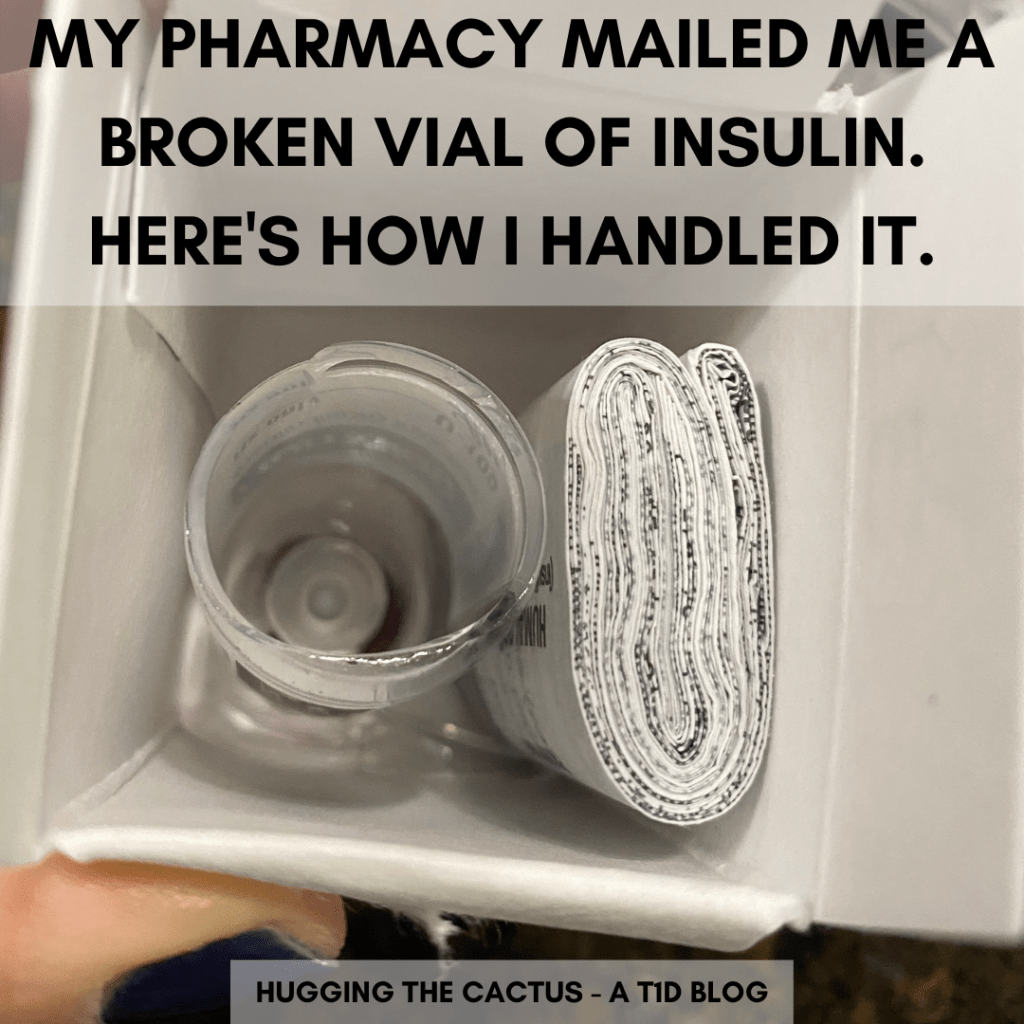
Upon further investigation, I discovered that one of the five cardboard boxes encasing the vials was totally damp to the touch. Gingerly, I opened it from the bottom flap, which was sticking out slightly due to the wetness. That’s when I saw the shattered insulin vial: Somehow, the bottom part of the vial had broken, spilling and wasting all of its contents.

I wish that smell-o-vision was a thing, because OMG…the smell coming from this was STRONG.

I was shocked. In all my years of diabetes, nothing like this had ever happened to me before!

I didn’t really give my next step a second thought: Immediately, I jumped on the phone with Express Scripts, which is the mail order pharmacy that I use for my insulin and some other medications. I spoke with and explained the issue to a customer service representative, who connected me with a technician that promised a replacement vial would be mailed to me at no additional cost to make up for the broken one. I asked if they needed me to send the broken one back to them, but I was reassured that it wouldn’t be necessary because I had called them so they could document the incident.

My issue was resolved, just like that, in fewer than 15 minutes. While it was annoying to have to take time out of my day to figure that out, I’m very happy that I got a replacement quickly and easily. But really, where was quality control on this one?!

Insulin is expensive, as we all know. And to see that a perfectly good vial full of it was rendered useless due to defective packaging was a major punch to the gut, indeed.

But this reminded me of the importance of being proactive whenever I suspect something is wrong with any of my diabetes supplies…when in doubt, do something about it.

5 Things I Hate About Pod Failures

I’ve had a slew of pod failures – three in the last two weeks.

What gives? I’m not exactly sure yet, but I’m hoping to get to the bottom of it. I sent my most recent failed pod to OmniPod/Insulet for analysis, and my suspicions are telling me that I have a bad batch of pods in my arsenal.

While I wait to hear back, I decided to write a blog post listing the five things I hate the most about pod failures as a form of catharsis…

1 – How suddenly and randomly they occur. Pods don’t give an eff as to whether or not they fail at an inconvenient time. In the middle of a conference call? Fails can happen. Sleeping? Fails can happen. On a date? Fails can happen. Just sitting there minding your own damn business? Yes, still, fails can happen. The unpredictability of pod failures makes them doubly obnoxious and loathsome.

2 – That wretched, unrelenting BEEEEEEEEEEEEEEEEEEEEEEP. Crying babies, barking dogs, ambulance sirens – I’d much prefer any of those other sounds over the high-pitched scream of a failed pod. I get why it’s necessary – how else are you supposed to know that a pod is no longer functioning – but it makes my ears want to bleed. Plus, you’ve got no choice but to silence the pod by sticking a paperclip/toothpick/other equally skinny object into that teensy-weensy crevice in the corner of the device! Let’s be real here, who has a paperclip just…available like that at all times in the event of a pod failure? It’s no wonder I chose to silence my most recent screeching pod by taking a hammer to it (note to anyone else who chooses to use this method: DON’T DO IT INDOORS, go outside and smash it on the pavement or in your garage…and maybe wear something to protect your eyes, just in case).

I smashed this screaming pod with a hammer and let me tell you, it felt great to release my frustration that way!

3 – The perfectly good insulin that gets wasted. When I deal with a pod failure, I can sometimes salvage the remaining insulin left within by inserting the syringe from the brand-new replacement pod into the insulin reservoir and sucking it out (literally the opposite of adding insulin into the reservoir for a routine pod change). But it isn’t always possible to rescue the insulin due to time constraints, amount left, and so forth. So it’s extra painful to just toss the failed pod away knowing there’s insulin left inside it that I just won’t be able to use.

4 – You don’t always find out why it happened in the first place. I am a naturally inquisitive person who is always asking “why”. So when a pod fails, I want to know what went wrong. Unfortunately for me, I don’t always get an answer. OmniPod/Insulet customer service representatives might be able to tell me why based on the reference code I provide them when a pod fails – when that reference code is found in their database, the answer might be that static electricity caused it to fail, or that when the pod was performing its routine and automatic safety checks, the pod itself determined it could no longer be used. But there have been plenty of other times that my reference code didn’t signify anything, leaving me permanently clueless as to what happened to make the pod fail. SO FRUSTRATING!

5 – You have to call customer support in order to get a replacement. As someone who has customer support experience, I dread these sort of calls. It’s just a giant pain in the neck to have to go through everything about your experience with a failed pod, such as how long I was wearing it for, what brand of insulin I use, where the pod was located, the lot, sequence, and reference code numbers…the list of questions go on and on. The silver lining here is that I’ve almost always had a very positive experience when calling OmniPod/Insulet to report a pod failure. My issue is usually documented in 10 minutes or less, and I’ve never had a problem getting a replacement, which shows is indicative of superior customer service.

But…is it so much to ask for the dang thing to simply work the way it’s supposed to 100% of the time?!

Can Certain Sites Trigger More Insulin Pump Failures?

Insulin pump sites have been a hot topic for me lately.

Not only did I share that I’m in the process of experimenting with some new (intimidating) sites, but I’m also contemplating the efficacy of all of my current sites.

My site lineup (as of this writing) includes the abdomen, upper arms, lower back, and thighs. And I’ve noticed an unusual pattern emerging with one of these sites that I know for a fact isn’t happening just to me – it’s happened to my mom, too…

…and that pattern is a series of failures with sites on the upper arms.

I can’t offer any explanation for it other than it’s definitely been a “thing” for my mom and I these last few weeks. It started happening to her first. I think she had 3 or 4 pod failures throughout August, and it only happened to pods that she was wearing on her upper arms. At first, I was skeptical of this and assumed it was maybe a bad batch or a total coincidence.

But then it happened to me, twice in a row.

On both occasions, I’d been sitting there, minding my own business (well, the first time, I was a passenger in a car and the second time, I was leading a virtual meeting with a couple dozen people on the call…the latter was far more disruptive).

Can Certain Sites Trigger More Insulin Pump Failures_
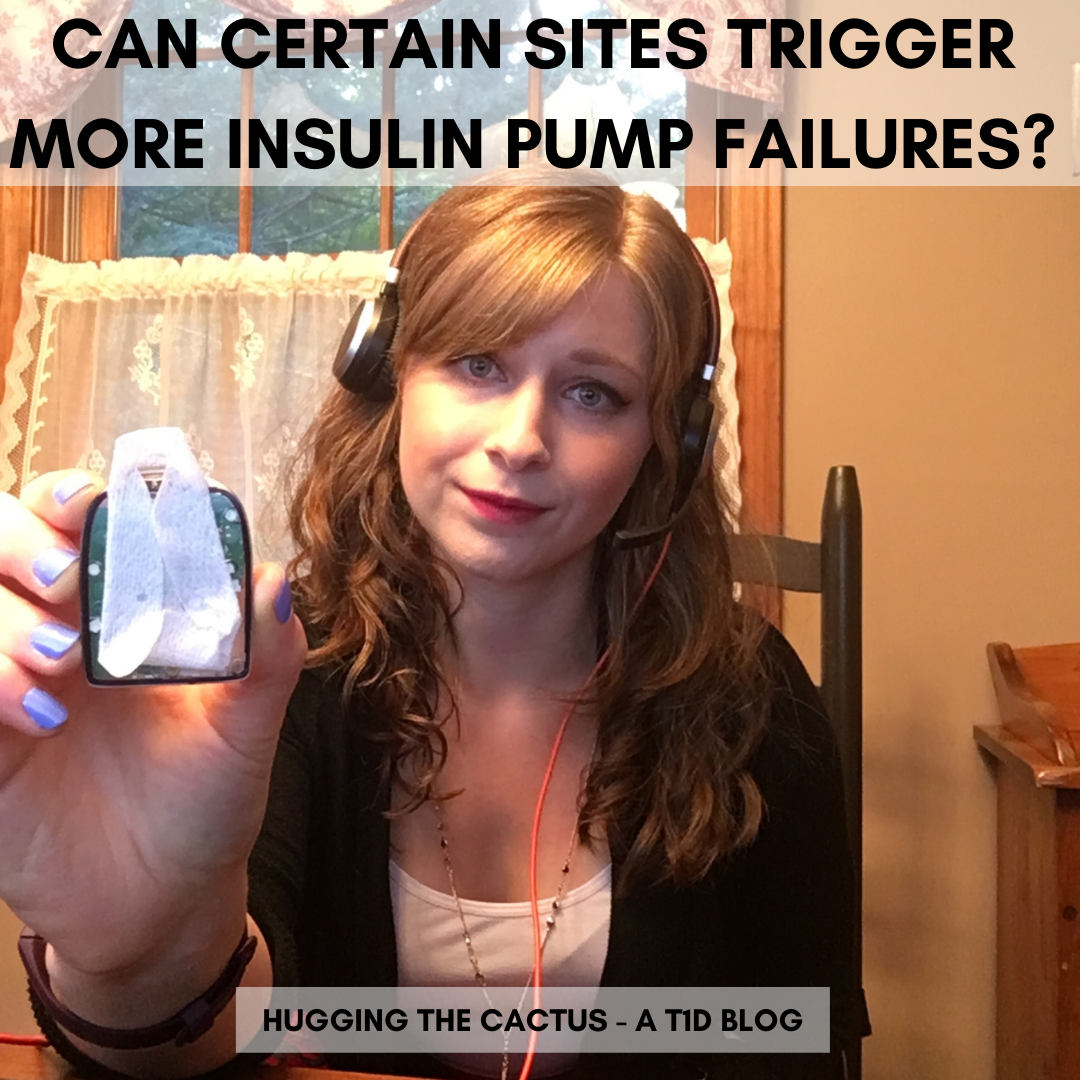
Here I am, holding up the second offending pod, right after I wrapped up the call during which it alarmed. Clearly, I was not amused.

My pods hadn’t been delivering a bolus.

I didn’t bump up or come into contact with the pods in any manner whatsoever.

My pods weren’t due to expire for another 12ish and 48ish hours, respectively.

There was no blood at the pod sites.

The cannulas on both pods weren’t kinked.

Static electricity wasn’t a factor.

But what these pods did have in common was that they were on my upper arms – one on the right, one on the left.

It’s straight-up bizarre, and when I called Insulet/OmniPod to report the second instance, I made sure they noted in their records that this phenomenon has occurred not just for me, but also for my mom. The representative didn’t say whether other people have been calling in with this issue, but it’s definitely weird that it’s happened more than once to both my mom and to me.

So while I can’t say for certain – at this time, anyways – whether particular sites result in more pod failures than others, I can say that I won’t be wearing a pod on my upper arm any time soon…and I’m going to be on the lookout for similar stories from other OmniPod users in the DOC. After all, our ingenious community can be even better than the pump manufacturers themselves when it comes to troubleshooting, so I’m hopeful that I can get to the bottom of this before long. I like my upper arm as a site because my insulin absorption is great there, but I’m not willing to use it again until I know I won’t experience another pod failure in the foreseeable future.

Navigating New Insulin Pump Sites and Nerves

Am I the only T1D out there who feels incredibly nervous about trying new insulin infusion sites?

I’ve been this way as long as I can remember, now that I’m thinking about it. Throughout my childhood, I stubbornly stuck to injecting in my arms, legs, and upper buttocks (tee-hee) because those were the areas I felt comfortable with. I don’t think I even considered jabbing myself in my stomach until I was in my teens, and it was only after I realized the importance of site rotation and reducing scar tissue.

So it’s kind of funny that when I went on the OmniPod just over five years ago, I only used my stomach and my lower back (just above the upper buttocks region, tee-hee) for pod placements. It was partly because my guinea pig – I mean, my mom – used those areas for her pods with success, and also because I was hesitant in the beginning to wear my pods on my arms or legs because of their increased visibility.

It went that way for a couple of year – four basic sites ’round my abdomen – when it occurred to me yet again that site rotation was also important for insulin pumpers, not just MDI-ers (multiple daily injection…ers). So I added my upper arms into the mix, and soon after, my upper thighs followed.

Navigating New Insulin Pump Sites and Nerves
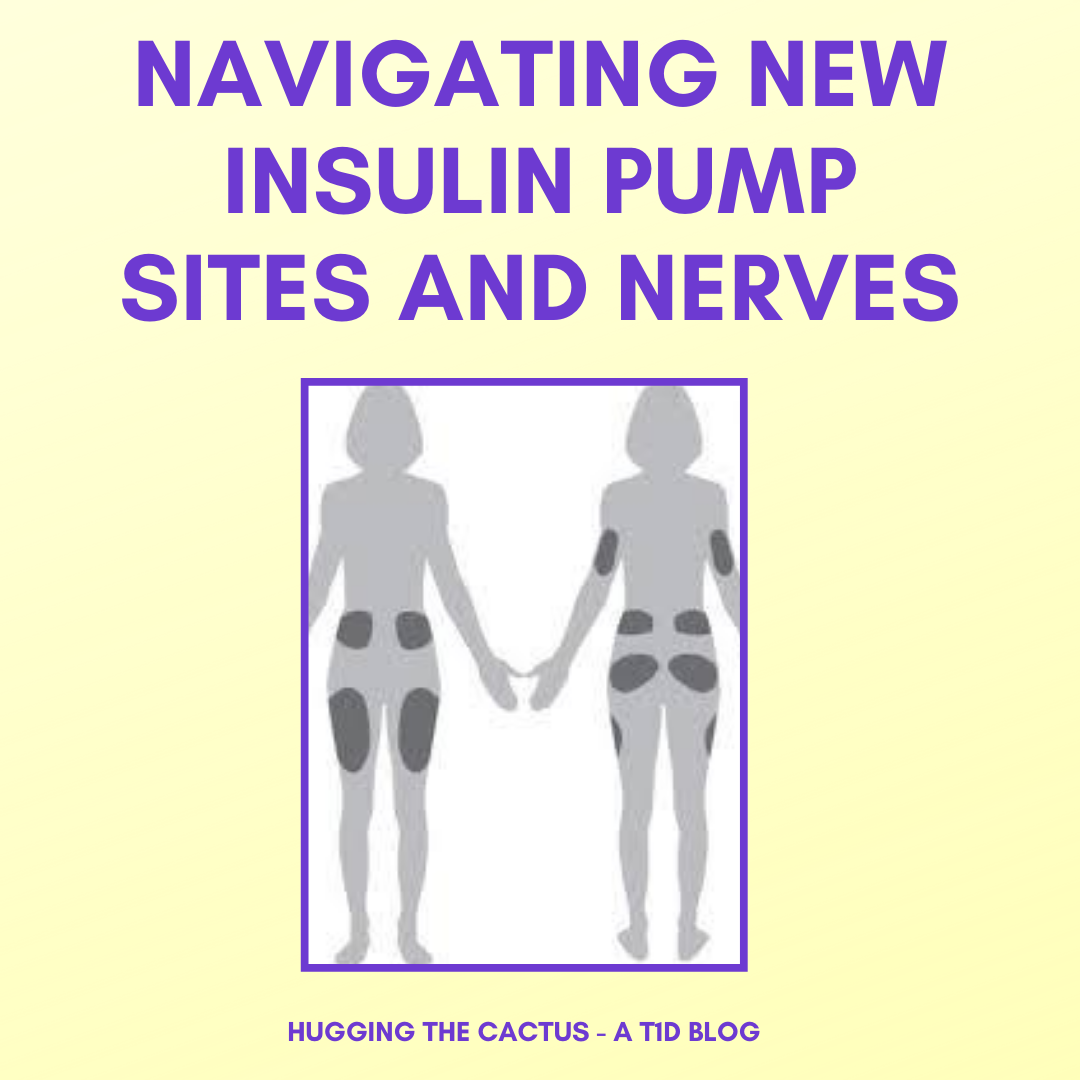
The little diagram (courtesy of Insulet/OmniPod) above only shows a few of the sites that people with diabetes use…over the years, we’ve gotten a lot more creative!

But lately, I’ve shied away from wearing pods on my thighs because the area isn’t overly comfortable. When I roll over in my sleep at night, my pod presses up against my leg and the resulting pressure is just enough to disrupt my sleep and make it difficult for me to find a more restful position to sleep in.

As a result, I’ve started contemplating potential new pod sites, and one of the first places I went to for advice was…Instagram! Because…duh.

The DOC (diabetes online community) on Insta is a natural resource for this sort of thing because many people tend to share photos of their sites. It’s kind of a thing. One simple scroll through my feed taught me that people can get very inventive when it comes to finding new locations to place their CGMs and insulin pump infusion sites.

I saw people wearing Dexcoms on their forearms and calves. I saw pods on backs, calves, and even the upper chest area, the latter of which I found most intriguing. For men, it seems like a very accessible spot that causes little irritation, but for women? How the heck did the T1D ladies I saw with pods on their chest deal with it?

The general consensus, it seemed, was that women wearing pods on the upper chest agreed it was a site with great absorption and minimal discomfort.

I was still skeptical, though. I was worried about how it would look if I was wearing a v-neck tank with my pod poking out of, well, my bra! Then it hit me that my pod garners questions from strangers regardless of where it’s located. Furthermore, people will (probably?) be less likely to ask about it if it’s located on my chest because, um, that’s really awkward. My eyes are up here, people!!!

Then I remembered: I could give the site a try without wasting a pod because I have a demo pack that I got from a diabetes conference awhile back! The demo pack comes with a dummy pod that looks and feels just like a regular pod, but there’s no reservoir built into it, so insulin can’t be injected into it.

So right now, as I’m writing this, I’m wearing two pods: one on my upper arm that’s actually giving me insulin, and a fake one on my chest just to see how I like it. I must admit, so far, so good! I slept comfortably with it on last night and I haven’t had any issues wearing clothing or undergarments with it. I even went for a jog with it on and got pretty sweaty, but it stayed secure/I didn’t feel it bouncing around at all (thought the adhesive got a bit too damp for my liking…it stayed on but if I wasn’t careful I totally could’ve knocked it off).

While I’m still having a hard time wrapping my head around an actual cannula piercing my skin at this location (eeeek), now that I know I can handle the pod itself living there, I’m one step closer to trying (and liking) a site that’s more intimidating to me – a win in my book.