28 and Feeling Great

I turn 28 years old today!

As I say farewell to 27 and welcome a new year of life, I can’t help but reflect on how different the world was this time last year.

The pandemic was in full(er) force. The new normal was just establishing itself. Each day was scary and uncertain as hopes for a vaccine any time soon were somewhat bleak.

Fast-forward to the present: As the weather gets warmer, social distancing and masking guidelines are easing. More and more people are getting vaccinated on a daily basis. While we’re far from returning to life before the pandemic, we’re definitely much closer to being able to enjoy the simple pleasures in life (such as hugging a family member or friend) with less anxiety.

So even though the milestones I met in my 27th year (buying my first home, getting my puppy, surviving heartbreak and falling in love again, to name a few) are things that I celebrate daily, I’m also really looking forward to the minutiae of the next 365 days…seeing my family and friends in-person more frequently, breaking out of the bubble (safely, of course) that is my home, going to new and old places for both familiar and unknown experiences…in other words, I’m excited to embrace the things that I took for granted pre-pandemic.

Me with one of my favorite parts of 27

I’m hoping that year 28 brings a whole lot of “great” with it: lots of love, joy, adventures, and hugs from all the people that I’ve missed hugging in the last year or so. Just like with everything else in my life, I’ll bring my diabetes along for the ride and celebrate it, too, because it just makes me appreciate all the things that make life worth living that much more.

Do You Know What It Means to “Sensor Soak” Your CGM?

This post was originally published on Hugging the Cactus on September 27, 2019. I’m sharing it again today because I still find the concept of “sensor soaking” to be fascinating, though I haven’t been brave enough to try it yet. Not sure what sensor soaking is? Read on to find out…

I saw an Instagram story a few weeks back that intrigued me.

In it, a friend of mine was talking about how she “soaks” her CGM sensors. Instantly, I was confused: What the heck did she mean by that? Soaks them in what, hot water or some other liquid?

Contrary to the connotation of the word “soaking”, this does not mean you’ll be submerging your CGM in any sort of liquid.

Within seconds, her definition of “soaking” became much clearer. “Soaking” a CGM sensor means inserting a fresh sensor hours before you intend to activate it. Rather than giving your sensor just two hours to warm-up, you’re giving it 4-6 hours so it can supposedly provide much more accurate readings immediately after the warm-up period has ended.

I was interested in this practice because I’ve definitely experienced sensors that were off for several hours post-insertion/warm-up. Sometimes, it even takes a full day for a sensor to start reporting accurate numbers, and I wouldn’t exactly call that efficient.

While I haven’t had the guts to actually try sensor soaking yet – I’d like to sometime in the near future – I’ve been doing some research on it so I’m fully prepared to try it whenever I’d like. Here are some questions I had about the process, and the answers I’ve found to them:

Q: Doesn’t this mean that you’re wearing two sensors at once?
A: Yes. But it’s only for a short window of time, until the old sensor expires and it’s time to activate the new one; in other words, for the full soaking period.

Q: How long should I let a new sensor soak?
A: According to what I’ve found online, it seems that 4 to 6 hours is the sweet spot for soaking. It’s basically doubling or tripling the built-in warm-up period that all sensors must go through, so I can see how this might contribute to improving immediate accuracy.

Q: How do I protect the new sensor if it doesn’t have a transmitter snapped in it for several hours?
A: The reason why I haven’t tried soaking yet is because I was worried about wearing a sensor that didn’t have a transmitter snapped in it. But I found some photos online of people who wore transmitter-less sensors with stretchy, self-adhesive wrap tape to protect the nook in which transmitters rest for the soaking period. It’s smart to protect that space, because in theory, it could be vulnerable to catching on clothing or other surfaces. Plus, tape like that is really easy to remove without damaging the sensor in the process.

Q: What changes about the sensor activation process when it’s finally time to start the new soaked sensor?
A: My research leads me to believe that nothing really changes at the end of the soaking period/when it’s time to activate the soaked sensor. All that will be needed is the sensor code so it can be properly activated within the receiver/Dexcom app. So the most important thing you can do at the very start of the soaking period is hold onto your sensor code/store it somewhere safe so you’ll be able to enter it at the end.

Q: So…why would anyone bother trying this again?
A: My understanding is that it all relates back to making sure a fresh sensor is as accurate as possible once it’s activated. I can’t tell you how many times I’ve put on a new sensor, only to discover a few hours after it has warmed up that it’s off by 40 or 50 points – and that just doesn’t cut it. So I don’t think there’s any harm in me giving sensor soaking a shot one of these days. I just have to remember to do it, and have the patience to wear three devices at once (my pod, the soon-to-expire sensor, and the new soaking sensor).

Have you tried soaking? If so, please drop a comment and let me know your thoughts on it – and be sure to tell me if I missed any key steps in my research!

3 Things That Make Low Blood Sugars More Tolerable

This post was originally published here on Hugging the Cactus on August 21, 2019. I’m sharing it again today because it’s the perfect little companion to Monday’s more hateful post geared towards high blood sugars.

Okay, to be TOTALLY honest, low blood sugars aren’t – and won’t ever be – fun. Nine times out of ten, they can be inconvenient, upsetting, and even scary (depending on how low it is). But like most things associated with diabetes, I try to look at the bright side every now and then to remind myself that it could be worse. So even though I don’t welcome low blood sugars in just about any circumstance, I decided to look at them, and their less-than-pleasant side effects, from another perspective. Hence, this three-item list that explains what makes low blood sugars slightly more tolerable to me.

#1: The sweat. I detest sweating. I don’t care if sweat is the result of a good workout or a day spent at the beach – it’s gross either way. And it’s definitely not an attractive low blood sugar symptom. But…on the other side…I tend to sweat a LOT when my blood sugar is low and it makes me feel like I’ve just had an excellent workout without any effort or exertion on my part. So I guess it’s kinda like gleaning the health benefits that you’d get from sitting in a sauna for a bit? IDK…it’s a bit convoluted but just agree with me on this one.

#2: The excuses. I’ve made it a personal mission to try to avoid using my diabetes as a scapegoat. There are times, though, that it really does prevent me from doing something in a timely manner/when I’m asked. For example, if I’m experiencing a low blood sugar at work and a colleague comes by to talk to me and ask me for something, I do find it’s best to let them know that I can’t attend to it right away because of the blood sugar. Nine times out of ten, people understand, and they let me treat it accordingly. And it gives me time to just relax and deal with it, taking the stress away from a situation by simply being honest about it (so I guess it isn’t really an excuse, but sometimes I feel a little guilty about using a low as an out on something. Low guilt is real, people!).

#3: The cake. (Or really any food when you’re low. Because it all tastes delicious. But nothing is quite as satisfying as cake.) I think the inspiration for this blog post came when I was enjoying a big, fat slice of cake in order to bring my blood sugar back up. My goodness, some foods just taste beyond amazing when I’m using them to treat a low. The sweeter it is, the more satisfying it is to both my taste buds and blood sugar levels. And anyone who has experienced a low blood sugar before (people with and without diabetes) can attest to the fact that food is simply a million times better when it’s being consumed at a time that your body is URGENTLY telling you to feed it.

Alright…now that I’m looking back at these three things, I’m kind of laughing at myself. Because I can TRY to make low blood sugars a more positive thing, but let’s be real, they still kind of suck. But I guess there’s no harm in trying to be upbeat about them.

8 Things I Hate About High Blood Sugar

This was originally published here on Hugging the Cactus on April 5, 2019. I’m sharing it again today because this is an evergreen post, the kind that will always ring true for me. These are the things I simply cannot stand about high blood sugar…

High blood sugar, high bg, hypergycemia, sky high…whatever you want to call high blood sugar, it doesn’t change how I feel about it. I hate it. My loathing of high blood sugar is probably not unique among other T1Ds – I’m sure most would agree that it’s the worst – but on a recent and particularly bad day of high blood sugars, I started thinking about why I hate being high so much and it turned into this blog post…which turned into a very cathartic thing for me to write.What do you hate about high blood sugar?

What are the eight things that I hate about high blood sugar? Here they are…

#1: It makes me thirsty. This reference may be lost on some of my readers, but to those who get it, it’ll be wildly funny (or at least it will be in my mind): *Parched Spongebob Squarepants voice* “Waaaaaaaaater! I neeeeeeeeed it!” When my blood sugar is high, I basically turn into that shriveled-up version of Spongebob that appeared in the episode in which he visits Sandy the squirrel’s treedome for the first time. He doesn’t realize that, being a mammal, Sandy doesn’t depend on water like he does to be able to live/breathe. Hence, he struggles throughout the episode to stay hydrated. I bet that if he were dealing with a high blood sugar at the same time, his desperation for water would become much more dire…because let me tell you, I simply cannot drink enough of it when my blood sugar is above 200. This results in many trips to the bathroom, and as I’m sure you can imagine, it’s pretty annoying.

#2: It turns me into a major grump. Nothing kills a good mood quite as swiftly as high blood sugar…I don’t like admitting it, but I tend to snap at people when my blood sugar’s elevated. So really, it’s a lose-lose situation for everyone.

#3: It’s a weight on my shoulders. If my blood sugar is high, I can’t help but wonder what I did wrong to make it so. Did I miscalculate my carbs? Should I have given myself more insulin? Should I have timed my exercise better? Is my insulin pump work properly? The list of questions and possible answers are practically endless, and it weighs heavily on me when I’m dealing with an inexplicable high.

#4: It’s disruptive. When my blood sugar is high for a prolonged period of time, I can’t focus on anything else but that. I’ll do anything and everything I can to take my mind off it and just let my corrective insulin dose go to work, but I can’t help but worry. This can be especially disruptive when I’m trying to get work done at my desk job, or when I’m trying to enjoy a night out with friends. It can suck the joy out of any situation, and that can be incredibly disheartening.

#5: It doesn’t get along with exercise. High blood sugar is weird, because sometimes it cooperates with exercise, and other times it reacts very badly to it. I find that if I workout at 250 or below, my blood sugar responds wonderfully to the movement and it’ll drop my blood sugar down to a better level much faster than insulin. But if I dare to workout above 250, then things can go terribly wrong and my blood sugar will go up even more. I learned that lesson the hard way in college, when I went to a high-intensity spinning class…I was so nervous about going low in the middle of the class that I overcompensated with a pre-workout snack. So over the course of the class, my blood sugar shot up to 300 due to the strenuous exercise coupled with the extra carbs. Not fun.

#6: It makes my CGM wail. I appreciate the alarms on my CGM, but NOT when they go off over and over and OVER again. It feels like my CGM is judging me for being high and it couldn’t be more obnoxious…and I just want to throw my device across the room to get it to shut up.

#7: It prevents me from eating when I’m hungry. I don’t always want to eat when my blood sugar is high, but occasionally, high blood sugar coincides with mealtimes and I end up staring longingly at food while I wait for my blood sugar to stabilize at a better level. Depending on when the high happens and how badly I wanted to eat some food, I can get very hangry (angry AND hungry), which is never a good state of mind to be in.

#8: It’s stubborn. The worst part about high blood sugar is that sometimes, it feels like it takes FOREVER for it to come back down. During the waiting period, anxiety, irritation, and anger are all emotions that can manifest themselves within me. And it sucks. The mental games that high blood sugar can play with me are straight-up cruel, and since a high can be so damn stubbornly slow to respond to insulin, it makes it that much harder to handle…which is why, I can say with 100% certainty, that I hate high blood sugars with a bloody passion.


Stuck.

I’m stuck in a creative rut.

Lately, I just can’t seem to come up with fresh ideas for the blog. The desire to write is there, for sure, but the ability to compose engaging content is definitely not.

Does this have anything to do with the bout of burnout that I mentioned I’m currently experiencing?

I don’t think so.

When it comes to blogging, lately, I’m as stuck as this sticky note (so no fear, y’all – it’s not permanent).

I’ve gone through burnout periods before in which diabetes was the last thing I wanted to talk about, and I can recognize that this isn’t one of those times. In fact, this “stuck” feeling with my blog is rather inconvenient, because I count on my ability to come up with new posts to help me sort through some of the emotions associated with diabetes…ah well, such is life.

Anyways, I’m asking you, my lovely reader, to bear with me for a bit. I promise new material is on the way. In the meantime, please don’t be deterred if you see me republishing old blog posts. I’m quite selective in choosing which blog posts to share again, so rest assured that I’m doing my best to re-up pieces that I think you’ll care about. Thank you, as always, for stopping by and checking out the blog – I’m infinitely grateful for your support.

Do You Know About Monogenic Diabetes?

This post was originally published on October 28, 2019 here on Hugging the Cactus. I decided to share it again today because I think it’s important to raise awareness that there are more than two types of diabetes. As I reread it, I realized that even someone like me, a person who has diabetes, still has a long way to go when it comes to understanding how each type differs from one another. Read on to learn more…

It was the statistic that impelled me to learn more information:

“Approximately 1 in 50 people with diabetes have monogenic diabetes.”

Mono-what?

I was staring at the giant banner bearing this statistic in the exhibition hall of the Friends for Life Falls Church conference. I read it a few times before I finally walked over to the table at which two women were seated. One of the women was an associate professor at the University of Maryland School of Medicine and a human geneticist. The other woman was a typical T1D for several decades of her life before she received a proper diagnosis of monogenic diabetes. Ever since that revelation rocked her world, she’d gone off insulin and took sulfonylureas (a type of drug that stimulates the pancreas to release insulin) to maintain healthy blood sugar levels.

Just how many types of diabetes are on the spectrum

Naturally, the whole concept was simultaneously foreign and fascinating to me. I wanted to know more.

As I discovered that evening, monogenic diabetes is best explained by its name. “Mono”, of course, meaning “one”, and “genic” meaning “relating to genes”. Therefore, it’s a type of diabetes that is caused by changes in a single gene.

Here are some “fast facts” that I learned about monogenic diabetes:

  • Most cases of it are misdiagnosed as type 1 or type 2 diabetes
  • Proper diagnosis of monogenic diabetes sometimes changes treatment from taking insulin to a pill, or no medications at all
  • There is an emerging clinical spectrum when it comes to genetic testing for diabetes. At the time of this writing, the following situations are when it’s recommended to undergo a genetic test to determine whether an individual has monogenic diabetes:
    • The individual received a diabetes diagnosis within the first 6 months of life
    • The individual’s diabetes does not follow typical characteristics of type 1 or type 2 diabetes – this might mean that the individual is non-obese or has a strong family history of diabetes
    • The individual has a stable fasting blood glucose between 100 and 150 mg/dL
  • From the pamphlet I picked up that featured stories from individuals with monogenic diabetes: “I was 21, taking metformin and aspirin daily and sitting in a type 2 diabetes class with three much older participants. Despite dropping my BMI from 26 to 23 my A1c had risen to 6.4%, not a high number, but certainly one worth watching. I knew of no one else in my family with diabetes. Eventually I did get that dreaded diagnosis, and because it didn’t seem to be type 1, they said it was type 2. Fast forward 2 years and my sister now had ‘GDM,’ (gestational diabetes mellitus) twice, my dad finally admitted to having ‘borderline sugars’ since he was in college, and I got my genetic results back saying I had GCK-MODY (GCK being a gene that can have a variant that triggers monogenic diabetes, MODY being maturity onset diabetes of the young). It changed everything: gone were the pills, gone was the restrictive diet and exercise plan, and when my son was born with high blood sugars, we did nothing, because he was like me, and there is nothing that needed doing.”

Now, if YOU are like ME, all of that might read like some mumbo-jumbo. It took a few weeks of me reflecting on it to decide whether I should even write this post, because I feared that it might cause some people to be paranoid about whether or not they were misdiagnosed with their diabetes (I admit that I was worried about that for myself in the days after learning about monogenic diabetes).

But the big takeaway here that I thought should be captured in a blog post is that it’s important for patients to advocate for themselves when things just don’t add up. There were a few more stories from individuals with monogenic diabetes in the pamphlet I got, and there was a recurring theme in all of them: Doctors kept telling these patients that their diabetes was atypical, but it wasn’t until these patients sought genetic counseling that they began to understand why.

It goes back to what I said at the beginning of this blog post: I find this variant of diabetes to be intriguing. It makes me wonder whether we should continue to define diabetes in such a black-and-white manner (either you have type 1 or type 2). I’m curious if diabetes is more of a spectrum of diseases that present similar symptoms, but require different levels of treatment and management. It’s certainly interesting food for thought, and considering that diabetes continues to be a semi-mystifying condition to many researchers and doctors, it won’t surprise me if future studies eventually uncover more types of diabetes.

Anyways, enough of my musings on genetic testing and speculations on how many types of diabetes are really out there. If you’d like to know more about monogenic diabetes, I was guided to several different resources. Check them out below:

How I Realized I’m Experiencing a Bout of Diabetes Burnout

Diabetes burnout is the generic term used to describe a state in which a person with diabetes becomes tired of managing it and may become neglectful of one or more aspect of diabetes care.

I say “generic term” because diabetes burnout doesn’t look the same for every person, though, so it can be tough to recognize it when it’s happening. I know this from personal experience: I’m going through a bout of diabetes burnout right now.

Diabetes burnout is just a part of having T1D.

It took me weeks to realize it, but I finally came to the conclusion that I was burnt out because several things dawned on me at once:

  • It was taking me longer to respond to CGM alarms. I would hear them going off, but I didn’t necessarily care to even look at them, let alone correct them. As a result, I let a lot of high blood sugars linger much longer than I should have, which made me feel frustrated and bad about myself for causing harm to my body.
  • I wasn’t eating healthy foods. The Easter holiday brought an abundance of chocolates and sweets into my kitchen, so instead of choosing fruits or veggies to snack on, I was going for high-carb items with zero nutritional value…and I didn’t bother bolusing for them, which of course, wreaked havoc on my blood sugar.
  • I did the bare minimum to keep my blood sugars in check. I was still bolusing for all my meals, but the snacks in between? The little desserts I’d have? The alcoholic beverages I’d enjoy? Nope, certainly wasn’t taking those into account when I took mealtime boluses.
  • I got lazy with carb counting. I kept gravitating toward bottomless bags of snacks when I did my weekly grocery store trips, even though I knew that I have no restraint when it comes to highly addictive, faux-healthy foods like Annie’s cheddar snack mix or cute little teddy graham cookies. Whenever I’d crack open a fresh box or bag, I’d dig in and wouldn’t stop digging in, going way over the recommended serving sizes and not bothering to slow down and count out my carbs.
  • I was allowing my emotions to influence my diabetes care (or lack thereof). I’m a self-professed emotional eater. That, coupled with excess stress/anxiety levels, shifted my attention away from my diabetes.

So, yeah, there’s no question that I’m in a period of diabetes burnout. Joy.

As tired as I am of taking care of my diabetes, though, it doesn’t compare to how exhausted it makes me to beat myself up over my burnout day after day.

I’ve been through burnout before. I know I’ll make it through, just like I have in the past, and I am also aware that I’m likely to experience it again in the future. And rather than come up with a super-specific action plan to conquer it, or give myself a timeline to overcome it, I’m just going to ride it out knowing that I’m trying my best each and every day, and that’s what matters most.

When Carbs Collide with a Bent Cannula, Chaos Ensues

Sushi. Wine. Not one, but two slices (I swear they were slivers, honest) of cake. A pod with a cannula that got bent out of shape accidentally due to clumsiness.

The above sounds like some sort of weird laundry list, but it’s really just all the factors that contributed to a night of high blood sugars and relative sleeplessness.

Let me explain what happened: The night started out fabulously! I got sushi for dinner from a local spot that I was trying for the first time. I was excited about it because sushi is a rare treat for me, and I figured the occasion warranted some wine – my first glass(es) that I’ve had in about 2 months (I gave it up for Lent).

Those two things right there are definitely a “dangerous” duo that can cause carbohydrate calculation errors or prolonged blood sugars, but I tucked that in the back of my mind because I wasn’t done with indulgences for the evening.

I want to say I regret nothing about this carb-o-licious evening, but…

That’s right, I kept up with the carb-loading by enjoying some cake (white chocolate blueberry cake that I made myself that is just as decadent as it sounds) soon after dinner was done. My problem is that I thought I’d curbed the impact of the carbs by setting a temporary basal increase and stacking a small amount of my insulin, but no such luck. I’d destroyed my second piece (it was just a tiny sliver, people) and noticed that I was creeping up. I took more insulin and soon forgot about my high blood sugar as I immersed myself in episode after episode of Impractical Jokers, which, side note: It’s a series I just discovered and it’s hilarious cringe comedy that is the perfect thing to watch after a long day.

A handful of episodes later, it was time for bed. Or so I thought…because soon after I was settled in bed, I twisted around in just the right – or in this case, wrong – manner that was rough enough to loosen my pod from its allegedly secure location on my back. The smell of insulin was pungent and indicated to me immediately that the pod would have to be ripped off completely and replaced. And the sooner, the better, because my blood sugar was getting closer and closer to 300…definitely not a level I want to see before I go to sleep.

By 12:30 A.M., the new pod was on my arm and a temp basal increase was running to combat my lingering high blood sugar. I also gave myself yet another bolus and crossed my fingers, hoping that the combination would be enough to bring my levels down overnight.

At around 2 A.M., my PDM started beeping to let me know that it’d been about 90 minutes since the new pod was activated, so in response I woke up to silence it and glance at my CGM. My blood sugar barely budged! Frustrated, I gave myself more insulin and fell back into a restless sleep.

Several hours later, my alarm was blaring, far sooner than I wanted it to. I hit the snooze button, also taking care to check out my CGM yet again before I made an attempt at 15 more minutes of sleep. And guess what – I was still high. Quite high. Not 300, but in the mid-200s.

It was official: My blood sugar was punishing me for my night of careless carb consumption and reckless pod-handling. I shouldn’t have been surprised by the resulting chaos, but at least I was able to restore peace again the next morning…eventually.

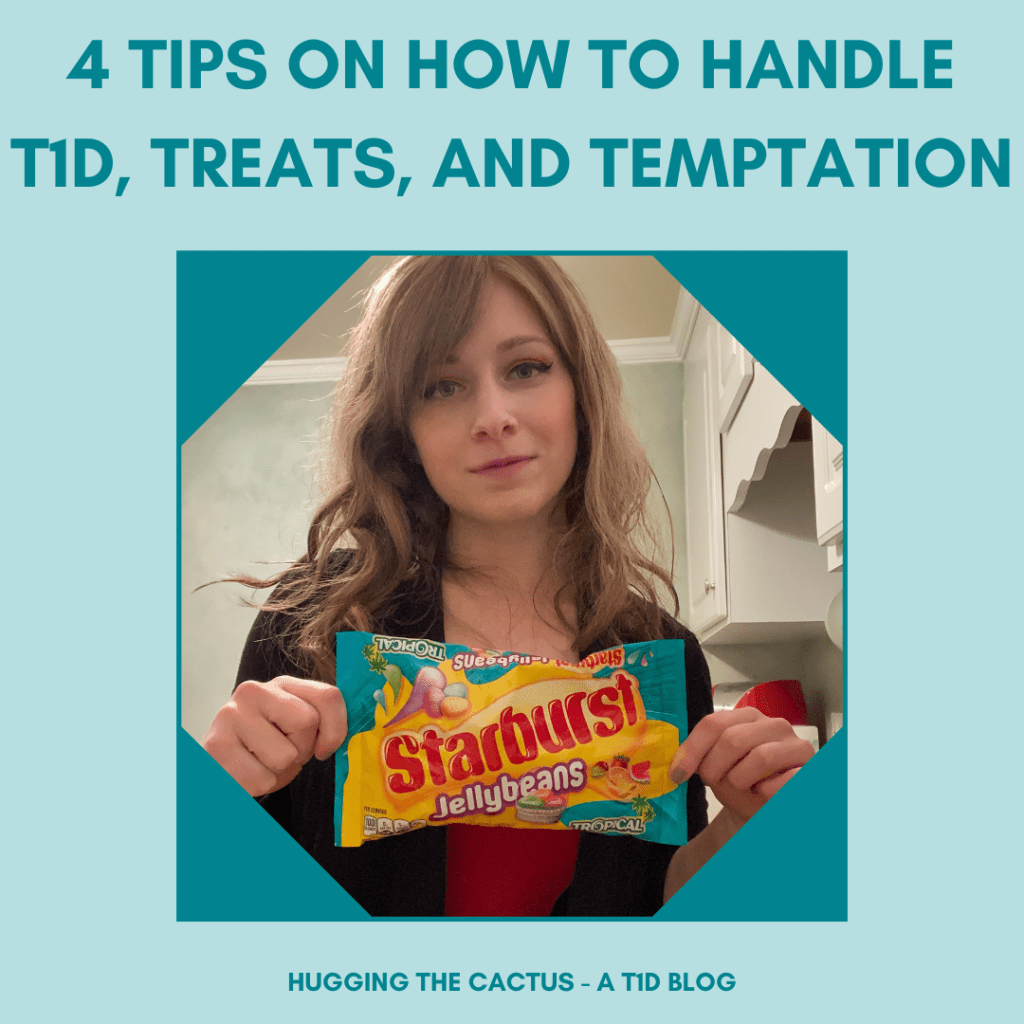
4 Tips on How to Handle T1D, Treats, and Temptation

If you regularly read this blog, then you know that I’m not a strict person with diabetes, in the sense that I don’t really restrict the foods that I include in my diet.

I’ve always been of the mindset that my diabetes can’t dictate what I choose to consume, though it might limit the actual quantity of a given food type that I eat.

So while my fridge and freezer is almost always stocked with fresh and frozen fruits/veggies/proteins, my pantry often stores more shelf-stable (and usually less healthy) things like crackers, cookies, and even candy. In fact, a full week post-Easter, my cabinets contain 3 bags of jellybeans, a chocolate bunny, and several Reese’s eggs. And it’s very tempting to reach into the cupboards and help myself to as much sugary sweetness as I can stomach in one sitting – screw my diabetes/blood sugar, I’ve got delectable confections to consume!

I don’t even like jelly beans very much, but that doesn’t mean that I doubt my ability to crush this bag in one sitting…

But of course, I know that indulging my cravings will only wreak havoc on my blood sugar levels, so I’ve found a few ways to curb temptation but still keep tasty treats in my home. Here’s 4 things that have worked for me:

  1. Only eat these treats when my blood sugar is low. I call this “medically necessary” candy consumption, and let me tell you, it makes low blood sugars a whole lot more tolerable when they’re treated with something that’s more fun and yummier than chalky glucose tablets or juice boxes.
  2. Keep them out of sight. I do my best to shove bags of treats in the very back of my top cabinets. That way, if I’m tempted to dig into them, I remember that I won’t be able to reach them unless I get a chair and rummage through the contents of the top shelves…and usually, that’s enough to take away my desire to snack on something sugary. I’m not saying it always happens, but laziness will typically beat my sweet tooth.
  3. Pre-portion single servings of treats. I have a real problem with snacks that come in bottomless bags – it’s hard to know when to stop and my blood sugar always suffers the consequences. So I like to study the serving size on bags and use it as a guide to portion out single servings of treats. It’s much easier to bolus for whatever it may be (or treat a low blood sugar as described in tip #1) when I know the exact carbohydrate count; after all, a few handfuls of an unknown number of Skittles have far more carbs than a single serving of 15 Skittles.
  4. Be picky about the types of treats kept in the house. My kryptonite is most definitely Reese’s cups…I love the salty/sweet combination of peanut butter and chocolate almost as much as I love my dog. So I recognized that a bad habit was forming when I kept a little bowl out in my living room filled to the brim with mini cups. I was breaking every single one of the above rules with this practice! After I realized this, I put the bowl away and stopped buying Reese’s every time I went to the grocery store. I still have other things around the house that will satisfy my sweet tooth (before Easter, I bought a package of dark chocolate Oreos that I’ve easily kept around for the last 6 weeks because they don’t tempt me in the same way that Reese’s cups do), so I’m really not depriving myself at all.

Temptation can be tricky to navigate when you have T1Ds and love sugary treats as much as I do…but as long as you can come up with ways to cope with temptation like I did, then you don’t have to feel guilty for giving in to your cravings every now and then. I sure don’t!

The Forgotten Bolus

My friends and family have always complimented me for having a good memory.

What can I say? I have a knack for remembering names and faces. I’m slightly better than decent at keeping track of birthdays. And I’ve kept journals of some sort for most of my life, so I’m usually able to recall the date on which a certain event took place (or I can at least look it up fairly quickly).

But my memory can fail me sometimes, and it did just that the other day when I forgot to bolus for dinner.

I don’t think I’ve ever forgotten a mealtime bolus in more than 23 years of life with diabetes. I suppose there’s a first time for everything…

To give myself a little credit, I truly thought that I had bolused. I remembered picking up my PDM and entering my blood sugar and carbohydrate information, but I never actually hit the very important “enter” button that would start delivering my insulin.

Imagine my surprise, then, when I saw my blood sugar rapidly rising – I’m talking double “up” arrows here – approximately 20 minutes after I finished my dinner.

And at first, I decided to ignore it! I thought that my insulin just needed a little more time to kick in, so I waited. And waited. And waited. But when I saw that I was rising above 250 mg/dL, I figured I should increase my temp basal…perhaps my body just needed a bit more insulin than I anticipated.

That’s when I picked up my PDM and saw that I had zero units of insulin on board. Extreme confusion turned into extreme panic as I asked my mom if I could check her PDM – what if I had picked hers up instead when I bolused for dinner and mistakenly gave her the insulin that was intended for me?!

Thankfully, that wasn’t the case, and I slowly began to piece together that I simply forgot to hit the bolus delivery button.

Whoops.

Almost one full hour after finishing my meal, I was finally delivering my mealtime bolus and silently fuming over my high blood sugar that ended up lasting several hours. It was a completely avoidable situation that shouldn’t have happened, but at least one good thing came out of it: I don’t think I’ll be forgetting to bolus any time soon.