You have a new message in MyChart! Please sign in to read your message.”
Whenever this notification pops up in my inbox, I’m filled with a sense of dread because it usually means one of 3 things: 1) I owe money to one of my doctors’ offices, 2) I have an upcoming medical appointment that I forgot about, or 3) There’s a problem with one of my prescriptions and my doctor’s office needs more information from me.
I never would’ve accounted for a fourth possible scenario, one that makes me feel good as a patient, being remotely likely…until it actually happened to me.
The message in question was from my diabetes nurse practitioner, and she wrote to me asking if I could recommend any diabetes support groups to another patient with T1D who was roughly my age. She explained that she thought to ask me because she knew that I have this blog/platform and remembered that I’ve spoken about how the diabetes community has greatly helped me over the years.
Upon reading the message, I immediately felt flattered that she thought to ask me. I typed up a thoughtful reply, including several different resources that might meet the patients’ needs, and sent it, feeling totally awestruck over how trust was definitely a two-way street in this particular HCP/patient relationship. It means a lot to me that my NP trusted my recommendations enough to not only want to pass them along to another patient, but to reach out and ask me for them in the first place. While my current overall healthcare team is lacking in some major ways – I won’t get into details on that, but let’s just say the search for a couple of new physicians is one that I’ll reluctantly embark on soon – this is reassurance that I do still have allies working for (and with) me. And that’s a really great feeling.
I’ve never really sat and thought about the power of seeing diabetes represented in media. Mostly, if diabetes is ever seen or mentioned in a TV show or podcast, it’s the butt of the joke, or portrayed with the slightest (or extreme, there’s no in-between) inaccuracies.
I guess the only time that I ever really considered it is when I weighed my experience filming a Dexcom G6 commercial (which you can read about here or watch here) against the knowledge that some other diabetes companies don’t have people who actually live with diabetes in their commercials; instead, they hire actors. I was – and still am – beyond grateful that Dexcom chose me and other people living with diabetes to be part of the G6 marketing campaign. It made me feel seen and heard, and perhaps inspired my mild irritation over the fact that other companies have chosen actors to appear in their ads. Actors can certainly pretend to know what it’s like to wear our devices or deal with diabetes 24/7, but the stark reality is that they have no clue – and let me tell you, it’s a lot more difficult than these commercials filled with smiling, happy people portray.
Anyways…the concept of diabetes representation mattering in a variety of contexts was driven home to me when I agreed to participate in a social media campaign for my pole fitness studio. All I knew was that the owner was going to film my very full level 1 class one night, and I had no idea if I’d actually appear in any of the footage selected for the Facebook/Instagram ads. Admittedly, I didn’t really care either way because I was just focused on learning the climbs, spins, and poses taught to us that evening, so I gave my permission to appear in the ads without a second thought. Imagine my surprise when, weeks later, I noticed a 3-second clip of myself climbing woven into one of the ads!
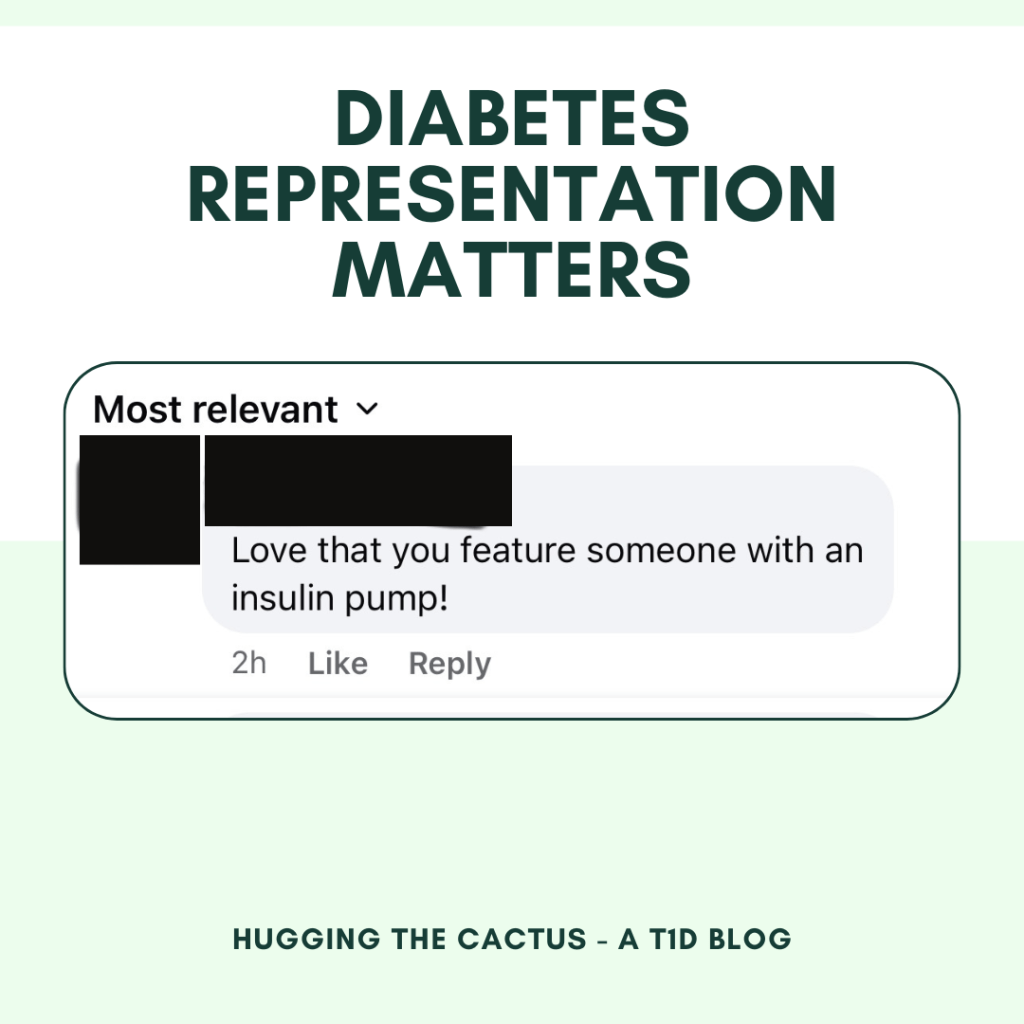
When I first saw it, I was a little embarrassed because I’m just naturally self-conscious and my form looked off in the video. But as days went by and it popped up every now and then on my social media feeds, I grew accustomed to it and let my inhibitions fade away. Any lingering anxieties over my appearance, though, turned into a burst of confidence and pride when this comment on the ad caught my eye one day:
Love that you feature someone with an insulin pump!
It’s funny how 9 words written by a total stranger on the Internet made me feel so good. It really serves as proof that representation does make a difference in defeating diabetes stigma and giving a normally invisible chronic illness greater visibility.
Thank you, random person who commented on this ad, for reinforcing that almost-forgotten notion for me.
This past June, I wrote a blog post about how cleaning is an unexpected blood sugar buster for me – meaning that my levels are guaranteed to start dropping after a prolonged period of tidying.
And just today, I realized that there’s another (perhaps even more unanticipated) blood sugar buster for me…and that would be…
Trying on clothing. Yup! An innocent, well-intentioned act meant to improve my wardrobe resulted in a low blood sugar, and reminded me why I hate shopping for clothes so much.
Before you jump in and say, well of course her levels dropped, she was walking around a store, let me tell you that this store really wasn’t even that large. There were so many racks of clothing strewn about haphazardly that I felt more like I was stumbling my way slowly through a maze as opposed to the laps I can easily take by walking around a Target or a grocery store. My pace was positively snail-like, and I got more and more dragged down over time by the weight of the clothing items I was carrying in my arms.
By the time I got to the dressing room, my energy was going downhill as it had mentally worn me out to search for clothing even remotely close to the style I was looking for. I only had 9 items to try but the prospect of putting on each piece felt daunting. (Let alone doing so while maneuvering around the matchbox-size dressing room; seriously, it was so small that if I spread my arms wide then I would be touching both sides of the room.) With impending senses of claustrophobia due to the teensy room and dread at the notion of trying on new clothes, I also registered that I was getting very, very warm. And a little dizzy.
Was I blacking out from my latest endeavor in clothes shopping, or was it just my blood sugar going low?
Naturally, it was the latter. Something about hauling a haphazard collection of clothing around the store, then trying said clothing on (and getting increasingly frustrated as my “no” pile grew) triggered a low that I wasn’t anticipating, and suddenly my desire to leave the store hit its peak as I knew it was more important for me to take care of myself than to score big on new wardrobe additions.
With a heavy sigh, I paid for the couple of items that I ended up liking enough to want to buy, and made my way to my car where a low snack in privacy was waiting for me. I also walked away musing over this unexpected blood sugar buster and how to prevent it from happening again and again in the future – perhaps with a nice mall snack? A treat from the food court?
Sounds like a nice way to put the fun back into clothes shopping, that’s for sure.
(Gotta give credit where credit is due on inspo for this blog post’s title – Judith Viorst authored the children’s book Alexander and the Terrible, Horrible, No Good, Very Bad Day in 1972 and a movie that was loosely based on it came out in 2014. I admit that I’ve seen neither but as someone who has appreciation for books and movies, I can at least claim an awareness of both and a deep appreciation for such a memorable title.)
At the end of July, I had my worst 24 hours of diabetes in literal years.
I’m being a little dramatic, but really, everything that could go wrong pretty much did. And what made it that much worse is that it just happened to coincide with my girls’ weekend with my college friends.
It all started after dinnertime. I had flatbread from a local restaurant that I frequent, and I substituted traditional crust in favor of cauliflower crust – my hope being that this would have less of an impact on my blood sugar levels.
No such luck. In the 3-4 hours post-dinner, my blood sugar steadily climbed, reaching a peak of the low 300s at its highest. It just didn’t make sense! I had 4 pieces of flatbread. They weren’t massive. Veggies were the only topping. Maybe it was my pod? When I went to check my PDM to see how much insulin I had on board for what felt like the fiftieth time that evening, I discovered that I’d been burning through so much insulin that I only had a few units left in the pod, meaning that I’d definitely have to change it before I went to bed to ensure I didn’t run out of insulin overnight.
I was super annoyed as a result of my hyperglycemic state and the need to do a premature pod change, but apparently also exhausted by the ordeal as I lapsed into an early sleep in my armchair while my friends stayed up. By the time I snapped out of my slumber, I was groggy, thirsty, and upset that my diabetes was affecting my ability to hang out. When we all turned in for the evening around midnight, I went to bed hoping that my mood and blood sugars would be turned around by the time I woke up in the morning.
Except they didn’t. I woke up in the middle of the night with not one, but two separate low blood sugars. My broken sleep combined with the wild oscillations of my blood sugar caused me to roll out of bed with a stinging pain in my eyes and a defeated spirit that I tried my best to hide from my friends, but to no avail. In fact, I ended up in a heap on the floor, crying to them as I apologized for my grumpy mood and attempted to explain to them what had gone wrong in the last 12 hours. They were all very understanding and supportive, but I felt horrible for being so temperamental and curt with them; after all, none of this was their fault. I promised them that I’d cry it out, wash my face, get dressed, and spend the rest of my time with them with an adjusted attitude.
This mostly worked – we were able to enjoy bagels and lattes for breakfast, as well as a long walk in the first truly gorgeous morning of weather we’ve had since May. My attention was absolutely still partially focused on my diabetes, especially since bagels are notoriously tricky to bolus for, but my resulting spike from indulging in one wasn’t too bad since it was offset by the walk.
By the time my friends departed, my blood sugar was mostly back under control. This must be when things started turning around for me, right? Wrong! As I cleaned up my condo, I ripped my pod – the one that I had just applied the previous evening – clean off my leg. Cursing, I tried to calm myself down because this was something I could easily fix. I decided to call my boyfriend while I did the pod change routine, which was yet another mistake on my part as I accidentally deployed the cannula before the pod was even on my body.
It was like a comedy of errors. I shouted – yes, legitimately yelled – to my bemused boyfriend that I had to go. I needed to get this pod change done and over with, distraction-free. So I repeated the process, only to find that pod #2 was unusable because the cannula was poking out.
Was the universe laughing at me at this point? It sure felt like it.
Third time’s the charm, I told myself as I audibly sighed out of frustration. And thank goodness that it really, truly was – the third attempt at putting a new pod on was the one that did the trick. I remember falling back in my chair after the pod was securely attached on my body. The rollercoaster blood sugars and the unpredictable technology demands truly drained me, and this was just one 24-hour window of dealing with diabetes.
Thank goodness most days aren’t like this terrible, horrible, no good, very bad diabetes day!
Diabetes is a medical condition that should come with its own dictionary.
I’m not exaggerating. A diabetes diagnosis means having to learn what feels like a whole new vernacular in order to thrive with it. Words and terms like bolus, basal, CGM, A1c, among many others, can be straight-up confusing – especially if you didn’t grow up with diabetes like I did. It only recently occurred to me that I avoided a tough learning curve by receiving my diabetes diagnosis early in life. I knew the meaning of “hypoglycemia” and “endocrinologist” at an age when most kids were just trying to figure out how to say simpler phrases like “the cat sits on the mat”. I grew up speaking diabetes, a second language that I don’t always give myself credit for knowing as well as I do.\
I know it so well, in fact, that I’m often sprinkling in diabetes words and phrases into my regular daily conversations. I expect my close relatives and friends to know what the difference between my “pod” and my “PDM” are, but I sometimes forget that colleagues or acquaintances might find my diabetes terms confusing. That’s one reason why I added a “diabetes dictionary” section to this website. It’s definitely not complete, but it’s a solid starting point for anyone who’s trying to understand the many acronyms and fancy-sounding medical terms that make up the language of diabetes. And a second reason, that goes hand-in-hand with that explanation, is to hopefully make it a little easier for newer readers and visitors to this website to pick up on the diabetes-related words that I use throughout most of my blog posts.
So feel free to peruse my incomplete diabetes dictionary here – I promise it’s a much shorter read compared to a traditional dictionary. And let me know in the comments if there’s anything you think I should add there, as it’s been a minute since I revisited it.
This blog post was originally published on Hugging the Cactus on August 3, 2022. I’m sharing it again today because the dog days of summer are officially here and I’m THIS. CLOSE. to giving into the temptation to eat ice cream for dinner most nights. And guess what? I can, if I truly wanted to, and it doesn’t even have to be sugar free. Read on for my thoughts on ice cream and diabetes…
I have strong opinions about ice cream. Potentially controversial ones:
Chocolate ice cream is the weakest flavor out there.
My ratio of ice cream to mix-ins is…gimme ALL the mix-ins. The more chopped-up chunks of goodness, whether it be cookie dough or candy, the better.
Ice cream tastes best when it’s a little softened – like, almost to the point of being soft-serve consistency. I used to microwave my ice cream for about 20 seconds when I was a kid before eating it and loved every drop of my ice cream “soup”.
See? I warned you. Those are some triggering statements I just made about my personal ice cream preferences. But one not on that list, that I think most people would happen to agree with me on, is that sugar-free ice cream just ain’t it.
“Oooh, Molly, look! They have sugar-free ice cream on the menu, are you going to get some?” One of my truly well-meaning girlfriends asked me this, ever-so innocently, on a recent ice cream outing.
I remember raising my eyebrows incredulously as my eyes scanned the regular list of ice cream compared to the sugar-free options. There were dozens of delectable-sounding regular ice cream flavors: all the traditional ones, plus more exotic ones like cotton candy, blueberry pie, s’mores, German chocolate cake, coffee kahlua cream…and then in direct opposition to that were TWO, yes TWO meagerly sugar-free choices: black raspberry and coffee.
I turned to my friend and, as non-condescendingly as I possibly could say it, told her that those “choices” had to be a joke and that furthermore, sugar-free ice cream just ain’t it for me. If I’m going to eat ice cream (and I’ve consumed LOTS of it this summer, let alone throughout my lifetime), then I’m going for the real stuff – no question about it. So with the air cleared on that particular matter, we both got matching ice creams (the blueberry pie flavor with blueberry and graham cracker swirled in a vanilla cream base) and enjoyed the heck out of them.
What if I told you that at the beginning of this year, I started training in a new type of exercise that has truly pushed me out of my comfort zone, empowered me, and made me begin to appreciate my body, as it is, more than I have in a long time?
I bet you’d be curious to know more about this form of fitness that has instilled such confidence in me.
It’s pole dancing.
Now, before you get all judgmental on me, let me encourage you to pause for a beat and realize that any stereotypes or preconceived notions you have about pole fitness are likely wildly incorrect, or at least unfair. Shove any thoughts about certain types of clubs out of your brain, here!
I’ve come to learn that pole dancing is less about sexy, slinky movement (unless you want it to be that way, which is also perfectly acceptable) and more about athleticism. The way that I have decided to approach pole is that I am testing my body’s ability to move with strength and grace, and I’m really proud of the progress that I’ve made in the 7 or so months since I attended my first class. I’ve learned that my body (and as a result, my mind) are capable of so much more than I ever thought, and I’ve also found out a few other important things about pole as a sport.
It’s for everybody. Any person of any gender, size, and age can learn how to do it.
There are many different styles of pole. You can learn a choreographed routine, you can wear heels, you can go barefoot, you can spin, you can be static, and so much more.
The biggest obstacle in learning pole is your mind. I’m constantly talking myself into (and out of) certain poses and movements because I am scared of the unknown. It can be frightening to climb eight feet up into the air and put your trust fully in your muscles in order to hang on, much less contort into an elegant posture! But diabetes definitely hasn’t stopped me in any form or fashion from making the most out of a class, and I got proof that there’s other people with diabetes out there who pole not too long ago.
It’s common to have a pole buddy in most of my classes, due to the fact that there’s only a handful of poles available in the studio and twice as many available spots in a given class. So when a woman who was slight in stature and soft spoken asked me if I was okay with sharing a pole with her, I welcomed her over and was pleasantly surprised by what she said next.
“I saw your pump and figured it made sense to share a pole with another diabetic,” she said, motioning toward her own pump which was clipped to her shorts.
My face probably immediately lit up. I was excited to be partnered up with someone who shared something that we both innately understood. We started chatting about the fairly unique experience of pole-ing with diabetes; more specifically, whether or not our diabetes devices got in the way during classes. She shared that one time, her pump detached from her shorts, flung out as she maneuvered around the pole, and got its tubing wrapped around the pole as a result! She was totally fine, but embarrassed by the attention that the incident got her. I reassured her that I’ve had similarly mortifying experiences in fitness classes before, the most memorable being the time that my CGM kept going off in the middle of a yoga class and disturbing the quiet environment. We shared a laugh before refocusing our attentions on the instructor, and for the remainder of the class, our diabetes and our devices became afterthoughts as we transitioned from one pose to the next.
It was a short exchange, but one that bonded us and served as evidence to me that diabetes really can’t stop me (or anyone else living with) from pursuing what we want to do, even something less conventional like pole. This was one of my favorite “diabetes in the wild” encounters that I’ve had in quite some time, and now I know that any time we take a class together, I’ve got someone close by who gets me. And that’s a nice feeling.
This blog post was originally published on Hugging the Cactus on June 19, 2020. I’m sharing it again today because truth be told, I needed to hype myself up a bit about having my diabetes devices be a lot more visible during the summer months. As I’ve gotten older I’ve grown less comfortable having them on display, but it’s inevitable when I’m wearing short sleeves, shorts, or a bathing suit. Read on to learn about the other things that make diabetes a little less invisible in the summertime…
Sun’s out, guns pumps out, amirite guys?
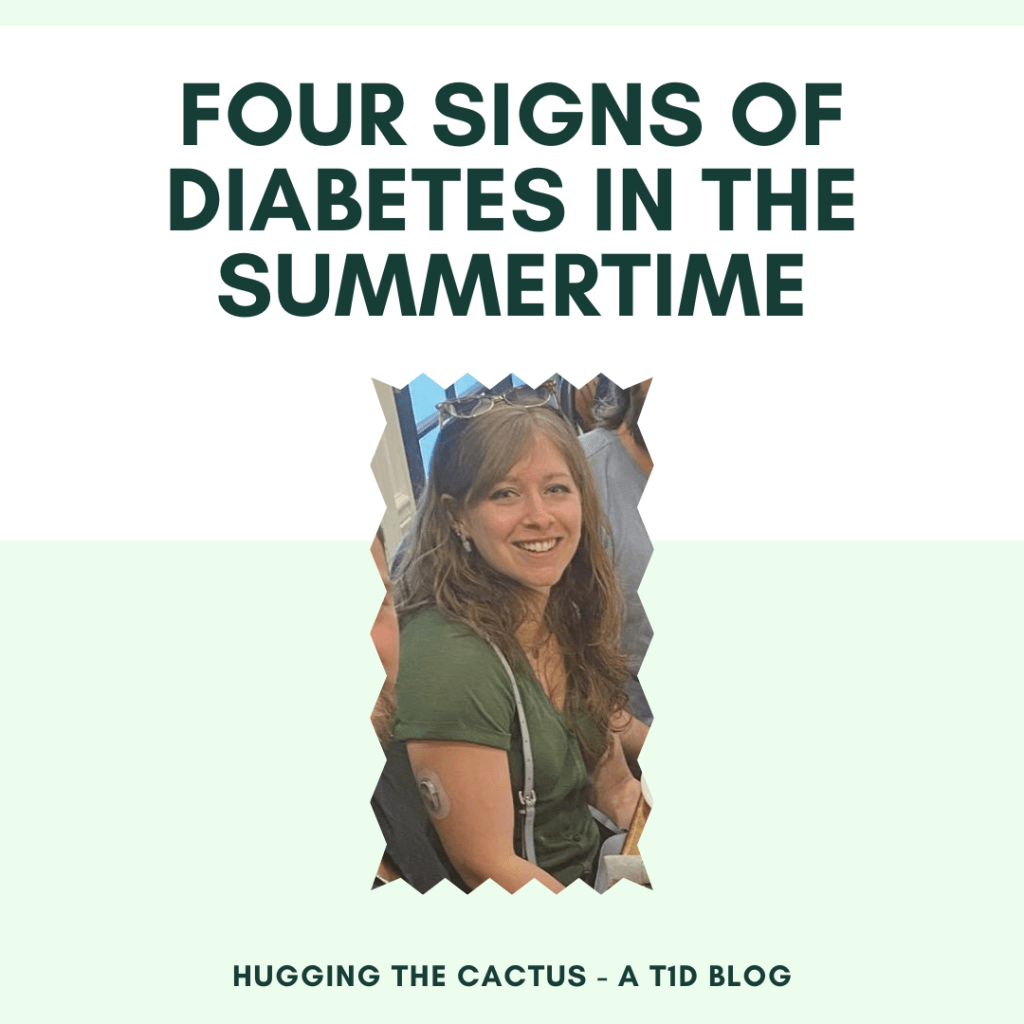
The summertime season is in full swing, and now that it’s here I’m thinking of the various ways my diabetes is more pronounced in the warmer weather. It’s much more visible, leading to many more questions, but what are the cues that give it away to others? I thought of four…
Visible sites. Shorts-and-t-shirts weather makes it much harder to place pods or CGM sensors in discrete locations. And if I’m going to the beach? There’s no way that I can even attempt to hide my devices. That’s probably why I make them even more obvious with…
…Pump and sensor art. I’ve written about Pump Peelz and GrifGrips in the past – they make adhesives and skins that are specially designed to fit pods, PDMs, pumps, meters, and more. The products they make are truly little works of art for diabetes devices, and I like to make sure all of mine are decked out in the summer months so I can show off tech that’s not only functional, but also stylish.I’m looking forward to donning my best beach-y Pump Peelz on what I hope will be many trips to the beach this summer.
It’s tough to “hide” diabetes in the summer when short sleeves and tank tops become wardrobe staples.
Gadget tan lines. Or if you’re like me, it’s more like sunburn lines. That’s because each summer, without fail, I somehow manage to neglect the space around my pod or my sensor, so when it’s time to remove it, there’s a huge red circle around the perimeter of where the device was situated. Maybe this year I’ll actually learn my lesson and take the time to apply sunscreen properly so I can avoid the very not-cute sunburn circles.
Travel coolers. This is probably the least obvious sign of diabetes in the summertime, but to those in the know, coolers meant to protect insulin are pretty recognizable compared to regular coolers. Whether it’s a Frio cooling pouch or another brand of insulin cooler, people with diabetes tend to carry these throughout the summer months in order to prevent insulin from spoiling due to heat exposure.
When my pod fails, it’s pretty obvious due to the fact it’ll emit a long, loud, impossible-to-miss BEEEEEEEEEEEPing sound. (Said sound tends to inspire immediate rage, but also relief because at least my device is letting me know that it’s not working properly.)
What’s less obvious is when a pod is malfunctioning, and the beeping sound doesn’t get triggered. In this context, I define “malfunctioning pod” as a pod that’s leaking insulin, or a pod that appears to have deployed the cannula correctly into my skin, but somehow it’s become dislodged.
Both of those scenarios are infuriating because they’re much more difficult to discover.
But lately, I’ve found myself dealing with both – more than likely, it’s just totally random, but it also may be due in part to the fact that I sometimes have more trouble with pods in the summertime. Heat and humidity don’t always bode well for my pod’s adhesive, and my pods have fallen victim to peeling up and off my body as a result of my sweaty summertime skin.
Since I’ve got recent experience with both types of malfunctioning pod as described above, I decided to share my tips on how to identify (and then deal with) these phenomenons:
Leaky pod: The first sign that my pod is leaking insulin is my blood sugar being higher than usual. If I’m bolusing for foods that I consume on a regular basis and seeing serious spikes afterward, I check my site by lightly running my fingertips around my pod, and then sniffing them to see if I can detect the pungent scent of insulin. It might sound kind of funny to go about it that way, but it really is the best way to confirm a leak as it’s riskier to just up and rip the pod off my skin to look for puddled insulin underneath. If I do smell insulin after my sniff test, then I will go ahead and change the pod – and double confirm my suspicions by looking at the leaky pod’s adhesive at that point in time. More often than not, the adhesive will be visibly wet around where the cannula is, and that is always a signal to me that the pod was indeed leaking and therefore responsible for my high blood sugars. And on a very rare occasion, a leaky pod will be obvious before it even goes on my body (as shown in the below photo), making it much easier to handle as I can address it before it starts to negatively impact my levels.
Dislodged cannula: You would think that I would immediately know if a cannula was no longer poking my skin, but honestly, it’s difficult to tell when it gets jostled out of place! And it’s even harder to figure out if the adhesive surrounding the pod is fully intact. So what are the signs of this happening? Well, high blood sugar is the main one, but I’ve also realized that itchy skin is another. It’s strange and I don’t have an explanation for it, but when my cannula is on the cusp of ejecting (or already has), my skin gets super itchy. If I’m experiencing that itchy sensation and my adhesive has already begun to peel around the edges, I don’t even question going through with a pod change, as I’m almost always able to visually confirm that my cannula is out of place. When I don’t have that visual guidance, it’s much more of a crapshoot and I still almost always end up changing my pod in an attempt to stabilize my blood sugar levels. After removing it, I can sometimes see that the cannula was bent at a funny angle or something to that effect, but I don’t always get that verification. In that instance, I just chalk it up to a fussy pod and then do my best to move on from it.
The big takeaway here? More often than not, my pods work exactly as they should. Every now and then, though, I have to deal with one that malfunctions – whether it’s a total failure or one of the other situations I described above. I’ve found that when I’m in doubt or suspicious that my pod isn’t working right, then it’s best to troubleshoot within reason before making the judgment call to change it. I’d much rather have to change my pod prematurely in order to maintain in-range blood sugars than deal with 3 full days (the lifespan of one pod) filled with highs and frustration.
But for real, this particular post isn’t so much about my diabetes and more so about my recent experience recording an episode of…the Hardly Focused Podcast.
Admittedly, I was slightly confused when my former colleague from an old job reached out and asked me to be a guest on a podcast he co-hosts. Why the confusion? Well, I wasn’t really sure what value I’d add to it seeing as it’s the first non-diabetes-related podcast that I’d be appearing on. Upon further conversation (and a little bit of my own research), I realized that the name “hardly focused” is hardly an exaggeration. The whole point of the show is to run the gamut of possible discussion topics. They’ve had guests come on to chat about everything from news, politics, sports, and pop culture, and I’ve got to say that such a varied show increased my interest because I liked that the gentlemen behind the podcast were open to talking about, well, anything.
So I agreed to join them for an episode recording, and I’m so glad that I did. I really appreciated the opportunity to talk about diabetes with people who admitted that they knew next to nothing about it. (See my most recent post for more on that topic.) I haven’t had the chance to dig into diabetes basics in a super long time, so it was a nice brush-up for me on how I choose to speak about my individual experience with it. Not to mention, it was pleasant to do so with two co-hosts who asked thoughtful questions and clearly knew how to keep a podcast interview going.
My episode of Hardly Focused will be available on Apple Podcasts, Spotify, and wherever else you listen to your podcasts later this week. In the meantime, check out the YouTube recording of the episode below:







 Hugging the Cactus