Across social media, I keep seeing the same type of photo pop in my feeds that sparks jealousy, triumph, fear, confusion, and hope all at once: the COVID-19 vaccine selfie, fondly referred to as the “vaxxie”.
I’m beyond happy that dozens of family members and friends have received the vaccine. It makes me feel good to know that they’re doing their part to help protect themselves and others, and it’s wonderful to know that the vaccine is being distributed to some extent.
However, I take issue with part of the distribution plan in my state.
Using my voice to hopefully change/improve the rollout of the vaccine in MA felt good.
In Massachusetts, COVID-19 vaccine rollout has been chaotic, to put it mildly.
It’s probably similar in many states, but the part that I find most frustrating is the fact that people with type 1 diabetes (and seemingly no other co-morbidity) are being lumped together with the last group of individuals to be vaccinated.
My endocrinologist confirmed this for me the other day during my virtual appointment: “Why is it [presumably her computer system] showing you in phase 3? You should be in phase 2…” I nodded vigorously and we talked for a few minutes about how disconcerting the whole vaccine rollout plan is. I explained to her that the Massachusetts chapter of #insulin4all was coming up with language to email to local representatives to implore them to do everything possible to prioritize vaccination for all people with diabetes, and a couple days later, I got my chance to do just that.
I looked up my local and state representatives with a quick Google search and emailed three individuals who are in positions to revise public guidance regarding COVID vaccinations. As soon as I hit “send”, I felt this amazing sense of empowerment – it felt good to do something about an issue that I’m very passionate about.
While I wish that I could do more to ensure change, I do feel a sense of pride that I tried to do something by using my voice. It represented the first (but certainly not the last) time that I plan on contacting legislators to help improve diabetes care, management, and accessibility of supplies – not just for myself, but for all people living with diabetes.
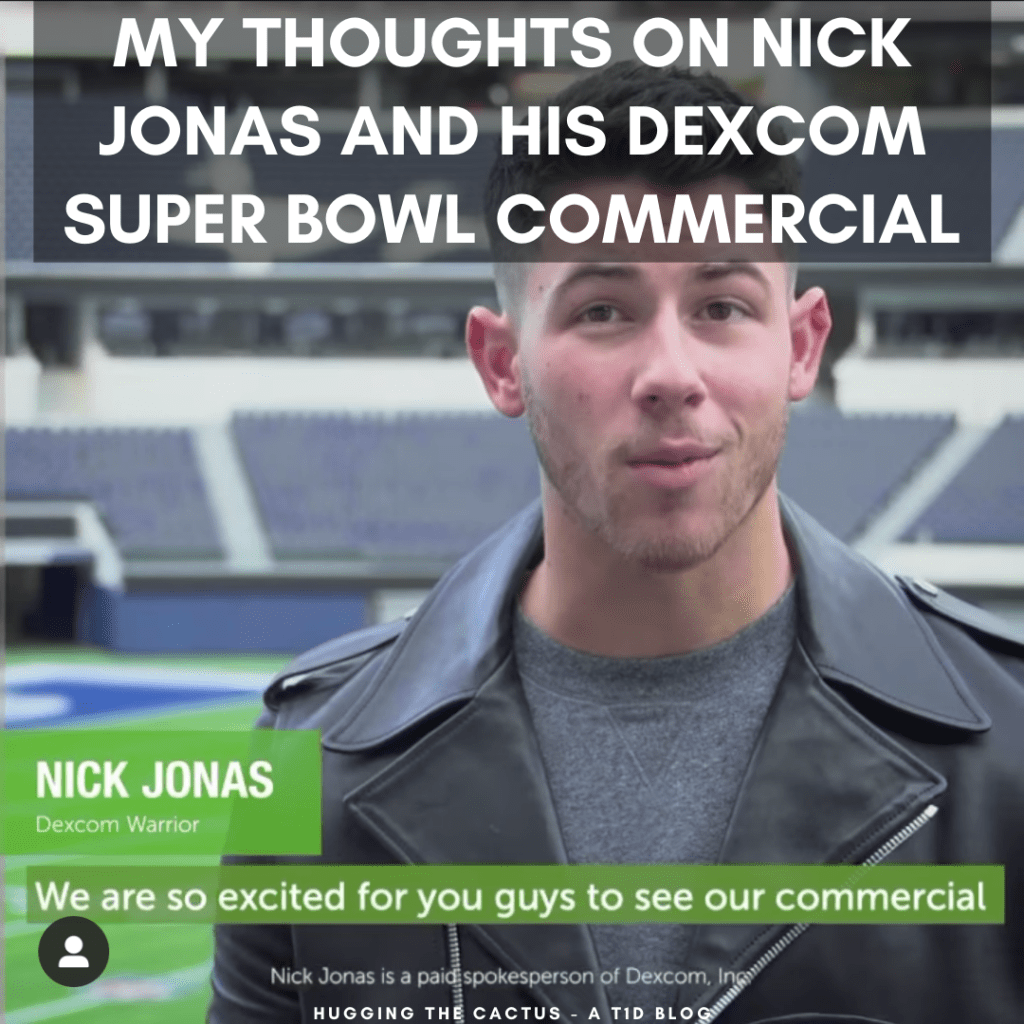
On February 2nd, Dexcom announced some major news: Nick Jonas – yes, the famous guy from that band – is starring in a Dexcom commercial that will be airing in a coveted Super Bowl Sunday advertisement slot.
This is pretty big for a couple of reasons, one being that Nick Jonas is now an official paid Dexcom spokesperson. In addition, this represents the first time that a diabetes company like Dexcom will be airing an ad that will be delivered to millions of Americans at the same time, which is definitely a big deal.
Upon hearing this news, the diabetes online community and I had some intense and justified reactions.
Nick Jonas is officially a Dexcom spokesperson, which generated some strong reactions from the diabetes community.
A lot of people expressed frustration that a superstar like Nick Jonas only ever seems to talk about his type 1 diabetes when he’s being paid to do so.
And listen, that frustration is warranted. It’s like the guy is trying to monetize his diabetes and it’s a little gross. There’s collective annoyance that Nick Jonas doesn’t use his (massive) platform and following on a more regular basis to advocate for diabetes. That’s a hard pill to swallow for a lot of us who have created blogs, podcasts, social media profiles, and more in order to help the diabetes community and beyond by doing things like raising awareness and talking about real issues regarding access to necessary diabetes care and medication (and so much more). So when Nick Jonas finally opens up about it, apparently it’s to advertise an expensive piece of technology that isn’t available to all people with diabetes. (And here’s my disclaimer: Yes, I use a Dexcom G6 CGM and I love it. But I’m very aware that I’m fortunate to be able to afford it because others cannot.)
It’s a little difficult for me to sympathize much with Nick Jonas here. Of course, I don’t know him (though I’m sure he’s a lovely guy and obviously he’s quite talented). I have no idea what it’s like to be a celebrity. He’s been in the limelight since he was a teenager. Many of us grew up with him. I can’t imagine what kinds of pressure he’s faced, so something like diabetes (a deeply personal condition) might be tough for him to talk about in a candid manner in front of the mass media. Or maybe he simply doesn’t know how to frame discussions around it. Who knows, but his acceptance of this sponsorship deal warrants the conversations that it has generated. Moreover, I can’t ignore his involvement with a non-profit that’s become infamous for accepting money from big pharma, which is massively problematic in the fight to make insulin affordable for all.
Let me end that line of thought by pointing out that he’s not the only person with diabetes featured in this commercial. There are two other “real-life”, non-celebrities living with diabetes who got this incredible opportunity to be featured in a freakin’ Super Bowl commercial. As someone who has participated in Dexcom ads in the past*, I can understand how exciting this time must be for these two people, and I hope that it isn’t diminished by the diabetes online community’s reaction to Nick Jonas’s appearance and sponsorship deal.
Now let’s pivot to the fact that Dexcom has dropped (probably) millions of dollars to appear in this Super Bowl ad slot…and signing a high-profile celeb like Nick Jonas as a company spokesperson likely wasn’t cheap, either.
It definitely leaves me feeling unsettled. Why did the company feel it was necessary to spend so much on this new advertising campaign? As my friend Stacey put it, Dexcom is putting corporate and celebrity money before patient needs. The reality here is that not everyone can afford insulin, let alone a “gratuitous” piece of diabetes technology like a Dexcom continuous glucose monitor. Elevating diabetes to the national spotlight only does good when it can do something about insulin access and affordability, or to raise awareness about it, or to explain how to recognize the symptoms of diabetes.
To sum it all up, I’ll share a thought from another person I’ve come to know from the diabetes online community: @miss__diabetes. The day that Dexcom announced the commercial, she tweeted:
Nick Jonas is the advocate of a privileged life with #type1diabetes. Doing super bowl ads tells the rest of the world that diabetics are living their best life with diabetes technology when the reality is diabetics are dying because they can’t afford insulin. #Insulin4all
A nicely phrased sentiment as well as a reminder that we’ve got a long way to go in the fight for affordable insulin, don’t you think?
*When I appeared in Dexcom advertisements, I was not compensated beyond the company paying for my transportation, on-set meals, and hotel. If you want to learn more about the experience, I wrote this blog post about it, and I am always open to answering questions.
Last month, I wrote about how I decided to join my state’s chapter of #insulin4all because I’ve been upset about the high costs of insulin for awhile now, and I want to do anything I can to help make it more affordable…not just in Massachusetts but all across the U.S., and even in the world.
Our first meeting was introductory, but the second one focused on legislative action.
Truth be told, I wasn’t exactly stoked on this topic because, well, I don’t find law-making particularly interesting. I always imagine a bunch of stuffy middle-aged white men sitting in a room and arguing about section X of law Y and I’m sorry, but…yawn.
However, I was surprised by how much I took away from this meeting that recapped the current state of legislation and action for the MA chapter of #insulin4all. Here are my big takeaways:
There’s a lot that one person can do in order to help make legislative change. It goes beyond contacting local legislators – an individual who offers their time, resources, and voice can do so much by learning the legislative process, attending hearing or floor sessions, testifying, and acting as a resource to legislators. As a person with diabetes, I have stories and knowledge to share that can help legislators really understand what a person with diabetes experiences and needs…and that in itself is a powerful tool.
Access to insulin is a human right that, unfortunately, we have to fight for.
Attempts at change have been made…and tabled. One piece of legislation we talked about extensively during this meeting is Kevin’s Law, which is named for Kevin “Howdy” Houdeshell. He passed away in 2014 from rationing insulin, after he was unable to refill his prescription for insulin due to his prescription being expired and the unavailability of his doctor due to the New Year’s holiday. This law would allow for pharmacists to dispense a chronic maintenance drug such as insulin to a patient without a current prescription in limited circumstances. In Massachusetts, the bill was reported favorably by the senate committee last March, but tabled in July due to a variety of factors. On the bright side, a meeting has been scheduled with a recently elected representative who could help revitalize discussions of the bill, so we can be hopeful that change will be made.
Public production of insulin is one way to make it more affordable. So this is pretty neat: California is the first state to establish public production of “biosimilars” that include insulin. This article that I’m linking to explains it best, but basically, this just means that the state of California is getting into the generic drug business to prevent price gouging and fight back against big pharma. But what’s really cool and exciting to me is that Massachusetts may be just as capable (in other words, have just as much market power as California) to produce generic insulin, too. MassBiologics is a non-profit, FDA-licensed manufacturer of vaccines that could also potentially produce insulin. Though I did a quick search and couldn’t find much on the matter, it’s a fascinating concept that could make insulin much more affordable in Massachusetts.
And those are just a few of the key points we covered in the meeting. I left the Zoom session feeling so much more informed as to how legislation works in the state of Massachusetts, and the steps that I can take to make changes not just as an individual, but as someone working with a motivated and knowledgeable group like the MA chapter of #insulin4all.
So…remember when I said I didn’t have time to rewrite a classic Christmas carol this year? (Please refer to last week’s post.)
Well, that was before inspiration struck.
Regular readers of this blog know that the cost of insulin has been on my mind a lot this year…so when I was thinking about that and a certain Mariah Carey song came on, I knew what had to be done.
Without further ado, please enjoy my rendition of Mariah Carey’s “All I Want for Christmas is You”…with the words changed with insulin affordability in mind. Do read/sing along to this – break out your best diva voice!
I think Nick Jonas should volunteer to sing my new version of this song…
I don’t want a lot for Christmas There is just one thing I need I don’t care about the presents Underneath the Christmas tree I just want insulin costs to go down More than you could ever know People with T1D deserve this win, All I want for Christmas is affordable insulin
I don’t want a lot for Christmas There is just one thing I need (and all PWD) Don’t care about the presents Underneath the Christmas tree We don’t need to pay so much To evil big Pharma (I) Eli Lilly won’t make me happy With generic insulin on Christmas day
I just want insulin costs to go down (ooh) More than you could ever know (ooh) People with T1D deserve this win, All I want for Christmas is affordable insulin (yeah, baby)
I won’t ask for much this Christmas I won’t even wish for diabetes to go (and I) I just don’t wanna keep on waiting For those prices to go low
I won’t make a complaint and send it To Amazon for their new insulin – (it’s lame) I won’t even roll my eyes When I file another insurance claim
‘Cause I just want insulin costs right (ooh) I’m tired of putting up this fight (ooh) What more can I do Oh, Baby all I want for Christmas is affordable insulin (ooh, baby)
All the pods are pumping So much insulin everywhere And the sounds of disgust over Insulin prices fill the air (oh)
And everyone is surmising (oh, yeah) Why are those prices rising? Santa won’t you bring me (yeah) What I really need (oh) Won’t you please make insulin affordable quickly
I don’t want a lot for Christmas This is all I’m asking for (I) I just want big Pharma to Listen to us all, for sure
I just want insulin for all (ooh) More than you could ever know (ooh) Help PWD win Baby, all we want for Christmas is affordable insulin (yeah, baby)
All I want for Christmas is affordable insulin, baby All I want for Christmas is affordable insulin, baby All I want for Christmas is affordable insulin, baby All I want for Christmas is affordable insulin, baby All I want for Christmas is affordable insulin, baby
I love Christmas, crafting, and some might argue that I love T1D (that’s mostly false, but when you’ve got a chronic illness, you’ve got to learn how to love some aspects of it…otherwise, you’ll be miserable).
So I recently *attempted* to combine all three of these things and do a little DIY project with an empty insulin vial.
And I learned a few things along the way…
I do not recommend messing with a glass vial without safety glasses, gloves, and a trash can nearby. I was lucky enough to avoid any major glass breakage, but some did happen, and I could totally see this craft getting wicked messy and potentially ouchie without taking the proper precautions.
Insulin vials are stable AF…they are not meant to be tampered with.
Glitter cannot be directly injected into an insulin vial. Period, bottom line, don’t even try it.
Okay, so now that I’ve got my disclaimers/lessons learned out of the way, let me tell you why I decided to fill an empty insulin vial with gold glitter.
For years, I’ve seen DIY projects floating around online involving old diabetes supplies. They range in the level commitment and skill involved, but there’s no questioning the creativity of our community when it comes to recycling supplies we’d normally throw away after using.
One project that I’ve seen over and over again is transforming an empty insulin vial into a Christmas ornament: Simply stick an ornament hook into the insulin vial’s rubber top, hang it on a Christmas tree branch, and bask in its beauty. I decided to take this concept to the next level by putting gold glitter into the vial because insulin is often referred to as “liquid gold” within the diabetes online community. What better way to represent that than to make it appear as though the contents of a vial were truly liquid gold?
In order to do this, I set aside a vial once I was finished with it/sucked every last drop of insulin out of it. Then, I made a sad attempt at combining glitter with water and using an old syringe to transfer it to the vial (needless to say, I had no luck). So I came up with a new strategy: Pierce the rubber stopper and try to funnel glitter in…and that didn’t work. It became evident that I’d have to remove the top entirely, so using my nifty new toolkit that my father just purchased for me (thanks, dad), I set about the task. I used a razor to carve the rubber stopper up and out, and then pliers to get the metal maroon covering off completely. I broke off a small piece of glass in the process – whoops – but using those tools did the trick for me…all I did after that was take the cap from a new vial of insulin and glued it to the top of the glitter vial to ensure most of its sparkly contents would remain inside.
And voila, here’s the end result:
Despite the glass breaking off, this DIY came out better than I expected.
As I held the glittery vial in front of my Christmas tree for a few photos (if I didn’t take pictures, then it didn’t happen), it occurred to me that there’s a strong likelihood that many families will have to make a difficult choice this holiday season: Give a special gift to a loved one, or use that money to pay for insulin instead. Or even more seriously, to have to choose between making this month’s mortgage/utilities payments, or getting life-saving medication.
The thought shook me, as nobody should have to make a choice like that ever.
And so I thought of something to add to my Christmas wishlist: affordable insulin for all.
On Saturday, December 5th, I attended my very first T1International #insulin4all meeting for the Massachusetts state chapter (virtually, of course).
What motivated me to join this meeting?
There’s a couple of factors…for starters, I’ve been a digital advocate for T1International for just over six months now. In that time, I’ve become familiar with their mission to not just promote diabetes awareness, but to empower individuals to share their stories and experiences with diabetes and fight for change to make insulin affordable for all.
I’ve spent the last few months reposting and sharing infographics and blog posts from T1International, but lately, I’ve felt the urge to do more because clearly, we’ve still got a long way to go when it comes to lowering the list price of insulin.
The problem for me, though, was that I wasn’t sure where to start, and since I work full-time, I was definitely foggy on how much of my spare time I could dedicate to a cause.
I’m excited to get involved with my state’s #insulin4all chapter.
I had a vague awareness that #insulin4all chapters existed across the country, but I didn’t know whether the one in my state was active or if joining it would be the right fit for me.
So I felt it was kismet when I saw an Instagram post from a friend I met through the College Diabetes Network (hi, Claire!) announcing that she was going to take over leadership of the Massachusetts #insulin4all chapter. Through her post and a couple of messages back and forth, I learned that the chapter had been stagnant for awhile and it was Claire’s goal to assemble a group to revitalize it and start making real progress in our state.
Our first meeting went incredibly well: A handful of people showed up and we got to know each other as well as the rough roadmap that would direct our next several meetings over the coming months. What really struck me is that everyone who attended obviously had diabetes in common, but on top of that, we all shared a frustration with the current cost of insulin, even though we haven’t directly felt the impact of it like other members of our community have. It seemed that each person felt motivated to work together to do what we can in our state, and to me, that was a sign that I was going to be glad that I joined the group.
What’s next for the Massachusetts #insulin4all chapter? I’ll be sure to share it as we develop goals and set out to achieve them!
This post originally appeared on the T1International blog on November 30, 2020, and it was written by Marina Tsaplina. I am sharing it here today because it made me start to think about creativity and activism as a unit for the first time. Want to know exactly what makes it so powerful to join art with activism? Read on…
When I think about activism, I think about creativity. The two are inseparable. Think about how much creativity and strength it has taken the #insulin4all movement to:
Counter the stories put out by the for-profit U.S. health industry about why insulin “has” to be so expensive and transform the national narrative around insulin affordability
Continually transform the pain in our community into stories for change
Imagine a world where insulin is affordable and accessible for every single person who needs it to live.
#insulin4all, as a banner of the movement, is itself an act of fierce creativity. It imagines a world that we do not yet have, one that countless activists are organizing to bring forward. The courage and imagination that this statement holds brings forward a vision for the world we want to see. It makes it possible to strategically identify those whose actions harm or block us from achieving this vision. And under the banner of the #insulin4all vision – this dream that we are turning into a reality – we organize and strategically map out the steps we must take in order to achieve the world we want to see.
#insulin4all also means a different thing for each of us: each person who joins the movement has their own personal meaning and reason for why we join. And it is these deeply-felt personal stories that make adding art into advocacy and activism actions so powerful. It is another way to bring our personal voice into a collective movement for change. It is also fun!
Here are five reasons – showcasing #insuiln4all and other social change movements around the world – why joining art, creativity and activism together is so powerful. It fosters self-expression, community building, activation, it is inspiring and attention grabbing, and it leads activists to better engage with the media.
1. Self Expression
Getting creative helps hone your personal advocacy voice, transforms a personal feeling into a political message, and contributes your creative spirit into collective creativity. It also helps people feel that every single person’s voice matters. Because each voice does matter. Community art making is a deeply democratic process.
Patient activists pictured below are expressing their personal stories. As another example, signs created by individuals from the disability community NoBody is Disposable call for an end to the discriminatory medical rationing policies during #COVID19.
2. Community Building
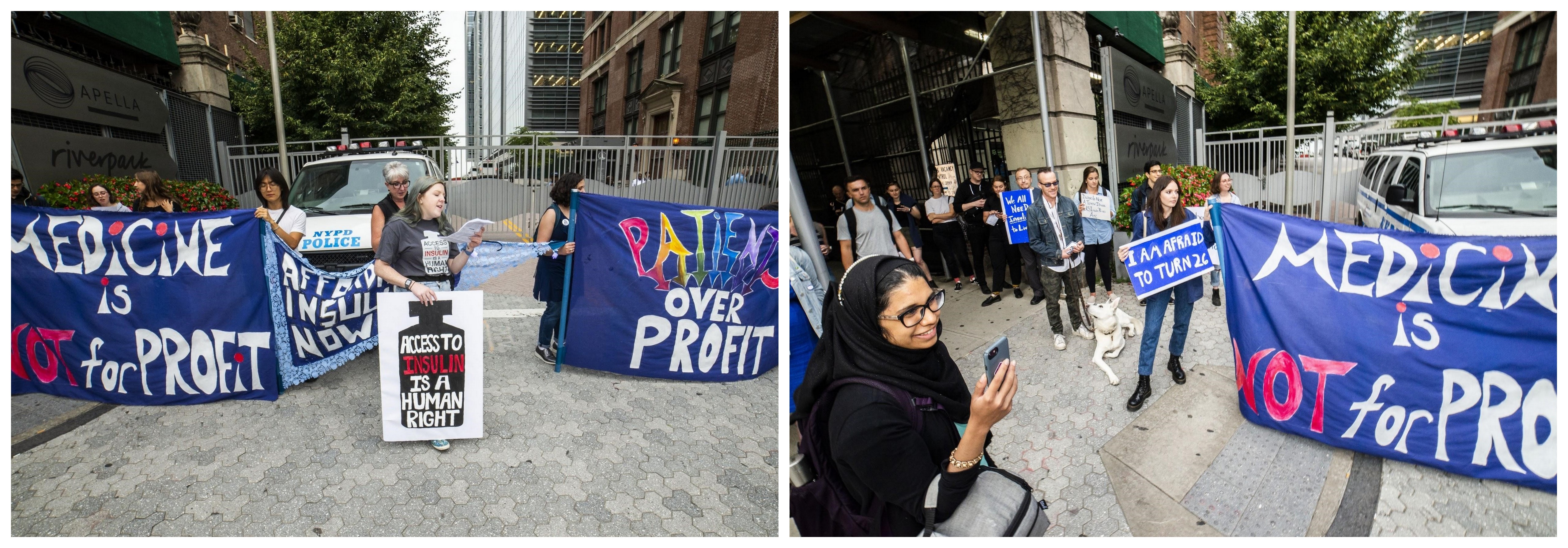
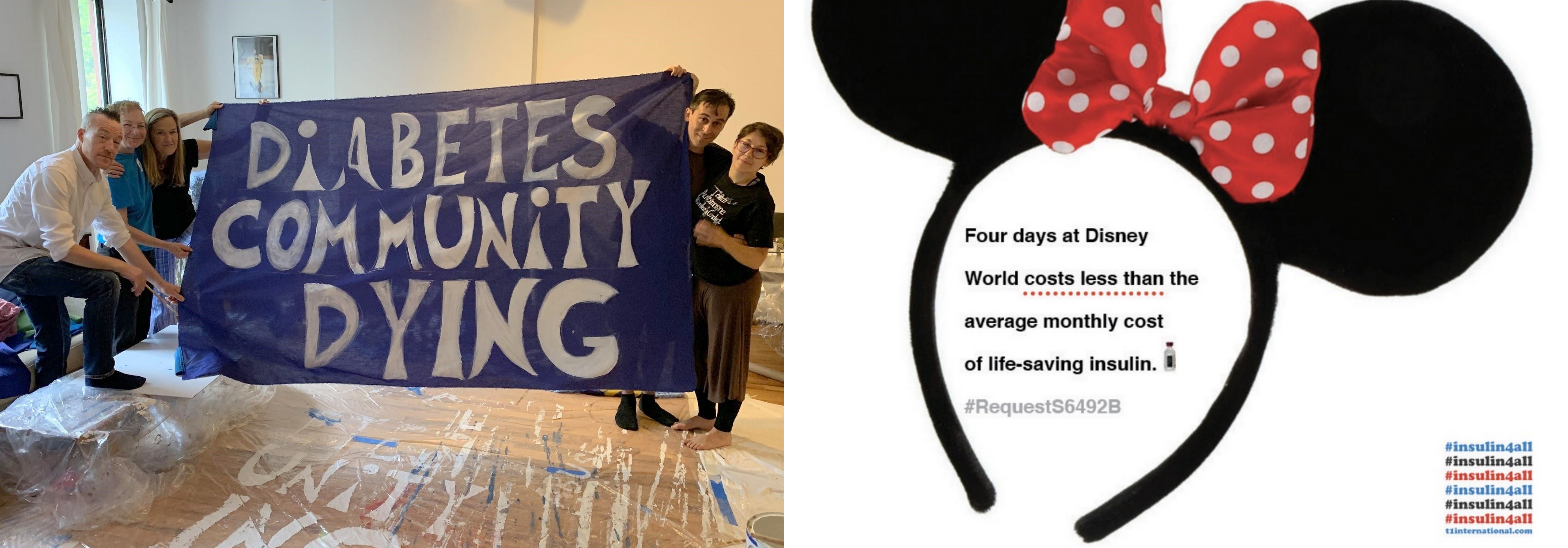
Working on an art-build is a fantastic way to build community. Pictured below is one of the in-process photos from advocates making large banners for the New York #insulin4all Chapter and actions. The Chapter was still new and forming, and the art-making process, as well as the many advocacy actions the Chapter continues to do, forms connections between the members. Yes, it takes energy and effort, but once you’ve done it, you have the materials to use in many future actions! Not to mention, people showing up to contribute helps each of us know we are not alone in this fight.
This below pictured postcard was designed by New York #insulin4all Chapter member Annalisa van den Bergh for advocates to fill out and send to the governor. This is a great example of digital (and safe!) advocacy during COVID.
Community artist and organizer Rachel Schragis created screen-printed signs and banners, and led on the creation of many concepts for the Sunrise Movement, because climate health = public health = our health.
3. Political Activation
There’s no one right way to join creativity and advocacy – the image here shows the powerful way an imprint of a red hand across the mouth united indigenous women and allies across Turtle Island (United States and Canada) to bring awareness to the gender-and-race-based violence being perpetrated against indigenous communities.
Being immersed in creative energy opens the space within people to reflect on their own experiences, share and unite in dialogue with others, share opinions, build knowledge and commit to actions. People may often feel embarrassment, or shame, for being unable to afford insulin. This is how oppression works: we internalize external causes and place the blame on ourselves. Creative activism helps activate and engage a person to realize that their suffering has social origins, and helps inspire them to become an advocate and activist who works for policy change.
4. Inspiration and Attention Grabbing
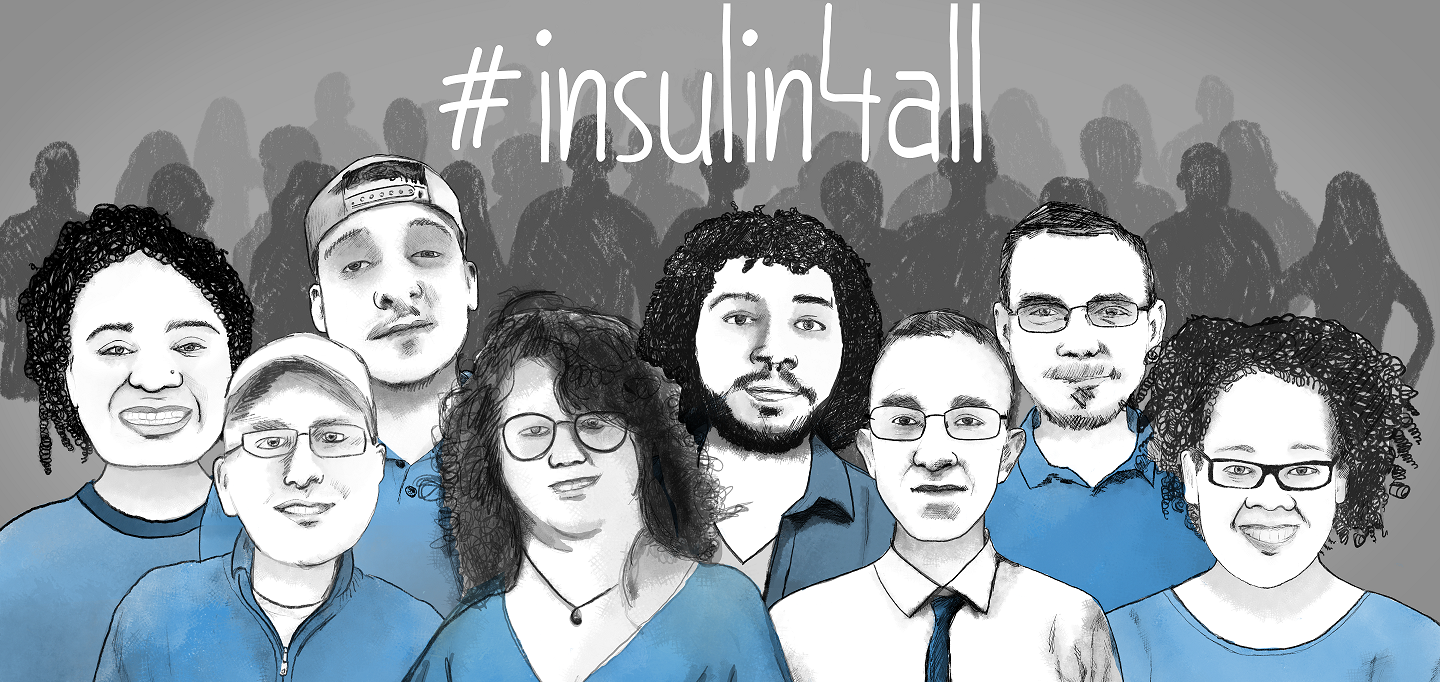
To build energy and grab attention of the public to join your cause, there’s no better way than through creating a bit of a public spectacle. The large banners that the New York Chapter created took up space, and made our messages loud and clear for both the media, and passers-by. The portraits below of the lives lost to insulin rationing by artist Mike Lawson created a deeply-felt homage in helping us mourn the sons, daughters, sisters, brothers, mothers and fathers we have lost to pharmaceutical greed.
Giant puppets have a long and deep history in activism, including the HIV/AIDS movement and beyond. Little Amal, a giant refugee puppet, embarked on an epic journey from Syria to Europe in order to “rewrite the narrative about refugees”.
5. Media Engagement
Finally, by uniting creativity, purpose, emotion and action and creating attention-grabbing visuals, our cause is more likely to catch the attention of social media, and the press. Strong, clear messaging, unique perspectives, and inspiring visuals unite joy, inspiration and purpose in the long, winding road of social change.
Most of all, art and creativity helps us remember the most important thing: We are unstoppable, and another world is possible!
This post was originally published on the T1International blog on October 27, 2020. I am reposting it here because this situation is completely, utterly horrifying and heartbreaking. As a community that collectively lives with the same chronic condition, we must come together and help Iranian people with diabetes be heard. It’s a grim reminder that the notion of “insulin for all” does not only mean that we must fight for affordableaccess to insulin, but we must also fight for access, period. And that simply isn’t how it should be.
To be honest, “there is no insulin” is the actual situation. Shortages of insulin are not something new in Iran, but recently there is no insulin at all. We were shocked by responses from our politicians who said, “The shortage is just for pens and we have plenty of internal production of insulin. People can replace it.” However, the types of insulin that are produced in Iran are NPH and R. Few consumers in Iran use NPH. About 70 percent of Iranian people with diabetes use insulin pens.
I myself could only find Novo Rapid insulin that was 10 times more expensive than what I normally pay – and what I paid about three weeks ago. The cost was not logical at all. We have heard many heartbreaking stories. For instance, there was a mother who did not feed her children with diabetes because they couldn’t find insulin.
We’ve made groups on social media and we are using hashtags to support each other with our own insulin, even if we are worried that we won’t have enough. In these days of quarantine, there are already a lot of people dying in Iran because of coronavirus. Now we worry that we will lose more because of the insulin shortage.
“I worry that the promise of insulin was meant to make us silent, but we have to keep speaking out.”
People have to search lots of pharmacies in their city. If they are lucky, they can find two or three pens (usually only short-acting ones). Recently, the only available type of long acting insulin pens are with insulin called “Basalin”. There is no international evidence and confirmation of safety (such as FDA approval) for this medicine.
In Iran, we just have access to glucose meters. There are no other advanced devices available, such as continuous glucose monitors or other sensors. But now, in addition to our insulin problems, we have to cope with the shortage of glucose test strips, too. How can we control our blood sugar levels without them?
As far as we can tell, it seems like our own government does not consider the current situation to be a serious issue. These days are suffocating for us. We are so unsure about everything and we don’t know exactly why this happened. When we seek an answer, we don’t get a proper one. Some say it is because of the economic sanctions imposed on Iran by the USA. Political issues should not affect something like that. People’s lives matter.
The government of Iran reacted to recent protests by saying they will distribute 600,000 pens of insulin, but they did not mention the type. Although some of us have found insulin, others are still searching pharmacies and can’t find any. I worry that the promise of insulin was meant to make us silent, but we have to keep speaking out. Thank you for helping us to be heard.
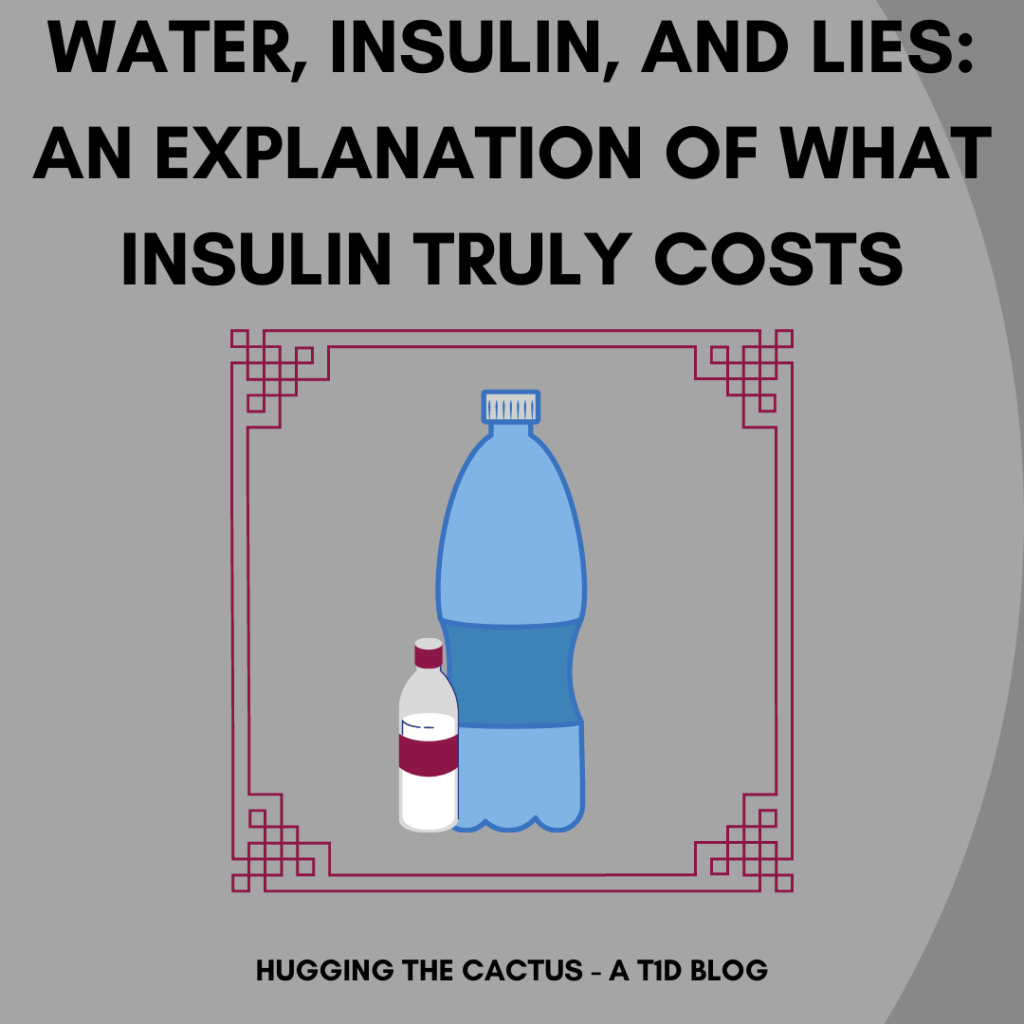
Let’s talk about a couple of life-saving liquids for a moment: water and insulin.
Water is a clear liquid that quenches thirst and hydrates. It is essential for human life and costs $1.69 per one liter.
Insulin is a clear liquid that manages blood sugar levels. It is also essential for human life, but it costs $300 per 10 milliliters.
That’s outrageous on its own (and its something I’ve written about before, and will continue to write about, until insulin is affordable and accessible to all).
But what’s even more bewilderingly egregious is the fact that on September 29, 2020, the President of the United States of America lied about his actions (or shall I say, inactions) taken to lower the cost of insulin during the first presidential debate.
My jaw dropped when I heard him boast that he’s reduced insulin prices 80-90% and that it’s “like water” for people with diabetes now.
There are so many things completely and utterly wrong with that statement that it’s almost impossible to cover them all, but let’s start with the bill I paid for my last 90-day supply of insulin. I forked over $200. If I was uninsured, I would’ve had to pay $1,236.15.
I don’t know any water in the universe that costs $200, let alone $1,236.15.
The title of this blog post could be a book title…in fact, I bet there are people who really could devote entire books to this subject. Rightfully so.
I’m not going to mince words here: Under our current President, the cost of insulin has not lowered. And if you think I’m exaggerating his lack of delivery on his promise to do so, then please read the following from my friends at T1International regarding executive orders that were released in July (if you don’t have time to read the entire thing, please read the first paragraph):
On July 24th*, President Trump released four executive orders intended to lower drug prices, including two targeted directly at lowering the cost of insulin for patients who rely on it. Despite his assertion that these orders are intended to “completely restructure the prescription drug market,” these orders will not do anything to fix the underlying cause of the insulin crisis in America. Patients will still need to wait months for the rulemaking process to run its course, and likely even longer after that if these orders end up in court. While T1International is glad that the administration has stated that making insulin more affordable is a priority, these orders miss the mark. We don’t need incremental bureaucratic steps as an election approaches – we need transformative change that will make our medicine more affordable now.
The two orders that are most relevant to the lives of people with diabetes are the order that requires federally qualified health centers (FQHCs) to allow patients to purchase insulin directly from the FQHC at a steeply discounted price, and the order that builds on the plan released by the Department of Health and Human Services to allow for the importation of drugs such as insulin from Canadian manufacturers. Neither order would hold Eli Lilly, Sanofi, and Novo Nordisk accountable for their price gouging, nor would they do anything to reduce the list price of insulin, which has soared by well over 100% since 2012.
As previously noted on T1International’s blog, getting insulin through a 340B pharmacy can help patients to afford this life-sustaining medication. On the surface, President Trump’s order to make it easier for patients to purchase insulin through an FQHC seems helpful. However, his executive order ignores that FQHCs were never the problem with the 340B program in the first place. It is hospitals that are most responsible for taking the discounts offered by the 340B program, and they use those discounts to generate profits, rather than serve patients.
Similarly, #insulin4all advocates know better than most that the insulin they need, which costs hundreds of dollars per vial in the United States, is more affordable just across the border in Canada. However, the Canadian government has already made clear that they are not interested in exporting Canada’s supply of medicine en masse to the United States just because the U.S. government refuses to confront Big Pharma and lower drug prices for the exact same medicine, rendering this policy ineffective on a broad scale.
99 years ago today, Frederick Banting and Charles Best first isolated insulin, which would soon make it possible for people with diabetes to manage their condition. But since then, unchecked corporate greed has put this life-saving medication out of reach for too many people. President Trump was correct in diagnosing the problem and its solution before he even took office when he said that pharmaceutical corporations are “getting away with murder.” Since then, he has considered every policy option available to bring drug prices down except for the most obvious: action that will reduce medication list prices for everyone, including people without insurance. If the president really wants to lower the price of insulin and address the crisis of high drug prices, he already knows the solution; the question is whether he has the political courage to pursue it.
*On September 13, President Trump released a new executive order that would implement a “most favored nation” price for drugs under Medicare Part B and Part D. Patients need relief from predatory insulin prices now, but the President’s executive order won’t deliver. While this Executive Order could dramatically lower insulin costs for some senior citizens if it goes into effect, that could take months or years if it ever happens at all — and patients don’t have that kind of time to wait for change. Rather than make announcements he can tout on the campaign trail, the President should use his existing authority under federal law to bring down the price of insulin immediately.
Frederick Banting said it all when he remarked: “Insulin does not belong to me, it belongs to the world.” And that is a sentiment that I will be taking with me when I go to vote this November.
This was originally published on the T1International blog on August 21, 2020. I am sharing it here today because it is incredibly important to me that you, readers of this blog, and the entire diabetes online community collectively understand how serious this matter is to me. I firmly believe that there is no place for bullying, hate speech, or disrespect in any type of interaction, regardless of when or where it takes place. It truly sickens me to think that anyone has tainted this hashtag with ugly personal attacks and I implore anyone using this hashtag to use it with the utmost respect and kindness – anyone who chooses not to do so diminishes the message behind this movement and harms the diabetes community as a whole. As for myself, I can promise you that as both the creator/writer behind Hugging the Cactus and as a T1International digital advocate, you can always expect me to interact with others in an open-minded, respectful, compassionate manner, no matter what.
T1International has been made aware of a recent increase in hateful speech, as well as disrespectful and non-collaborative behavior on the #insulin4all hashtag. While hashtags cannot be owned by anyone, T1International’s global work is tied to #insulin4all. As one of the creators of the hashtag, we want to acknowledge our concerns over these issues and set clear lines about what we stand for as an organization, and what we do not. We do not stand for or tolerate bullying, hate speech, abusive language, or words or actions that are intended to demoralize others.
The History of #insulin4all The #insulin4all campaign was launched in the lead up to World Diabetes Day in 2014 by T1International and other organizations. Although World Diabetes Day began in 1991 in order to “draw attention to issues of paramount importance to the diabetes world”, the organizations felt that the true spirit of the day had been lost. The campaign was an effort to emphasize that people living with diabetes struggle to survive or face extreme difficulties because they cannot afford or access their life-saving insulin, blood glucose test strips, or basic healthcare. Others are caught in conflict or living in countries where there is little humanitarian assistance for people with diabetes. Many suffer complications and premature death without affordable or sustainable access.
The #insulin4all hashtag caught on quickly, and, in many ways it took on a life of its own. Advocates across the globe use the hashtag on various online platforms and in-person as a rallying cry to support their efforts to improve the lives of people with diabetes.
T1International’s #insulin4all Chapters T1International’s USA Chapters and some of our Global Chapters have #insulin4all in their names, which reflects the grassroots nature of the movement and the volunteer efforts, though the Chapters are supported by the T1International Team. All Chapter Leaders and Leads sign an agreement to abide by our policies and values. Through this agreement, they are specifically required to act in a way that is respectful and that represents T1International in a professional manner, honouring T1International’s values and upholding the charity’s reputation. Chapter Leaders and Leads are also provided with guidance and tools for engaging in-person and digitally in ways that reflect the respectful, inclusive, and intersectional movement that we are collectively building.
This slideshow requires JavaScript.
What #insulin4all Means to T1International
T1International sees #insulin4all as a community-led effort that is not solely focused on one person, entity, or country, but is a collaborative effort to bring equality to all people living with diabetes. This involves not only a fight for equality through affordable access to insulin, supplies and healthcare, but equity and inclusion when it comes to people with all types of diabetes, from all socioeconomic backgrounds, races and ethnicities, gender identities, countries of origin, and more. There is a lot of work to be done, and we believe in doing that work together wherever possible. We believe in doing it respectfully, transparently, and in a way that upholds our values.
The #insulin4all movement has built significant power, and there is a great need to use that power responsibly to advance the cause. When that collective power is focused on those responsible for the problem that have the power to fix it – that means Eli Lilly, Novo Nordisk, and Sanofi, along with other actors that want to profit on insulin even if it means people die because of its price – it is unifying for the community, and serves as a force for driving change.
When that power is focused on people who aren’t in a position to make change themselves as individuals – and especially when that focus intersects with other sources of power like white privilege, economic privilege, hetero/cis privilege, and other types of privilege – it ends up being a source of division and moves us further from our end goal of affordable insulin. Holding the Big Three and their executives accountable is categorically different from attacking individuals who aren’t in positions of power.
What #insulin4all Does Not Mean to T1International As a small team of staff that are deeply committed to the values outlined, it pains us to see the hashtag and, thus, the affiliation with T1International’s name being used in harmful ways. It is worth reiterating: we do not stand for or tolerate bullying, hate speech, abusive language, or words or actions that are intended to demoralize others. Using the #insulin4all hashtag to attack people of color, members of the LGBTQ+ community, any marginalized group – or any person or group for that matter – is actively harmful to the movement. We do not believe in meeting problematic behavior with problematic behavior. We believe in calling out unhealthy or damaging behaviors – like the pharmaceutical industry’s price-gouging – in ways that are bold and that ignite change to improve the lives of patients, but are not vicious.
We hope that the #insulin4all community, and whatever it means to each member of that community, can come together over the shared aim of improving the lives of people with diabetes, starting with making insulin affordable and accessible to everyone who needs it. As the fight continues, we ask that our volunteers and supporters approach these issues with the same outstanding passion and commitment we see every day, while being open-minded and respectful in their approach.



 Hugging the Cactus