I have some exciting news…I’m switching to the OmniPod DASH!
While I won’t start using my DASH until after my old OmniPods are used up (first generation OmniPods aren’t compatible with the DASH PDM), I’m still really excited about switching things up. Nearly a year ago, I expressed my desire to switch to the DASH in addition to my frustration that it would be more expensive for me to make the change.
But with a new job comes new health insurance and a whole new set of “rules” that I’ve been figuring out in the last couple of months.
And let me tell ya…it hasn’t been easy. But more on my struggles to get my basic diabetes prescriptions filled under my new health insurance to come in a blog post very soon…
Violet is excited about my new DASH PDM, too!
Anyways, back to the DASH. When I called Insulet to report a failed pod not too long ago, the representative I was speaking with was asking me if I’d heard about or was interested in the DASH system. Normally, I would’ve brushed her off and explained that I was only interested in getting a replacement for my failed pod that day, but I happened to have some spare time on my hands and decided to ask her if she could see if/how my new insurance would cover the DASH.
She kindly did some research and reported back to me that yes, it was indeed, and that all I’d have to do is get my doctor’s office to prescribe some DASH pods to me and in the meantime, Insulet could send my DASH PDM to me so that I had it on hand when I was ready to start using it. What really sold me, though, was the price – I’d be paying less for a 90-day supply of DASH pods than what I was paying for regular OmniPods under my old health insurance plan.
It was a no-brainer, really.
Even though I’m not DASHing away to start up my DASH (again, gotta make use of those old pods first), I’m still looking forward to getting acquainted with a new piece of diabetes technology that will feel familiar to me because of my years on the OmniPod system. I can’t wait to share more when I finally get DASHin’!
This post was originally published on Hugging the Cactus on June 3, 2020. I’m sharing it again today because I have seriously benefited from learning the “true” length of time that a single OmniPod lasts on my body. Read on to learn more…
When people notice my OmniPod insulin pump, the first question that I’m asked is “what IS that?”
After I explain that it’s my insulin pump, and it’s called a pod, the second question I’m asked is some variation of “how long does it last?”
The canned answer that I provide is something about having to change it every three days, because that’s how the OmniPod is advertised.
But I’ve used this pump for years now and never bothered to really test this three-day limit. I’ve known for a long time that my pod works a handful of hours after the expiration alarm starts chiming, but I wasn’t sure about exactly how many hours I had before a pod expired for good.
So, the other day, I decided to find out.
Have you ever made your pod last longer than 80 hours? If so…are you a wizard???
My pod expired at 10:22 A.M. Since I prefer to change my pods in the evening, I figured it was the perfect time for this little experiment, assuming that the pod really would last me for the majority of the day.
And, well, it did! At 10:22 on the dot, the pod beeped at me to notify me that it was expired. And in the six hours after that, it would alarm every hour (on the 22nd minute) to remind me, time and time again, that it was expired. In the seventh hour – beginning at 5:22 P.M. – my PDM started chirping at me on and off every 15 minutes or so. First it was because I was running out of insulin, but then it was to really get the point across that my pod was expired!
I was determined to use every last drop of insulin in the pod, though, so I bolused for my dinner around 5:45 and I was pleased to discover that I got my full dose of insulin without any issues. As I was cleaning up after dinner, that’s when the signature OmniPod BEEEEEEEEEEEEEEEEEP went off as one blaring, unceasing alarm. I checked the time: 6:22 P.M.
So there was my answer. An OmniPod can last precisely 80 hours after you initially activate it for the first time (or in other words, 8 hours after you receive the first expiration message)…as long as it still has insulin in it. It’s definitely something good to know for sure now, because in the future, it might come in handy and help me avoid wasting precious insulin.
A “yay”: Summer is here!!! Hooray for warm weather, beach trips, and backyard BBQs! (Not to mention VACCINES!)
A “nay”: My pods and my CGM sensors are about to bare themselves for the world to see and we are NOT READY for it.
My confidence in my appearance is rarely, if ever, high. But I like to fake it ’til I make it and act like I’m rocking my summer wardrobe instead of stressing about how my legs or arms look in the staples of the season that are designed to show more skin.
Usually, I have a lot more success in feeling good about how my medical devices appear on my body. Whether they’re hidden under my clothes or out for the world to see, I typically don’t care because these gadgets are keeping me alive!!! And that’s a lot more important than any negative body image connotations they may create.
A picture from a time during which I was very okay with PDA (public displays of my arms).
But something about this year feels different to me. I am so not looking forward to the extra stares that my diabetes technology attracts. I’m not sure if it has to do with being sheltered in the last year and a half because of the pandemic, but whatever the cause may be, this is something I’m grappling with as the temps creep up and the temptation to hit the beach grows stronger.
I know I’m not the only one dealing with this. In fact, I was in Maine for a couple of days with my parents and I was wearing my pod on my leg, whereas my mom had hers on her arm. And we had multiple people approach us about our pods! They weren’t necessarily rude in their approaches – curiosity drove them to speak with us and that’s innocent enough – but it’s still weird to know that people are looking closely enough at our bodies to see our devices and feel comfortable enough to ask us about them. Plus, I felt extra self-conscious about it because in typical Molly fashion, I had a sunburn all around my pod thigh site…when applying sunscreen, I almost always miss the area directly around my pods because I’m afraid of the sunscreen making my adhesive weaker or interfering with the pod’s functionality. So not only did I have this big chunk of plastic sitting on my leg, it was also red all around the site, drawing even more attention to it. It was a relief when I was able to put shorts on over my swimsuit and cover up both the burn and the pod.
So while I’m not loving how wary I’ve felt lately about baring my diabetes devices, I’m also coming to terms that it’s just a sort of phase that I’m going through right now. And that’s okay. I’m also trying to remind myself that I don’t have to feel obligated to go into detailed explanations when people ask me about my pod or CGM. It’s a natural tendency that I have to use it as a teaching moment and be a good diabetes advocate, but sometimes I just don’t have the energy for it. I’m keeping my fingers crossed that as the summer season goes on, my comfortability with my diabetes devices increases and I worry less about the looks they tend to draw.
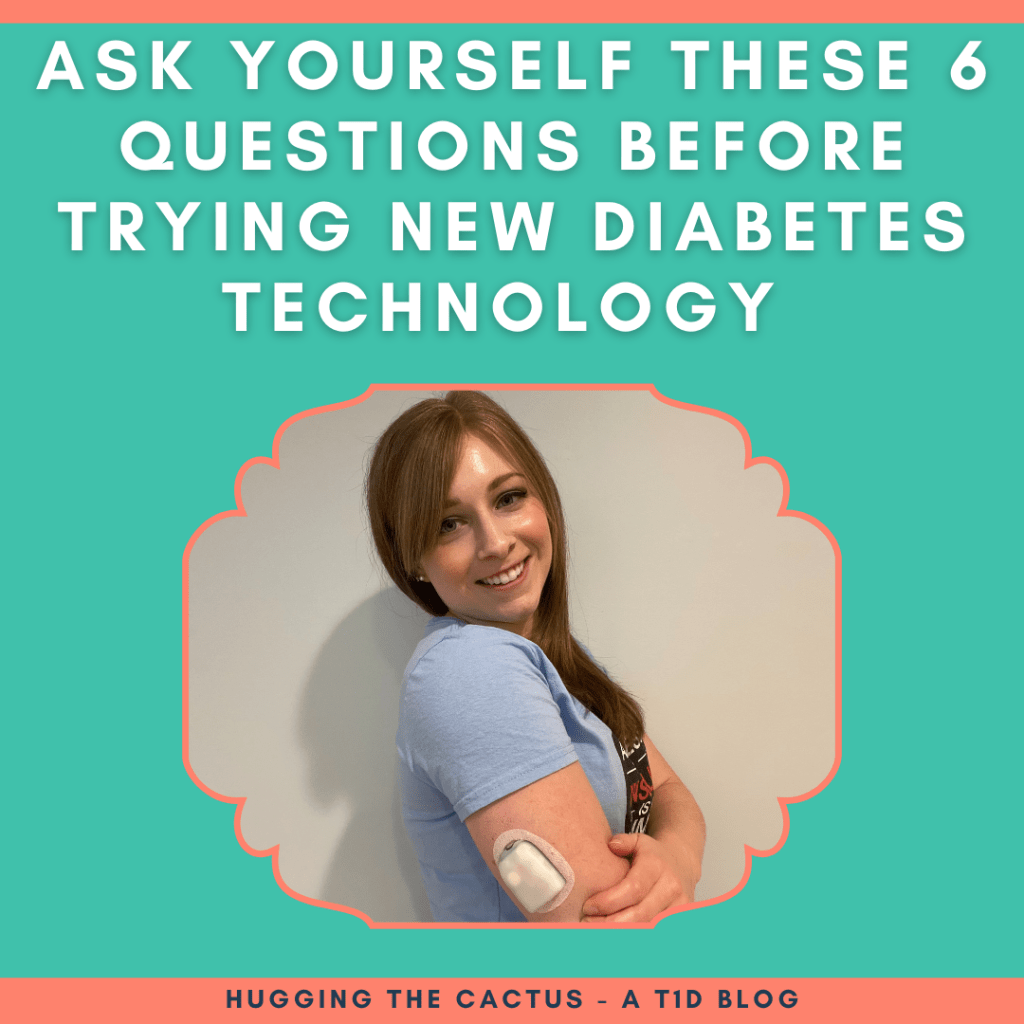
This blog post was originally published on Hugging the Cactus on May 13, 2020. I’m sharing it again today because I think it’s super important to weigh the answers to these questions before deciding to try new diabetes technology. This is coming from someone who waited 17 years before she tried her first insulin pump, and even though it has had an enormously positive influence on my life and sometimes I wish I’d tried it sooner, I’m ultimately glad that I waited that long! Read on for more details…
So you want to try your first continuous glucose monitor. Or maybe you’re ready to leave behind multiple daily injections and switch to insulin pump therapy. Whichever diabetes device you’re looking to start using, there are some questions you’ll probably want to have answers to before decide that now’s the time to introduce new diabetes technology into your daily routine.
The following is a compilation of the questions that I thought long and hard about (literally for years) and that I wish I’d thought long and hard about before I made the transition to the OmniPod insulin pump.
1.Am I ready for it? It took me 17 years before I decided that I was ready to try an insulin pump. 17 freakin’ years!!! I spent most of that time being too afraid of introducing such a drastic change to a routine I’d had down pat for such a long period of my life. There are times when I wish I’d gone onto my insulin pump sooner, but ultimately, I’m glad that I wasn’t swayed by my family or doctors to go on it before I truly felt ready. By the time I started using my OmniPod, I had the maturity, responsibility, and emotional intelligence that I felt that I needed for an insulin pump.
2. Will I be able to afford it? Obviously, this isn’t a question that I wondered about when I was younger, but it’s one of the first things that comes to mind as an adult on her own health care plan. We all know that diabetes supplies are expensive, and it seems that the more technologically advanced something is, the more money that has to be forked over in order to obtain it. This isn’t right or fair, but it’s a simple truth and an important one to think about before choosing one pump or continuous glucose monitor over another.
3.Why do I want to start using it? I wanted to start using my OmniPod because my mom experienced great success when she started using it. And I decided to get a Dexcom CGM because I fell in love with the technology after undergoing a trial period with my endocrinologist. In both situations, I felt very much in control of my decision to start using these devices and I didn’t really listen to anyone else’s opinions. But I am very aware of the fact that social media and real-life friendships with other people with diabetes can often sway people in different directions. After all, if I saw a post on Instagram from a dia-influencer who was singing the praises of a Tandem T:slim pump, then I might seriously start thinking about switching to it (this has actually happened to me). But the bottom line is to think about the why – will this device enhance quality of life for me? Will diabetes be easier to manage with it? Will it help me achieve my A1c and/or blood sugar goals? Do I need to add something new to my routine because I’m feeling burnt out by doing things the same way all the time? Knowing why I wanted to use an OmniPod or a Dexcom CGM made me feel that much better during the whole process of learning how to use them – I felt like I had clear goals that would help me navigate the integration of these new technologies into my daily routine.
Did you know that Insulet/OmniPod has demo pods that you can wear? They don’t hold insulin or deploy a cannula, but they can give you a good sense of what it’s like to wear a pod on a daily basis!
4. Will I be comfortable wearing it 24/7? This is a big one! Pods, pumps, and CGMs are very visible, and it can be jarring to go from being “naked” to having bumps and lumps underneath clothes that can get caught on doorknobs, chairs, and the like. Personally, the benefits of my OmniPod and Dexcom outweigh something like this which is a bit superficial, but that doesn’t mean it’s not something to think about. But it’s also worth thinking about comfort and what is least painful when it comes to insulin delivery, so that’s why this is an important question to ask.
5.Do I know anyone else using it who can provide feedback from a patient’s perspective? I’ve talked about this before, but I’m not sure when, if ever, I would have seriously considered using the OmniPod if my mother hadn’t tried it first. The fact that we both have diabetes has probably made us a little closer and strengthened our bond, so if there’s anyone’s opinion that I’m going to trust when it comes to something like this, then it’s hers. I can actually remember her first few weeks on the OmniPod – in which she learned a lot of valuable lessons – and how pleased she was with it once a few months with it elapsed. She taught me the ins and outs of the OmniPod when I started to use it, and I’d argue that her advice was more helpful than that of my diabetes educator. So I’d advocate gathering opinions from family and friends (if either is applicable) or the diabetes online community before going on a new diabetes device, in addition to the research component below…
6.Have I done enough research on it? …Like any smart shopper, it’s crucial to really consider all options and research them thoroughly, especially when it comes to the top contender. I definitely did not complete sufficient research before going onto the OmniPod or Dexcom; rather, I trusted that they were just right for me. If I were to switch to something else tomorrow, though, you can bet that’d I’d spend a lot of time scouring the web for every last bit of information on the device so I could make the most informed decision possible.
New diabetes technology can be both scary and exciting. But more than anything else, it can really make life with diabetes much more carefree, and I’m glad that in this day and age there are so many options available to people with diabetes that continue to be technologically impressive
WARNING: If you are at all squeamish when it comes to blood…then this blog post is NOT for you! I will not be posting any graphic photos or anything, but I’ll be telling a bloody tale that might make the faint of stomach a bit queasy. Read on if you have no fear…
There’s nothing quite like waking up and doing a routine pod change…only to have blood literally pour out of your body the moment you tear your old pod from its site.
Okay, so using the word “bloodbath” in the title might be a gross exaggeration (LOL at my pun because yep it was GROSS), but I digress…blood really did stream in a rivulet down my arm. It sounds wild, but it’s true!
This happened to me a couple of weeks ago. I don’t often change my pod first thing in the morning, but every now and then, I’ll time it so that my pod is set to expire (like, really expire – pods expire for good 8 hours after receiving the initial “pod expired” message on the PDM) as soon as my wake-up alarm goes off. My only goal in prolonging the pod like that is to use up as much insulin as possible that’s left in the reservoir…naturally, I don’t like the idea of tossing a pod when it’s still got 50+ units of insulin left in it.
So I literally woke up on this particular morning at 6 A.M. to my pod screaming because I’d hit the 8-hour mark. I rolled out of bed and stumbled over to my mirror so I could have a better view of the pod, which was sitting on the back of my arm, and proceeded to rip the pod off. That’s when I saw blood – not just a tiny drop, but a full-on stream running down my arm!
The ‘betes can get bloody from time to time.
I was surprised, but still had my wits about me to the extent that I was able to run into my bathroom and grab some tissues so I could start wiping up the blood and apply pressure at the site. I barely made it in time – the blood was coming out so fast that drops were falling on the floor and my sink was getting dotted with red. I wasn’t really freaked out, per se, because I knew that if I just pressed hard enough with a tissue, then I’d be able to staunch the wound. And sure enough, within 5 minutes or so, I’d successfully done just that. I peeked under the last tissue I’d used and noticed a purplish mark at the old pod’s site, which indicated to me that I must’ve hit some sort of vein when I had put that pod on. Definitely not intentional, but something I hope to avoid going forward.
And undoubtedly…definitely not my favorite way to start the day!
In 23ish years of life with type 1 diabetes, I’ve never really experienced DKA…and I feel wildly fortunate to have avoided it.
But the other day, I came extremely close to it, and it’s something I won’t soon forget.
Here’s what happened: It was the wee hours of a Sunday morning. I woke up because I had to use the bathroom. My pod was on my thigh. I was due to change it that Sunday evening. I noticed that the pod’s adhesive folded up in the exact wrong way (it was crinkled up by the cannula), causing the cannula to bend and dislodge itself from my body…
…except I didn’t make that super-important observation until around 11 A.M., after several hours of tossing and turning in bed, unable to sleep because I was battling both a headache and stomachache.
What’s more is that around 10 A.M., I noticed that my CGM had been reporting a high blood sugar since about 5 A.M., and I simply hadn’t heard it alarming. When I saw that I was high, I took a bolus, but I didn’t bother checking on my pod because to my knowledge at that point, there was nothing wrong with it. Fast-forward to one hour later to when I did discover the dislodged cannula and I was feeling downright terrible: My stomachache turned into full-blown nausea, my head was pounding, my throat was drier than the Sahara, I couldn’t unfold myself out of the fetal position, AND I was feeling incredibly stupid for 1) missing my CGM’s blood sugar alerts and 2) not checking my pod to make sure it was secure to my body.
What bothered me more during this whole ordeal: my headache, my stomachache, or my anger at myself for letting this happen? (If you guessed the latter, then you’d be right.)
Fortunately, I did have a back-up pod and insulin with me, so I went about activating the new pod as quickly as possible. I felt a fleeting sense of relief when it was on me, but that relief turned into panic when I felt a swooping sensation in my stomach that indicated I was about to be sick. I ran to the bathroom and retched once, grateful that nothing actually came up, then sank down on the floor in shame, wondering how I could let myself get to this point of obvious borderline DKA.
The next few hours passed in a blur as I crumbled back into bed. I drank as much water as I could stomach, gave myself bolus after bolus, increased my basal rate, and tried to settle into a comfy position. I was extremely lucky that I wasn’t alone during this whole ordeal: My significant other was very concerned and doing everything he possibly could to help me. I was and am still so grateful for his care and attention. I didn’t admit it to him, but I was a little freaked out by the whole experience, but I took consolation over the fact that it didn’t come down to him having to bring me to the hospital.
By 4 o’clock that afternoon, my blood sugar was finally below 180 again and I was able to eat a little food, though I wasn’t overly hungry. I spent the remainder of the day beating myself up for letting this happen, but I guess that if I learned anything from it, it’s that I need to remember to 1) keep the volume turned up on my CGM so I can hear the alarms going off overnight, 2) check my pod immediately after hearing a high alarm so I can rule out any obvious pod issues, and 3) bring a syringe with me wherever I go so I can inject myself with insulin/get it in my system faster than a pod would be able to.
The experience also taught me a couple of other things…DKA is very real, very dangerous, and should be taken very seriously. The fact that I just barely dodged it is a jarring reminder that I should never underestimate it. On a much lighter note, though, I also proved to myself that I’m able to take control of a situation like that the moment I become aware of what’s going on. Thank goodness I was at least prepared enough that I had an extra pod and insulin on hand. I hope there isn’t a next time, but if there is, I know exactly what to do in order to take care of it as quickly as possible, thanks to this icky experience.
My friends and family have always complimented me for having a good memory.
What can I say? I have a knack for remembering names and faces. I’m slightly better than decent at keeping track of birthdays. And I’ve kept journals of some sort for most of my life, so I’m usually able to recall the date on which a certain event took place (or I can at least look it up fairly quickly).
But my memory can fail me sometimes, and it did just that the other day when I forgot to bolus for dinner.
I don’t think I’ve ever forgotten a mealtime bolus in more than 23 years of life with diabetes. I suppose there’s a first time for everything…
To give myself a little credit, I truly thought that I had bolused. I remembered picking up my PDM and entering my blood sugar and carbohydrate information, but I never actually hit the very important “enter” button that would start delivering my insulin.
Imagine my surprise, then, when I saw my blood sugar rapidly rising – I’m talking double “up” arrows here – approximately 20 minutes after I finished my dinner.
And at first, I decided to ignore it! I thought that my insulin just needed a little more time to kick in, so I waited. And waited. And waited. But when I saw that I was rising above 250 mg/dL, I figured I should increase my temp basal…perhaps my body just needed a bit more insulin than I anticipated.
That’s when I picked up my PDM and saw that I had zero units of insulin on board. Extreme confusion turned into extreme panic as I asked my mom if I could check her PDM – what if I had picked hers up instead when I bolused for dinner and mistakenly gave her the insulin that was intended for me?!
Thankfully, that wasn’t the case, and I slowly began to piece together that I simply forgot to hit the bolus delivery button.
Whoops.
Almost one full hour after finishing my meal, I was finally delivering my mealtime bolus and silently fuming over my high blood sugar that ended up lasting several hours. It was a completely avoidable situation that shouldn’t have happened, but at least one good thing came out of it: I don’t think I’ll be forgetting to bolus any time soon.
The answer to this question has subtly haunted me for years.
My PDM is the only device in my diabetes management kit that actually runs on batteries. Everything else, such as my Dexcom receiver and my blood sugar meter, can be recharged, which is highly preferable over batteries. But until I make the transition to the OmniPod DASH system (which uses a rechargeable lithium battery in lieu of AAA batteries), I’m stuck with replacing the AAAs in my PDM whenever they drain.
But it was never overly clear to me…how do I actually know when the batteries are out of juice?
Just by looking at the battery display, you’d think that I’d need to swap out the AAAs A.S.A.P…but I discovered that isn’t the case.
There’s a battery icon on my PDM, of course, that shows roughly how much life my batteries have left in them. When new batteries are put into the PDM, it shows a fully charged battery. Some time after that, the battery icon is half full, and then after more time, it goes down to a tiny sliver to indicate the batteries are running low.
Ever since I became an OmniPod user, I always assumed that the batteries had to be replaced as soon as the display ran down to that itty bit of battery life. I just figured that was the signal. Plus, I didn’t want to run the risk of delivering a bolus or changing my pod only for my PDM to completely die halfway through, leaving me to figure out how much insulin I had left to deliver – or worse, with a pod not fully activated that I’d have to scrap.
For a long time, though, I’ve been wondering if I’ve been changing the batteries prematurely. Maybe they had more life past that little sliver. So I put my theory to the test: Last month, my PDM displayed the low battery icon. Instead of changing the batteries immediately, I decided to wait and see what would happen.
And I can report that my batteries did last much longer after that initial low battery icon appeared. In fact, they lasted an addition 7-8 pod changes (I lost track after the first handful). I was pleasantly surprised to discover that my PDM could make it almost an additional month past that first indication of a low battery! And even better, I learned that the system does give a warning that makes it crystal clear when the batteries should be changed: The battery icon goes from having a tiny bit of life left to a flashing display showing a completely empty battery. I forget what the exact message was on my PDM, but I also got a system notification telling me to change my batteries soon.
I wish I remembered exactly when I changed the batteries last, but if memory serves me correctly, then it was sometime in November. So the AAA batteries in my OmniPod PDM lasted roughly three months.
Not too shabby, and now I know exactly when I can expect to change my PDM batteries.
I literally just got off the phone with OmniPod/Insulet as I’m writing this post.
I jumped on the computer right away because I was so impressed with the speediness of their customer support team.
Normally, I only call customer support to report the occasional pod failure. I had my first one of the year over the weekend, so I made some time during the week to give them a call and tell them about it.
I’m used to being hit with all kinds of questions when I call customer support: Where were you wearing the pod? What were you doing when it failed? How long were you wearing it for? What kind of insulin were you using in it? What’s your date of birth/shipping address/Social Security Number? (Okay, they don’t ask about that last one, but they need so much information from me that they might as well get that, too!)
This time, after I verified my shipping address, I was simply asked to rattle off the alarm code that triggered this pod failure, and state approximately how long I wore the pod.
That’s it.
I couldn’t believe how quick and easy it was to get a replacement pod.
Just a couple easy questions that I could answer straightaway because I had my PDM on hand (I always do when calling Insulet because 9 times out of 10, they’ll need information from it). The rep I spoke to on the phone just had one final question for me: Did I mind ground shipping for the replacement they were going to send to me, or did I need them to overnight it?
I let her know that standard shipping was just fine, and then I felt compelled to tell her that I was appreciative of her swift solution and professionalism. She thanked me and also clued me into the fact that Insulet’s worked hard to streamline the number and type of questions asked when customers call in, which made someone like me doubly happy.
I thanked her for her help again before hanging up the phone. Then I noticed: The length of our phone call was just under 5 minutes. It takes me a bit longer than that, on average, to apply a new pod.
In 5 minutes flat, a replacement pod was on its way to this satisfied customer. It’s nice to know that when pod failures happen – they do, and they will happen again – it’ll be much easier going forward to get them replaced.
One of the many reasons why I love the diabetes community is that I’m constantly learning new information, finding inspiration, and enjoying support from my fellow friends living with T1D. Sharing our stories with one another leads to us finding that it’s more than diabetes that we have in common.
Here’s an example: My friend, Cherise Shockley, recently wrote an article for DiaTribe in which she made a confession to herself regarding how she counts her carbs. I recommend reading the extremely well-written article to get a full sense of what she discovered, but in short, Cherise recently realized that her carb counting is inaccurate because of the “glass ceiling” for entering carbs into her pump for bolus calculations. In other words, Cherise’s personal maximum of carbs that she was comfortable with dosing for using her pump wasn’t aligning with the actual amount of carbs she was consuming. This excerpt explains part of it:
That was my moment of truth. I told Natalie I ate my favorite chocolate chunk cookie that day. She asked me how many carbs the cookie contained, and I told her 68 grams; she wondered why I only bolused for 55 grams. I paused before I replied – I did not know the answer.
Natalie then asked me if I had a glass ceiling for entering carbs in my pump. She explained that this means even though I know I eat 63 carbs, I will only enter 50 carbs in my pump because anything higher than that concerns me. What she said was interesting; I had never heard anyone describe it to me in that way.
-Cherise Shockley
When I read this, I said, “Yes! Finally, someone is able to articulate exactly how I handle carb counting!”
This is the truth about my carb counting: I have limits when it comes to how many carbs I will bolus for at a time, but those limits do not apply to the actual number of carbs that I consume.
In my 23 years of life with type 1 diabetes, I never knew the meaning behind my carbohydrate glass ceiling.
To explain, I am only comfortable with bolusing for a maximum of 60 grams of carbohydrate at a time. I do not know how I came up with this particular number, but I do know that there are situations (e.g., holiday celebrations) in which I am absolutely consuming more than 60 carbs in a sitting, and yet I only bolus for that amount.
Still confused by what I mean? Read the full article to understand, but this excerpt from it helps to explain why this fear of bolusing for more than 60 carbs at a time exists for me:
To learn more about carbohydrate glass ceilings and why some people have one, I talked to Dr. Korey Hood, a professor of pediatric endocrinology and psychiatry and behavioral sciences at Stanford University who has lived with type 1 diabetes for over 20 years. Dr. Hood told me that all parts of diabetes management can be challenging, and carb counting is particularly tough because it is hard to be accurate and precise. He always recommends people with diabetes meet annually with their diabetes educator (CDCES) to get a refresher on different aspects of diabetes management, including carb counting.
Dr. Hood said that the glass ceiling is most likely due to one of two issues – worries about hypoglycemia or the meaning behind taking such a big dose of insulin. Dr. Hood said that “many of us with diabetes, particularly those on insulin, worry about going low. Why wouldn’t we – it is a terrible feeling! We often experience fears of hypoglycemia because we had a terrible low in the past and have a desperate desire to avoid it in the future. When we worry about hypoglycemia, we scale back our insulin dosing. This prevents the low but also likely results in high glucose levels. So, it really is not a good strategy.”
-Cherise Shockley
This was a major revelation for me because suddenly I realized what my reasoning is for my carbohydrate glass ceiling: I have a hypoglycemia fear. I have experienced scary episodes in the past (fortunately, none of which have required medical attention). I have friends who have experienced severe hypoglycemic episodes, and when a colleague of mine experienced a low episode that was so bad that I had to call 911 for him, it left a mark on me. So on the occasions that I do eat more than 60 carbs in a sitting, I simply don’t take the amount of insulin that I should to account for those carbs, and I wind up going high, exactly as Dr. Hood describes in the quote above.
When it comes to diabetes, there is no such thing as “perfection”. My blood sugars cannot and will not be perfect 100% of the time. But one thing that I do have control over is doing the absolute best that I can with carb counting and bolusing. It’s time I hold myself more accountable to my carbohydrate glass ceiling…in fact, it’s time for me to smash through it.
A ginormous thank you to Cherise for being so open and honest in this piece and for inspiring me to own my carbs, too.










 Hugging the Cactus