A few years ago, I wrote a blog post about how I received a shattered insulin vial in my mail order pharmacy delivery. At that point in time when it initially happened, I’d never experienced anything like that before and was immediately panic-stricken about how I could get a replacement for something that wasn’t my fault, as the vial was smashed upon arrival.
Fortunately, a quick phone call resolved the situation, and I’ve been lucky enough to receive fully intact insulin vials in the mail every 90 days or so ever since. But imagine my fear and concern when I got my most recent insulin delivery and discovered, upon opening the package, that one of my insulin vial’s cartons was totally squished!
The smooshed packaging, in question.
I have no idea how it happened to just one out of the five in the order, seeing as they were all put into the package with the exact same level of cushion and protection. The 5 vials were in a zip-top plastic bag, which lay on top of 3 ice packs, which were surrounded by layers of soft foam packing material, all of which was placed in a mid-size cardboard box. It’s not like the squished insulin carton was separate from the other four in any fashion, so truly, I’m at a loss as to how it got so severely misshapen. But what I can say is that I was beyond relieved when, after further inspection, I found that the vial was fully intact – not a drop of insulin missing from it nor a crack in the glass to be found. Phew! Momentary worry faded into reassurance that I wouldn’t have to make any phone calls to obtain a replacement, and that all I had left to do was put my new insulin vials in the butter compartment of my fridge (naturally) with my remaining old vials.
Squished upon arrival, but definitely not destroyed – though a good reminder nevertheless to always inspect my insulin when it’s delivered, just in case any surprises await me.
This blog post was originally published on February 9, 2019, on Hugging the Cactus. I’m sharing it again today because it’s a great reminder that trying new things (in terms of both diabetes and life in general) can be scary but definitely worth it. Oh, and that I have a really great dad. Read on for more…
The first time I self-injected insulin, I was absolutely terrified at the mere thought of it.
Since I’ve never really minded needles that much, you’d think that self-injecting would be a cinch for me. That couldn’t be further from the truth, at least for the first few times that I had to do it.
It goes back to one endocrinologist appointment when I was nine, maybe ten years old. My doctor and my parents were talking about how I was reaching an age where I should start to take on a little bit more responsibility in terms of my diabetes care. I don’t remember whether my endo or my parents suggested it, but one of the two parties said that a good starting place would be to start giving myself my own insulin.
Initially, I protested. I hated the idea. But I warmed up to it when my parents reassured me that they would check the syringe for me before I stuck it into my skin. At this point in time, I’d practiced drawing up my own insulin dosages. I’d pass the syringe along to my mother or father for the actual injection. So I had the first step in the process down pat, and it only made sense for me to put two and two together and do it all independently.
Since I was hemming and hawing over the prospect, though, my endo had the brilliant idea to practice on my father with a saline injection right then and there, given that he was willing for me to do it. As he rolled up his sleeve, I grinned wickedly (I was annoyed with him for some trivial reason that day) and waited while my doctor prepared the saline injection. As she brought it over, I panicked a little, and I must’ve asked two or three times whether it was actually safe for me to do this. Because even if I was irritated with him, for whatever stupid thing it was, I didn’t actually want to hurt him.
Once I was adequately assured that the injection would be harmless, I took the syringe into my hand, took a deep breath, and stuck it into my dad’s arm. I remember pushing down on the plunger slowly, and my dad sitting in the chair, totally composed and un-bothered by the sensation. When I took the needle out of his arm, I exhaled loudly, not realizing that I had been holding my breath the whole time. What can I say, it was a nerve-wracking feeling. It’s not every day that you learn how to inject yourself, or someone else for that matter, with a syringe.
Over the course of the next week or two, I practiced my new skill on oranges supplied to me courtesy of my parents. With each practice injection, my confidence grew and I realized that it wasn’t that scary. I would press the orange against my leg or my arm, pinch at its peel, and give it an injection of salt water – super quick, super easy.
In no time at all, I felt brave enough to give myself my first self-injection. Just like I did with my dad in the doctor’s office, I breathed deeply before plunging it into my leg, exhaling only when I was done. And I felt the satisfaction of having done it on my own, which was sweeter than I thought it would be.
Working up the courage to self-inject is just one example of many experiences I’ve had with diabetes and being afraid to try something new. Whether it was trying a CGM for the first time or transitioning to a pump, each new thing I introduced to my diabetes care and management routine scared the hell out of me at first. But just like I proved to myself that self-injecting was nothing to be afraid of, I’ve shown myself time and time again that new things for diabetes aren’t always so bad.
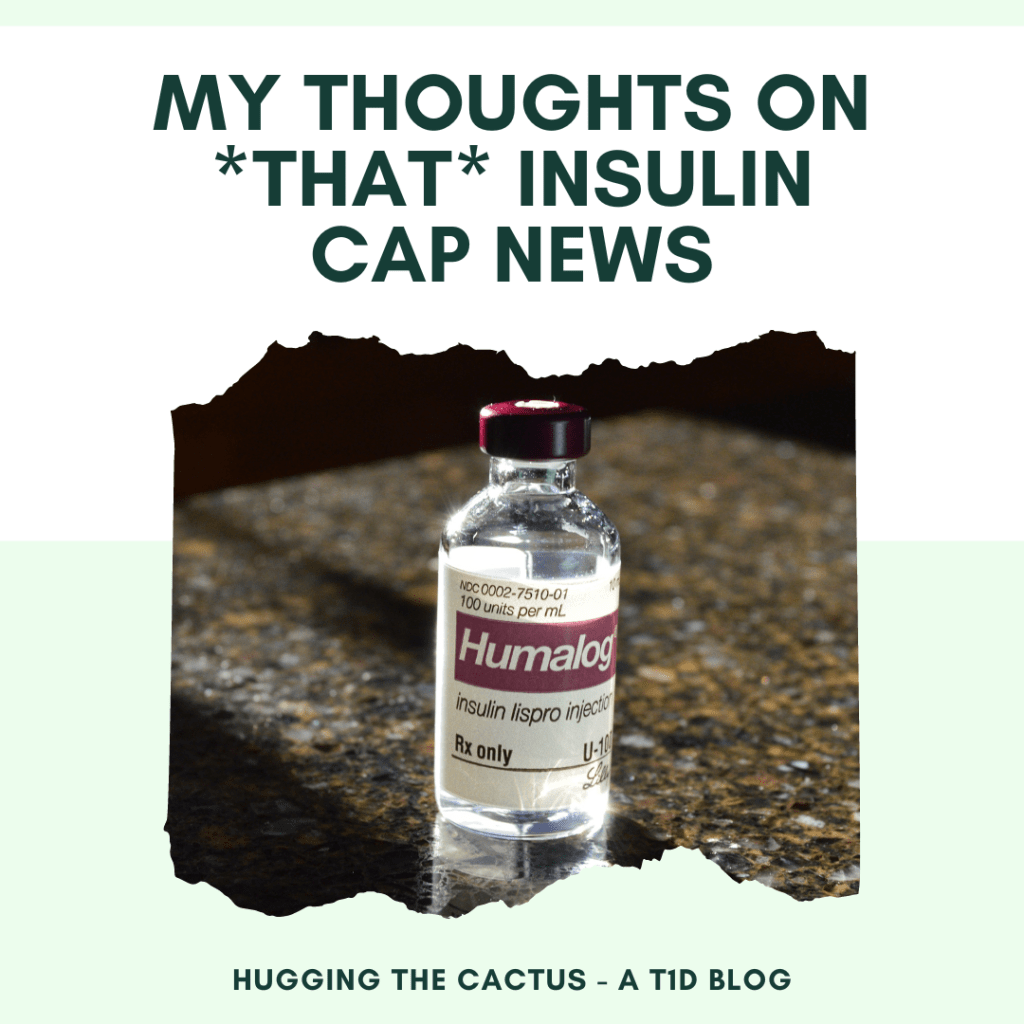
Just over a week ago, Eli Lilly announced a 70% reduction in price for its most commonly prescribed insulins that resulted in a cap of patient out-of-pocket costs at $35 or less per month.
This news was huge and spread like wildfire across the diabetes online community. And for good reason – it’s something that so many people with diabetes have needed to happen for a very long time. Most reactions I saw were that of complete and utter joy and relief. I’ll admit that’s what I felt at first, too, until I saw the more displeased responses that directed additional frustration and rage at Eli Lilly for not taking this action sooner, or reducing the cost of insulin to make it free altogether. Those posts got me thinking.
I’ve had time to reflect and gather my thoughts on the matter, and I think I land somewhere between thrilled and bummed, myself.
This news is absolutely something to be celebrated, as it will undoubtedly assist people who struggle to afford insulin with astronomically high price tags. This is an issue that I’ve spoken about on the blog before, and while I feel very fortunate to never have personally struggled with affording my own insulin (though I’ve certainly complained about out-of-pocket costs in the past), I’ve read countless stories about individuals in the United States who’ve had to take drastic measures in order to obtain this life-saving medication. So this news is wonderful, for sure, but it also feels a little too late.
Is this response from Lilly induced by the pressure that they’ve felt from diabetes advocates in the last several years? Is it a genuine call to action to other insulin manufacturers to follow suit and slash prices? Is it all just some sort of PR stunt? My suspicion is that it’s a mixture of all three, and while this feels like a victory for now, I don’t think that I will personally be satisfied until all people with diabetes are able to get insulin for free – no bottom line, no gimmicks, no nothing other than access for all.
Valentine’s Day is tomorrow. Whether you love or loathe the day, it’s an occasion that’s synonymous with chocolate, love, and flowers; more specifically, a dozen red roses.
A dozen red roses is a classic Valentine’s gift. But what if you received 11 roses in your bouquet, instead of 12? What if you knew that a rose was spared because the value of that flower helped provide insulin to someone who needs it to live?
I bet you wouldn’t mind getting one less rose in that case. And it might just make you like the holiday a little bit more!
A little bit of history: Nearly 10 years ago, folks from the Diabetes Online Community (DOC) started the Spare a Rose campaign for the organization Life for a Child. This campaign was able to give insulin and diabetes supplies to children and young adults with T1D in under-resourced countries. Last year, these individuals looked at how they might be able to support all people with diabetes, seeing as the need for insulin and related supplies and care lasts well beyond childhood.
Thus, Spare a Rose, Save a Life was born! Donations to this campaign go to Insulin for Life, a charity that provides resources, education, and advocacy to many of the same under-resourced countries that were supported by the original Spare a Rose campaign.
It’s an absolutely wonderful idea that will positively impact – and save the lives of – even more people living with diabetes who need access to vital medication, supplies, and healthcare.
I’ve written about the Spare a Rose campaign here on Hugging the Cactus for years now because it’s a beautiful way to celebrate a day that makes some swoon and others sick to their stomachs. A common complaint among people in this day and age is that too many holidays are all about raking in the dough for companies like Hallmark; in other words, most holidays have lost their original meaning and have become too commercialized.
So here’s your chance to bring back some significance to Valentine’s Day. In the light of the health challenges the world has collectively faced in the last couple of years, it’s more important than ever that we do all that we can to help people with diabetes access life-saving supplies and care.
Learn more about Insulin for Life, Spare a Rose, and donate here.
Just a couple of weeks ago, I shared my annual blog post in support of the Spare a Rose campaign – you can read about what it is, who it benefits, how it started, and why I like to do what I can to raise awareness of the campaign each year here.
But right here, right now, is about how the Spare a Rose campaign has been extended and taken on a new meaning due to recent world events.
The Spare a Rose campaign takes on even more important meaning in the month of March.
Presently, the campaign is now called Spare a Rose for Ukraine. In the past several days, I’ve seen rallying cries around the diabetes online community that have all echoed similar sentiments: What can we do to support people living with diabetes in Ukraine who need access to life-saving medical supplies in this time of crisis? That’s how Spare a Rose for Ukraine was born.
Throughout the month of March, donations made to the Spare a Rose platform will support people with diabetes in and out of Ukraine. These donations will help people who are in desperate need of supplies obtain them, and with donations being directed to Insulin for Life – a charity that has more than 20 years of experience providing insulin/diabetes supplies to under-resourced countries as well as responding to emergencies – I feel confident that this campaign will result in countless lives being saved in such dire circumstances.
If you’d like to learn more, or make a donation, please visit the Spare a Rose website.
If there was a rulebook devoted to the do’s and don’ts of life with diabetes…it would be quite the tome. I imagine it to be as long as the fifth Harry Potter book, which had 766 pages and weighed just shy of 3 pounds, though it would certainly not be as engaging of a read.
As I started to visualize a diabetes rulebook, I started thinking about the actual rules it would list out. It would cover the basics, for sure, of life with diabetes, like “count carbs at every meal” and “remember to take your insulin”. But it would also get into the minutia – the things that aren’t so obvious, even to those who are fairly well-versed in diabetes. Things that I didn’t know until adulthood, like how glycemic index, alcohol, caffeine, dawn phenomenon, and so much more can affect blood sugar levels.
Yeah, it would definitely be a boring-ass read.
The diabetes rulebook would probably resemble this and look completely, utter unremarkable (otherwise known as BORING).
But as I was coming up with a seemingly endless mental list of diabetes rules, it stuck out to me that there’s one that I don’t follow. In fact, I’m not sure that I ever followed it. And that rule pertains to insulin.
The rule is about how if you open a vial of insulin, it’s best to use it within a 30-day (or maybe it’s 28-day) window. I think it’s because manufacturers claim it loses its potency after that timeframe passes, but to me, it’s a bunch of BS.
Maybe I do go through whole vials of insulin in a one-month period, or maybe I don’t. I have no clue, I don’t keep track of my supplies to that extent. But what I do know is that “expiration dates” and “best by” labels aren’t always based on exact science. I’ve totally eaten my fair share of “expired” foods (things like granola bars or cans of soup, definitely not wilted spinach leaves or moldy yogurt) because I use my common sense when making judgment calls about consuming those items. For me, it works kind of the same way with insulin. As long as an insulin vial has been properly stored since opening it (in a refrigerator’s butter compartment, because of course), then I feel safe using it beyond a 30-day period – again, within reason, using logic (I doubt that I’d use insulin dated YEARS ago).
I’ve even heard of folks using insulin that’s past it’s expiry date, and while I haven’t done that myself, I can’t say I blame anyone for trying to use up every last drop of the stuff when it’s in possession and it’s necessary to take. It’s too expensive to waste.
So if by breaking this “rule” makes me or other people rebels, I’ll don the title with pride…and smirk to myself as I think about other diabetes rules (ahem, pertaining to prolonging CGM sensor life, or using sites other than the abdomen for my Dexcom, or hardly ever remembering to change my lancets…) that I’ve broken over the years.
This post was originally published on Hugging the Cactus on December 16, 2020. I’m sharing it again today because this was a fun and festive (if not messy) craft that I did with an insulin vial that I saved. Currently, I have about a dozen or so empty insulin vials set aside and I’m wondering what kind of craft I should do next…
I love Christmas, crafting, and some might argue that I love T1D (that’s mostly false, but when you’ve got a chronic illness, you’ve got to learn how to love some aspects of it…otherwise, you’ll be miserable).
So I recently *attempted* to combine all three of these things and do a little DIY project with an empty insulin vial.
And I learned a few things along the way…
I do not recommend messing with a glass vial without safety glasses, gloves, and a trash can nearby. I was lucky enough to avoid any major glass breakage, but some did happen, and I could totally see this craft getting wicked messy and potentially ouchie without taking the proper precautions.
Insulin vials are stable AF…they are not meant to be tampered with.
Glitter cannot be directly injected into an insulin vial. Period, bottom line, don’t even try it.
Okay, so now that I’ve got my disclaimers/lessons learned out of the way, let me tell you why I decided to fill an empty insulin vial with gold glitter.
For years, I’ve seen DIY projects floating around online involving old diabetes supplies. They range in the level commitment and skill involved, but there’s no questioning the creativity of our community when it comes to recycling supplies we’d normally throw away after using.
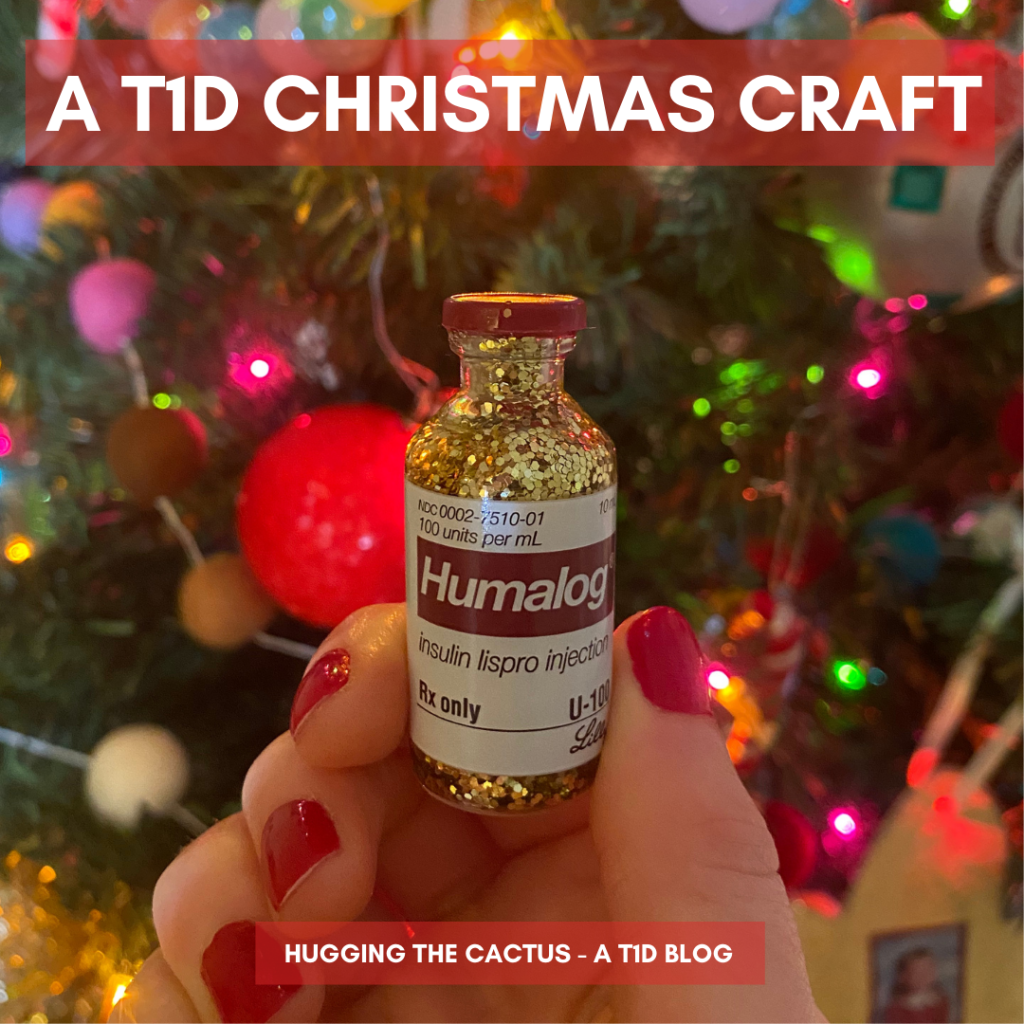
One project that I’ve seen over and over again is transforming an empty insulin vial into a Christmas ornament: Simply stick an ornament hook into the insulin vial’s rubber top, hang it on a Christmas tree branch, and bask in its beauty. I decided to take this concept to the next level by putting gold glitter into the vial because insulin is often referred to as “liquid gold” within the diabetes online community. What better way to represent that than to make it appear as though the contents of a vial were truly liquid gold?
In order to do this, I set aside a vial once I was finished with it/sucked every last drop of insulin out of it. Then, I made a sad attempt at combining glitter with water and using an old syringe to transfer it to the vial (needless to say, I had no luck). So I came up with a new strategy: Pierce the rubber stopper and try to funnel glitter in…and that didn’t work. It became evident that I’d have to remove the top entirely, so using my nifty new toolkit that my father just purchased for me (thanks, dad), I set about the task. I used a razor to carve the rubber stopper up and out, and then pliers to get the metal maroon covering off completely. I broke off a small piece of glass in the process – whoops – but using those tools did the trick for me…all I did after that was take the cap from a new vial of insulin and glued it to the top of the glitter vial to ensure most of its sparkly contents would remain inside.
And voila, here’s the end result:
Despite the glass breaking off, this DIY came out better than I expected.
As I held the glittery vial in front of my Christmas tree for a few photos (if I didn’t take pictures, then it didn’t happen), it occurred to me that there’s a strong likelihood that many families will have to make a difficult choice this holiday season: Give a special gift to a loved one, or use that money to pay for insulin instead. Or even more seriously, to have to choose between making this month’s mortgage/utilities payments, or getting life-saving medication.
The thought shook me, as nobody should have to make a choice like that ever.
And so I thought of something to add to my Christmas wish list: affordable insulin for all.
This post originally appeared on Hugging the Cactus on September 23, 2020. Just over one year later, I’m sharing it again because it’s a reminder that life with diabetes is filled with the unexpected, and it’s important to be proactive when dealing with these curveballs. Read on to find out how I handled the broken insulin vial…
As soon as I opened the package, I knew something was wrong.
The contents of said package were five vials of insulin – my regular 90-day supply. On the surface, nothing seemed wrong. They arrived in their usual styrofoam cooler that was taped shut. After removing the tape, I saw four ice packs next to the plastic packaging containing the insulin vials; again, this was all expected.
When I picked up the plastic package and used scissors to cut it open, though, a pungent odor greeted my nose.
A medicinal, harsh, familiar scent…the smell of insulin.
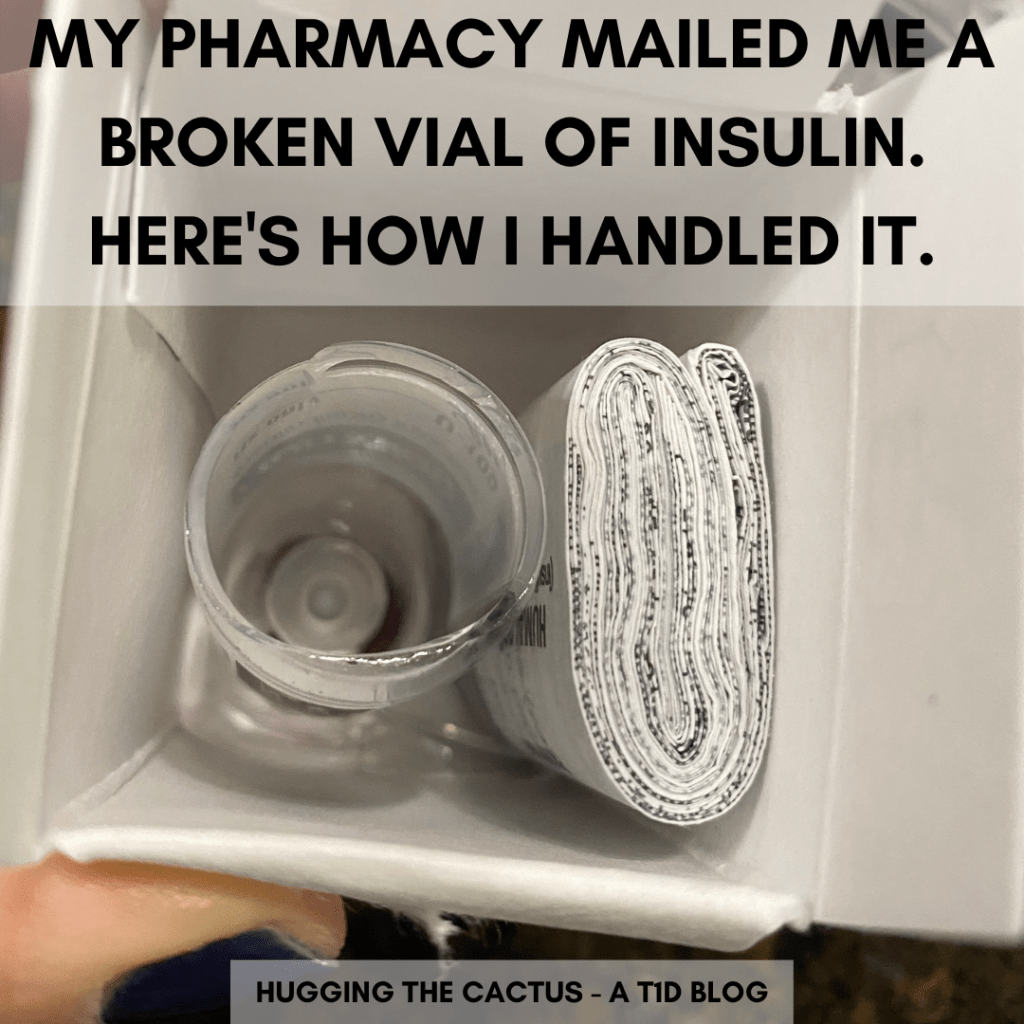
Upon further investigation, I discovered that one of the five cardboard boxes encasing the vials was totally damp to the touch. Gingerly, I opened it from the bottom flap, which was sticking out slightly due to the wetness. That’s when I saw the shattered insulin vial: Somehow, the bottom part of the vial had broken, spilling and wasting all of its contents.
I wish that smell-o-vision was a thing, because OMG…the smell coming from this was STRONG.
I was shocked. In all my years of diabetes, nothing like this had ever happened to me before!
I didn’t really give my next step a second thought: Immediately, I jumped on the phone with Express Scripts, which is the mail order pharmacy that I use for my insulin and some other medications. I spoke with and explained the issue to a customer service representative, who connected me with a technician that promised a replacement vial would be mailed to me at no additional cost to make up for the broken one. I asked if they needed me to send the broken one back to them, but I was reassured that it wouldn’t be necessary because I had called them so they could document the incident.
My issue was resolved, just like that, in fewer than 15 minutes. While it was annoying to have to take time out of my day to figure that out, I’m very happy that I got a replacement quickly and easily. But really, where was quality control on this one?!
Insulin is expensive, as we all know. And to see that a perfectly good vial full of it was rendered useless due to defective packaging was a major punch to the gut, indeed.
I attended a Massachusetts #insulin4all meeting recently that got me thinking about how good people with diabetes tend to be at minimizing.
I speak for myself, and some other people with diabetes I know, when I say that we’re really good at making it seem like it’s not a big deal. We manage a 24/7, 365 chronic condition like it’s not the full-time job that it is. I have family and friends who occasionally pick up on this and marvel at my ability to be present in a myriad of social situations while discreetly watching my blood sugar levels or calculating insulin dosages. I rarely act like diabetes is as serious as it is and that’s because I’ve become an expert at making it seem like small potatoes in my life.
And I’m not just good at minimizing my diabetes – I’m also highly proficient in minimizing the fact that it has forced me to make difficult decisions in my life, particularly when it comes to financial choices.
Over the years, I’ve become excellent at downplaying the impact of diabetes on many aspects of my life.
During this #insulin4all meeting, I was conversing with other chapter members about whether or not we, as individuals, have struggled to afford insulin. And a lot of us confessed that we’ve been pretty lucky and have never really had to resort to making truly difficult choices when it comes to affording insulin or other diabetes supplies. Despite that, we feel passionately about those who struggle to gain access because we understand how high the stakes are – it’s literally a matter of life or death.
But just because we’re able to (for the most part) afford insulin, that doesn’t mean that we haven’t had to make certain choices that we might not have had to make if we didn’t have diabetes.
For example, when it comes to my career, I’d never consider a job that doesn’t offer solid health insurance plans. Even if my strongest desire was to be a freelance writer, I wouldn’t go through with it because I know that it would be challenging to figure out my health insurance. And I know that the minute I run out of FSA dollars each year, I start thinking about setting money aside just to cover the costs of my diabetes supplies…which means that instead of buying some new clothes or planning a weekend getaway, I sometimes have to sacrifice those luxuries in favor of ensuring I have enough money to cover my fixed expenses as well as my diabetes medications.
When I think about it, of course I realize that it’s not fair, but haven’t really considered it before because this is just how it is. I’m used to it. And so are many other members of my #insulin4all chapter. We’re all accustomed to having to make certain choices about our lifestyles or spending habits that minimize the larger issue of insulin affordability. We’re used to it, even accepting of it, but that doesn’t make it right and it certainly underscores the terrifying fact that too many people simply can’t afford insulin and have to make much tougher decisions in order to get it.
It’s time to become a little less good about minimizing and better at vocalizing – not just the seriousness of diabetes, but also the dire nature of insulin affordability and access that affects millions around the world.
This is a post by Pramita Jasuja that was originally published on the T1International blog on April 9, 2021. I am sharing it here today because I thought it was an interesting take on how type 1 diabetes is (or in this case, is not) recognized in another country. Thank you to Pramita for sharing her story and explaining the importance of legislation in advocating for people with diabetes.
Every new type 1 diabetes (T1D) diagnosis can be intimidating, both for the person and the family members. Many people with T1D are told they should be able to live a “normal” life and that they can do everything that a person without diabetes can do.
As a newly diagnosed child with blood sugar levels of over 570mg/dl, all that was on my mind was T1D. But a year post-diagnosis, when daily needles became the new normal, I was told by my family that I was completely fine and that there “was no need to tell anyone” about my medical condition. “I am normal” was stuck in my mind and I took it very seriously. So much so, when my endocrinologist asked me as the “patient” to sit near her chair, I replied: “I am not a Patient.” Both my parents and the endo smiled.
It’s been 7 years since that incident and I now reflect on my statement, especially over the word “normal”. Calling yourself “disabled” can have negative connotations attached to it. People often refrain from using that word, as if living with a disability is abnormal. Though if we do this, we deny a part of us. When it comes to legalities, the word “disability” is significant. Disability legislation considers people living with disabilities as subjects who possess rights capable of claiming that they have a disability – not those simply given charitable treatment. This was spelled out in the UN Convention on the Rights of People with Disabilities (CRPD), the human rights convention that hit the highest number of signatories.
I live in India. It’s one of the countries that has ratified this convention, but it’s also a country where myths and stigma overtake the real issues. A report by WHO found that in low-income countries where superstitions surrounding diabetes are common, the fatality rate is high. India is no exception. Due to a lack of proper health care facilities and a lack of national registry exclusively for T1Ds, children in the country are facing late diagnosis and even death. Considering the level of poverty in the country, blood test strips and continuous glucose monitors (CGMS) should be subsidized. Unfortunately, that is not the case. People with T1D are rationing them, which makes diabetes management challenging. Plus high blood sugar levels and/or ketones hinder the ability to perform “normal” day to day activities.
Insulin is like water. Someone with T1D can not live without it, but medical insurance in India does not cover it, and not every type of insulin is subsidized. So for those with T1D and financial struggles, there are the worries about the price of life-giving insulin and medical supplies.
After considering these facts, let’s look at the definition of “person with a disability” under the Rights of People with Disabilities Act (RPWD) 2016 that was enacted after India ratified CRPWD: “a person with long term physical, mental, intellectual, or sensory impairment which, in interaction with barriers, hinders his full and effective participation in society equally with others.”
“When it comes to legalities, the word “disability” is significant. Disability legislation considers people living with disabilities as subjects who possess rights capable of claiming that they have a disability – not those simply given charitable treatment.”
The sad part, however, is that T1D is not considered a disability under this Act, even though the current problems faced by people with T1D in India do “hinder (their) full and effective participation in society equally with others”. I’m arguing that you can not tell every T1D to live “normally” when the condition doesn’t always allow for it. The community is suffering silently and legislative action is being denied.
It is through the recognition of injustices and assertion of our rights that we can ensure equal opportunities. T1D advocacy is emerging in India and as a collective we are highlighting these issues. Change is happening. In 2020 in Kerala High Court, a public interest litigation was filed over the issue of including T1D in the list of disabilities and creating a national registry for people with T1D. This step is important. Recognition of T1D as a “disability” would obligate the government to fulfill what is laid down in the Act, for example providing affordable and accessible health care, ensuring the implementation of non-discrimination clauses and creating special faculties at educational institutions.
Seven years after that endo visit incident, even though I will never be able to deny that I am a patient, what I can do is advocate for patient rights. At a macro level this means standing up for the community. Recognition under the legislation of people with diabetes as those with disabilities is the first step, a chapter in the book of advocacy in my country of India.


 Hugging the Cactus