Nothing makes me feel as defeated as high blood sugar.
Maybe it’s because it takes so long for my blood sugar to come back down from a high.
Maybe it’s because I feel like I directly caused it – miscalculated my carb intake, or snuck in a snack that I shouldn’t have.
Most of these highs occurred due to a bent cannula in my pod a couple weeks ago.
Maybe it’s because it makes me feel like I’ve lost all control. That I can’t do anything but monitor the situation and take more insulin as necessary. I hate feeling so dependent, so trusting, of my insulin alone.
Maybe it’s because the technology has failed me, and there’s few things more frustrating than that. Imagine doing everything the “right” way, the way you’re supposed to, and getting the “wrong” results. You begin to question everything and your emotions get the better of you.
Whatever the reason is, I know I’ve got to work on accepting the fact that highs happen. I’ve dealt with many over the years, and I know I’ll encounter plenty more in the future. They’re upsetting, tiring, and irritating. They test my patience as I wait for long stretches of time for my insulin to finally kick in and stabilize my blood sugar. They are one of the more mentally and physically draining components of type 1 diabetes management.
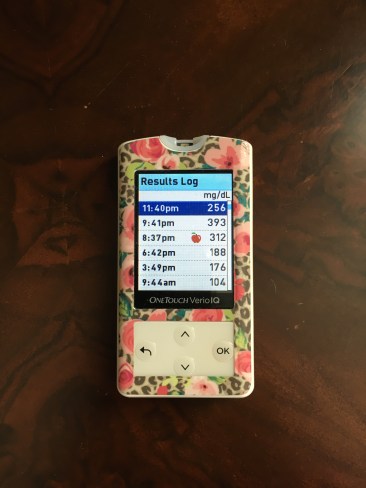
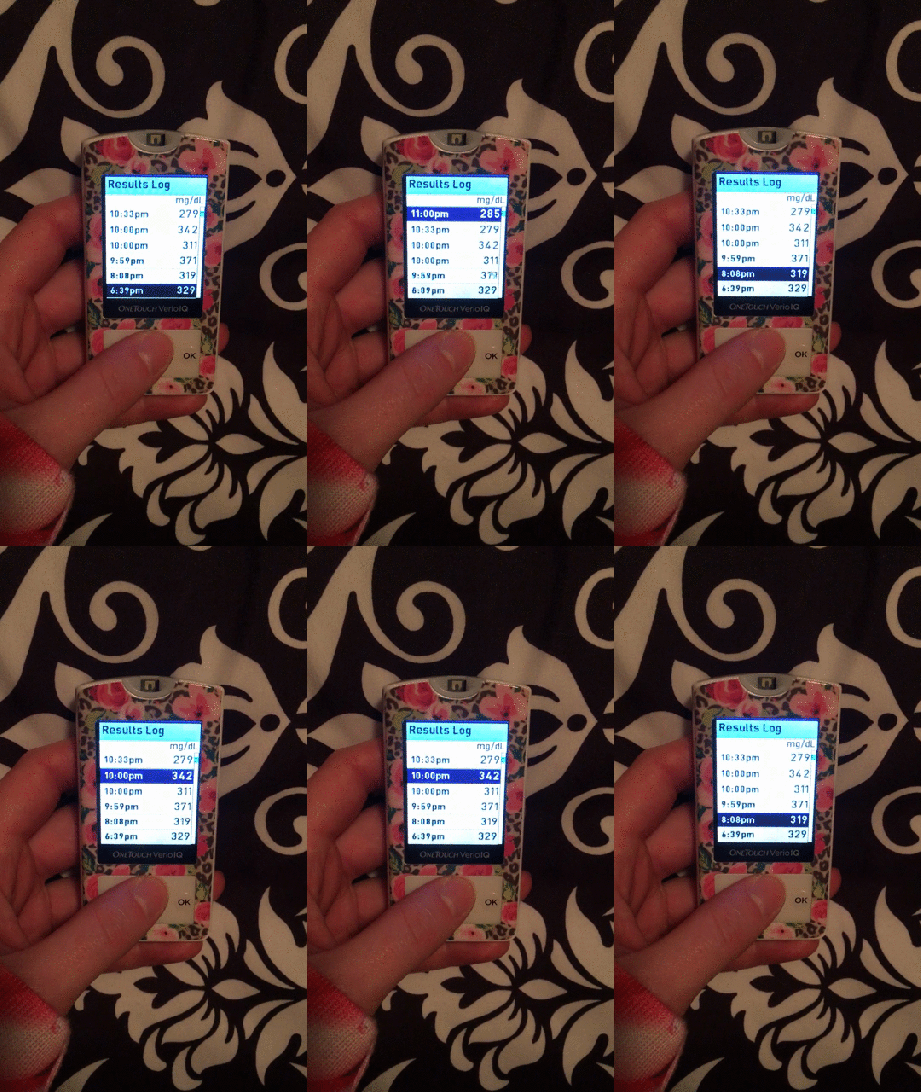
I tested three times in the span 60 seconds the other night.
Why?
High blood sugar.
That was the culprit. For five hours, I was high – over 300 mg/dL, to be exact. I still can’t quite explain how it happened. I didn’t eat more than my usual amount of carbohydrates at dinner. I didn’t deviate at all from my mealtime routine; the only thing that maybe affected this was the fact that I had to change my pod that night.
But still. It was maddening, sitting there and watching my blood sugar climb and stick to the 300s. I did everything I should do to correct it: increase my temp basal, take corrective boluses, drink water, refrain from eating. And yet, the high persisted. All I wanted to do was go to sleep, but I was afraid to. Yes, afraid to get the rest that my body needed! That’s what diabetes does sometimes – it instills fear that you can’t shake until those numbers change the way that you need for them to. It’s paralyzing; it’s helplessness in its purest form.
It’s why I ended up stacking my boluses that night, even though I knew it might not be a smart call. But I was so stuck in the high 200s and low 300s. What else was I supposed to do? I even tested THREE times in 60 seconds because I thought that my meter was wrong. I desperately wanted it to show that I was coming down, and felt tears sting my eyes when I realized it wasn’t. I had no choice but to wait some more, so I made myself comfortable in bed and watched the Gilmore Girls (because a nonstop dialogue and excellently obscure pop culture references are good for the soul). I could only get semi-absorbed in Lorelai and Rory’s back-and-forth banter though, because my mind was otherwise occupied by the nagging high blood sugars.
I couldn’t help testing over and over again, hoping for any sort of positive change.
Finally, I saw that I was coming down to the mid-200s shortly before 11:30 P.M. I decided it was safe to close my eyes. But I didn’t dare do so until I set an alarm for about an hour from then, just so I could continue to monitor my blood sugar. I woke up when it blared, and let out a massive sigh of relief when my CGM showed I was floating down to 150 mg/dL.
I fell back asleep only to wake up again, two hours later: This time, it was because of a low blood sugar. I tested, saw that I was 67, and corrected it. But falling asleep wasn’t as easy this time around. Again, I felt fear – what if I continued to drop down? What if I corrected too much? I was so emotionally exhausted and consumed by the feeling that it took me well over an hour to drift back to sleep.
When I woke for work the next morning, I was 148. The evening’s episode was over. But my head was spinning as I did my best to analyze what I could and should have done better.
And this is when I told myself to stop. I had to stop beating myself up and going over every choice I made. I had to remind myself I did the best I could in that moment, and that should be enough. It is enough.
Last week, my mom and I both rediscovered the reason why we usually order side salads with burgers or sandwiches served in restaurants: french fries. They’re tasty, carb-y, salt bombs that wreak havoc on our blood sugar. We’re both convinced that our indulgence in fries at dinner was responsible for the dramatic spikes, followed by sharp plummets, that interrupted our sleep overnight and made us understandably grumpy the following morning.
Here’s the timeline of what happened:
6:30 P.M. – Dinnertime. Ordered a chicken pesto sandwich with a side of sweet potato fries. I thought I’d be safe as long as I didn’t eat all of my fries, and if I left behind half of the bun. This certainly helped, but my carb counting was either severely off or the high amount of fat that I consumed threw my blood sugar for a loop.
7:30 P.M. – Blood sugar holding fairly steady around 160 mg/dL. Maybe restraining my carb consumption worked, after all!
9:00 P.M. – Eh, not so much. I’m seeing a diagonal arrow pointing up, indicating that I’m slowly creeping into the 200s. I’m not pleased.
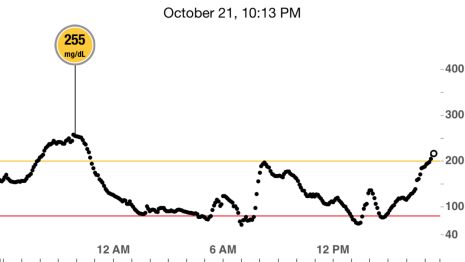
10:13 P.M. – Yep, topping out at about 255 mg/dL. Gross! I take some insulin and wait for it to kick in.
This is as high as my blood sugar got after eating the evil french fries…
11:30 P.M. – I feel relieved, I’ve come down to below 180 mg/dL and I can now go to sleep. I’m not dropping fast and I suspect that, due to the insulin I have left on board, I’ll level out around 130 mg/dL overnight.
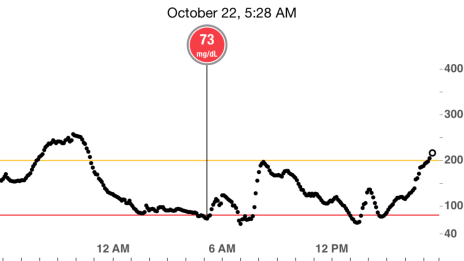
5:28 A.M. – Ah, a blissful five and a half hours of sleep before my diabetes said “LOL nope” and woke me up. I’m feeling shaky, so I roll over to check my CGM. Sure enough, I’m below my low limit (which is set at 80). My symptoms match my Dexcom graph, so I pop three glucose tablets into my mouth and plop my head back down on my pillow. I should be okay until I get up in a few hours.
…and this is one of the multiple low points I hit in the wee hours of the morning.
7:00 A.M. – Except nope! My CGM’s alarms and my low symptoms wake me up again. I’m frustrated, because it’s beyond annoying to wake up at the same time I normally do for work on a Sunday morning, and especially since it’s because of my diabetes. I reach for a granola bar that contained 22 grams of carbs (way more than I needed for my correction) and wolf it down. I toss and turn for the next hour. I can’t fall back asleep because it feels like my CGM won’t stop alerting me to what my blood sugar’s doing. It’s almost 8:00 A.M. when I decide to take a small bolus, because I definitely over-corrected for the last low.
9:30 A.M. – I get up for real and start my day. Miraculously, I test my blood sugar and it’s 148 mg/dL. I thought it would be worse but I guess the single unit of insulin I took did its job.
This is a night in the life of a PWD. This is what it’s like to have a chronic illness that doesn’t sleep. This is what it’s like to feel out of control of your own body.
And this is why I think french fries are evil – because they’re fatty, slow-releasing but high carb little jerks.

 Hugging the Cactus