Endo Appointment Anxiety

I’m feeling anxious about my appointment with my endocrinologist tomorrow.

I don’t know why. I like my doctor very much: She’s always encouraging, pleasant, and helpful. The only thing I’d change about our appointments is to slow them down a bit; sometimes, she whips through them so quickly that I forget to ask her the questions floating around in the back of my mind.

Could it be that I’m worried about my A1c test? Possibly. I don’t know whether my A1c has gone up or down in the last three months. I have stretches of time in which my blood sugar behaves the way I want it to, but I also experience clusters of days here and there of complete diabetes chaos. In the last month, for instance, there were a few too many circumstances in which my blood sugar was above 300 mg/dL. Each time, I’d correct the high, only to either experience 1) a sudden drop resulting in a low or 2) several hours of prolonged high blood sugar because it was taking the insulin a long time to take effect.
815A7B61-EDD2-4804-B8D0-D8760D19A26A
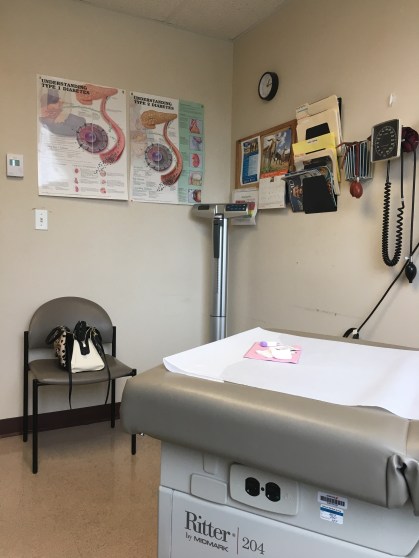
I love that there are posters about “understanding” diabetes on the wall – it’s too complex to break down into a few bullet points.

Now that I’m thinking about it, maybe those scattered, wicked-high blood sugars are the reason why I’m anxious about this appointment. I know that my doctor will probably ask me about them, and I’m going to have to admit to her that a combination of emotional eating, lack of carb counting, and general carelessness resulted in those highs. I know that she won’t judge me, but…I can’t help but judge myself for causing the blood sugar swings. The rational part of me is aware that it’s unhealthy to blame myself for occasional slip-ups, but the goodie-two-shoes, Miss “Perfect Diabetes” part of me is shaking her head in shame and disappointment.

If nothing else, this is a prime example of how diabetes can be an absolute (warning: foul language following) mind fuck.

What Went Wrong During my Recent Visit to the Eye Doctor

You want to know what went wrong during my annual eye doctor’s appointment last week? Just about everything, that’s what went wrong!

Okay, that’s being over-the-top dramatic. Nothing life altering happened, thank goodness. But the appointment started out on the wrong foot when I had to wait more than an hour to be seen by the doctor. Let me tell you, there is nothing pleasant about waiting in a room that hasn’t been updated since about 1982, with ancient stacks of National Geographic as the sole source of entertainment.

Anyways, after an agonizingly long hour and change, I was finally called in to see the doctor. He started the appointment asking the usual slew of questions: How are you? How are your eyes? (My answer to both was a short, but still polite, “good”.) Then he asked the annoying question: Is your diabetes under control?

I hate that – the “under control”. It makes it seem as though diabetes can be tamed 100% of the time, like it’s a savage beast that just requires domesticating in order to live a normal life. But I answered it anyways, knowing he wouldn’t care to hear why his word choice was bothersome. “I’m doing well,” I said, my eyes wandering over to the doorway. I couldn’t understand why he’d chosen to leave the door open – the hallway to the waiting room was very short, and based on what I’d heard when other patients went in to see the doctor, everyone in the waiting room would be able to hear the entire doctor-patient interaction. Definitely not cool in my book, but instead of confronting the doctor about it, I opted to speak in a much quieter tone of voice than normal. At this point, I just wanted the appointment to be over.

BE183505-1A74-4C0D-B051-C3E9BAC9BED7
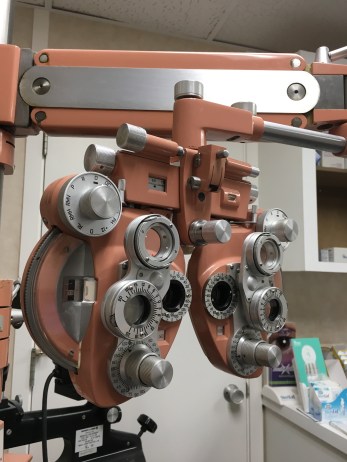
QUIZ TIME! Is this A) a medieval torture device OR B) a phoropter? (It’s B, which is the legitimate name of this piece of ocular equipment. Who knew?)

He spent 15 minutes running the standard eye tests (read the chart in front of you, does this setting make it better or worse, etc.), then dilated my eyes. I was sent back to that horrid waiting room for another 20 minute while the dilation took effect. When he called me back in to give my dilated pupils a final inspection, the following exchange happened:

Doctor: You know, I saw a patient the other day who was diagnosed with diabetes at birth.

Me: Yeah, I know a couple of people who were diagnosed as babies. It’s awful.

Doctor: Even though he’s had it his entire life, he doesn’t take very good care of it. He’s got diabetic retinopathy now. *shuffles paperwork*

Me: *Fidgeting uncomfortably in the chair, waiting for him to add to that. A long 20 seconds elapses before he finally says…*

Doctor: Fortunately, that’s not the case for you.

Um, WTF, Doc?! What’s up with that weird dramatic pause? Were you TRYING to freak me out? Mission accomplished, dude. But my oh my, such a sweet relief to hear that there is no diabetes in my eyes.

As I walked out of the building a few moments later, I couldn’t help but think about how this was a textbook example of how an appointment shouldn’t go. I left feeling an odd mix of emotions: disappointment with my doctor’s behavior as well as relief with his assessment that my eyes, at least, were proof of my well-managed (NOT under control) diabetes.

Dexcom Delivered When I Needed it Most

Last week, I received not one, not two, but FIVE packages in the mail. No, I didn’t go overboard with some online shopping – it was all deliveries from Dexcom to help me get my CGM up and running again.

You might be wondering: Why were there so many packages? In theory, I just needed a couple of replacement sensors and a new transmitter – couldn’t it all go in one box? Well, I wound up getting a little more than just the aforementioned supplies…

79D46312-CF33-4E28-834E-9CDE7608BFEE
Not pictured: another two boxes I received from Dexcom. Not sure why they couldn’t send everything in one large box, but beggars can’t be choosers.

That’s because I had the stupendously (emphasis on the STUPID-sounding part of that word) great idea to power up my old G5 CGM while I waited for my G6 materials. I had a few G5 sensors leftover from before I made the transition to the G6, and to my knowledge, I had a working G5 transmitter. So I followed the procedure to get my G5 going: I inserted a G5 sensor (ouch!), snapped the transmitter into place, and started the warm-up on my G5 transmitter.

But something was…off. The Bluetooth icon was blinking in the upper left-hand corner, and I couldn’t see how much time had elapsed in the two-hour warm-up period. At a loss as to what to do next, I left the receiver on overnight to see if it would ever pick up a signal from my G5 sensor/transmitter, to no avail.

That’s when I made the “fatal error” of shutting the system down and trying to restart it. This triggered the G5 receiver to enter a reboot cycle that wouldn’t stop. Any time I pressed the circular home button, the system would buzz and the screen would light up, as if it was about to start working. After 45 seconds or so, the screen would go black again. There was no way to interrupt this reboot loop – even sticking a paper clip into the tiny hole in the back of the receiver wouldn’t correct the faulty software.

So now, not only was my G6 out of commission, but my G5 was a goner, too.

After a few phone calls to Dexcom technical support, I had answers as well as supplies sent my way. I learned that there’s a known error with the G5 system that causes the reboot cycle to launch. I should have waited longer for the G5 transmitter to connect with the Bluetooth on my receiver (i.e., I should’ve waited for the Bluetooth icon to stop blinking), but it wasn’t necessarily my fault for having a device with a known software issue. I would receive a new G5 receiver because my old one was still under warranty, as well as a G5 replacement sensor. I would NOT get a G5 transmitter, because I’m convinced the battery on the current one is still good, but I was informed that once a transmitter is activated, the battery keeps going until it runs out of juice. Interesting. That means that it could, in theory, stop working any day now, because the transmitter was activated and last used in April 2018.

Hopefully, I’ll never have to get another G5 transmitter because I’ll be able to rely on my G6 from here on out. It gives me comfort to know I have backup G5 supplies, but I’m pretty much married to my G6 at this point. Dexcom kindly sent me the required new transmitter for the G6 system, which arrived on Thursday of last week. I got a return kit for the old G6 transmitter the previous day, and on Friday, my new sensors came in along with a return kit for my defunct G5 receiver.

Sure, it was a lot of packages to sort through in the mail. And it was mildly frustrating that I had to wait two days between getting my new G6 transmitter and compatible sensors. But the most important thing is that I’m now reconnected to my G6 and feeling thankful that Dexcom delivered when I needed it most.


Bike Beyond, the Documentary: An Emotional Cinematic Experience

Last summer, a team of 20 international riders embarked on the journey of a lifetime. They spent 10 weeks cycling from New York City to San Francisco – east coast to west coast. As if this feat weren’t incredible enough, this team was comprised of individuals with type 1 diabetes.

This ride was risky enough, but throw diabetes into the mix, and it seemed impossible. Blood sugars would be a constant concern. Diabetes technology could fail. Careful watch of blood sugars could clash with the focus on cycling. Diabetes burnout could affect the riders physically and mentally.

But – spoiler alert – neither fear nor diabetes would prevent these riders from completing their arduous trip.

When Team Bike Beyond officially started their trek last summer, I remember following along as best as I could through various social media channels. I felt connected to the team: not just because of diabetes, but because I personally befriended a couple of the riders a few years ago at one of the College Diabetes Network’s Annual Student Retreats. I attended as a volunteer, and Jesse and Meagan were there as students. It’s funny how quickly friendships can form over the course of five days, but as anyone who’s gone to one of these retreats can tell you, there’s something about being immersed for a few days with a group of people who just get it. So it’s natural that we bonded over our mutually dysfunctional pancreases.

Anyways, as neat as it was to read those updates from Jesse, Meagan, and the team, there’s no way that words could capture what they were actually experiencing out on the road. I think that’s why watching the documentary was so emotionally captivating to me: Within the first few minutes, tears were rolling down my cheeks as the bikers explained the nervous energy they felt in the days leading up to the ride kickoff. In fact, my facial expressions changed so frequently throughout the film that I’m sure it was comical. One moment I’d be beaming, and in the next my jaw would drop open. I’d laugh when the riders were being goofy together on camera, and marvel with them as they took in stunning scenery across the country.

Overall, the documentary was incredibly well done. Victor Garber’s narration was fantastic – smooth and clear without taking attention away from what was happening onscreen – and the visuals were beautiful. I liked how footage from the riders’ GoPro cameras was incorporated so viewers could get an accurate representation of their perspectives from the bikes. It made me appreciate the physical intensity of the ride that much more, because diabetes aside, cycling such a long distance filled with rocky roads and steep inclines is extremely demanding on the body.

My recommendation? Check out the trailer. I included it above. I guarantee it’ll pique your interest and stir your emotions. You’ll want to watch the full documentary, which you can get here. After watching it, I think you’d agree with me that Team Bike Beyond crushed their goals of raising T1D awareness and eliminating stereotypes by completing this journey.

Diabetes: A Condition of Consistency

“Consistency is key” is a well-known adage for a reason: It applies to many things in life, including diabetes.

This has resonated more and more with me over the last few months, as I’ve experienced greater interruptions in my day-to-day routines. The most obvious change has affected my Monday through Friday lunch hour at work. I usually need to go home three out of five days to take care of my puppy – feed him, play with him, and make sure he hasn’t totally destroyed anything in the few hours since I last saw him. I don’t mind this at all, because I love my little Clare-bear, but on days that I have to be with him, my diabetes is definitely affected.

For starters, I have to eat my lunch much later than I normally do on non-Clarence days. Technically, I could eat my lunch when I go home to see him, but I have a very narrow window of time – approximately thirty minutes – to be with him. It doesn’t seem fair for me to go home, pour out his kibble, then spend the majority of our half hour together putting together and eating my own lunch. So I spend my lunch break giving the puppy my full attention, which makes us both pretty happy.

Clarence
My Clare-bear certainly knows how to keep me, and my diabetes, on our toes!

Eating lunch during my allotted break is ruled out, so I have to decide whether to eat it before or after my stop home. I usually end up forcing myself to wait until I get back from feeding Clarence to eat, but this is easier said than done for a few reasons: Sometimes, my blood sugar will crash while I’m with the dog, so I have to eat a snack to correct it because my actual prepacked meal is waiting for me in the office refrigerator. Or I have to scramble from one meeting to home and then back to the office for another meeting and won’t have a chance to sit and eat until 2 o’clock, which means that I have to sit through an afternoon meeting without a full attention span because all I can think about is my grumbling stomach. On those days, I’m pretty hangry by the time I get to eat, and even more so irritated when my blood sugar retaliates at me later on for waiting so long to eat.

That being said, I’ve had to make peace with the fact that my weekday/lunchtime blood sugars will be a bit all over the place. I know that things will be easier when Clarence gets older, but for now, I’m determined to enjoy his puppy-hood without diabetes interfering too much. And if nothing else, it reminds me how important it is to stick to the basics with diabetes: Eat regular, healthy meals and the habit will reflect well on blood sugar and A1c.

Favorite Things Friday: Mini Boxes of Yogurt-Covered Raisins

One Friday per month, I’ll write about my favorite diabetes products. These items make the cut because they’re functional, fashionable, or fun – but usually, all three at once!

Mini boxes of yogurt-covered raisins is an oddly specific kind of food, but they’ve literally saved my life (and my mom’s) hundreds of times.

I’m almost certain that I introduced these raisins into our low supply kit because I was looking for something that 1) was portable 2) had 10-15 grams of carbs 3) could be quick and easy to consume and 4) wasn’t glucose tablets (I get sick of them). I must’ve been browsing through the aisles of the grocery store when I found a bag containing 10 mini boxes of raisins. Clocking in at exactly 10 grams of carbs per box, they seemed to fit the bill nicely. I brought them on a trip to Disney World soon after buying my first bag, and that sealed the deal for me. They proved to be super convenient throughout the trip and helped prevent me from over-correcting my lows, which was huge for me.

E132E84E-66A6-422A-BCE6-540FE52192D2
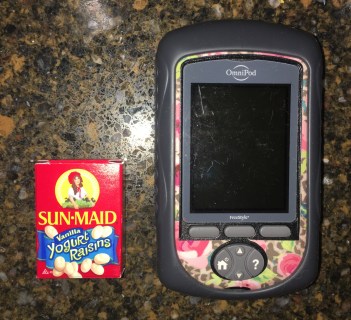
A box of raisins adjacent to my OmniPod PDM. I can easily fit several boxes of raisins into my purse, along with my other diabetes supplies.

Since that trip, the raisins have become a go-to low treatment for me and my mom, who agrees that they work just as well as glucose tablets. They’re much tastier than glucose tablets, and qualify as a healthier way to treat a low. As tempting as it might be to treat with Skittles or Starbursts, I struggle to control my intake of the candy when dealing with a particularly icky low. The raisins are already perfectly portioned, so that eliminates the can’t-stop-won’t-stop (eat ALL the foods!) feeling that can make dealing with low blood sugars difficult.

The raisins are excellent on the go, too. I can pop a box of them in the car, at my office desk, in the gym, or at church. I’ve even whipped them out at bars, and my friends get a bit of a chuckle when I down them like a shot of alcohol. But honestly, they’re so discreet and go down so easily that most of the time, people don’t even notice that I’m eating them. And if people aren’t noticing yet another part of my otherwise very prominent diabetes care kit, then that suits me just fine!

Memory Monday: The Diabetes Diet, 100 Years Ago

One Monday per month, I’ll take a trip down memory lane and reflect on how much diabetes technology, education, and stigma has changed over the years. Remember when…

…insulin had yet to be discovered? Of course you don’t actually remember it, unless you were born in or prior to 1921 (and if you were, wow!!! Thanks for checking out the blog!).

Anyway, prior to the groundbreaking discovery of insulin, people with diabetes lived difficult – rather miserable, actually – lives. I started reading a book called Breakthrough: Elizabeth Hughes, the Discovery of Insulin, and the Making of a Medical Miracle a little while ago. This book has made me realize just how fortunate I am to live during a time when insulin is around (even if it is grossly overpriced).

Many parts of this book have surprised, horrified, and downright depressed me. One of the more shocking things that I’ve learned from it, though, is the diabetes diet that was prescribed to patients in the early 1900s. Patients like Elizabeth Hughes, the T1D daughter of a U.S. politician, were expected to follow a strict meal plan upon admission to the Physiatric Institute in Morristown, New Jersey. Imagine following an eating plan like this every day:

Breakfast – One egg with two and one-quarter tablespoons of string beans boiled three times, and one tablespoon each of cream and coffee.

10 A.M. – Half a small orange for a snack.

12 P.M. – Two and a half tablespoons of cod with two heaping tablespoons of Brussels sprouts boiled three times, as well as five small olives and a half pat of butter…with a cup of tea to wash it all down.

Dinner – One egg and one egg white, 2 tablespoons of spinach (yes, boiled three times), with a half pat of butter.

Oh, scratch that part about following this diet every single day – patients had to fast one day each week. No food was permitted, at all.

Does that not sound vile?

I mean, I love eggs, and I happily eat veggies on a daily basis. But I’m certain I’d get sick of them no matter how they were prepared. And veggies boiled THREE times? I would think that they’d be reduced to mush, which, according to the book, is the point. Boiling them so many times would ensure minimal carbohydrate consumption since the nutrients would basically be cooked out of the vegetable. Plus, with portions so tiny, it’s hard to imagine that anyone ever felt full after consuming a “meal”.

DD0B7735-4A89-42C5-81A4-732B91E1F4BF
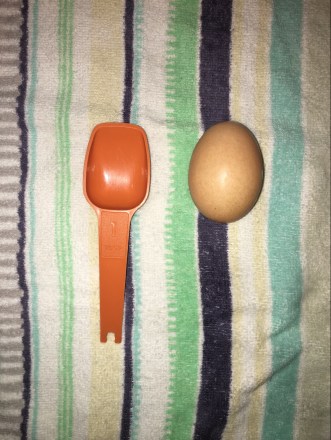
For context, one egg is about the same size as one tablespoon, meaning that portions on this diet plan were miniscule.

This extremely restrictive diet left patients yearning for pictures of food they saw in magazines, as well as severely undernourished. Following this meal plan practically guaranteed that patients would become emaciated. In fact, by the time 15-year-old Elizabeth Hughes left the Physiatric Institute, she weighed a mere 45 pounds – less than half what a healthy girl that age should weigh.

Even though I haven’t finished the book yet, it already serves as a reminder to be grateful for what I’ve got in this day in age: not just insulin, but amazing technology, wonderful doctors, and radical ongoing research in the diabetes field.

All of today’s advancements make me hopeful for the possibility of the eradication of diabetes, maybe not too far after the 100-year anniversary of the discovery of insulin.

That Time I Asked Someone to Prove Their Diabetes to Me

It was not my finest moment.

Yes, I doubted someone when they claimed to have diabetes. But there was no ill intent! Let me explain.

I worked at a local movie theater for five and a half years. During that time, I was trained to work the concession stand, sell tickets at the box office, and clean theaters with the ushers. More often than not, I was happiest working in the box office – it was nice and quiet when there weren’t any lines of customers to contend with, but when there were, time flew by as I worked at a frantic pace to get through the line as fast as I could.

One of my responsibilities as a ticket seller was to check to see what people were taking into the theaters with them. Mainly, I was supposed to make sure that outside foods or beverages weren’t making their way into our theaters, for a few reasons: 1) to encourage customers to buy snacks/drinks at our concession stand, 2) to reduce the possibility of customers leaving behind terrible messes for the ushers to clean up, and 3) to help ensure the comfort of other customers – after all, no one particularly enjoys the sharp stench of raw onions or malodorous tuna fish sandwiches.

IMG_7014
You have diabetes? Well, prove it! (At least I didn’t ask the kid to take a shot or show me his pump. That would’ve been over the top.)

So I was merely following protocol on this particular day when I asked a teenage boy to throw away his mysterious styrofoam food container once he entered the lobby. He looked at me, unsmiling, and said, “I have diabetes, I can’t throw it away.”

It’d been a long afternoon dealing with irate customers and pesky teenagers, so I figured he was just being bratty and didn’t want to toss the food he’d clearly just purchased from the mall. This is when I retorted back with, “Oh, really? I have type one diabetes, myself. Do you actually have it, too?”

He nodded. His face was expressionless, which made me even more suspicious. If I’d been in his shoes, I probably would’ve been a bit more emotional/passionate about my need to keep my food with me. His poker face prodded me into asking this next question, which nearly seven or so years later still makes me feel ashamed when I remember it:

“Well, then, show me your medical ID or your meter, or some other diabetes supplies!”

Ugh, I can practically hear my defiant tone. I was so certain I was about to catch a fibber! Alas, the boy lifted his arm to show off the gleaming medical ID hanging from his wrist. Again, he was completely wordless and his face betrayed no emotion – and for a beat, I couldn’t say anything, either…though I felt the blood rushing rapidly into my cheeks as I found my voice again.

“Oh, I’m sorry for the inconvenience. You’re all set to take the food in with you,” I said in a tone much higher for me than normal. I’m pretty sure I smacked my hand to my forehead out of pure embarrassment as he walked away.

To this day, I still can’t help but cringe when I reflect on this interaction that couldn’t have lasted more than two or three minutes. I felt horrible about it, but I guess that the one good thing that came from it is that it taught me to be a little more compassionate when I witness situations like this. Rather than assuming the worst, I should try to see the other side of the coin and view things a bit more rationally.

So to that teenage boy, who I never saw again: Please accept my extremely-belated but utterly sincere apology for that exchange of words.

Dad Appreciation Post

Father’s Day was yesterday, but as I did the day after Mother’s Day, I want to use today’s blog as an opportunity to express my appreciation for dads: Namely, my own father.

Besides being the family patriarch, my dad is a firefighter/EMT. He makes his family feel safe with his emergency preparedness knowledge and skills. He also deals with his diabetic wife and daughter on an almost-daily basis, which warrants, at the very least, a ginormous golden trophy with his name engraved on it in fancy script.

18DF9F6C-8133-4E60-9EF3-F89103EA0C66
A dad and his daughter.

That’s because he sees the ugly side of diabetes from time to time. The side that causes blood to spurt out of mom’s abdomen when she removes a pod that struck a vein. The side that causes me to lash out, because my blood sugar won’t seem to come down from a sticky high, no matter what I do. The side that causes mom and I to lose sleep, because we’re treating another middle-of-the-night low blood sugar. The side that forces mom and I to be prepared for any and every possible diabetes scenario that could occur while traveling. The side that causes us to cry, because we just can’t deal with diabetes today.

And he’s there through it all.

He’s there to apply pressure and gauze to the bloody site. He’s there, feeling just as upset as I am, because he just wants my blood sugar levels to come back down, too. He’s there to make sure mom and I have enough glucose tablets or juice to bring our levels back up. He’s there, keeping us calm as we pack for our next trip and taking care of all the travel arrangements. He’s there to comfort us when we need him to, and he hates that we live with diabetes – probably even more than we do.

He’s the kind of guy who says he’d trade his pancreas with us in a heartbeat if it meant we wouldn’t have to live with diabetes anymore.

He’s the kind of guy I’m proud to call my dad.

Thanks, Dad, for helping me handle my diabetes over the years, and supporting every venture (diabetes and otherwise) that I pursue.

Favorite Things Friday: Diabetes Apps

One Friday per month, I’ll write about my favorite diabetes products. These items make the cut because they’re functional, fashionable, or fun – but usually, all three at once!

Diabetes is a chronic condition that involves several different pieces of technology. Unsurprisingly, quite a few of these technological components are available via mobile apps, and some of them have become instrumental in helping me understand the patterns that my own diabetes follows. Let’s walk through the four that are mainstays on my iPhone home screen.

For starters, there’s the Dexcom CGM apps (there’s one for the G5, another for the G6). When I first downloaded the app for my G5, I marveled at how stinkin’ cool it was to be able to check my blood sugar on my phone. I spend far too much time each day playing with various apps on my phone, anyway, so it was very convenient for me to have this particular app installed.

05175519-9978-4BCA-815C-63ADC8058AF4
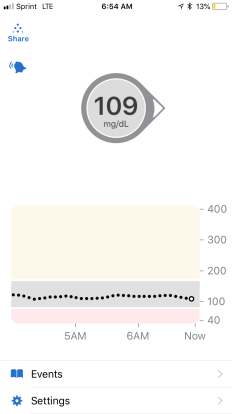
A screenshot from the G6 app

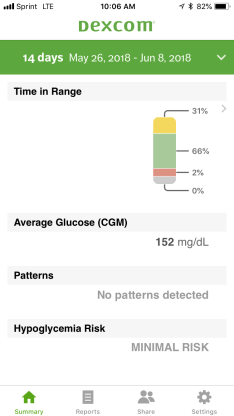
Dexcom also makes an app called Clarity, which happens to be something I’ve come to rely on in between appointments with my endocrinologist. That’s because Clarity links directly to my CGM and gathers data from it that creates reports for my analysis. With just a few taps, I can view information such as my time spent in range, average glucose, patterns, and risk for hypoglycemia. Even better, I can generate results for periods of time ranging from 48 hours to 90 days. The app also produces results in clean, easy-to-read charts and graphs, making it extremely easy for me to figure out how I can improve my A1c.

21A30946-E54D-4E29-A405-67BEFF8FB6D3
A view of the Clarity app

A few years ago, I found an app called Glucagon that’s made by Eli Lilly. As you could probably tell by the name of the app, it’s all about Glucagon: namely, how to inject it. It’s an interactive experience that I like to walk myself through every now and then so I’m familiar with how to use Glucagon – because you never know if and when it could come in handy.

A more recent discovery is DiaBits. Besides having a cute name, this app provides another breakdown of blood sugar data. It has a neat feature that estimates your current A1c, as well as other predictors that indicate how rapidly your blood sugar is rising or falling. It doesn’t replace any of my tools that more accurately check my blood sugar levels; it merely is a complementary app that gives me more insight on trends and averages.

One quick visit to the Apple App Store shows me that there are tons more diabetes-related apps out there. Quite frankly, I don’t know which ones to try next! Do you have any favorites or recommendations? Leave them in the comments!