Diabetes in the Wild Strikes Again

What if I told you that at the beginning of this year, I started training in a new type of exercise that has truly pushed me out of my comfort zone, empowered me, and made me begin to appreciate my body, as it is, more than I have in a long time?

I bet you’d be curious to know more about this form of fitness that has instilled such confidence in me.

It’s pole dancing.

Now, before you get all judgmental on me, let me encourage you to pause for a beat and realize that any stereotypes or preconceived notions you have about pole fitness are likely wildly incorrect, or at least unfair. Shove any thoughts about certain types of clubs out of your brain, here!

I’ve come to learn that pole dancing is less about sexy, slinky movement (unless you want it to be that way, which is also perfectly acceptable) and more about athleticism. The way that I have decided to approach pole is that I am testing my body’s ability to move with strength and grace, and I’m really proud of the progress that I’ve made in the 7 or so months since I attended my first class. I’ve learned that my body (and as a result, my mind) are capable of so much more than I ever thought, and I’ve also found out a few other important things about pole as a sport.

  1. It’s for everybody. Any person of any gender, size, and age can learn how to do it.
  2. There are many different styles of pole. You can learn a choreographed routine, you can wear heels, you can go barefoot, you can spin, you can be static, and so much more.
  3. The biggest obstacle in learning pole is your mind. I’m constantly talking myself into (and out of) certain poses and movements because I am scared of the unknown. It can be frightening to climb eight feet up into the air and put your trust fully in your muscles in order to hang on, much less contort into an elegant posture! But diabetes definitely hasn’t stopped me in any form or fashion from making the most out of a class, and I got proof that there’s other people with diabetes out there who pole not too long ago.

It’s common to have a pole buddy in most of my classes, due to the fact that there’s only a handful of poles available in the studio and twice as many available spots in a given class. So when a woman who was slight in stature and soft spoken asked me if I was okay with sharing a pole with her, I welcomed her over and was pleasantly surprised by what she said next.

“I saw your pump and figured it made sense to share a pole with another diabetic,” she said, motioning toward her own pump which was clipped to her shorts.

My face probably immediately lit up. I was excited to be partnered up with someone who shared something that we both innately understood. We started chatting about the fairly unique experience of pole-ing with diabetes; more specifically, whether or not our diabetes devices got in the way during classes. She shared that one time, her pump detached from her shorts, flung out as she maneuvered around the pole, and got its tubing wrapped around the pole as a result! She was totally fine, but embarrassed by the attention that the incident got her. I reassured her that I’ve had similarly mortifying experiences in fitness classes before, the most memorable being the time that my CGM kept going off in the middle of a yoga class and disturbing the quiet environment. We shared a laugh before refocusing our attentions on the instructor, and for the remainder of the class, our diabetes and our devices became afterthoughts as we transitioned from one pose to the next.

It was a short exchange, but one that bonded us and served as evidence to me that diabetes really can’t stop me (or anyone else living with) from pursuing what we want to do, even something less conventional like pole. This was one of my favorite “diabetes in the wild” encounters that I’ve had in quite some time, and now I know that any time we take a class together, I’ve got someone close by who gets me. And that’s a nice feeling.

10,000 Steps a Day to Keep Blood Sugars at Bay?

Without a doubt, insulin injections are primarily responsible for keeping my blood sugar levels in range.

But I’d be remiss if I didn’t also consider how movement factors into the equation.

Yup, gettin’ steppin’ is key in helping me maintain tighter control over my blood sugars. If my levels start spiking after a meal or a snack – and I didn’t pre-bolus my insulin – then I start walking for as little as 15 minutes as a surefire means of getting my number back down. If I need to get up during my workday for a quick stretch and blood sugar level-set, I start stepping. If my blood sugar is higher than I’d like it to be before I go to sleep at night, then you guessed it: I get those steps in, whether it’s just marching in place or literally doing laps around my tiny condo.

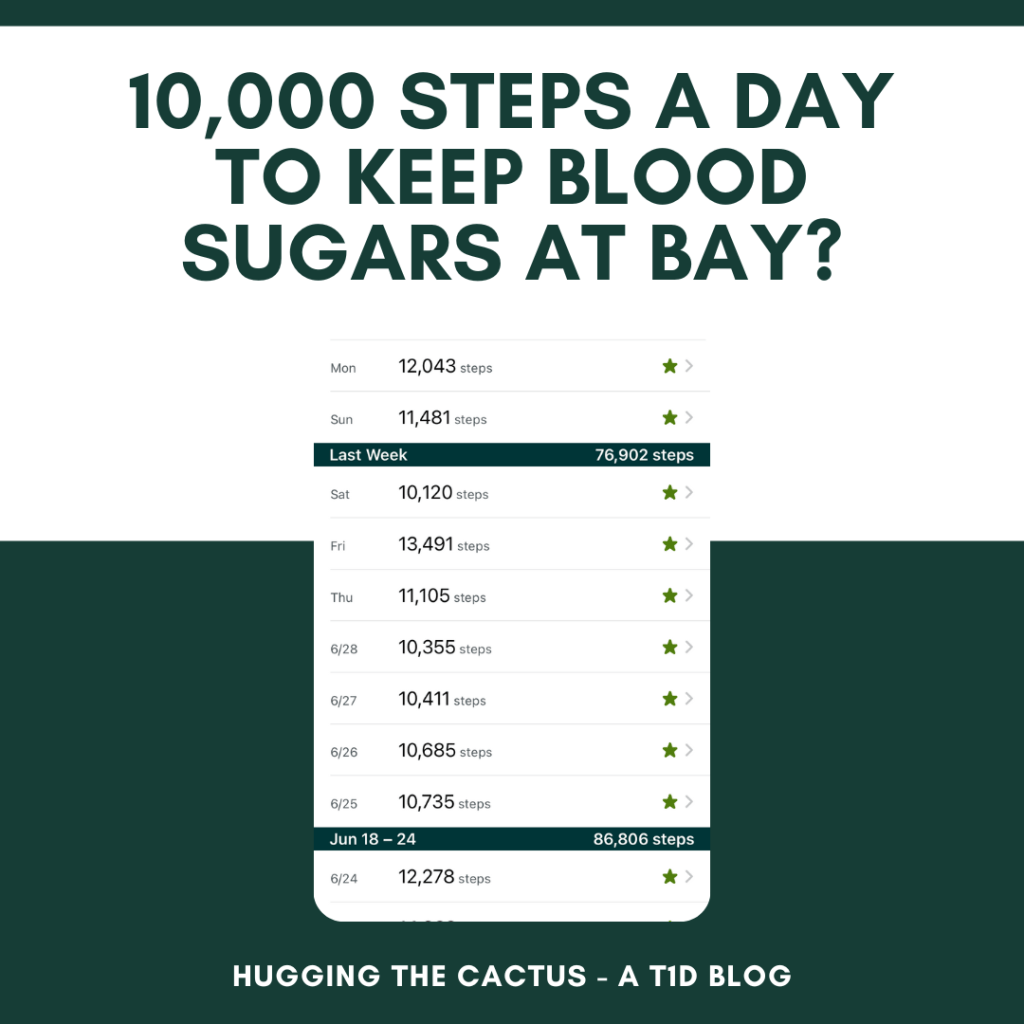
I don’t always get 80,000+ steps per week, but when I do, it’s a terrific feeling!

All this movement not only means that I hit my daily step goal of 10,000 steps, but it has also obviously proven successful in helping me deal with high blood sugars (the kinda, sorta high ones and the really, super-duper high ones). In the case of the latter, I’ve found that coupling a dose of insulin with 10-20 minutes of movement is really effective in bringing me back within range in about 45 minutes, whereas I might have to wait an hour or more if I rely on the insulin alone. That shows how powerful – and so stinkin’ simple – it is to get those 10,000 steps in on a given day.

The added bonus? It feels good to get all that movement in a day, especially considering I spend 40+ hours a week sitting at a desk for my job. My body, my mind, and my diabetes benefit so greatly from it, and it’s been part of my routine for so long that I know that I can consider my 10,000 steps a day a permanent part of my diabetes management toolkit.

The Unexpected Blood Sugar Buster

Spring cleaning is more than a practice of tidying one’s home. It’s also a great way to keep blood sugar levels down, as I was reminded when I decided to take on the long overdue task of cleaning out my closet.

Ever since I moved into my home (nearly 3 years ago), the clothing and random other junk taking up space in my decently sized walk-in closet has largely remained untouched. Not in the sense that I don’t take things in and out of my closet every day, because I do. Rather, I haven’t sorted through anything in my closet since I decided what would go in there and what order it would stay in. Forget clearing out clothing with seasonal changes or refolding items as they got jostled out of place, no way! It’s really no wonder that over time, my closet grew more and more cluttered until finally I couldn’t take it anymore and devoted a few hours to cleaning it out.

It was an exhausting exercise – and yes, the word exercise really applies here because I was sweaty, huffing, and puffing in no time. I had to take everything out, lay it in heaps on my floor, go through each pile individually to see what I wanted to keep and toss, and either refold or rehang garments as I filed stuff back into place to my liking. I’m not sure how many pounds worth of clothing I actually sorted through, but it was definitely a sizeable amount as my arms ached from pulling clothes down from shelves and my hanger bar. And it definitely made sense that I was getting overheated, as I kept walking back and forth between my closet and my bedroom floor with my arms weighted down and in a space that was overly warm due to insufficient air conditioning.

So when my blood sugar levels started tanking 30 minutes into my organizing process, I shouldn’t have been particularly surprised. But in hindsight, it makes perfect sense as the cleaning was basically an extended moderate-intensity cardio AND strength session. What I should’ve been was more prepared for the possibility of going low by enabling activity mode on my Omnipod so that my blood sugar target could be increased from 100 to 150 for the duration of my cleaning, but instead I was crashing and cursing that I had to interrupt my workflow with a fruit snack break.

Maybe next time I’ll do better and coincide my spring cleaning with a high blood sugar so I could reap the benefits of the extra exercise, thereby turning the unexpected blood sugar buster into a welcome one.

6 Tips for Snowboarding with T1D

I’m in an interesting phase of my life right now where I don’t like to say no to most things.

I think this has a lot to do with the fact that I’ve let fear and anxiety hold me back in many different areas. But if there’s anything I’ve learned as I’ve gotten older, it’s that life is too short to not jump at opportunities when they’re presented to me and to do my best to abandon my assumptions before deciding how I feel about something.

So when my boyfriend asked me if I wanted to go snowboarding with him last month, I enthusiastically said yes. I’ve never been a winter sports person, per se, but I’ve definitely spent too many weekends in the last couple of months cooped up indoors – so spending an afternoon outside at a nearby ski resort trying something completely new sounded like an awesome way to beat winter blues.

I should’ve expected it would also be a literal crash course in snowboarding with diabetes! Literal in more ways than one, because I fell…a LOT. Like, so many times that I lost count. But I was also learning how to navigate a brand-new physical activity with diabetes, which can be daunting. I handled it by preparing as best as I could, and practiced these tips and tricks that worked wonderfully for me when I hit the slopes:

#1: Set a temp basal. In the days leading up to snowboarding, I did a little research online to see what kind of tips other people with diabetes had to share about what to expect when snowboarding with diabetes. The most interesting piece of advice that I found and wound up taking was setting a temp basal with my pump. The physical activity of snowboarding, combined with the mountain’s higher altitude, meant that my insulin could be absorbed in my system at a more rapid pace. So I reduced the amount of basal insulin by about a third for a few hours, which worked out great because I didn’t have to worry about impending low blood sugars and could instead focus on trying to glide effortlessly across the snow like all the other skiers and snowboarders (I had little success in that, but that’s besides the point).

#2: Wear ALL the layers. The night before the snowboarding trip, I laid out all of the clothes that I would layer on the next day. I had thermal pants and a thermal undershirt that I wore for layer 1. I wore jeans and a sweatshirt for layer 2, followed by a fleece zip-up for layer 3. Before heading out onto the slopes, I put on my snow pants, winter jacket, waterproof gloves, snowboard boots, scarf, hat, helmet, and goggles…and yes, even though I resembled the Michelin man with all that clothing on, it was worth it because I didn’t feel the sting of the cold not even once. Plus, my diabetes devices, snacks, and other personal items were extra protected under all those layers, which gave me a sense of security throughout the day.

#3: Protect diabetes technology. This was my main concern for the day. I’ve heard horror stories about PDMs falling victim to particularly nasty skiing and snowboarding collisions. I refused to run the risk of smashing my screen by protecting it as best as I could. So I brought an extra sock with me that I used as a pouch for both my PDM and my cell phone. Once they were safely nestled in the sock, I placed it into a plastic baggie, which served as an extra layer of protection that was waterproof. I then put the plastic baggie into the pocket of the fleece I was wearing under my snow pants and zipped up the aforementioned pocket so there were zero chances of anything falling out of it. It was probably a little extreme in terms of protection, but my devices stayed completely dry and intact (despite the many, many falls I experienced over the course of the afternoon), and that was what mattered most to me!

If Shaun White (the pro snowboarder) is known as the Flying Tomato on the slopes, I want to be known as the Rainbow Wonder – I loved rocking my bright snowboarding accessories on the mountain!

#4: Be smart about packing snacks. I knew I would be limited in terms of what I could carry up and down the mountain – it’s not like I could safely snowboard with my purse or backpack strapped onto me (that would’ve added extra weight that would’ve made me even more wobbly on my board) – so my many pockets definitely came in handy and helped ensure that I had plenty of snacks stashed on me at all times. In addition, I chose to pack things like glucose tablets and granola bars because they were more likely to hold up in the cold weather/not freeze like a packet of honey or a juice box might.

#5: Stay hydrated. I think what surprised me more than anything else was how thirsty I felt after only about an hour of attempting to snowboard. In hindsight, though, it made sense – I was outside in the dry wintry air and trying to partake in fairly strenuous exercise, so of course I would be thirsty. Since I couldn’t carry around a water bottle with me, I made sure that any bathroom breaks that I took at the lodge also included trips to the water fountain – a strategy that kept me well hydrated out on the bunny slope.

#6: Monitor, monitor, monitor. I must’ve pulled out my phone to check my Dexcom graph a dozen different times over the course of the 4-5 hours we were snowboarding. That might sound like a bit much, but I had no idea what to expect in terms of the impact of snowboarding on my blood sugar. Watching my levels like a hawk helped me determine how much to eat at lunchtime, what kind of temp basal I should set, and how long I could stay committed to the activity before having to stop to treat a high or a low blood sugar. I felt extra grateful for my Dexcom on this day, because it would’ve been a pain and very inconvenient to check my blood sugar with a finger prick that many times.

Even though I wasn’t quite as badass as I wanted to be on the slopes (more like bruised-ass), I’m still really happy that I gave it a try and proved to myself that this is yet another thing that diabetes can’t stop me from enjoying. I look forward to my next attempt, which will hopefully include similar diabetes-related success as well as a lesson or two from an experienced instructor – because goodness knows I could benefit from that!

Trying to Outwalk a Low Blood Sugar

I was a mile into my regular morning walk when the beeps started.

Dammit.

The beeps were coming from my Dexcom app on my phone and they were alerting me to a low blood sugar. Rather than correcting the low, though, or even opening up the app to dismiss the alarm, I just kept walking.

Outwalk the low blood sugar, Molly.

Outwalking a low blood sugar is easier said than done.

I really couldn’t understand why my blood sugar was low in the first place considering that I had no food in my system or insulin on board (other than my standard basal rate). Fasting workouts tend to virtually guarantee stable blood sugars for me, which is wonderful because otherwise exercise tends to make me crash. But what was different about this morning? I was utterly befuddled. My Dexcom alarm chimed a second time.

Outwalk the low blood sugar, Molly.

Even more confusing was my complete and utter determination to not treat the low blood sugar until I got home. I had glucose tablets on me, so it’s not like it was a matter of lacking a treatment. Rather, I think I was more focused on maintaining my fasted state for as long as possible, since I almost always do an exercise circuit (weight lifting, cardio training, HIIT intervals, etc.) when I return home from my morning walks. My low alarm rang a third time, just as loudly as it had before.

Outwalk the low blood sugar. You’re only 15 minutes from home.

I was deaf to my Dexcom’s persistent alarms for the next 15 minutes as I somewhat floundered down the road home, letting my impatient puppy tug me along. It’s almost like she knew that I was low and was trying to hurry me home, and I was 100% okay with that because my brain was starting to get fuzzy.

Outwalk the low blood sugar…

At long last, nearly half an hour after my first low alarm sounded, I was crossing the threshold of my front door and fishing my phone from my bag. I tapped through my notifications and cleared the low alert, noting that I was 66 mg/dL and definitely needed to eat something before continuing on with my morning routine. I sighed, set my sight on the kitchen (where a low blood sugar food stash awaited me), and resigned myself to the fact that I couldn’t outwalk the low blood sugar this time.

The Best Time for Me and My Diabetes to Exercise

I am a phony morning person.

By that I mean that I pretend that I like getting up early in the mornings, but truth be told…I hate it. Oh how I long for the days that I could sleep in as late as I wanted and shun my very few responsibilities…

Even though I clearly don’t love waking up early, there is one benefit to it that truly lasts all day long. And that is getting my workouts done within the first hour or so of my day.

Listen, I’m not a fitness freak. I don’t have a ripped bod. More often than not, I’m working out so I can eat and drink the things that I like without feeling as terrible about it (only light sarcasm used in that previous sentence). But I do like exercising and try to do so every single day because, well, it’s good for me and definitely helps me to produce better blood sugars.

Exercising is a thousand times harder than it needs to be, though, when my blood sugar crashes halfway through a routine – which happened a lot more than I wanted it to when I was working out in the afternoons or evenings.

Fed up with the lows, I changed up my routine and that’s when I discovered the beauty of fasting morning workouts.

I am definitely not as flexible as this cartoon lady.

I learned that if I work out soon after I wake up in the morning and wait until after I’m done to eat breakfast, then lows almost never happen. It’s like magic. I’m able to get through my exercise routine (which is usually a half hour circuit of some sort) without having to modify my basal rates whatsoever. Since I don’t have any insulin on board (because I haven’t eaten any food yet), I’m only working out with my basal rate running in the background, so there’s a much lower chance that my blood sugar will really fluctuate when I’m exercising. Of course, mornings that I wake up with a low or a high blood sugar are a little more challenging, seeing as I either have to bring it back up to a good level for working out or get some insulin pumping in my system, but I wake up most mornings with my blood sugar in a range that makes me feel comfortable working out in.

All the diabetes business aside, I gotta say…my other favorite part of working out first thing is that it’s over with and done for the day. Ba-da bing, ba-da boom. It’s not looming over my head for the remainder of the day, and that’s a really nice feeling.

A.M. exercise is A-O.K. to my diabetes and me.

How Raising a Puppy is Similar to Dealing with Diabetes, Part 2

Just about three years ago, I was helping my parents raise their puppy, Clarence. And naturally, with me being who I am, I found that raising him was a lot like dealing with diabetes – and wrote about it in this blog post.

Now that I’m a puppy parent, I revisited that post and found that there are even more similarities between the two.

For starters, one of the biggest parts of diabetes management is the constant monitoring involved in it. As it turns out, the same can be said about raising a puppy! Much like my blood sugar, I am watching her like a hawk during all waking hours. I’m prepared to pounce on her if she’s chewing up a puppy pad or squatting down to her business indoors, just like I’m prepared to act when my blood sugar is going higher or lower than I’d like.

Raising a puppy is only this cute and sweet about 2% of the time. (Okay, total exaggeration here, but I’m writing this after Violet decided to do her business in her playpen just after I had her outside.)

Also, as it turns out – shocker – having a puppy around is exhausting. My sleep has been interrupted several times over the last few weeks by Violet’s whimpers. Before, I used to only have to worry about a Dexcom alarm waking me in the middle of the night, but now I have to respond to her cries, too. Fortunately, having a puppy isn’t totally like having diabetes in this regard, because at least I can nap when she’s napping! (We all know that diabetes never sleeps…)

Another similarity, one that I don’t mind so much, is the frequent exercise that Violet needs. Just like my diabetes tends to be “better controlled” when I exercise each day, Violet also responds really well to playtime. The best part is that after a nice, long session of fetch or tug-of-war, she tends to zonk out afterwards, which I see as the puppy equivalent of having the coveted 100 mg/dL blood sugar.

However, there are tons of obvious differences between raising a puppy and managing diabetes. But the best, perhaps biggest one of all? Violet improves (well, when she doesn’t have an accident indoors) my overall mood and mental health. I know that her ability to do this will only increase over time as she matures. And I know that having her around will help me through the tough diabetes days that I’m bound to face in the future, and for that and so much more, I’m thankful for my little pup.

How a Broken Bone Affects my ‘Betes

I still can’t believe that I broke my wrist…again. At least I changed it up a little this time and broke my left one instead!

A broken bone is a broken bone, but my healing experience has been very different compared to last time.

For starters, when I broke my right wrist a couple of years ago, it was in the middle of winter (I slipped and fell on ice in the driveway). I was put into a cast that I wore for 4-6 weeks that felt like 4-6 months because of the challenges I faced. Between attempting to become ambidextrous as I built up strength in my left hand and taking a solo trip to Atlanta, Georgia to film a commercial for Dexcom, I did my best to work around my injury…even though I felt incredibly defeated in the face of the limitations it imposed; specifically, I felt that I couldn’t keep up with the exercise regimen I’d worked so hard to establish. I feared that I’d exacerbate the injury, so I didn’t even try to work around it.

This time around, it’s summer. The break happened after I tripped and fell down some stairs (klutz, much?). I’m wearing a brace for 3-6 weeks instead of a cast: My orthopedist said it’d be much more comfortable versus a cast, which can get seriously stinky and sweaty in the warm weather. And rather than stressing about how I’ll continue to exercise while also allowing myself to heal, I’ve made modifications that have kept my body, broken bone, and ‘betes happy.

How a Broken Bone Affects my 'Betes
Can anyone else spot the lone strand of fur, courtesy of my dog, stuck to my brace?!

I guess I learned from the last broken bone that it’s better to keep moving in some way, shape, or form than dwell too much on the injury itself. In other words, I’ve been trying hard to focus on the things I can still do while I’m wearing a brace as opposed to the things I cannot do. For example, my broken wrist can’t stop me from taking daily walks or, when I’m feeling more ambitious, going for an occasional run. It can’t stop me from making the shift to lower-body-focused workouts or core strengthening routines. I refuse to let this injury be the reason that I get sloppy with my nutrition or workout routines, and it certainly isn’t an excuse to become unmotivated in terms of my diabetes care. If anything, it might just be the reason that I tighten things up and make some much-needed improvements.

They say that when life gives you lemons, make lemonade…so I’m going to try, because a broken wrist won’t stop me from getting something good out of this less-than-ideal situation.


How to Hit Your Step (and Blood Sugar) Goals When You’re Stuck at Home

My diabetes has never liked it very much when I’ve stayed idle for too long.

Unfortunately, my diabetes and I don’t really have much of a choice these days other than to stay put – and I know that just about everyone else in the world is in the same boat.

So how do you hit your daily step goals when you can’t leave the house?

You get creative.

hugging the cactus - a t1d blog
With a little creativity, you can find tons of ways to stay active when you’re stuck at home – which will make your blood sugar and body happy.

And, in turn, your blood sugars will generally respond positively to any extra movement you get throughout the day…plus, with endorphins spiking (instead of bg levels), you can see a huge improvement in your mood. And who doesn’t need a mood booster right now?!

Here are the ways in which I’ve been getting 10,000 steps or more each day:

Taking spontaneous dance breaks. My mom and I are both working from home and sitting in front of our computers for long stretches of time Monday through Friday. To combat this, we’ve come up with a ridiculous but fun game called “DJ Dance Party”. It’s simple: Every couple of hours, one of us cues up music and we just dance around for the duration of the song. DJ Dance Party is a welcome reprieve from work, especially when it happens right after long conference calls!

Playing with pets. Our animals can get just as stir-crazy as we can, so by helping them combat boredom, we’re also doing ourselves a favor by getting off our butts. I play with my parents’ dog, Clarence, by chasing him around the house, throwing his toys at him, taking him for neighborhood walks, and kicking the soccer ball around in the backyard (weather permitting).

Dust off those old fitness videos. Do you have old Jane Fonda/Windsor Pilates/Jazzercise tapes or DVDs just laying around, untouched for years? Dig ’em out from wherever you’ve got them and give them a spin. It might feel silly, but then again you might also get a good laugh in addition to some exercise. I’ve done a few Zumba routines in the last couple of weeks because we have some old DVDs, and they’ve been surprisingly fun.

Hit up YouTube and other fitness platforms for free workouts. Personally, I pay for a subscription to Beachbody, which gives me access to countless workouts lead by professional personal trainers. I’ve used Beachbody workouts in lieu of going to the gym for about a year now and it has worked really well for me, but if I didn’t have the service, I know I could rely on YouTube – in fact, one search of the word “workout” on that platform brought up tons of results that vary in length and intensity. It’s a treasure trove!

Pace around when on conference calls. When I’m not attending a virtual meeting with a video chat component, I’m constantly walking around while I talk on the phone. And it honestly helps me become a more active participant in meetings, sometimes, because I don’t have the distraction of my computer monitors in front of me. I imagine this is the closest I’ll get to having a fancy-schmancy treadmill desk, but I don’t knock it because it works!

March in place while watching TV. Binge on all the TV shows and movies you want guilt-free and challenge yourself by marching in place in 15-minute intervals or at every commercial break. Steps rack up quickly this way, and it’s a go-to for me when I can’t get a walk in during the day.

So even though I’ve barely left the house, doing one, two, or a combination of these above exercises have guaranteed that I’ll meet my step goal each day. And they’ve also really come in handy after meals and long stretches of sitting, when my blood sugars are most prone to going up.

Staying at home has disrupted routines for most people, but it’s good to know that we can still control how much exercise we get in a day.