
How to React When a Loved One With Diabetes is Struggling

If you have a partner/spouse, relative, or friend with type one diabetes, it can be difficult to know how to best support that person when they’re experiencing struggles related to diabetes. You might try to offer a shoulder for your loved one to lean on, but that might not always work. Your loved one might push you away or continue to internalize their issues. It can create turbulence in your relationship with one another, and it’s frustrating all around.

So what can you do?

We Have 10,000 Followers!

As someone who both has T1D and loves others with T1D (my mom, my aunt, many good friends), I believe that the best way to react is to just listen. Whenever I’ve faced serious struggles or emotional turmoil due to diabetes, nothing has helped me quite like a person who spares time for me to listen to me. Whether I just need to spew out an angry diatribe (LOL at the pun), cry about my problems, talk through issues, or seek advice, it’s worked wonders on me to know that I have individuals in my life who are willing to listen to me. Let me emphasize the listen part once again – listen, not tell me that I’m right or wrong, or offer advice (unless I specifically ask for it).

I get it; sometimes, it’s easier said than done to just listen. A few people I know are so determined to help me fix the problem that they can’t help but react emotionally along with me when I’m dealing with diabetes drama. But trust me, that usually heightens (rather than alleviates) the tension.

It’s all about teamwork. Give and take is involved. Often, enormous amounts of patience are required. Sometimes, it takes awhile for the struggles to subside. But one thing that is certain is that your loved one with diabetes will always thank you and be grateful for your support in their time of need. It’ll strengthen your relationship as well as function as proof that diabetes can’t break your bond, no matter how hard it might try.
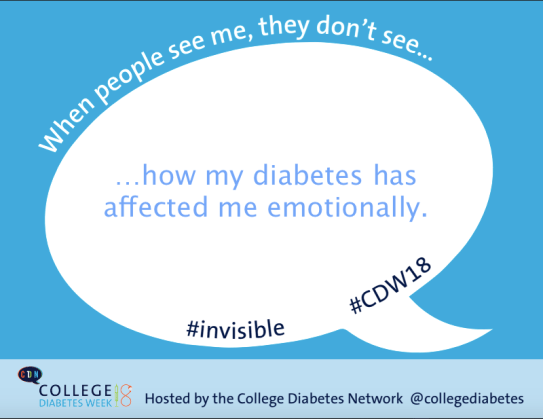
 

Type 1 Diabetes, an Invisible Illness

This blog post is a response to a prompt provided by my friends at the College Diabetes Network, who are celebrating College Diabetes Week from November 12-16. Even though I’m no longer in college, I like to participate in CDW activities as much as possible to show my support for the CDN!

Screen Shot 2018-11-04 at 7.52.43 PM

Invisible illnesses like diabetes can be difficult for healthy people to truly understand. Typically, they only see bits and pieces of it; for instance, when someone performs a blood sugar check or injects insulin. There’s so much that they don’t see: doctor’s appointments, late/sleepless nights, complex calculations, careful monitoring, and so forth.

But what’s really difficult for anyone to see is the emotional impact of diabetes.

Unless I choose to open up to someone about it – which is easier said than done – then there’s no way for another person to grasp the magnitude of the emotional side of diabetes. There’s no way for someone to feel the incredible amounts of anxiety, fear, and anger that cycle through me as I deal with diabetes. While I don’t experience these emotions every single day, I DO have to experience diabetes daily, and it’s impossible for someone to know what that’s like unless they either have T1D or care for someone with it.

I don’t wish for anyone in the world who’s unfamiliar with the (literal and emotional) ups and downs of diabetes to actually learn what it’s like. But I do wish for a world that’s a little more understanding, accepting, and educated when it comes to all things related to diabetes – and that’s why I advocate.

The Emotions of Low Blood Sugar

Previously, I’ve written about what it feels like to have low blood sugar. While many people with T1D feel the same symptoms as me when they experience a low, there are even more who experience a wider variety of emotions and sensations.

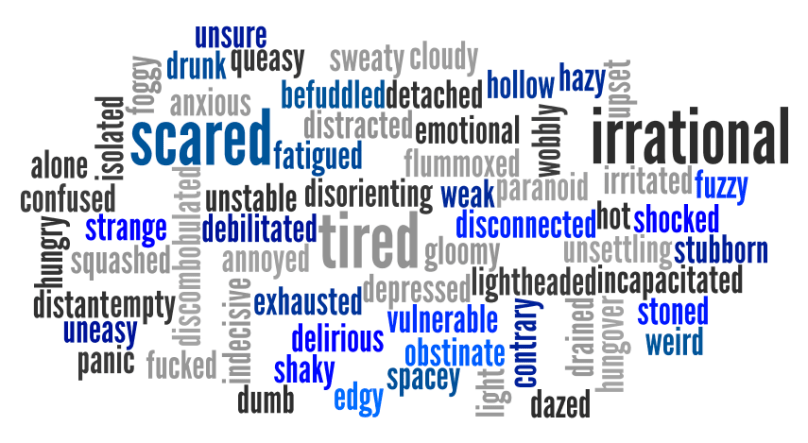
Renza, a T1D Twitter friend of mine, did a little investigating into how others would describe what it’s like to have a low blood sugar. She sent a tweet that read:

friends. I’m crowdsourcing (again). If you had to use ONE WORD to describe how hypos/lows feel to you, what would it be. Go!! #Hypoglycaemia

She received nearly 100 responses, which I’ve compiled into the below graphic.

Capture

Looking at this word collage is a bit startling because it represents the vast array of feelings associated with low blood sugar. Most of them are negative. A handful of them start with the prefix “dis”, which describes something with an opposing force. A couple of them relate to feelings associated with eating. And just about all of them can be summed up as sensations that I wouldn’t wish on anyone.

To me, this graphic serves as a stark reminder that diabetes is more than just a chronic illness that affects the body: It affects the mind, too.