10 Countries, 10 Global COVID-19 Perspectives

This blog post was originally published on the T1International website on April 10, 2020. I am highlighting it here on Hugging the Cactus because 1) I think it sheds a lot of light on the healthcare systems in other countries and 2) it’s a reminder that we’re all in this together.


Hear from ten people living with type 1 diabetes as they share their perspectives about the impact of the coronavirus on their country and their health.

Bolivia – Laura
Things are complicated here, and our health system is already problematic. There are no masks and a lack of other correct equipment to treat patients. The government has been very careful about prevention, and quarantine has been going on for several weeks already. Many people are poor and live day by day with what they earn. The government began to give money and food aid to older people and families who receive other types of government bonds, but not everyone can receive it and many say that they do not have enough money to eat. Based on the numbers on our identification, we know when we can go out to get groceries or medications – only on specific days. Still, there is a lot of ignorance and people are not following instructions. There are 200 cases confirmed, with 15 deaths and it is increasing every day. People who have to travel long distances to get medicine do not have good options. I have a friend who has no blood glucose test strips and her blood sugar keeps going too high, but because she does not have test strips, she doesn’t know it. It is very dangerous.

Costa Rica – Dani
Our small country is on lockdown, with only 10 people in ICU at the moment. The country is making at-risk patients a priority and currently even shipping their medicines to them to prevent them from going to the hospital and getting infected. Families have been given extra insulin for the next two months, and the community is supporting each other if there is an urgent need for support or extra supplies.

Germany – Katarina
Germany has one of the lowest COVID-19 related death rates so far. A lot has been undertaken to prevent the virus from spreading – test centres have opened their doors to the general public, hospitals are increasing their capacities for intensive care and ventilation, and research teams are working hard to improve diagnostics, therapy and find preventative methods. The pandemic is challenging our healthcare system, our economy, and our society, but it also opening new pathways. A lot of diabetes care centres are transitioning to telemedicine, and people with diabetes can get prescriptions and supplies by mail. Being a doctor on the frontline and a high-risk patient at the same time is not easy – I am constantly torn between my profession and my wish to self-isolate and stay safe.

Ghana – Yaa
With the rise in COVID 19 cases in Ghana, the government made it mandatory to close down schools for a month, to limit the number of people to no more than 25 in a social gathering, and to start a two week partial lockdown in contiguous districts (3 regions). This means no one is allowed to go out unless it is to buy food and drugs. Borders are closed, and importation of goods are restricted. For people with type 1 diabetes who get supplies at the government hospital using the national health insurance scheme, they still have to go all the way to the hospital for their supplies. The hospital is a major reservoir of the virus, so it increases the chances of people with type 1 who are already at high risk. The only other option is to go buy from the pharmacies, where there is currently a surge in prices. People with diabetes were asked and encouraged to stock up on their diabetes supplies, but not everyone was able to do this. We fear for the unknown and the long term impacts.

India – Apoorva
As a medical doctor I have been working and seeing new cases, but now my entire department is in isolation. I took steps back to prevent getting sick. Delhi is one of the hotspots, and we had sudden surge in cases. Rural impoverished areas are problematic due to people living in close quarters. Our government initiated a lockdown, but many tried to leave quickly, especially migrant workers who come and go from the city centres because they lost their livelihoods. This caused the virus to spread despite drastic measures taken by the government. Currently, there are no insulin shortages as all medical services and pharmacies are operational, but we have seen a possibility of analogue shortages and hope to try to ensure that does not happen. Our main aim is to support the actions of the government and I plead everyone to stay home and protect their families.
A4200DF1-A393-4A5B-B9A9-8B1FE05A856E
Enter a caption

Kuwait – Mohammad
We have been on lockdown for four weeks, and people who came to Kuwait from other countries were tested. If someone had symptoms, they were put in quarantine. Cases have been contained and so far, there has only been one death. It is interesting that there is now a COVID-19 database that was created rapidly, but there has never been a database of people with type 1 diabetes in Kuwait. Our medications tend to be provided and some are being delivered. Overall, things are OK now, but we are concerned about access to medication and food supply in the long term because most of it is imported.

Lebanon – Cyrine
Our country has been facing tricky political problems for the past five months, since we had a revolution in November. The banks have no money, and there is no money from the government. We can only have access to a specific amount of our money per month. We are facing shortages of medical supplies including ventilators and medical protective equipment. The whole country is in an emergency state now and there are military personnel on the streets. As cases continue to rise, people are only allowed to go out at certain times and we can only walk. I have been on self-quarantine for the past few weeks. What worries me most is the people who already struggled to afford their basic insulin and supplies. With 80% or more of the population having lost their jobs, what are those who cannot afford their insulin doing now? I am trying to help those I know about, but there is no government plan for people with type 1 diabetes. People do not have money anymore, so how can they cover their insulin costs?

South Africa – Estelle
Testing here is slow. On April 2nd, I heard only 46,000 tests had been done, which is not even 1% of the population. It looks like we have small numbers of diagnosed patients but there is so much unknown. Apparently there is enough stock of medication for up to a year. Medical aid, our version of insurance, said they will cover all treatment related to COVID-19, so that is a relief. A large proportion of individuals might not be taking it seriously enough. The biggest concern is keeping the virus out of the rural areas, which are densely populated. If it spreads there, it could be catastrophic because we do not have enough hospitals.

Tanzania – Johnpeter
We only have about twenty cases identified so far. I am currently in Serengeti which means I am far from cities where cases were confirmed and spreading. I am staying put and I had to cancel my doctor appointments and other appointments. I have had to reduce my insulin dose because I cannot get any insulin here in this rural area. I have some insulin in Dar es Salaam that my doctor gave to my brother for me. So right now I am working with my brother to try to find a way to get the insulin. I am not supposed to travel to cities to risk my health, but I am risking my health by staying here without insulin. It is incredibly stressful on top of the challenges I already face accessing and affording my insulin.

USA – Karyn
In Georgia, where I live, we are also on lockdown, with cases increasing every day. The biggest issue is shortages of ventilators and protective equipment for hospital staff. Cost and affordability issues are already a problem in the USA and this will likely be an even bigger challenge now. Due to the broken healthcare system here, it’s uncertain if people will even get tested if they go to the doctor. Some people are getting billed for the test even though it has been said they shouldn’t be. Last year around this time, I went to Canada to buy a year’s supply of insulin. I have a bit more, but I’m not sure what I’m going to do without being able to travel abroad this year. I already struggle a lot with the costs. Many people are losing their jobs, and therefore losing their insurance, which will inevitably also impact their ability to afford essential medicines.

TTFN, Twitter

The title of this post really should be “Sorry Twitter but I haven’t been an active user in about two and half months for some specific reasons I’m about to highlight here, but hopefully I’ll come back to you later when things settle down,” but that’s just not very catchy, is it?

Anyways…

The reason why I’m saying ta-ta for now, Twitter, is that it’s become a really tough space to dwell in – or even pop in for a quick visit – throughout this pandemic.

It’s nothing that any account that I follow did or tweeted specifically…it’s just an amalgamation of everything that appears on the site these days. Between the news alerts and downright depressing tweets showing up left and right on my feed, it’s taken a huge hit on my mental health.

TTFN
I’ll return to Twitter full-time…eventually.

It’s a shame because for a long while, Twitter was kind of my go-to in terms of connecting with the diabetes community. I participated in weekly diabetes social media advocacy chats that were a lot of fun and a great way to communicate with fellow T1Ds near and far. But as Twitter grew more and more negative for me, I found myself gravitating more towards Instagram, where things are admittedly a little too shiny/happy/beautiful/perfect all the time. Instagram doesn’t quite fill the void that Twitter did for me in terms of linking up with my T1D community, but it’s something steady I can rely on for now, and with the added benefit of introducing me to other T1Ds who might not be on Twitter.

I’ll end this post by saying that I doubt I’m the only one who feels this way about one or more types of social media during the pandemic. Actually, I know FOR SURE that I’m not the only one who has felt emotionally drained by logging into different platforms and seeing just the one post that is enough to sap you of all positive, happy feelings. And you know what my advice would be to anyone who has felt the same way as me? Recognize it by avoiding those platforms for as long as you need to. I deactivated my Facebook profile for a couple of different weeks so far this year and my mental health absolutely benefited from me doing so. I don’t tap on the Twitter app on my phone lately and I know I’m saving myself from a ton of anxiety and emotional turmoil.

Just like the world has adapted to this “new normal”, it’s all about being pliable enough to see what does and doesn’t work for your mental heath right now, and then identifying alternative ways you can support it.

5 Questions (and Answers) About the Dexcom G6

This post was originally published on Hugging the Cactus on November 19, 2018. I decided to update it, since some of my thoughts and observations on the Dexcom G6 have changed over time due to more experience with it. Updated answers will be in parentheses and/or italics just below (and in some cases, next to) the original answers…

I’ve been lucky enough to have the Dexcom G6 CGM in my life for just over six months now. (It’s actually been about 2 years at this point!) In that time, many people in my life – both T1Ds and non-T1Ds – have asked me countless questions about my experience with the device. I thought it’d make sense to address some of the most commonly asked questions here, in the hopes that I can provide some insight to those who are curious about the Dexcom G6.

Question: Can the Dexcom G6 be restarted?

Answer: In my experience, no. I cannot get the G6 to restart like I could get my G5 to restart. But take my “no” with a grain of salt, here, because I know of other people who HAVE had success restarting their G6 sensor, making its life extend much longer than the 10 days guaranteed by Dexcom. I have only tried to restart the G6 once, with absolutely zero success, following the process outlined here. My advice to those who want to try to restart their G6 is to do so cautiously, and make sure you’re not trying to do so with the last sensor in your stockpile.

Since I initially wrote this, I WAS able to restart the G6 and did so “successfully” a handful of times. But in my opinion, it wasn’t worth it because 1) the sensor would stop reading blood sugars 2-3 days after restarting and 2) I can’t be sure that restarting doesn’t wear out my transmitter faster, which wouldn’t work to my benefit since I don’t know how to reactivate transmitters. My two cents is that while reactivating old Dexcom models like the G4 or G5 often worked well, the technology within the G6 simply isn’t meant for accurate restarting.

Question: Is it actually safe to take acetaminophen (Tylenol) on the Dexcom G6?

Answer: Yes! I’ve noticed that acetaminophen can be taken safely on the G6. I did not anticipate for it to be unsafe, seeing as it was advertised as one of the big improvements Dexcom made from the G5 to the G6. I’ve taken Tylenol a handful of times without noticing any issues with my CGM readings, but as always, be sure to monitor your blood sugar carefully and perform a manual finger stick check if your symptoms don’t match up with your CGM.

This is still absolutely true! I’ve yet to observe Tylenol, or any other drug really, having an impact on my CGM’s readings.

Question: I can’t get my Dexcom G6 sensor to stay put for the full ten days. How do you make it last?

Answer: There’s tons of ways you can help ensure your G6 sensor stays stuck on for the entire ten-day duration. I always make sure that my skin is completely dry before the sensor makes any contact with the site. Avoiding any excess moisture is key in helping it stay put. If I notice the sensor starting to peel around the edges after a few days of wear, then I use a Pump Peelz CGM adhesive to keep it in place. Those tend to work really well for me. In times of serious adhesive doubt, I also use Skin Tac wipes, which basically glue that sucker down. One last tip I recommend is to avoid sites that come into contact with a wide variety of surfaces. In other words, a sensor that’s placed on the abdomen may fare better than a sensor on the leg, because the odds of the sensor getting accidentally knocked off due to contact with clothing or other objects are lesser. You know your own body better than anyone, though, so trust your own judgment when it comes to CGM placement.

So at the time of publication, I hadn’t tried my leg as a site for the CGM. Now that I have, my answer changes a little regarding the “usability” of this site: I’ve had great success keeping the CGM sensor on my leg for the full 10 days without a single peel in the adhesive. Another tip I’ve picked up along the way is to contact Dexcom and ask for their free “overlay patches”, which they produce and that work just like any medical adhesive that Pump Peelz or GrifGrips manufacture especially for Dexcom products.

I just want you to know...
Oh hey, it’s me! In my purple cast showing off the G6. Fun fact: I don’t own an Apple watch – the one I’m wearing here was provided to me to wear just for the G6 promotional materials.


Question: Is sensor insertion truly painless?

Answer: For me, G6 insertion has been pain-free approximately 85% of the time. It’s stung slightly a handful of times, but I’ve found that it only hurts when I choose a site that’s not particularly fatty. That’s why I generally stick with my abdomen – either side of my navel – or the back of my arms for G6 insertion.

I stand by this estimate – once in a while, I get a site that’s a little more sensitive and there’s a slight sting, but nothing like it used to be for the G4 or G5. And now that I’ve added my thighs as sites into the mix, I’ve got more site rotation going on, which can help.

Question: Is the G6 really that much more accurate compared to the G5, or any other CGM on the market?

Answer: Yes and no. That may not be a very satisfactory answer, but I’ll explain why that’s my belief. Overall, the G6 seems to be more accurate for me than the previous Dexcom CGM models I’ve worn. Are the number always on point compared to what appears on my meter? No. Do I wear the Dexcom CGM to have an accurate picture of what my exact number is at a given moment in time? Kind of, but I also know that this isn’t totally realistic. After all, users of the Dexcom CGMs know that it measures blood sugar levels in five-minute intervals. It can’t give me a clearer picture of what my blood sugar changes are minute-to-minute. So with that in mind, I find that the G6 is really excellent for monitoring trends – seeing how rapidly my blood sugar is falling or rising, or seeing how it changes gradually over time. The patterns are more important to me than the precise numbers; at least, that’s how I feel in my current stage of diabetes management.

I can’t really speak to other CGMs on the market, such as the Freestyle Libre or Medtronic’s CGM. But what I can say is that I’ve heard less-than-stellar reviews about both. It’s important to remember, though, that they’re not meant to be the exact same as the Dexcom CGM. The Libre itself isn’t really continuous and can’t provide users with information until they chose to wave the receiver over the sensor. And as far as I’m aware, the Medtronic CGM communicates directly with Medtronic pumps, and I’m not sure how seamlessly the systems work together.

Bear in mind that when it all comes down to it, I’m answering these questions with my experience, and my experience alone, in mind. Dexcom is and will always be the number one resource to go to with any questions regarding their CGM devices. But hopefully, the information I’ve shared here will at least help someone who is curious about the G6 feel more motivated to seek additional information. I stand by the fact that it has revolutionized my own diabetes care and management, and though it’s far from being flawless, it’s still an invaluable tool to have incorporated into my daily routine.

I still have not tried any CGM model out on the market except for Dexcom CGMs. To this day, it’s what I know and what I’m most comfortable with, so I don’t anticipate that changing any time soon (though it’d be kind of cool to try another and compare it to my G6). The one thing that has changed is that I rely on my G6 readings a lot more heavily these days. I use a blood sugar meter to check my blood sugar only once or twice a day now, whereas a year and a half ago, I was using it at least four times a day. I’ve put greater trust into my G6, but I do remain cautious against the technology and always check with my meter when I’m not fully believing my G6’s readings.

Why I Decided to Become a Digital Advocate for T1International

When I started Hugging the Cactus, I knew I wanted to do more with it than just use it as a platform to share my diabetes story.

I also wanted to make change.

I wanted to do more for my diabetes community.

I wanted to become the best advocate that I could possibly be.

But for a long time, I was stuck on how exactly to go about doing that.

During this time in quarantine, I’ve been able to spend more time thinking and researching ways that I could get more involved.

And that’s what lead me to T1International.

t1
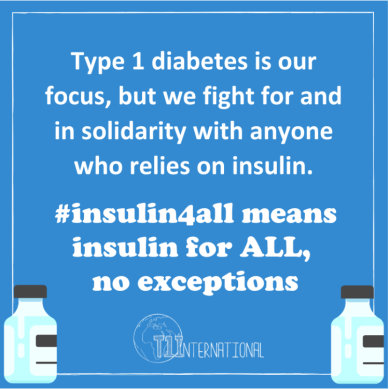
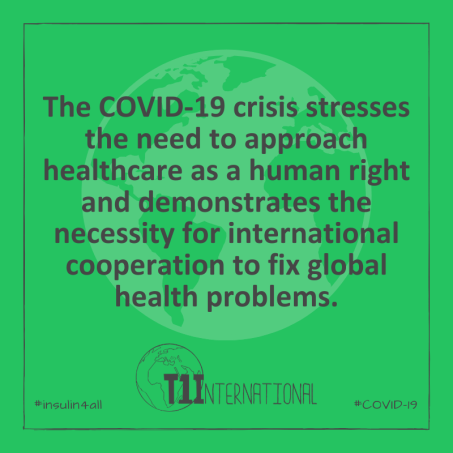
#insulin4all means FOR ALL.

As I mentioned in a blog post earlier this month, I’ve sort of known about T1International for a long time now. I knew that they were the organization behind the well-known hashtag #insulin4all, but I was curious to learn more about them and their mission.

As I discovered, T1International works to support local communities by giving them the tools they need to stand up for their rights so that access to insulin and diabetes supplies becomes a reality for all. They have a plethora of materials and information on their website that helps those who are interested become well-versed in this issues surrounding insulin and diabetes supply accessibility. In addition, the T1International team keeps site visitors up-to-date with their blog that contains articles on everything from global stories to legislation explanations.

It wasn’t long before I realized I wanted to work with T1International. So I reached out to their team and applied to become a digital advocate, and less than one week later, I completed my orientation. It’s official: I’m a proud T1International digital advocate.

This is meaningful to me because now I feel more empowered to advocate about the issues that matter, such as the #insulin4all movement. This movement is so important because access to insulin, no matter who you are, where you’re from, or what type of diabetes you have, is critical to the health of all individuals who rely on insulin to live.

Before I dive more into the insulin crisis, let me first acknowledge that I am extraordinarily lucky and privileged: Insulin affordability has never been a personal issue for me. Sure, I’ve had to pay way more out of pocket than I’d like to in order to cover the cost of insulin, but I’ve never had to make the impossible choice between paying for a month’s supply of insulin OR paying for monthly rent.

Many people have had to make that sort of choice, though. And that’s simply not okay.

Whether you’re familiar or unfamiliar with the current insulin crisis, consider the following facts (provided by T1International):

  • Since the 1990s, the cost of insulin has increased over 1,200%, yet the cost of production for a vial of analog insulin is between $3.69 and $6.16.
  • Spending by patients with type 1 diabetes on insulin nearly doubled from 2012 to 2016, increasing from $2900 to $5700.
  • A study of rising drug prices over the decade ending in 2018 found that list prices of insulins increased by 262%, with net prices increasing by 51%.
  • One of every four patients with type 1 diabetes has had to ration their insulin due to cost. Many have died.

These statistics are more than alarming. They’re downright disgraceful, unjust, and have forced patients to resort to drastic measures to stay alive.

Change needs to happen.

This is why I’m humbled, fired up, outraged, and beyond ready to join the T1International digital advocates team and become one more voice who helps to make the issues regarding insulin access and affordability heard.

My Favorite Blood Sugar

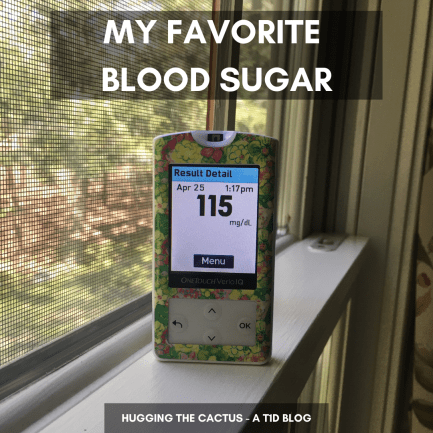
I have a favorite blood sugar reading. Can you guess what it is?

…Probably not. So I’ll just tell you. My favorite blood sugar reading of all time is…

115 mg/dL.

My Favorite Blood Sugar
Apparently the last time (on record) that my blood sugar was my favorite number was on April 25th – I’m sure I had an especially good day because of that.

I can justify my favoritism for this seemingly random reading, too. For starters, 115 literally contains my favorite number ever, 5. (I think it’s my favorite number because I was born in the fifth month, May, and it’s so easy to count in multiples of 5.)

115 also represents “perfect” stability to me. I’m guaranteed not to feel the shakiness of a low or the grumpiness of a high at this level. At 115, I can most likely even have a small snack (no more than 15 carbs, but still) and not have to take a single drop of insulin for it (given that I’m exercising for at least 15 minutes post-snack-consumption, of course).

Hmm…there’s definitely a pattern going on there with that trifecta of fifteens, but I digress.

A blood sugar of 115 makes me feel…invincible. Almost like I’m the proud owner of a functioning pancreas.


6 Questions to Ask Before Trying New Diabetes Technology

So you want to try your first continuous glucose monitor. Or maybe you’re ready to leave behind multiple daily injections and switch to insulin pump therapy. Whichever diabetes device you’re looking to start using, there are some questions you’ll probably want to have answers to before decide that now’s the time to introduce new diabetes technology into your daily routine.

The following is a compilation of the questions that I thought long and hard about (literally for years) and that I wish I’d thought long and hard about before I made the transition to the OmniPod insulin pump.

  1. Am I ready for it? It took me 17 years before I decided that I was ready to try an insulin pump. 17 freakin’ years!!! I spent most of that time being too afraid of introducing such a drastic change to a routine I’d had down pat for such a long period of my life. There are times when I wish I’d gone onto my insulin pump sooner, but ultimately, I’m glad that I wasn’t swayed by my family or doctors to go on it before I truly felt ready. By the time I started using my OmniPod, I had the maturity, responsibility, and emotional intelligence that I felt that I needed for an insulin pump.
  2. Will I be able to afford it? Obviously, this isn’t a question that I wondered about when I was younger, but it’s one of the first things that comes to mind as an adult on her own health care plan. We all know that diabetes supplies are expensive, and it seems that the more technologically advanced something is, the more money that has to be forked over in order to obtain it. This isn’t right or fair, but it’s a simple truth and an important one to think about before choosing one pump or continuous glucose monitor over another.
  3. Why do I want to start using it? I wanted to start using my OmniPod because my mom experienced great success when she started using it. And I decided to get a Dexcom CGM because I fell in love with the technology after undergoing a trial period with my endocrinologist. In both situations, I felt very much in control of my decision to start using these devices and I didn’t really listen to anyone else’s opinions. But I am very aware of the fact that social media and real-life friendships with other people with diabetes can often sway people in different directions. After all, if I saw a post on Instagram from a dia-influencer who was singing the praises of a Tandem T:slim pump, then I might seriously start thinking about switching to it (this has actually happened to me). But the bottom line is to think about the why – will this device enhance quality of life for me? Will diabetes be easier to manage with it? Will it help me achieve my A1c and/or blood sugar goals? Do I need to add something new to my routine because I’m feeling burnt out by doing things the same way all the time? Knowing why I wanted to use an OmniPod or a Dexcom CGM made me feel that much better during the whole process of learning how to use them – I felt like I had clear goals that would help me navigate the integration of these new technologies into my daily routine.

    6 Questions to Ask Before Trying New Diabetes Technology
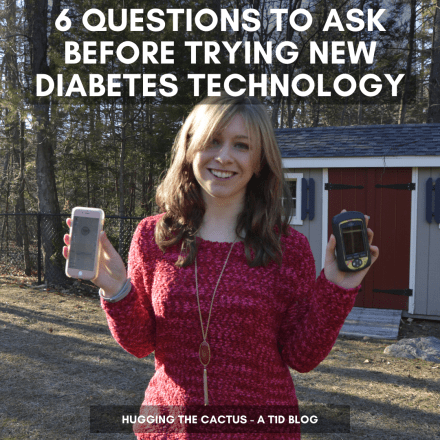
    Me, being a goofball with my two favorite diabetes devices.
  4. Will I be comfortable wearing it 24/7? This is a big one! Pods, pumps, and CGMs are very visible, and it can be jarring to go from being “naked” to having bumps and lumps underneath clothes that can get caught on doorknobs, chairs, and the like. Personally, the benefits of my OmniPod and Dexcom outweigh something like this which is a bit superficial, but that doesn’t mean it’s not something to think about. But it’s also worth thinking about comfort and what is least painful when it comes to insulin delivery, so that’s why this is an important question to ask.
  5. Do I know anyone else using it who can provide feedback from a patient’s perspective? I’ve talked about this before, but I’m not sure when, if ever, I would have seriously considered using the OmniPod if my mother hadn’t tried it first. The fact that we both have diabetes has probably made us a little closer and strengthened our bond, so if there’s anyone’s opinion that I’m going to trust when it comes to something like this, then it’s hers. I can actually remember her first few weeks on the OmniPod – in which she learned a lot of valuable lessons – and how pleased she was with it once a few months with it elapsed. She taught me the ins and outs of the OmniPod when started to use it, and I’d argue that her advice was more helpful than that of my diabetes educator. So I’d advocate gathering opinions from family and friends (if either is applicable) or the diabetes online community before going on a new diabetes device, in addition to the research component below…
  6. Have I done enough research on it? …Like any smart shopper, it’s crucial to really consider all options and research them thoroughly, especially when it comes to the top contender. I definitely did not complete sufficient research before going onto the OmniPod or Dexcom; rather, I trusted that they were just right for me. If I were to switch to something else tomorrow, though, you can bet that’d I’d spend a lot of time scouring the web for every last bit of information on the device so I could make the most informed decision possible.

New diabetes technology can be both scary and exciting. But more than anything else, it can really make life with diabetes much more carefree, and I’m glad that in this day and age there are so many options available to people with diabetes that continue to be technologically impressive.

A Shout-Out to Mothers of Children with Diabetes

Yesterday was Mother’s Day, but today I’d like to take the opportunity to give a shout-out to my mom – and all mothers – who care for children, young, fully grown, or any stage in between, with diabetes.

All moms, generally speaking, don’t get enough credit for all that they do for their families. I know that I am fortunate enough to say that growing up, and to this day, my mom (and dad) provided me with everything a child could ask for: a loving home, plenty of food to eat, and endless support, to name a few.

But on top of that, my mom also acted as my pancreas (and her own) throughout my childhood. She counted carbs for me, injected me with insulin, scheduled and took me to doctor’s appointments, and offered her guidance whenever I was dealing with a difficult diabetes issue.

A Shout-Out to Mothers of Children with Diabetes
Mom, please consider the pretty cherry blossoms in this picture my belated Mother’s Day bouquet to you.

Even in my adulthood, though I’ve taken over all of my day-to-day diabetes responsibilities, my mom is still one of the first people I turn to when I have a diabetes question.

She’s the real MVP and she’s helped me a lot during this stay-at-home situation. So I want to give her credit, and credit to all T1D moms: You’re doing great. I know that it can’t be easy, especially for those T1D moms with little ones at home who are dependent on you for everything, but you’re doing your best and your loved ones see that and appreciate that more than you could ever know.

Thank you to all the moms out there, but particularly mine: Thank you for helping to keep me grounded during this “challenging time”, and for, well, everything else you’ve done for me in my 27 years (both the non-diabetes things and the diabetes-related things).

3 Things I’ve Learned Since Switching to my Own Health Insurance Last Year

Just over 365 days ago, I made the switch from my parents’ health insurance plan to my own plan, provided by my employer.

In the last year, I’ve learned some important lessons about being responsible for my own healthcare coverage. Some lessons were easier to learn than others. I figured it might be helpful to others who just made the switch themselves (or who will be doing so in the near future) for me to sum up three big takeaways I’ve discovered along the way in the hopes that it makes the transition a little easier for those individuals, or at least saves them some time down the road.

AI Innovation Summit
Navigating the confusing world of health insurance has taught me quite a few lessons in the last year.
  1. Take advantage of a flexible spending account (FSA), if the option is available. I grew up knowing that FSAs exist – my parents would always bring their FSA account cards to all my doctor’s appointments and pay for all of my supplies using those cards – but I had no idea what the big deal was about them until I switched to my own health insurance plan. Basically, FSAs are a great employer-sponsored benefit because they allow account holders to pay for eligible medical expenses on a pre-tax basis. So those who have an FSA are able to pay for things they need tax-free, and the money is typically available to account holders on the first day of the health insurance plan year. My current health insurance plan allows a maximum contribution of $2,300, so I was able to put up to that amount on my account for 2020. It really comes in handy because my wallet doesn’t take as much of a beating from all of my necessary (and very expensive) diabetes supplies, and unlike the last half of 2019, I’m not paying as much out of pocket after my deductible is met.
  2. Keep records of everything. It might seem fussy to hold onto any and all receipts or transaction records, but there might come a day when one is needed. Case in point? At the end of 2019, my company announced during open enrollment that our FSA administrator was changing…which, at the time, I didn’t think was a big deal. I knew what the maximum contribution was, and I figured I’d only need to log into my FSA account sporadically to see how much money I had left for the year. Well…I was wrong about that. Back in February, I got a notification that I needed to submit verification of purchases of my regular OmniPod shipment, Dexcom sensors and transmitters, and my Humalog prescription. And you can bet your bottom dollar I didn’t have receipts for all three of those transactions because, well, my old FSA provider never once asked for receipts. As silly as it sounds now, I guess the thought never crossed my mind that my new FSA administrator would need purchase records. Long story short, I was able to submit an explanation of benefits in lieu of the receipts, but it would’ve been easier just to hold onto the original records (and I can assure you I’ve done that since this whole incident).
  3. Don’t be afraid to ask questions when things don’t add up. I had my annual physical in January and I had quite the shock when I was billed over $300 for all of the lab work that my primary care physician had me do. The moment I got that charge, I knew something wasn’t right – never before in my life have I been charged that much for a standard battery of tests that I take for my physical. So I wrote in to my PCP’s billing department and asked about the charges. That’s when I learned that I was mistakenly charged this amount and that I needed to reach out to my health insurance provider to re-run the charges. Although it was a little annoying to have to go back and forth between my health insurance provider and my PCP’s office, it was worth it because I saved myself $300 that I never actually owed in the first place. This taught me the importance of asking questions and following up with people until I understand, well, anything that’s confusing to me when it comes to my health insurance.


Dealing with Loneliness and Diabetes During a Global Pandemic

If I was an old-timey sailor keeping a log on my voyage across the ocean right now, I imagine that my entry for today would look a little something like this:

Quarantine, Day #55: It’s been almost two full months since I’ve set foot outside of the confines of my home. I’m so appreciative of the little things, like good weather days and food to sustain me, but I never realized how much I would miss face-to-face interaction with human beings. I miss everyone: my extended family, my friends, my coworkers. I miss people who are physically close by and far away from me. I miss strangers. No wonder all the rum is gone, me hearties!

Okay, so that last line is a bit of a stretch, but you get the gist of it.

The times and the circumstances are making me (and many others) feel a unique sense of loneliness.

Yes, I’m lucky enough to be quarantined with people and a dog who love me. I don’t take that granted for a second, nor do I want to forget how fortunate I am to have so many things that others do not (ample food, clothing, Internet access, entertainment options, etc.).

Still, I’ve felt deep, dark pangs of loneliness and sadness a handful of times since my quarantine began.

Dealing with Loneliness and Diabetes During a Global Pandemic
This whole situation has made me rather introspective.

I’ve felt profound sadness for others: My heart aches for anyone who has lost a loved one due to this wretched thing. I constantly worry about the physical and mental health of those on the front lines of it all and wish there was more I could do.

I’ve felt isolated from my loved ones: Sure, I have video chat and texting and those are excellent ways of keeping in touch with people. But it doesn’t compare to the in-person connection that I have with my extended family, friends, coworkers, and others in general.

In my most melancholy moments, I’ve cried ugly tears that I couldn’t control because I can’t find the words and I can’t even fully understand my own feelings in those fleeting periods.

Is it disgust at myself for crying in the first place when I don’t really have anything to cry over because I am a gainfully employed individual who has access to her medication and other living essentials?

Is it frustration at myself for allowing myself to be dragged down by my conflicting emotions?

Is it anger over taking the little things for granted or for this whole situation, in general?

Is it grief over the many life changes I’ve faced in the last year? A longing for the way things were before?

I don’t know the answers to those questions, but I do know that the waves of loneliness I’ve ridden in the last six weeks (and are bound to continue to ride occasionally) have directly impacted my diabetes.

I’m going to be real with myself (and you) for a hot second here: I haven’t taken particularly excellent care of myself in all this. My eating habits have changed. I’ve spent more time knocking down my body and its appearance than appreciating it for what it is. And I’ve berated myself over and over again, asking myself why I can’t just get my shit together and produce better blood sugars, dammit.

So…how exactly am I going to change this? How can I make my thoughts and feelings about myself and my diabetes healthier when I’m already struggling with loneliness during a global pandemic?

I think the answer, for now, is simple but effective: I’m going to work harder at keeping a routine that incorporates setting and achieving small but meaningful goals each week. I’m going to follow the tried-and-true SMART (specific, measurable, attainable, relevant, and time-based) goal-setting formula and more importantly, I’ll take the time to actually write them down. I may share them here sometimes, but I think I should also be consistent and capture them in some sort of journal that is only for my eyes. Writing in a journal may seem silly to some, but after seeing some posts on Instagram about the benefits of doing so and talking with a few friends who actively maintain journals…I think it’s just what I need right now, in tandem with leaning a little harder into my various support networks during those particularly blue moments.

Plus, gentle reminders to myself that even though I may feel on my own when it comes to my diabetes and other roller coaster emotions during this global pandemic, I’m never truly alone. And neither are you.


27 Acts of Kindness: Days 25, 26, and 27!!!

The 27 acts of kindness challenge is…COMPLETE!

Wow…this was truly such a special way to celebrate the weeks leading up to my 27th birthday.

I’ve spent time this weekend reflecting on how my thoughts and feelings about this challenge have changed over the last four-ish weeks. Some days were easier than others. I grappled with doing my best to make a true difference while also staying safe and maintaining social distance guidelines.

That was probably the hardest part – not being able to interact with more people throughout this whole process. It was really hard to feel like anything I was doing had any sort of impact. But given the limitations of the circumstances, I can end this challenge knowing that I tried my hardest to do something unique each day…and like I said at the beginning, if a single act made someone feel good or inspired someone else to commit an act of kindness, then I feel as though my mission was accomplished.

With that said, here is what I was up to this weekend:

Friday, 5/1 – Act of Kindness #25: I wanted to make sure I made another effort to support small, local businesses as the week drew to a close, so I purchased a gift card for future use as well as ordered takeout from two separate places. Yes, I’ve done that a couple of times since my challenge began, but I feel strongly about supporting my community as much as possible these days.

Saturday, 5/2 – Act of Kindness #26 and Sunday, 5/3 – Act of Kindness #27: Lumping these together may seem like a copout, but I swear, that’s not what I tried to do with the last couple days of the challenge! Instead of focusing on very specific/deliberate acts, I decided to just…be. I wanted to be there for family and friends, whether it was in-person or virtually. I had conversations with loved ones. I helped out my parents as much as I could. I started to learn more about my new role advocating for T1International (more to come on that). I enjoyed the outdoors and tried to reduce my overall screen time. I soaked up the sun and appreciated a beautiful birthday celebration for what it was, not what I wished or thought it should have been.

I just…wanted the people and things that I care about to feel some of that in a more pronounced way. I admit that I wasn’t perfect the entire time – I said some things without thinking and could have done more – but I’m now reflecting on it and trying to learn from it so I can be the kind of person who doesn’t have to think long and hard about certain acts of kindness that I can do each day: I want it to come naturally.

So even though the formal “27 acts of kindness” thing is done, the meaning behind it is far from over for me. I want to continue to do things that make people smile or that have some sort of impact going forward.

The only difference between the start and the end of the challenge is that I now have greater insights on how I can do little things on “ordinary” occasions that mean something, to someone, somewhere.

And I think that realization is a great gift to receive for my 27th birthday.

27 Acts of Kindness_ Days 25, 26, and 27!!!
One last fun GIF-image hybrid to round off the challenge.

Thanks for following along with the challenge, Cactus Huggers. There’s a recap of the last 27 days below, and I’ll be publishing new blog posts again starting Wednesday this week.

The 27 Acts of Kindness Round-Up

  1. Sent some money to a loved one as a special treat
  2. Wrote and mailed a card to a hospitalized child
  3. Emailed a hardworking coworker to let her know she’s appreciated
  4. Donated to a fundraiser that was delivering pints of ice cream to essential workers
  5. Gave a large tip when ordering takeaway from a restaurant
  6. Sent a thank you message to my church’s priest
  7. Invited friends to join me for a virtual yoga session with an instructor
  8. Posted Instagram shout-outs to some of my favorite accounts
  9. Donated to my community’s food pantry and got a double match from my employer
  10. Reconnected with old friends virtually
  11. Made coworkers smile and laugh by dressing up as Dwight Schrute for meetings
  12. Gave half of my CWD FFL 2020 registration fee back to CWD after it was canceled
  13. Spent the day helping my parents
  14. Reached out to a friend who is struggling
  15. Visited fellow diabetes bloggers’ sites and left comments on posts
  16. Filmed a video to spread some cheer to those living in nursing homes
  17. Volunteered virtually and talked to high school students about my career
  18. Wrote a special thank you card to my father, who is an essential employee
  19. Made a sign for the yard thanking ALL essential employees
  20. Made digital greeting cards and expressed words of encouragement and appreciation to essential employees
  21. Virtually adopted a red panda
  22. Purchased and sent requested supplies to a local animal shelter
  23. Signed up to become a digital advocate for T1International
  24. Donated in my mother’s name to a cause that she supports
  25. Bought a gift card to use at a local business at a future date
  26. Tried to live in the moment and be more mindful…
  27. …and reflect on what this challenge taught me!