A Rookie Mistake

You’d think that 24 years of living with diabetes would turn anyone into a seasoned veteran of the condition, but even the most experienced people with diabetes slip up and make mistakes every now and then…

Case in point? Me, because I neglected to make sure I had a way of monitoring or checking my blood sugar when exercising…and then experiencing a scary low that I probably could have caught sooner, or maybe even avoided, if I hadn’t been so careless.

This all happened because I inserted a new Dexcom sensor just before taking off for my 3-hour self-defense class. I knew that the sensor’s warm-up period would end and that my continuous blood sugar readings would begin partway through class, so I felt fairly comfortable going without a blood sugar meter as a back-up. After all, my Dexcom sensors almost always start up without any issue, so I was trusting that this one would follow suit.

And that was my biggest mistake: trusting my technology.

Any time I make a rookie diabetes mistake, my palm goes straight to my face in embarassment.

When the warm-up period was complete and the class was taking a quick water break, I decided to check my Dex to see what my first blood sugar readings were. I was surprised (and instantly annoyed) to see that instead of a number, my Dexcom was displaying a request for a blood sugar calibration – just like the old G5s used to ask for upon insertion of a new sensor. I couldn’t understand why this happened, but I knew that pondering the matter wouldn’t make any difference…the only thing that would get my Dexcom running normally again was the finger stick checks, which wouldn’t be possible for me to do until I got home from the class because I was without my meter.

So I had no choice but to rely on nothing but my instincts and sensations in order to get a sense of where my blood sugar was headed for the remainder of the class.

And let me tell you, I can’t remember the last time I felt so vulnerable in terms of my diabetes. I was running on zero information, other than the fact that I typically can feel oncoming low blood sugars and that I tend to feel thirstier when my numbers are on the upswing. It was disconcerting – even more so when a little while later I started to feel shaky and dizzy, like I was starting to go low.

I knew I could either 1) treat what I thought was a low blood sugar and deal with the potential consequences (high blood sugar) when I got home, or 2) take a chance and ignore the low symptoms because I couldn’t confirm whether or not I was actually low. I hate to admit it, but I let a good 15-20 minutes pass before I decided it was better to correct what felt like a low rather than run the risk of passing out in front of the entire class. Turns out that I made the right call to treat my low: I felt much better after I ate some fruit snacks, and my blood sugar when I got home that evening was in the low 80s, indicating that I probably avoided a pretty nasty low in class.

While the whole incident could’ve been easily avoided, it did remind me that I ought to take some of the trust that I have in my technology and distribute it a little more evenly between it and my instincts. I proved to myself that in emergency situations, I don’t need a meter or a CGM to pick up on low blood sugars (though I obviously would prefer to have that equipment at my disposal at all times). Instead, I need to trust my instincts more and procrastinate less when it comes to taking an action – because if I had waited longer than those 15-20 minutes, the situation could’ve escalated and then I would’ve really been kicking myself for leaving my meter at home.

Rookie mistakes suck when they happen, but at least the silver lining is that there’s always a lesson to be learned (or reinforced) when they do.

Stress: The Sneaky Blood Sugar Spiker

Carbohydrates. Insulin intake. Exercise. These are things that most obviously impact blood sugar levels. But things like sleep, time of day, medication interactions, environmental changes, and yes, stress, might be more surprising factors that can wreak havoc on blood sugar in much stealthier ways.

Stress, in particular, is the one that’s been driving me (and my blood sugars) up the wall lately.

Truth be told, I’ve invited most of this stress into my life by committing to one (or seven) too many things this month. My calendar is positively overflowing with meeting invitations, hangouts, classes, and appointments, making the one or two evenings a week that I have to myself feel incredibly precious. Honestly, I kinda knew what I was doing when I flooded my schedule with so much because a significant part of me thrives under pressure and needs to stay busy. This is the same part of me that misses working full-time in an office because it broke up my otherwise fairly mundane routine; ergo, I felt justified in amping up my recent social activity.

Yet, there is another (smaller but still powerful) part of me that wishes I knew when to say “enough is enough”.

This image sums up the month of March perfectly for me: a bit of a time warp.

And now, that smaller part of me is standing with her hands on her hips, looking at the busy bee part of me defiantly, and saying “well, what did you expect?” in regards to the stressed-out feeling I haven’t been able to shake lately, as well as the high blood sugar levels that have been a direct result of that.

I’ve been doing everything I can to combat them – increasing my temp basal rate, lowering my carb intake, staying hydrated, getting daily exercise, and taking (nearly) double mealtime insulin doses at times. Some of these things have worked better than others, but as I sit here and write this post, I’m wondering if taking time to actively destress, in addition to prioritizing sleep, are the missing pieces in the puzzle.

Between jetting off from one thing to the next, I’ve barely had enough time to breathe, let alone practice self-care such as meditation or just…sitting on the couch and just being. And I’ve definitely not been getting as much sleep as I should. My teenage tendency to stay up late has collided with my adult habit of getting up early, which is an unpleasant combination.

So I’m thinking that the best way to evade stress, the sneaky blood sugar spiker, is to tackle it head on by addressing my lack of sleep and self-care. I know that my diabetes, and the rest of my body, will thank me once I take the chance to slow down.

5 Tips for People with Diabetes Who Live Alone

This was originally published on Hugging the Cactus on January 6, 2021. I’m sharing it again today because there seems to be a lot of stigma about people with diabetes who live alone. I wrote this post because I wanted to reassure other people who live with diabetes and who might be nervous about living alone. I was definitely scared when I moved out of my parents’ home for good, but I’ve learned lessons along the way that really helped me become comfortable with it and enjoy it more. Read on for my perspective…

For the first time in my entire life, I’m living alone. (Well, I have my puppy Violet to keep me company, but no other humans.)

The prospect of living by myself always freaked me out a little bit, mainly because of the fears I have about diabetes and the “what ifs”: What if my blood sugar goes too low and I can’t get help? What if I’m sick or spilling ketones and need someone to assist me? What if “something bad” (pick any bad scenario here that you can think of) happens, and because I live alone, I can’t take care of myself?

With these questions lurking in the back of my mind, I decided to do something about my worries. I moved into my new place a couple of months ago and since then, I’ve come up with some strategies on how to manage my concerns about living alone with diabetes that have provided both peace of mind and confidence in my ability to thrive in my new home.

Tip #1: Utilize the Dexcom Share feature. This is the best thing that I have done since moving out of my parents’ home. I had a conversation with them after a particularly frightening middle-of-the-night low, and we all agreed that it would be wise for me to invite my dad to follow my blood sugars using Dexcom Share. My favorite part about this arrangement is that my dad and I discussed what we were both comfortable with in terms of data sharing – we decided that it wasn’t necessary for him to view my blood sugar graph at all times, but that he should get alerted when I’m below 50 or above 400. It makes me feel so much safer knowing that he will know if and when those situations should happen, and that he will be able to help me (albeit, from a slight distance) if I can’t help myself.

Tip #2: Keep low snacks all over the place. I keep low snacks on every floor of my condo (the main floor, upstairs, and in my basement) and right next to my bed on my nightstand. It might seem like overkill to have juice boxes, gummy snacks, and glucose tablets all over the place, but the point of that is I never know when a bad low blood sugar will strike, and it’s much easier to walk a few steps to get a low treatment than to walk up or down a set of stairs. I’m able to treat lows very quickly using this method, and since my fear of low blood sugars is one of my biggest concerns about living alone, this helps me make sure that I can handle them efficiently when they occur.

A bonus tip: Get a dog! Violet helps me manage loneliness and has a (mostly) positive impact on my mental health (I say “mostly” because my pup can be naughty).

Tip #3: Stay organized. It might sound strange that staying organized is a big help when it comes to living alone with diabetes, but I’ve found that it ensures that I’m able to access any of my supplies within seconds, if needed. I don’t have to rifle through drawers or cabinets to find out how many pods I have left, I simply have to walk into my bedroom closet and look at my shelf to see. I also have all of my medical paperwork – receipts, prescriptions, health plan information, etc. – stashed away in a clearly labeled folder in the filing cabinet by my desk, which again makes my life much easier when I need to find particular documentation at a moment’s notice.

Tip #4: Have emergency contacts identified and readily available. Nobody likes to think about something bad happening…least of all me. But I give myself peace of mind by having emergency contacts labeled in my iPhone using the Medical ID feature. If I needed to call one of them, it would simply take the push of a button (and a quick swipe).

Tip #5: Seek support over social media. When in doubt, I’ve had great success turning to my different social media platforms and chatting with others about issues surrounding living alone. Whether I add a story to my IG profile or send out a tweet when I have blood sugar concerns, I know that the diabetes online community will respond with guidance and insight to help me through whatever issue I may be experiencing. There’s something extraordinarily comforting about knowing that even though I’m living alone, I’m never truly alone because of the support I have.

6 Tips for Snowboarding with T1D

I’m in an interesting phase of my life right now where I don’t like to say no to most things.

I think this has a lot to do with the fact that I’ve let fear and anxiety hold me back in many different areas. But if there’s anything I’ve learned as I’ve gotten older, it’s that life is too short to not jump at opportunities when they’re presented to me and to do my best to abandon my assumptions before deciding how I feel about something.

So when my boyfriend asked me if I wanted to go snowboarding with him last month, I enthusiastically said yes. I’ve never been a winter sports person, per se, but I’ve definitely spent too many weekends in the last couple of months cooped up indoors – so spending an afternoon outside at a nearby ski resort trying something completely new sounded like an awesome way to beat winter blues.

I should’ve expected it would also be a literal crash course in snowboarding with diabetes! Literal in more ways than one, because I fell…a LOT. Like, so many times that I lost count. But I was also learning how to navigate a brand-new physical activity with diabetes, which can be daunting. I handled it by preparing as best as I could, and practiced these tips and tricks that worked wonderfully for me when I hit the slopes:

#1: Set a temp basal. In the days leading up to snowboarding, I did a little research online to see what kind of tips other people with diabetes had to share about what to expect when snowboarding with diabetes. The most interesting piece of advice that I found and wound up taking was setting a temp basal with my pump. The physical activity of snowboarding, combined with the mountain’s higher altitude, meant that my insulin could be absorbed in my system at a more rapid pace. So I reduced the amount of basal insulin by about a third for a few hours, which worked out great because I didn’t have to worry about impending low blood sugars and could instead focus on trying to glide effortlessly across the snow like all the other skiers and snowboarders (I had little success in that, but that’s besides the point).

#2: Wear ALL the layers. The night before the snowboarding trip, I laid out all of the clothes that I would layer on the next day. I had thermal pants and a thermal undershirt that I wore for layer 1. I wore jeans and a sweatshirt for layer 2, followed by a fleece zip-up for layer 3. Before heading out onto the slopes, I put on my snow pants, winter jacket, waterproof gloves, snowboard boots, scarf, hat, helmet, and goggles…and yes, even though I resembled the Michelin man with all that clothing on, it was worth it because I didn’t feel the sting of the cold not even once. Plus, my diabetes devices, snacks, and other personal items were extra protected under all those layers, which gave me a sense of security throughout the day.

#3: Protect diabetes technology. This was my main concern for the day. I’ve heard horror stories about PDMs falling victim to particularly nasty skiing and snowboarding collisions. I refused to run the risk of smashing my screen by protecting it as best as I could. So I brought an extra sock with me that I used as a pouch for both my PDM and my cell phone. Once they were safely nestled in the sock, I placed it into a plastic baggie, which served as an extra layer of protection that was waterproof. I then put the plastic baggie into the pocket of the fleece I was wearing under my snow pants and zipped up the aforementioned pocket so there were zero chances of anything falling out of it. It was probably a little extreme in terms of protection, but my devices stayed completely dry and intact (despite the many, many falls I experienced over the course of the afternoon), and that was what mattered most to me!

If Shaun White (the pro snowboarder) is known as the Flying Tomato on the slopes, I want to be known as the Rainbow Wonder – I loved rocking my bright snowboarding accessories on the mountain!

#4: Be smart about packing snacks. I knew I would be limited in terms of what I could carry up and down the mountain – it’s not like I could safely snowboard with my purse or backpack strapped onto me (that would’ve added extra weight that would’ve made me even more wobbly on my board) – so my many pockets definitely came in handy and helped ensure that I had plenty of snacks stashed on me at all times. In addition, I chose to pack things like glucose tablets and granola bars because they were more likely to hold up in the cold weather/not freeze like a packet of honey or a juice box might.

#5: Stay hydrated. I think what surprised me more than anything else was how thirsty I felt after only about an hour of attempting to snowboard. In hindsight, though, it made sense – I was outside in the dry wintry air and trying to partake in fairly strenuous exercise, so of course I would be thirsty. Since I couldn’t carry around a water bottle with me, I made sure that any bathroom breaks that I took at the lodge also included trips to the water fountain – a strategy that kept me well hydrated out on the bunny slope.

#6: Monitor, monitor, monitor. I must’ve pulled out my phone to check my Dexcom graph a dozen different times over the course of the 4-5 hours we were snowboarding. That might sound like a bit much, but I had no idea what to expect in terms of the impact of snowboarding on my blood sugar. Watching my levels like a hawk helped me determine how much to eat at lunchtime, what kind of temp basal I should set, and how long I could stay committed to the activity before having to stop to treat a high or a low blood sugar. I felt extra grateful for my Dexcom on this day, because it would’ve been a pain and very inconvenient to check my blood sugar with a finger prick that many times.

Even though I wasn’t quite as badass as I wanted to be on the slopes (more like bruised-ass), I’m still really happy that I gave it a try and proved to myself that this is yet another thing that diabetes can’t stop me from enjoying. I look forward to my next attempt, which will hopefully include similar diabetes-related success as well as a lesson or two from an experienced instructor – because goodness knows I could benefit from that!

The Dexcom Site I’d Never Try Again

This blog post was originally published on Hugging the Cactus on February 26, 2021. I’m sharing it again today because I see folks trying new Dexcom sites all the time, usually with a lot of success! I thought it was worth it to share my experience with the forearm site because it was the polar opposite of a win for me – read on to learn why.

I don’t usually regret trying new sites for my Dexcom and OmniPod.

But recently, I discovered the one area that I wish I hadn’t tried…and that is my forearm.

The forearm Dexcom site gets a big old NOPE and OUCH from me.

For a couple years now, I’ve seen forearm Dexcom sites all across social media. People lauded the location for how comfortable it is and the accurate readings it produces, so I figured, why not give it a shot? (LOL diabetes humor.)

Plus, I wanted to give my stomach and the backs of my arms a break. I put both pods and sensors in those locations and while I like them a lot, I’m wary of scar tissue building up.

So with little fanfare, I tried putting my Dexcom on my left forearm (my non-dominant arm). And I knew immediately after hitting the orange button to insert the sensor that it was a bad choice because it STUNG. It stung something fierce! I remember wincing the moment it pierced my skin, and fortunately, the pain did go away…but resurged with a vengeance about half the time I made any arm motions. It didn’t matter if I was flexing it up or down or twisting it to reach for something – any movement could trigger varying degrees of pain. Nothing incredibly intolerable, but enough to make this site uncomfortable.

My face says exactly how I feel about this site: It’s not a winner.

And this pain didn’t altogether disappear one day: I still felt stings 24 hours after I put the sensor on. Maybe I hit precisely the wrong spot (I noticed a very small amount of blood discoloring the white adhesive of the sensor), but I asked the diabetes online community and it seems that the general consensus is that this location sucks. The half-dozen or so people who messaged me said that either the pain was too much and they took the sensor off early, or they toughed it out for a full 10 days and never used the site again.

What’s more is that this site wasn’t as out-of-the-way as I wanted it to be. I roll up my sleeves dozens of times each day for different tasks, and each time I went to roll up my left sleeve, I had to go about it gingerly so I didn’t risk bumping into the site and prompting ripples of pain. This was straight-up annoying because my diabetes devices don’t usually inhibit my movements so much.

The one plus-side of trying the new site, and the only thing that motivated me to keep it on for the full 10 days, is that it was just as accurate as any other Dexcom site I’ve tried. My readings matched up pretty closely with how I felt and with what my blood sugar meter reported, so that was a saving grace. And I have to admit that even though I was worried that sleep would be impossible with the sensor in such a tender spot, it really didn’t interfere with my slumbers, which was a relief.

All in all, though, the accuracy wasn’t enough to convince me to want to keep forearm sites in my regular rotation. I’ll stick with abdomen and upper arm sites for now, with the occasional thigh site to further prevent scar tissue.

Yes, I Can Eat Cheesecake and Pizza.

Yes, I have diabetes.

Yes, I can eat cheesecake and pizza.

Yes, I can actually eat whatever I want – I just have to know the carbohydrate content of whatever I’m consuming (and being mindful of portion size doesn’t hurt either).

Yes, I’m telling you this because at the time of this writing, that’s actually what I had for lunch this afternoon: homemade pizza and cheesecake. The pizza crust was store-bought, but everything else – from the sauce to the cheesecake crust to the strawberry topping – was made by me and it was damn good.

Funny story: I sent a picture of my cheesecake (shown above) to my coworkers and because I have terrible lighting/I’m not a food blogger, someone thought it was a photo of baked beans and I couldn’t stop laughing.

I guess I’m just taking a moment to 1) congratulate myself on semi-mastering the home-cooked versions of these two foods, but also to 2) reflect on how there’s so much stigma, STILL, on what people with diabetes can/can’t or should/shouldn’t eat. It’s wild to me that there are countless people in our world who misunderstand that a diabetes diagnosis automatically eliminates certain food groups from an individual’s diet.

Let me say it louder for those in the back who can’t hear: People with diabetes can eat whatever they want. Diabetes varies from person to person, and so do dietary preferences – so just because one person with diabetes might follow a strict keto diet, it doesn’t mean that ALL people with diabetes do. It doesn’t make it right or wrong for a person with diabetes to choose or not choose to eat certain things – period, bottom line, end of the story.

And by the way – I took a big old bolus of insulin for aforementioned pizza and insulin and my blood sugar didn’t spike past 188 mg/dL several hours later – score! So I’m also using this blog post to remind myself that it’s okay to eat “treat” foods like this from time to time, and that does not make me a bad diabetic.

Spare a Rose for Ukraine

Just a couple of weeks ago, I shared my annual blog post in support of the Spare a Rose campaign – you can read about what it is, who it benefits, how it started, and why I like to do what I can to raise awareness of the campaign each year here.

But right here, right now, is about how the Spare a Rose campaign has been extended and taken on a new meaning due to recent world events.

The Spare a Rose campaign takes on even more important meaning in the month of March.

Presently, the campaign is now called Spare a Rose for Ukraine. In the past several days, I’ve seen rallying cries around the diabetes online community that have all echoed similar sentiments: What can we do to support people living with diabetes in Ukraine who need access to life-saving medical supplies in this time of crisis? That’s how Spare a Rose for Ukraine was born.

Throughout the month of March, donations made to the Spare a Rose platform will support people with diabetes in and out of Ukraine. These donations will help people who are in desperate need of supplies obtain them, and with donations being directed to Insulin for Life – a charity that has more than 20 years of experience providing insulin/diabetes supplies to under-resourced countries as well as responding to emergencies – I feel confident that this campaign will result in countless lives being saved in such dire circumstances.

If you’d like to learn more, or make a donation, please visit the Spare a Rose website.

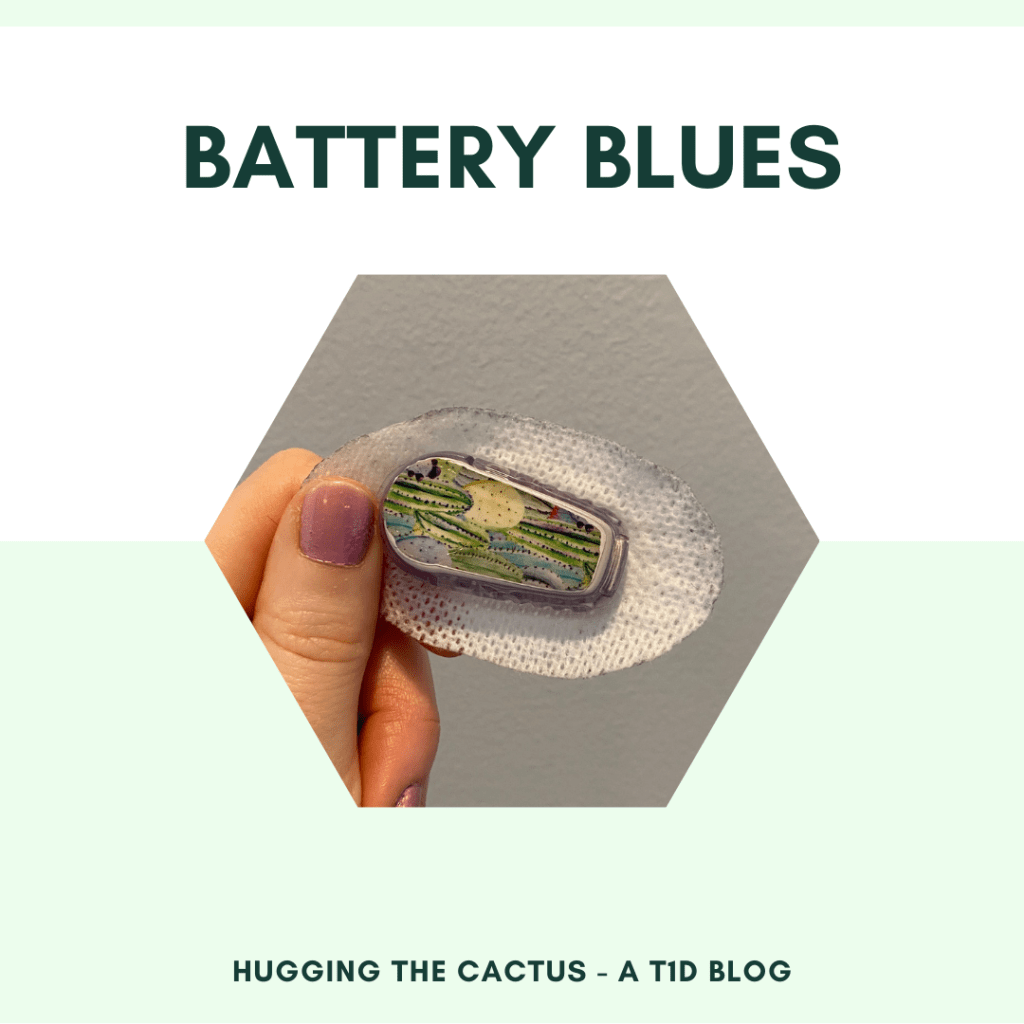
Battery Blues

Between this post and the one from a couple of weeks ago, this blog is rapidly turning into one in which I bemoan the battery life of my diabetes devices…

The fact of the matter is, though, that I’ve definitely had my share of battery issues lately. The Omnipod DASH problem was resolved (rather swiftly), thanks to the folks at Insulet. But now it’s my Dexcom transmitter battery that’s acting up…and resulting in a whole lot of lost data (and even more frustration) for me.

If I can’t have a working pancreas can’t my diabetes devices at least have everlasting batteries?

It all started about a week and a half ago, when my Dexcom app notified me that my transmitter battery would be expiring in 3 weeks. That was to be expected – Dexcom transmitter batteries last 90 days, and according to my records, the one I’d been using was for sure approaching the expiry date.

What I didn’t expect was that the waning battery life in my transmitter would trigger multiple false blood sugar readings and periods of no readings whatsoever. At least I think my transmitter is to blame – I hadn’t experienced any issues with sensors from my last shipment and the app usually never experiences errors like this unless there’s a problem with the sensor and/or transmitter, so logic led me to conclude that my transmitter was simply losing reliability as it came closer and closer to its expiration.

My workaround was to do finger stick checks any time I was untrusting of my Dexcom, or whenever it was giving me a “no readings” alert. Plus, I’ve got a fresh transmitter ready to be activated once this one stops working, so it’s not like I’ll be without a Dexcom for an unbearable length of time.

In spite of that, I still thought this was worth talking about here on the blog because 1) I can’t remember if I’ve ever had a transmitter fade so dramatically in the last 3 weeks of its lifespan, 2) it was an exasperating situation and I needed to vent, and 3) I’m wondering if this has ever happened to anyone else before, and if there’s a workaround.

At this moment in time, I’m not quite sure what a feasible solution would be besides ripping a sensor off prematurely and sticking to finger stick checks for a few days until my annoyance ebbs…which is exactly the strategy that I decided to go with. I’m definitely looking forward to new transmitter time…

That “Thing” on my Arm

This blog post was originally published on June 12, 2019 on Hugging the Cactus. I’m sharing it again today because when you live with T1D, it’s inevitable that you’ll attract stares – and sometimes questions you’d rather not answer – from people who are befuddled by your diabetes gadgets and gizmos. This one encounter in particular is a great reminder that not all oglers have ill intent…read on for more.

“Yo, I don’t mean to be rude, but what’s that thing on your arm? Looks pretty cool.”

I turned around to face the stranger who was looking at me and asking me this question. It was well after midnight and we were on the rooftop of a fairly crowded bar. It was a balmy, summery night and I was enjoying the atmosphere with my boyfriend and my best friend. I’d had a few drinks over the course of the night, but judging by the state of everyone else on the rooftop, I was probably more sober than most of them.

That “thing” on my arm is basically my pancreas – please don’t stare at it, bro.

I could’ve answered his question in a scolding manner; it wasn’t a “thing”, it was a device that keeps me alive.

I could’ve totally dismissed him and told him to mind his own beeswax, because really, it is sort of rude to point out something on another person’s body.

I could’ve lied and told him it was something that it’s not to get him to stop bothering me.

I could’ve launched into an educational breakdown of what an insulin pump is and why my OmniPod looks the way it does.

I could’ve done any number of things, but instead I decided to say, “Oh, this is my insulin pump. I’ve got it decorated right now with a picture of a lighthouse because I like adding some style to it.” I smiled at him as a way of reassuring him that I really didn’t care that he was asking me, because I didn’t.

My straightforward answer seemed to please this random man. He told me again that he thought it was cool, and then we chatted a bit about where the lighthouse is and discovered we both have a connection to Massachusetts. Within a few brief moments, the conversation was over as we went our separate ways.

It was a perfectly harmless interaction that could’ve went a number of different ways, but to me, it’s all about context. This guy was just asking out of curiosity, and I truly don’t think he was trying to be rude about it. So I answered his question succinctly but good-naturedly, because I felt that was the only way to go about it in this busy party environment. Plus, let’s be real here…had I delved into a discussion about diabetes and devices, this drunk man probably wouldn’t have digested a single detail of my description. (Ahh, I love alliteration.) And another important point? He was damn right, my pump did look cool because of the lighthouse sticker!

But man, how much simpler it’d’ve been if I’d just been wearing my “THIS IS MY INSULIN PUMP” sticker on my pod that night.

Diabetes is All About Getting Comfortable Being Uncomfortable

“Get comfortable being uncomfortable” is a phrase I first grew familiar with when I developed a more serious workout regimen a few years ago.

My daily exercise usually consists of walking my dog, then spending 30-45 minutes completing a workout video of some sort. While these workouts vary in terms of exercise type, one thing remains consistent among them all…and that is the ferocity of the trainers, who besides showing me proper form and technique, also do their part by shouting motivational phrases as I sweat.

“It doesn’t get easier, you just get stronger!”, “You don’t wish for it, you have to work for it!”, and of course, part of the title of this blog post…”Get comfortable being uncomfortable!”

During a particularly challenging workout, that saying stuck out to me. Suddenly, it was dawning on me that this was an extremely good way of summing up life with diabetes. After all, nobody asks for diabetes to happen to them – it just does, and it’s up to people with diabetes and their care teams (loved ones, healthcare providers, and so forth) to accept it and adapt to it.

Life with diabetes is sort of like walking barefoot on rocks…adapting to and getting comfortable with being uncomfortable.

And let’s be real here: There’s nothing comfortable about diabetes. In fact, there’s a lot of uncomfortable things about it. Constant pokes and prods from sharp needles, interrupted nights of sleep, gadgets that alarm at inopportune and sometimes awkward times…and these are just a few of the things that keep me and other people living with diabetes walking on a tightrope at times.

Despite the often-disagreeable ways of diabetes, it’s important that those of us who live with it find comfort in embracing it for what it is. We can’t change diabetes itself, but we do have the power to change how we perceive life with it. So while diabetes has the ability to make me physically uncomfortable (and frustrated, sad, annoyed, anxious…a whole laundry list of emotions), it’s on me to get comfortable with these feelings and live my best life in spite of them. And like exercise, though it can be an exhausting, challenging, and the very last thing I might want to do sometimes, it’s also something that benefits my body and mind in the moment and in the long run. Why not think about diabetes in the same way, or even move past comfortability with it and into embracing it?

At this point in my diabetes journey, I think I’m mostly there…and therefore happy to say that I am comfortable being uncomfortable.