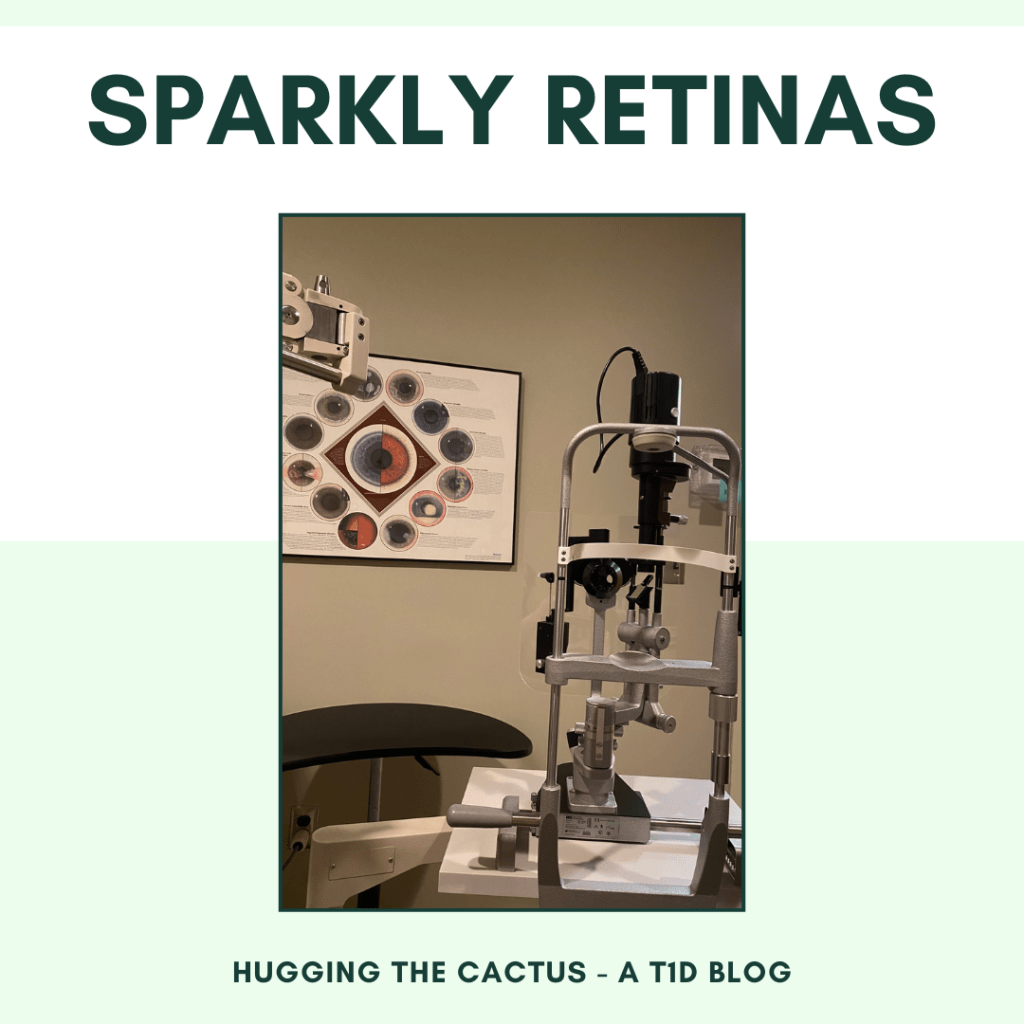
That’s how long my annual appointment with my ophthalmologist lasted this past week. I think we may have set a record in eye doctor appointment efficiency, as it was only such a short visit because there wasn’t a whole lot to talk about other than my “sparkly retinas”.
Yup, that was indeed the exact phrasing my doctor used to describe the state of my eye health upon dilation and examination. She went on to add several other gushing exclamations about my eyes, most of which I can’t recall because I was laughing at her comments.
It might sound like the appointment was rushed or that my doctor was less than thorough, given how short it was, but I was asked more than once if I had any eye concerns that I wanted to discuss with the doctor before I left. And I genuinely couldn’t think of anything worth mentioning, as my eye health has been stable in the last year and I haven’t had any noticeable vision changes. So we didn’t need to prolong my visit by any means. We probably spent a collective 7 or 8 minutes together before I was given a clean bill of eye health and asked to make my appointment for next year before leaving the building. It was that easy-peasy.
And I am extremely grateful for that.
Almost 26 years of living with diabetes and so far, it hasn’t impacted my eye sight. I don’t take that for granted. I know that may not always be the case. But for now, I’m more than happy to give up a measly hour of my day (I would’ve said 30 minutes, but I had to factor in the drive time to and from the doctor, naturally), once a year just to have that reassurance that I’m doing something right when it comes to my overall health. And maybe to hear that I have “sparkly retinas”, because that is quite a unique compliment.
You have a new message in MyChart! Please sign in to read your message.”
Whenever this notification pops up in my inbox, I’m filled with a sense of dread because it usually means one of 3 things: 1) I owe money to one of my doctors’ offices, 2) I have an upcoming medical appointment that I forgot about, or 3) There’s a problem with one of my prescriptions and my doctor’s office needs more information from me.
I never would’ve accounted for a fourth possible scenario, one that makes me feel good as a patient, being remotely likely…until it actually happened to me.
The message in question was from my diabetes nurse practitioner, and she wrote to me asking if I could recommend any diabetes support groups to another patient with T1D who was roughly my age. She explained that she thought to ask me because she knew that I have this blog/platform and remembered that I’ve spoken about how the diabetes community has greatly helped me over the years.
Upon reading the message, I immediately felt flattered that she thought to ask me. I typed up a thoughtful reply, including several different resources that might meet the patients’ needs, and sent it, feeling totally awestruck over how trust was definitely a two-way street in this particular HCP/patient relationship. It means a lot to me that my NP trusted my recommendations enough to not only want to pass them along to another patient, but to reach out and ask me for them in the first place. While my current overall healthcare team is lacking in some major ways – I won’t get into details on that, but let’s just say the search for a couple of new physicians is one that I’ll reluctantly embark on soon – this is reassurance that I do still have allies working for (and with) me. And that’s a really great feeling.
I’m still not used to having an endocrinology appointment every 6 months.
For my first two decades with diabetes, I saw an endocrinologist (or diabetes nurse practitioner [NP]) every 3 months. In hindsight, this sounds like a slightly aggressive amount of visits, but it’s what worked for me for a long time. Those appointments often served as motivation for me to do better, as well as learn about new diabetes care options available to me. And I’m fairly certain that they were a good opportunity for my parents and healthcare team to put their heads together, at least when I was younger, and come up with ways to make life with diabetes easier for me.
But as I’ve grown older and become more independent in my diabetes journey, I’ve relied a little less on these four-times-per-year check-ins. I don’t know exactly when, but in the last few years, my diabetes appointments became more of a nuisance than a boon…and I think my provider at the time recognized that. She suggested reducing my appointment frequency to twice a year, and since making that change I’ve greatly benefited from it.
And it’s why, when I attended my first appointment of the year recently, it felt like a nice little status check of where I’m at with my diabetes. In fact, that’s exactly how my NP kicked off the appointment: She asked me, “how are you doing? Is there anything new going on that you’d like to discuss?”
It felt great to be able to tell her: It’s all good.
Nothing new, no major complaints. We did chat a bit about my “diabetes cure” fluke from last month, in which we came up with no definitive answers but I was encouraged to monitor my blood sugars around my cycle a bit more carefully to see if I could come up with any patterns. We also went over my bloodwork and she was pleased to report to me that everything looked good, which is always reassuring to hear. The appointment ended with a check of my feet and thyroid, as they always do, and then I was free to go.
Even though we didn’t make any changes to my diabetes management, it was still worthwhile and comforting to know that my care team agrees with me that everything is all good and to keep up what I’m doing. That, in its own unique way, is enough motivation for me to do the best possible job taking care of my diabetes between now and the next appointment. It really is all good, and I’m grateful for (and proud of) that.
Like most people with diabetes, I see an ophthalmologist (essentially an eye health specialist) once a year. This is because diabetes can affect vision and overall eye wellness, so an ophthalmologist will look for things like cataracts, glaucoma, and macular degeneration within my eyes to make sure they’re healthy.
These appointments have all followed a similar pattern for me in the last couple dozen years that I’ve had diabetes. I’m brought into an exam room, my vision is tested with an eye chart, and then my eyes are dilated and examined with extremely bright lights. And I’ve been very fortunate to hear the same verdict from the ophthalmologist year after year: There’s no evidence of diabetes in my eyes, which translates to my eyes look healthy and normal.
This lack of diagnosis has always reassured me, and this year it was no exception. The only thing that actually changed for me was that it dawned on me that this appointment really means a lot to me. It was relatively quick, completely painless, and, dare I say, pleasant because of my doctor’s deep personal connection to diabetes (her son is around my age and also has T1D). She truly gets what it’s like, and didn’t make a big deal whatsoever when my Dexcom interrupted our appointment with a high alarm.
My annual appointment with my ophthalmologist is like performing a maintenance check on a car – it’s my chance to make sure everything is operating smoothly.
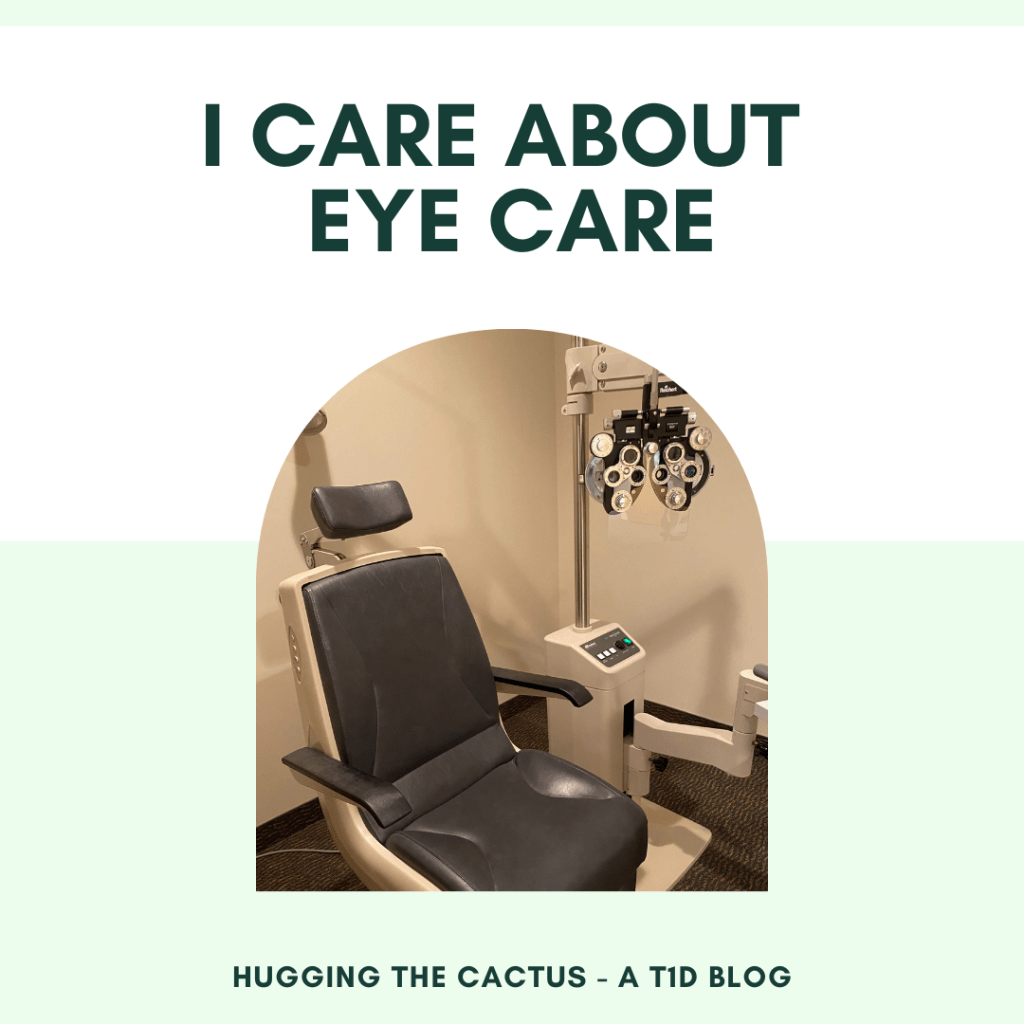
I’ve come to realize that even though it’s a blip on the radar compared to all the other doctors and healthcare specialists I see throughout the year, it’s still significant to me because I don’t take my vision for granted. Sure, I can’t see much without the aid of my contacts or glasses, but I can still see without pain, blurriness, or any other general eye discomfort. That makes me lucky and also motivates me to continue doing all the right things for my eyes, such as replacing my contact lenses on schedule and taking care to use high-quality cosmetic products. I can’t say that those two factors alone have contributed to my eye health (in fact, I can say with certainty that it’s my diabetes management more than anything else), but even so…I recognize that eye health is not to be taken lightly.
I care about eye care, and I definitely see the connection that doing my best for my ‘betes benefits it, my eyes, and well…all of me.
This was the message conveyed to me after one of the best endocrinology appointments I’ve ever had, at least in my adulthood.
I’ll confess that I was nervous going to my first endo appointment of the new year. I didn’t know what to expect as I wasn’t bringing any specific concerns with me – besides the fact that I was upset about a conversation I’d had with a different doctor regarding a separate issue.
After the nurse practitioner and I exchanged pleasantries, she sat down at the computer screen that was displaying my record and asked me what I wanted to discuss during our appointment.
That’s when it all came flooding out.
I babbled about how I didn’t have anything in particular I wanted to talk to her about besides the fact that I got a very discouraging message from a doctor who told me I needed to have better control over my diabetes, and that this was infuriating to me because 1) not all of my health concerns can be blamed on my diabetes and 2) it was disheartening to be told by one subset of my health care team that I’m doing great with an A1c of around 7, but to hear from another subset that I’m not doing great and need to work harder. Once I finished my train of thought, I braced myself for a less-than-favorable reaction.
But that’s not what I got.
I’m really glad that nobody walked into the exam room as I was taking goofy selfies like this.
Rather, my NP asked me to explain my concerns in greater detail. She sat, listened, and told me that she disagreed with the comments from my other doctor’s office. It was validating to hear someone who actually does work in diabetes reassure me that, for starters, my diabetes might not necessarily be to blame for any other health issues I was experiencing. She also made me feel better about my A1c and that my track record proves how hard I’ve worked over the years to maintain a 7 (or below) and that it’s not indicative at all of a lack of control over anything.
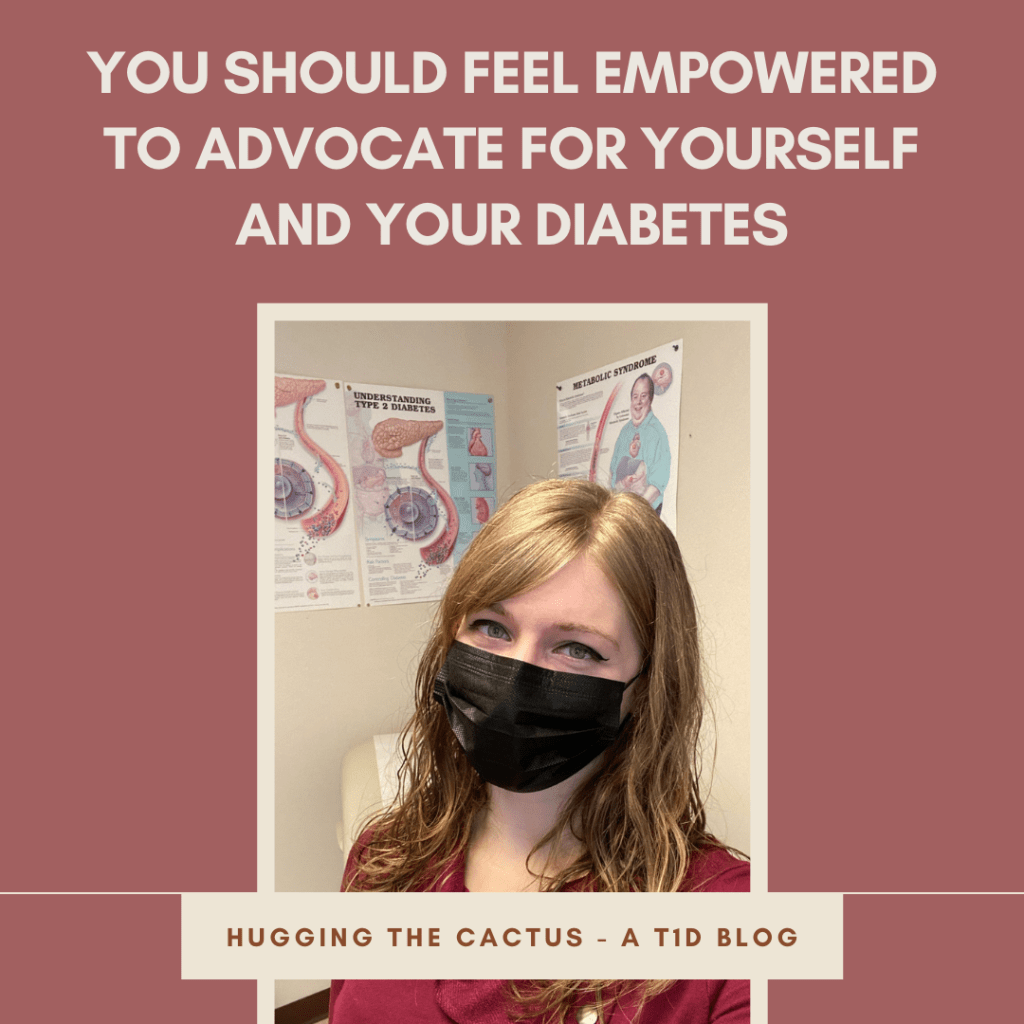
Best of all, when I sheepishly admitted to her that I’d been embarrassed to write in about the health concern in question, she reminded me that I should always feel empowered to advocate for myself and my overall wellness. It was an incredibly powerful message for her to convey to me, seeing as my self-doubt had manifested itself in full-force over this whole interaction with the doctor’s office. And it’s a message that I plan to carry with me to future doctor’s appointments to help ensure that I do stay on top of my health to the fullest extent possible, while also making my voice heard.
At the end of the appointment, my NP turned and said to me that I’m an inspiration. While I don’t exactly agree with her words, I can’t remember the last time I left an appointment feeling truly understood as a patient living with type 1 diabetes. That’s what’s inspiring to me…the fact that a physician took the time to recognize the hard work it takes to live everyday life with T1D. And the discovery that my A1c has dropped by .3 to a level that I’m very proud to have reached – well, that’s the cherry on top of my first endocrinology visit of 2022.
I read those six words, all strung together in a terse message from my doctor’s office.
Not exactly the response I was anticipating when I reached out to them to express concerns over a minor health issue I was experiencing…
Let me back up a bit. In early January, I decided to message one of my doctor’s to discuss said minor health issue. A week went by and I didn’t hear anything from them, so I sent them another message, reminding them gently that I was hoping for a reply sooner rather than later. Several more days pass by and I start to get annoyed, but I still keep everything in perspective: Maybe they’re understaffed at the moment. Perhaps a computer error prevented them from getting my messages. Or they might be just crazy busy with beginning-of-the-year appointments and responsibilities. Whatever the case may be, I decided to message one more time, drawing attention to the fact that my first message had been sent two weeks prior and that if I didn’t hear back by the end of the week, then I’d just call the office to hopefully connect with a nurse.
Luckily, it didn’t come down to that because within 48 hours of me sending that third message, I finally heard back from someone. And this someone said something that left me a bit gobsmacked:
“…with an A1c of 7 – you need to be better with your control.”
Life with diabetes often feels like this image – like you’re the only one in the control room of a command center that dictates whether or not you live. And yep, it’s exhausting.
I couldn’t believe what I’d just read, for multiple reasons. For starters, I’d mentioned in my first message that I *think* my A1c was right around 7, but I couldn’t be sure because it’s been a bit since I last had my A1c checked. So clearly, by reading the response from my doctor, nobody had gone in to check my records or look up my historical A1c – which may or may not have provided them with better context so they could answer my question better, but that’s besides the point. What had me most irate was the fact that I’ve been told – time and time again – that I’m doing a great job with an A1c around 7. I’ve had endos and nurse practitioners alike tell me that I don’t need to make any major changes and that I’m too hard on myself when I express a desire to get a lower A1c. So to have a completely different medical professional make a snap judgment right then and there that implies I do not have control over my A1c is obviously in direct conflict with what I’ve heard from others. How maddening is that?
Furthermore…I’m sorry, but A1c does not paint a complete picture of my “control”. I believe, along with many other people in the diabetes community (including medical professionals) that time in range is where it’s at. The amount of time I spend in range is leaps and bounds better than where I was in college – and honestly, so is my A1c.
This is why it’s incredibly frustrating to me that this person handled my health issue as though it was directly related to my diabetes and their perception of my lack of control. The three-sentence, curt reply to my initial message didn’t exactly help matters either, though I’m trying to not read too much into that…after all, you can’t gauge tone via written message.
I’ve decided the best way to handle this whole exchange is to bring my issue up again when I see this doctor later in the year. I’m not going to reply in the message thread, because I don’t see how that would cause any good, but I will bring this up when I go to see the nurse practitioner at my endocrinologist’s office at the end of this month. While she likely can’t fully help me address my health concern, she’s bound to provide me with some insight and some actual helpful advice that won’t involve her jumping to conclusions about my control. We’ll see how it goes.
For now, I will just have to try to keep my head held up high by taking control of the situation, if not my diabetes.
As a person with diabetes, I see (what feels like) a ton of doctors. It’s probably not that many more compared to most people, but in addition to seeing doctors like a primary care physician and a dentist, I also see an ophthalmologist (eye care specialist), an endocrinologist (my diabetes doctor), an allergist, and a mental health professional.
But recently, one more doctor got added to that list: a podiatrist.
A podiatrist has become the newest member of my diabetes care team.
I wrote about how the nurse practitioner at my endocrinologist’s office promised to hook me up with a referral to a podiatrist in this blog post. Long story short, I voiced my concerns to her over the calluses on my feet, and she suggested I see a podiatrist so I could get an expert’s opinion on whether or not they were something to be worried about.
Fortunately, my first meeting with the podiatrist went well as I was assured that my calluses aren’t anything to stress over…but that initial appointment turned into a series of follow-ups (I’ll be seeing him every six months) as I learned that the podiatrist wanted me to start wearing orthotics to support pronation in my feet that I never realized I had. The doctor advised me to come back every six months so the degenerative changes in my feet can continue to be monitored, even though he was very pleased to see in my X-rays that the overall health of the bones in both feet is good.
Naturally, I had mixed feelings regarding the outcome of my first two appointments with the podiatrist.
On the one hand, I was happy to hear that my diabetes wasn’t creating any complications (beyond poor circulation – my feet are always cold and according to the podiatrist, this is due to Raynaud’s). Nerve damage is always something that I fear and I was genuinely frightened that the doctor was going to tell me that I was beginning to show signs of diabetic neuropathy in my feet. Obviously, I’m so relieved that this isn’t the case.
On the other hand, I was bummed to hear that his recommendation was to wear orthotics. Orthotics? Before I’m 30?! I guess it’s just the connotation of the word (it conjures up images of elderly folks hobbling around on canes and wearing special-made sneakers to support unsteady gaits) that’s got me rattled. I never realized that my tendency to walk around on my tippy-toes was due to the way my foot is shaped…but honestly, if wearing orthotics in my shoes now will help prevent or delay hip and knee pain later on in life, then I’ll quit complaining and just get on with it, even though it means I’ve got another doctor to see semi-regularly now.
So I’ve got an update on my whole I-haven’t-seen-my-endocrinologist-in-8-months situation.
It’s not exactly the update I was hoping for, but it’s one that I believe just might push me into making some positive change around my diabetes care.
As it turns out, my endocrinologist is on leave and not taking appointments until February 2022, at the earliest.
What’s even crazier than that February 2022 wait time? The fact that I haven’t been at an in-person endo appointment since 2019.
I found this out after contacting her office and receiving a message back that I could either wait until that time to see her, or I could schedule an appointment with a doctor at a different location that the office would suggest to me.
At first, I wasn’t sure what the right move was. I was almost certain that I couldn’t (and shouldn’t) wait another 4 months to see someone about my diabetes; after all, I’ve been unhappy with my management for most of this year. But even though I have been similarly unhappy about my relationship with my current endo (it’s practically nonexistent), I admit that I felt fear over the prospect of seeing someone new because any other provider would only know me based on the information available to them in my records. In other words, they would only know me based on numbers, not based on who I am and my personal diabetes management style/beliefs.
So I sat on this news for a few days as I pondered whether or not to take this as a sign that it’s time for me to find a new permanent endo, despite the mere thought being incredibly daunting to me.
During my pondering period, I happened to get a call from my endo’s office that wound up making my mind up for me.
They called to let me know about an available appointment with the nurse practitioner who works closely with my endo – an appointment that I could get this week.
I hesitated for a moment (I really hadn’t anticipated getting an appointment before the end of the month) before agreeing to take the open slot. And I’m glad that’s what I decided to do, because 1) at least I can talk to someone about what I think I’m lacking in terms of my current diabetes management; 2) I might end up getting some quality advice that will redeem my endo’s office in my eyes; and 3) even if I don’t see eye to eye with this person, it will be the push I need to start actively pursuing a new endo that will more closely match my diabetes care style.
My first-ever virtual endocrinologist appointment – and my first one of 2021 – took place last week. I’m going to sum it up list-style, because who doesn’t love a good bullet-point list?
It wasstrange. I didn’t think I would be weirded out by having my endocrinologist “in” my home, but it was freakin’ bizarre to see her face show up on the monitor that I do my day job from, that happens to live on a desk in my bedroom.
I had to wait to see my doctor. It took almost 10 minutes for me to receive my pre-appointment check-in call, and another five before my doctor actually joined. That felt normal.
We made a single change to my pump settings in the whole appointment. She suggested a solitary tweak to my correction factor. I’m not sure I agree with said change, but we’ll see how I feel about it over time.
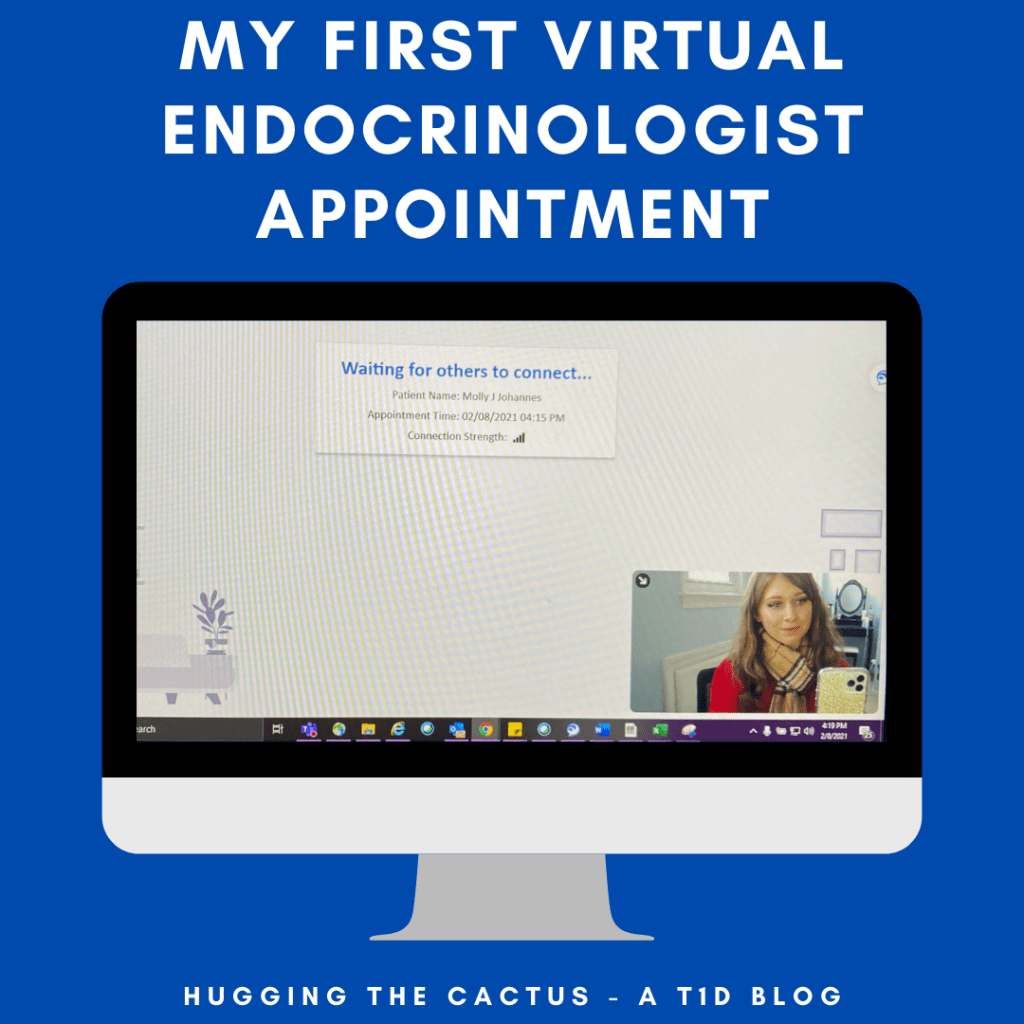
Look, it’s actually me in the virtual waiting room! Smirking at the camera and everything! Thank goodness my doctor didn’t join at this moment…
My lab results were barely discussed. My doc mentioned that my cholesterol was a little higher than it was last time, and I unabashedly told her that this was probably because I hit the drink somewhat harder than I used to in the past (sorry not sorry, I like wine). I brought up my A1c and I said I was proud of myself for achieving it, and she just nodded, otherwise disregarding this data point.
We figured out which prescriptions I needed. When she asked about my supplies, I explained to her that Dexcom is no longer shipping sensors and transmitters to me directly and they want me to use another supplier called Byram (more on that in a future post). I asked if she could send my prescription to my regular mail-order pharmacy instead, and she obliged, telling me to double-check on the script in a few days to make sure it would go through properly.
It was just as short as they typically are. The whole damn appointment lasted only 15 minutes and 2 seconds…and we talked about me/my diabetes, specifically, for fewer than 5 minutes. We spent the rest of the time discussing our collective confusion over my COVID vaccine eligibility and my frustration over my postponed physical. It was both gratifying and dismaying to discover that she couldn’t understand why the state of Massachusetts considers me ineligible to receive the vaccine until the third (final) distribution phase, but I’m hoping that will change soon.
She wants to see me again in 6-7 months. My doctor ended the appointment by asking me to schedule an appointment in the August/September range, which seems so far away. I let her know I’d schedule it at a later date for a couple of reasons, one being that I have no clue whether I’ll want to go in person or do it virtually again, and another being that I really don’t know that I want to keep her as my endo.
That just about covers it. I’m not the happiest patient in the world – I’ve been uncertain about this doctor since I started seeing her – but for realsies, I’m glad that I trusted my instincts and requested a virtual appointment instead of an in-person one.
The drive would’ve been longer than the visit, and for me, that just doesn’t make it worth it.
“Molly, we’re calling to inform you that your 10 A.M. appointment for this Thursday has been canceled. We still aren’t taking patients in the office and we won’t be rescheduling you until April. Please give us a call back so we can set up a new appointment time.”
I listened to the voicemail twice before it sank in that my primary care doctor’s office was calling me to postpone my annual physical.
Why, exactly, did it get postponed? And how do I feel about it?
My doctor’s office called me two days before I was scheduled to come in…leaving me to also wonder why such short notice of the cancellation?
Well, I can only theorize the answer to the first question. I’m certain that my doctor’s office is absolutely overwhelmed with phone calls and appointments…and they’ve probably been like that for the past year or so. I’m guessing that they’re only keeping appointments with higher-priority patients that absolutely need to be seen…someone like me, a pretty healthy (discounting my diabetes) and younger individual, is likely not very high on the list of patients they want to see. Plus, even though I know they’re doing virtual appointments for medical questions as they come up, there probably is no purpose in doing a virtual physical because there’s only so much they can do via video call. So I get the postponement, but that doesn’t mean I’m happy about it.
My annual physical is the doctor’s appointment for me, the one that I have each year that I know won’t be a total waste of time. Each year, I get my blood work and urinalysis completed at this appointment, as well as an EKG to monitor my heart. I also get to go over any general health concerns I have with my PCP, who is very thorough when explaining things to me. During this particular visit, I’d hoped to talk about (what I believe to be) the stress-induced hives I’ve experienced in the last month, but now it sounds like I won’t have the chance to do that until April.
But I’m also wondering…when I go to the appointment in April, will I receive my COVID vaccine then, too?
I messaged the doctor’s office to find out and learned…nothing helpful:
I believe by that time you should qualify for the vaccine so you should be able to get it. This of course depends on if the state has given us the vaccine. We will know soon about that and will be sending information to all our patients.
Uhh…according to the multi-phase vaccine plan outlined by the state of Massachusetts, I should be eligible for the vaccine prior to April. (But quite frankly, the whole phase plan has been a bit of a hot mess. I’m just glad to have 2 out of 4 immediate family members vaccinated at this point.) And the “if” there? Definitely unsettling.
I have so many questions: Can they postpone again in April? When will they be able to tell us more information about the vaccine? Do they think that it’s safer to wait in April because there will hopefully be more vaccinated individuals overall then? Or are they actually worried about vaccine distribution and don’t want to clue anyone into that?
So I feel not-so-awesome about having to wait three more months to check in with my PCP. I take my overall health very seriously, not just my diabetes. One thing has everything to do with the other. However, I do have a virtual appointment with my endocrinologist in a few weeks…maybe that will be the health check-in that I’m desiring?


 Hugging the Cactus