Diabetes in the Wild: Beach Edition

I’d just settled into my beach chair, ready to crack open a book, when I spotted her.

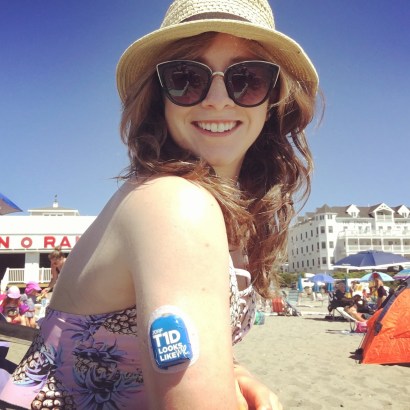
She was walking as quickly as she could through the sand to help her friend carry a cooler, but not fast enough for me to miss the CGM on her upper arm. I sat up in my chair and wondered whether I should say something to her – after all, not all T1Ds are excited to encounter one another in the wild.

She caught up with her friend and grabbed the other end of the cooler. As they passed me, I saw she was wearing an OmniPod on her opposite arm. Not just any OmniPod, though: This one was decorated with some sort of emerald green design. I took that as a sign, a literal green light, that she probably wouldn’t mind if I said something.

“Nice OmniPod!” I called out.

She looked around, trying to locate my voice. My mother, who’d been reading the whole time and was unaware of a fellow T1D in our midst, shot a bemused look in my direction as the woman finally made eye contact with me.

“I have one too,” I said, pointing to my arm.

“Nice! I like your decoration. Do you have a Dex, too?” She asked, smiling at me.

“Yup – I’m wearing mine on my abdomen. I saw you had both and couldn’t resist saying something.”

“Well, we’ve got two OmniPodders over here,” She pointed to where she’d set up camp for the day.

Beaming, I told her that we had two in our group, as well. My mom offered her arm up to show her pod. I think that Mom was half entertained, half embarrassed over the whole exchange, so it made me happy to see her join in at the end.

The woman returned to her spot and we wished her well. Mom and I soaked up the sun for a few hours before deciding to pack up for the day. As we were getting our belongings together, a young woman approached us.
1AC16B6B-1C34-4BC7-B8E9-96D612287930
Proud to wear my pod.

“Excuse me, may I ask what is on your arms? I’ve seen numerous people wearing that sort of thing today and I can’t figure out what it is, for the life of me!”

I was going to answer for the both of us, but my mom beat me to the punch. She explained that it was an insulin pump, though other people may wear different medical devices that look similar to it. The girl, seemingly appreciating the response, remarked that it was cool and that she was surprised to see so many people wearing them on the beach. She wondered out loud if she was missing out on some sort of trend.

“Yeah, all the cool kids have them,” Mom said, and we all laughed.

I don’t know how many people on the beach that day were wearing OmniPods – or any other insulin pump, for that matter – but I do know for certain that my mom is right: All the cool kids have them, and they’re much cooler for wearing them with pride in full view of the world.
Endo Appointment Anxiety

I’m feeling anxious about my appointment with my endocrinologist tomorrow.

I don’t know why. I like my doctor very much: She’s always encouraging, pleasant, and helpful. The only thing I’d change about our appointments is to slow them down a bit; sometimes, she whips through them so quickly that I forget to ask her the questions floating around in the back of my mind.

Could it be that I’m worried about my A1c test? Possibly. I don’t know whether my A1c has gone up or down in the last three months. I have stretches of time in which my blood sugar behaves the way I want it to, but I also experience clusters of days here and there of complete diabetes chaos. In the last month, for instance, there were a few too many circumstances in which my blood sugar was above 300 mg/dL. Each time, I’d correct the high, only to either experience 1) a sudden drop resulting in a low or 2) several hours of prolonged high blood sugar because it was taking the insulin a long time to take effect.

815A7B61-EDD2-4804-B8D0-D8760D19A26A
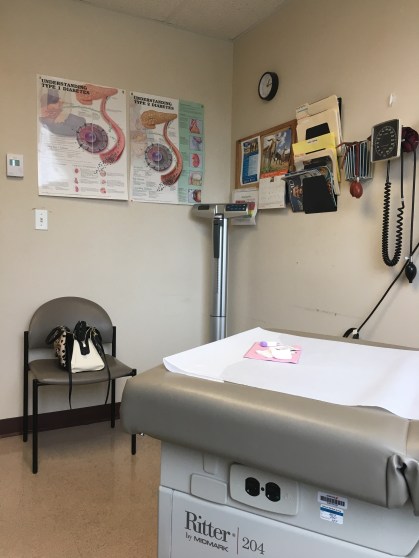
I love that there are posters about “understanding” diabetes on the wall – it’s too complex to break down into a few bullet points.

Now that I’m thinking about it, maybe those scattered, wicked-high blood sugars are the reason why I’m anxious about this appointment. I know that my doctor will probably ask me about them, and I’m going to have to admit to her that a combination of emotional eating, lack of carb counting, and general carelessness resulted in those highs. I know that she won’t judge me, but…I can’t help but judge myself for causing the blood sugar swings. The rational part of me is aware that it’s unhealthy to blame myself for occasional slip-ups, but the goodie-two-shoes, Miss “Perfect Diabetes” part of me is shaking her head in shame and disappointment.

If nothing else, this is a prime example of how diabetes can be an absolute (warning: foul language following) mind fuck.

What Went Wrong During my Recent Visit to the Eye Doctor

You want to know what went wrong during my annual eye doctor’s appointment last week? Just about everything, that’s what went wrong!

Okay, that’s being over-the-top dramatic. Nothing life altering happened, thank goodness. But the appointment started out on the wrong foot when I had to wait more than an hour to be seen by the doctor. Let me tell you, there is nothing pleasant about waiting in a room that hasn’t been updated since about 1982, with ancient stacks of National Geographic as the sole source of entertainment.

Anyways, after an agonizingly long hour and change, I was finally called in to see the doctor. He started the appointment asking the usual slew of questions: How are you? How are your eyes? (My answer to both was a short, but still polite, “good”.) Then he asked the annoying question: Is your diabetes under control?

I hate that – the “under control”. It makes it seem as though diabetes can be tamed 100% of the time, like it’s a savage beast that just requires domesticating in order to live a normal life. But I answered it anyways, knowing he wouldn’t care to hear why his word choice was bothersome. “I’m doing well,” I said, my eyes wandering over to the doorway. I couldn’t understand why he’d chosen to leave the door open – the hallway to the waiting room was very short, and based on what I’d heard when other patients went in to see the doctor, everyone in the waiting room would be able to hear the entire doctor-patient interaction. Definitely not cool in my book, but instead of confronting the doctor about it, I opted to speak in a much quieter tone of voice than normal. At this point, I just wanted the appointment to be over.

BE183505-1A74-4C0D-B051-C3E9BAC9BED7
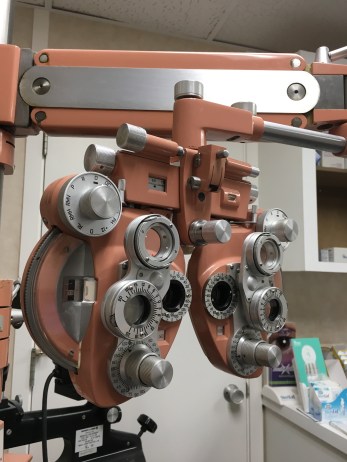
QUIZ TIME! Is this A) a medieval torture device OR B) a phoropter? (It’s B, which is the legitimate name of this piece of ocular equipment. Who knew?)

He spent 15 minutes running the standard eye tests (read the chart in front of you, does this setting make it better or worse, etc.), then dilated my eyes. I was sent back to that horrid waiting room for another 20 minute while the dilation took effect. When he called me back in to give my dilated pupils a final inspection, the following exchange happened:

Doctor: You know, I saw a patient the other day who was diagnosed with diabetes at birth.

Me: Yeah, I know a couple of people who were diagnosed as babies. It’s awful.

Doctor: Even though he’s had it his entire life, he doesn’t take very good care of it. He’s got diabetic retinopathy now. *shuffles paperwork*

Me: *Fidgeting uncomfortably in the chair, waiting for him to add to that. A long 20 seconds elapses before he finally says…*

Doctor: Fortunately, that’s not the case for you.

Um, WTF, Doc?! What’s up with that weird dramatic pause? Were you TRYING to freak me out? Mission accomplished, dude. But my oh my, such a sweet relief to hear that there is no diabetes in my eyes.

As I walked out of the building a few moments later, I couldn’t help but think about how this was a textbook example of how an appointment shouldn’t go. I left feeling an odd mix of emotions: disappointment with my doctor’s behavior as well as relief with his assessment that my eyes, at least, were proof of my well-managed (NOT under control) diabetes.

Favorite Things Friday: My Verio IQ Meter

One Friday per month, I’ll write about my favorite diabetes products. These items make the cut because they’re functional, fashionable, or fun – but usually, all three at once!

One of the most crucial components of a T1D toolkit is the glucometer, also known more simply as the meter. This little device instantly measures blood sugar levels in a person with diabetes: stick a test strip in the meter, poke a finger, and wipe a drop of blood on the test strip in order to get a blood sugar check within seconds from the meter.

Ideally, a meter is used multiple times a day by a person with diabetes – the exact number depends on how often they prefer to check their levels. Personally, I check my blood sugar five or six times each day, so I’m using my meter fairly frequently. As such, it’s always been important to me that I have a meter that is accurate, user-friendly, and compact.

Fortunately, I found all of that with my Verio IQ meter.

IMG_4393
I can’t imagine checking my blood sugar with any other meter.

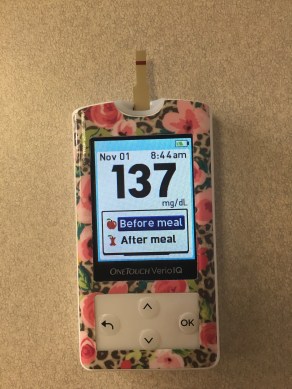
The slim, bright white device fits nicely into my Myabetic case, making it easy to tote around with me everywhere. It’s pretty trusty and generates results commensurate with my CGM. It doesn’t run on batteries; rather, it can conveniently be recharged every 10 days or so. But my favorite feature of my meter is the back light: If I need to wake up in the middle of the night to check my blood sugar, I don’t have to switch on the lamp that sits on my nightstand. Rather, I merely stick a strip into the meter and it lights up on its own, making it easy for me to see where to wipe my drop of blood. After five seconds elapse, bam, my blood sugar reading pops up on the screen in bold numbers.

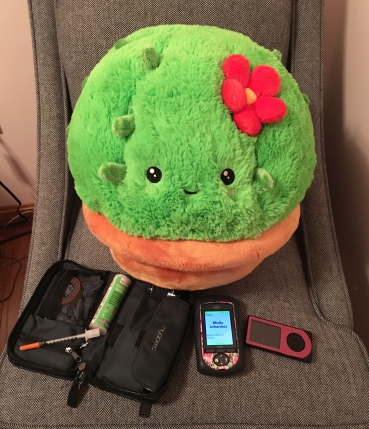
I can’t remember exactly when I started using my Verio IQ – definitely prior to college – but I’ve stuck with it for at least eight years now because it works so well for me. When I got onto the OmniPod three years ago, it never even crossed my mind to give up my Verio in favor of using the PDM to check my sugars. It might seem crazy to others that I carry around one superfluous device, but it’s what works for me.

Dexcom Delivered When I Needed it Most

Last week, I received not one, not two, but FIVE packages in the mail. No, I didn’t go overboard with some online shopping – it was all deliveries from Dexcom to help me get my CGM up and running again.

You might be wondering: Why were there so many packages? In theory, I just needed a couple of replacement sensors and a new transmitter – couldn’t it all go in one box? Well, I wound up getting a little more than just the aforementioned supplies…

79D46312-CF33-4E28-834E-9CDE7608BFEE
Not pictured: another two boxes I received from Dexcom. Not sure why they couldn’t send everything in one large box, but beggars can’t be choosers.

That’s because I had the stupendously (emphasis on the STUPID-sounding part of that word) great idea to power up my old G5 CGM while I waited for my G6 materials. I had a few G5 sensors leftover from before I made the transition to the G6, and to my knowledge, I had a working G5 transmitter. So I followed the procedure to get my G5 going: I inserted a G5 sensor (ouch!), snapped the transmitter into place, and started the warm-up on my G5 transmitter.

But something was…off. The Bluetooth icon was blinking in the upper left-hand corner, and I couldn’t see how much time had elapsed in the two-hour warm-up period. At a loss as to what to do next, I left the receiver on overnight to see if it would ever pick up a signal from my G5 sensor/transmitter, to no avail.

That’s when I made the “fatal error” of shutting the system down and trying to restart it. This triggered the G5 receiver to enter a reboot cycle that wouldn’t stop. Any time I pressed the circular home button, the system would buzz and the screen would light up, as if it was about to start working. After 45 seconds or so, the screen would go black again. There was no way to interrupt this reboot loop – even sticking a paper clip into the tiny hole in the back of the receiver wouldn’t correct the faulty software.

So now, not only was my G6 out of commission, but my G5 was a goner, too.

After a few phone calls to Dexcom technical support, I had answers as well as supplies sent my way. I learned that there’s a known error with the G5 system that causes the reboot cycle to launch. I should have waited longer for the G5 transmitter to connect with the Bluetooth on my receiver (i.e., I should’ve waited for the Bluetooth icon to stop blinking), but it wasn’t necessarily my fault for having a device with a known software issue. I would receive a new G5 receiver because my old one was still under warranty, as well as a G5 replacement sensor. I would NOT get a G5 transmitter, because I’m convinced the battery on the current one is still good, but I was informed that once a transmitter is activated, the battery keeps going until it runs out of juice. Interesting. That means that it could, in theory, stop working any day now, because the transmitter was activated and last used in April 2018.

Hopefully, I’ll never have to get another G5 transmitter because I’ll be able to rely on my G6 from here on out. It gives me comfort to know I have backup G5 supplies, but I’m pretty much married to my G6 at this point. Dexcom kindly sent me the required new transmitter for the G6 system, which arrived on Thursday of last week. I got a return kit for the old G6 transmitter the previous day, and on Friday, my new sensors came in along with a return kit for my defunct G5 receiver.

Sure, it was a lot of packages to sort through in the mail. And it was mildly frustrating that I had to wait two days between getting my new G6 transmitter and compatible sensors. But the most important thing is that I’m now reconnected to my G6 and feeling thankful that Dexcom delivered when I needed it most.


Advocacy is not “One Size Fits All”

Not too long ago, someone told me that my blog wasn’t really a form of diabetes advocacy, a point that I strongly refuted.

Advocacy looks different to everyone, and people can be advocates in countless ways. I think it depends largely on 1) what someone is trying to advocate and 2) their personality. For instance, maybe someone is really good at fundraising and wants to raise money to donate to a particular charity. Perhaps someone thrives from advocating at the group level, whereas another person prefers to do it individually. Maybe political advocacy for a cause like diabetes is right up one person’s alley, and another person is more comfortable with using social media to raise awareness and interact with others in an environment like the diabetes online community.

IMG_5153
My blog is my diabetes advocacy outlet.

If you haven’t guessed it by now, my preferred way to partake in diabetes advocacy is blogging. I feel that writing down my story, whether it’s lessons I’ve learned over the years or mundane anecdotes about life with diabetes, is the form of advocacy that makes the most sense for me. It allows me to open up to a large, eclectic audience (i.e., the entire Internet) and show them what it’s like, to some degree, to live with diabetes. I keep things real in my posts and write about the good, the bad, and the ugly when it comes to T1D, and to me, that is advocacy.

What to do When Diabetes Technology Fails (at the Worst Possible Time)

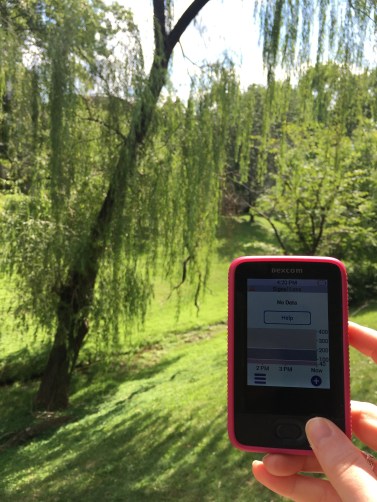
This past Saturday afternoon, my Dexcom G6 sensor stopped working. It wasn’t sending data to my smartphone app or my transmitter, so I was forced to fly blind…at a party with tons of people I’d never met before, an impressive food spread, and few beverage options other than beer from a keg or spiked punch.

Definitely not a good time for my Dexcom sensor to go kaput, especially considering I was getting on a plane the next day and didn’t have a backup. And I wouldn’t get my hands on a fresh sensor for a couple more days, when I would return home from my adventures in Washington, D.C. and Nashville, Tennessee.

So yeah, it was pretty much the worst timing ever for my heavily-relied-upon diabetes technology to fail.

How did I handle it? It might sound incredibly obvious, but…I just reverted back to life before a CGM, meaning that I tested my blood sugar much more often than I do when the ol’ Dexcom is up and running. At the aforementioned party, I sucked it up and pulled myself away from conversations to check my numbers every so often with my meter. I still participated in barbecue and beer consumption, but I dialed it back because I couldn’t be sure of what direction it would send my blood sugar in, or how quickly it would happen.

As for the rest of my trip, and my travel days, I remained diligent. I’d test and correct as needed approximately every two hours. I set alarms for the middle of the night so I could be certain that I wasn’t too high or too low. I went back to relying on sensation – was I feeling thirsty because my blood sugar was high? Was my shakiness a sign of an oncoming low? It surprised me how easily I slid back into those routines, but I guess that after so many years of practicing them, it makes sense that I was still in tune with my body.

393F3AB0-9B48-4E65-BA9F-8EBDFB3622AD
No data…no problem.

And, perhaps most shocking of all, I remained pretty calm about the whole situation. Normally, it’d send me into a panic and I’d chide myself over and over for not having a backup sensor. But, really, I carry around enough diabetes junk – adding a clunky sensor insertion device into the mix sounds excessive. After all, the sensors are supposed to WORK for the full ten days that they guarantee. It gets exhausting, having to anticipate technology failures when they should never happen, so I shouldn’t be upset with myself for not carrying more than the essentials.

The lesson in this experience, I think, is to be unafraid to depend on my intuition. I literally grew up managing my diabetes with hardly any technological aid, and I can do it again now in a heartbeat as long as I trust myself and the process.

Bike Beyond, the Documentary: An Emotional Cinematic Experience

Last summer, a team of 20 international riders embarked on the journey of a lifetime. They spent 10 weeks cycling from New York City to San Francisco – east coast to west coast. As if this feat weren’t incredible enough, this team was comprised of individuals with type 1 diabetes.

This ride was risky enough, but throw diabetes into the mix, and it seemed impossible. Blood sugars would be a constant concern. Diabetes technology could fail. Careful watch of blood sugars could clash with the focus on cycling. Diabetes burnout could affect the riders physically and mentally.

But – spoiler alert – neither fear nor diabetes would prevent these riders from completing their arduous trip.

When Team Bike Beyond officially started their trek last summer, I remember following along as best as I could through various social media channels. I felt connected to the team: not just because of diabetes, but because I personally befriended a couple of the riders a few years ago at one of the College Diabetes Network’s Annual Student Retreats. I attended as a volunteer, and Jesse and Meagan were there as students. It’s funny how quickly friendships can form over the course of five days, but as anyone who’s gone to one of these retreats can tell you, there’s something about being immersed for a few days with a group of people who just get it. So it’s natural that we bonded over our mutually dysfunctional pancreases.

Anyways, as neat as it was to read those updates from Jesse, Meagan, and the team, there’s no way that words could capture what they were actually experiencing out on the road. I think that’s why watching the documentary was so emotionally captivating to me: Within the first few minutes, tears were rolling down my cheeks as the bikers explained the nervous energy they felt in the days leading up to the ride kickoff. In fact, my facial expressions changed so frequently throughout the film that I’m sure it was comical. One moment I’d be beaming, and in the next my jaw would drop open. I’d laugh when the riders were being goofy together on camera, and marvel with them as they took in stunning scenery across the country.

Overall, the documentary was incredibly well done. Victor Garber’s narration was fantastic – smooth and clear without taking attention away from what was happening onscreen – and the visuals were beautiful. I liked how footage from the riders’ GoPro cameras was incorporated so viewers could get an accurate representation of their perspectives from the bikes. It made me appreciate the physical intensity of the ride that much more, because diabetes aside, cycling such a long distance filled with rocky roads and steep inclines is extremely demanding on the body.

My recommendation? Check out the trailer. I included it above. I guarantee it’ll pique your interest and stir your emotions. You’ll want to watch the full documentary, which you can get here. After watching it, I think you’d agree with me that Team Bike Beyond crushed their goals of raising T1D awareness and eliminating stereotypes by completing this journey.

Baseball, Beers, and ‘Betes

I really wish that I could write a blog post entitled “Bears, Beats, and Battlestar Galactica”, and have it relate to diabetes in some way…but I guess I’ll have to deal with the fact that it’s not easy to work quotes from “The Office” into a diabetes blog.

Guess that this title will have to do! Plus, it really does tie into the content of this post, so…

There’s nothing like a baseball game in summertime. I admit that I’m far from a sports fanatic, but I do take pride in my Boston teams (namely, the Red Sox and the Patriots). When I found out that the Red Sox would be playing against the Nationals when I visited Washington, D.C. last week, I was pretty pumped and decided to buy tickets. After all, what better way to break up the workweek?

3FCC0E85-59B0-44E2-8EA0-8B6416859719
An important note: The Red Sox crushed the Nationals at this game. Final score: 11-4.

It was a great choice. Even though it was a sweltering 100 degrees out, I had a fun time with friends. We drank beers, ate burgers/French fries/hot dogs, and cheered loudly for the Sox. My diabetes stayed far from my mind for once as my blood sugars played nicely, which was pretty surprising to me because I wasn’t exactly consuming low-carb items. I think that walking around the stadium in the heat helped combat the starchy foods, though I did have to bolus for a high blood sugar by the time we got home from the game.

But the point is, it felt wonderful to not worry about my numbers, even if it was for just a few hours.


A Bad Case of T1D FOMO

You might be staring at the latter half of this post’s title and asking yourself, “What kind of acronym is THAT?”

Let me help you out: The title is meant to indicate that I’m suffering from a bad case of type 1 diabetes-specific fear of missing out. (T1D FOMO…if it wasn’t a thing before, it is now.)

I decided that this was the best way to describe how I’m feeling about missing out on tons of excellent diabetes conferences, events, and meet-ups this summer. I think it’s striking me particularly hard this week because I know that the Friends for Life conference is about to kick off in Orlando. That one is special to me because it’s the first conference I ever attended, and it’s hard to believe that it was already five years ago.

1A21FA0F-4B51-4F32-A3D7-293B7C269EB4
#SquadGoals from my first conference, which was already five years ago.

Why am I unable to go to most of these gatherings? And what’s so great about them, anyways? Well, to answer that first question, there’s several reasons why I have to skip many of them. The biggest reason is financial: The cost of conference attendance can be astronomical. Between airfare, hotel, registration, and various other conference fees, you’re easily looking at spending a minimum of $800 – and that’s if you can find cheap and direct flights to the destination. The other side of the coin is that I’d have to reserve my limited vacation time for these events, and potentially sacrifice time off that I could’ve spent with family and friends. I understand that logistically speaking, it makes the most sense to have the majority of these events in the summer months – kids are done with school, generally good weather makes it easier to travel, etc. But having to choose between a diabetes conference that’s bound to be a wonderful time and a highly-anticipated vacation with loved ones is a choice I’d rather not make.

So you think that those factors would make my decision easy, but it isn’t. I hate not going to these events because I know firsthand how magical they are. It’s really neat to meet up with so many people from the T1D community all at once, and it’s even more incredible when you get to shake hands or embrace someone you’ve connected with online, but hadn’t met IRL (in real life) yet. Whether the conference is just a weekend or several days long, it’s awesome to feel “normal” throughout the whole thing. You’re among people who don’t look at you funny when you test your blood sugar before a meal, and the chorus of beeps and buzzes from medical devices never get mistaken for cell phones going off. Sure, I can virtually attend a conference by scrolling through my social media feeds and reading updates from T1D attendees, but it just isn’t the same. While it makes me happy to see them having a fabulous time together, reunited at last, I can’t help but feel slight pangs of jealousy – this is where the FOMO comes into play – as I imagine everything I’m missing out on.

I know I’m not alone in this feeling – there are many others in the diabetes community who can’t go to conferences for several different reasons, even though they want to go. And I can take comfort in the fact that even though I couldn’t go to a bunch this time around, there will always be more in the future, and some will be more affordable than others.

My bad case of FOMO will go away before long, and in the meantime, I know that there are probably tons of other T1Ds who are attending their inaugural conferences this summer, and who will experience what I did five years ago for the very first time. And that thought puts a smile on my face.