Can Certain Sites Trigger More Insulin Pump Failures?

Insulin pump sites have been a hot topic for me lately.

Not only did I share that I’m in the process of experimenting with some new (intimidating) sites, but I’m also contemplating the efficacy of all of my current sites.

My site lineup (as of this writing) includes the abdomen, upper arms, lower back, and thighs. And I’ve noticed an unusual pattern emerging with one of these sites that I know for a fact isn’t happening just to me – it’s happened to my mom, too…

…and that pattern is a series of failures with sites on the upper arms.

I can’t offer any explanation for it other than it’s definitely been a “thing” for my mom and I these last few weeks. It started happening to her first. I think she had 3 or 4 pod failures throughout August, and it only happened to pods that she was wearing on her upper arms. At first, I was skeptical of this and assumed it was maybe a bad batch or a total coincidence.

But then it happened to me, twice in a row.

On both occasions, I’d been sitting there, minding my own business (well, the first time, I was a passenger in a car and the second time, I was leading a virtual meeting with a couple dozen people on the call…the latter was far more disruptive).

Can Certain Sites Trigger More Insulin Pump Failures_
Here I am, holding up the second offending pod, right after I wrapped up the call during which it alarmed. Clearly, I was not amused.

My pods hadn’t been delivering a bolus.

I didn’t bump up or come into contact with the pods in any manner whatsoever.

My pods weren’t due to expire for another 12ish and 48ish hours, respectively.

There was no blood at the pod sites.

The cannulas on both pods weren’t kinked.

Static electricity wasn’t a factor.

But what these pods did have in common was that they were on my upper arms – one on the right, one on the left.

It’s straight-up bizarre, and when I called Insulet/OmniPod to report the second instance, I made sure they noted in their records that this phenomenon has occurred not just for me, but also for my mom. The representative didn’t say whether other people have been calling in with this issue, but it’s definitely weird that it’s happened more than once to both my mom and to me.

So while I can’t say for certain – at this time, anyways – whether particular sites result in more pod failures than others, I can say that I won’t be wearing a pod on my upper arm any time soon…and I’m going to be on the lookout for similar stories from other OmniPod users in the DOC. After all, our ingenious community can be even better than the pump manufacturers themselves when it comes to troubleshooting, so I’m hopeful that I can get to the bottom of this before long. I like my upper arm as a site because my insulin absorption is great there, but I’m not willing to use it again until I know I won’t experience another pod failure in the foreseeable future.

T1D, A1c, and Time in Range

Time in range versus A1c…which measurement matters more when it comes to T1D care and management?

Well, I’m not exactly in a position to answer that, because I think the answer is unique to all people with diabetes. But I can explain what exactly both of these numbers are and how I view them.

A1c: Also known as Hb1c or hemoglobin A1c, this is a test that is conducted every 3 months (or as requested) by an endocrinologist. A patient gets blood drawn to determine the average amount of glucose concentration in the blood during that 3 month period. The result of this test is a percentage amount, with 5% being an average result for a non-diabetic individual. I consider the A1c result to be highly personal, so I don’t often share mine with others; however, I do refer to it when describing ways in which I want to improve my diabetes care and management.

Time in range: This value describes the literal amount of time that a person’s blood sugar is in “range” for a given period of time (e.g., one day, one week, one month, etc.). “Range” refers to above a person’s low threshold and below a person’s high threshold. One person’s defined range may vary greatly from another person’s, but for me, I have my low set at 80 and my high set at 180 on my Dexcom. In a perfect world, my range would be more like 80-120, but I have a higher threshold set to minimize the number of alarms that go off.

Add a heading
Diabetes…the chronic conditions with like, way too many acronyms.

So really, both are just two different ways of measuring blood sugar performance over the course of certain time frames. And while I try to bear in mind that these are both simply numbers that help me see part of the diabetes picture, and not sole indicators of how “well controlled” I am or am not, I do pay special attention to them and have certain goals for myself. (I strive for an A1c of under 7 and I like my time in range to be at least 75%: These are goals I came up with independently, without my endocrinologist’s feedback, because it’s what I feel comfortable with when it comes to my diabetes…other T1Ds feel differently, and that’s totally okay!)

It’s important to me that I remember that my “success” as a person with T1D is not defined by either of these numbers. In fact, I know many other T1D individuals feel the same way that they should be viewed as signposts along the road to achieving desired diabetes results. It can be hard to do, though, because of how much weight is placed on these numbers by medical professionals and from people across the Internet.

The bottom line? I try to tune out the background noise and focus on taking it one day at a time. By no means am I perfect, but nobody is, and I know better than to put pressure on myself to strive for perfection. Instead, I do the best that I can to maintain my A1c and time in range goals, while doing everything I can to keep the bigger picture in mind instead of individual numbers.

Navigating New Insulin Pump Sites and Nerves

Am I the only T1D out there who feels incredibly nervous about trying new insulin infusion sites?

I’ve been this way as long as I can remember, now that I’m thinking about it. Throughout my childhood, I stubbornly stuck to injecting in my arms, legs, and upper buttocks (tee-hee) because those were the areas I felt comfortable with. I don’t think I even considered jabbing myself in my stomach until I was in my teens, and it was only after I realized the importance of site rotation and reducing scar tissue.

So it’s kind of funny that when I went on the OmniPod just over five years ago, I only used my stomach and my lower back (just above the upper buttocks region, tee-hee) for pod placements. It was partly because my guinea pig – I mean, my mom – used those areas for her pods with success, and also because I was hesitant in the beginning to wear my pods on my arms or legs because of their increased visibility.

It went that way for a couple of year – four basic sites ’round my abdomen – when it occurred to me yet again that site rotation was also important for insulin pumpers, not just MDI-ers (multiple daily injection…ers). So I added my upper arms into the mix, and soon after, my upper thighs followed.

Navigating New Insulin Pump Sites and Nerves
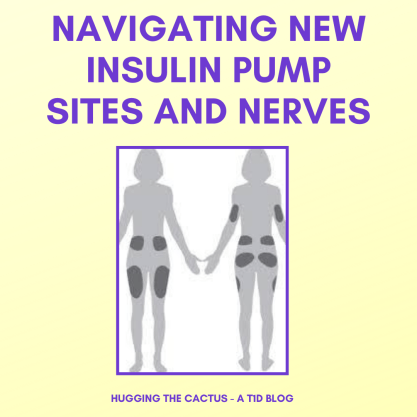
The little diagram (courtesy of Insulet/OmniPod) above only shows a few of the sites that people with diabetes use…over the years, we’ve gotten a lot more creative!

But lately, I’ve shied away from wearing pods on my thighs because the area isn’t overly comfortable. When I roll over in my sleep at night, my pod presses up against my leg and the resulting pressure is just enough to disrupt my sleep and make it difficult for me to find a more restful position to sleep in.

As a result, I’ve started contemplating potential new pod sites, and one of the first places I went to for advice was…Instagram! Because…duh.

The DOC (diabetes online community) on Insta is a natural resource for this sort of thing because many people tend to share photos of their sites. It’s kind of a thing. One simple scroll through my feed taught me that people can get very inventive when it comes to finding new locations to place their CGMs and insulin pump infusion sites.

I saw people wearing Dexcoms on their forearms and calves. I saw pods on backs, calves, and even the upper chest area, the latter of which I found most intriguing. For men, it seems like a very accessible spot that causes little irritation, but for women? How the heck did the T1D ladies I saw with pods on their chest deal with it?

The general consensus, it seemed, was that women wearing pods on the upper chest agreed it was a site with great absorption and minimal discomfort.

I was still skeptical, though. I was worried about how it would look if I was wearing a v-neck tank with my pod poking out of, well, my bra! Then it hit me that my pod garners questions from strangers regardless of where it’s located. Furthermore, people will (probably?) be less likely to ask about it if it’s located on my chest because, um, that’s really awkward. My eyes are up here, people!!!

Then I remembered: I could give the site a try without wasting a pod because I have a demo pack that I got from a diabetes conference awhile back! The demo pack comes with a dummy pod that looks and feels just like a regular pod, but there’s no reservoir built into it, so insulin can’t be injected into it.

So right now, as I’m writing this, I’m wearing two pods: one on my upper arm that’s actually giving me insulin, and a fake one on my chest just to see how I like it. I must admit, so far, so good! I slept comfortably with it on last night and I haven’t had any issues wearing clothing or undergarments with it. I even went for a jog with it on and got pretty sweaty, but it stayed secure/I didn’t feel it bouncing around at all (thought the adhesive got a bit too damp for my liking…it stayed on but if I wasn’t careful I totally could’ve knocked it off).

While I’m still having a hard time wrapping my head around an actual cannula piercing my skin at this location (eeeek), now that I know I can handle the pod itself living there, I’m one step closer to trying (and liking) a site that’s more intimidating to me – a win in my book.

An Enjoyable Eye Exam

I think I just had the best doctor’s appointment of my life (so far).

And the most incredible part about that statement? This was my very first appointment with this particular doctor and she absolutely nailed it. I’m almost bummed that I only have to see her annually…

Let me back up a bit. This doctor is my new ophthalmologist (eye care specialist). I switched to her because I’d seen my previous one for just about my entire life, and while he was unquestionably an excellent and knowledgeable doctor, we had some…personality clashes that made my yearly visits with him not so great. It wasn’t like we had a breaking point or anything during my last appointment with him, I just decided that now was the time to make the switch to someone else.

So I did. In August, I contacted the new doctor’s office and set up an appointment. I also wrote to my old doctor and requested the last few years’ worth of notes to be faxed to the new doctor. I’d never written a formal letter like that before, but I kept it short, sweet, and professional by informing him that I’d be seeing a new doctor, providing him with her location and fax number, and thanking him for taking great care of me over the years.

An Enjoyable eye exam
I totally snagged this picture of the exam equipment during the few minutes I was in the room alone. 

Making the switch was as simple as those steps – I had nothing else to do but show up for my appointment on September 1.

When I arrived to the office, I took note of all the social distancing protocol in place. There were only a dozen or so chairs spread out throughout the waiting room. There were dividers in place and stickers on the floor to mark six or more feet apart from the next person in line. The receptionist took my temperature with a contact-less thermometer and of course, nobody was allowed into the area without a mask.

Pleased with the careful measurements the office had taken, I waited for a few minutes before being called into an exam room. A nurse gave me a brief exam and had me read an eye chart using my current glasses prescription, then she dilated my eyes before leaving to go get the doctor.

Within a couple minutes, the doctor entered…and it was nonstop chatter from the moment she came in to the moment I left the practice. Her bubbly energy was infectious and it was obvious I was speaking to someone who truly loves her job. She let me know straightaway that her son is also a T1D right around my age, so she’s more than familiar with every facet of caring for it (with, of course, a special focus on eye health).

We talked a little about everything from insulin pumps, careers, CGMs, my broken bone (she was rocking a brace on her foot, so we shared a laugh over our injuries), and our studies in college. And yes, eventually we did get to the eye exam component, which took barely 60 seconds. She exclaimed with enthusiasm over my “gorgeous” eye health and told me that she is a T1D cheerleader, meaning she recognizes how hard we work to take the best possible care of ourselves.

Absolutely amazing, right?!

The appointment ended with me mentioning my appearance in Dexcom G6 advertisements, and she requested that I send her a clip via email. I did so shortly after I got home, and received the loveliest response back:

“You are spectacular. See you next year!”

I swear, I’ve never left a doctor’s appointment feeling so wonderful about myself. It’s a credit to all physicians like this one, who are passionate about what they do, happy to really engage with patients, and demonstrate in-depth knowledge of medicine and the human body.

It’s Not Always Diabetes’ Fault

“OMG, it sounds like you have super brittle bones. What’s up with that? Is it because of your diabetes?”

I sighed into the phone, grateful that the telehealth professional couldn’t see my annoyed facial expression.

“Oh no, it’s nothing like that. I’m just clumsy!” I tried to keep my tone light and threw in a little laugh for good measure. She went on to say something about how I might want to consider taking calcium and/or vitamin D supplements, but while she went off on her tangent, my mind wandered.

What does bone health have to do with diabetes? And why does it seem like everyone assumes that all of my health issues are directly related to my diabetes?

it's not always diabetes' fault
When it comes to blaming diabetes for other conditions, some people have their heads in the clouds…

Truthfully, it’s a safe assumption – the vast majority of the time, anyways – that my diabetes does have some sort of influence over the rest of my health. Plenty of studies indicate that comorbidity is common with type 1 diabetes (in other words, other conditions are diagnosed alongside the primary condition, in this case, diabetes).

But is my diabetes the cause for my seasonal asthma? Is it the reason I’m allergic to cats and dogs? Did my diabetes create the digestive issues I’ve faced since childhood? I don’t know, maybe. There could be a tenuous connection there.

On the flip-side, is my diabetes responsible for my (almost always) excellent blood pressure? Does it have anything to do with my slight arrhythmia? It’s not as clear-cut in those areas; in fact, I’d be hard-pressed to find a real cause-and-effect relationship when it comes to those things.

So do I blame my diabetes for “brittle bones”? Heck no. I blame my breaks in the last couple of years purely on myself and my tendency to rush around in an uncoordinated manner. And on top of that, based on how quickly I healed from my last break, I expect my recovery to go as well this time around, and I doubt that’d be the case if I genuinely had brittle bones.

This time around, it’s not my diabetes’ fault, that much is clear. And it’s also pretty obvious that I need to exercise a little more patience with health professionals who 1) don’t know me well and 2) are just trying to help me improve my overall health.

It’s a gentle reminder to be a touch more graceful in how I move…and how I respond to innocent queries about my diabetes and other health conditions.

When it Comes to Dexcom Alarms…Never Assume

I may have had diabetes for more than three-quarters of my life, but that doesn’t mean that I don’t make silly mistakes with it from time to time.

But I must admit, I still surprise myself on the occasions that I make a slip-up that’s incredibly stupid…and incredibly avoidable.

When it Comes to Dexcom Alarms...Never Assume
In life with diabetes (and in general), mistakes are bound to happen…

For example, one morning my Dexcom started alarming, and I thought that I knew exactly why it was sounding off: It sounded like the signature triple buzz of a high alert, so I did what anyone else would do when it’s very early in the morning and not quite time to wake up yet…I ignored it and fell back asleep.

But true to typical Dexcom alarm nature, my sleep was interrupted again by continued buzzing. Rather than pick up my phone to dismiss the alarm, though, I decided to bolus for a couple of units without ever verifying that I was, indeed, high.

Yikes. Can you say rookie mistake?

Fortunately for me, I really did have to get up and start my day within a couple of hours of taking that bolus. Thank goodness I did, because when I got up, I immediately glanced at my Dexcom and was taken aback to see that my blood sugar had not ticked up past my high threshold in the last several hours…it had actually lost reception completely.

Ahh…so that’s what it was trying to tell me. Oops.

Furthermore, my blood sugar was inching below my low threshold – the two units I’d carelessly taken had kicked in, and all I could feel in that moment was relief that I hadn’t taken more insulin.

This story could’ve had a very different ending. I’m still kind of in disbelief that I didn’t just roll over to check my Dexcom and confirm the reason why it was alarming in the first place. I mean, that’s what I do any other time it goes off, regardless of the time of day. I suppose that I was just overly confident in what kind of alarm it was. Coupled with the fact that I was barely awake when this all went down, then it really isn’t all that crazy that this happened…but it doesn’t make me feel any less dumb.

Lesson learned. When it comes to Dexcom alarms, always check them, and never make assumptions.


4 Cocktails That Have Little or No Impact on My Blood Sugar

YAY, it’s FRIDAY! *Does happy dance*

In order to “cheers” the weekend’s arrival, I might indulge in an alcoholic bevvy or two tonight.

And if you’re like most people who are curious about my diabetes, you may be wondering…how does alcohol affect my blood sugar?

Remember that it’s different for everyone, but personally, alcohol itself (hard liquor/spirits) doesn’t really impact my blood sugars too much. More often than not, it’s the sugary juices, syrups, and sodas that are found in mixed drinks that are wreaking havoc on my levels. That doesn’t mean I don’t allow myself to have a carb-o-licious margarita or a frozen cocktail (a local bar makes them with ice cream and they’re incredible) from time to time, but I definitely don’t do it frequently because the inevitable blood sugar spike just isn’t worth it.

So what do I stick to instead? I have a few go-to cocktails that play nice with my diabetes:

1 – Gin and tonic. Did you know that diet tonic water is a thing? It is, and it can be purchased by the bottle from just about any grocery store. I love having diet tonic water as an option because it eliminates the carbohydrates that are found in regular tonic water. This means that any carbs in this cocktail are coming from the gin, and it’s such a trace amount that I don’t need to factor it into a bolus (again, this is just what works for me). All I do is pour my gin and diet tonic water over a tall glass of ice, add a squeeze of lime juice, and enjoy knowing that I’ve created a nearly carb-free cocktail.

2 – Rum and Diet Coke. People always seem surprised when they see me drinking rum because of the connotation that it’s a sugary spirit. But I’ve never noticed rum impacting my blood sugar more than any other spirit such as bourbon, scotch, tequila, or gin. So when I’m leaning towards something that’s on the sweeter side in terms of taste but not heavy on carbs, I’ll go with a rum and diet coke.

4 Cocktails That Have Little or No Impact on My Blood Sugar
Raise a glass to the weekend…and to drinking *safely* with diabetes!

3 – Whiskey on the rocks (or mixed with diet soda). This is pretty bare-bones in terms of mixology, but I’ve found that I can’t go wrong with this simple combination when I’m in the mood for something to sip slowly and enjoy. Whiskey purists might disagree with how “on the rocks” I tend to get, but I like whiskey best when it’s as cold as possible and, truthfully, a little watered down. But ice or no ice, I know that whiskey won’t make my blood sugar budge, which makes it a-okay in my book.

4 – A glass of wine. Okay, so this isn’t technically a cocktail, but it’d be very remiss of me to exclude wine from this roundup. Not only am I a big fan of whites, reds, and bubbly alike, but it just so happens that wine gets along very well with my blood sugar. The only time that I run into real trouble is if I’m drinking something super sweet like Moscato (which is rarely, if ever, because it’s waaaaay to saccharine for my tastes) or mixing the wine with something (such as Prosecco and orange juice for a mimosa). Otherwise, I know that a glass (or two) of most wines is the perfect way for me to unwind without it having a negative impact on my blood sugar.

To wrap up this particular post, I’m including a few links from Beyond Type 1 below about drinking and diabetes. I’ve found that this topic in general invites a lot of questions, so the resources on their website can help address some of the trickier ones. Remember that if you have diabetes, make sure that you go about it safely if and when you decide to drink alcohol (and if you don’t, that’s perfectly okay, too)!

How much alcohol and what type is best with diabetes?

Why doesn’t glucagon work with alcohol?

Why and how to adjust your basal rate when drinking

The Alcohol and Diabetes Guide


T1International Releases Important Statement on #insulin4all

This was originally published on the T1International blog on August 21, 2020. I am sharing it here today because it is incredibly important to me that you, readers of this blog, and the entire diabetes online community collectively understand how serious this matter is to me. I firmly believe that there is no place for bullying, hate speech, or disrespect in any type of interaction, regardless of when or where it takes place. It truly sickens me to think that anyone has tainted this hashtag with ugly personal attacks and I implore anyone using this hashtag to use it with the utmost respect and kindness – anyone who chooses not to do so diminishes the message behind this movement and harms the diabetes community as a whole. As for myself, I can promise you that as both the creator/writer behind Hugging the Cactus and as a T1International digital advocate, you can always expect me to interact with others in an open-minded, respectful, compassionate manner, no matter what.

T1International Statement on #insulin4all

T1International has been made aware of a recent increase in hateful speech, as well as disrespectful and non-collaborative behavior on the #insulin4all hashtag. While hashtags cannot be owned by anyone, T1International’s global work is tied to #insulin4all. As one of the creators of the hashtag, we want to acknowledge our concerns over these issues and set clear lines about what we stand for as an organization, and what we do not. We do not stand for or tolerate bullying, hate speech, abusive language, or words or actions that are intended to demoralize others.

The History of #insulin4all
The #insulin4all campaign was launched in the lead up to World Diabetes Day in 2014 by T1International and other organizations. Although World Diabetes Day began in 1991 in order to “draw attention to issues of paramount importance to the diabetes world”, the organizations felt that the true spirit of the day had been lost. The campaign was an effort to emphasize that people living with diabetes struggle to survive or face extreme difficulties because they cannot afford or access their life-saving insulin, blood glucose test strips, or basic healthcare. Others are caught in conflict or living in countries where there is little humanitarian assistance for people with diabetes. Many suffer complications and premature death without affordable or sustainable access.

The #insulin4all hashtag caught on quickly, and, in many ways it took on a life of its own. Advocates across the globe use the hashtag on various online platforms and in-person as a rallying cry to support their efforts to improve the lives of people with diabetes.

T1International’s #insulin4all Chapters
T1International’s USA Chapters and some of our Global Chapters have #insulin4all in their names, which reflects the grassroots nature of the movement and the volunteer efforts, though the Chapters are supported by the T1International Team. All Chapter Leaders and Leads sign an agreement to abide by our policies and values. Through this agreement, they are specifically required to act in a way that is respectful and that represents T1International in a professional manner, honouring T1International’s values and upholding the charity’s reputation. Chapter Leaders and Leads are also provided with guidance and tools for engaging in-person and digitally in ways that reflect the respectful, inclusive, and intersectional movement that we are collectively building.

This slideshow requires JavaScript.

What #insulin4all Means to T1International
T1International sees #insulin4all as a community-led effort that is not solely focused on one person, entity, or country, but is a collaborative effort to bring equality to all people living with diabetes. This involves not only a fight for equality through affordable access to insulin, supplies and healthcare, but equity and inclusion when it comes to people with all types of diabetes, from all socioeconomic backgrounds, races and ethnicities, gender identities, countries of origin, and more. There is a lot of work to be done, and we believe in doing that work together wherever possible. We believe in doing it respectfully, transparently, and in a way that upholds our values.

The #insulin4all movement has built significant power, and there is a great need to use that power responsibly to advance the cause. When that collective power is focused on those responsible for the problem that have the power to fix it – that means Eli Lilly, Novo Nordisk, and Sanofi, along with other actors that want to profit on insulin even if it means people die because of its price – it is unifying for the community, and serves as a force for driving change.

When that power is focused on people who aren’t in a position to make change themselves as individuals – and especially when that focus intersects with other sources of power like white privilege, economic privilege, hetero/cis privilege, and other types of privilege – it ends up being a source of division and moves us further from our end goal of affordable insulin. Holding the Big Three and their executives accountable is categorically different from attacking individuals who aren’t in positions of power.

What #insulin4all Does Not Mean to T1International
As a small team of staff that are deeply committed to the values outlined, it pains us to see the hashtag and, thus, the affiliation with T1International’s name being used in harmful ways. It is worth reiterating: we do not stand for or tolerate bullying, hate speech, abusive language, or words or actions that are intended to demoralize others. Using the #insulin4all hashtag to attack people of color, members of the LGBTQ+ community, any marginalized group – or any person or group for that matter – is actively harmful to the movement. We do not believe in meeting problematic behavior with problematic behavior. We believe in calling out unhealthy or damaging behaviors – like the pharmaceutical industry’s price-gouging – in ways that are bold and that ignite change to improve the lives of patients, but are not vicious.

We hope that the #insulin4all community, and whatever it means to each member of that community, can come together over the shared aim of improving the lives of people with diabetes, starting with making insulin affordable and accessible to everyone who needs it. As the fight continues, we ask that our volunteers and supporters approach these issues with the same outstanding passion and commitment we see every day, while being open-minded and respectful in their approach.

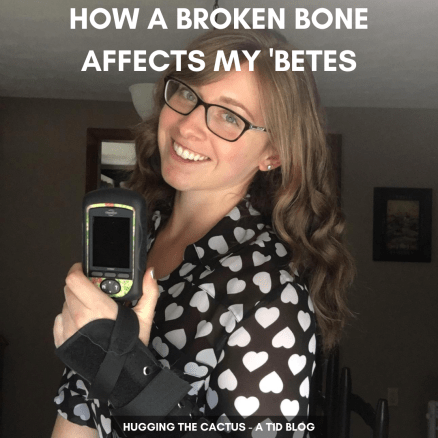
How a Broken Bone Affects my ‘Betes

I still can’t believe that I broke my wrist…again. At least I changed it up a little this time and broke my left one instead!

A broken bone is a broken bone, but my healing experience has been very different compared to last time.

For starters, when I broke my right wrist a couple of years ago, it was in the middle of winter (I slipped and fell on ice in the driveway). I was put into a cast that I wore for 4-6 weeks that felt like 4-6 months because of the challenges I faced. Between attempting to become ambidextrous as I built up strength in my left hand and taking a solo trip to Atlanta, Georgia to film a commercial for Dexcom, I did my best to work around my injury…even though I felt incredibly defeated in the face of the limitations it imposed; specifically, I felt that I couldn’t keep up with the exercise regimen I’d worked so hard to establish. I feared that I’d exacerbate the injury, so I didn’t even try to work around it.

This time around, it’s summer. The break happened after I tripped and fell down some stairs (klutz, much?). I’m wearing a brace for 3-6 weeks instead of a cast: My orthopedist said it’d be much more comfortable versus a cast, which can get seriously stinky and sweaty in the warm weather. And rather than stressing about how I’ll continue to exercise while also allowing myself to heal, I’ve made modifications that have kept my body, broken bone, and ‘betes happy.

How a Broken Bone Affects my 'Betes
Can anyone else spot the lone strand of fur, courtesy of my dog, stuck to my brace?!

I guess I learned from the last broken bone that it’s better to keep moving in some way, shape, or form than dwell too much on the injury itself. In other words, I’ve been trying hard to focus on the things I can still do while I’m wearing a brace as opposed to the things I cannot do. For example, my broken wrist can’t stop me from taking daily walks or, when I’m feeling more ambitious, going for an occasional run. It can’t stop me from making the shift to lower-body-focused workouts or core strengthening routines. I refuse to let this injury be the reason that I get sloppy with my nutrition or workout routines, and it certainly isn’t an excuse to become unmotivated in terms of my diabetes care. If anything, it might just be the reason that I tighten things up and make some much-needed improvements.

They say that when life gives you lemons, make lemonade…so I’m going to try, because a broken wrist won’t stop me from getting something good out of this less-than-ideal situation.


A Full Vlog Review of my Livongo Meter

As promised, here’s my vlog showcasing my thoughts on the Livongo meter! (Yes, I know it’s 10 minutes long, but I couldn’t help going into detail and really tried to showcase all of its features. Hopefully, my rainbow nails and peppy personality keep you engaged.) Like I say in the video, be sure to ask me any questions you may have about the meter – as I use it more, I discover additional details that I will cover in a follow-up post in the future. But for now, ENJOY the video and know that all opinions are my own: I am not being compensated in any way, shape, or form for creating this video and sharing my views.