A few years ago, I wrote a blog post about how I received a shattered insulin vial in my mail order pharmacy delivery. At that point in time when it initially happened, I’d never experienced anything like that before and was immediately panic-stricken about how I could get a replacement for something that wasn’t my fault, as the vial was smashed upon arrival.
Fortunately, a quick phone call resolved the situation, and I’ve been lucky enough to receive fully intact insulin vials in the mail every 90 days or so ever since. But imagine my fear and concern when I got my most recent insulin delivery and discovered, upon opening the package, that one of my insulin vial’s cartons was totally squished!
The smooshed packaging, in question.
I have no idea how it happened to just one out of the five in the order, seeing as they were all put into the package with the exact same level of cushion and protection. The 5 vials were in a zip-top plastic bag, which lay on top of 3 ice packs, which were surrounded by layers of soft foam packing material, all of which was placed in a mid-size cardboard box. It’s not like the squished insulin carton was separate from the other four in any fashion, so truly, I’m at a loss as to how it got so severely misshapen. But what I can say is that I was beyond relieved when, after further inspection, I found that the vial was fully intact – not a drop of insulin missing from it nor a crack in the glass to be found. Phew! Momentary worry faded into reassurance that I wouldn’t have to make any phone calls to obtain a replacement, and that all I had left to do was put my new insulin vials in the butter compartment of my fridge (naturally) with my remaining old vials.
Squished upon arrival, but definitely not destroyed – though a good reminder nevertheless to always inspect my insulin when it’s delivered, just in case any surprises await me.
It’s said that good things come in small packages – and, at 5 foot, 3 inches, I’m inclined to agree in most cases.
But when it comes to diabetes devices, I’m not sure that saying still rings true for me.
When Tandem recently announced FDA clearance of the Tandem Mobi pump, which boasts the title of being the world’s smallest and most durable insulin delivery system, I started wondering about device sizing and best practices. As someone who tends to misplace things like my car keys and cell phone on a semi-regular basis, I usually appreciate it when my belongings are large enough to be easily visible from a distance; thereby, making them instantly locatable when I forget where I last put something down. I totally get that, as a tubed insulin pump, it’s almost impossible to misplace a Tandem Mobi (especially when it’s physically attached to a body), but I still think it’s worth thinking about the practicality of sizing for diabetes devices.
Yes, at first glance, smaller size likely means greater convenience and levels of discretion – two things that people with diabetes undoubtedly appreciate. But a pump that’s so small that it can fit inside the tiny coin pocket of my blue jeans (yes, that pocket that really serves no other purpose than to home a quarter or two) just seems like it’s begging to be lost or forgotten somewhere. Again, I’m fully acknowledging that the Mobi isn’t like my Omnipod due to the tubed versus tubeless design, but I’m imagining any component of my Omnipod system (the pod or the PDM) shrinking down in size and finding myself cringing rather than rejoicing. I just know that if either were smaller, I’d definitely be more likely to misplace my PDM more often, or fret over a teenier pod reservoir because logic dictates that a smaller pod would mean a smaller reservoir, causing a need for more frequent pod changes due to size alone.
So this begs the question: Is smaller really better when it comes to diabetes devices? Or, does small translate to convenience or annoyance for other people with diabetes? One thing’s for sure, smaller seems to be the way of the future for medical technology in general, so I may just have to get used to the idea that my diabetes devices are going to shrink over time and that I will just need to keep an open mind about that.
Don’t go into the kitchen at work, where you know there’s a platter of delectable-looking donuts, just waiting to be devoured.
Don’t do it! Don’t -!
Oh…well, you did it…at least they’re cut into quarters, so it’s not like you’re having a full donut. Just one-quarter donut is enough to satisfy your mid-morning snack craving.
Except you’ve got a post-lunch sweet tooth going on, and you’re aware that there’s plenty more goodies up for grabs in the kitchen.
Ah, another quarter of a donut polished off. Both were tasty, but no more. Not unless I want to gamble with my CGM graph and see my numbers spike due to a rapid amount of carb intake in a relatively short window of time…
The above scenario is precisely what happened to me on a day in which my self-control was difficult to reign in. But it got me thinking about self-control, in general, in the context of living with type 1 diabetes. After all, I could’ve totally gone bananas and helped myself to a whole bunch of donuts and nothing would’ve stopped me, other than the brief need to calculate my carb intake and do my best to bolus accurately for it. (And if anyone saw me scarfing down a whole bunch of donuts; well, then…I think I would’ve been extremely embarrassed so that would’ve likely stopped me, too.) Since I prefer not to consume tricky-to-bolus-for things like donuts on a regular basis, and since I’d like to avoid judgment for eating all the donuts, that might imply that I have a certain amount of self-restraint. It could also indicate that generally speaking, I make wise food decisions and only indulge in treats in limited quantities.
So with that said, does my diabetes give me a greater sense of self-control?
The donut pieces I had IRL were not nearly as pretty as these ones.
I say yes and no…because my levels of self-control fluctuate on a daily basis, much like the weather, my mood, or any other number of things.
I’m a person living with type 1 diabetes, but ahead of that diabetes diagnosis is being a person – meaning that I’m human and I deal with cravings just like anyone else. Sometimes I can satisfy my cravings with a small portion, other times I want to go wild and have multiple servings of whatever it might be that’s tempting my taste buds. And yes, there are even some times in which I can completely walk away from (or steer clear) of whatever food that’s up for grabs – whether it’s due to my blood sugar levels in the moment or because I simply don’t want the free bagels or leftover cookies from Panera. Whatever direction I might oscillate in, I take comfort in knowing that first and foremost, it’s okay to help myself to indulgences as long as I bolus responsibly, to the best of my ability, for them. I’m still working on not beating myself up for it when I don’t nail the bolus and pay the consequences in the form of high blood sugar, but at least I can say that I know myself well enough to know that this is an issue of mine.
Self-control is just a small puzzle piece in the broader diabetes management picture. It’s a component that’s worth considering in many different contexts, certainly, but it’s more about knowing where it fits in with all the other pieces and finding acceptance in the fact that it might not always stay at the same levels – just like my actual blood sugar.
Without a doubt, insulin injections are primarily responsible for keeping my blood sugar levels in range.
But I’d be remiss if I didn’t also consider how movement factors into the equation.
Yup, gettin’ steppin’ is key in helping me maintain tighter control over my blood sugars. If my levels start spiking after a meal or a snack – and I didn’t pre-bolus my insulin – then I start walking for as little as 15 minutes as a surefire means of getting my number back down. If I need to get up during my workday for a quick stretch and blood sugar level-set, I start stepping. If my blood sugar is higher than I’d like it to be before I go to sleep at night, then you guessed it: I get those steps in, whether it’s just marching in place or literally doing laps around my tiny condo.
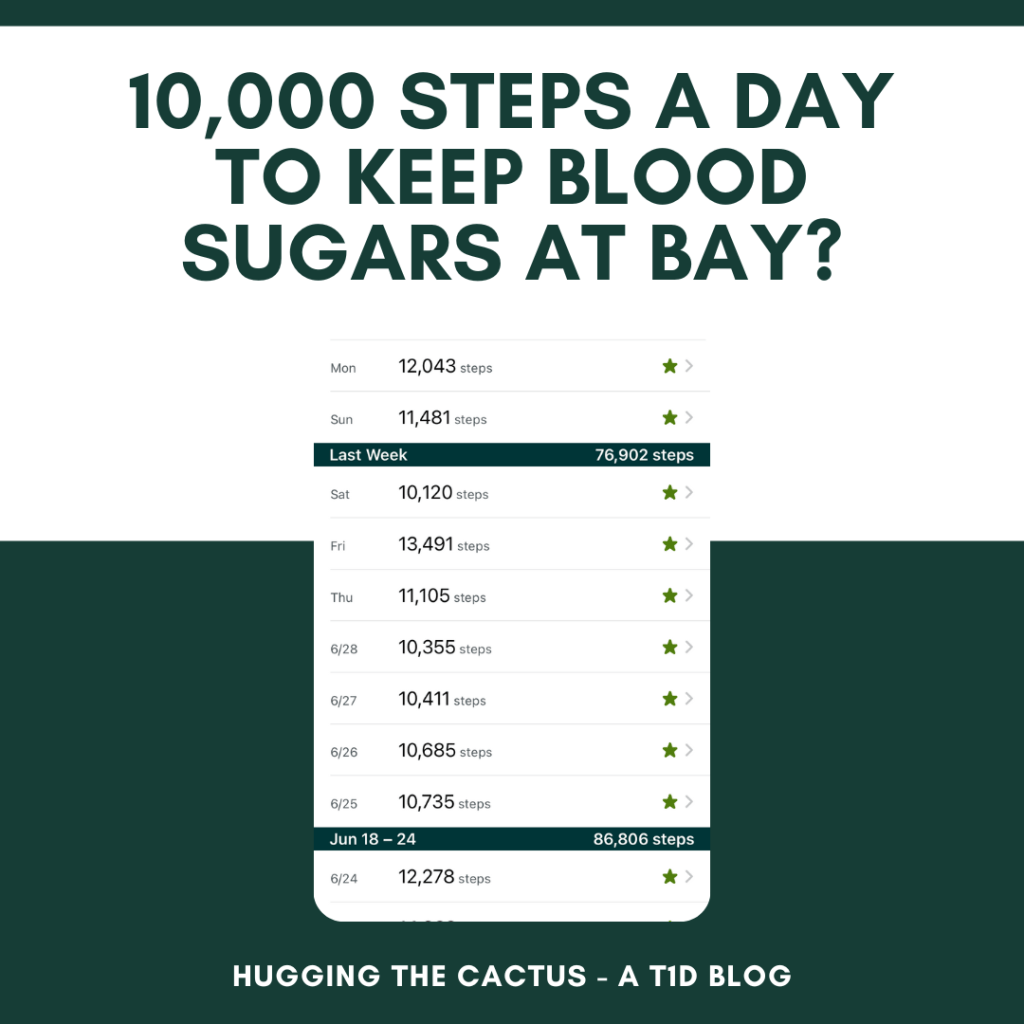
I don’t always get 80,000+ steps per week, but when I do, it’s a terrific feeling!
All this movement not only means that I hit my daily step goal of 10,000 steps, but it has also obviously proven successful in helping me deal with high blood sugars (the kinda, sorta high ones and the really, super-duper high ones). In the case of the latter, I’ve found that coupling a dose of insulin with 10-20 minutes of movement is really effective in bringing me back within range in about 45 minutes, whereas I might have to wait an hour or more if I rely on the insulin alone. That shows how powerful – and so stinkin’ simple – it is to get those 10,000 steps in on a given day.
The added bonus? It feels good to get all that movement in a day, especially considering I spend 40+ hours a week sitting at a desk for my job. My body, my mind, and my diabetes benefit so greatly from it, and it’s been part of my routine for so long that I know that I can consider my 10,000 steps a day a permanent part of my diabetes management toolkit.
Butter boards. TikTok ramen noodles. A McDonald’s McFlurry and hash brown sandwich. Something called a “Jennifer Aniston salad” that I’m pretty sure Jennifer Aniston herself denied ever eating and claimed it was instead a type of Cobb salad (though who really cares, I’m sure either iteration is tasty).
What do the above foods have in common, besides sounding vaguely like fever dreams cooked up by someone with an insatiable (or maybe, possibly some-type-of-high-induced) appetite?
Why, these are all viral recipes that have been trending online in the last year or so, largely thanks to TikTok…a platform that I try to avoid because of things like this that make me insanely hungry.
Have I tried any of the aforementioned “recipes” or food combos? No, even though the Jennifer Aniston salad sounds pretty good, and actually quite healthy. I tend to steer clear of the trends because a lot of them are a little too out there for me to be remotely interested in (sorry, but I’d take a traditional cheese board over an icky-sounding butter board any day of the week), or they’re so laden with carbohydrates that just aren’t bolus-worthy to me that my taste buds aren’t even tempted.
But the one that did pique my interest recently is cottage cheese cookie dough – both in the form of ice cream and non-frozen form.
Cottage cheese? Cookie dough? Together??? This duo also sounded really bizarre to me, but it was getting so hyped up on my Instagram feeds that I knew I had to try it for myself. The first recipe I made consisted of four simple ingredients: cottage cheese, honey, peanut butter, and chocolate chips. Easy enough. I tossed everything but the chocolate chips into my blender and whipped it all together until the consistency was smooth, then poured it into a container, added the chocolate chips in, gave it a good stir, and then put it into my freezer overnight. I tried it the next day and couldn’t believe how delicious it tasted! As someone who is generally repulsed by cottage cheese, I was most pleasantly surprised by how it instantly became more appetizing in appearance once all the curds were blended out of it.
But I was less impressed by how much honey I needed to use in this particular recipe: 1/3 cup, which contains roughly 90 grams of carbs! I knew it was a key ingredient to help sweeten up the concoction, but I also knew that since I found it so yummy it would be difficult to resist eating it in large quantities…making it tricky to bolus for and causing unwanted blood sugar spikes. So I figured the next batch I put together would need some modifications.
I went to one of my favorite healthy foodie Instagram accounts, @eatingbirdfood, for some inspiration. This is one of the places that lauded the benefits of protein-packed cottage cheese cookie dough in the first place, so I figured she’d have a recipe I could adapt to suit my needs. Sure enough, she had one that I decided to make over. Here was her original ingredient list:
1 cup of cottage cheese, any kind
2 tbsp maple syrup
1 tsp vanilla
1 cup almond flour
1 tbsp natural peanut butter or almond butter
1/4 cup vanilla protein powder
1/2 cup chocolate chips
Not a bad starting point for my own take, considering the ingredient with the most carbs was the easiest one for me to sub out. I replaced the 2 tablespoons of maple syrup with sugar-free syrup, and I decided to use 2 scoops of my own low-carb vanilla protein powder instead of measuring with a full quarter-cup (sometimes, you just have to measure with your heart…as I did with the chocolate chips, pouring in a generous amount of semi-sweet ones instead of more-sugary milk chocolate ones). I also skipped the vanilla because I figured my protein powder would add enough of a vanilla-y punch to my recipe.
I combined everything and immediately fell in love with my version of cottage cheese cookie dough. It really did resemble real cookie dough, only my version contained only a few grams of carbohydrates and way more protein. It’s been a long time since I genuinely enjoyed something sweet that wasn’t so bad for me, and that wasn’t a boring old serving of fruit. And it had a minimal impact on my blood sugar levels, making this recipe a genuine keeper all around. Maybe it’s a sign that I should play around more with some of the more interesting-sounding viral recipes that are out there – I’m looking at you, dunkaroo dip – and adapt them to suit my (and my diabetes’) tastes!
This blog post was originally published on Hugging the Cactus on December 4, 2020. I’m sharing it again today because while it may not seem obvious, diabetes can make relationships of any type difficult. Get my advice on how to help friends and loved ones better understand diabetes and your needs below.
Diabetes can interfere with so many aspects of daily life…including friendships and relationships with others.
I’m an extremely fortunate person: I’ve never had my diabetes be a “deal-breaker” for a friendship or a relationship. I’ve never had much difficulty in explaining it to others or receiving support from friends when I’ve needed it. Of course, the level of support that I get from people in my life with T1D is much different compared to the support I get from people in my life without it, but both types of support are invaluable.
Recently, I had an Instagram follower ask me for my advice on how to help friends understand T1D: what it’s like and what’s appropriate to do/say to a person with diabetes. She expressed her frustration with a friend who doesn’t seem to understand that just because she has diabetes it doesn’t mean that she can’t enjoy sugary treats from time to time. So in response to her anecdote, I decided to round up my five best tips on how to navigate T1D and friendships/relationships in which there’s a lack of understanding and a little too much judgment.
#1: Be open, honest, and willing to answer questions. In almost two-and-a-half decades of life with diabetes, I’ve learned that this is the most important thing I can do when meeting new people and forging friendships/relationships. It’s not like my diabetes is the very first thing I say to people (“Hi, I’m Molly and I have diabetes” sounds like a South Park gag)…but it is something that I make sure to casually cover early on in the relationship. Opening the door to communication about diabetes from the get-go seems to have helped me avoid tricky situations in which I have to spend too much time correcting misunderstandings about life with diabetes and not enough time on fostering my connection with an individual.
#2: Show all aspects of life with T1D. My philosophy is to never hide any part of my diabetes from friends. I let them watch me when I do fingerstick checks, site changes, and more. I involve them when I need help correcting a low blood sugar or need to take a moment to do a bolus calculation. I’ve found that this really helps my friends feel included and they tend to show more interest and genuine curiosity when I do my “diabetes stuff” around them. It creates natural learning experiences for my friends and they get to see firsthand just how much work it can be to take care of my diabetes.
about:blank
#3: Tag along to endocrinologist appointments. I understand that this might not be possible right now in this “new normal”, but in the past, I’ve had my significant other come with me to endocrinology appointments. The most memorable experience was seeing a diabetes educator with my significant other so I could be retrained on how to use an emergency glucagon kit, and so he could learn for the first time. It was really eye-opening for my partner, and ever since then, I’ve encouraged others to invite their loved ones or the person/people they live with to attend appointments every now and then. And hey, since so many doctors’ visits are virtual these days, maybe it’ll be even easier for more people to tag along to these appointments than before.
#4: Make an introduction to the DOC. Some of my friends are more social media savvy than others, so for those who have shown interest, I’ve introduced them to the diabetes online community on Instagram. There are sooooo many profiles there ALONE – forget Facebook/Twitter/other diabetes blogs – that do an incredible job of shedding light on the significant and mundane (and everything in between) parts about daily life with diabetes. These accounts have helped them truly get diabetes in a way they hadn’t previously and I think it’s made my friendships stronger, healthier, and judgment-free.
#5: Correct misconceptions – gently. Even my closest friends, or the ones with the best of intentions, have slipped up now and then and said something to my face that is simply not true about diabetes. And that’s okay, they’re not perfect (and they certainly know that I am not). When this happens, I use it as a teaching opportunity and let them know why what they said is wrong or factually incorrect. I find that the gentle, patient approach helps to reinforce whatever it is that I’m telling them, so at the end of the day, it’s a win-win for all parties.
Random confession time: I used to think that I couldn’t order anything at “fancy” coffee shops like Starbucks other than a plain, black coffee.
Truthfully, I do drink my coffee black 99% of the time. I used to load it up with Splenda and a generous pour of cream, but in an effort to reduce my artificial sweetener intake (and cut excess calories from the cream), I started drinking it black in my late teens and haven’t really looked back…
…except for when I find myself ogling the incredible-sounding concoctions from places like Starbucks.
Vanilla sweet cream cold brew? Iced brown sugar oatmilk shaken espresso? Mocha cookie crumble frappuccino? All of those sound fantastic, and I don’t even know what “shaken espresso” or “cold brew” really means! But besides having appealing monikers, these drinks’ names also imply heavy sugar contents, and that scares me as a person with diabetes who tries to avoid sugary drinks (I’d rather “save” my daily carbohydrate intake for actual food). Moreover, I’ve always assumed that it wasn’t worth it to ask for substitutions in those drinks, so up until recently I’ve just stayed away from them.
Things changed, though, when I won a couple of Starbucks gift cards at work and I decided that I wanted to venture out of my comfort zone. I wanted to try a “fancy” drink, dammit, or at least one that was a notch or two above my usual plain black coffee! So I hit up the website to see what my options were, and in pursuit of as much nutritional information as I could find.
I was pleasantly surprised to discover two things: One being that nutritional information was extremely easy to locate, and the other being that I could customize any drink of my choosing by clicking on it and making modifications to my heart’s desire. So I started with the most intriguing-sounding drink – the shaken espresso – and swapped out the oatmilk for almond milk (which is much lower carb), the vanilla syrup for sugar-free vanilla syrup (they don’t have many sugar-free syrup options, but they do have basic flavors which was just fine by me), and a light caramel drizzle for fun (I liked that you could choose to make the drizzle light, regular, or extra). The website updated in real-time to reflect my customization options, so I had a sense of how many carbs the drink would contain. I opted to make it a large – venti in Starbucks-speak – and picked it up from the closest café to me.
I’m happy to report that my drink upgrade was delicious and didn’t spike my blood sugar like I feared its sugary counterparts would. It was a total win! And a learning experience to do a little more research before making assumptions about what I can and can’t have from different restaurants. I have to remind myself that many places are making strides to not only make nutritional information more accessible, but to also accommodate people with food sensitivities/allergies. So swaps aren’t necessarily an uncommon or unreasonable request for most spots oblige.
Duly noted (and appreciated) by this person with diabetes.
Okay, okay, I didn’t – but I sure looked like I did. Isn’t that close enough? One moment, I was sitting at my desk and the very next, I registered beads of sweat forming and dripping down my forehead, back, and chest.
It was pretty disgusting, but also pretty alarming as I knew almost immediately that this was a blood sugar-induced sweat.
In my haze of hypoglycemia, I started reaching for anything and everything that would bring me back up. A leftover Reese’s egg from Eastertime, a handful of Wheat Thins crackers, and a whole bunch of Lucky Charms marshmallows (and I’m serious when I say just the marshmallows, my boyfriend knows how much I love them and bought me a bag of the colorful shapes sans oat pieces not too long ago) were among the items that I ate in hasty desperation, as if the faster I downed them, the sooner it would be for the sweat to evaporate off my body.
The whole episode couldn’t have lasted longer than 10 minutes, but it was an absolute frenzy as I hunted down and devoured each carbohydrate separately. By the time I decided I had eaten enough, I was exhausted, so I collapsed onto my bed in a gross, sweaty heap. I guess that the low blood sugar and the subsequent snacking really took a toll on me, because within minutes, my eyes were drifting shut and I flat-out fell asleep for an unexpected 20 minute catnap.
I woke up to my CGM buzzing, signifying to me that my blood sugar was coming back up. I silenced the alarm, doing my best to snap out of my haze, and felt a little emotional about the ordeal. Tears stung the corners of my eyes, but I did not let them fall as I registered what had just happened. I was embarrassed about the excessive amount of food I’d just eaten to fix a fairly run-of-the-mill low blood sugar. I was mad at myself for losing control. I was stunned that it had knocked me off my feet, literally, and lulled me into an afternoon nap that I wouldn’t have otherwise taken.
Sweat, tears, and blood (sugar)…all within 10 minutes or less. Just like running a marathon, except much, much faster. Guess that makes me some sort of athlete!
Who doesn’t love a wedding? I love the opportunity to witness family and friends come together to celebrate the marriage of a couple. I like getting all dressed up and sampling a little bit of everything at cocktail hour. And I have a blast on the dance floor and always eagerly await that slice of wedding cake.
But wait a second, I just thought of someone – or rather, something – that doesn’t love weddings as much as I do. Yup, you guessed it, my diabetes (or more specifically, my blood sugar levels).
At just about every wedding I’ve attended in my adulthood, I’ve dealt with some sort of blood sugar issue. There was the time that I went sky high after eating one too many hors d’oeurves and had to spend the entire rest of the evening rage bolusing. There was the time that I accidentally ripped off my pod at the rehearsal dinner the night before a wedding, causing whacky blood sugar levels and major frustration. And there was the time that I decided it was wise to eat a humungous blueberry muffin in the hours before making the waltz down the aisle as a bridesmaid in my cousin’s wedding, causing my blood sugar to go high then low then high again as I figured it would be better to be running on the higher side rather than run the risk of an “urgent low” alarm going off in the middle of the vows.
In a nutshell, my diabetes tends to throw curveballs at me when I’m partaking in wedding festivities.
But the good news is that I think I’ve finally figured out the secret to keeping blood sugar well-behaved for the full duration of a wedding! Besides monitoring blood sugar levels early on in the day and often, and making sure to make wise food choices pre-wedding, I think the trick is…
…dance like a damn FOOL at the reception.
Sweaty selfie at the reception (yes, I did the best I could to filter the sweat off my face in this photo. I’m unashamed to admit that!)
I’m not kidding. Most weddings follow the same structure in which you arrive, attend the ceremony, transition into cocktail hour, sit down for dinner, and then spend the rest of the evening enjoying the reception by dancing and socializing. I’ve been to plenty of weddings in which the vibe wasn’t super dance-y, and those weddings almost always ended with me having a higher-than-ideal blood sugar level because I’d spent them mostly stagnant in my seat. Other weddings, though, I’ve danced from the very first song to the last, and this was exactly my strategy at my cousin’s wedding earlier this month. Post-dinner buffet, I knew that I needed to curb some of my carbohydrate consumption with a little activity, so I was ready to go when the DJ cued up the music. This attitude paid off the rest of the night, too – a surprise Ben and Jerry’s ice cream truck, followed by a cake-and-cannoli dessert spread (major props to Matt and Janet for appealing to my sweet tooth by serving up some of my all-time favorites), meant that I was doubling down on dancing and insulin intake. My dancing, which was flat-out jumping up and down to some songs, resulted in stellar blood sugar levels that I’d be happy with any day of the week, but especially on a day filled with lots of food and drink that I don’t consume on a regular basis.
So even though I was a sweaty mess by the end of the night, that was a price worth paying in order for the peace of mind I had by the time I went to bed, knowing that I’d finally been able to play nice with my diabetes and my blood sugar levels for a wedding.
Over the years, I’ve seen many online debates (and participated in a few in-person) about the language of diabetes: the power of it, the meaning behind pairing certain words and phrases together, the connotations that can be unintentional or intentional…or even both at the same time.
As someone who writes as part of my full-time job (and, obviously, as a side hobby on this blog), I try to be very deliberate about my word choice. I may not always be 100% correct in my spelling or grammar – I am human, after all – but I’d like to think that I’m thoughtful in both my writing and my speaking. Specifically, when it comes to talking about diabetes, I’m careful to phrase things in a way that doesn’t discriminate or dehumanize people who live with diabetes, and generally avoid pessimistic undertones. I wrote about this before in a blog post from August 2018 – here’s an excerpt from that post that features some clear examples:
Read the following five sentences. Can you tell what’s wrong with them?
She’s a diabetic.
He’s testing his blood sugar right now.
Her diabetes is out of control!
Isn’t that a really bad blood sugar?
He suffers from diabetes.
Have you figured it out?
The language in those five sentences is extremely negative. “Bad,” “out of control,” and “suffers” are obviously gloomy and cynical words to use when referring to diabetes – you don’t need to be a wordsmith make that connection immediately. But what’s wrong with “diabetic” or “testing”? It’s the connotations around those words. Calling someone with diabetes a “diabetic” is labeling them with the disease and removing the actual person from the equation. Saying that a person with diabetes is “testing” their blood sugar makes it sound so…clinical. It also implies that the person could pass or fail the so-called test, adding pressure and guilt to the situation.
So those are just a few sample sentences in which the language of diabetes is definitively negative, in turn, making it more difficult to have conversations about it that are productive. But what about the case of this blog post’s title?
Diabetes is tough.
Or is it…diabetes can be tough?
I think both are true.
I’ve read through a few different social media threads recently in which the phrase “diabetes can be tough” is ripped to shreds. The argument is that people living with it know for a fact that it IS tough, period, bottom line, end of story. There isn’t a gray area where that “can be” belongs, so it simply shouldn’t be the way that folks characterize life with diabetes.
I’m not saying that I disagree with people who are pro-diabetes-is-tough: I absolutely have my days where it’s virtually impossible to live with and I think that nothing in my life is more difficult than my diabetes. Fortunately for me, though, those days are outnumbered by the days in which diabetes and I coexist – not always peacefully, but at least side-by-side with little fanfare. Those are the days that I can say with confidence that I’m fully aware that diabetes can be seriously sucky, but it’s not like that’s always the case for me.
So to me, both phrases – diabetes CAN BE tough and diabetes IS tough – can be true at the same time because it just depends on how easy or challenging it is for me on a given day to manage it. That’s just my truth. Plus, as someone who tends to avoid negative words when it comes to describing my life with diabetes, I like the power that I can find from the “diabetes can be tough” phrasing. In my mind, it perfectly captures and acknowledges that diabetes isn’t easy, but that it isn’t the worst thing in the world, nor does it stop me from living a full life. That’s just my take on the debate. I know folks will both agree and disagree with me, and that’s totally acceptable.
If there’s one thing we can all agree on, at least, it’s that the language of diabetes is a complex matter filled with many nuances.









 Hugging the Cactus