What Went Wrong During my Recent Visit to the Eye Doctor

You want to know what went wrong during my annual eye doctor’s appointment last week? Just about everything, that’s what went wrong!

Okay, that’s being over-the-top dramatic. Nothing life altering happened, thank goodness. But the appointment started out on the wrong foot when I had to wait more than an hour to be seen by the doctor. Let me tell you, there is nothing pleasant about waiting in a room that hasn’t been updated since about 1982, with ancient stacks of National Geographic as the sole source of entertainment.

Anyways, after an agonizingly long hour and change, I was finally called in to see the doctor. He started the appointment asking the usual slew of questions: How are you? How are your eyes? (My answer to both was a short, but still polite, “good”.) Then he asked the annoying question: Is your diabetes under control?

I hate that – the “under control”. It makes it seem as though diabetes can be tamed 100% of the time, like it’s a savage beast that just requires domesticating in order to live a normal life. But I answered it anyways, knowing he wouldn’t care to hear why his word choice was bothersome. “I’m doing well,” I said, my eyes wandering over to the doorway. I couldn’t understand why he’d chosen to leave the door open – the hallway to the waiting room was very short, and based on what I’d heard when other patients went in to see the doctor, everyone in the waiting room would be able to hear the entire doctor-patient interaction. Definitely not cool in my book, but instead of confronting the doctor about it, I opted to speak in a much quieter tone of voice than normal. At this point, I just wanted the appointment to be over.
BE183505-1A74-4C0D-B051-C3E9BAC9BED7
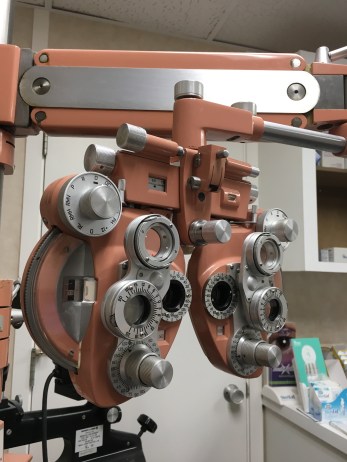
QUIZ TIME! Is this A) a medieval torture device OR B) a phoropter? (It’s B, which is the legitimate name of this piece of ocular equipment. Who knew?)

He spent 15 minutes running the standard eye tests (read the chart in front of you, does this setting make it better or worse, etc.), then dilated my eyes. I was sent back to that horrid waiting room for another 20 minute while the dilation took effect. When he called me back in to give my dilated pupils a final inspection, the following exchange happened:

Doctor: You know, I saw a patient the other day who was diagnosed with diabetes at birth.

Me: Yeah, I know a couple of people who were diagnosed as babies. It’s awful.

Doctor: Even though he’s had it his entire life, he doesn’t take very good care of it. He’s got diabetic retinopathy now. *shuffles paperwork*

Me: *Fidgeting uncomfortably in the chair, waiting for him to add to that. A long 20 seconds elapses before he finally says…*

Doctor: Fortunately, that’s not the case for you.

Um, WTF, Doc?! What’s up with that weird dramatic pause? Were you TRYING to freak me out? Mission accomplished, dude. But my oh my, such a sweet relief to hear that there is no diabetes in my eyes.

As I walked out of the building a few moments later, I couldn’t help but think about how this was a textbook example of how an appointment shouldn’t go. I left feeling an odd mix of emotions: disappointment with my doctor’s behavior as well as relief with his assessment that my eyes, at least, were proof of my well-managed (NOT under control) diabetes.

Favorite Things Friday: My Verio IQ Meter

One Friday per month, I’ll write about my favorite diabetes products. These items make the cut because they’re functional, fashionable, or fun – but usually, all three at once!

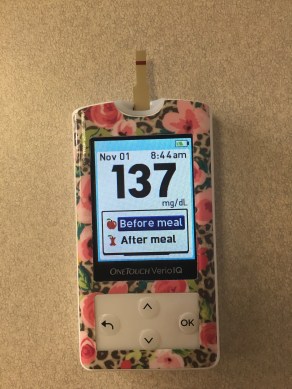
One of the most crucial components of a T1D toolkit is the glucometer, also known more simply as the meter. This little device instantly measures blood sugar levels in a person with diabetes: stick a test strip in the meter, poke a finger, and wipe a drop of blood on the test strip in order to get a blood sugar check within seconds from the meter.

Ideally, a meter is used multiple times a day by a person with diabetes – the exact number depends on how often they prefer to check their levels. Personally, I check my blood sugar five or six times each day, so I’m using my meter fairly frequently. As such, it’s always been important to me that I have a meter that is accurate, user-friendly, and compact.

Fortunately, I found all of that with my Verio IQ meter.

IMG_4393
I can’t imagine checking my blood sugar with any other meter.

The slim, bright white device fits nicely into my Myabetic case, making it easy to tote around with me everywhere. It’s pretty trusty and generates results commensurate with my CGM. It doesn’t run on batteries; rather, it can conveniently be recharged every 10 days or so. But my favorite feature of my meter is the back light: If I need to wake up in the middle of the night to check my blood sugar, I don’t have to switch on the lamp that sits on my nightstand. Rather, I merely stick a strip into the meter and it lights up on its own, making it easy for me to see where to wipe my drop of blood. After five seconds elapse, bam, my blood sugar reading pops up on the screen in bold numbers.

I can’t remember exactly when I started using my Verio IQ – definitely prior to college – but I’ve stuck with it for at least eight years now because it works so well for me. When I got onto the OmniPod three years ago, it never even crossed my mind to give up my Verio in favor of using the PDM to check my sugars. It might seem crazy to others that I carry around one superfluous device, but it’s what works for me.

Dexcom Delivered When I Needed it Most

Last week, I received not one, not two, but FIVE packages in the mail. No, I didn’t go overboard with some online shopping – it was all deliveries from Dexcom to help me get my CGM up and running again.

You might be wondering: Why were there so many packages? In theory, I just needed a couple of replacement sensors and a new transmitter – couldn’t it all go in one box? Well, I wound up getting a little more than just the aforementioned supplies…

79D46312-CF33-4E28-834E-9CDE7608BFEE
Not pictured: another two boxes I received from Dexcom. Not sure why they couldn’t send everything in one large box, but beggars can’t be choosers.

That’s because I had the stupendously (emphasis on the STUPID-sounding part of that word) great idea to power up my old G5 CGM while I waited for my G6 materials. I had a few G5 sensors leftover from before I made the transition to the G6, and to my knowledge, I had a working G5 transmitter. So I followed the procedure to get my G5 going: I inserted a G5 sensor (ouch!), snapped the transmitter into place, and started the warm-up on my G5 transmitter.

But something was…off. The Bluetooth icon was blinking in the upper left-hand corner, and I couldn’t see how much time had elapsed in the two-hour warm-up period. At a loss as to what to do next, I left the receiver on overnight to see if it would ever pick up a signal from my G5 sensor/transmitter, to no avail.

That’s when I made the “fatal error” of shutting the system down and trying to restart it. This triggered the G5 receiver to enter a reboot cycle that wouldn’t stop. Any time I pressed the circular home button, the system would buzz and the screen would light up, as if it was about to start working. After 45 seconds or so, the screen would go black again. There was no way to interrupt this reboot loop – even sticking a paper clip into the tiny hole in the back of the receiver wouldn’t correct the faulty software.

So now, not only was my G6 out of commission, but my G5 was a goner, too.

After a few phone calls to Dexcom technical support, I had answers as well as supplies sent my way. I learned that there’s a known error with the G5 system that causes the reboot cycle to launch. I should have waited longer for the G5 transmitter to connect with the Bluetooth on my receiver (i.e., I should’ve waited for the Bluetooth icon to stop blinking), but it wasn’t necessarily my fault for having a device with a known software issue. I would receive a new G5 receiver because my old one was still under warranty, as well as a G5 replacement sensor. I would NOT get a G5 transmitter, because I’m convinced the battery on the current one is still good, but I was informed that once a transmitter is activated, the battery keeps going until it runs out of juice. Interesting. That means that it could, in theory, stop working any day now, because the transmitter was activated and last used in April 2018.

Hopefully, I’ll never have to get another G5 transmitter because I’ll be able to rely on my G6 from here on out. It gives me comfort to know I have backup G5 supplies, but I’m pretty much married to my G6 at this point. Dexcom kindly sent me the required new transmitter for the G6 system, which arrived on Thursday of last week. I got a return kit for the old G6 transmitter the previous day, and on Friday, my new sensors came in along with a return kit for my defunct G5 receiver.

Sure, it was a lot of packages to sort through in the mail. And it was mildly frustrating that I had to wait two days between getting my new G6 transmitter and compatible sensors. But the most important thing is that I’m now reconnected to my G6 and feeling thankful that Dexcom delivered when I needed it most.


Advocacy is not “One Size Fits All”

Not too long ago, someone told me that my blog wasn’t really a form of diabetes advocacy, a point that I strongly refuted.

Advocacy looks different to everyone, and people can be advocates in countless ways. I think it depends largely on 1) what someone is trying to advocate and 2) their personality. For instance, maybe someone is really good at fundraising and wants to raise money to donate to a particular charity. Perhaps someone thrives from advocating at the group level, whereas another person prefers to do it individually. Maybe political advocacy for a cause like diabetes is right up one person’s alley, and another person is more comfortable with using social media to raise awareness and interact with others in an environment like the diabetes online community.

IMG_5153
My blog is my diabetes advocacy outlet.

If you haven’t guessed it by now, my preferred way to partake in diabetes advocacy is blogging. I feel that writing down my story, whether it’s lessons I’ve learned over the years or mundane anecdotes about life with diabetes, is the form of advocacy that makes the most sense for me. It allows me to open up to a large, eclectic audience (i.e., the entire Internet) and show them what it’s like, to some degree, to live with diabetes. I keep things real in my posts and write about the good, the bad, and the ugly when it comes to T1D, and to me, that is advocacy.

The T1D Taste Test: My Unofficial Ranking of Drugstore Glucose Supplements

You may have heard of glucose tablets, but what about glucose gummies? Or liquid glucose, or glucose gel? Have you tried any of these forms of glucose?

B40CD359-8AE4-46A5-88E0-0E745CDE2A8C
The four forms of glucose (that I’ve tried).

I’ve used them all, and I’ve formed some pretty strong opinions about each of them. I thought it’d be fun to rank them in order of most appetizing to least appetizing, because while they can effectively and efficiently correct low blood sugar, they certainly aren’t created equally:

  1. Best Tasting: Glucose Tablets. I can hardly believe that the most boring variety is the winner here, but it blows the competition out of the water for several reasons. For starters, glucose tablets come in an array of flavors. Orange, raspberry, fruit punch, grape, tropical, and sour apple are among the flavors I’ve tried over the years, and most of them are palatable. Plus, glucose tablets are most akin to actually candy: I’ve described them as giant Smarties to inquiring friends in the past. While actually Smarties are more fun to eat, glucose tablets are their closest counterpart in the diabetes world, making them a number-one choice in low blood sugar situations.
  2. Runner-Up: Glucose Gummies. I’m awarding second place to glucose gummies, mainly because of their novelty. It’s not particularly a standout in other categories like taste and texture. The gummies only come in three flavors: grape, orange, and apple, leaving something to be desired in terms of variety. And all three of those flavors taste a little…off, like there’s a little too much artificial additives going on. Maybe this was done deliberately to distract from the texture of the gummies, which tends to be hard/stale in my experience. It’s nice that the gummies have a layer of sugar on them to convey the likeness of real gummies, but that stuck-to-your-teeth feeling makes it harder to appreciate the gummies for what they are.
  3. Third Place: Glucose Gel. I’ve only ever found glucose gels in the fruit punch flavor at Walgreens – do they actually come in other flavors? Besides being one-note, the gel is a unique texture situation…not quite a liquid, not quite a solid. Gels aren’t a mainstay in my low blood sugar kit because I’m not fond of having to slurp them out of the pouch like a tube of Go-Gurt; in fact, I’d much rather have yogurt from a plastic tube than a gel because the yogurt is much tastier. The gel is just too artificial, with a medicinal aftertaste. And it doesn’t help that the consistency of it reminds me of hand sanitizer.
  4. The Loser: Glucose LiquidIt’s surprising that the glucose liquid wound up in last place, because on the surface, it had a lot going for it. I liked that it came in a small bottle and it seemed like it would be super easy to consume. All I’d need to do is pop the cap off and swig it down. But MAN, the taste was HORRIBLE! I thought I’d like the mixed berry flavor, but it tasted so supremely saccharine and fake that I could scarcely force myself to swallow it. I know, I know, it’s liquid glucose, it’s supposed to be very sweet. But this stuff was just over the top. I definitely will not be buying glucose liquid again any time soon. I’ll stick with my tried-and-true tablets.

Do you agree with my rankings? Did I miss any form of glucose that can be bought in most drugstores, and you think I should give it a try? Let me know in the comments!