On Saturday, December 5th, I attended my very first T1International #insulin4all meeting for the Massachusetts state chapter (virtually, of course).
What motivated me to join this meeting?
There’s a couple of factors…for starters, I’ve been a digital advocate for T1International for just over six months now. In that time, I’ve become familiar with their mission to not just promote diabetes awareness, but to empower individuals to share their stories and experiences with diabetes and fight for change to make insulin affordable for all.
I’ve spent the last few months reposting and sharing infographics and blog posts from T1International, but lately, I’ve felt the urge to do more because clearly, we’ve still got a long way to go when it comes to lowering the list price of insulin.
The problem for me, though, was that I wasn’t sure where to start, and since I work full-time, I was definitely foggy on how much of my spare time I could dedicate to a cause.
I’m excited to get involved with my state’s #insulin4all chapter.
I had a vague awareness that #insulin4all chapters existed across the country, but I didn’t know whether the one in my state was active or if joining it would be the right fit for me.
So I felt it was kismet when I saw an Instagram post from a friend I met through the College Diabetes Network (hi, Claire!) announcing that she was going to take over leadership of the Massachusetts #insulin4all chapter. Through her post and a couple of messages back and forth, I learned that the chapter had been stagnant for awhile and it was Claire’s goal to assemble a group to revitalize it and start making real progress in our state.
Our first meeting went incredibly well: A handful of people showed up and we got to know each other as well as the rough roadmap that would direct our next several meetings over the coming months. What really struck me is that everyone who attended obviously had diabetes in common, but on top of that, we all shared a frustration with the current cost of insulin, even though we haven’t directly felt the impact of it like other members of our community have. It seemed that each person felt motivated to work together to do what we can in our state, and to me, that was a sign that I was going to be glad that I joined the group.
What’s next for the Massachusetts #insulin4all chapter? I’ll be sure to share it as we develop goals and set out to achieve them!
This post originally appeared on the T1International blog on November 30, 2020, and it was written by Marina Tsaplina. I am sharing it here today because it made me start to think about creativity and activism as a unit for the first time. Want to know exactly what makes it so powerful to join art with activism? Read on…
When I think about activism, I think about creativity. The two are inseparable. Think about how much creativity and strength it has taken the #insulin4all movement to:
Counter the stories put out by the for-profit U.S. health industry about why insulin “has” to be so expensive and transform the national narrative around insulin affordability
Continually transform the pain in our community into stories for change
Imagine a world where insulin is affordable and accessible for every single person who needs it to live.
#insulin4all, as a banner of the movement, is itself an act of fierce creativity. It imagines a world that we do not yet have, one that countless activists are organizing to bring forward. The courage and imagination that this statement holds brings forward a vision for the world we want to see. It makes it possible to strategically identify those whose actions harm or block us from achieving this vision. And under the banner of the #insulin4all vision – this dream that we are turning into a reality – we organize and strategically map out the steps we must take in order to achieve the world we want to see.
#insulin4all also means a different thing for each of us: each person who joins the movement has their own personal meaning and reason for why we join. And it is these deeply-felt personal stories that make adding art into advocacy and activism actions so powerful. It is another way to bring our personal voice into a collective movement for change. It is also fun!
Here are five reasons – showcasing #insuiln4all and other social change movements around the world – why joining art, creativity and activism together is so powerful. It fosters self-expression, community building, activation, it is inspiring and attention grabbing, and it leads activists to better engage with the media.
1. Self Expression
Getting creative helps hone your personal advocacy voice, transforms a personal feeling into a political message, and contributes your creative spirit into collective creativity. It also helps people feel that every single person’s voice matters. Because each voice does matter. Community art making is a deeply democratic process.
Patient activists pictured below are expressing their personal stories. As another example, signs created by individuals from the disability community NoBody is Disposable call for an end to the discriminatory medical rationing policies during #COVID19.
2. Community Building
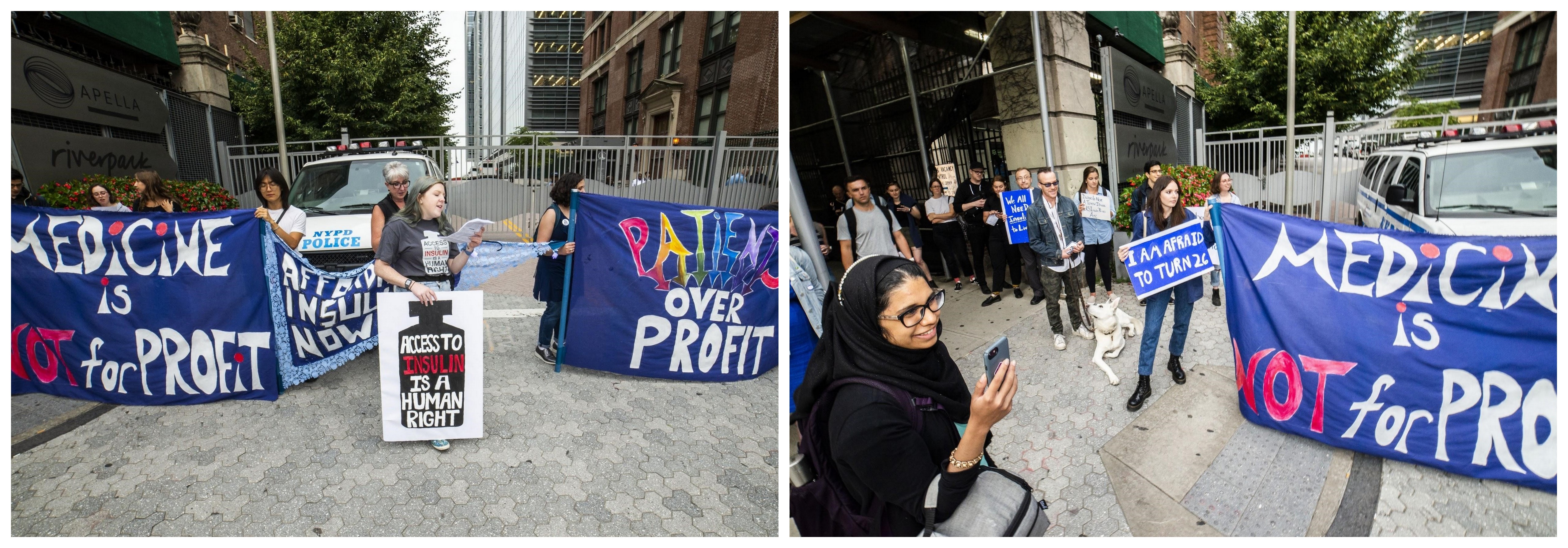
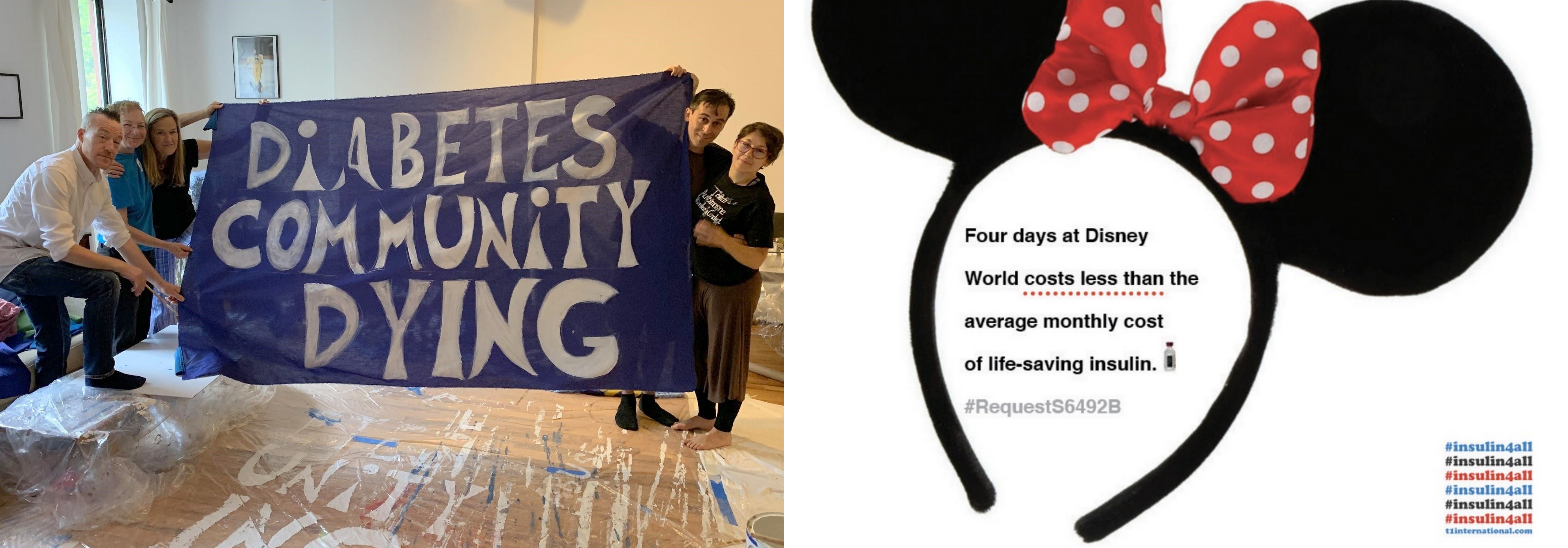
Working on an art-build is a fantastic way to build community. Pictured below is one of the in-process photos from advocates making large banners for the New York #insulin4all Chapter and actions. The Chapter was still new and forming, and the art-making process, as well as the many advocacy actions the Chapter continues to do, forms connections between the members. Yes, it takes energy and effort, but once you’ve done it, you have the materials to use in many future actions! Not to mention, people showing up to contribute helps each of us know we are not alone in this fight.
This below pictured postcard was designed by New York #insulin4all Chapter member Annalisa van den Bergh for advocates to fill out and send to the governor. This is a great example of digital (and safe!) advocacy during COVID.
Community artist and organizer Rachel Schragis created screen-printed signs and banners, and led on the creation of many concepts for the Sunrise Movement, because climate health = public health = our health.
3. Political Activation
There’s no one right way to join creativity and advocacy – the image here shows the powerful way an imprint of a red hand across the mouth united indigenous women and allies across Turtle Island (United States and Canada) to bring awareness to the gender-and-race-based violence being perpetrated against indigenous communities.
Being immersed in creative energy opens the space within people to reflect on their own experiences, share and unite in dialogue with others, share opinions, build knowledge and commit to actions. People may often feel embarrassment, or shame, for being unable to afford insulin. This is how oppression works: we internalize external causes and place the blame on ourselves. Creative activism helps activate and engage a person to realize that their suffering has social origins, and helps inspire them to become an advocate and activist who works for policy change.
4. Inspiration and Attention Grabbing
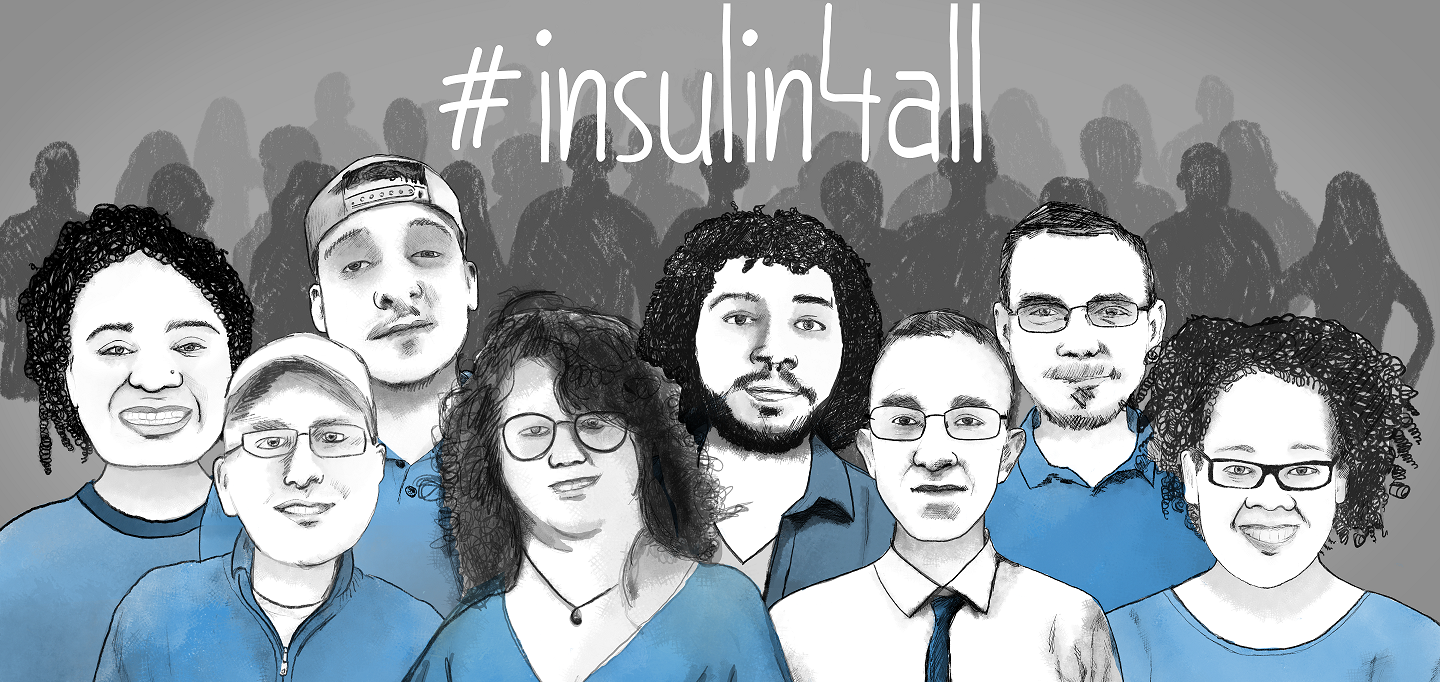
To build energy and grab attention of the public to join your cause, there’s no better way than through creating a bit of a public spectacle. The large banners that the New York Chapter created took up space, and made our messages loud and clear for both the media, and passers-by. The portraits below of the lives lost to insulin rationing by artist Mike Lawson created a deeply-felt homage in helping us mourn the sons, daughters, sisters, brothers, mothers and fathers we have lost to pharmaceutical greed.
Giant puppets have a long and deep history in activism, including the HIV/AIDS movement and beyond. Little Amal, a giant refugee puppet, embarked on an epic journey from Syria to Europe in order to “rewrite the narrative about refugees”.
5. Media Engagement
Finally, by uniting creativity, purpose, emotion and action and creating attention-grabbing visuals, our cause is more likely to catch the attention of social media, and the press. Strong, clear messaging, unique perspectives, and inspiring visuals unite joy, inspiration and purpose in the long, winding road of social change.
Most of all, art and creativity helps us remember the most important thing: We are unstoppable, and another world is possible!
Diabetes can interfere with so many aspects of daily life…including friendships and relationships with others.
I’m an extremely fortunate person: I’ve never had my diabetes be a “deal-breaker” for a friendship or a relationship. I’ve never had much difficulty in explaining it to others or receiving support from friends when I’ve needed it. Of course, the level of support that I get from people in my life with T1D is much different compared to the support I get from people in my life without it, but both types of support are invaluable.
Recently, I had an Instagram follower ask me for my advice on how to help friends understand T1D: what it’s like and what’s appropriate to do/say to a person with diabetes. She expressed her frustration with a friend who doesn’t seem to understand that just because she has diabetes it doesn’t mean that she can’t enjoy sugary treats from time to time. So in response to her anecdote, I decided to round up my five best tips on how to navigate T1D and friendships/relationships in which there’s a lack of understanding and a little too much judgment.
Some of my favorite conversations about diabetes with my friends have taken place on a comfy couch with a good glass of wine, making this a great photo for this post.
#1: Be open, honest, and willing to answer questions. In almost two-and-a-half decades of life with diabetes, I’ve learned that this is the most important thing I can do when meeting new people and forging friendships/relationships. It’s not like my diabetes is the very first thing I say to people (“Hi, I’m Molly and I have diabetes” sounds like a South Park gag)…but it is something that I make sure to casually cover early on in the relationship. Opening the door to communication about diabetes from the get-go seems to have helped me avoid tricky situations in which I have to spend too much time correcting misunderstandings about life with diabetes and not enough time on fostering my connection with an individual.
#2: Show all aspects of life with T1D. My philosophy is to never hide any part of my diabetes from friends. I let them watch me when I do fingerstick checks, site changes, and more. I involve them when I need help correcting a low blood sugar or need to take a moment to do a bolus calculation. I’ve found that this really helps my friends feel included and they tend to show more interest and genuine curiosity when I do my “diabetes stuff” around them. It creates natural learning experiences for my friends and they get to see firsthand just how much work it can be to take care of my diabetes.
#3: Tag along to endocrinologist appointments. I understand that this might not be possible right now in this “new normal”, but in the past, I’ve had my significant other come with me to endocrinology appointments. The most memorable experience was seeing a diabetes educator with my significant other so I could be retrained on how to use an emergency glucagon kit, and so he could learn for the first time. It was really eye-opening for my partner, and ever since then, I’ve encouraged others to invite their loved ones or the person/people they live with to attend appointments every now and then. And hey, since so many doctors’ visits are virtual these days, maybe it’ll be even easier for more people to tag along to these appointments than before.
#4: Make an introduction to the DOC. Some of my friends are more social media savvy than others, so for those who have shown interest, I’ve introduced them to the diabetes online community on Instagram. There are sooooo many profiles there ALONE – forget Facebook/Twitter/other diabetes blogs – that do an incredible job of shedding light on the significant and mundane (and everything in between) parts about daily life with diabetes. These accounts have helped them truly get diabetes in a way they hadn’t previously and I think it’s made my friendships stronger, healthier, and judgment-free.
#5: Correct misconceptions – gently. Even my closest friends, or the ones with the best of intentions, have slipped up now and then and said something to my face that is simply not true about diabetes. And that’s okay, they’re not perfect (and they certainly know that I am not). When this happens, I use it as a teaching opportunity and let them know why what they said is wrong or factually incorrect. I find that the gentle, patient approach helps to reinforce whatever it is that I’m telling them, so at the end of the day, it’s a win-win for all parties.
This post was originally published on Hugging the Cactus on December 12, 2018. I’m sharing it again now because the holidays are quickly approaching, and just because they look different this year, it doesn’t mean that cookies and other baked goods won’t be in abundance (baking is a great hunker-down activity, after all)! If you’re doubting whether a person with diabetes could or should eat cookies…then please continue reading this post.And excuse the absence of photos of the cookies described in the first paragraph, I didn’t want to trigger any drooling (‘cuz I totally would).
Check out that spread. You’re looking at an assortment of nine different kinds of Christmas cookies, all baked fresh by my mom, aunts, and cousins for our annual cookie swap this past weekend. And I can attest to the fact that each of them were effing delicious.
Now, if you’re thinking that people with diabetes can’t or shouldn’t eat cookies, sweets, or carbs in general…I’m here to (gently) tell you that you’re wrong. It’s a myth, a grain of utmost untruth, that people with diabetes cannot have carbohydrates of the sugary or starchy varieties. It’s fake news, y’all!!!
The FACT of the matter is that people with diabetes don’t have limits on what foods they’re able to eat. But there are matters of condition and preference to take into consideration here. First and foremost, carbs MUST be counted before they’re consumed. This is crucial because it determines how much insulin a T1D must inject. And then things like personal taste, diet, and comfort levels come into play that account for the variations in eating habits among people with diabetes. And that is the reason why you’ll meet some who are low carb, high fat followers, some who do not consume gluten, and others who do not exclude any particular food group from their diet.
I tried to choose a photo of Christmas cookies that weren’t absolutely delicious looking in order to avoid cravings…a much harder task than it sounds!
I’ve written a bit about this before, so why am I repeating it again? Because it’s worth knowing and accepting that everyone is different. Bodies respond differently to different stimuli, including the foods and insulin we put into them. And whatever works best for someone should be unconditionally tolerated, not judged, by others.
So if I want to eat a bunch of Christmas cookies as part of my Christmastime celebrations, then here’s my friendly reminder that I can – and you bet your bottom dollar that I did, and was very grateful for insulin after doing so.
And just like that, we’ve somehow, bewilderingly, arrived at the final day of National Diabetes Awareness Month 2020.
Not sure how that’s possible considering it should still technically be March 2020 (you know, when shit hit the fan), but here we are!
The blue circle…a symbol of diabetes awareness and advocacy efforts.
At the beginning of November, I really wasn’t sure that I was ready to don my diabetes advocacy hat and amp up my awareness efforts for the entire month. I’ve had enough going on in my personal life (spoiler alert: I bought a condo and moved into it at the start of the month) and as a result, I’ve spent much less time on social media and a whole lot more doing my very best attempt at adulting.
And despite that, I still found myself immersed in advocacy efforts – and blown away by what everyone else in the diabetes online community was doing.
Daily posts, live IG videos, fundraising efforts, and so much more happened all month long. They were inspiring, educational, and highly motivational to someone like me who was tepid at best about diving into advocacy activities this year. They were definitely enough to encourage me to keep posting for one of the many diabetes-themed Instagram challenges for the month. As minor as it was to write captions each day based on the prompts, it’s still what worked best for me in this weird year.
My big takeaway from this, though, isn’t that I should have done more or that I should feel guilty for doing the bare minimum…no, it’s a reminder that advocacy doesn’t take place during a single month or on one day.
Advocacy is a year-round thing.
I’m proud to talk about diabetes practically every damn day in some shape or form because I think that it helps people in my life realize that diabetes itself is a 24/7, 365-kind-of gig.
And I’ll keep talking and writing and expressing and advocating ’til the day there’s a cure for it.
There should be an asterisk after this blog title…because this is going to be about the lowest bg that I can really remember and have an actual blood sugar to associate with it.
Let me elaborate…
My real lowest low happened when I was in high school – I got out of bed one morning, stumbled down the stairs, and slurred to my mom that I wanted a bowl of Special K cereal for breakfast (she couldn’t understand what I said and promptly panicked before realizing I must be low). I don’t know what my blood sugar level was that morning because I neglected to do a fingerstick check, but I do know that it was a downright freaky incident that’s cemented in my memory.
But another new incident recently occurred that shook me in a similar way.
It was 1:30 A.M. I was nodding off when I heard my Dexcom alarming. I checked it and was somewhat surprised to see that I was 92 with two double down arrows. (I say “somewhat surprised” because in the earlier evening hours, I spent 3-4 hours chasing a stubborn high blood sugar and definitely wound up stacking insulin doses.)
Even though I wasn’t feeling any low symptoms, I decided to start treating the low. I ate two boxes of mini raisins, equaling about 20 carbs…
…and swiftly grew worried when I saw the number on my Dexcom app to continue to drop.
Below 55.
Okay, let’s have another box of raisins.
Below 50.
Alright, let’s do a fingerstick check.
42.
Sheesh, I’m fumbling around in the dark, trying to locate my meter…
LOW.
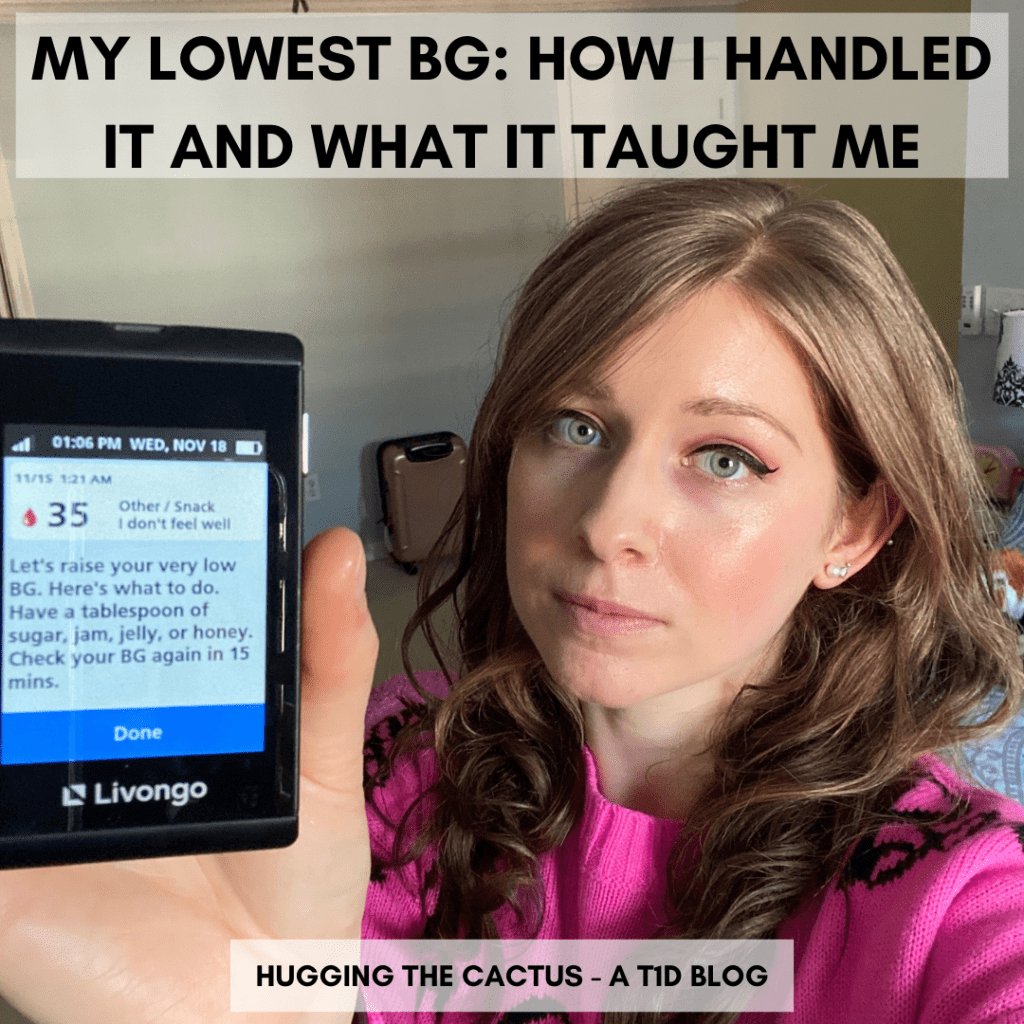
By the time my Dexcom said “LOW”, it was confirmed on my meter that I was, indeed, quite low. 35, to be exact.
If only my Livongo meter knew I needed a whole lot more than a tablespoon of sugar, jam, jelly, or honey…
And that was a number that frightened me.
Thank goodness I wasn’t alone when I was dealing with this 35 (that wound up lingering for a solid 15-20 minutes before slowly creeping up about 45 minutes after I ate my first box of raisins).
Thank goodness I had someone there to make sure I had plenty of sugar in my system before I fell asleep.
Thank goodness I had a can of regular ginger ale, some Reese’s, Dove chocolates, and popcorn all within arm’s reach (yes, I really did need to eat all those carbs in order to treat this one low).
Obviously, I recovered from this scary low, but it taught me that now that I’m living alone and won’t always have someone around me in the middle of the night, I should start thinking about inviting someone to follow me on the Dexcom app.
The next day, I talked to my parents about what happened and the three of us agreed that my dad will receive notifications if/when my blood sugar drops below 55. I feel a lot better knowing that he has access to my levels and that he knows to contact me if I’m low.
I’m not exactly grateful that I experienced this very low blood sugar…but I do appreciate that it’s reinforced the importance of having a nightstand fully stocked with low treatments as well as making sure that my family has a way of checking in on me when I may need their support.
Most years since I’ve been a diabetes blogger, I’ve tried to write some sort of blog post in which I reflect on the things that I’m grateful for.
My Thanksgiving gratitude list hasn’t really changed year after year…I’ll always be thankful for my family and friends, the roof over my head, and the food on my plate.
But what’s changed this year is that there are some new additions to the list:
Diabetes and gratitude aren’t two words that many people would probably put together in a sentence, but I do…keep reading to learn why.
My job. Given the record unemployment numbers this year, I feel especially grateful that I have a job that keeps me safe at home.
Access to insulin. I’ve always taken my insulin accessibility for granted. I don’t struggle to afford my 90-day supply (though it would certainly make my life easier if it was cheaper) and I am fortunate enough to have a solid supply on hand at all times. I know that other people with diabetes can’t say the same: an awful reality, but one that opens my eyes to something I should never take for granted.
Video chat programs. I used Skype in college to keep in touch with my high school friends and hadn’t really given it a second thought since then…until this year, of course. Between Zoom, FaceTime, and Skype, I’m so glad that this technology exists and helps me stay connected to my friends and family members.
Essential employees. There are a number of people who I consider heroes, and those who are essential employees are among them. It’s not just nurses, doctors, or first responders – it’s also the individuals who must risk exposure on a daily basis in order to support themselves and their families. I hope they know that their sacrifices don’t go unnoticed, and that they’re beyond appreciated for what they do to help the general public in so many ways.
Diabetes itself. Yes, I am thankful for diabetes. Here’s why: I could spend all my time resenting it for (occasionally) making my life miserable. A long time ago, though, I chose to embrace diabetes for what it is. In turn, I’ve learned to be grateful for diabetes because of all it has brought and taught me…friendship, independence, discipline, and so much more. After nearly 23 years with it, how could I not find gratitude in life with diabetes? And in a year of what’s felt like perpetual change (both for me personally and for the world), I’m thankful that diabetes remains a constant that actually helps keep me grounded by being a part of my routine. I’m always going to want and fight for a cure, but for now, I actively accept my diabetes and find the positives in my life with it.
It’s true that my Thanksgiving celebrations tomorrow will be a little different than what I’m used to, but I know that one thing that will stay the same is my gratitude for it, my diabetes, and all that life has to offer.
We all know that 2020 has been a sucky year, so it’s not exactly surprising that immediately following Halloween, the world seemed to throw itself into the holiday spirit.
Between the commercials on TV, Black Friday sales, sparkly decorations, baking galore, and Hallmark movies, the Christmas season kicked off early and with major vivacity. Normally, I’m the kind of person who prefers to enjoy one holiday at a time, and I was somewhat repulsed to see all the Christmas merchandise in stores before Halloween was over.
So even though Thanksgiving hasn’t even come and gone yet, I’ve abandoned any remaining willpower I’ve had to hold off on decorating for Christmas. Like the rest of society, I simply couldn’t hold back my desire for some cheer!
One afternoon last week, I decided to haul up my Christmas tree and its accompaniments from the basement and start the process of decking the halls…
…but my diabetes had other ideas.
Maybe my diabetes would’ve liked it better if I decked the halls with glucose tablets and test strips…
I’d just finished assembling my modest tree when I heard my Dexcom alarm sounding off, alerting me to a low blood sugar.
And I hate to admit it, but it didn’t surprise me – I’d felt the oncoming low for about 10 minutes prior.
I just wanted to decorate so badly that I was willing to ignore my blood sugar in order to embrace the Christmas spirit!
Alas, not too long after I heard that alarm, I knew I had to change my priorities as I started to get sweaty and a little woozy…so I left my tree naked and sought out a low treatment, slumping at my table in defeat while I ate it.
My diabetes told me it was too early to decorate for Christmas at that moment in time…
But you know that I told my diabetes otherwise later that night when I spent hours trimming the tree!
‘Tis the season and ain’t no way that my diabetes will prevent me from basking in it.
I crack open the slot on the back of my PDM where two AAA batteries are nestled. I smack them out from their slots, insert two fresh ones, and replace the cover. I wait for the system to power back on and am greeted with a high-pitched beeping sound soon after it’s reactivated…
…and become simultaneously annoyed, confused, and a bit panicked when I see a “system error” message displaying on the screen.
I follow the steps that flash on its display, instructing me to reset the date and time. Once I take care of that, my pod immediately deactivates, aggravating me further. I assemble all the supplies I need to activate a new pod, and once I have it on, I receive a message that I won’t be able to use the bolus calculation function on my PDM for 3-4 hours.
The whole incident was majorly inconvenient, but such is life with diabetes…
Anyways, if you’re like me, you’re probably wondering what exactly happened, and why it triggered my pod to fail.
Error messages on diabetes technology are never something I’ll be glad to see, but they do happen.
Fortunately, I can explain it!
I’ve experienced this phenomenon before – it happens when the internal battery within the PDM (not the AAA batteries) has a problem and stops working the way it should. It causes the system to get confused when new AAA batteries are inserted (because the system shuts off and turns back on) and it doesn’t remember the date or time. Because of that, it can’t identify when the current pod was activated, so it immediately triggers it to stop working so new one can be applied.
It’s obnoxious as heck because it’s a total unpredictable phenomenon, but it is what it is. It can be dealt with in a matter of a few hours, and the best part is that Insulet can be contacted so they can be made aware of the issue and overnight a new PDM – which is what they did for me. The day after this PDM problem occurred, I gave them a call, and within 10 minutes I was promised a new PDM that I would receive in about 24 hours.
So when a PDM system error happens again – not that I actually anticipate it to for a long time – I know the right course of action is to keep calm, follow the system’s instructions, and give Insulet a phone call. In other words? Rolls with the punches, because diabetes is good at directing them my way.
Today is Day 18 of the #TrueDiabeticChallenge that I’ve been posting about on Instagram all month long! I’m using the prompt to inspire the topic of today’s blog post: mental health. Read on to learn how I’ve been juggling my diabetes and mental health lately…
When I think of “diabetes and mental health”, a lot of things cross my mind: Burnout, self-care, and a whole slew of emotions, to name a few of them.
So as I pondered what I’d write about when it comes to this topic – and be totally transparent as to how my mental health is lately as it pertains to my diabetes – I knew that one emotion in particular would be the focus.
Loneliness.
I’m actually a bit envious of this cartoon girl because at least she has a furry friend to keep her company.
For the first time in my life, I’m living alone (mostly by choice). While this new chapter is certainly exciting, it’s also downright petrifying at times, especially when I’m contending with literal highs and lows of my blood sugar.
I struggle the most with being alone and managing my diabetes when I go low. This probably isn’t uncommon among other people with T1D who also live alone and I knew to expect to feel this way to a certain extent before making this transition. But I didn’t realize exactly how much comfort I take in the presence of others when my blood sugar is low.
I don’t know what it is, exactly…it’s not like I suddenly forget how to treat low blood sugars. It’s not that I ever relied on someone else to bring low blood sugar treatments to me (though I’ve always appreciated that on the occasions it’s happened). And I benefit from having a Dexcom CGM to monitor my blood sugars 24/7 and alert me to sudden changes. So…what gives?
As I search for that answer, I’m going to try to remember to be patient with myself as I navigate my new circumstances. It takes time to acclimate to a new environment and diabetes can make that more challenging. I mentioned self-care at the start of this post…maybe it’s time I start practicing it more deliberately to help make this transition smoother!





 Hugging the Cactus