Yesterday, I turned 29 years old. True to Hugging the Cactus tradition, I’m using today’s blog post as an opportunity to reflect on how I feel about this next year of my life.
29 feels just fine to me.
I’m feeling…just fine about 29. Before you think I’m just saying that because it rhymes, or because I’m not genuinely happy to be 29 (the rhyming is just a bonus and honestly, I’m happy to be any age because it means I’m living and that’s a wonderful thing), let me jump in and say it feels fine because…it just feels right for me, right here and right now. It’s not “just fine” in a sarcastic or curt way; rather, it’s “just fine” in the sense that it feels good and perfectly acceptable and something that I will embrace.
To tie it all back to diabetes, “good and perfectly acceptable and something that I will embrace” is kind of the attitude that I strive to maintain when it comes to how I feel about my diabetes. Of course, I have my days where everything is far from good, perfectly acceptable, or embrace-worthy. But generally speaking, I’ve worked hard to get to a place where I simply and peacefully coexist with my diabetes. I ride the waves of highs and lows and always find a way or means to overcome the unexpected ripples of randomness that my diabetes drifts my way.
So I’d like to carry that mindset into the last year of my 20s: a mindset in which I take comfort in knowing that I’m capable of riding the waves caused by diabetes, or anything else in my life, really. Arming myself with the knowledge that I grow through what I go through will help me thrive with diabetes and life, and it seems like an excellent nugget of wisdom to bring with me into year 29.
I spent way too long trying to come up with a good title for this blog post.
Let’s be real, here. It’s hard to think of compelling, descriptive titles that will make people want to read a piece of content. This post was particularly challenging for me because of the subject matter: bumps.
Before you jump to any conclusions, I’m not talking about baby bumps or any sort of metaphorical or literal bumps in the road. The bumps that I’m referring to are physical manifestations on my skin of my diabetes that I find unsightly, which is why I had a difficult time figuring out how to talk about them in a blog post.
I don’t understand why the bumps only appear on my thighs, but…c’est la vie.
Let me elaborate on the exact nature of these bumps. They only show up when I remove a pod that had been on my thigh. No other site experiences this blemish, and no other diabetes device (e.g., my CGM) causes a raised bump to appear on my skin’s surface. The bumps themselves are relatively small – they look a little bit like mosquito bites. You can always tell the exact location that the pod’s cannula was in because the skin looks slightly more irritated and raised there, whereas the skin around that site has a pink tinge to it. These bumps don’t hurt me, aren’t typically itchy, and usually fade in a week or so.
In the grand scheme of things, the bumps probably don’t sound like that big of a deal. But I can’t help but feel self-conscious about them because to me, they’re stark reminders of the physical marks that diabetes leaves on my body. I made peace with having to wear two different gadgets (my pod and my CGM) years ago and having those stuck on my being, but these ugly little bumps? I didn’t exactly consent to having those on my body, too.
I suppose I could solve the problem by avoiding using my thighs as sites for my pods, but to me, that’s just giving in to my diabetes and giving up an extra bit of real estate on my body that I need so I can properly rotate my pod and CGM sites. I’m a little too stubborn to just accept that I shouldn’t wear pods on my legs if I want the bumps to stop appearing. That doesn’t mean that I have to be okay with them, though.
Sharing about the bumps in a blog post is me being vulnerable about a component of my diabetes that embarrasses me. I’m hoping that it results in that shame evolving into a sense of acceptance, or maybe even pride, over my bumps. Because even though they’re far from cute, they do add visibility to my diabetes and represent the strength that my body and mind have developed in order to coexist with it on a daily basis.
Maybe writing this post is the launching point for me to think of these bumps not as blemishes, but as diabadass beauty marks, instead.
In my humble opinion (and experience), the best kind of diabetes conversation happens when it’s least expected among a group of people who are willing to listen and learn about it.
I was fortunate enough to have this exact type of conversation with my newly formed volleyball team after our first match of the season. (Side note that until then, I’d never played volleyball in my entire life. I was a ball of nerves the whole time, but I think that joining the league will have a positive impact on my mental health, social life, and diabetes, so I’m excited to see where the season takes me.) We were gathered around the table in a bar, enjoying a pitcher of beer and learning more about one another, when diabetes entered the conversation – as it almost always does, eventually, when I meet new people.
It’s not always easy to have a conversation with new people about diabetes.
We probably spent less than 10 minutes on the subject of diabetes, but the whole time we did talk about, I felt extremely thankful to be surrounded by people who asked thoughtful questions, demonstrated curiosity to learn more, and made a pointed effort to ensure my comfort throughout the whole conversation. The energy that the group was emitting made me feel good as I shared my experiences and showed them my Dexcom and Omnipod devices, the latter of which isn’t always easy to do around new people because I can be a little self-conscious of how they appear on my body. But it felt natural to be open and upfront about all things diabetes, as I’ve experienced it, because everyone genuinely cared to learn more.
That’s what made it such a lovely conversation; in turn, it will also serve as a great reminder to me that telling new people about diabetes doesn’t always have to be an intimidating or stressful ordeal.
My Omnipod’s adhesive was damp from the shower. I was putting a pair of pants and not paying any mind to the pod I’d only been wearing for about 12 hours.
It’s no wonder that I brushed the fabric of my pants up against my pod in precisely the wrong way.
I heard the telltale sound of adhesive tearing off my skin and cursed before looking down to inspect the damage.
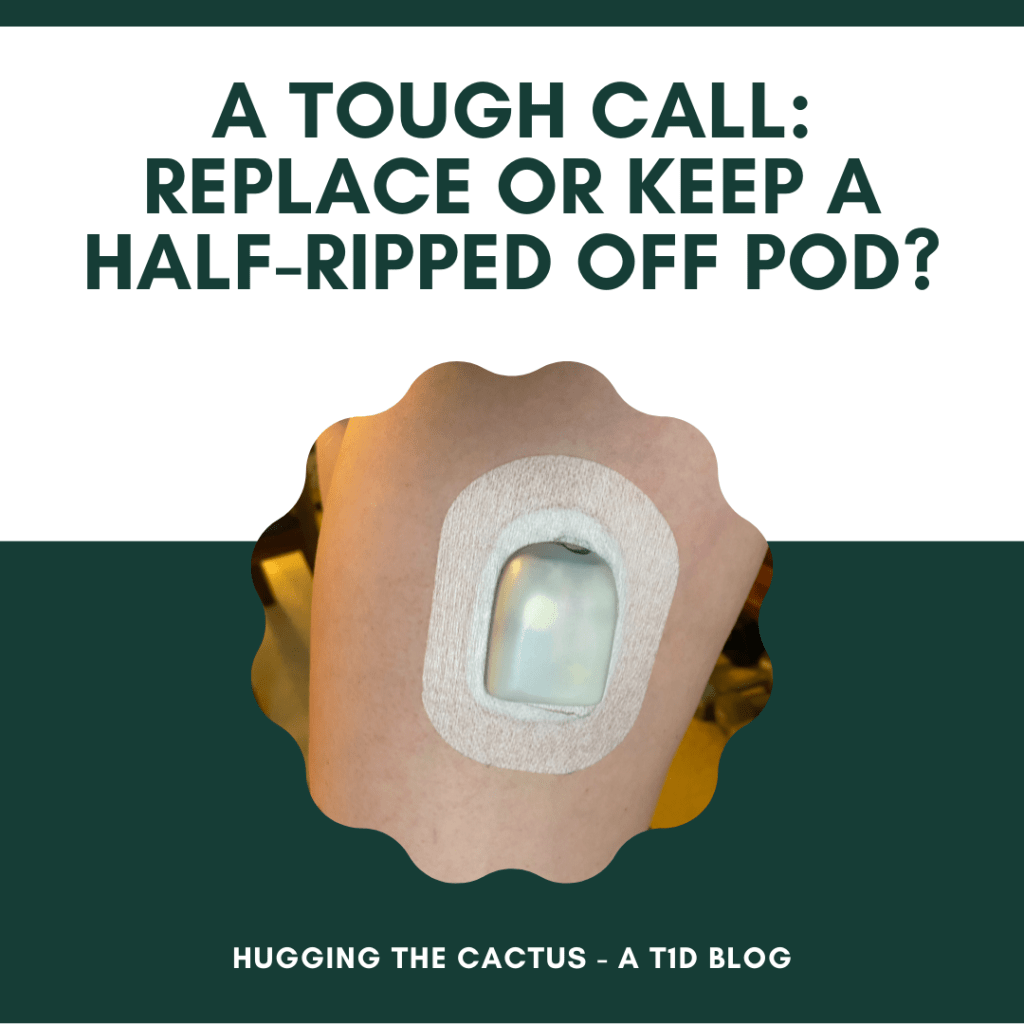
I expected to see a pod dangling on my leg by a thread, but instead I noticed that the adhesive around the cannula-end of the pod (the important end) still seemed totally stuck to my skin. It was the opposite end that was in trouble and definitely needed taping up if I hoped to save the pod.
So while I waited for my pod’s adhesive to completely dry from the shower so I could check it out further, I pondered: Do I run the risk of keeping this pod on, even though its security was significantly decreased? Or do I err on the side of caution and replace it, and enjoy the peace of mind that comes with a freshly applied pod?
Both options had pros and cons.
Spoiler alert: I decided to keep the pod on, but made sure it was as secure as it possibly could be by adding an overlay patch around it.
If I kept the pod on, my blood sugars might start to run high because I couldn’t say with 100% certainty that the cannula was still inserted in my skin. It looked like it could be, but the sound of half the adhesive ripping off made me suspicious. But if I replaced the pod, I would be wasting all the insulin I had just put into it the night before, which was a thought that was difficult for me to stomach.
I decided that the more favorable option to me was keeping the pod on, so once I knew it was dry, I added a little extra security by applying a PodPal (an Omnipod-shaped adhesive overlay meant to reinforce a pod’s stickiness) around it. As of this writing, only time will tell whether this was the right call to make, but my point in sharing this story is that this is an example of just one of the many judgment calls that people with diabetes have to make on pretty much a daily basis. This single decision took up mental energy and time that I would’ve rather used at work, or for chores around my house, or for just about anything else – but instead, diabetes had to be at the forefront of my thoughts and actions because it often demands just that much attention.
That’s why it’s kind of staggering to know that people with diabetes make around 180 decisions per day...with that in mind, there’s no doubting that diabetes is a condition defined by choices made. No matter how big or small – even as tiny as choosing whether or not to replace a pod – they all add up together to determine long-term health outcomes, and that in itself is a very big deal.
today because it’s a great reminder that diabetes isn’t a static condition – what works for a person with diabetes one day might not work the same way the next. So when I decided to take a Dexcom break, it was a much-needed change in my diabetes care routine that worked wonders for my mental and physical health. I just might take another one after reading this post again…read on for the full story.
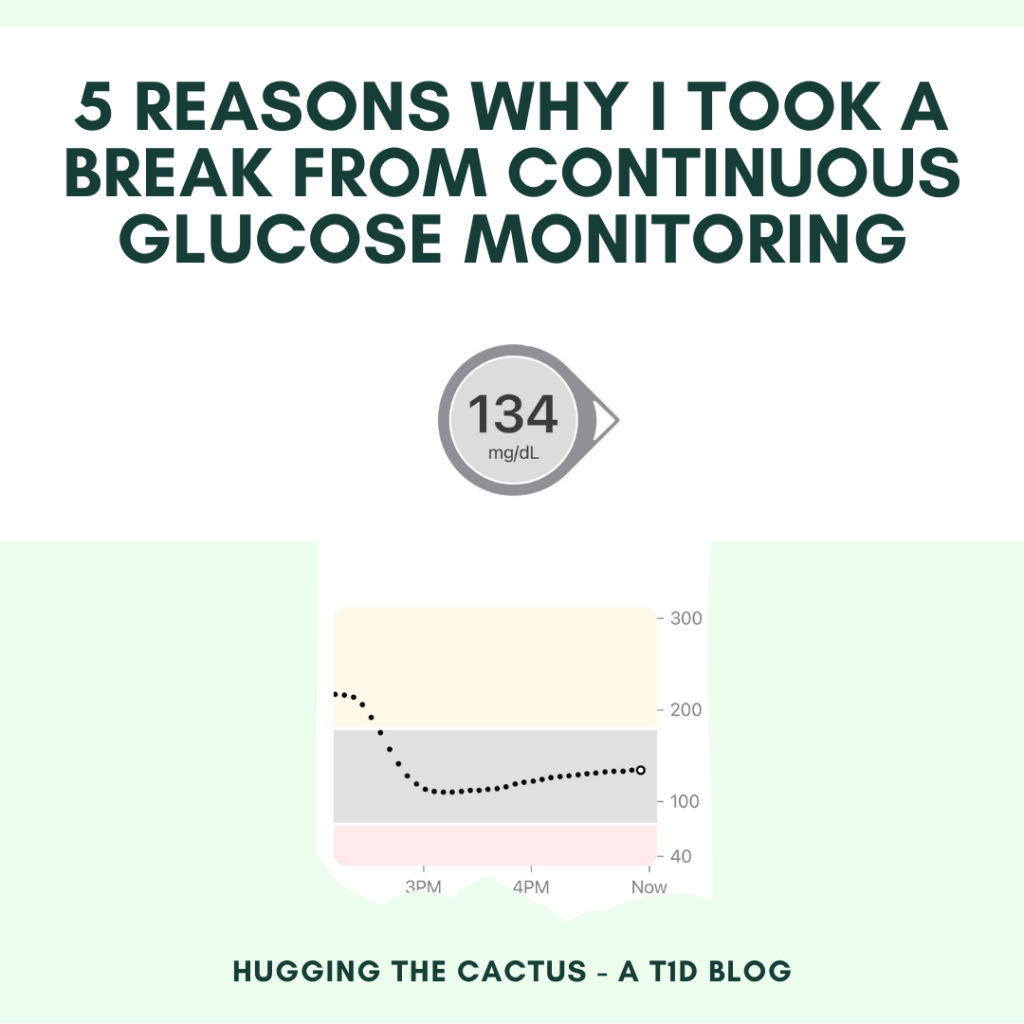
I’ve decided to take a break from continuous glucose monitoring. This means that for an undefined period of time – maybe 3-4 days, a week, or a few weeks – I’m not going to wear my Dexcom G6 CGM.
Initially, I wanted to give myself a break because I was just burnt out from wearing it all the time and feeling so dependent on it. But as I started thinking about more, I realized that there were some other really great reasons for me to take a break from my CGM:
1 – I wanted to wear one less device. It can be tough to wear two medical devices 24/7. Sometimes I get super self-conscious of them. Other times they just aren’t comfortable to wear, such as when I roll over one the wrong way when I’m sleeping at night. So it’s nice to feel a little more free with one less device stuck to my body at all times.
2 – I was sick of the constant data feed. All those alarms going off whenever I cross my high or low threshold are straight up annoying!!! I know I could just turn them off on my CGM receivers, but the point of them (for me) is to try to maintain as tight of a control on my numbers as possible. But now that I’m intentionally not wearing my CGM, I’m realizing how much I appreciate the reprieve from all that buzzing and beeping. There’s lots of reasons to take a break from continuous glucose monitoring, but sometimes one is enough.
Taking a break from my Dexcom was a much-needed change in my daily diabetes care routine.
3 – I have some new blood glucose meters to try. The only way that I can really put my new meters to the *test* (lol) is to use them – and goodness knows that I have very little desire to do manual finger stick checks when I’m wearing my CGM.
4 – I’d like to hold myself more accountable. I rely on my Dexcom heavily at all times. I look to it before I start exercising, before I eat something, before I do anything, really. I bolus using the data it provides and trust it implicitly. But I’ve recognized that by developing this habit, I’ve become lazy. I don’t measure out food as much because I figure that if I bolus too much or too little for it, I can just watch what my Dexcom tells me and treat from there. It’s kinda sloppy, in my humble opinion, so I’m trying to put more of the trust back in myself for my diabetes monitoring.
5 – I’m trying to reacquaint myself with my body’s cues. Before CGM technology, I was really good at recognizing high and low blood sugar symptoms…but then I started using a CGM and found myself reacting to highs and lows (e.g., treating them prematurely), even if I didn’t feel those high/low symptoms. So I want to retrain myself so I can make sure I never lose that ability, because I think it’s important to know exactly how my body alerts me to various blood sugars, rather than depending solely on a piece of technology to do it for me.
Pre-bolusing: It’s the term that describes taking insulin before eating food. The “before” part in the definition is key, because the amount of time that “before” is can and will vary among people with diabetes. It depends on a few factors, including the amount and type of insulin being used, the amount and type of food to be consumed, current blood sugar levels, and so forth.
It’s one of those things that’s tricky to nail the timing of, but boy, when it works it’s so worth it.
Pre-bolusing works well, but only when the timing of it is perfect.
I have two examples to complement that belief, one in which pre-bolusing almost lead to a disastrous outcome and the other in which everything turned out ideally. I’ll start with the more chaotic scenario first.
In this situation, my boyfriend and I spent the night in New Hampshire to attend a friends’ wedding and had a pretty late night, which meant we slept in a little later than we had intended the next day…actually, a lot later. We only had about 20 minutes to race around our room, pack up our belongings, and get ourselves looking presentable before we had to check out of the hotel. Luckily, our scrambling paid off and we made it out in time, but sleeping in cost us the opportunity to enjoy a complimentary hotel breakfast. We decided that it made sense to stop for brunch on our drive back home to Massachusetts, so we Googled a diner that was on our route home and stopped there for a meal.
When we got there, the restaurant was pretty crowded, but we were seated and able to place our brunch orders almost immediately – a good sign. I assumed this meant we wouldn’t have to wait more than 20 minutes or so (that feels like a restaurant standard) for our food to be ready, so I went ahead and pre-bolused my mealtime insulin. After all, I’d ordered a hearty omelet that would come with breakfast potatoes and toast, so I wanted to be proactive about avoiding high blood sugar and get my insulin in system sooner rather than later.
Unfortunately for me, our food ended up coming out later rather than sooner. In fact, we waited nearly 45 minutes for our dishes to finally come out. In that period of waiting, I was getting more and more anxious about my decision to pre-bolus with each minute that passed without food in front of me. By the 30-minute mark, I was close to full-on panic. Even though my Dexcom wasn’t indicating that my blood sugar was low (it held out steady the whole time), I was worried that the system delay in reporting my blood sugars would fail to catch a serious low in a timely manner. I told my boyfriend what was going on, and without hesitating he went to his car to grab some packs of honey that he’d stored in his glove compartment in case of emergency. We talked it over, and decided that it was probably best for me to consume at least one pack of honey because we couldn’t possibly know when our food was going to come out, and at this rate, we wanted to play it safe rather than be sorry. That didn’t exactly lessen the sorrow and stupidity that I felt for taking a pre-bolus (even though I couldn’t have possibly known that our food would be so delayed, I still felt badly about the whole thing), but it was what it was. And ultimately, I felt like I paid the price several hours later, when I was dealing with the very same high blood sugars that I’d hoped my pre-bolus would prevent. So much for making the pre-bolus grade that time…
But that doesn’t mean pre-bolusing always fails! This brings me to my other example. My mom and I had a nice lunch together last week. Before we left to go to the restaurant, I noticed my blood sugar was a little high. I decided to give myself a correction dose, plus one extra unit of insulin, because I knew we’d be eating foods that aren’t typical for me to consume at lunchtime that could result in highs later in the day. So again, I was aiming to be proactive and prevent prolonged high blood sugar.
And this time, the strategy worked great! At the restaurant, I stacked that pre-bolus with my actual meal bolus (not always a recommended tactic, but it was useful here) and rounded out my afternoon with a blood sugar in the 120s – a win in my book. Thanks to my pre-bolus, I didn’t experience any pesky blood sugar spikes and still landed in range, which in turn showcases the power of the pre-bolus perfectly.
So just like anything in life with diabetes, when pre-bolusing works, it’s wonderful…but it definitely requires a little finesse to learn exactly when/how/where to use it.
Turns out, living with type 1 diabetes means that I’m testing a whole lot more than just my blood sugar levels…
…I’m testing my memory, too – and rather frequently.
As a person with T1D, it’s on me to remember to do basic things like bolus for meals, be prepared with back-up supplies at all times, get prescriptions filled before I run out of anything, and so much more. More often than not, I pass these memory tests.
But naturally, I’m bound to fail one every now and then.
Case in point: I forgot where I left my PDM the other day. I had prepared my dinner and went to take a bolus for it when I realized that I couldn’t remember when or where I last saw it.
When the “Find my PDM” feature fails, there’s nothing to fall back on other than memory…and maybe a bit of luck, as well.
It was an infuriating scenario. I knew it was somewhere in my home. I hadn’t left the house all day, other than to take my dog outside to do her business. I spent the better part of a half hour wandering up and down the stairs, searching with an increased sense of franticness, for my PDM. The urgency to locate it only heightened when I tried to use the “Find my PDM” feature on the Omnipod Display app and it wouldn’t work. That was a first – up until this day, I’d always been able to use it to track down my PDM when I’d misplaced it. It showed no indication that it was going to suddenly start working again any time soon, so I gave up and was forced to retrace my steps in order to find my PDM…which was going to be difficult considering in the middle of my search, my Dexcom went off, alerting me to an impending low blood sugar.
Think, think, think…I could practically feel the wheels turning in my head as I tried to recall where I last saw my PDM. I’d bolused for lunch earlier in the day, most definitely. That much I knew. I had eaten lunch downstairs, so I surmised that I brought my PDM upstairs with me when I was done so I could have it nearby as I continued on with my workday.
I looked high and low, all around my bedroom, without success. That’s when it dawned on me that there was a slim chance that my PDM fell outside of my pocket when I took my dog out just before I’d made my dinner. So I ventured outside, sweat starting to bead on my forehead as I grew shakier from my low blood sugar. I scoured the parking lot and the lawn for my PDM and no dice. That was when I decided to head back inside, drink a juice box, and take a moment to really contemplate the time and place I last saw my PDM.
That’s when it hit me – it had to be on my bedroom floor, next to my bed, because I suddenly remembered how it had accidentally slipped off my bed when I’d placed it there after lunch! I raced back upstairs, feeling triumphant and relieved when I saw the PDM in that precise spot and could confirm that my memory had finally served me correctly.
Now, this might sound like some silly, random anecdote about how I had a forgetful moment. But to me, it actually demonstrates just how much a person with diabetes needs to remember to do on a daily basis. It’s so much more than the finger stick pokes or insulin injections – it’s a lot of accountability. It shows that diabetes tests a whole heck of a lot more than blood sugar…it tests patience, responsibility, and yes, in this particular situation, memory. This is why I think people with diabetes deserve recognition for dealing with these daily, innumerable tests as gracefully as we can.
This blog post was originally published on Hugging the Cactus on June 27, 2018. I’m sharing it again today because it’s a blog post that has a surprising number of views – likely due to the fact that people have strong opinions (rightfully so) on glucose tablets and their various iterations! Read on for my thoughts on the best version of drugstore glucose supplements…
You may have heard of glucose tablets, but what about glucose gummies? Or liquid glucose, or glucose gel? Have you tried any of these forms of glucose?
The four forms of glucose (that I’ve tried).
I’ve used them all, and I’ve formed some pretty strong opinions about each of them. I thought it’d be fun to rank them in order of most appetizing to least appetizing, because while they can effectively and efficiently correct low blood sugar, they certainly aren’t created equally:
Best Tasting: Glucose Tablets. I can hardly believe that the most boring variety is the winner here, but it blows the competition out of the water for several reasons. For starters, glucose tablets come in an array of flavors. Orange, raspberry, fruit punch, grape, tropical, and sour apple are among the flavors I’ve tried over the years, and most of them are palatable. Plus, glucose tablets are most akin to actually candy: I’ve described them as giant Smarties to inquiring friends in the past. While actually Smarties are more fun to eat, glucose tablets are their closest counterpart in the diabetes world, making them a number-one choice in low blood sugar situations.
Runner-Up: Glucose Gummies. I’m awarding second place to glucose gummies, mainly because of their novelty. It’s not particularly a standout in other categories like taste and texture. The gummies only come in three flavors: grape, orange, and apple, leaving something to be desired in terms of variety. And all three of those flavors taste a little…off, like there’s a little too much artificial additives going on. Maybe this was done deliberately to distract from the texture of the gummies, which tends to be hard/stale in my experience. It’s nice that the gummies have a layer of sugar on them to convey the likeness of real gummies, but that stuck-to-your-teeth feeling makes it harder to appreciate the gummies for what they are.
Third Place: Glucose Gel. I’ve only ever found glucose gels in the fruit punch flavor at Walgreens – do they actually come in other flavors? Besides being one-note, the gel is a unique texture situation…not quite a liquid, not quite a solid. Gels aren’t a mainstay in my low blood sugar kit because I’m not fond of having to slurp them out of the pouch like a tube of Go-Gurt; in fact, I’d much rather have yogurt from a plastic tube than a gel because the yogurt is much tastier. The gel is just too artificial, with a medicinal aftertaste. And it doesn’t help that the consistency of it reminds me of hand sanitizer.
The Loser: Glucose Liquid. It’s surprising that the glucose liquid wound up in last place, because on the surface, it had a lot going for it. I liked that it came in a small bottle and it seemed like it would be super easy to consume. All I’d need to do is pop the cap off and swig it down. But MAN, the taste was HORRIBLE! I thought I’d like the mixed berry flavor, but it tasted so supremely saccharine and fake that I could scarcely force myself to swallow it. I know, I know, it’s liquid glucose, it’s supposed to be very sweet. But this stuff was just over the top. I definitely will not be buying glucose liquid again any time soon. I’ll stick with my tried-and-true tablets.
Do you agree with my rankings? Did I miss any form of glucose that can be bought in most drugstores, and you think I should give it a try? Let me know in the comments!
So many emotions accompany living with type 1 diabetes: occasional sadness, some anger, a bit of bitterness, flares of acceptance, and a whole lot of frustration.
But another emotion that comes with it that I recently found myself thinking about (and feeling) is guilt. Not guilt over the fact that I have diabetes, per se – because my diagnosis was out of my control – but guilt over the ways that it affects those around me.
Life with diabetes is so much more than blood sugar checks and insulin injections – it’s also about learning how to navigate emotions like guilt.
I feel guilty for all the times my devices’ alerts and alarms disrupt my partner’s sleep.
I feel guilty for complaining to family and friends about my diabetes because they don’t deserve to be burdened by it.
I feel guilty when I have to leave a social event early because I forgot to bring back-up supplies with me or because I experienced a device failure.
I feel guilty when a high blood sugar makes me lash out at my loved ones…and when a low blood sugar causes them to be worried about me.
This guilt weighs heavy on my shoulders, and when coupled with the guilt I carry around when I have a bad diabetes day or let my emotions about diabetes get to the best of me, it can sometimes feel like I’ll collapse at any second because I’m simply not strong enough to handle it. Of course, I don’t feel crushed by the weight of guilt all the time; in fact, it’s only occasional. But when it does rear its ugly head, it’s not fun, and it makes it that much harder to deal with the day-to-day of diabetes.
The reason why I chose to write this blog post about guilt and diabetes is to bring awareness that living with diabetes is so much more than daily insulin injections and blood sugar checks. It also means coming to terms with the fact that it’ll cause a lot of discomfort, both physically and emotionally – and finding out ways to overcome that discomfort, and the emotions of diabetes (guilt included), is what makes people who live with diabetes absolute warriors in my eyes.
This was originally published on Hugging the Cactus on September 7, 2020. I’m sharing it again today because my mom and I were recently talking about pod placements and the places where we would (and would not), hypothetically, feel comfortable wearing a pod. It got me thinking about how I’ve had to work up the courage to try new sites over the years, which inspired me to write this post to hopefully help others who feel the same way about navigating new pump sites and nerves. Read on for more…
Am I the only T1D out there who feels incredibly nervous about trying new insulin infusion sites?
I’ve been this way as long as I can remember, now that I’m thinking about it. Throughout my childhood, I stubbornly stuck to injecting in my arms, legs, and upper buttocks (tee-hee) because those were the areas I felt comfortable with. I don’t think I even considered jabbing myself in my stomach until I was in my teens, and it was only after I realized the importance of site rotation and reducing scar tissue.
So it’s kind of funny that when I went on the OmniPod just over five years ago, I only used my stomach and my lower back (just above the upper buttocks region, tee-hee) for pod placements. It was partly because my guinea pig – I mean, my mom – used those areas for her pods with success, and also because I was hesitant in the beginning to wear my pods on my arms or legs because of their increased visibility.
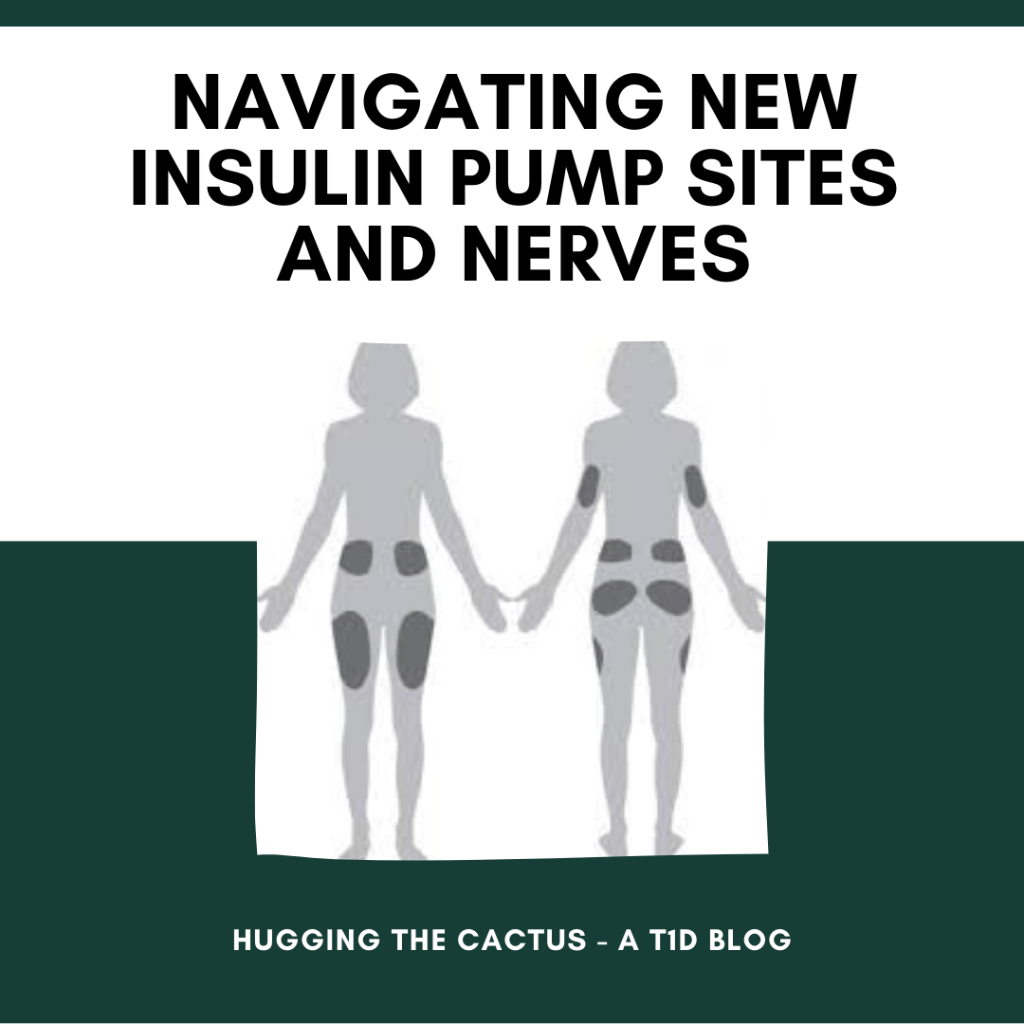
It went that way for a couple of year – four basic sites ’round my abdomen – when it occurred to me yet again that site rotation was also important for insulin pumpers, not just MDI-ers (multiple daily injection…ers). So I added my upper arms into the mix, and soon after, my upper thighs followed.
The little diagram (courtesy of Insulet/OmniPod) above only shows a few of the sites that people with diabetes use…over the years, we’ve gotten a lot more creative!
But lately, I’ve shied away from wearing pods on my thighs because the area isn’t overly comfortable. When I roll over in my sleep at night, my pod presses up against my leg and the resulting pressure is just enough to disrupt my sleep and make it difficult for me to find a more restful position to sleep in.
As a result, I’ve started contemplating potential new pod sites, and one of the first places I went to for advice was…Instagram! Because…duh.
The DOC (diabetes online community) on Insta is a natural resource for this sort of thing because many people tend to share photos of their sites. It’s kind of a thing. One simple scroll through my feed taught me that people can get very inventive when it comes to finding new locations to place their CGMs and insulin pump infusion sites.
I saw people wearing Dexcoms on their forearms and calves. I saw pods on backs, calves, and even the upper chest area, the latter of which I found most intriguing. For men, it seems like a very accessible spot that causes little irritation, but for women? How the heck did the T1D ladies I saw with pods on their chest deal with it?
The general consensus, it seemed, was that women wearing pods on the upper chest agreed it was a site with great absorption and minimal discomfort.
I was still skeptical, though. I was worried about how it would look if I was wearing a v-neck tank with my pod poking out of, well, my bra! Then it hit me that my pod garners questions from strangers regardless of where it’s located. Furthermore, people will (probably?) be less likely to ask about it if it’s located on my chest because, um, that’s really awkward. My eyes are up here, people!!!
Then I remembered: I could give the site a try without wasting a pod because I have a demo pack that I got from a diabetes conference awhile back! The demo pack comes with a dummy pod that looks and feels just like a regular pod, but there’s no reservoir built into it, so insulin can’t be injected into it.
So right now, as I’m writing this, I’m wearing two pods: one on my upper arm that’s actually giving me insulin, and a fake one on my chest just to see how I like it. I must admit, so far, so good! I slept comfortably with it on last night and I haven’t had any issues wearing clothing or undergarments with it. I even went for a jog with it on and got pretty sweaty, but it stayed secure/I didn’t feel it bouncing around at all (thought the adhesive got a bit too damp for my liking…it stayed on but if I wasn’t careful I totally could’ve knocked it off).
While I’m still having a hard time wrapping my head around an actual cannula piercing my skin at this location (eeeek), now that I know I can handle the pod itself living there, I’m one step closer to trying (and liking) a site that’s more intimidating to me – a win in my book.








 Hugging the Cactus