A Serendipitous T1D Encounter

Sometimes, when you’re in the most random of places, surrounded by a couple of people you know but mostly strangers, but the vibe is juuuuuust right and you feel perfectly at home?

That kinda describes how I felt at…an arcade bar, of all places, on a Saturday night outing earlier this month.

I was at the local arcade bar with my boyfriend and a bunch of our friends. I always have a blast when we go there, and this particular evening was no exception. But what made it extra special was what happened when I was playing pinball.

I don’t have a picture from this particular evening, and YES I know that Galaga isn’t pinball…but it IS my favorite arcade game, and this picture also features a sunburn around an old Dexcom site…so it works well enough for this post.

I was using arguably the best pinball machine on the property (the Lord of the Rings themed one), and my favorite band from my teenage years (okay, and admittedly probably my favorite band of all time…My Chemical Romance) was blaring on the speakers. I was on cloud 9 from that alone, but then this happened: The person playing Pirates of the Caribbean pinball next to me (another excellent choice), nonchalantly said to me, “I miss my Omnipod…my insurance won’t cover it for me anymore.”

I glanced sideways at him, not wanting to lose track of my silver pinball but also wanting to show my interest in the conversation. I nodded empathetically, and said something about how insurance matters can make things so difficult. He agreed, before quickly showing me his “ancient Medtronic pump”, deftly maneuvering it from his pocket so the tubing wouldn’t get tangled around anything. I smiled and we both returned our attention back to our respective games, which we went on to play in a companionable silence.

It was totally random, not at all expected, but a sweet and subtle reminder that I’m not alone, even in places where it seems like diabetes is the last thing on anyone’s mind except mine. I hope this guy felt the same way…a little positive reassurance that we’re all in this together and doing a really great job of living well with diabetes.

A1c and Time in Range: To Share or Not to Share?

“A1c: Also known as Hb1c or hemoglobin A1c, this is a test that is conducted every 3 months (or as requested) by an endocrinologist. A patient gets blood drawn to determine the average amount of glucose concentration in the blood during that 3 month period. The result of this test is a percentage amount, with 5% being an average result for a non-diabetic individual.”

This is the definition of A1c that I’ve shared in the diabetes dictionary section of Hugging the Cactus, and while of course the meaning and purpose of an A1c test will never change, one thing certainly has – and that’s the question of whether or not it’s the gold standard metric that indicates diabetes management.

That’s because A1c has a little competition called time in range. The concept is exactly what it sounds like: It’s an indicator of the amount of time a person with diabetes has their blood sugar within their preferred range, and it can best be captured by a percentage (e.g., I spent 70% of my day yesterday in range, with 30% of my readings either lower or higher than my ideal range).

While these two metrics vary from one another in how they are captured and analyzed, they do have one thing in common for a person with diabetes…is it a data point to share with others outside your healthcare team, or is it something to keep to yourself?

To share or not to share A1c and/or time in range…that is, indeed, the question.

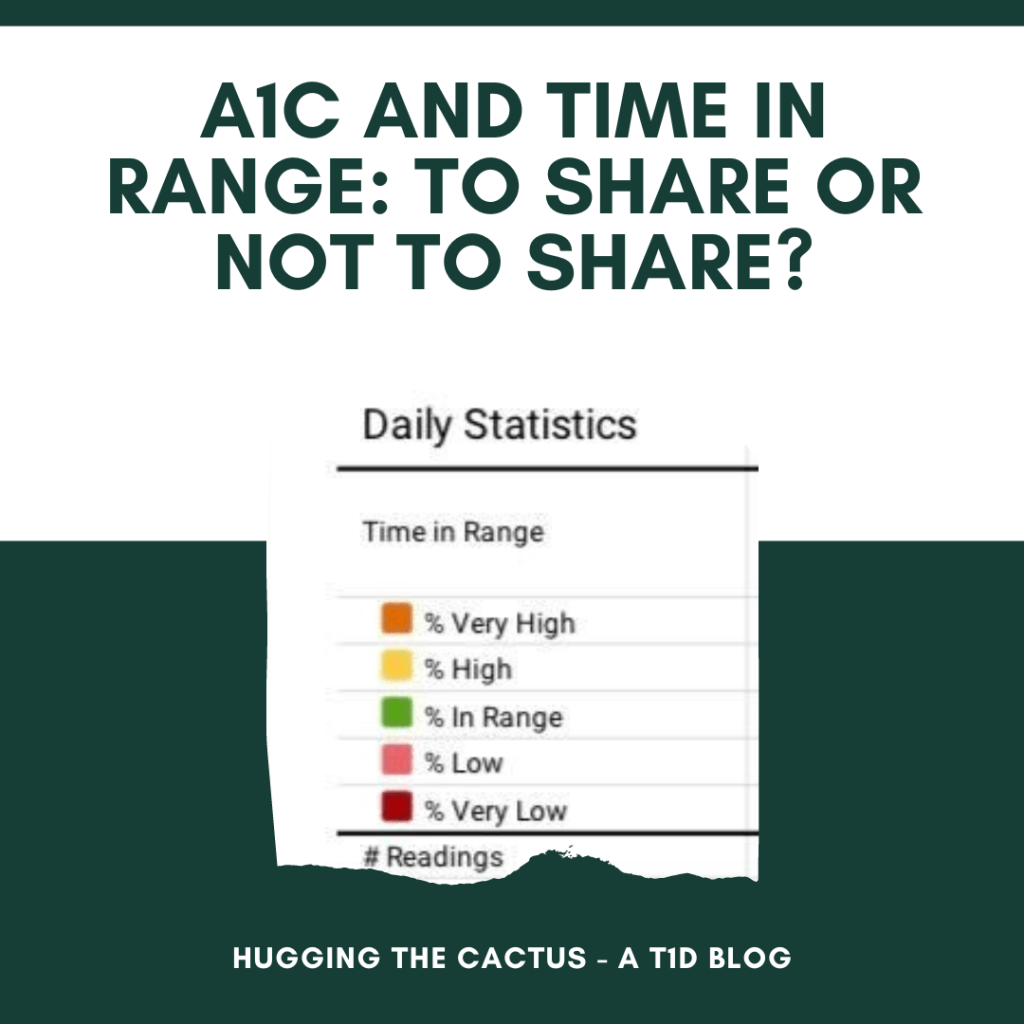
Above is a screenshot from my Dexcom Clarity app. Note that you can see some of the information it captures, but you can’t see any of my personal percentages because I prefer not to share that with others.

The answer is personal and unique to every individual with diabetes, and for me, I keep it to myself in both cases. I’ve never felt comfortable opening up about my A1c or time in range online or in person. I think that’s mostly because I struggle with comparing myself to others. I do my best not to, but I can definitely turn diabetes into a competition that I internalize at all costs because I don’t want other people to know that sharing about these data points makes me deeply uncomfortable.

It’s how I am, how I’ve always been, and likely how I’ll be for quite some time. I’m curious to discover whether or not starting the Omnipod 5 will impact that at all, seeing as I have high hopes that the system will greatly increase my time spent in range as well as lower my A1c. But for now, I’m content with keeping these diabetes numbers to myself, and will aim to get better about telling people that I prefer not to discuss either.

Diabetes in the Wild: Doggie University Edition

I’ve enrolled my dog, Violet, into Doggie University.

You see, Violet is a perfect pup…except for the fact that she is highly reactive. If she sees another dog on a walk? She barks. A person? She barks. A car? She sometimes barks. A leaf blowing in the wind? Yes, she’ll bark even at that.

Her extreme observation skills are impressive, but not exactly what I’d call acceptable behavior in terms of how a well-mannered dog should react to any external stimuli. So I decided to start formally training her with the help of a local trainer.

Violet loved her first day of school (in which she spent the full day playing with other dogs and getting introduced to some basic commands), but I wanted to be more hands-on with her training. That’s why I got a 1:1 lesson with a trainer so we could work together with Violet.

And it turned into a completely random and unexpected diabetes in the wild encounter – just as they usually tend to be!

Here’s my sweetpea, demonstrating her mastery of the “place” command!

I walked into our lesson and the trainer asked me, point-blank: “Do you have diabetes?”

I was surprised. How did she know? The blank expression on my face must’ve been obvious to her, because she then pointed out that she could see my pod and Dexcom on the backs of my arms. I was literally wearing my diabetes and completely forgot about it.

I said, “Yup, I am! Do you know someone who uses either of these devices?”

She nodded eagerly. “My sister has type 1 diabetes, too, so I’m pretty familiar with all the technology.”

I smiled warmly at her; after all, it’s always nice when a diabetes-in-the-wild interaction is as pleasant and straightforward as this one. We chatted for a couple of minutes, in which I told her about my job working for a diabetes nonprofit, and she shared with me that she’s aware of some of the bigger diabetes organizations out there and “all the great things they’re doing for people with diabetes”. I loved how she acknowledged that, and how seamlessly we were able to transition from a casual diabetes convo to putting my pup to work.

All in all, it was a great lesson for both me and Violet – in terms of how quickly Violet caught onto things and how well that quick diabetes talk went. I enjoy it when people feel free to ask me about my diabetes upfront rather than bemusedly ogle at my devices. It’s a reminder that even when it feels like the diabetes community has a long way to go when it comes to combatting stigma, there’s still plenty of allies out there who really do get it.

Happy Mail

It arrived on a seemingly ordinary Wednesday, during a week in which I really needed a pleasant surprise.

I opened my front door to take my pup out to do her business when I noticed a large package on my front steps.

I wasn’t expecting anything to come in the mail, so I eagerly tore into it once my dog and I returned indoors.

And this sight was before me:

Violet is just as curious and excited about the Omnipod 5 as I am!

Yup, I’m the proud owner of an Omnipod 5 – finally!

I won’t be starting it until early next month, though. And I’ve got good reasons to delay it: 1) I’m traveling a decent part of August and I know from experience (or shall I say, my dear mom’s experience) to never try new diabetes technology when you’re out of routine, 2) I have about a month’s worth of old pods to use up before I officially switch over – I can’t imagine not using up my full supply just so I can get started on the new system faster. As I’m sure you must know by now, diabetes supplies are extremely expensive and I am diligent about using up every last pod, CGM sensor, and of course, insulin vial, before it goes into the trash.

While it’s a bit of a tease to know that automated insulin delivery is literally just feet away from me right now, it’s mostly very exciting to know that I have this to look forward to in the coming weeks. It’s nerve-wracking to go on new d-tech, yes, but the rave reviews of the Omnipod 5 have far outweighed any anxieties I have about starting the system.

And once I do, you can bet that I’ll be blogging about it!

My Endo Broke Up With Me

Break ups…they’re hard not to take personally. Especially when they aren’t done in person, face-to-face.

Phone calls are worse. But letters are the worst. Breaking up with anyone by sending them a letter in the mail removes all emotion from the equation. But I suppose there was no other way for my endocrinologist to end our doctor-patient relationship than via a vague, impersonal letter that wasn’t delivered just to me, but all of her patients.

That’s right…my endocrinologist broke up with all of us and informed us in a letter that she was leaving her (well, OUR) endocrinology office.

So long and farewell, endocrinologist…

She’s officially gone from the practice that I’ve been going to for nearly half of my life now, and I’m not going to lie, her abrupt departure shook me a bit. It’s not that I’m going to miss this doctor – I was never a huge fan of her bedside manner or approach to my concerns with my diabetes care. It’s more so that I’ll miss the convenience of traveling to this particular clinic, as well as the familiarity I have with all of their processes.

And it’s even more so that this situation is forcing me to face something I’ve been in serious denial about for quite some time: I need to prioritize finding a new endocrinologist that actually understands my wants and needs, and break out of the cycle of complacency that I’ve been stuck in all my adulthood.

It’s a daunting prospect and a reality that I’ve been trying to accept as I’ve gotten older and as my needs have changed, but real talk? Shopping around for a new doctor is exhausting. It’s just as bad, if not worse, than dating. You read about a person online, get your hopes up that they’ll be a perfect match, make plans to pencil them into your schedule, and then when you finally meet them…you’re disappointed. Wash, rinse, and repeat until you make a genuine connection with someone. Only the stakes feel higher in this situation because a doctor plays an integral role in your overall health and well-being.

So while it’s far from fun to find myself on the search for a new diabetes provider, I can still find a silver lining in the scenario. And that’s the belief and optimism that there is a doctor out there who will become a reliable and supportive player on my diabetes care team. I will find someone who is not located too far away, and who is kind, caring, compassionate, and knowledgeable when it comes to all things diabetes.

I’ve just got to have faith – and a little patience as I pour time and energy into the process.

People with Diabetes Are Good at Minimizing

A version of this blog post was originally published on Hugging the Cactus a couple of years ago. I’ve updated it and am sharing it again today because it still rings true – I’m good at minimizing my diabetes. Multiple aspects of it, in fact. Read on for more…

I was just sitting here, minding my own business when I got to thinking about how good people with diabetes tend to be at minimizing.

I speak for myself, and some other people with diabetes I know, when I say that we’re really good at making it seem like it’s not a big deal. We manage a 24/7, 365 chronic condition like it’s not the full-time job that it is. I have family and friends who occasionally pick up on this and marvel at my ability to be present in a myriad of social situations while discreetly watching my blood sugar levels or calculating insulin dosages. I rarely act like diabetes is as serious as it is and that’s because I’ve become an expert at making it seem like small potatoes in my life. And I’m not just good at minimizing my diabetes – I’m also highly proficient in minimizing the fact that it has forced me to make difficult decisions in my life, particularly when it comes to financial choices.

Over the years, I’ve become excellent at downplaying the impact of diabetes on many aspects of my life.

I’ve conversed with plenty of other people with diabetes about whether or not we, as individuals, have struggled to afford insulin. Most have been pretty lucky and have never really had to resort to making truly difficult choices when it comes to affording insulin or other diabetes supplies.But just because I’m able to afford insulin, that doesn’t mean that I haven’t had to make certain choices that I might not have had to make if I didn’t have diabetes.For example, when it comes to my career, I’d never consider a job that doesn’t offer solid health insurance plans. Even if my strongest desire was to be a freelance writer, I wouldn’t go through with it because I know that it would be challenging to figure out my health insurance. And I know that the minute I run out of FSA dollars each year, I start thinking about setting money aside just to cover the costs of my diabetes supplies…which means that instead of buying some new clothes or planning a weekend getaway, I sometimes have to sacrifice those luxuries in favor of ensuring I have enough money to cover my fixed expenses as well as my diabetes medications.When I think about it, of course I realize that it’s not fair, but haven’t really considered it before because this is just how it is. I’m used to it. And so are many other people. We’re all accustomed to having to make certain choices about our lifestyles or spending habits that minimize the larger issue of insulin affordability. We’re used to it, even accepting of it, but that doesn’t make it right and it certainly underscores the terrifying fact that too many people simply can’t afford insulin and have to make much tougher decisions in order to get it.It’s time to become a little less good about minimizing and better at vocalizing – not just the seriousness of diabetes, but also the dire nature of insulin affordability and access that affects millions around the world.

Is a Bleeder a Reader? My Take on Bloody Dexcom Sensors

This blog post was originally published on Hugging the Cactus in 2019, and again in 2020. I’m sharing it for a third time because 1) it’s one of the most popular posts I’ve ever written and 2) it’s STILL an issue debate among the diabetes community! My opinion on bleeders being readers hasn’t changed. Read on for more (and be warned that the topic might make you a little squeamish, if you wince when talking about blood).

I placed the new Dexcom G6 sensor on my abdomen, hovering my index finger above the large orange insertion button. I pressed it, exhaling as I felt the minute needle pierce my skin’s surface. I looked down, and started to rub the adhesive in circles to make sure it was stuck, when I saw blood. Not just a drop, but a decent-sized pool forming beneath the sensor. Before long, just about the entire surface of the white adhesive was soaked in red.

Yeah, this was going to be a no-go.

Previous iterations of this post featured some kinda gnarly bloody Dexcom imagery. This time around, I’m sparing you (and me) from that.

It’s pretty rare for me to experience blood at the site of a Dexcom sensor. If I had to put a number on it, I would say less than 10% of my insertions draw blood. An even smaller amount – like, 2% – have caused me to bleed as much I did in the scenario described above. But I know I’m not alone in my bloody sensor experiences – it’s something that many other T1Ds who use a Dexcom have gone through.

There’s a bit of debate, though, that I’ve noticed in the past on Twitter threads and Instagram posts. What to do with a bleeder? Keep it and assume that it’ll read blood sugars normally? Or change it immediately and call Dexcom for a replacement?

Are bleeders readers? Or does it depend?

I’m going to go with…it depends.

Obviously, in that situation I described in the opening of this post, I decided that it wasn’t a good idea to keep the sensor on my body. There was too much blood and I didn’t trust that it would adhere well to my body. I didn’t know how long it would take for the blood to stop (only a few minutes, but still), and I couldn’t be sure that it wouldn’t mess up my readings. On top of that, I wasn’t trying to stain my clothing, if I could help it.

So in that circumstance, I did change my sensor right away, and was glad that the second try resulted in a much cleaner, blood-free insertion. I called Dexcom, explained what happened to the customer support representative, and got a replacement sensor mailed to me.

However, just about any other time I bleed upon a sensor insertion, it tends to be a minuscule amount of blood. I usually don’t even notice until it’s time to replace the sensor, and there’s a bit of dried blood left on the site. Other times, I’ll see small beads of blood forming underneath the spot where the transmitter snaps in. And there’s been a couple of occasions that I’ve bled a fair amount and been totally unaware of it until I caught my reflection in the mirror and noticed the blood staining the white adhesive. And in all of those cases, I’ve kept the sensor on for the full ten days, without noticing any discrepancies in my readings.

All that considered, in my inexpert opinion, I think that bleeders usually are readers and that they’re safe to continue wearing. Of course, there will be exceptions, like when there’s just too much blood to salvage the sensor. But every time I’ve kept using a bloody sensor, I’ve had the same amount of success with its functionality…so yes, I think that for me, bleeders are indeed readers.

No Sugar Free Ice Cream for Me

I have strong opinions about ice cream. Potentially controversial ones:

  • Chocolate ice cream is the weakest flavor out there.
  • My ratio of ice cream to mix-ins is…gimme ALL the mix-ins. The more chopped-up chunks of goodness, whether it be cookie dough or candy, the better.
  • Ice cream tastes best when it’s a little softened – like, almost to the point of being soft-serve consistency. I used to microwave my ice cream for about 20 seconds when I was a kid before eating it and loved every drop of my ice cream “soup”.

See? I warned you. Those are some triggering statements I just made about my personal ice cream preferences. But one not on that list, that I think most people would happen to agree with me on, is that sugar-free ice cream just ain’t it.

Even my parents’ dog, Clarence, can’t resist a delicious serving of ice cream (of course, he gets the special doggie kind, saving the good stuff for us humans).

“Oooh, Molly, look! They have sugar-free ice cream on the menu, are you going to get some?” One of my truly well-meaning girlfriends asked me this, ever-so innocently, on a recent ice cream outing.

I remember raising my eyebrows incredulously as my eyes scanned the regular list of ice cream compared to the sugar-free options. There were dozens of delectable-sounding regular ice cream flavors: all the traditional ones, plus more exotic ones like cotton candy, blueberry pie, s’mores, German chocolate cake, coffee kahlua cream…and then in direct opposition to that were TWO, yes TWO meagerly sugar-free choices: black raspberry and coffee.

I turned to my friend and, as non-condescendingly as I possibly could say it, told her that those “choices” had to be a joke and that furthermore, sugar-free ice cream just ain’t it for me. If I’m going to eat ice cream (and I’ve consumed LOTS of it this summer, let alone throughout my lifetime), then I’m going for the real stuff – no question about it. So with the air cleared on that particular matter, we both got matching ice creams (the blueberry pie flavor with blueberry and graham cracker swirled in a vanilla cream base) and enjoyed the heck out of them.

Worth every drop of insulin.

Am I Tired or Experiencing Diabetes Burnout?

“I’m just…tired. Maybe I’ve been going through burnout these last couple of months and I didn’t even realize it until just now,” I said, sinking back into my chair.

I was at a virtual appointment with my therapist when I uttered these words, surprising myself because the thought that I’ve been experiencing burnout hadn’t occurred to me previously. But the moment I said it out loud, I knew it was true.

I didn’t think that I was experiencing diabetes burnout until I considered the possibility out loud.

It just makes sense. It explains some of my more turbulent blood sugar levels as of late. It explains my frustration, lack of interest, and utter annoyance that I feel every time I check my blood sugar levels or calculate carbohydrates for yet another dose of insulin. And it definitely explains why yes, I have indeed been tired lately – more often than I’d like to admit, I’ve had to get up in the middle of the night to treat a low or correct a high, so naturally, my sleep is presently fitful at best.

I guess I didn’t connect the dots right away because I was in denial. I still talk about my diabetes all the time. I’m still able to show up and perform at my full-time job at a diabetes non-profit. I still take insulin for all of my meals, just maybe not the right amounts all the time. So because I was “still doing” all the normal aspects of my diabetes management routine, I assumed that I wouldn’t fall victim to another round of burnout.

But this is when I remind myself that burnout doesn’t always look the same. Burnout can mean wanting/choosing not to take insulin, paying less attention to blood sugars (if any at all), feeling cranky about all things related to diabetes, or even being depressed or flat-out tired when just thinking about diabetes. And there’s probably other ways that burnout can manifest itself that I haven’t even experienced yet, even though I’ve lived with diabetes for 24 years.

With that last point in mind, in particular – the length of time I’ve lived with diabetes – it’s no damn wonder that I’m tired. And it’s okay for me to feel this way. I’ll just ride the burnout wave as long as it happens to last this time around, and check in with myself (and absolutely my therapist) as often as needed.

Swimming Into a Pod Failure

The latter half of July in New England has been hot, hot, hot this year. It’s almost pleasant compared to last year’s rainy summer months, but let’s emphasize “almost” in that sentiment.

Fortunately, something that makes the heat a bit more bearable is the fact that the condo complex that I live at has a pool! And what’s even better is that it’s pretty easy to find slots of time on the weekends to hang out by it and enjoy it undisturbed by other community members. Case in point? My boyfriend and I found an hour on a scorching Sunday evening to take a dip before grilling some chicken and veggies for dinner.

We had only just entered the pool up to our waists when a familiar screeching sound blared in our ears. Yup…my pod had just failed.

My community pool! Not pictured? My wailing pod!

Rather than get cranky about it, though, I just shrugged and figured it was no big deal, I had to change it in the next few hours, anyways. I was about to rip it off my abdomen when my boyfriend pointed out that the moment I submerged myself more fully in the water, then I wouldn’t hear the screaming pod anymore. Sure enough, he was right – I could only hear the shrill sound when I was underwater, making for an interesting soundtrack whenever I swam under the water’s surface.

We swam and chatted for about an hour before deciding that I probably shouldn’t procrastinate any longer when it came to putting on a new pod. So we dried off and headed inside, and discovered that my blood sugar had lingered in the low 100s the entire time. That was a welcome sight to see – my assumption is that I’d had enough insulin on board from earlier in the day that coupled with the exercise I got from swimming to prevent any sort of blood sugar bump.

So even though I literally swam right into a pod failure, it worked out in a funny way. It’s nice to know that pod failures don’t always have to be a total nuisance.