What It’s Like to Wear a Medical Device 24/7

This was originally published on Hugging the Cactus on May 7, 2018. I’m sharing it again today because for as long as I continue to wear an insulin pump and CGM, I know that this is a question that I’ll be asked. Wearing these pieces of medical technology almost all the time has certainly changed how I feel about my body and my body image, and I elaborate on that below…

A question I’m often asked is: “Can you feel your CGM or insulin pump on your body?”

The simple answer to that is: usually, no. It’s something that you just get used to. You grow accustomed to seeing a lump underneath your clothing. You adjust to putting clothes on (and taking them off) carefully to avoid accidentally ripping a site out. You acclimate to showering without being completely naked.

And, of course, you get used to the questions from strangers asking about that device stuck to you.
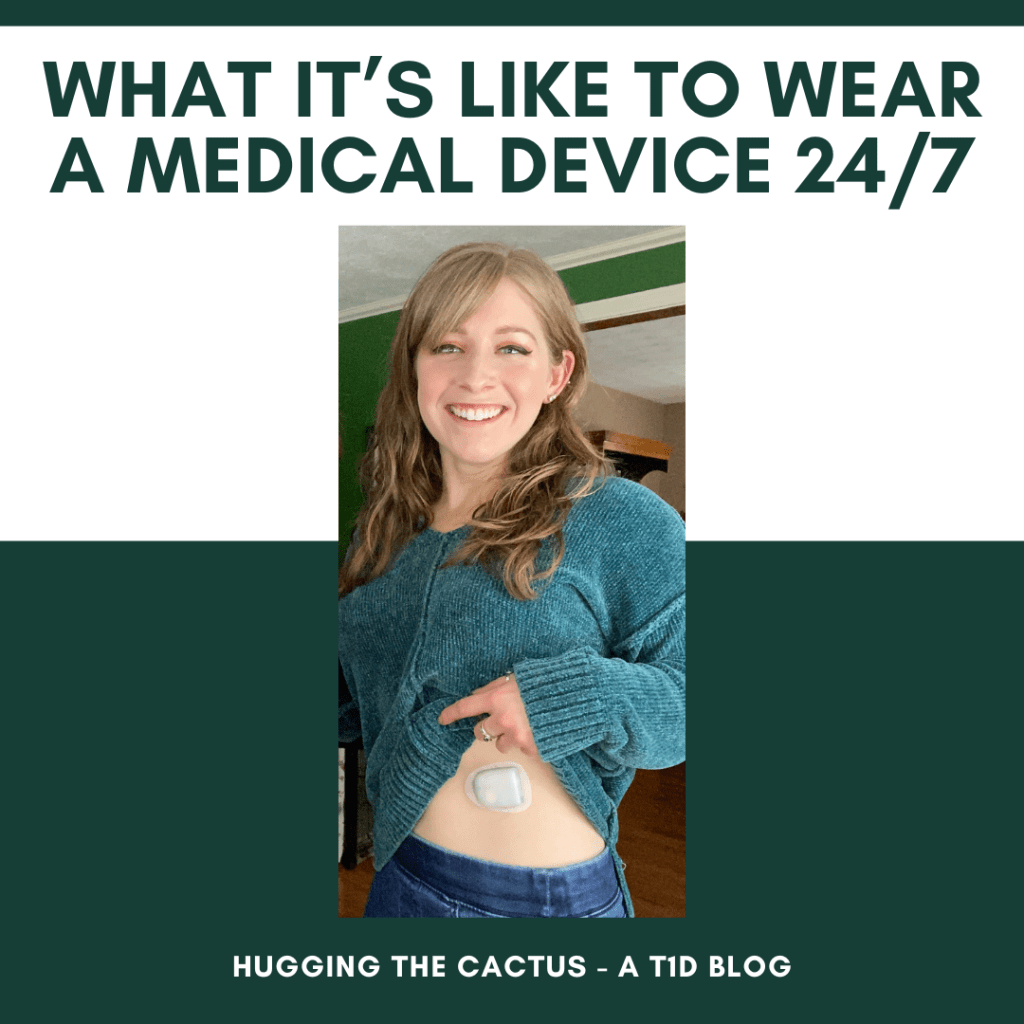
But the more honest answer to that question would be that there are times that I feel it more than others. For example, sometimes I forget where I’m wearing my pump until I hit it against something (I’m a major klutz who constantly runs into doorways and trip over things, almost always managing to catch my pod on whatever it is), resulting in pain at the site and a curse word or two to fly out of my mouth.

I feel it the most, though, when people stare. Whether unconsciously or purposely, people do ogle at it in very not subtle manners. Which makes me feel extremely uncomfortable. It’s worse when they don’t even ask me what it is – I’d rather have a chance to use it as a teaching moment than to have someone walk away not knowing what the device does. This tends to make swimsuit season a little less welcome for me. Nothing will stop me from donning a bathing suit at the beach or by the pool, and I do so as much as possible in the summertime. But it’s just not as fun when I’ve got to cope with lingering looks, especially when I’m an admittedly insecure person in the first place.

So it’s a more complex question to answer than you might realize. Wearing a medical device 24/7 is humbling. It keeps me alive. I’m privileged to have access to it. I’m grateful for the ways it’s improved my life. I’m always wearing it, but it’s not at the forefront of my mind – unless it chooses to make its presence known by alarming, or I’ve got people blatantly checking it out. It’s kind of like diabetes itself. It can make you feel a gamut of emotions, but no matter what, it’s always there. It’s just a part of me, and I can deal with that.
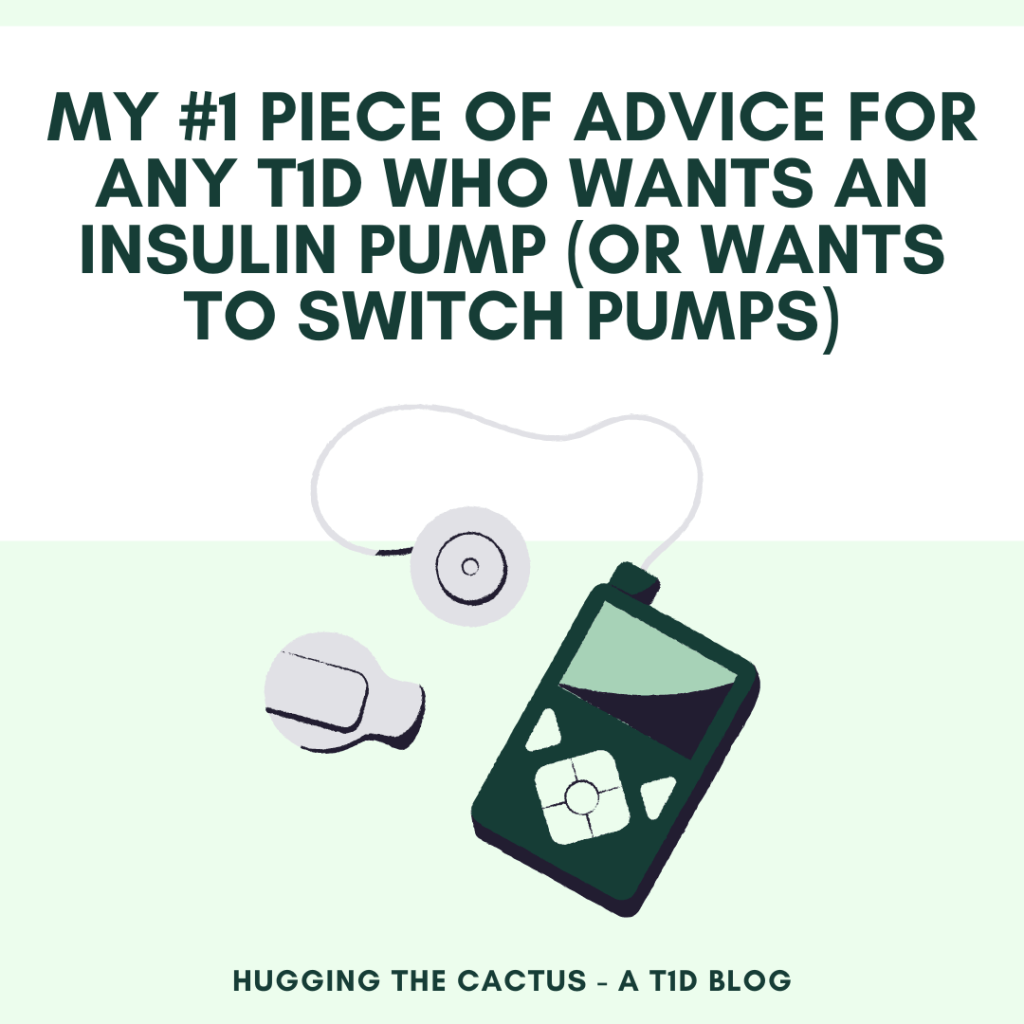

My #1 Piece of Advice for Any T1D Who Wants an Insulin Pump (or Wants to Switch Pumps)

As someone who was so stubbornly resistant to the idea of switching from multiple daily injections (MDIs) to insulin pump for my entire childhood with T1D, I surprised myself quite a bit when I finally decided, around age 21, that I was ready to start using a pump.

And I haven’t looked back since I made that choice – that’s how much of a difference it made for me.

In my almost 10 years of pumping, I’ve realized that there is one, major piece of advice that I’d share with anyone who is looking to make a similar switch, or even go from one pump to another. It doesn’t matter if that person is newly diagnosed, a diabetes veteran, or somewhere in between. Or if a person is a pro at adapting to new technology, or wary of any kind of electronic device… because in my humble opinion, this advice applies to all. So what is it?

Don’t do it alone.

When I started using an Omnipod back in 2015, it was with the help from a team that included my endocrinologist, a diabetes care and education specialist, and a more experienced Omnipod user who I actually lived with – my mother. It was the guidance that all three of these people gave me that ensured a fairly easy transition to pump therapy.

My experience was starkly different when I went on the Omnipod 5 late this past summer. In a word, I was too cocky about it. I thought I knew enough from my prior pod experience, and had enough exposure to all the literature that had come out about the Omnipod 5, that I could make this upgrade just as seamless as it was to start up pump therapy in general. And that was most definitely not the case. I struggled for the first 8-10 weeks of life with the Omnipod 5, and it was such a rollercoaster that I seriously questioned whether or not I’d made the right decision to try out a more advanced pump.

Of course, I don’t regret switching to the 5 – not at all – now. That’s because I did finally get help, first from the nurse practitioner at my endocrinology office, and then from an educator at Omnipod who was really able to explain the 5’s algorithm to me and suggest changes that ended up working wonderfully for me within days of our conversation. It just goes to show that it’s okay to reach out for help when I’m feeling stuck with my diabetes (or when I need it in any other facet of my life, to boot), and I’m here to remind you of that, as well. Don’t do it alone. Lean on your community. Get support from healthcare professionals. And you’ll be amazed by the outcome.

Feelin’ Odd About my Pod

I don’t often perform pod changes in public. This is mainly due to the fact that I’m most comfortable changing my pod in my own home, where I have all my supplies readily available…and more importantly, it’s where I feel safe taking off a pod from an old site and putting a fresh one onto a new location.

So you can imagine the level of unease I felt when I had no choice but to change my pod at my office for the first time since starting my new job.

I did this plenty of times at my last office job, but that was always behind the privacy of a closed conference room door that I could lock and that nobody could see into. This level of discretion meant that I could take my time with my pod changes without worrying about someone seeing me and getting the wrong idea about what I was doing (even I can admit that it looks a bit suspicious to see someone in a non-hospital setting drawing an unidentified liquid out of a vial with a syringe).

Both fortunately and unfortunately for me, my new office space is so modern in its design that every single conference room is encased with glass walls and doors – making it all too easy to peer inside each one to determine whether or not it’s occupied. That’s great for off-the-cuff meetings, but not so much for someone who needs just 5 minutes to change an insulin pump site.

Due to the lack of privacy in my office suite, I had to venture out to the main building bathrooms as a next resort. But I wasn’t just going to use any old bathroom. No, I sought out the one that had what I suspected to be the least amount of foot traffic and also the cleanest sink, because I most certainly was not going to lock myself into a stall to ensure more privacy when changing my pod. Absolutely not. Sure, it would mean that I had the stall door blocking me from view, but it also meant I’d have to change my pod without a table in front of me to put my supplies on, and I wasn’t about to do that because it would virtually guarantee that I drop something on the unsanitary bathroom floor – or worst-case scenario, maybe even break my vial of insulin. I wasn’t about to risk that, so I set about changing my pod at the bathroom sink, keeping my fingers and toes crossed the entire time that nobody would walk in while I was at any stage of the process.

My mission was accomplished; a few moments later, I was rocking a brand-new pod and also marveling over how something fairly mundane (because I do it every 72 hours or so) could cause me such anxiety and make me feel self-conscious about needing to do this medically necessary routine in public. I’m not accustomed to feeling odd about my pod and the maintenance actions I take to keep it running smoothly – and to keep myself healthy, to boot – but there’s a solid, highly realistic chance that I’ll have to publicly change my pod again in the future. Hopefully, I can work on it so that changing my pod, whether within the walls of my own home or in the most public of locations, is something that I feel normal about doing, and worry less about whether or not people are judging me over it.

The Best Laid Plans

You know what they say with the best laid plans…

…something always goes awry with them. It doesn’t matter how meticulously pre-calculated they are, or when/where they take place – sometimes, they just aren’t meant to be.

Such was the case with my Christmas plans this year. (And a partial reason why I’ve fallen behind on my twice-per-week blog posts.)

I know, I know – I had written a whole blog post about how I was going to spend Christmas, particularly Christmas Eve, celebrating my diaversary in the company of my loved ones. And I did…sort of. Except it was just one loved one, who unfortunately had tested positive for it-shall-not-be-named just a day before.

Even though he was entirely asymptomatic – and I was testing negative with at-home test kits and a PCR test conducted by my primary care doctor – we decided it was best to stay away from others and skip out on our highly anticipated Christmas Eve plans with my family. It was pretty devastating, but I’d be remiss if I didn’t count my blessings over the situation. First of all, my partner was feeling great (seriously, it was a completely different experience compared to what we both dealt with when we fell ill with the same condition this past spring) and I was on the road to recovery from a mild head cold I’d been dealing with. Second, we were still able to make the most of the holiday by going for a ride around town to see lights in the neighborhood and ordering sushi to feast upon at home while watching Christmas movies. It was an enjoyable way to spend the holiday, but I definitely missed my family and was a bit heartbroken I couldn’t see all my relatives as I’ve done my entire life, every Christmas Eve.

The only thing missing from the whole ordeal – besides my loved ones, of course – was that I didn’t think about my major diabetes milestone of officially living with diabetes for 25 years, not once, throughout the entire day. My mind was far too preoccupied. But now, in hindsight, it’s serving as additional proof to me that diabetes isn’t always at the front and center of my mind. Sometimes, there are things that take precedence over it. And honestly, that’s a pretty cool thought for me to hold onto, especially on the days where it seems like diabetes is determined to ruin everything for me.

It’s only in charge when I allow it to be. I have ultimate control. I can’t think of a better message to be driven home to me on my 25th diaversary (rather, in the days following my diaversary).

‘Betes and Burns: Playing it Safe

If you told me that I would get a second degree burn on my fingertip from a dish that was in a microwave for a measly 24 seconds, I would’ve laughed in your face.

But then I would’ve apologized immediately to you, because such a thing actually did happen to me a few weeks ago.

The full story isn’t particularly exciting; in fact, it’s as boring as it gets. But for the sake of context…I’d put a tablespoon of butter in a ramekin so I could melt it in the microwave for a recipe that I was making. I knew it would likely take fewer than 30 seconds for it to melt completely, so I stopped the microwave a little early and used my bare hand to take it out. The moment my fingertips met the ramekin, I became acutely aware that the dish had overheated – I couldn’t believe how blazingly hot the exterior was. I dropped the ramekin in the sink almost immediately, but the milliseconds of contact it had with my skin was enough to create a blister on my right middle fingertip that burned painfully for the remainder of the day.

I was quick to put some bacitracin and a bandage on the injury, but reluctant to expose the blister in the ensuing days as I didn’t want to exacerbate the wound (and honestly, it was unsightly, so I was eager to keep it under wraps so I didn’t have to look at it). So I changed my bandage every 24 hours or so, taking care to wash and dry my hands completely before applying a new band-aid.

But roughly one week after the injury occurred, I noticed that the blister was swelling. I peeked at it between bandage changes and saw that it was white and bubbly in appearance – totally gross, but also worrisome as it looked like it might pop should I strike it on any surface in just the wrong way. That’s when I made the executive decision to see my primary care doctor to get a medical professional’s opinion on the matter.

And I’m glad I did. I got confirmation that it was, indeed, a second-degree burn and that I’d done the right thing to keep it covered up. My healthcare provider reminded me that as a person with diabetes, I should do everything I can to avoid infection, so applying antibiotic ointment and keeping an eye on the wound was smart thinking. But I was also advised to remove the bandage when I went to sleep at night so the injury wouldn’t stay super moist for prolonged periods of time (added bonus that I could let it air out overnight while I was asleep so I could again avoid looking at it). More than two weeks post-incident, the burn is healing nicely as the skin grows healthier and I no longer need to wear a bandage over it.

What’s the point of this little anecdote about my kinda ridiculous, definitely painful injury? It’s that it’s always better to play it safe, just as my healthcare provider commended me for doing so. Silly injuries like this happen, but it’s important to roll with them when they do and act accordingly instead of just shrugging them off.

All health matters…well, matter when you have diabetes, and I’ve learned to look out for myself by checking in with my team whenever I’m concerned about something.

It’s More Than a PDM

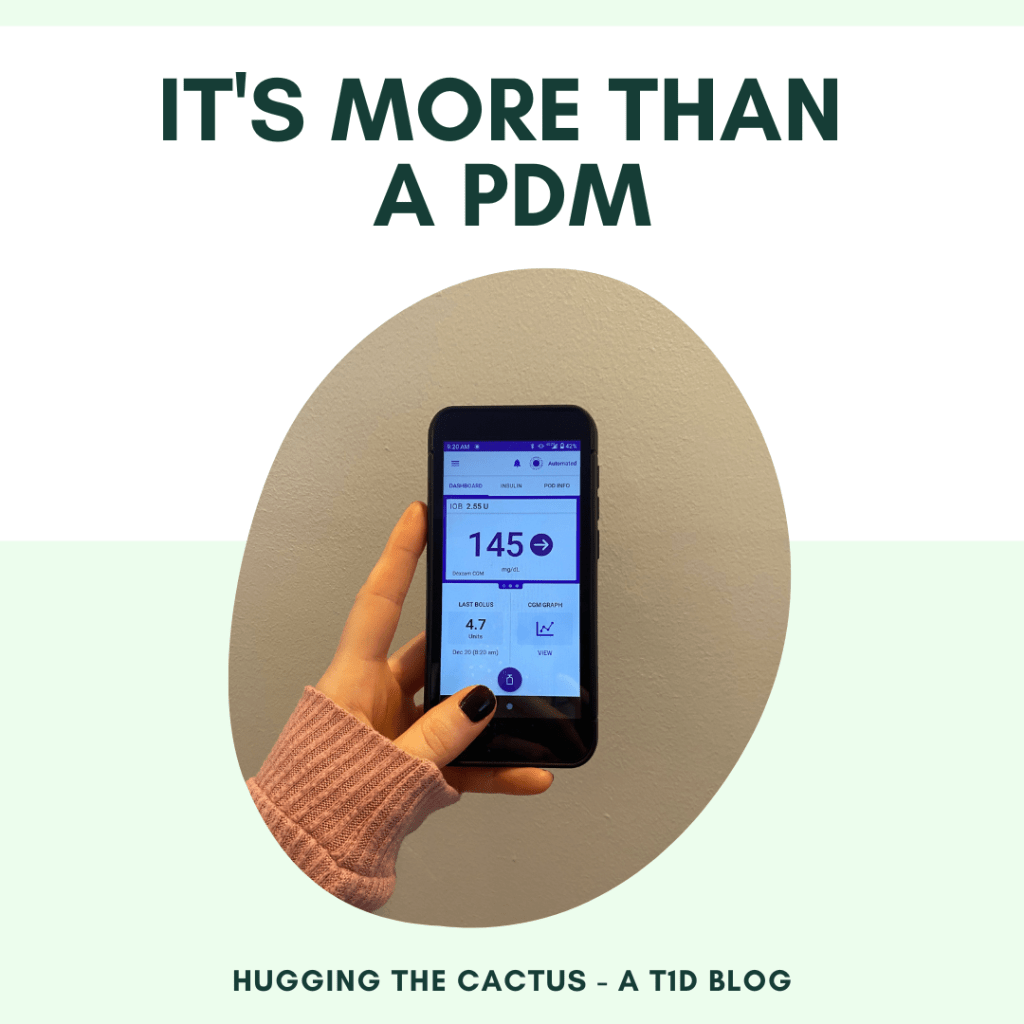
My PDM (Personal Diabetes Manager) is more than just a medical device. It’s basically an extension of my body at this point.

Much like people treat cell phones as a must-have-on-me-at-all-times sort of item, that’s how I feel about my PDM. I carry it (and my cell phone, TBH) around as a small but mighty stack of technology. When I set it down somewhere and struggle to recall where I left it, I panic and can’t focus on anything else until I’ve found it. I make sure to keep the battery charged, and would argue that I get more concerned if the battery is low on that device than I do with my phone. And I’d sooner give my phone over to a toddler to play around with than consider handing off my PDM, even to a trusted family member or friend.

It’s more than just my PDM, it’s a lifeline.

In a world that remains ever-increasingly reliant on technology, there are times where I certainly wish I didn’t have to depend on my PDM so much. It would be nice to not have to carry it around all the time and fuss over it, making sure it’s charged and working properly. But just when I start to grow resentful of the device, I remember how much easier, overall, it’s made my life. It’s given me freedom that I wouldn’t have discovered if I’d chosen to stick to multiple daily injections. I also believe that, combined with my Dexcom CGM, it’s responsible for my improved blood sugars and time in range into my adulthood.

So even though I didn’t exactly wish for a PDM to be an extension of my very being, I’m glad that it is, because it’s proven to be a valuable piece of equipment in my diabetes care toolkit.

25 Years

This Christmas Eve marks 25 years since I was diagnosed with diabetes.

25 years feels like a significant milestone – and that’s because it is. Diabetes has been my “normal” for that entire length of time; I don’t remember what it’s like to live free from its burden.

I accepted that long ago, but still experience some sadness and bitterness over it from time to time. Can you blame me? There are times when I find myself envious of people with diabetes who were diagnosed later in life and have memories that remain entirely unimpacted by diabetes, but when I find myself getting swept up in morose emotions, I ground myself by remembering that (as trite as it may seem) everything happens for a reason. My diabetes story has taken very deliberate twists and turns, whether or not I was aware of them when they were happening. Each and every challenge, all the emotions, and the many experiences and relationships it has brought into my life were bound to happen, and I’m glad that they did because they’ve made me who I am today.

And today, just a few days shy of officially celebrating my quarter-century diabetes diagnosis, I find myself once again being so happy that it’s happening on a day that I will be around so many of my loved ones. I say it every year, but having my diaversary on a major holiday makes the celebration that much more special to me. The day is always more about spending time with my family than it is about diabetes. Instead of sadness, I feel joy in the reminder that diabetes can’t and won’t overshadow Christmas or any other day for that matter.

So here’s to 25 years of a life enriched and uninhibited by diabetes – and many more to come.

Is it Possible to Decentralize Diabetes?

First of all…what does that question even mean? What does it mean to decentralize diabetes?

In this context, I think of it as deprioritizing diabetes (maybe that’s the better word to use here, but let’s bear with me…let’s stick with decentralize). It’s knocking it down a few pegs rather than keeping it as a permanent fixture at the top of my to-do list.

So I guess this question should be phrased less generally – because of course it’s possible to decentralize diabetes – and more specifically target me, as an individual who is solely responsible for her diabetes care and management…

…is it possible for me to decentralize diabetes from my life?

I’m of two minds when it comes to landing on an answer. On the one hand, I can’t really imagine myself ever being successful at decentralizing diabetes. I’m always thinking about it. Every decision I make, consciously or subconsciously, is made knowing that it will have implications (in some way or another) on my diabetes. Even when I’m asleep, I can’t escape diabetes because if it’s not directly impacting my slumber by waking me up, then it’s the first thing I think of each day because I do a blood sugar check the moment my eyes are open.

On the other hand…

I’ve been using an Omnipod 5 since late August/early September and although I struggled to adapt to it until recently, it’s since come to represent what feels like a diabetes reprieve. For the first time in my life, I’m thinking of diabetes a teensy-weensy bit less, and I do think that my newfound understanding of the automated insulin delivery system is directly responsible for that. It’s been scary to relinquish control that I’ve maintained for so long over every aspect of my diabetes routine – and hand it over to a piece of technology, to boot – but it’s finally beginning to pay off. Which reiterates the question: Is it really, truly possible for me to decentralize diabetes and let myself be a person first, rather than a diabetic first?

After writing this post and musing further on the subject, I’d comfortably say…it very well could be. With some more time and heaps of patience, I do think I can get to a point where my whole world revolves a little less closely ’round my diabetes.

It’s the Most Bolus-Worthy Time of the Year

This post has appeared on Hugging the Cactus a few times now over the years. It’s popping up again today because, well, I had fun writing and singing along to this piece. Plus, in light of a couple of Christmas celebrations over the weekend in which many bolus-worthy goodies were consumed, it only felt appropriate to share this post again today...

It wouldn’t be the Christmas season if I didn’t attempt to rewrite a classic Christmas carol…

I apologize in advance for the cheesiness of this “new” tune, but I was thinking about how there are just so many parties, gatherings, and opportunities to eat absolute junk food this time of year. But even though I’m feeling pretty disgusting by the time January rolls around, I don’t regret it because I love everything about this season…so you might say that I think it’s worth every extra unit of insulin I have to take to cover the food I eat, making it the most “bolus-worthy” time of the year.

So naturally, “It’s the Most Wonderful Time of the Year” was the perfect song to redo for this blog post.

I sprinkled in references about questions that people with diabetes commonly get, as well…because with all the time that’s spent with family and loved ones, they’re bound to come up again just as they do year after year.

Without further ado, here is my rendition of the song…please feel free to read (sing!) along to the tune of the original – it makes it so much more fun, trust me!

It’s the Most Bolus-Worthy Time of the Year

It’s the most bolus-worthy time of the year
With the Dexcom CGMs yelling
And everyone telling you “what’s that I hear?”
It’s the most bolus-worthy time of the year

It’s the ca-carb-iest season of all
With those holiday sweets
And so many treats when friends come to call
It’s the ca-carb-iest season of all

There’ll be parties for pumping
Temp basals a-bumping
And answering the same old,
There’ll be “can you eat that?”
And all that chit-chat
You can’t help that your eyes rolled

It’s the most bolus-worthy time of the year
There’ll be so much indulging
And insulin will be flowing when goodies are near
It’s the most bolus-worthy time of the year

There’ll be blood sugar for checking
Marshmallows for correcting
And sensors and sites to change
There’ll be silly relatives’ questions
And answers in your irate expressions
They should know by now ‘betes isn’t so strange

It’s the most bolus-worthy time of the year
There’ll be so much indulging
And insulin will be flowing when goodies are near
It’s the most bolus-worthy time
It’s the most bolus-worthy time of the year!

How I Handle my Diabetes During the Holiday Season

It may be the most wonderful time of the year, but my diabetes doesn’t necessarily agree with that sentiment.

In fact, this December 24th (yep, Christmas Eve) marks my 25th year of living with diabetes – crazy thought, right? I’ll have a dia-versary reflection post ready later in the month, but for now, I find myself thoroughly immersed in the overall spirit of the holiday season.

And with that immersion comes a certain level of strategizing. After all, several of the days leading up to and including Christmas are fraught with a variety of celebrations – some more diabetes-friendly than others. For example, a blood-sugar friendly Christmas activity for me is shopping for gifts in stores, as I can spend a handful of hours walking around and keeping my level nice and steady. Conversely, seasonal staples that are decidedly not conducive to my diabetes/blood sugars are the annual cookie swaps (yes, I have more than one that I go to) hosted by family and friends, as well as just about any type of holiday gathering (whether it’s an office party or gift exchange with my two childhood besties).

So in light of the upcoming festivities, I’ve found myself thinking about what’s worked (and what hasn’t) in terms of making the most of the holidays without letting my diabetes interfere – or suffer. Here’s my general game plan for accomplishing that, loosely inspired by Christmas carols…because I couldn’t resist the chance to put a seasonal spin on this how-to post:

  • Have Yourself a Merry Little Pre-Bolus (or pre-bolusing to help ensure more balanced blood sugar levels) – If there’s one tried-and-true technique to keeping my blood sugar levels more stable throughout the many decadent dinners and desserts I consume this time of year, then it’s pre-bolusing. Taking insulin 15-20 minutes before I actually start eating food can be tough to remember, but it pays off big time, particularly when I’m eating foods that I don’t typically have otherwise. So pre-bolusing is perfect for avoiding crazy blood sugar spikes and, in turn, keeps me very merry indeed.
  • Dexcom the Halls (or don’t be afraid to talk to others about diabetes loudly and proudly) – It’s interesting how the holidays bring you closer to both those you know well and those who are total strangers, by way of various gatherings. I know that I’ll be spending at least a couple of holiday parties in the company of people I’ve never met before, and I know I won’t hesitate to talk about my diabetes if it comes up organically or if people are curious about the devices adorning my body. In fact, from experience it can be a pretty good talking point when meeting people for the first time, so I won’t try to hide my diabetes from anyone this holiday season and embrace every opportunity to answer questions about it.
  • It’s Beginning to Look a Lot Like a Pharmacy (or stay prepared with back-up supplies) – Honestly, nobody wants to have to worry about running out of essential medical supplies any time of the year, but least of all during the holidays. So I like to keep back-ups of my back-ups on hand so I don’t have to stress about ordering more supplies or waiting for them to show up in the mail along with all the Christmas presents I’ve ordered.
  • I Saw Molly Eating All the Carbs (or enjoying every treat with minimal diabetes guilt) – This is arguably my most important holiday how-to, and it’s all about remembering to enjoy every little part of this special time of year. It’s such a short window of time that’s filled with so many celebrations (and treats) that it can be easy to get caught up in guilt over indulging in everything or putting diabetes on the backburner for a couple of weeks. But I’ve found that it’s easier to cope with both of those as long as I keep everything in perspective by reminding myself that the holidays fly by so I might as well just enjoy them for what they are rather than putting any sort of negative spin on them. It’s a lot more fun that way!