Sudden as Lightning

It was as sudden as lightning, when it streaks across the sky just before the rain begins to fall, signs of a storm that that refuses to go unseen or unheard.

“It” being the sweat that began to bead on my forehead, then trickle down fast and furious as I grew more and more aware of a low blood sugar episode.

One moment, I was sitting cool, calm, and collected. I was alert and engaged in the conversation happening around me. And then boom, the sweat started and my concentration on my surroundings ended. Voices grew more distant as I honed in on my outward appearance. Panic struck – could others see how sweaty I was getting? Were they noticing my incessant fidgeting, a coping technique I have when my blood sugar drops and I get paranoid about maintaining an air of everything being just fine? My foot, already jiggling up and down as part of my fidget routine, seemed to pick up the pace as I began to get a grip on the reality that I needed to do something about this low before I further deteroriated.

The door to the room opens. I dart out, walking briskly down the hallway to where my low blood sugar supplies sat waiting for me. I gobble down a pack of fruit snacks as quickly as possible, and then force myself to sit. The sweat’s gotten worse and I worry about it being visible on my clothing. Seconds melt into minutes, somehow, though I pay them little attention as all I can think about is having this low blood sugar episode end, please please please, as soon as possible. I desperately want to escape to a restroom for privacy (and to mop the sweat off my body), but I’m immobilized by the low and also slightly nervous that it’s major enough that I might need help from someone in the vicinity so it’s a terrible idea to isolate myself from others. I push that thought out of my mind – I just need to give the fruit snacks some more time to work, that’s all. Keep it together, you’ve got this, stop freaking out so mu-…

…and just as suddenly as it had struck, the sweat dissipates. My shaky hands steady themselves. I regain an awareness of my environment. I exhale, relief flooding throughout my body as I realize that I’m recovering from the low.

Sudden as lightning, both in how it had struck and then how it had disappeared, leaving hardly any trace that it’d been there at all.


Why I Can’t Commit to Keto

As an ardent lover of all types of carbohydrate-packed foods, I can say with almost 100% certainty that I could never commit to a keto diet.

Before I dare to delve even deeper into that train of thought, let me just say that I know plenty of people with diabetes who do follow a keto diet successfully. It’s what works for them. And that’s wonderful! Truly, I know firsthand how difficult it can be to find a nutrition plan that cooperates with diabetes, and that just because one plan works well for one individual does not mean that it will work the same for others. In a nutshell? You do you, and I support that.

Okay, now that I’ve got that out of the way – let’s get to the root of the matter.

It’s not just my utter adoration of carbs that would cause me to struggle on a keto diet. Absolutely not. In my years of relatively light research on the keto diet (which consists of many conversations I’ve had with strict followers of it, as well as my social media lurking on pages plugging keto), I’ve learned that just about all carbs can be replaced by a keto version: You just have to get creative and have keto-friendly ingredients in your kitchen cabinets. So I’d find solace in knowing that I could always bake low-carb muffins, bagels, pizzas, cakes, and the like as long as I had a good recipe and the proper ingredients on hand.

The real reason that I’d totally fail at a keto diet is that I have a hard time with self-control when it comes to 0 or minimal-carb treats. I actually go to town on them. Since I know that I don’t have to bolus for something with low or no carbohydrates, it’s like they become “free” foods to me, meaning that I can eat as much as I want without having to worry about the consequences…which may or may not impact my blood sugar, but which definitely could affect my waistline.

In other words, I have a difficult time remembering that just because something has 0 carbs, it doesn’t mean it has 0 calories.

During the short-lived (think 3 days at a time) keto phases of my life, I found myself eating more and more. Since I was deprived of carbs, I felt entitled to consume more keto foods than I actually needed. My blood sugar may have benefited overall, but it was not at all necessary to be mowing down on all the keto-friendly treats (think keto ice cream, keto cookies, keto bread) that are out there and available to me. I didn’t recognize it right away, but when I did, I realized it came down to my lack of ability to exercise restraint as well as acknowledge the difference between carbs and calories as both a person with diabetes and a person who aims to maintain a particular caloric intake.

So when it comes to keto, it’s a no-go because I finally understand how it impacts my relationship with carbs and calories. I’ll stick to what has generally worked best for me in my 25 years of diabetes, which is a classic: everything in moderation.

Battling ‘Betes

One thing that I love about Hugging the Cactus is that it encourages me to check out other diabetes bloggers’ content. It may be more difficult to come by these days, as most diabetes content on the Internet can be found on Instagram and TikTok, but I’ll always enjoy the written word format (and can definitely appreciate the time and energy put into a single blog post).

Plus, I’m always struck by how other diabetes bloggers are able to articulate some of the complex emotions around diabetes, in ways that I’ve struggled to do but certainly have been able to relate to.

Take, for example, Renza’s recent post about her personal battle with diabetes.

I won’t do it justice – you should really read the full post here – but in sum, Renza talks about how words that invoke battle are used widely across the diabetes community (think “warrior”, “fighter”, “army”, “challenger”, etc.). We are asked – no, demanded – to wage a war against diabetes in rhetoric all over the place, meaning that we must always fight to maintain “ideal” blood sugars, A1c, time in range, and all the other numbers associated with diabetes. But as Renza puts it, no matter what the metrics may be, diabetes remains. There’s no way to defeat it, which makes militarized language around the matter that much more infuriating and paradoxical. What a massive burden to place on the shoulders of a person living with diabetes, to ask them to fight with all their might against an enemy that can’t literally be defeated…but one that perhaps is open to a resolution of sorts.

To quote directly from Renza’s post, because she said it best:

“To be at war with diabetes is to be at war with myself. I can’t divorce myself from my diabetes – it is me and I am it. We are a tag team, a group package, a two-for-one deal. I don’t get a say in that, and no one else does either, no matter how much they implore me to fight.  

It’s not a battle with diabetes that I need. In fact, it’s the complete opposite. It’s finding peace. That’s what I want to work towards – a peaceful existence that doesn’t add more burden.”

Renza Scibilia

I had never thought about it that way before, but as I continued to read Renza’s post, I marveled more and more over how she was able to put into words a feeling that has gnawed at me for many years now about trying to win a never-ending war against diabetes. Why should I be so focused on winning, when it’s more so about learning to live in a peaceful coexistence with a condition that I know is here to stay (until we get that cure in 5 years, wink wink)? Why just accept that I am fighting an unrelenting fight, when in reality it will take much less of my valuable time and energy to seek harmony with diabetes?

Thank you to Renza for such an honest, insightful, and surprisingly optimistic post that challenges conventional thinking about the “fight” against diabetes.

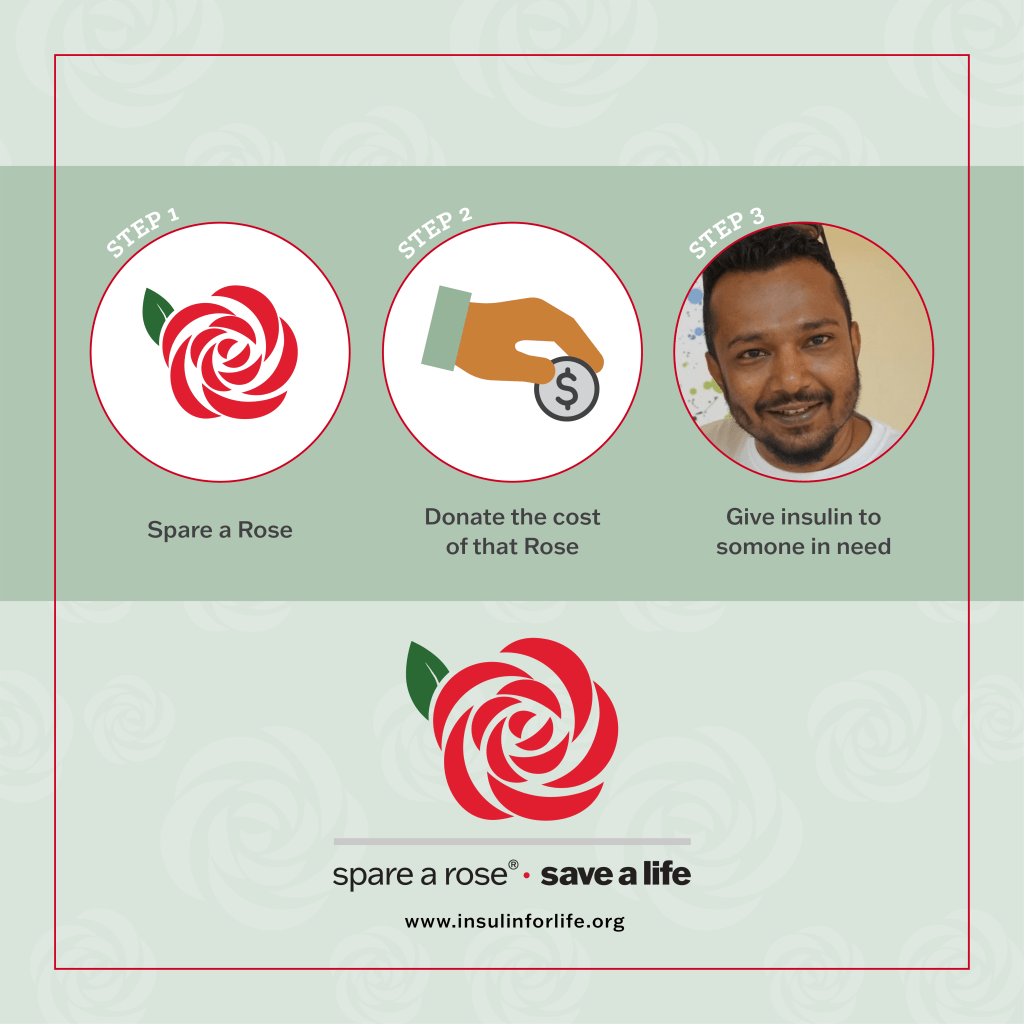
Spare a Rose and Save a Life this Valentine’s Day

Valentine’s Day is tomorrow. Whether you love or loathe the day, it’s an occasion that’s synonymous with chocolate, love, and flowers; more specifically, a dozen red roses.

A dozen red roses is a classic Valentine’s gift. But what if you received 11 roses in your bouquet, instead of 12? What if you knew that a rose was spared because the value of that flower helped provide insulin to someone who needs it to live?

I bet you wouldn’t mind getting one less rose in that case. And it might just make you like the holiday a little bit more!

A little bit of history: Nearly 10 years ago, folks from the Diabetes Online Community (DOC) started the Spare a Rose campaign for the organization Life for a Child. This campaign was able to give insulin and diabetes supplies to children and young adults with T1D in under-resourced countries. Last year, these individuals looked at how they might be able to support all people with diabetes, seeing as the need for insulin and related supplies and care lasts well beyond childhood.

Thus, Spare a Rose, Save a Life was born! Donations to this campaign go to Insulin for Life, a charity that provides resources, education, and advocacy to many of the same under-resourced countries that were supported by the original Spare a Rose campaign.

It’s an absolutely wonderful idea that will positively impact – and save the lives of – even more people living with diabetes who need access to vital medication, supplies, and healthcare.

I’ve written about the Spare a Rose campaign here on Hugging the Cactus for years now because it’s a beautiful way to celebrate a day that makes some swoon and others sick to their stomachs. A common complaint among people in this day and age is that too many holidays are all about raking in the dough for companies like Hallmark; in other words, most holidays have lost their original meaning and have become too commercialized.

So here’s your chance to bring back some significance to Valentine’s Day. In the light of the health challenges the world has collectively faced in the last couple of years, it’s more important than ever that we do all that we can to help people with diabetes access life-saving supplies and care.

Learn more about Insulin for Life, Spare a Rose, and donate here.

Tingly

I knew something was wrong when my tongue inexplicably began tingling.

It was a sudden, prickly sensation – almost like I had pins and needles on my tongue. (This is a sensation I get in my feet when I’ve had them in a certain position for too long and I need to get the blood flowing properly again. A quick Google search taught me that just about anyone can experience this, so odds are you already know what I’m talking about.) And it lingered for a solid 20 minutes, making my entire mouth feel as though it was simultaneously numb and on fire from the unrelenting feeling.

This is my new(ish) low symptom: tongue tingling.

And I hate it.

It only seems to occur when my blood sugar hits the 50s or 60s, which doesn’t happen too often. But when it does, it hits me so abruptly that it catches me off guard every time. It’s an unpredictable phenomenon – usually, my first sign of a low blood sugar is feeling shaky/sweaty/dizzy. Once I feel those initial signs of a low, I’m pretty good about being quick to do something about it by grabbing something sugary to eat…and when tingly tongue strikes, it can make the entire eating experience unpleasant because it almost feels like I’m having an allergic reaction to my low snack. And it lasts longer than it takes for my Dexcom to pick up on a recovering low blood sugar.

I’ve genuinely been worried that I was having an anaphylactic reaction in addition to a hypoglycemic event, prompting me on more than one occasion to run over to the closest mirror to check and make sure that my mouth and face aren’t swelling up or turning red. Let me tell you, it’s enough to deal with the low blood sugar sensation – feeling like I’m having an allergic reaction on top of that makes a normally easy-to-deal-with low that much, well, suckier, to be blunt about it.

I classify it as only sorta, kinda new because I’ve dealt with something similar in the past. In fact, roughly 4 years ago, I wrote about “a fuzzy towel tongue” feeling that I experienced after a low blood sugar. It’s funny that I wrote about it because I think at the time, I only ever felt that a handful of times, and the symptom seemed to disappear. But now, it’s apparently back with a vengeance, as the tingling feels much worse now than the numbness I’d felt a few years back.

At least I know that I’m not alone. I’ve talked to my fellow T1D mother about this and she’s also experienced it, in addition to the folks I’d interacted with in the context of my original post on the matter. It might not be fun, but there’s (quite literally) strength in numbers.

My Thoughts on the Discontinuation of the Omnipod Eros System

Too soon.

Those were the first words that came to mind when I learned that the Omnipod Eros system – the one that comes with a bulkier, non-touchscreen PDM – was going to be discontinued at the end of this year. (You can get more information about this decision here.)

Now, you might be wondering why I’d have that reaction, especially considering I haven’t been on the Eros system in over two years. And when I am fully aware of the fact that the Omnipod Dash and 5 systems are out, available, and the latest/greatest offerings when it comes to pump therapy from Insulet.

The main reason why I think it’s too soon to nix the Eros system? It’s because of how it affects choice. By discontinuing it, this means there’s one less option on the market for people who are interested in Omnipod’s tubeless insulin delivery. Not so much in terms of the pod itself, as that design has largely remained unchanged as Insulet innovates products over time, but certainly regarding the PDM device.

It goes without saying that the Eros PDM is clunky, uglier, and overall out-of-date compared to it’s newer counterparts. The Eros PDM is a behemoth in size that relies on AAA batteries to keep it running and features chunky buttons that need to be firmly pressed in order to navigate from one screen to the next. Meanwhile, the Dash and 5 PDMs are sleek, touchscreen models that can be charged just like a cell phone. So I can’t deny that the Eros looks like it’s from the Stone Age when comparing it to the Dash and 5.

But this is actually favorable to some people. One thing that kept me from transitioning to an insulin pump for a long time was that I didn’t want to feel super attached to yet another physical piece of equipment I’d have to carry around; at that point in my life, I was already toting around my phone and separate CGM receiver (this was pre-Dexcom app days) everywhere I went. When I finally did start using the Omnipod Eros, it took time for me to get used to the PDM, but I came to appreciate it for its distinct heft, and could quickly and easily grab it from my bag without really having to look for it due to its size.

I liked my Eros PDM so much that I have more than one image of myself holding it up in my photo archives…

Now, I constantly get my PDM and cell phone mixed up – sometimes, I even go to text someone from my PDM, only to realize after I unlock it that I grabbed the wrong device. And I hate that I have another piece of tech that needs to be recharged so frequently. I monitor the battery life all the dang time, and have to plug my PDM in every few days to fully recharge it, whereas with the Eros all I had to do was swap out the batteries every 3 or so months. It doesn’t sound like that big of a deal, but I already have so much to monitor when it comes to my diabetes that I sometimes resent that I have to also keep an eye on the technology that’s supposed to help me simplify my management.

Moreover, a reason why the Eros PDM was so bulky was that it also doubled as a blood sugar meter. Admittedly, I scarcely ever utilized it as such, but it was always nice to know that I had the option of doing so if I wanted. Since the Dash and the 5 PDMs are essentially repurposed smartphones, the blood sugar meter function isn’t available on either, and I know this is probably a bummer to some people with diabetes who preferred using the PDM device as an all-in-one type of technology.

So while I get the decision to encourage more folks to upgrade to newer Omnipod systems, I’m also a little bummed for the individuals who were deliberately postponing that move, or not wanting to make it in the first place. I can totally relate to not feeling ready to make a diabetes tech change-up; after all, I waited almost 15 years of having diabetes before I even thought about trying an insulin pump. I benefited from being able to make that transition when I felt ready, and I just feel that it’s a shame that others won’t be able to do the same due to the pending discontinuation of the Omnipod Eros.

Girl, Interrupted (by Diabetes)

A packed conference room. A Dexcom alert due to a low blood sugar. A girl, interrupted as she tries to reconcile what her diabetes demands and what her professional responsibilities required her to do.

A girl, interrupted by diabetes.

Oh hey, I am that girl, and I found myself in this precise scenario when I attended in-office training for my job.

It was just after noon and I was rebounding from a high blood sugar that I’d dealt with earlier in the day. We were going to break for lunch at any moment, and it wasn’t like my blood sugar was tanking – it was holding steady around 65-70 mg/dL. But it was enough to disrupt my concentration on the work presentation and throw me off-guard.

It’d been quite some time – years, honestly – since I found myself dealing with the stress of a low blood sugar in a room filled with people, most of whom I didn’t know. Likely, it hadn’t occurred since I was at my last office job. But it didn’t really matter how long ago or when, precisely, it happened – all I could think about was, how the heck did I manage lows before in workplace meetings that I couldn’t easily excuse myself from?

It might sound like I was overcomplicating matters – I could just get up and excuse myself from the room while I found a snack to treat the low – but one shortcoming that’s followed me about my diabetes and my professional journey is that I like to keep all diabetes matters as low of a priority as possible during the workday. Of course, I take care of myself by making sure I eat regularly and keeping extra supplies on-hand, but I don’t always correct my blood sugar as quickly as I might normally when I’m somewhere else, such as home. I don’t know if it’s my determination to prove to my colleagues that diabetes doesn’t interfere with my workflow or some factor that gets in my way, but I know enough that I’m able to admit that it’s a slight issue for me that I ought to work on.

So when I began to feel the shakes of an oncoming low blood sugar, that was confirmed by a buzzing Dexcom, I found myself toying between two choices: 1) Either I could excuse myself from the conference room and grab a snack, or 2) I could power through, as there was likely 20 minutes or less remaining in the session. As I deliberated, anxiety slowly crept in as I started imagining nightmare scenarios in which I passed out in front of my colleagues. That’s when *ding* the lightbulb went off over my head: I remembered the hard candies I’d pocketed earlier in the day, which I’d intended to be a bit of a post-lunch treat but then realized they’d work great as a smaller-scale low treatment just when I needed it.

I popped one in my mouth and spent the next 15 minutes doing my best to immerse myself back into the training, while also taking a moment to acknowledge that I’d made a mountain out of a molehill in this situation. I don’t need to feel so self-conscious when minor diabetes-related issues happen, whether I’m at work or anywhere else. The most important thing is that I take action in a timely manner, so I can prevent more severely disruptive scenarios from happening.

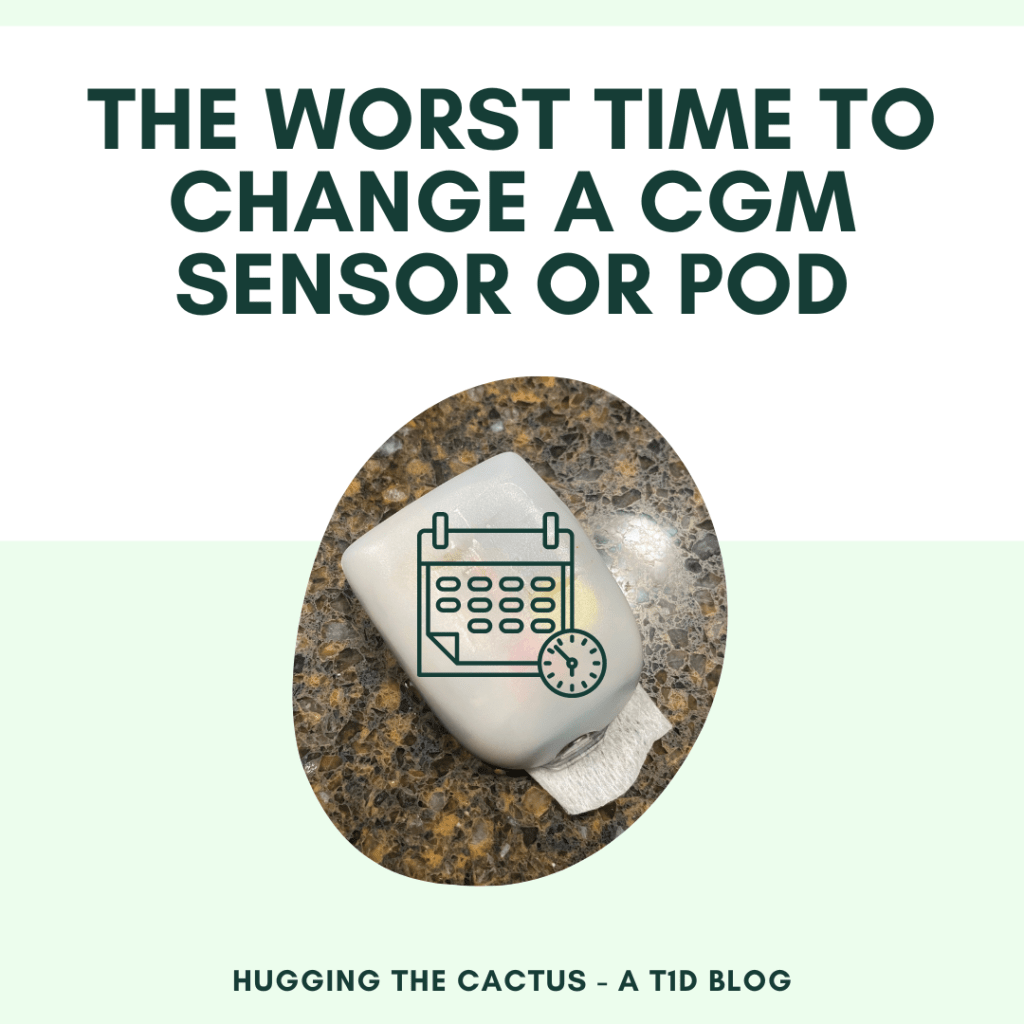
The Worst Time to Change a CGM Sensor or Pod

I’m not kidding when I say I think I’ve definitively identified the worst possible time to change a CGM sensor or pod – of course, I can only speak to a Dexcom CGM sensor and an Omnipod, so it’s probable that the worst time to do a site change may vary depending on the specific piece of equipment being used.

But I’ve learned from my own experiences that the worst time to do a site change is within a one-hour window of taking a shower.

Unless you want your pod to fall off and look sad like this one, maybe avoid changing it before taking a shower.

This is because I’ve found that the sensor or pod adhesive needs a solid block of time to firmly adhere to my skin. If I shower soon after completing a site change, I can almost guarantee that the heat and steam from the shower will be enough to dissolve the adhesive and cause the sensor or pod to fall off.

I’ve played around with the timing, too, and I’ve discovered that the more time I put in between a site change and shower, the better – an hour seems to be the absolute minimum. It can be a little inconvenient in the times that I have to forgo my CGM data for a longer period than I’d like, but my goodness, is it wonderful when the stars align and I can take a completely device-free shower. This doesn’t happen often as my sensor and pod change days don’t usually happen on the same day, but it’s undeniably a nice break when it does.

So, there you have it – a word of caution from me, a semi-pro CGM and pod wearer with about a decade’s worth of experience wearing both devices – the worst time to undergo a site change. A pod or CGM failure almost always can’t be helped, but I think it’s worth knowing how to prevent the likelihood of one or both of them needing to be replaced sooner than expected.

Sluggish

Pasta for lunch. I knew it was a gamble, but on a snowy Friday afternoon when I had a bowl of leftover spinach-stuffed ravioli in the fridge that was begging to be heated up, I simply couldn’t resist it.

I took a larger-than-usual lunchtime bolus to account for the heavy carbs. Or at least I thought it’d account for the carbs. But I was way off. Roughly 45 minutes after I gobbled up my meal, my blood sugar was beginning to take off – with no sign of a smooth landing in sight.

Not that I noticed. Rather, I found myself feeling…slow. My eyes felt droopy with a gradual drowsiness that I couldn’t fight off. Normally, this would feel quite pleasant, especially if I was about to take a nap. But on a Friday afternoon, when I had some work items to wrap up, it was far from a welcome sensation.

As I sat there, staring blankly at my monitor and pretending I couldn’t hear my buzzing CGM that was trying to alert me to the current state of my blood sugar, I was falling deeper and deeper into a state of utter sluggishness. I craved the warmth emitting from my space heater by my desk, relishing how the heat lulled me into listlessness.

In that moment, I was the human equivalent of a happy little slug, oblivious to the realities around it and going about life at my own passive pace, without a single other care in the world.

A representation of me as a slug in a high blood sugar stupor, complete with pod.

I don’t remember what caused me to snap out of my stupor – perhaps I’d heard my CGM vibrate one too many times, or maybe common sense jolted me into realizing that I had stuff to do and couldn’t afford to be overcome by this sensation. But I did find myself peeking at the number that my Dexcom was reporting to me and being somewhat appalled by my hyperglycemic state, as well as being almost grateful for having a logical explanation for why I’d turned into a slow-moving shell of a person. It’s funny how even after 25 years of diabetes, a high blood sugar can still throw me off my game in such a dramatic way. Luckily, a solid correction bolus, change of scenery from my overly cozy desk in my bedroom to the cooler comfort of my downstairs setup, and a large bottle of water brought me back down to where I needed to be – maybe a bit more slowly than I would’ve liked, but hey, a slug can’t complain about swiftness (or lack thereof).

An Almost Seamless Transition

Small blessing. A stroke of luck. Straight-up good karma. Whatever it was that made 1) my overall transition to a new healthcare plan and 2) my receipt of all my necessary diabetes medications and supplies so completely smooth this month, I’m extremely grateful for it – and kind of amazed that it all went so well.

See that above block of text, folks? It’s the reason why you don’t finish writing this type of post until you know exactly what’s gone right and wrong in the transition to a new health plan.

You see, I was counting my chickens before they hatched because, well, things really did go superbly when I refilled some of my essential diabetes medications. I was blown away by how easy it was to obtain my Omnipod 5 pods and my insulin, and even more so stunned by how much my plan covered for both. In fact, I can’t remember a time in my life that I had to pay so little for a 90-day supply of insulin, and for that I remain extremely grateful and very aware that not all people with diabetes have the same experience.

However, getting ahold of sensors and transmitters for my Dexcom G6 was another story. When I told my doctor’s office about my new health plan, I also provided them information from my prescription and health ID cards that they would need in order to get my prescriptions refilled. They took care of contacting my new mail order pharmacy (OptumRx), who sent me my pods and insulin in a timely manner. When I didn’t see any updates from them regarding my Dexcom supplies, I took it upon myself to log into their patient portal and see what kind of information I could uncover there.

I realized that I had a balance to pay for my insulin, so I did that and saw an option to order more Dexcom supplies. Fantastic! Or so I thought. When I hit “submit order”, I was brought to a page on the website that showed me the newly generated order status for my Dexcom supplies…as well as an order total. And that order total was nearly $2,000.

That couldn’t possibly be right…was my first thought. My second thought was to call OptumRx directly and ask if additional information was needed before the order was processed. Maybe my doctor’s office needed to submit a prior authorization in order for me to get my Dexcom at a lower cost. Maybe the system miscalculated. Maybe my Dexcom really would be this expensive under my new health coverage, at least until my deductible was met. Whatever it was, I vowed right then and there to get to the bottom of it so I could get by knowing that I’d done my due diligence on the matter.

One 10-minute phone call later, and I had an explanation: For some reason, OptumRx had duplicated my account information. The representative that I spoke with didn’t really elaborate on this; rather, she muttered here and there as she seemingly went through my data and cleared out information that was repetitive or irrelevant to me and my needs. By the end of the call, she was reporting that my Dexcom sensors and transmitters would cost me roughly $500 for a 90-day supply (infinitely better than 2 grand) and she processed the order so I’d receive everything in just a few days. Finally, just about three weeks into the new year and my new health plan, and I was on track to have all the diabetes supplies I need. Those three weeks are nothing compared to what I’ve dealt with in the past, but it definitely felt like a long time considering all the uncertainty and nerves I felt about costs.

Ultimately, I suppose that my almost seamless transition will serve as a reminder to be appreciative when things go in my favor, and to enter into full-on detective mode when they don’t so I can get what I need, when I need it. And I guess it doesn’t hurt to try and remember that having a back-up supply of all major supplies on-hand at all times can be an absolute saving grace. In this particular scenario, it’s the reason why I never really panicked because I knew that I had a reserve to fall back on, and that I wouldn’t let it deplete until I had all my ducks in a row for replenishing it.