The Holy Grail of Glucose Tabs

I feel a desire to share with the world that I’ve found it.

Erm…what is “it” though?

Why, glucose tablets, of course. Not just any old glucose tabs. I’m talking about glucose tabs that are actually delicious. The kind that are obviously effective and can quickly raise low blood sugar, but that are also so tasty that I sort of want to eat them by the handful out of the jar.

I’ve got your curiosity piqued now, don’t I?

Well, then, I’ll let you in on the secret “holy grail” glucose tabs that I’ve been enjoying…
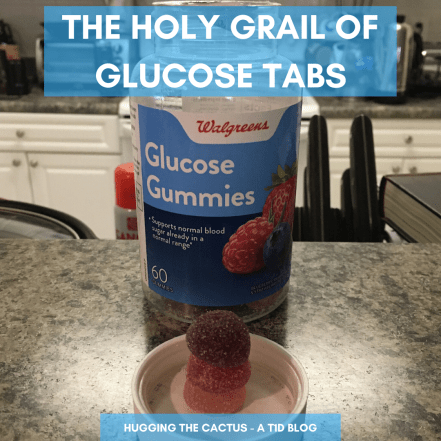
The holy grail of glucose tabs.png
I never thought I’d do a mini photo shoot for glucose gummies, but then again, I never thought I’d do a lot of the weird things I’ve done in my life so far.

Spoiler alert: They’re not technically tabs; in fact, they’re gummies.

I’ve written about glucose gummies in the past and it’s safe to say I was fairly underwhelmed by them. They had flavor and texture issues, and ultimately, they were pretty disappointing. I’d counted on them to change the glucose game, but this rendition of Walgreens-brand glucose gummies totally failed to do that.

So a few months ago, when I noticed that Walgreens had given their glucose gummies a makeover, I figured I’d give them one last chance to impress me.

And SWEET SUCCESS, THEY DID IT!

There are some similarities between the old and new gummies; namely, three gummies has 10 carbs…just under the amount of carbs that are usually in three standard glucose tabs. The old and new gummies are both also covered in sugar crystals (I’m not sure if that’s intended to make them look appetizing?). Otherwise, they couldn’t be more different from one another in terms of color, shape (old gummies were ring-shaped, new gummies are kind of gumdrop-shaped), and obviously, palatability.

What’s different about the gummies this time is that they improved on every major complaint I had about the previous version. The best, biggest improvement had to do with texture. Previously, the gummies were stale and difficult to chew quickly. These new gummies are very soft and don’t leave you with that sticky teeth feeling that’s typical of most gummy candies.

The flavors are also much better. Before, the gummy flavors were super artificial tasting. The grape, orange, and apple flavors were almost medicinal and hardly tasted like their genuine counterparts. Now, the gummies still come in three different flavors, but they’re all of the same variety: blueberry, raspberry, and strawberry. The mixed berry combination just works here. There’s no odd after taste and, when eaten together, a three or four gummies at once just tastes like a small handful of conventional gummy candy. Not my personal favorite kind of confection, but it definitely is much more appealing than regular old glucose tablets.

Maybe I’m overselling Walgreens’ glucose gummies version 2.0, but really, after 22 years of diabetes, there are just some things that are worth getting excited about…even if they seem insignificant in the grand scheme of things.

The Surprise A1c

I started out 2020 with an A1c that surprised me. It was a good surprise: Anything under 7 is a win in my book.

I won’t specifically say what the number was, because I don’t really believe in doing that and I fear that it will invite unwelcome judgment and/or comparisons. But I will celebrate that achieving this A1c was far from easy. It’s required a lot of work from me in the last few months, which have generally been a very turbulent period of time for me.

It seemed like the “diabetes gods” were really testing me in the latter half of 2019. From a month of unexplained highs to random incidents of technology failing me, I felt like I was being put through the wringer. I felt like a failure on just about all diabetes fronts, and it seemed like my efforts to maintain my desired blood sugar levels were fruitless.

Hey, Handsome
More than one surprise came with an unexpected A1c result.

So that’s why I could hardly believe my current A1c reading. Maybe it seems even more impossible to me because I didn’t even get to discuss it with an endocrinologist. In fact, I never got to talk to my new endo (the one I may or may not continue to see) about any of my A1c goals. Doesn’t that seem kind of effed up? Shouldn’t my doctor want to know what I hope to accomplish, in terms of my diabetes, in the next 3-6 months?

In that regard, this A1c has surprised me in more than one way…it’s not just that I’ve managed to get here (really, I’ve managed to stay here, my A1c in the last 2-3 years has been right around this number), it’s also about how it’s more than just a measurement of my average blood sugars in a 90-day period…it’s a marker of how I feel, emotions-wise, about my diabetes. I never thought about it much before, but as I’ve grown older, it’s really become a sign for me as to whether or not I have my shit together with my diabetes. It can signify how I’ve felt about my diabetes in a given period of time, from the lowest of the low burnouts to the highest of the high determined and motivated.

Kind of crazy and yes, surprising, how a single reading can mean this much.

The Expired Test Strip Experiment

Nearly every diabetes supply I own comes with an expiration date. Insulin vials, pods, ketones testing strips, and Dexcom sensor/transmitters are among the items that I’m always closely monitoring to ensure they’re still fresh and usable, but test strips? They’re basically the last thing that I worry about.

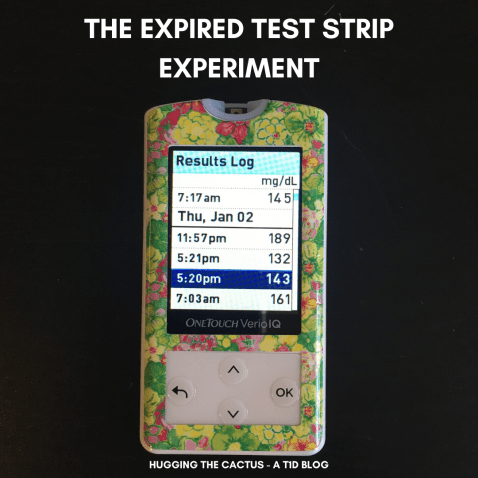
So I was curious when I recently noticed that my current test strip vial has an expiration date of 12/31/19. Would these strips still measure my blood sugar accurately, or was the New Year’s Eve expiration hard and fast?

I wanted to find out.

The Expired Test Strip Experiment
An introductory blog post to a potentially ongoing experiment.

My experiment design was rudimentary: I’d simply continue to use the 12/31/19 test strips until the vial was empty. I’d check any blood sugar results that I was unsure about against my Dexcom readings, and in cases that I deemed necessary, I’d use test strips with a far-off expiration (July 2020) to see how they matched up with the expired strips.

To my slight surprise, though it’s only been about a week since the old strips expired, it doesn’t seem to affect things much at all. They’re just as accurate as newer strips and my Dexcom.

In fact, in many cases, the old strips were only off (according to my measurements) by no more than 9 points. Not bad. I’ve had a wider spread in results between strips from the exact same vial, so the fact that the old strips were so close to new ones was interesting to me. And four days after the strips expired, I checked my blood sugar (I was 263) and used a new strip to double check that (it read 262). A single point difference is pretty impressive.

So now I know that I’m safe if I use test strips a week after they’ve expired…which is great! But now I’m sort of curious to see just how far out from the expiration date I can use them. I might hang onto this vial of test strips for a few more weeks and continue to test them against newer test strips. I might not (because really, when it comes to diabetes, there are just more important things to be worried about…and I might not want to push my luck and end up wasting strips). We’ll see what I end up doing.

I think that the more compelling questions to stem from this experiment are 1) how many other diabetes supplies are safe (up to a certain limit) to use after expiring and 2) why are supplies labeled with expiration dates if, in the grand scheme of things, they seem to function just fine after expiring? Could it just be a nasty trick played on people with diabetes by prescription drug companies…?

Those are the kinds of questions that really make me wonder.

First Impressions: How I Feel About my New Endocrinologist

Last week, I wrote about how I had an appointment with my first new endocrinologist in about 10 years. I compared my thoughts and feelings about the whole thing to a first date: Many of the same anxieties are felt in both situations.

By now, I’m sure you’re wondering…how did the date go?

Well…I don’t know that there will be another one.

Freedom is the atmosphere in which humanity thrives. Breathe it in.
This blog post serves as a bit of an endocrinologist evaluation.

Before I dive into my appointment postscript, let me just clarify that my thoughts and feelings are just that. They’re my opinions on how my experience was with this particular doctor. That doesn’t mean that she isn’t a great endocrinologist; in fact, I’m certain she is. But I just don’t think that we are doctor-patient soulmates.

For starters, the appointment got off to a weird start because none of my typical vital signs were measured upon arrival. I’m used to having my weight, blood pressure, blood sugar, temperature, and heart rate checked at the beginning of every appointment. But this time around, the only thing that was looked at was my…blood pressure? It was kind of random, and I never got an explanation as to why nothing else was looked at by the nurse, but whatever.

The actual appointment with the doctor herself mostly went as I expected it to. We spent about 20 minutes together (about 5 minutes longer than I usually get with the endo) and I told her a little bit about my diabetes history. She offered me some advice on what to do about the high blood sugars my new inhaler was causing (more on that in another post) and checked my feet as well as my thyroid, just like my previous endo did at every appointment. But she did not check my eyes, and she also…did not review my A1c with me.

This was pretty huge, though not totally unexpected. I knew this clinic didn’t have finger stick A1c machines like the previous clinic did, and that I would have to come to the lab at another point in time to get a current A1c reading. But it was surprising to me that she just glossed over it, like it wasn’t super important at that moment. She didn’t even review my Dexcom/OmniPod/Verio IQ meter graphs with me, despite having downloaded information from all three devices. However, these weren’t the most shocking parts of the appointment.

What caught me off-guard the most is when she said that I could come back in six months instead of my usual three.

In my 22 years with diabetes, I’ve gone to see my endocrinologist every three months, no matter what. Some of these appointments were more like maintenance checks to make sure I was on track with everything, but other appointments came at crucial times for me in terms of improving my diabetes management. I asked the new doc why six months instead of three, and she said something along the lines of…

“Well, it seems like you have everything under pretty good control. And you seem in-tune enough with your body to know to contact us with any questions.”

That latter statement is true, but the former…I don’t know about that. How could she have this impression after talking with me for a mere 20 minutes? It was mildly alarming. I probably could’ve pushed for another appointment in three months, but I got the distinct feeling that I would’ve been rejected had I done so. As a result, I walked out of the clinic that day with another appointment set for July and a feeling of unease settling in the pit of my stomach.

I don’t know that I can wait that long to see an endocrinologist, and I don’t even know if I’ll want to see the same person again. I have no idea how she’d be able to remember me, for goodness’ sake, especially given the brevity of our first and only meeting (so far).

Among all these unknowns, there’s one absolute truth: I miss my old endo.

Just Breathe

Just breathe…a mantra easier said than done when each breath flows in and out smoothly, instead of in ragged, wheezing gasps.

I’m no stranger to asthma. I dealt with it throughout most of my childhood. The details are blurry on when I experienced my first asthma attack, but all I know is that it left me rasping and feeling (on top of sounding) like the cute little penguin from the Toy Story series, Wheezy.

The only thing that would keep my asthma symptoms at bay was nebulizer treatments. The nebulizer is one of those loud machines that generates vapors – albuterol medicine – that must be breathed in through a mouthpiece. I hated these treatments because they left me feeling shaky for a long time afterward and often caused high blood sugar, but it was much easier and more comfortable to breathe after them…so they were worth it.

Throughout my teenage and most of my young adult years, though, asthma slowly became a distant memory. I experienced it less frequently until it stopped altogether, and suddenly diabetes was the only thing I had to worry about. And I was glad for it.

But then…let’s fast-forward to the week leading up to Christmas. I was busy. I mean, wicked busy. I was running all over the place, jetting from one party to another, interacting with all sorts of people who were bringing germs from all over to each of these merry gatherings. I was getting run down and sleeping less due to the holiday celebrations, so really, it shouldn’t have surprised me when I felt the first tinge of a sort throat in church on Christmas Eve. But when that sore throat was soon followed by a tight chest and a whistling sound whenever I exhaled, I was taken aback – not to mention straight-up annoyed.

IMG_5471
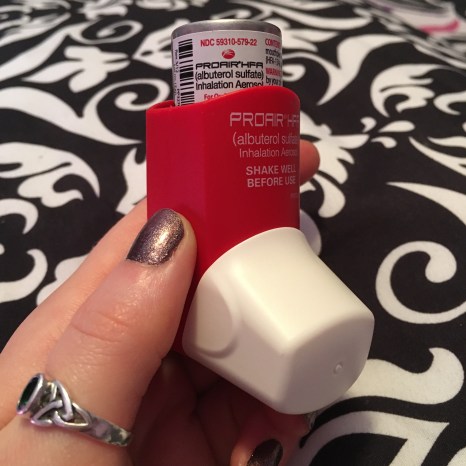
The rescue inhaler that’s been my best buddy the last couple of weeks.

I treated the initial waves of wheeziness with my rescue inhaler. But when that started to be less effective over shorter and shorter lengths of time, I knew I needed to get in touch with my primary care doctor. So I did, and I met with a nurse practitioner who diagnosed me with something new: reactive airway disease. I left the office feeling shell-shocked over a new diagnosis that would mean that I would have to use a different kind of inhaler twice daily for the next two weeks.

I was afraid to start it for many reasons, but the two biggest ones were 1) I was nervous it would make my blood sugar go up and 2) it can cause thrush (also known as an oral yeast infection, which sounds positively nightmarish) if I forget to rinse my mouth out with water after each dose.

Overall, though, it doesn’t sound like too big of a deal, right? If it helps my breathing, it shouldn’t be an issue to add this inhaler into my morning and evening routines.

Silly old me, however, did turn this into a big deal. I wasted far too much time fretting over this inhaler and saying “woe is me” for having to deal with yet another medication that was extremely expensive (I paid $56.83 for the darn thing…I have no idea what the total would have been if I was uninsured).

My logical self knows that this won’t do any good. So now, I’m getting my act together and just rolling with the punches.

I’m trying to gently remind myself…just breathe.


Happy New Year!

They say that hindsight is 2020…well, I say that because it is officially 2020, we’re going to be hearing a lot about that little pun in the coming days and weeks.

So today marks the beginning of a new year; more significantly, an entire decade. The last time a new decade began, I was the tender age of sixteen. Ah, how young and naive I was then. If only I knew then what I did now…!

Happy New Year!
Welcome, roaring twenties!

On a more serious note, this decade of diabetes is bound to be much different compared to my last decade of diabetes. For starters, I’m beginning this one with a whole lot more T1D tech than I had in 2010: I’ve got my Dexcom CGM and my OmniPod insulin pump. I was also still in high school ten years ago; in the last decade I graduated, earned my bachelor’s degree, and I’m now five years into my career. Oh, and I also moved out of my parents’ house for the first time. Needless to say, much has happened in the last ten years, and I can’t believe I was able to summarize the biggest changes in just a couple quick sentences.

Anyways, they do indeed say that hindsight is 2020. Vision becomes clearer and you learn lessons from the mistakes you’ve made.

For me, this blog is actually a bit of its own 2020. It serves as a record of how my thoughts and feelings toward diabetes have changed, and with that comes a bit of clarity and insight. And I like it. It helps me process my diabetes and stay in tune with the emotions that come with it. So in that regard, I think a little hindsight can be healthy, as long as I don’t dwell in what I could and should have done – only what I can and will do.

With that said, Happy New Year. I wish you all a happy, healthy, and prosperous 2020.

Why Meeting a New Endocrinologist is Scarier Than Going on a First Date

I have an appointment with my endocrinologist today. Or should I say, the person who I hope is my new endocrinologist. I really want this patient-doctor relationship to work out!

It’s my first new endocrinologist in about ten years and I am effing nervous. It’s comparable to going out on a first date with someone, only I’m not hoping to be wooed with flowers or treated to a fancy meal.

I’m hoping that this person is someone I can trust with my health…which I value a lot more than any of the associated costs of a first date.

Why Meeting a New Endocrinologist is Scarier Than Going on a First Date
There are higher stakes with a new endocrinologist than with a new dating-app match.

Why is this new doctor terrifying to me? For starters, I have so many questions. What if she doesn’t like me? What if I don’t like her? What if she judges me? What if she’s too lenient? What if…? The list goes on and on.

Plus, I’m seeing her after smack dab in the middle of holiday celebrations, also known as the most turbulent time of the year for me and my blood sugars. I’ve had so many highs in the last month that I’ve tried to stay on top of, but she’s bound to notice them and ask me if this is a regular thing for me. It’s also pretty likely that my weight has gone up as a result of the many indulgences I’ve enjoyed in the last few weeks, and I’m worried about whether comments will be made on that.

Not to mention that I haven’t seen an endocrinologist since…late August, I think? And that appointment was with my “old” doctor, who left to practice somewhere far, far away. It was a bittersweet parting, and it wasn’t on amicable terms because neither of us was ready for it to be over. So I’m heading into a new potential endocrinologist relationship with that in my mind, and my new doctor has a lot to live up to when compared with my old doctor.

I just want everything to go well. I know that if it’s not a perfect fit, it’ll be pretty evident straightaway, and I can seek another new endocrinologist. But to continue with the dating metaphor, it’s not as easy as just swiping along and seeing what other nearby options I have. There are other concerns beyond location: I need to make sure my doctor can accept my insurance, on top of them being likable, knowledgable, and eager to help me manage my diabetes. It might be surprising to learn that this particular combination is a tall order, but again, when it comes to my health I refuse to just settle.

Fingers crossed, it’s a match from the start and all of my concerns will be rendered invalid late this afternoon at the conclusion of my appointment…


The Emotions of a Low Blood Sugar

This post was originally published on Hugging the Cactus on October 8, 2018. I decided to re-up it today because I think we could all use a little reminder that diabetes is different for everyone. Remember…your diabetes may (almost always will) vary.

Previously, I’ve written about what it feels like to have low blood sugar. While many people with T1D feel the same symptoms as me when they experience a low, there are even more who experience a wider variety of emotions and sensations.

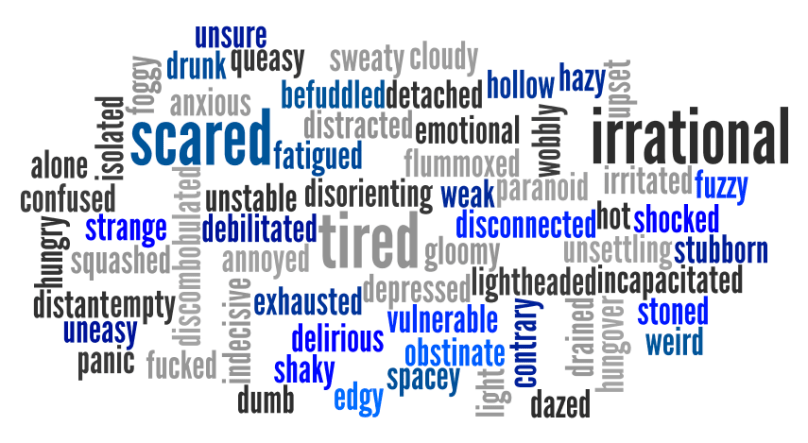
Renza, a T1D Twitter friend of mine, did a little investigating into how others would describe what it’s like to have a low blood sugar. She sent a tweet that read:

friends. I’m crowdsourcing (again). If you had to use ONE WORD to describe how hypos/lows feel to you, what would it be. Go!! #Hypoglycaemia

She received nearly 100 responses, which I’ve compiled into the below graphic.

Capture

Looking at this word collage is a bit startling because it represents the vast array of feelings associated with low blood sugar. Most of them are negative. A handful of them start with the prefix “dis”, which describes something with an opposing force. A couple of them relate to feelings associated with eating. And just about all of them can be summed up as sensations that I wouldn’t wish on anyone.

To me, this graphic serves as a stark reminder that diabetes is more than just a chronic illness that affects the body: It affects the mind, too.

Merry Christmas!!!

Dear Reader,

Merry Christmas (and if you do not celebrate, happy holidays)! I am taking today (as well as Friday) off from blogging in order to give myself a much-needed break – though I will republish an old blog post on Friday, just to keep pace with things. I’ll return with fresh content on Monday, December 30th.

DEA6BF6A-4CF6-4FAB-9EC5-0C530A4A9733
This silly, seasonal GIF of me is too funny (and appropriate) to not use today – and all throughout the holiday season as my blog’s banner.

Until then, here is a friendly reminder to be kind to yourself. I understand that this is not the most wonderful time of the year for everyone, and no matter how you feel about it, know that it’s okay – I hear you. Don’t beat yourself up over your blood sugars. Forgive yourself and look for the bright side when things don’t go your way. And whether you do or do not have diabetes, it’s important that you know that I genuinely appreciate you for visiting this blog and that I wish you nothing but the best today, and every day.

Warmly,

Molly

My 22nd Diaversary

Tomorrow is Christmas Eve (already) and it just so happens that it’s also my diabetes diagnosis anniversary…or “diaversary,” as it’s colloquially known.

This means that tomorrow marks 22 years of living with diabetes.

For some, that might mean I should celebrate with a cupcake or another special, carb-y treat. And I probably will, because it’s Christmas Eve and sweets are sure to be bountiful at any gatherings I attend tomorrow. But I don’t really plan to do so with my diaversary in mind; for me, it’s the holiday that’s got me in a more festive mood than the fact that my diabetes is 22.

I don’t really know how to feel about this diaversary. My feelings last year about my 21st were very clear: I was down in the dumps about it. I was desperate for a break. And I really didn’t say much more beyond that.

Hey Christina,.png
If you were me, would you do anything special to celebrate 22 years of diabetes?

This year is a little different. I feel the same as last year in that I would do anything for just a single day off from diabetes, but also…I guess I’ve just learned to embrace the routine of it?

I dunno. My relationship with diabetes is always going to be a bit of a roller coaster, just as my blood sugar can sometimes be. I’ll have my highs and my lows, and in between all that…is how I feel now. It exists. It’s just…there. It’s been part of me for 22 years and it will continue to be a part of me as we head into this next decade. (Where’s that cure they’ve been promising us…oh, it’s another 5 years from now, right?)

So my diabetes is 22 and I’m feeling “meh” about it. And that’s perfectly okay. I won’t deny my feelings (or lack thereof). I’ll simply just continue to live my life with diabetes, learning from both the literal and figurative highs and lows as I go along.

Merry Christmas and happy holidays, dear readers. Be well, hug your loved ones, and enjoy the spirit of the season.