August is just ’round the corner (!!!) and that…feeling is creeping up on me.
That uncomfortable feeling that’s intensified by hot and humid weather.
That annoying feeling that happens when my CGM sensors and insulin pods seem to fall off my body and wither in the summer heat – the adhesives are no match for the sun’s merciless rays.
That restless feeling that creeps up when it’s too damn muggy out for my daily afternoon walks…the walks I rely on to help regulate my blood sugars and my mental health.
That fed-up feeling that’s the result of me going outside for 15 minutes, hoping to get some fresh air, only for my blood sugar to drop rapidly thanks to the high temps.
That creeping feeling of needing some kind of relief: Relief from the hottest days of summer and from every facet of diabetes management becoming just a bit more complicated because of it.
Is this the picture associated with this post just because I wanted to show off my dog being cute on a boat? No! Never! Absolutely not…okay fine yes.
And now that I’m acknowledging how much I’m craving relief, it honestly just sounds like I’m going through some genuine diabetes burnout.
It’s not surprising: This year’s been a wild one for me (and let’s face it, the world) in multiple ways. Overall, my stress and anxiety levels are up and my motivation to do everything that I “should” do to manage my blood sugar levels is way down. I’m very aware of what’s good about my diabetes management lately (such as my daily exercise routines) and what’s maybe not so good (my constant desire to snack on carbs and not measure them out and/or bolus for them).
I’m hopeful, though: Maybe as I continue to cope with my seesawing emotions and blood sugars, they’ll find a way to balance out on their own and be a little less intense…just as the weather will become once Autumn rolls around.
I thought about how I was going to write this post many, many times. I so wanted to come up with a cute or clever euphemism for what I’m about to discuss, but really, that old “Ant Flo” cliche is all I could come up with, and that’s so overplayed.
If that didn’t give you a clue as to what this is all about, then look at the title again.
Still nothing?
Okay, this post is about my period.
Yep, the menstrual cycle, that time of the month, the curse…whatever name you want to call it, I’m talking about it today. And if you’re already cringing, chill. I promise there’s no need to, I’m not about to get graphic on you or anything.
Rather, I’m about to write about a reality that many women with diabetes face: The week leading up to a period, or the week that it starts, can be hell. And I’m not just referring to cramps or mood swings.
This picture is actually a pretty accurate cartoon version of me…cacti plants, GameBoy, and pink included.
I’m talking about blood sugars, of course. I’ve thought about how my period and my diabetes interact more and more lately because of an “interesting” (that’s the nice way to put it) pattern that I’ve noticed each week leading up to my period for the last few months, and that’s how insulin essentially becomes as effective as water when I get it pumping through me: That is to say, my insulin intake has nearly doubled the week leading up to my period, and it’s something I never really noticed until recently.
I think I caught onto the trend in April. The week before my period started, I blamed my bad blood sugars and higher insulin intake on the fact that we were only a few weeks into quarantine, so it was natural that my body was having a tough time adjusting.
In May, I wondered whether I was dealing with faulty pods or bolusing incorrectly for my foods.
By the time June rolled around, though, I realized that there was something different at play here.
Last month, I dealt with the issue by raising my temp basal for most of the day – a 95% increase for 6-8 hours through the morning and afternoon – and giving myself 2-3 units more than I normally would at mealtimes. I still didn’t have great numbers, but they were better, and that was all that mattered to me.
But this month? I’m totally confused because this “periodic problem” did the opposite of what I expected it to do…the week before my period, it seemed like I need LESS insulin! It was simultaneously bemusing but exciting. I’ll never necessarily complain about having to take less insulin, or being able to eat an entire blueberry muffin without needing to bolus for it (yes, that really happened), but damn…some consistency here would be nice.
Who knows what my body will decide to do next month. At least I feel a little bit better knowing that there is some sort of pattern going on here that I need to pay attention to, so I’ll continue to monitor so I can try to anticipate what the week before my period will look like for my blood sugars.
Just one more reason why I kind of dread “that time of the month”, but also another justification to eat more chocolate in order to cope with it when it does come ’round.
This post was originally published on the T1International website on June 29, 2020, and was written by Cyrine Farhat. She discusses her participation in the WHA virtual forum on Access to Insulin and how she used it as an opportunity to voice her concerns about barriers to insulin access in her country (Lebanon) and around the world.
An Insulin Resolution is Necessary for Lebanon and the World
Diabetes has been on the global agenda in some form ever since World Diabetes Day was created in 1991,which is also the year I was born. It took 15 years to put diabetes on the United Nations agenda after that, to tackle the urgent need to pursue multilateral efforts to promote and improve human health, and provide access to treatment and health-care education. Fast forward another nine years to 2015 when the 2030 agenda was launched and the Sustainable Development Goals (SDGs) were adopted. Despite all of that, we are now in 2020, talking about access to insulin when we should have already made it widely available and affordable to all pillars of society.
Sadly, my country and many others are still facing many challenges with insulin access and affordability. Lebanon’s recent financial crisis has caused a dollar shortage that, since September, has restricted the ability of medical supply importers to import vital medical supplies. First it started with masks, gloves, and other protective gear, as well as ventilators and spare parts, and now even essential diabetes supplies are sometimes unavailable. The government has also not reimbursed public and private hospitals for bills, which has made it harder for diabetics to purchase their medication and other diabetes-related medical supplies. For example, Novorapid insulin has been hard to find at pharmacies over the past two weeks.
I had the honour to participate in the WHA virtual forum on Access to Insulin and to address all my concerns as a patient advocate from Lebanon. The aim of the virtual forum was to facilitate a wide discussion between a group of experts and advocates on this issue. The crucial problem is that almost a 100 years after the breakthrough that has saved millions of lives worldwide – the discovery of insulin – many people still cannot access or afford it.
Patients like Cyrine have the power to change the world.
The fact that I was able to voice my concerns as a person with type 1 diabetes among the panellists that the forum included was very empowering. The panel included Zachariah Muriuki, Project Manager – National Diabetes Prevention and Control Program at Ministry of Health, Kenya; Dr. Kaushik Ramaiya, Consultant Physician and Chief Executive Officer at Shree Hindu Mandal Hospital, Dar es Salaam, Tanzania; Greg Perry, Assistant Director General, IFMPA; and Emer Cooke Director, Regulation of Medicines and other Health Technologies, World Health Organization.
The forum started by showing a video that displayed testimonials from people living with type 1 diabetes around the world, including the barriers they face in regards to access to insulin, and responses from health care providers. Although I’ve personally lived with diabetes for almost 13 years and have dealt with so many obstacles, it still breaks my heart when I see what people with diabetes worldwide have to go through in order to get insulin and remain alive.
When asked during the forum about the barriers that the Lebanese have been facing with access to insulin and how the government needs to address these concerns, I depicted the current economic situation in Lebanon. The government is absent, especially after the revolution that spiked in October 2019 and left behind a collapsing economy. With hyper-inflation skyrocketing at 240% and the Lebanese Lira collapsing, the government has decided to remove the subsidy from bread and combustibles. The Central Bank has set their own policies restricting depositors’ access to funds in their current dollar accounts and the transfer of money abroad, making it harder to finance imports, including of medical equipment and medicine. These issues can put people living with diabetes in a very dangerous position. With no substitute to imported insulin, and the decline in purchasing power due to inflation, how will Lebanese people be able to afford their medication?
I shared that I believe in the upcoming months we will be left with an insulin crisis once the subsidy is also removed from medication. Patient advocates in Lebanon have been trying to reach out to the government, to no avail. The only thing we can do is to continue to raise our voice until we are heard.
In another question, I was asked what it meant to have the World Health Organization (WHO) and their Member States recognize and prioritize access to insulin, and how people living with diabetes and the global community can take this issue forward. I said that once the international community admits and perceives “insulin as a human right”, the entire scope of advocacy for access to insulin would have solid foundations and would shift from voicing about lack of access to actually forcing governments to comply. As advocates, we must seek accountability from governments regarding progress on WHA targets and address hurdles and bottlenecks in the process. Governments should also set state-level targets, and develop a strong participatory monitoring framework and management information system to measure outcomes of targets under SDGs and WHA.
The panel discussed other matters such as steps that have been carried out in Kenya to enhance access to insulin, how Tanzania has also worked towards improving access and the recommendations it provides to other countries, and how the WHO is committed to improving equitable access to insulin. It was concluded that the WHA resolution on insulin needs to be comprehensive in the requests to governments and to the WHO on actions they should take. Here, civil society, governments, and WHO need to define key requests and alight goals that serve making insulin accessible.
As a Global Advocate for T1International, I will continue to push for change in any way possible. Insulin is life support and no person should have to decide between putting food on the table or affording insulin. I truly believe that we are capable of creating change. The right of access to insulin is mine, yours, and the world’s. If it is our right, then we will not stop until we get it!
Every summer, I spend at least a handful of days at the same beach town. These trips have created so many memories for me, my family, and friends over the years. But back when the pandemic started and travel came to a standstill, I wondered whether it would even be possible to head up to my ocean-side oasis this year. After all, many states have restrictions about visitors right now, and protocols aren’t always clear. Luckily, though, due diligence was done before it was determined that yes, my family and I could still go on our trip, though we knew it might look a little different compared to our trips in the past.
Based on my experience, I’ve come up with a few dos and don’ts when it comes to traveling with diabetes during this pandemic:
Do wear a mask. Please, for the love of everything you hold sacred in life, wear a mask when you’re out in public. It’s not about political leanings or agendas: It’s about protecting yourself and the ones around you. I kept a mask on at all times when I was out and about and only removed it when others were more than six feet away from me. It was the smart and sensible thing to do. Just because I was by the beach for a week doesn’t mean that the pandemic wasn’t a reality for me. As someone who has an invisible illness, I know that I appreciated it (and still do) when I saw others wearing masks because they were not only protecting themselves from exposure, but they were also protecting me from being exposed to them.
Don’t neglect what works best for you and your diabetes when you’re at home while you’re away. I exercise in some way, shape, or form almost every single day. So being on vacation didn’t mean I was taking a break from that and my job. On the contrary, I can’t remember the last time I was so physically active, and my blood sugars responded well to that…at first. Then I started to neglect the fact that my diabetes does best when I eat a moderate amount of carbs per day (maybe around 120 total)…I definitely ate way more than that and paid the price with some sky-high numbers. I wish I’d been more mindful of my diet, but oh well, I learned from it.
Do have extra supplies on hand at all times. Besides all of my extra diabetes supplies, I also had access to an abundance of PPE (gloves, masks, hand sanitizer) throughout my trip. It brought me peace of mind knowing that I was prepared and wouldn’t have to worry about running out of any of these items.
I wish I could say I was at this gorgeous-looking tropical oasis; instead, I was at a quaint New England beach town for a week…which was perfectly fine by me.
Don’t go somewhere or do anything that makes you feel uncomfortable. This is absolutely common sense under normal circumstances, but times are far from normal now. It was important to me that my family and I have discussions about what we did each day on vacation so we could make sure everyone was comfortable with the plan: the number of people that might be around to us, where to eat, what to do, how diabetes might come into play…we talked about it all and I think it helped assuage some of our worries.
Do think outside the box when planning daily activities. If you’re like me, you’re probably more than a little wary about spending prolonged periods of time around groups of people other than the ones you’ve quarantined with. This meant that I was not looking to eat inside at restaurants, go into stores, or even use public restrooms (which may or may not be an extreme view of mine). So what exactly did I do when on vacation? Well, for starters, I hit the beach nearly every day. I hit the jackpot weather-wise because it was a little too cool to be totally comfortable on the beach, so it was never crowded and I could easily stay more than six feet away from others. In keeping with the “outdoors” theme, I visited a state park, rode my bike around town, and went for a hike while I was away. I ate outside at a few different places that handled social distancing rules very well, and of course, I attended the Virtual Friends for Life Orlando conference. All of that kept me pretty busy, and I found that I didn’t really miss hanging out indoors.
Don’t forget to enjoy yourself. At the end of the day, a week off from work is a week off from work! Despite my fears about going on this trip, I’m really glad that I did because a break is exactly what I needed. My anxiety is much less intense when I’m by the beach, and I’m relieved that the weirdness of the world lately didn’t take that away from me.
This past week, I attended my very first virtual diabetes conference: the 2020 Friends for Life Orlando conference, hosted by the Children with Diabetes (CWD) organization.
Before I recap my experience, I’ve got to give a heartfelt round of applause to every single individual involved in the process of turning this in-person event into a virtual one. Between figuring out the technology and adapting the program to make sense in an online format, I’m sure it wasn’t easy, but the CWD staff and many volunteers made it appear seamless. While every conference attendee (myself included) would have loved to see each other in real life in Orlando for this event, it was the right (safest) call to make this conference a digital one. And the majorly bright side of doing the conference online was that more people were able to attend *for free* – literally thousands of people! Each state in America was represented, as well as dozens of countries. The massive turnout makes me happy as I think about how much more accessible this particular conference was to people with diabetes and their families around the world.
Moving along to…the actual conference!
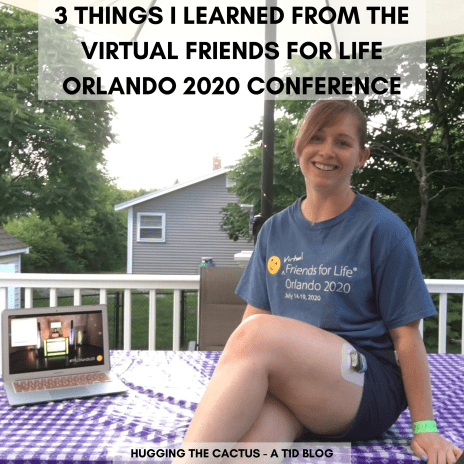
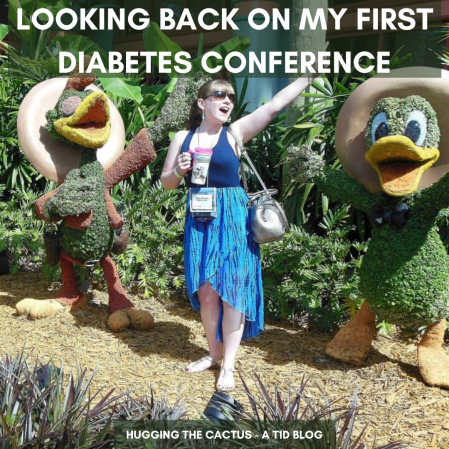
All decked out in my conference gear – t-shirt, name tag, green band, and OmniPod, to boot.
It ran from Wednesday, July 14th through Sunday, July 19th. Given that I was away with my family for the duration of the conference, I knew going into it that there was no way I would be able to attend every session or social event. (I was by the beach for a week, so when given the choice between staying indoors or logging onto my laptop…need I say more?). However, I also learned pretty quickly that many of the sessions were going to be recorded and made available at a later date (along with a report summarizing the conference, which will be ready on the CWD site in early August)…so there’s a good chance I’ll refer to some of those recordings for the sessions I missed.
But in terms of the handful of sessions that I did make it to, there were some major takeaways I got from them. Here’s what I learned:
#1: There are some important steps that I (and the rest of the diabetes online community) can take in order to address underrepresentation within our community. In the last few months, issues of underrepresentation of people of color within our diabetes online community has gained overdue attention. Individuals and organizations are working hard to address this and make everyone’s voices equally heard. However, I’m sure that I’m not the only person who felt helpless when trying to figure out how I, as just one person, can make a tangible difference. During one of the conference sessions that I attended, I learned that there are actual a few simple steps that I can take that will make a big impact over time: Follow social media accounts run by people of color. Amplify their voices by sharing and highlighting their content. Support and listen to their experiences as non-white individuals with (and without) diabetes. The bottom line is that everyone deserves to have their voice heard, no matter what, and our community must come together in order to help make this happen. It’s an uncomfortable truth that these representation issues exist, but it’s one worth acknowledging and doing everything within our power to fix it.
#2: Diabetes care and management comes in many different formats, and what works best for one person should always be respected. Of course, I’ve always known and believed in this, but this notion was reinforced for me during one of the sessions that I attended. I can’t remember the exact context, but it was brought up that sometimes people who choose to manage diabetes with multiple daily injections (MDI) take a little heat from people who use insulin pumps. In other words, those who prefer MDI might get pestered and questioned by this choice, which is unfair because it’s a very personal one. It reminded me of how I refused to even contemplate an insulin pump for nearly two decades of life with diabetes – I was so ardently against them for no real reason other than I just preferred my MDI regimen. But then when I did switch to a pump, I was instantly converted and I can’t really imagine going back to MDI. So when I saw a lot of MDI-ers reminding the rest of us that pumps aren’t for everyone, I remembered that diabetes care and management tools aren’t always high-tech (and that doesn’t make them any less effective) and that devices shouldn’t be pushed onto those who get by just fine the old-school way. At the end of the day, we’re all doing our best to take care of our diabetes in the way that’s right for us, and we should always remember that we’re in the fight together.
#3: Our community is strong, resilient, and adaptable – the virtual format didn’t put a damper on anyone’s enthusiasm. It was truly incredible to see how much energy every speaker, staff member, and attendee had for the event. You could practically feel it radiating through the computer screen in some of the sessions! Diabetes forces us to make decisions that are tough sometimes. It throws curve balls in our paths and we must find a way to deal with them, and we always do. This collective tenacity totally translated to this conference as we embraced the virtual format. It was heartwarming to see photos all across social media throughout the five days from attendees and speakers alike showing snippets of their at-home conference experiences, and I loved how everyone had so much spirit for the event. I admit that I even got up and danced (to several songs) when we had our virtual banquet on Thursday night. I gladly draped the tablecloth and fairy lights I got in my BoFFL (Box of Friends for Life, a package I got in the mail last month containing swag from conference sponsors that was available to the first 500 conference registrants) to really set the mood as I ate dinner “with” diabetes community members across the country and ’round the world…and smiled widely because my T1D mom was able to experience it with me for the first time.
So yes, while it’s a bummer that I didn’t get to hug so many of my friends from the diabetes online community or meet new ones for the first time in-person, I’d say that the virtual conference exceeded my expectations in terms of what it delivered using the available technological resources and passion from the community. Hats off to the sponsors for doing what they could to really engage attendees, and another extra-special kudos to the staff, volunteers, and speakers who pulled off yet another amazing conference.
It just makes my anticipation for the next in-person one that much greater, knowing how wonderful it will be to see everyone in-person again.
In my final post for this week’s conference reflection series, I’m republishing my experience at the 2018 TypeOneNation Summit in Boston. This post was originally published on Hugging the Cactus on March 19, 2018. This conference was different from the other two I revisited this week because it took place in my neck of the woods, requiring very little travel. It was also one of the first times where a diabetes conference felt like family reunion to me, and it was very special. Read on for my full experience…
St. Patrick’s Day is a favorite holiday of mine because I enjoy celebrating my Irish heritage. Almost every year, I eat a traditional boiled dinner, listen to Irish music, and wear an excessive amount of green.
This year, though, was a little different. In addition to all of the above, I attended the TypeOneNation summit in Boston. The event was organized by JDRF and just about 900 people with diabetes attended, along with their families and caregivers.
There’s nothing like being in Boston on St. Paddy’s day, even if it is for an event that has nothing to do with the holiday’s shenanigans. The spirit of the day made it slightly less painful to wake up at the crack of dawn in order to catch an early morning commuter rail into the city. As I sipped an Irish cream iced coffee from Honey Dew (absolutely delicious) on the ride, I got myself pumped up for what would surely be a fun day.
Once we arrived at the Back Bay station, I was one frigid (and mercifully short) walk away from the event space: the Boston Marriott Copley hotel. I went straight to the registration table so I could receive a name tag and itinerary, then made a beeline for the vendor hall. You can never have too much free diabetes swag, am I right?
Within the hall, I recognized many familiar faces and happily made the rounds to chat with some of my T1D friends in attendance. I couldn’t help but feel like I was at a family reunion of sorts as I reconnected with people who I don’t get to see often enough.
This year’s TypeOneNation Summit in Boston had to be canceled at the last minute due to COVID, but here’s to hoping that it can safely happen again next year.
Before long, the events of the day got into full swing as the keynote speaker, Nicole Johnson, addressed the crowd. Nicole won the Miss America pageant in 1999 soon after she received her diabetes diagnosis. She’s done many incredible things since earning that accolade, and she delivered an inspiring speech about living life with diabetes to the fullest. As she spoke, I looked around the room and noticed all the little kids who were there. It warmed my heart to see how they received Nicole’s words. Many of them looked at her in absolute awe. It was obvious that they thought she was pretty great, and I bet that having diabetes in common with her helped them to feel just as cool. Nicole is definitely a wonderful role model!
The rest of the day went by much too quickly as I went to two different talks offered at the summit. One was about going to college with diabetes, and the other was about sex and drugs – the “taboo” diabetes topics. Even though I’ve already experienced what it’s like to go off to college with diabetes, I wanted to go to this talk because it was given by my friends from the CDN. I also wanted to meet the parents and children at the session because I was curious to learn about their concerns. As someone who went to a very similar talk seven (?!) years ago, I felt that I could potentially offer reassurance to these families, especially since the whole college experience was so recent for me. And it turned out that the woman seated next to me was an anxious mom who seemed receptive to the words of encouragement I spoke to her at the end of the panel. While I believe that the session could’ve lasted many more hours (everyone was so engaged in the conversation), I think that the session acted as a good launching point into future discussions for many families who are going to make this transition soon.
I wolfed down a quick lunch – I loved seeing the food labeled with carb counts – before heading to the next session. I chose it because, c’mon, a title like “Sex, Drugs, and Rock n’ Roll” can get anyone’s attention. Plus, I feel very strongly that the touchier diabetes topics SHOULD be talked about more often. They can be scary to approach, but it’s important to know what to expect in certain situations in which diabetes can play a major role. I had to duck out of this one a bit early to catch the commuter rail back home, but they were delving into some pretty juicy stuff when I got up to leave. I give major credit to all of the panelists in that one – it can’t be easy to talk about highly personal intimate matters in a room filled with strangers!
Although my time at the summit was truncated, I’m so glad that I took the time to go to it. It’s no secret that I enjoy talking with other people with diabetes. Hearing their stories and sharing experiences makes diabetes feel less isolating. And I’m thrilled that I finally got to meet a few people I knew from the DOC but had yet to see in person!
Diabetes conferences, meet-ups, summits…they’re the types of family reunions you actually get excited about and want to attend.
I’m continuing to revisit my blog posts on past diabetes conferences I’ve attended. Today’s post was originally published on Hugging the Cactus on October 16, 2017. This “Weekend for Women” conference was an absolute whirlwind and a one-of-a-kind experience! Read on to learn more about it…
It’s always amazing to me how powerful it is to be in a room filled with people with diabetes.
I was lucky enough to experience that wonderful sensation this past weekend as I attended the 2017 Weekend for Women Conference held in Alexandria, Virginia. This conference brought together all sorts of individuals: people with type 1 diabetes (and people with T2D), people who love or care for someone with diabetes, diabetes educators, registered dietitians, certified personal trainers, gifted public speakers, and individuals who came to the conference willing to share with and learn from others. It was also a bit different from standard conferences because it was coordinated by two groups – DiabetesSisters and Diabetes Collective, Inc. (which created the Diabetes UnConference).
The 48 hours that I spent at the conference were an absolute whirlwind, but I’ll do my best to recap it for you here.
Let’s start with Friday evening. Almost immediately after arriving at the Embassy Suites hotel in Alexandria, Virginia, I sat down for my first session of the weekend: The Diabetes Policy Advocacy Coalition (DPAC) boot camp. I learned what exactly diabetes advocacy policy is and how easy it is for me to get involved with it. Now more than ever, it’s extremely important for PWD and those who care for them to push our policymakers into supporting public policy initiatives that improve the health of those with diabetes.
After this energizing session, it was time to mingle with all the other conference attendees. It was really neat to meet people who I previously “knew” from interacting with them online and make that face-to-face connection. I also enjoyed meeting new people and expanding my own personal diabetes network. We rounded off the evening by attending a hilarious forum called Sex, Pods, and Rock n Roll, where a panel of diabetes all-stars answered questions from the audience about the more “taboo” diabetes topics. All you need to know is that this session resulted in a room full of PWD brainstorming a new product idea: edible underwear. It’d be perfect for low blood sugars when you’re in…the heat of the moment, no?
Fast-forward to Saturday, a day with an extremely full agenda. It was hard to choose which workshops to attend, but I wound up going to sessions about mindful eating, the physiology of diabetes and exercise, balancing an active life and diabetes, and making use of the glycemic index. I found myself learning something new in each session, which is really cool. After all, I’ve had diabetes for almost 20 years, but it goes to show that you can always learn something new and useful about your chronic condition by listening to others.
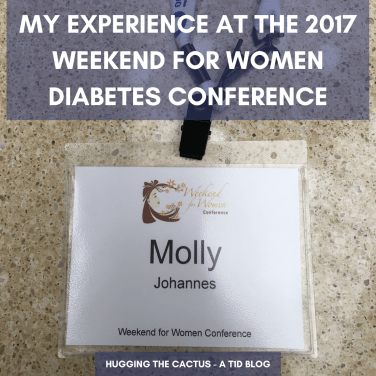
Who else has a collection of conference name tags/badges?
In between the sessions, we enjoyed an extended lunch break in which I got to meet even more new people. I was particularly excited to meet and interview with Stacey Simms, who hosts the podcast called Diabetes Connections. That means there’s a chance you’ll hear my voice in one of her upcoming podcasts!
The evening ended with a reception hosted by Dexcom, similar to the one the night before. I didn’t stay for the whole thing, but I loved every second of it because I became immersed in a thoughtful conversation with other women with T1D. We talked about healthcare, politics, and what it’s like to be a woman with T1D in this day and age. It was a pleasure listening to what each lady had to say and again, really great to be talking to a like-minded group.
And just like that, it was Sunday morning – the final day of the conference. We only had a half day together, but it was just as awesome as the previous days. One session I went to was about diabetes and pregnancy, and the other was about being the CEO of your own healthcare. Just like the previous days, the speakers presented fantastic information and I found myself feeling sad that it was my last day with this group of people.
I had to duck out of the last group-wide activity a bit early, but I got the gist of the message it was meant to convey: Invest in you. Take time to look at the areas in your life that need attention, and come up with a plan to improve them. Put in the hard work to make your life what you want it to be and you’ll reap the rewards. I thought this was an especially good way to end the conference because it wasn’t necessarily related to our diabetes. It was a reminder that we are MORE than our diabetes and that we, ultimately, have control on how to live our lives happily and fully.
This was the conference, from my perspective, in a nutshell.
A special thank you to Anna Norton from DiabetesSisters and Christel Marchand Aprigliano from DPAC/the Diabetes Collective for their efforts to make this weekend a success. Thank you to each of the speakers for being engaging and putting together magnificent presentations. I wish I could personally thank each and every single attendee for being an active participant and making this conference worthwhile. I’m extra grateful to the people who I got to make more personal connections with, and I’m looking forward to keeping in touch with them. Thanks to YOU, if you were at the conference, and are now reading this recap! I’d love to hear from you what your favorite parts were – please feel free to leave a comment about your experience. Here’s to connecting with more members of the incredible diabetes community.
This post was originally published on July 18, 2013, on the ASweetLife website. Since I’m away on vacation this week, and it also happens to be the week of the 2020 CWD FFL conference, I thought it’d be fun to look back on the diabetes conferences I’ve attended in the last seven years. I got very nostalgic when reading this old post – all the feelings that I had during that week rushed back at me. To this day, I feel so lucky that I got to go and meet so many amazing people with diabetes – many of whom have literally become my friends for life. Read on for my full conference experience…
Children With Diabetes Friends for Life Conference 2013: A First-Timer’s Report
I was the kind of diabetic child who refused to attend any sort of diabetes camps or events. I always told myself, I don’t need any diabetic friends. I can do this by myself. And I wasn’t exactly alone with my diabetes. My mother has type 1 diabetes, too. We’ve always had a diabetic partnership, and for most of my life that has been enough of a support system for me.
However, as years have gone on I have become more comfortable with the diabetic part of my identity, so much so that I joined the College Diabetes Network (CDN) last year, an organization whose mission is to empower and improve the lives of students living with type 1 diabetes through peer support and access to information and resources. Through CDN I started meeting other diabetics my age, and was blown away by how refreshing it was to chat with them about the daily challenges of living with diabetes as a college student. And thanks to CDN, I learned about an opportunity to apply for a scholarship to attend the Children With Diabetes Friends for Life conference in Orlando, Florida. The CDN team, Christina Roth and Jo Treitman, encouraged me to go for it. This past April I applied, and by May, I had received the news that I was chosen as a scholarship recipient. I was overjoyed.
I recreated my overjoyed reaction to receiving the scholarship almost immediately upon arriving to Disney. Here’s the photographic evidence.
Fast forward to July 10th, when I found myself sitting next to my father, the most wonderful traveling companion, on a plane. Our destination was the Coronado Springs Resort located in Disney World, where we would spend the next five days taking advantage of all the conference had to offer. I wasn’t sure what to expect. Would I meet other people my age? Would I enjoy myself? Would I benefit from the conference? I was anxious, to say the least.
My concerns were allayed once I registered and saw a lobby full of conference attendees. I did my best to absorb the sea of faces before me: all of those people had something gigantic in common with me. It dawned on me that I would get to know some of them well over the course of the next few days, and I couldn’t wait to start the process of making some friends for life.
Before I go on, you might be wondering what exactly happens at a Children With Diabetes Friends for Life conference. In short, families or adults with type 1 gather to spend time together. Participants are are divided into groups by age. I was sorted into the college-age group, which was for 18-22 year olds.
For the duration of the conference, attendees are encouraged to participate in workshops that address a large variety of diabetes topics, like the latest technology for diabetics, dating and diabetes, starting a family with diabetes, and creating diabetes blogs. I had the pleasure of meeting Jessica Apple and Michael Aviad at the diabetes bloggers session, as well as fellow bloggers Kerri Sparling and Scott Johnson. As a relatively new diabetes blogger, I found this workshop to be enlightening as I listened to the advice other bloggers had to offer. I’m excited to explore the intriguing realm of diabetes blogs and gain insight that I can apply to my own blog.
As far as the social aspect of the conference was concerned, I hit it off immediately with several people at the college dinner that was held on Wednesday night. Each person I spoke to had a different perspective on what it was like to be a young adult with diabetes. I was impressed by the clear resilience and independence of the students around me, and I was truly pleased to learn that diabetes wasn’t the only thing we all had in common. Thursday night proved to be fantastic, too. We attended the Friends for Life banquet and ball, which was a full-fledged party with food, music, and dancing. Then my newfound friends and I ventured to Downtown Disney and had a blast soaking up the magic of Disney World and exchanging stories – both diabetes related and unrelated.
One story that I heard at the conference particularly moved me. I was at Brandy Barnes’ workshop about Women and Diabetes – another excellent session – when a diabetic woman sitting next to me became emotional as she spoke about her young daughter with diabetes. She explained how she was dealing with guilt, as she felt responsible for her daughter’s diabetes. She feared the consequences this would have on her little girl later on in life. I felt a compelling need to reach out to this woman and let her know everything would be okay. I spoke to her briefly after the workshop, and explained to her that my mom and I are a diabetic duo, too. I told her that when her daughter grows up she’ll be grateful for her support, knowledge, and perspective as a fellow diabetic with a deeper understanding of diabetes. My mom and I can attest to how even though diabetes has tried to knock us down over the years, we’ve taken control of it and become stronger as a result. I gave the woman my e-mail and the address to my blog, and if she is reading this now, I want her to know that I meant what I said: everything will be okay.
Looking back now with the eyes of someone who attended the Children with Diabetes Friends for Life conference I can say that I regret – to a certain degree – not attending camps when I was younger. Being around others with diabetes has given me greater awareness of what it means to live with diabetes. Additionally, I am feeling more inspired than ever as a diabetic and a writer to put my story out there and do anything I can help and impact others, all while listening to and learning from what others affected by diabetes have to say about it, too.
Starting tomorrow, I’m on vacation for a week – not from my blog, of course, but from my real-world job.
I’m headed to the beach for the week. It just so happens it’s also the week of the first virtual CWD FFL conference, which I plan on jumping in and out of throughout vacation.
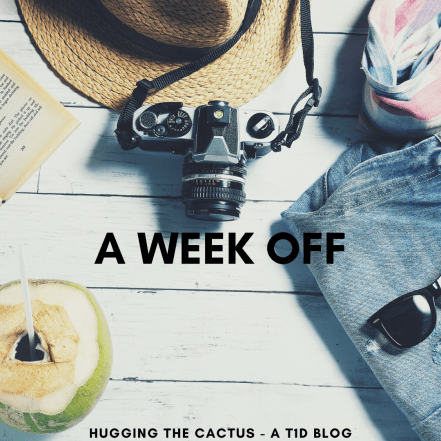
I HOPE my week off involves all of the things in this photo – I’m looking at you, fancy coconut drink.
Like many other 2020 CWD FFL conference registrants, I have many mixed feelings about the conference turning virtual. I’m sad and disappointed that after a seven-year hiatus from conferences, I’m not able to make my IRL return to it this year. But I’m also exceptionally grateful that the CWD FFL staff made the call months ago to turn virtual because they recognized it would be safest for our at-risk population. I’ve been in awe over how quickly they made the transition from an enormous in-person event to an enormous-er virtual event – they’ve proven how effective they are at organizing this sort of thing, and I applaud everyone involved for their efforts.
My original plan was to attend the conference in-person this year while my family was at the beach for the week. But obviously, when the conference became virtual, I decided to tag along to the beach with my laptop in tow because I wanted the best of both worlds: family time and diabetes online community time.
Normally, I wouldn’t dream of packing a laptop along with my swimsuits and sunscreen, but even a trip to the beach looks a little different this year. I have no idea if my family and I will be able to even go to the same strip of sand and ocean without having to worry about things like too many people and not enough masks. We probably won’t be able to eat at many restaurants like we typically do on vacation; instead, we’ll likely cook a significantly higher percentage of our food at home. And we definitely won’t be able to peruse the shops like we have done every year since going to this particular beach town – we’ll have to be a little more creative when it comes to staying entertained.
It’s a weird adjustment to have to make, but I think we’re all in agreement that we’re just happy to have a safe place to get away to for a period of time. And I’m very glad to have the option to soak up the sun while also soaking up support, information, and friendship from the diabetes community.
Welp, I had my appointment with my endocrinologist on Monday.
In sum, it was mostly an uneventful affair, considering the times.
Immediately upon arriving, I was asked to put on a clinic-provided mask and to sanitize my hands. I checked in with the receptionist and sat in a chair in the mostly-abandoned waiting area, taking in the fact that seating was reduced in order to maintain social distance.
A nurse came out to bring me into my exam room and she took my blood pressure (good) and my weight (let’s not talk about it) before leaving to get my doctor. I was slightly surprised that she didn’t check my temperature with a contact-less thermometer, but I decided not to second-guess it.
My endocrinologist entered soon after…and she spent all of 15 minutes with me. She said that she reviewed the information I sent her from my Dexcom, as well as data from my pump, and said she couldn’t really detect any patterns besides some lingering lows in the late mornings/early afternoons. Again, I found myself a bit bemused by this observation, because I hadn’t picked up on it. She decided to adjust my basal for the 11 A.M. to 1 P.M. window (I went from 0.9 to 0.8 units for those two hours) and then asked me if I had any questions.
She didn’t check my feet, listen to my heart, examine my thyroid, or review my labs with me…all things that I’ve come to expect from previous endocrinologists.
My mild shocks of surprise from earlier in the appointment turned into something else: As the kids say, I was SHOOK…meaning that it was absolutely wild to me that she was already done with me.
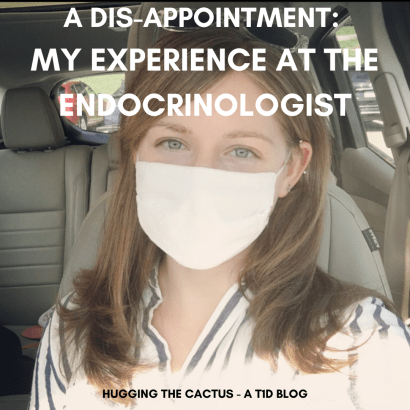
Am I smiling or frowning underneath this mask? Given how my endocrinologist appointment went, I bet you can guess…
I expressed my dismay with my A1c – it had gone up a little bit – and she told me that I was “still under good control”.
I said that I was befuddled by my weight gain – I’ve been working out like a fiend the last couple of months – and she suggested that perhaps it’s muscle.
I asked if she could recommend any blood sugar meters to me – I’ve had the same one for practically a decade and I worry about its accuracy – and she said that I should try a new meter from the same manufacturer that’s supposed to hit the market “soon”.
For every question or concern I brought up in that short span of time, she had an immediate, unsatisfactory answer that made me feel like my concerns were being brushed away.
But the real kicker? I’m not seeing her again for another seven months.
SEVEN MONTHS?!
That’s right, folks. I went from having quarterly endocrinologist appointments for my first 22 years of life with diabetes to once every six months, and now in SEVEN months.
This means that I will have seen my endocrinologist once for the entire year of 2020.
That’s bananas to me, and a sign that my instincts from our first meeting were correct: This may not be the right doctor for me. I have no doubt of her intelligence or capability, but sometimes you just know when a given doctor-patient relationship isn’t the healthiest one for you.
The whole appointment – the brevity, the indifference, and the outcome – was almost enough to make me forget about my anxieties surrounding medical facilities during this pandemic…
…almost.
Luckily, that’s what face masks, Clorox wipes, several squirts of hand sanitizer, and a thorough hand-washing or five are for.




 Hugging the Cactus