Diabetes is a medical condition that should come with its own dictionary.
I’m not exaggerating. A diabetes diagnosis means having to learn what feels like a whole new vernacular in order to thrive with it. Words and terms like bolus, basal, CGM, A1c, among many others, can be straight-up confusing – especially if you didn’t grow up with diabetes like I did. It only recently occurred to me that I avoided a tough learning curve by receiving my diabetes diagnosis early in life. I knew the meaning of “hypoglycemia” and “endocrinologist” at an age when most kids were just trying to figure out how to say simpler phrases like “the cat sits on the mat”. I grew up speaking diabetes, a second language that I don’t always give myself credit for knowing as well as I do.\
I know it so well, in fact, that I’m often sprinkling in diabetes words and phrases into my regular daily conversations. I expect my close relatives and friends to know what the difference between my “pod” and my “PDM” are, but I sometimes forget that colleagues or acquaintances might find my diabetes terms confusing. That’s one reason why I added a “diabetes dictionary” section to this website. It’s definitely not complete, but it’s a solid starting point for anyone who’s trying to understand the many acronyms and fancy-sounding medical terms that make up the language of diabetes. And a second reason, that goes hand-in-hand with that explanation, is to hopefully make it a little easier for newer readers and visitors to this website to pick up on the diabetes-related words that I use throughout most of my blog posts.
So feel free to peruse my incomplete diabetes dictionary here – I promise it’s a much shorter read compared to a traditional dictionary. And let me know in the comments if there’s anything you think I should add there, as it’s been a minute since I revisited it.
This blog post was originally published on Hugging the Cactus on August 3, 2022. I’m sharing it again today because the dog days of summer are officially here and I’m THIS. CLOSE. to giving into the temptation to eat ice cream for dinner most nights. And guess what? I can, if I truly wanted to, and it doesn’t even have to be sugar free. Read on for my thoughts on ice cream and diabetes…
I have strong opinions about ice cream. Potentially controversial ones:
Chocolate ice cream is the weakest flavor out there.
My ratio of ice cream to mix-ins is…gimme ALL the mix-ins. The more chopped-up chunks of goodness, whether it be cookie dough or candy, the better.
Ice cream tastes best when it’s a little softened – like, almost to the point of being soft-serve consistency. I used to microwave my ice cream for about 20 seconds when I was a kid before eating it and loved every drop of my ice cream “soup”.
See? I warned you. Those are some triggering statements I just made about my personal ice cream preferences. But one not on that list, that I think most people would happen to agree with me on, is that sugar-free ice cream just ain’t it.
“Oooh, Molly, look! They have sugar-free ice cream on the menu, are you going to get some?” One of my truly well-meaning girlfriends asked me this, ever-so innocently, on a recent ice cream outing.
I remember raising my eyebrows incredulously as my eyes scanned the regular list of ice cream compared to the sugar-free options. There were dozens of delectable-sounding regular ice cream flavors: all the traditional ones, plus more exotic ones like cotton candy, blueberry pie, s’mores, German chocolate cake, coffee kahlua cream…and then in direct opposition to that were TWO, yes TWO meagerly sugar-free choices: black raspberry and coffee.
I turned to my friend and, as non-condescendingly as I possibly could say it, told her that those “choices” had to be a joke and that furthermore, sugar-free ice cream just ain’t it for me. If I’m going to eat ice cream (and I’ve consumed LOTS of it this summer, let alone throughout my lifetime), then I’m going for the real stuff – no question about it. So with the air cleared on that particular matter, we both got matching ice creams (the blueberry pie flavor with blueberry and graham cracker swirled in a vanilla cream base) and enjoyed the heck out of them.
What if I told you that at the beginning of this year, I started training in a new type of exercise that has truly pushed me out of my comfort zone, empowered me, and made me begin to appreciate my body, as it is, more than I have in a long time?
I bet you’d be curious to know more about this form of fitness that has instilled such confidence in me.
It’s pole dancing.
Now, before you get all judgmental on me, let me encourage you to pause for a beat and realize that any stereotypes or preconceived notions you have about pole fitness are likely wildly incorrect, or at least unfair. Shove any thoughts about certain types of clubs out of your brain, here!
I’ve come to learn that pole dancing is less about sexy, slinky movement (unless you want it to be that way, which is also perfectly acceptable) and more about athleticism. The way that I have decided to approach pole is that I am testing my body’s ability to move with strength and grace, and I’m really proud of the progress that I’ve made in the 7 or so months since I attended my first class. I’ve learned that my body (and as a result, my mind) are capable of so much more than I ever thought, and I’ve also found out a few other important things about pole as a sport.
It’s for everybody. Any person of any gender, size, and age can learn how to do it.
There are many different styles of pole. You can learn a choreographed routine, you can wear heels, you can go barefoot, you can spin, you can be static, and so much more.
The biggest obstacle in learning pole is your mind. I’m constantly talking myself into (and out of) certain poses and movements because I am scared of the unknown. It can be frightening to climb eight feet up into the air and put your trust fully in your muscles in order to hang on, much less contort into an elegant posture! But diabetes definitely hasn’t stopped me in any form or fashion from making the most out of a class, and I got proof that there’s other people with diabetes out there who pole not too long ago.
It’s common to have a pole buddy in most of my classes, due to the fact that there’s only a handful of poles available in the studio and twice as many available spots in a given class. So when a woman who was slight in stature and soft spoken asked me if I was okay with sharing a pole with her, I welcomed her over and was pleasantly surprised by what she said next.
“I saw your pump and figured it made sense to share a pole with another diabetic,” she said, motioning toward her own pump which was clipped to her shorts.
My face probably immediately lit up. I was excited to be partnered up with someone who shared something that we both innately understood. We started chatting about the fairly unique experience of pole-ing with diabetes; more specifically, whether or not our diabetes devices got in the way during classes. She shared that one time, her pump detached from her shorts, flung out as she maneuvered around the pole, and got its tubing wrapped around the pole as a result! She was totally fine, but embarrassed by the attention that the incident got her. I reassured her that I’ve had similarly mortifying experiences in fitness classes before, the most memorable being the time that my CGM kept going off in the middle of a yoga class and disturbing the quiet environment. We shared a laugh before refocusing our attentions on the instructor, and for the remainder of the class, our diabetes and our devices became afterthoughts as we transitioned from one pose to the next.
It was a short exchange, but one that bonded us and served as evidence to me that diabetes really can’t stop me (or anyone else living with) from pursuing what we want to do, even something less conventional like pole. This was one of my favorite “diabetes in the wild” encounters that I’ve had in quite some time, and now I know that any time we take a class together, I’ve got someone close by who gets me. And that’s a nice feeling.
This blog post was originally published on Hugging the Cactus on June 19, 2020. I’m sharing it again today because truth be told, I needed to hype myself up a bit about having my diabetes devices be a lot more visible during the summer months. As I’ve gotten older I’ve grown less comfortable having them on display, but it’s inevitable when I’m wearing short sleeves, shorts, or a bathing suit. Read on to learn about the other things that make diabetes a little less invisible in the summertime…
Sun’s out, guns pumps out, amirite guys?
The summertime season is in full swing, and now that it’s here I’m thinking of the various ways my diabetes is more pronounced in the warmer weather. It’s much more visible, leading to many more questions, but what are the cues that give it away to others? I thought of four…
Visible sites. Shorts-and-t-shirts weather makes it much harder to place pods or CGM sensors in discrete locations. And if I’m going to the beach? There’s no way that I can even attempt to hide my devices. That’s probably why I make them even more obvious with…
…Pump and sensor art. I’ve written about Pump Peelz and GrifGrips in the past – they make adhesives and skins that are specially designed to fit pods, PDMs, pumps, meters, and more. The products they make are truly little works of art for diabetes devices, and I like to make sure all of mine are decked out in the summer months so I can show off tech that’s not only functional, but also stylish.I’m looking forward to donning my best beach-y Pump Peelz on what I hope will be many trips to the beach this summer.
It’s tough to “hide” diabetes in the summer when short sleeves and tank tops become wardrobe staples.
Gadget tan lines. Or if you’re like me, it’s more like sunburn lines. That’s because each summer, without fail, I somehow manage to neglect the space around my pod or my sensor, so when it’s time to remove it, there’s a huge red circle around the perimeter of where the device was situated. Maybe this year I’ll actually learn my lesson and take the time to apply sunscreen properly so I can avoid the very not-cute sunburn circles.
Travel coolers. This is probably the least obvious sign of diabetes in the summertime, but to those in the know, coolers meant to protect insulin are pretty recognizable compared to regular coolers. Whether it’s a Frio cooling pouch or another brand of insulin cooler, people with diabetes tend to carry these throughout the summer months in order to prevent insulin from spoiling due to heat exposure.
When my pod fails, it’s pretty obvious due to the fact it’ll emit a long, loud, impossible-to-miss BEEEEEEEEEEEPing sound. (Said sound tends to inspire immediate rage, but also relief because at least my device is letting me know that it’s not working properly.)
What’s less obvious is when a pod is malfunctioning, and the beeping sound doesn’t get triggered. In this context, I define “malfunctioning pod” as a pod that’s leaking insulin, or a pod that appears to have deployed the cannula correctly into my skin, but somehow it’s become dislodged.
Both of those scenarios are infuriating because they’re much more difficult to discover.
But lately, I’ve found myself dealing with both – more than likely, it’s just totally random, but it also may be due in part to the fact that I sometimes have more trouble with pods in the summertime. Heat and humidity don’t always bode well for my pod’s adhesive, and my pods have fallen victim to peeling up and off my body as a result of my sweaty summertime skin.
Since I’ve got recent experience with both types of malfunctioning pod as described above, I decided to share my tips on how to identify (and then deal with) these phenomenons:
Leaky pod: The first sign that my pod is leaking insulin is my blood sugar being higher than usual. If I’m bolusing for foods that I consume on a regular basis and seeing serious spikes afterward, I check my site by lightly running my fingertips around my pod, and then sniffing them to see if I can detect the pungent scent of insulin. It might sound kind of funny to go about it that way, but it really is the best way to confirm a leak as it’s riskier to just up and rip the pod off my skin to look for puddled insulin underneath. If I do smell insulin after my sniff test, then I will go ahead and change the pod – and double confirm my suspicions by looking at the leaky pod’s adhesive at that point in time. More often than not, the adhesive will be visibly wet around where the cannula is, and that is always a signal to me that the pod was indeed leaking and therefore responsible for my high blood sugars. And on a very rare occasion, a leaky pod will be obvious before it even goes on my body (as shown in the below photo), making it much easier to handle as I can address it before it starts to negatively impact my levels.
Dislodged cannula: You would think that I would immediately know if a cannula was no longer poking my skin, but honestly, it’s difficult to tell when it gets jostled out of place! And it’s even harder to figure out if the adhesive surrounding the pod is fully intact. So what are the signs of this happening? Well, high blood sugar is the main one, but I’ve also realized that itchy skin is another. It’s strange and I don’t have an explanation for it, but when my cannula is on the cusp of ejecting (or already has), my skin gets super itchy. If I’m experiencing that itchy sensation and my adhesive has already begun to peel around the edges, I don’t even question going through with a pod change, as I’m almost always able to visually confirm that my cannula is out of place. When I don’t have that visual guidance, it’s much more of a crapshoot and I still almost always end up changing my pod in an attempt to stabilize my blood sugar levels. After removing it, I can sometimes see that the cannula was bent at a funny angle or something to that effect, but I don’t always get that verification. In that instance, I just chalk it up to a fussy pod and then do my best to move on from it.
The big takeaway here? More often than not, my pods work exactly as they should. Every now and then, though, I have to deal with one that malfunctions – whether it’s a total failure or one of the other situations I described above. I’ve found that when I’m in doubt or suspicious that my pod isn’t working right, then it’s best to troubleshoot within reason before making the judgment call to change it. I’d much rather have to change my pod prematurely in order to maintain in-range blood sugars than deal with 3 full days (the lifespan of one pod) filled with highs and frustration.
But for real, this particular post isn’t so much about my diabetes and more so about my recent experience recording an episode of…the Hardly Focused Podcast.
Admittedly, I was slightly confused when my former colleague from an old job reached out and asked me to be a guest on a podcast he co-hosts. Why the confusion? Well, I wasn’t really sure what value I’d add to it seeing as it’s the first non-diabetes-related podcast that I’d be appearing on. Upon further conversation (and a little bit of my own research), I realized that the name “hardly focused” is hardly an exaggeration. The whole point of the show is to run the gamut of possible discussion topics. They’ve had guests come on to chat about everything from news, politics, sports, and pop culture, and I’ve got to say that such a varied show increased my interest because I liked that the gentlemen behind the podcast were open to talking about, well, anything.
So I agreed to join them for an episode recording, and I’m so glad that I did. I really appreciated the opportunity to talk about diabetes with people who admitted that they knew next to nothing about it. (See my most recent post for more on that topic.) I haven’t had the chance to dig into diabetes basics in a super long time, so it was a nice brush-up for me on how I choose to speak about my individual experience with it. Not to mention, it was pleasant to do so with two co-hosts who asked thoughtful questions and clearly knew how to keep a podcast interview going.
My episode of Hardly Focused will be available on Apple Podcasts, Spotify, and wherever else you listen to your podcasts later this week. In the meantime, check out the YouTube recording of the episode below:
I’ve lived a quarter of a century with diabetes and I’d 100% be lying if I said that I knew everything about it. Hell, I’m not even an expert on my own individual experience with it, as it has changed (and will continue to change) over time. I recognize that I am not well-versed in all aspects of it, and certainly not when it comes to any other type of diabetes besides type 1.
That’s why when I recorded a podcast earlier this week (which I’ll be posting about here next week, be sure to tune in) with two hosts who admitted that they knew next to nothing about diabetes, I applauded them for sharing that with me.
I appreciated their transparency, and quite frankly it made recording the episode so much easier because I was able to reassure them that no question they asked me would be a silly one. We had a candid back-and-forth about how a portion of society tends to act like they are subject matter experts on diabetes, and I was able to express my frustration with that mindset because of the stigma it perpetuates around diabetes. It’s a lot more difficult to talk to people who claim knowledge on the diabetes subject when this “understanding” of diabetes is only obtained via hearsay or information gleaned from online forums that are filled with judgment or only small bits and pieces of the broader diabetes puzzle.
It’s uncomfortable to admit to a person or to people that you don’t know well that you’re feeling vulnerable or uneducated about a topic, but I’ve found that in doing so, the best and most natural conversations take place as a result. I walked away from the recording feeling grateful for the opportunity to speak to open-minded individuals who merely wanted to hear my perspective, and the experience served as a reminder to me to be objective in my own conversations that I have with others on topics I’m less-versed in, and to just listen and learn to get the most out of them.
A few years ago, I wrote a blog post about how I received a shattered insulin vial in my mail order pharmacy delivery. At that point in time when it initially happened, I’d never experienced anything like that before and was immediately panic-stricken about how I could get a replacement for something that wasn’t my fault, as the vial was smashed upon arrival.
Fortunately, a quick phone call resolved the situation, and I’ve been lucky enough to receive fully intact insulin vials in the mail every 90 days or so ever since. But imagine my fear and concern when I got my most recent insulin delivery and discovered, upon opening the package, that one of my insulin vial’s cartons was totally squished!
The smooshed packaging, in question.
I have no idea how it happened to just one out of the five in the order, seeing as they were all put into the package with the exact same level of cushion and protection. The 5 vials were in a zip-top plastic bag, which lay on top of 3 ice packs, which were surrounded by layers of soft foam packing material, all of which was placed in a mid-size cardboard box. It’s not like the squished insulin carton was separate from the other four in any fashion, so truly, I’m at a loss as to how it got so severely misshapen. But what I can say is that I was beyond relieved when, after further inspection, I found that the vial was fully intact – not a drop of insulin missing from it nor a crack in the glass to be found. Phew! Momentary worry faded into reassurance that I wouldn’t have to make any phone calls to obtain a replacement, and that all I had left to do was put my new insulin vials in the butter compartment of my fridge (naturally) with my remaining old vials.
Squished upon arrival, but definitely not destroyed – though a good reminder nevertheless to always inspect my insulin when it’s delivered, just in case any surprises await me.
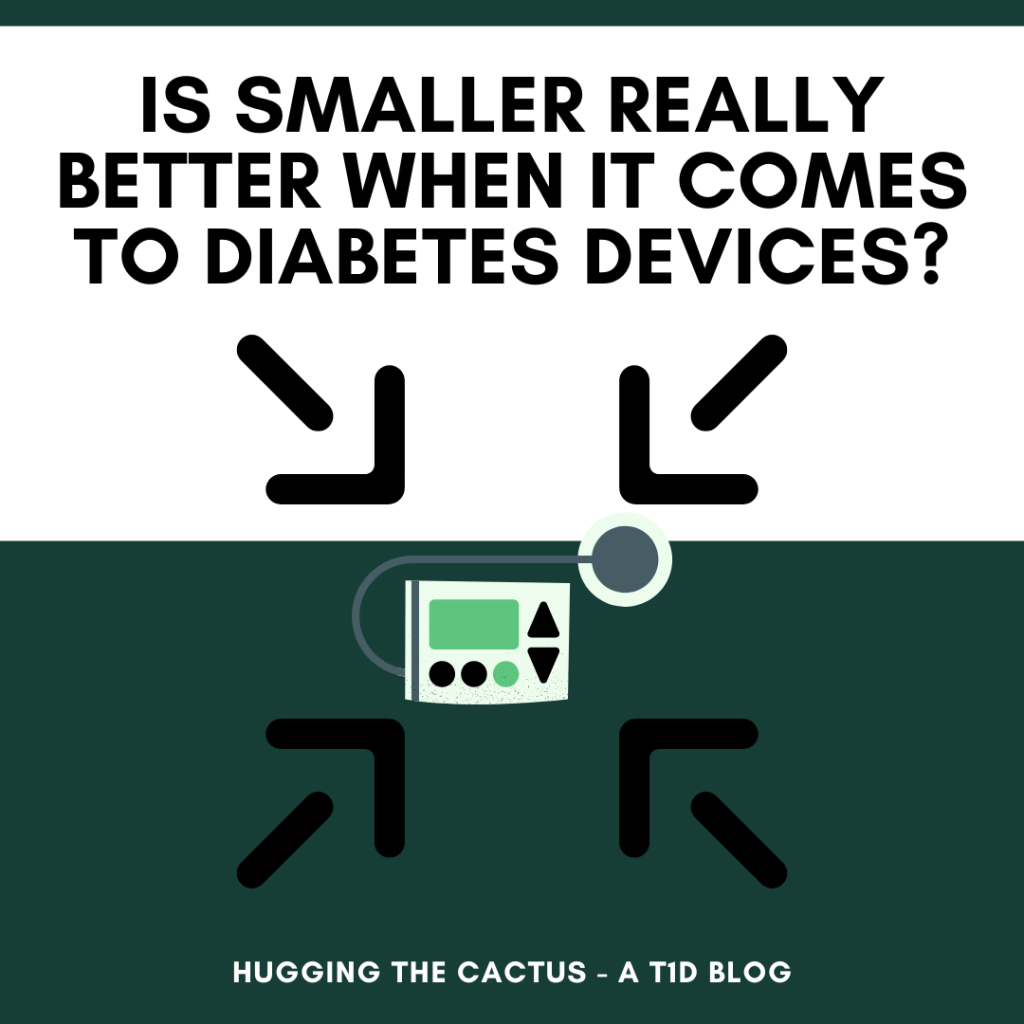
It’s said that good things come in small packages – and, at 5 foot, 3 inches, I’m inclined to agree in most cases.
But when it comes to diabetes devices, I’m not sure that saying still rings true for me.
When Tandem recently announced FDA clearance of the Tandem Mobi pump, which boasts the title of being the world’s smallest and most durable insulin delivery system, I started wondering about device sizing and best practices. As someone who tends to misplace things like my car keys and cell phone on a semi-regular basis, I usually appreciate it when my belongings are large enough to be easily visible from a distance; thereby, making them instantly locatable when I forget where I last put something down. I totally get that, as a tubed insulin pump, it’s almost impossible to misplace a Tandem Mobi (especially when it’s physically attached to a body), but I still think it’s worth thinking about the practicality of sizing for diabetes devices.
Yes, at first glance, smaller size likely means greater convenience and levels of discretion – two things that people with diabetes undoubtedly appreciate. But a pump that’s so small that it can fit inside the tiny coin pocket of my blue jeans (yes, that pocket that really serves no other purpose than to home a quarter or two) just seems like it’s begging to be lost or forgotten somewhere. Again, I’m fully acknowledging that the Mobi isn’t like my Omnipod due to the tubed versus tubeless design, but I’m imagining any component of my Omnipod system (the pod or the PDM) shrinking down in size and finding myself cringing rather than rejoicing. I just know that if either were smaller, I’d definitely be more likely to misplace my PDM more often, or fret over a teenier pod reservoir because logic dictates that a smaller pod would mean a smaller reservoir, causing a need for more frequent pod changes due to size alone.
So this begs the question: Is smaller really better when it comes to diabetes devices? Or, does small translate to convenience or annoyance for other people with diabetes? One thing’s for sure, smaller seems to be the way of the future for medical technology in general, so I may just have to get used to the idea that my diabetes devices are going to shrink over time and that I will just need to keep an open mind about that.
Don’t go into the kitchen at work, where you know there’s a platter of delectable-looking donuts, just waiting to be devoured.
Don’t do it! Don’t -!
Oh…well, you did it…at least they’re cut into quarters, so it’s not like you’re having a full donut. Just one-quarter donut is enough to satisfy your mid-morning snack craving.
Except you’ve got a post-lunch sweet tooth going on, and you’re aware that there’s plenty more goodies up for grabs in the kitchen.
Ah, another quarter of a donut polished off. Both were tasty, but no more. Not unless I want to gamble with my CGM graph and see my numbers spike due to a rapid amount of carb intake in a relatively short window of time…
The above scenario is precisely what happened to me on a day in which my self-control was difficult to reign in. But it got me thinking about self-control, in general, in the context of living with type 1 diabetes. After all, I could’ve totally gone bananas and helped myself to a whole bunch of donuts and nothing would’ve stopped me, other than the brief need to calculate my carb intake and do my best to bolus accurately for it. (And if anyone saw me scarfing down a whole bunch of donuts; well, then…I think I would’ve been extremely embarrassed so that would’ve likely stopped me, too.) Since I prefer not to consume tricky-to-bolus-for things like donuts on a regular basis, and since I’d like to avoid judgment for eating all the donuts, that might imply that I have a certain amount of self-restraint. It could also indicate that generally speaking, I make wise food decisions and only indulge in treats in limited quantities.
So with that said, does my diabetes give me a greater sense of self-control?
The donut pieces I had IRL were not nearly as pretty as these ones.
I say yes and no…because my levels of self-control fluctuate on a daily basis, much like the weather, my mood, or any other number of things.
I’m a person living with type 1 diabetes, but ahead of that diabetes diagnosis is being a person – meaning that I’m human and I deal with cravings just like anyone else. Sometimes I can satisfy my cravings with a small portion, other times I want to go wild and have multiple servings of whatever it might be that’s tempting my taste buds. And yes, there are even some times in which I can completely walk away from (or steer clear) of whatever food that’s up for grabs – whether it’s due to my blood sugar levels in the moment or because I simply don’t want the free bagels or leftover cookies from Panera. Whatever direction I might oscillate in, I take comfort in knowing that first and foremost, it’s okay to help myself to indulgences as long as I bolus responsibly, to the best of my ability, for them. I’m still working on not beating myself up for it when I don’t nail the bolus and pay the consequences in the form of high blood sugar, but at least I can say that I know myself well enough to know that this is an issue of mine.
Self-control is just a small puzzle piece in the broader diabetes management picture. It’s a component that’s worth considering in many different contexts, certainly, but it’s more about knowing where it fits in with all the other pieces and finding acceptance in the fact that it might not always stay at the same levels – just like my actual blood sugar.










 Hugging the Cactus