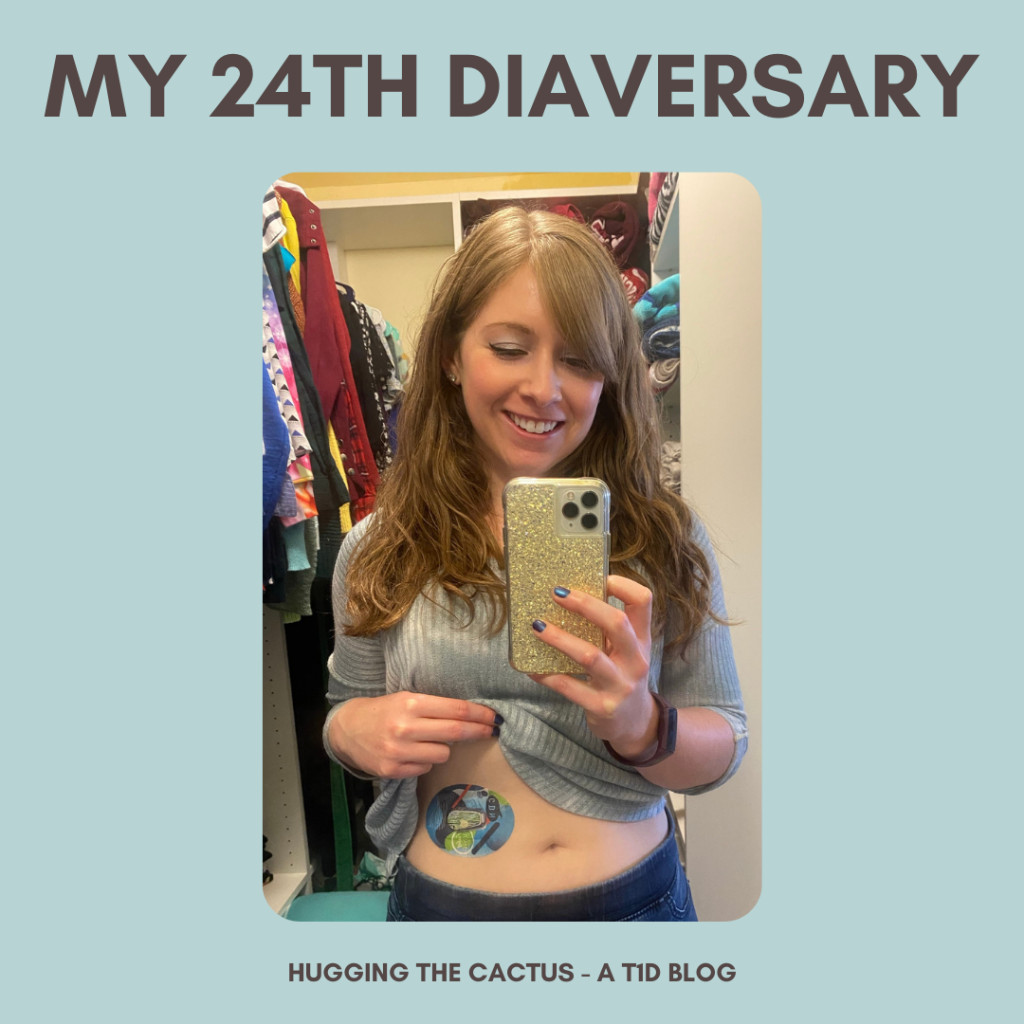
My 24th diaversary shall be known as…the one I almost forgot.
My diaversary, which falls on Christmas Eve, has never been something that I actually actively celebrate because I’m always too busy celebrating the holiday season with my family. And that’s exactly what happened this year: I was living in the gift of Christmas present (there’s a pun in there, I know) rather than reflecting on that fateful one 24 years ago.
My 24th year of living with diabetes…my, how time flies when you’ve got a broken pancreas and robot parts on the outside of your body.
It feels fitting, really, that I didn’t remember my diaversary until a couple weeks after it came and went, because this Christmas Eve was extra special in a different way. It was the first significant holiday since the pandemic hit that my entire family could be together. And I mean my entire family – I saw both my mothers’ side and my fathers’ side, and even my big brother was able to come home from Nashville for the week. So I was spending the holidays really rejoicing in the fact that we were all able to safely see one another for the first time since Christmas 2019, rather than dwelling on my diabetes diagnosis.
After all, it’s the people who surround me that make something like diabetes manageable. My supporters – family, friends, partner, dogs – are the ones who motivate me when I’m experiencing diabetes burnout. They’re the ones who let me cry on their shoulders when diabetes is too much. They’re the ones who high-five every diabetes triumph that I experience. They’re the ones who remind me that my life is not defined by diabetes (despite how much I talk about it). So with that in mind, I can get behind doing what I did this diaversary: celebrating them instead of my diabetes for every Christmas Eve to come.
I collapsed onto my dining room chair, grappling with a dinnertime dilemma as my hands shook from a swiftly dropping blood sugar:
Do I correct the low now with something sweet, and wait to eat my dinner awhile, or do I wolf down my meal and stay seated until my blood sugar stabilizes?
Both options come with their own set of pros and cons. In the first scenario, I’d be eating dessert before dinner – nothing totally groundbreaking, but not overly appealing and requiring me to account for the sweet’s extra carbs in my dinnertime bolus. But at least I wouldn’t deal with low symptoms all throughout my meal. In the second scenario, I wouldn’t be enjoying my food at all; instead, I’d hoover it down like a human vacuum and keep all my fingers and toes crossed that the complex carbohydrates would kick in as quickly as possible. On the bright side, I also wouldn’t have to eat or bolus for any extra/unwanted sweets if I went with the inhale-all-the-food choice.
But what both options have in common is that they also completely ruin the dinner experience for me by either delaying the timing of my meal or rushing me through it, neither of which is desirable.
Hey, diabetes…you weren’t invited to the dinner table.
That’s just life with diabetes, though – dealing with a series of undesirable scenarios. In this particular situation, I ended up eating my dinner as quickly as I could and my blood sugar came back up about 20 minutes after I was done with it. I was simultaneously annoyed and relieved. Sure, I didn’t get to enjoy dinner at the pace I wanted, but at least my blood sugar was back to normal. And I suppose it just makes me appreciate all the other meals that I get to eat that aren’t disrupted by diabetes, and those totally exceed the ones that do (thank goodness).
I remember my first-ever cup of coffee. I was around 10 years old. I had it at my grandparents’ house, where much of my family was gathered for some sort of holiday or other occasion. Coffee was being served with dessert, and I asked my mother if I could try some – I wanted to know why all the adults in the room were so enamored with the seemingly innocuous brown beverage.
I’d like to say it was love at first sip, but I think it was only after I poured in a hearty amount of cream and 2 or 3 Splenda packets that I felt any affection for coffee. But once I did that? I was a goner. Coffee became a staple for me. I’d get it from Dunkin’ Donuts at the mall whenever I went shopping with friends, pour a cup on the weekends to have at breakfast, and when I was feeling fancy, I’d go to Starbucks and get a couple of pumps of sugar-free syrup to jazz up an otherwise ordinary order.
But whenever I try to add anything like milk, real sugar, syrups, or whipped cream…coffee gets real dicey for me and my diabetes.
Coffee can get real confusing for a person with diabetes.
In other words? I’m at a loss as to how to bolus for things like lattes, mochas, or cappuccinos – let alone any of the crazy, carb-loaded concoctions that you can get at cafes or Starbucks.
As a result of my confusion around coffee drinks and, let’s be real here, my laziness (because I could look up carb counts, but the sugary spike that my blood sugar could experience after having one of these drinks make it not even worth it for me to do research), I tend to drink coffee black. And luckily, I like it that way. But that doesn’t mean that I’m not tempted from time to time – like when the local coffee shop that’s just a half-mile away from my home introduced a winter drink menu with things like an Irish cream latte, eggnog latte, and gingerbread latte on it. I seldom give into the impulse to try those kinds of drinks, but they sounded too good to skip out on.
So rather than have all 3 at once – because I’m not totally reckless like that – I did give the seemingly-lower-carb option a try (the Irish cream latte), while my boyfriend got the eggnog latte. I figured it was the best of both worlds because I could have a fancy drink to myself while also getting to try one of the more sugary options.
And guess what? My blood sugar didn’t spike after I drank it, not even a little bit. I think the secret to my success was being super active all morning long after I got the latte (I was busy running errands and tidying up my home for guests that were coming over later in the day). My insulin intake for the latte, coupled with lots of movement, seemed to prevent any disastrous blood sugars – and I think it also helped that I ordered almond milk in lieu of regular milk to go in the latte. Whatever the actual cause(s), I was just thrilled to learn from this little experiment that I can enjoy specialty coffee drinks after all – probably not all the time, but definitely as an occasional treat, which makes me a happy and well- caffeinated T1D.
2022 will be here in a few short days and the prospect makes my head spin. Where did 2021 go?!
Me, looking comfy as I casually ponder where the eff 2021 went.
As we approach the new year, I’m feeling several different emotions – the most prevalent one being gratitude.
Amid all the chaos of the past year that was filled with so many literal and figurative highs and lows, I can’t help but feel grateful for the many people and experiences that kept me calm in the storm. My family, my boyfriend, my friends, my dogs. The roof over my head. The opportunity to start a new job at a diabetes organization, which in turn reunited me with old friends and helped me make new ones. The chance to travel across the country and go on several weekend trips to closer-by destinations. And as often as I gripe about having so little time to myself, I’m also grateful to have such a jam-packed schedule that keeps my both my mind and body active and well.
With everything in the world feeling uncertain lately (oh, how unnervingly familiar it feels to merely say that), it’s helpful to remind myself of these things that make life so rich for me. I’m looking forward to carrying this reminder into 2022 with me and likewise, I can’t wait to continue connecting with the greater diabetes community in the coming year.
Happy New Year, Cactus Huggers – may you be healthy, well, and happy in 2022 and beyond!
This blog post was originally published on Hugging the Cactus on May 8, 2020. I’m sharing it again today because had I known these 3 tips when I first got my own health insurance plan, I would’ve saved myself from a whole lot of trouble – and headaches. Read on to learn more…
Just over 365 days ago, I made the switch from my parents’ health insurance plan to my own plan, provided by my employer.
In the last year, I’ve learned some important lessons about being responsible for my own healthcare coverage. Some lessons were easier to learn than others. I figured it might be helpful to others who just made the switch themselves (or who will be doing so in the near future) for me to sum up three big takeaways I’ve discovered along the way in the hopes that it makes the transition a little easier for those individuals, or at least saves them some time down the road.
Navigating the confusing world of health insurance has taught me quite a few lessons.
Take advantage of a flexible spending account (FSA), if the option is available. I grew up knowing that FSAs exist – my parents would always bring their FSA account cards to all my doctor’s appointments and pay for all of my supplies using those cards – but I had no idea what the big deal was about them until I switched to my own health insurance plan. Basically, FSAs are a great employer-sponsored benefit because they allow account holders to pay for eligible medical expenses on a pre-tax basis. So those who have an FSA are able to pay for things they need tax-free, and the money is typically available to account holders on the first day of the health insurance plan year. My current health insurance plan allows a maximum contribution of $2,300, so I was able to put up to that amount on my account for 2020. It really comes in handy because my wallet doesn’t take as much of a beating from all of my necessary (and very expensive) diabetes supplies, and unlike the last half of 2019, I’m not paying as much out of pocket after my deductible is met.
Keep records of everything. It might seem fussy to hold onto any and all receipts or transaction records, but there might come a day when one is needed. Case in point? At the end of 2019, my company announced during open enrollment that our FSA administrator was changing…which, at the time, I didn’t think was a big deal. I knew what the maximum contribution was, and I figured I’d only need to log into my FSA account sporadically to see how much money I had left for the year. Well…I was wrong about that. Back in February, I got a notification that I needed to submit verification of purchases of my regular OmniPod shipment, Dexcom sensors and transmitters, and my Humalog prescription. And you can bet your bottom dollar I didn’t have receipts for all three of those transactions because, well, my old FSA provider never once asked for receipts. As silly as it sounds now, I guess the thought never crossed my mind that my new FSA administrator would need purchase records. Long story short, I was able to submit an explanation of benefits in lieu of the receipts, but it would’ve been easier just to hold onto the original records (and I can assure you I’ve done that since this whole incident).
Don’t be afraid to ask questions when things don’t add up. I had my annual physical in January and I had quite the shock when I was billed over $300 for all of the lab work that my primary care physician had me do. The moment I got that charge, I knew something wasn’t right – never before in my life have I been charged that much for a standard battery of tests that I take for my physical. So I wrote in to my PCP’s billing department and asked about the charges. That’s when I learned that I was mistakenly charged this amount and that I needed to reach out to my health insurance provider to re-run the charges. Although it was a little annoying to have to go back and forth between my health insurance provider and my PCP’s office, it was worth it because I saved myself $300 that I never actually owed in the first place. This taught me the importance of asking questions and following up with people until I understand, well, anything that’s confusing to me when it comes to my health insurance.
I can’t believe Christmas is just a couple of days away!
It feels like the Christmas season just started, but really, I’ve had visions of sugar plums dancing in my head a whole lot longer than 23 days now.
Not just sugar plums, though. Christmas cookies. Homemade caramel sauce. Spiked hot chocolate. Reese’s trees (and bells, and nutcrackers, and any other shape Reese’s comes in)…
Conundrum: I love baking. I love Christmas cookies. I love tasting Christmas cookies that I’ve baked. As such, the above image of my Irish cream cookies is very tempting to me.
Needless to say, I feel like my sugar consumption is at an all-time high lately, no doubt due in part to the endless array of seasonal treats that seem to be readily available to me. This is partially my fault – I always have a stash of Reese’s in my home, and baking is one of my favorite hobbies (I feel obligated to try my creations before doling them out to friends and family, y’know, for quality assurance purposes). I should know better because I am very aware of the fact that I have little self-control, but said self-control is completely lacking lately.
So my conundrum is: Do I consume all the carbs this Christmastime and just have a “IDGAF” attitude about it? Or do I go ahead and enjoy all the delicious, carbohydrate-laden sweets of the season with minimal guilt?
I think the solution lies somewhere between those two extremes.
I won’t deprive myself of carbs, but I’ll be deliberate in how I go about eating them. I’ll pre-bolus so sugary spikes won’t appear as often in my Dexcom graphs. I’ll look up carb counts when I can. I’ll enjoy things in moderation, eating one treat at a time or sharing with others when I can so my carb intake gets automatically halved. And I won’t stop baking – it’s one of the things that brings me joy in life, so I know better than to cut out that entirely.
Besides, the Christmas season is so fleeting. I should indulge a little here and there and remind myself that it’s not just about the carbs and blood sugar spikes that cookies cause…it’s also about the holiday traditions associated with cookie baking and the memories made when eating them (and all the carbs). That fuzzy feeling makes me feel a whole lot better about my carb conundrum; coupled with my plan on how to approach carb consumption, I’m actually looking forward to eating many more Christmassy confections over the next few days.
This post was originally published on Hugging the Cactus on December 16, 2020. I’m sharing it again today because this was a fun and festive (if not messy) craft that I did with an insulin vial that I saved. Currently, I have about a dozen or so empty insulin vials set aside and I’m wondering what kind of craft I should do next…
I love Christmas, crafting, and some might argue that I love T1D (that’s mostly false, but when you’ve got a chronic illness, you’ve got to learn how to love some aspects of it…otherwise, you’ll be miserable).
So I recently *attempted* to combine all three of these things and do a little DIY project with an empty insulin vial.
And I learned a few things along the way…
I do not recommend messing with a glass vial without safety glasses, gloves, and a trash can nearby. I was lucky enough to avoid any major glass breakage, but some did happen, and I could totally see this craft getting wicked messy and potentially ouchie without taking the proper precautions.
Insulin vials are stable AF…they are not meant to be tampered with.
Glitter cannot be directly injected into an insulin vial. Period, bottom line, don’t even try it.
Okay, so now that I’ve got my disclaimers/lessons learned out of the way, let me tell you why I decided to fill an empty insulin vial with gold glitter.
For years, I’ve seen DIY projects floating around online involving old diabetes supplies. They range in the level commitment and skill involved, but there’s no questioning the creativity of our community when it comes to recycling supplies we’d normally throw away after using.
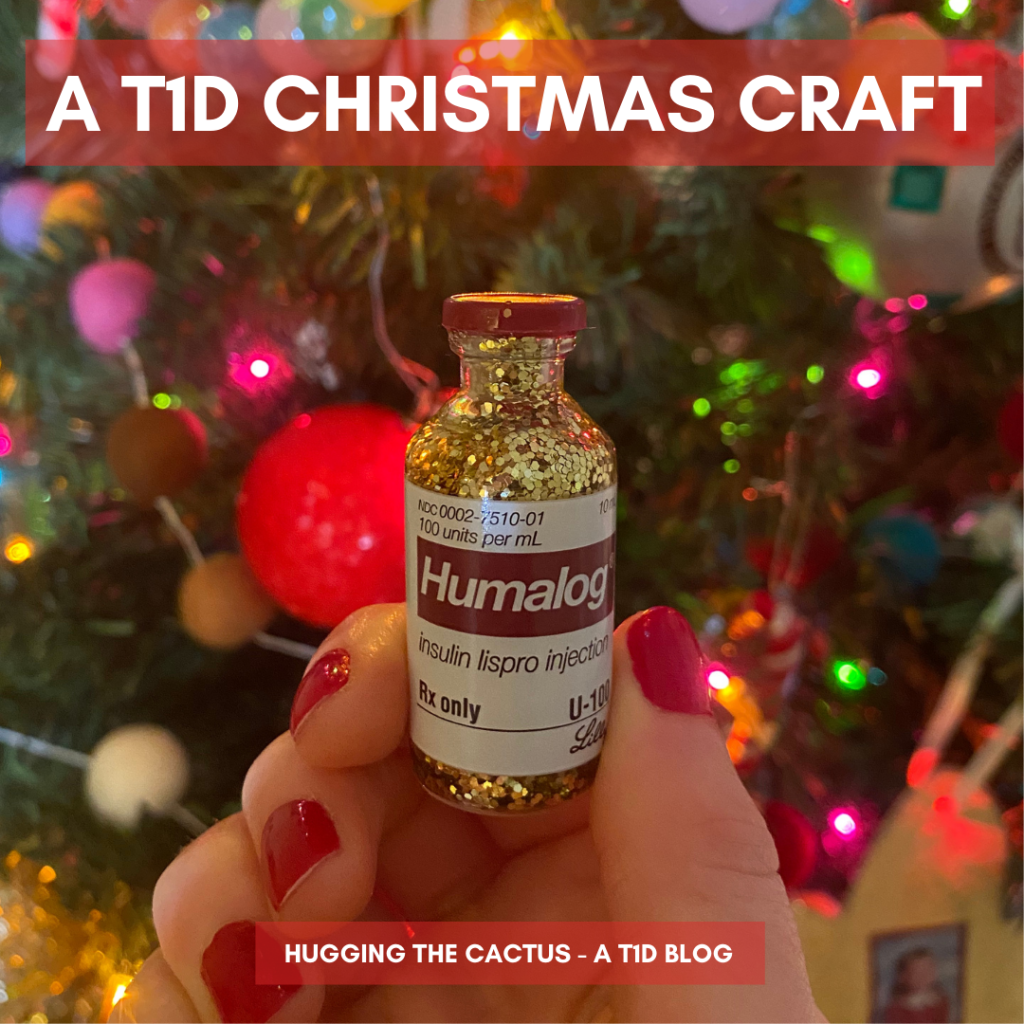
One project that I’ve seen over and over again is transforming an empty insulin vial into a Christmas ornament: Simply stick an ornament hook into the insulin vial’s rubber top, hang it on a Christmas tree branch, and bask in its beauty. I decided to take this concept to the next level by putting gold glitter into the vial because insulin is often referred to as “liquid gold” within the diabetes online community. What better way to represent that than to make it appear as though the contents of a vial were truly liquid gold?
In order to do this, I set aside a vial once I was finished with it/sucked every last drop of insulin out of it. Then, I made a sad attempt at combining glitter with water and using an old syringe to transfer it to the vial (needless to say, I had no luck). So I came up with a new strategy: Pierce the rubber stopper and try to funnel glitter in…and that didn’t work. It became evident that I’d have to remove the top entirely, so using my nifty new toolkit that my father just purchased for me (thanks, dad), I set about the task. I used a razor to carve the rubber stopper up and out, and then pliers to get the metal maroon covering off completely. I broke off a small piece of glass in the process – whoops – but using those tools did the trick for me…all I did after that was take the cap from a new vial of insulin and glued it to the top of the glitter vial to ensure most of its sparkly contents would remain inside.
And voila, here’s the end result:
Despite the glass breaking off, this DIY came out better than I expected.
As I held the glittery vial in front of my Christmas tree for a few photos (if I didn’t take pictures, then it didn’t happen), it occurred to me that there’s a strong likelihood that many families will have to make a difficult choice this holiday season: Give a special gift to a loved one, or use that money to pay for insulin instead. Or even more seriously, to have to choose between making this month’s mortgage/utilities payments, or getting life-saving medication.
The thought shook me, as nobody should have to make a choice like that ever.
And so I thought of something to add to my Christmas wish list: affordable insulin for all.
There is no doubt about it: My favorite candy in the entire world (in fact, one of my favorite foods ever) is the utterly irresistible Reese’s cup.
Something about the combination of smooth, salty peanut butter and sweet milk chocolate speaks to my very soul – or perhaps it’s more accurate to say my taste buds. I know that I’m not the only one who feels so passionately about Reese’s (in any shape or form) – in my immediate circle, it’s the candy of choice of my mom, my boyfriend, several coworkers, and countless of other T1Ds that I know in the community.
Oh Reese’s, how do I love thee? Let me count the ways.
Besides the impeccable taste, what is it about Reese’s that is so appealing to people with diabetes, specifically? I pondered this as I had a conversation with one of my coworkers who does not have T1D. She mused that it could be because of the higher protein/fat content of Reese’s compared to other candies, which could make it easier to bolus for. I found myself agreeing with this notion – Reese’s doesn’t cause major spikes to my blood sugar, unlike Skittles, Sour Patch Kids, or Gummi Bears. The peanut butter in a Reese’s probably causes it to have a lower glycemic index, meaning it takes longer to process in the system. And according to the very little research I’ve done, nutritionists tend to agree that Reese’s are a relatively smart candy choice for those reasons, and in spite of their higher sugar content.
Beyond this, though, I honestly don’t know why so many people with diabetes that I know rank Reese’s as their number one candy. But I do know this: We’re definitely right about it being number one. And I can get behind any excuse to eat more Reese’s – bolusing properly for every one that I have, of course.
So it was with zero shame that when I recently picked up my 90-day supply of insulin from the pharmacy, I also added 3 bags of seasonal Reese’s shapes to my basket…they are absolutely worthy of me using that insulin on in the coming weeks!
“Gimme a sec, I’m multitasking right now…owwwwwww!”
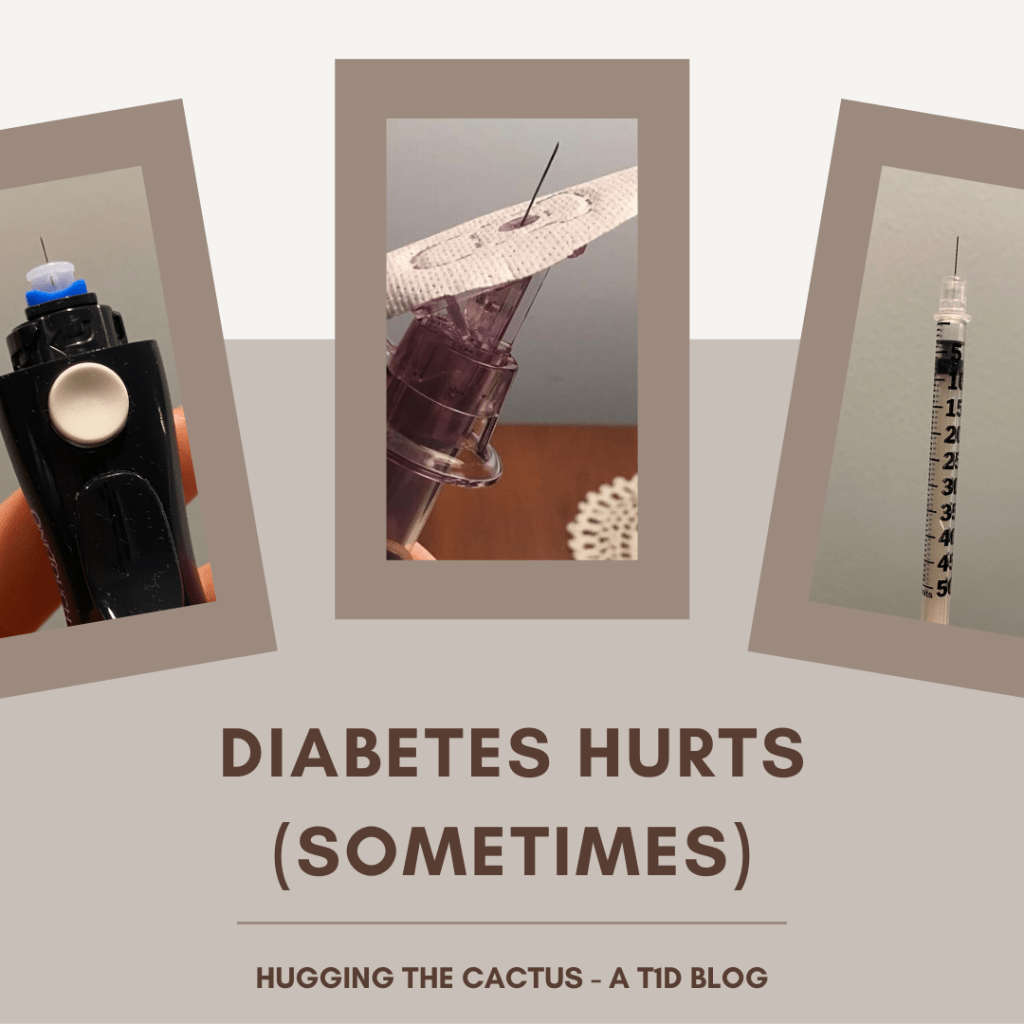
I was talking to my boyfriend on the phone and changing my Dexcom sensor at the same time when I was caught off-guard by (and yelped in surprise at) the sharp sting of the sensor’s needle plunging into my arm. It was a sting that evolved into a burn that lasted a solid 24 hours, much to my discomfort.
Examples of just a few of the many needles that I’m constantly poking myself with.
People often ask me whether or not my diabetes devices hurt. The answer is almost always no, because I’ve grown accustomed to the constant pricks and pokes. But once in a blue moon, I have a sensor or pod insertion that hurts so badly that my eyes well up with tears or I have to deal with a night or two of uneasy sleep, because it aches any time I roll over onto the stinging site.
It doesn’t matter that I’ve had at least 30,000 (yes, I did the math) shots and site changes over the years – diabetes still hurts, sometimes, and that’s just talking about the damage it does physically.
Diabetes hurts mentally, too, though that type of scarring is a whole lot more difficult to quantify.
The bottom line? Diabetes doesn’t hurt all of the time, but on the rare occasions it does, it’s a painful reminder that this is just the way of life for people like me who’ve got no other choice than to deal with it.
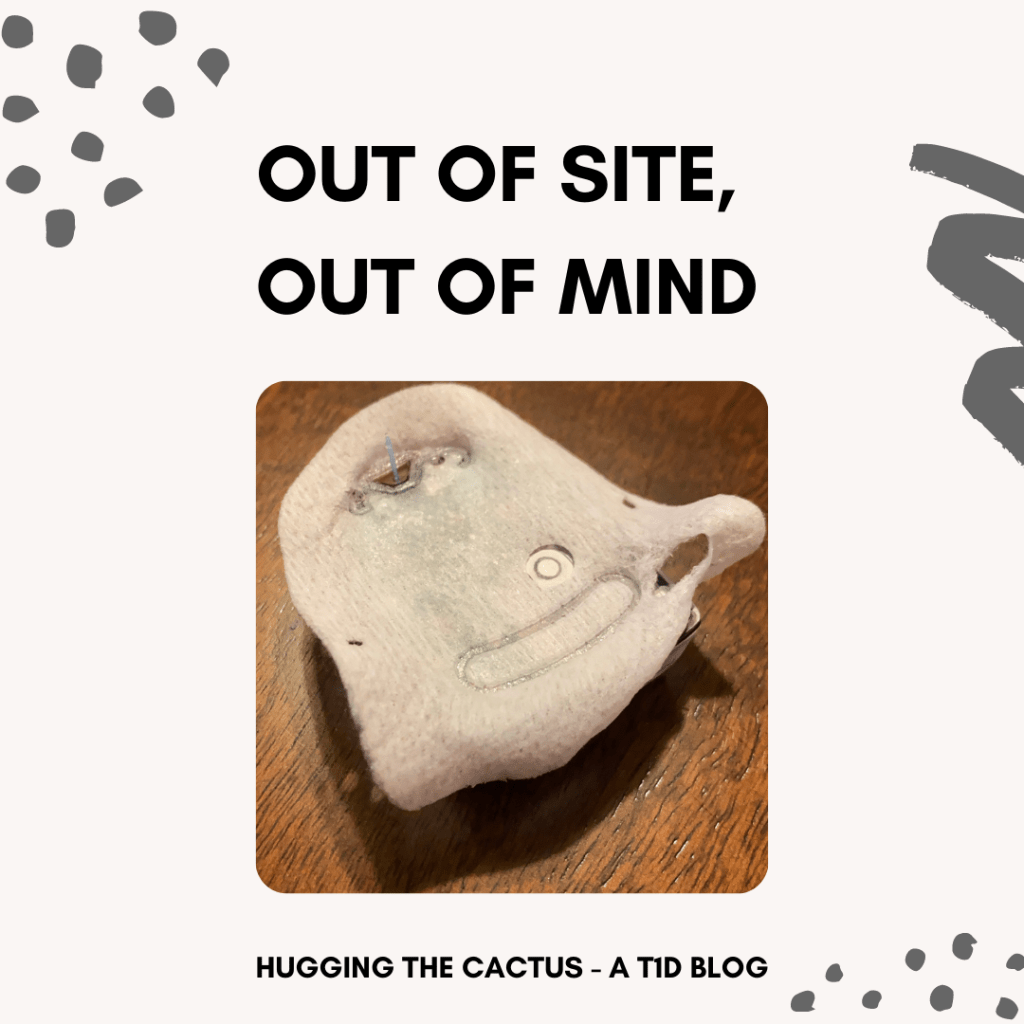
I knew I wanted to write a blog post about how I forgot to change my pod last week, and I knew I wanted to give it some sort of clever title…
…so out of site, out of mind is what I came up with. After all, my pump site was completely out of sight for me, which is one reason why I forgot it.
You’d think that it’d be impossible to forget about the device I have to wear 24/7, but it’s the sort of thing you get used to pretty quickly.
You’d think that after being on the Omnipod for almost 7 years, I’d never forget that I have to change my pod every 3 days. But just like I sometimes forget to reply to a text message or take a load of laundry out of the dryer, it slipped my mind the other night until just before I went to bed.
That’s when I was faced with a choice: Should I change the pod right then and there before I went to sleep, or let it expire overnight and change it first thing in the morning?
There were pros and cons to each. If I changed the pod before bed, then I wouldn’t have to worry about a screaming pod waking me up in the wee hours of the morning (well, I would if it failed, but the chances of that happening were small). But if I waited until the morning, I would ensure that the 30+ units of insulin still left in the pod would get used up as much as possible. It would also mean that I could push back my regular pod change by one whole day, which sounded appealing – until I remembered that it would mean that I’d have to change my pod on a Saturday when I’m double-hosting family, then friends, at my home.
So I sucked it up and changed my pod before going to sleep, knowing that in an hour and a half it would go off to remind me to check my blood sugar (to make sure that the pod was functioning properly), but feeling okay about this because I’d much rather deal with a gentle reminder over an aggressive malfunction alarm.
Now to the whole reason why I decided to share this seemingly insignificant anecdote in the first place: This is just one diabetes-related decision that I had to make on this particular day. I can’t even tell you how many other choices I had to make prior to this concerning which foods I ate, how much insulin I took, when I exercised, when I ate my meals, and so forth.
Diabetes is a disease defined by decisions. Fortunately, this one about when to change my pod was an easier one to make…but unfortunately, there are many others that are much more difficult. And I think all people with diabetes deserve goddamn decision-making trophies because of the funny conundrum of having no choice but to live life by making decisions.





 Hugging the Cactus