Spare a Rose and Save a Life this Valentine’s Day

The world has turned upside down in the last couple of years, but some things remain the same. For instance, we still celebrate holidays and special occasions with those we love. And today just so happens to be a holiday that’s all about love!

Valentine’s Day…whether you adore or abhor the day, it exists. It’s a day that’s synonymous with chocolate, love, and flowers; more specifically, a dozen red roses.

A dozen red roses is a classic Valentine’s gift. But what if you received 11 roses in your bouquet, instead of 12? What if you knew that a rose was spared because the value of that flower helped provide insulin to someone who needs it to live?

I bet you wouldn’t mind getting one less rose in that case. And it might just make you like the holiday a little bit more!

Who knew that the value of a dozen roses could pay for a child with diabetes to live another year of life?

A little bit of history: Nearly 10 years ago, folks from the Diabetes Online Community (DOC) started the Spare a Rose campaign for the organization Life for a Child. This campaign was able to give insulin and diabetes supplies to children and young adults with T1D in under-resourced countries. Starting in 2022, these individuals looked at how they might be able to support all people with diabetes, seeing as the need for insulin and related supplies and care lasts well beyond childhood.

Thus, Spare a Rose, Save a Life was born! Donations to this campaign go to Insulin for Life, a charity that provides resources, education, and advocacy to many of the same under-resourced countries that were supported by the original Spare a Rose campaign.

It’s an absolutely wonderful idea that will positively impact – and save the lives of – even more people living with diabetes who need access to vital medication, supplies, and healthcare.

I’ve written about the Spare a Rose campaign for the last few years on this blog because it’s a beautiful way to celebrate a day that makes some swoon and others sick to their stomachs. A common complaint among people in this day and age is that too many holidays are all about raking in the dough for companies like Hallmark; in other words, most holidays have lost their original meaning and have become too commercialized.

So here’s your chance to bring back some significance to Valentine’s Day. In the light of the health challenges the world has collectively faced in the last couple of years, it’s more important than ever that we do all that we can to help people with diabetes access life-saving supplies and care.

Learn more about Insulin for Life, Spare a Rose, and donate here.
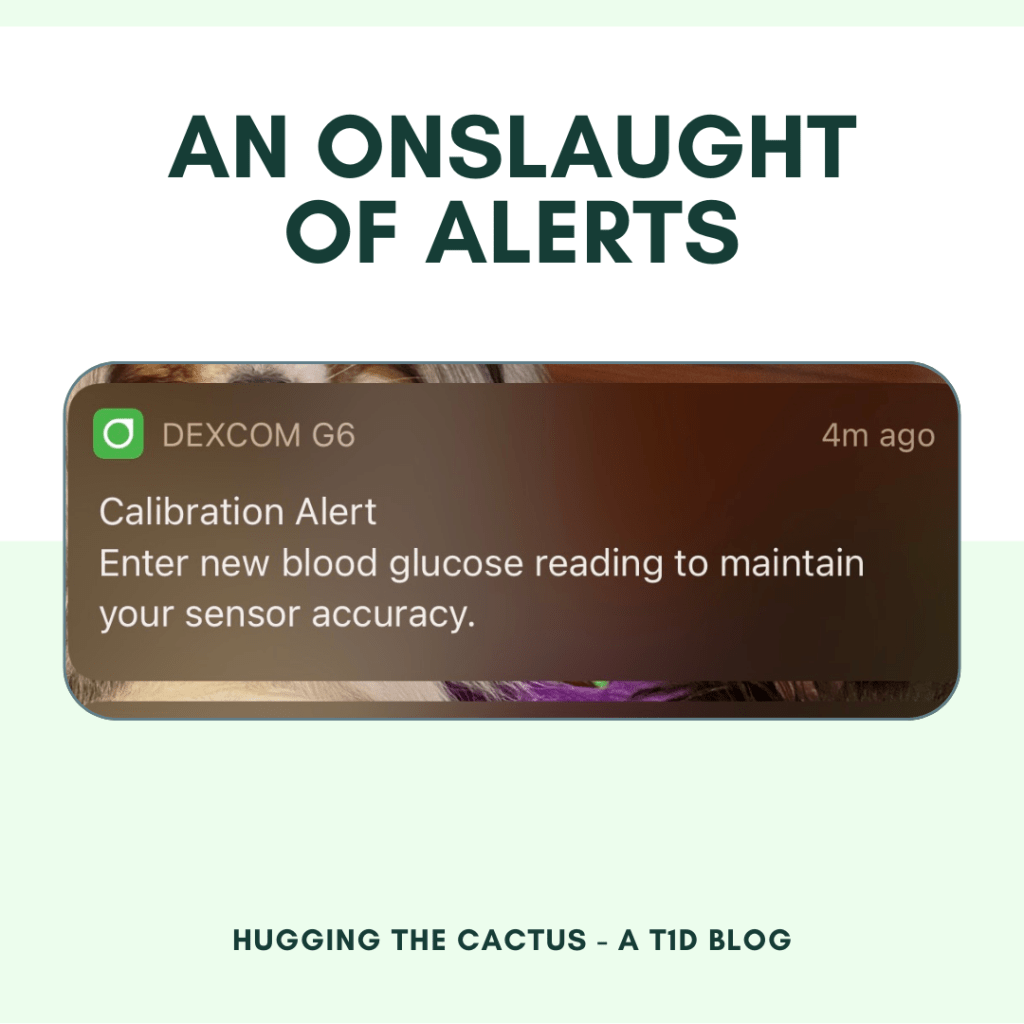
An Onslaught of Alerts

Imagine receiving the same notification on your phone every 5 minutes…over and over again…nonstop until you actually do what it’s demanding to you.

Sounds maddening, right?

Well, that’s exactly what I experienced with my Dexcom app recently. Every 5 minutes on the dot, I got a “Calibration Alert” push notification that told me to “enter new blood glucose reading to maintain your sensor accuracy”. Doesn’t sound like too big of an ask, right? Why not just do it?

Of course I just did it – the first handful of times that it asked. But when this alert persisted to appear on my phone each day, around 24 hours after I’d calibrated my Dexcom sensor, I started to get super irritated. But I was also confused. I shouldn’t have to calibrate my Dexcom, like, ever. The G6 was designed to make it so calibrations are a thing of the past. I only ever even bother to calibrate it within the first few hours of wear if I feel that the blood sugar it’s reporting is really off, and that usually forces it to correct itself and show far more accurate readings fairly quickly.

So why was my Dexcom being so forceful with the reminders for me to calibrate?

Imagine seeing this alert pop up on your phone…every 5 minutes…for an hour…or 3. That’s a few dozen reminders too many.

I knew that my best shot at finding the answer to this question was by going to the people who are intimately familiar with the ins and outs of Dexcom devices – no, not the manufacturers themselves. I’m talking about my colleagues, of course. (One of the best parts about working at a diabetes nonprofit is that my coworkers and I collectively have 100+ years of diabetes experience under our belts and constantly ask one another for advice or wisdom regarding various diabetes scenarios.)

When I asked them if they’d ever encountered anything like this, one person explained that the CGM can get a little confused if, when after the initial two-hour warm-up period, a super high or a super low blood sugar can trigger the system to get stuck – almost like it’s unsure of what it’s reading. This tracked for me because when I started up this particular sensor, the two-hour warm-up period collided with a particularly nasty low blood sugar of 35. That blood glucose value is low enough that the system can’t even pick up the number “35” – instead, it just shows that I’m “LOW”.

So as a result of this, my sensor was likely just in need of calibrations every 24 hours just to make sure it was working properly. It’s probably in the code of the software or something to prompt users to calibrate every day until the system feels more confident about what it’s reading. That makes sense and all, but dang, is it annoying. Sure, I could’ve silenced the alarms a lot faster if I just calibrated whenever I got the first alert of the day, but my schedule didn’t always allow for that. And besides, after 4 or 5 years of using the Dexcom G6, this T1D has gotten used to no more finger pricks; because of that, it’s hard to go back to old habits.

But hey, it has wound up being another diabetes scenario that I hadn’t experienced yet and just another lesson learned, so while it may have been a bit of a nuisance it was also educational. And I’m okay with that.

What I’m Looking Forward to the Most About the Omnipod 5

I experienced many emotions when it was announced, at long last, that the Omnipod 5 received FDA approval. The most prevalent one was joy: I was elated for myself, my mom, my coworker MJ, and all other people with diabetes who have greatly anticipated this day for what felt like ages. The thought that so much of the heavy weight associated with life with diabetes will soon be lifted off our collective shoulders is one that is thrilling beyond words.

Besides joy, I felt anxious (when will we actually have access to this technology?!), hopeful (the wait is bound to be worth it), surprise (I hadn’t expected the FDA approval this early into 2022), and…relief. That last emotion was probably the one I felt most strongly right behind my joy, and that’s because I’m taking solace in knowing that my secret diabetes struggle will be no more with the help of the Omnipod 5. And this leads me to the explanation of what I’m most looking forward to about the Omnipod 5…

I cannot wait to get my hands on the Omnipod 5…but for now, I’ll have to settle for staring at this promo image of it.

…and that is sleep. Yes, sleep. More specifically, sleeping soundly through the night, every night. Because my secret diabetes struggle has gotten in the way of that to new extremes in the last several months.

Long story short (I’ll save the long version for an upcoming blog post), my sleep is disrupted perhaps 3-4 times per week due to a low blood sugar. It’s annoying, sure, but part of the problem is my complacency in the matter. As crazy as it may sound, I’ve grown accustomed to the sound of my Dexcom alarming at any hour of the night and rolling over to grab a low snack from my nightstand drawer.

I think it’s been so easy for me to make peace with because of all the diabetes battles I could pick and choose (for example, if I had to choose waking up for lows or dealing with high blood sugars for hours on end any time of day), it’s the one that seems the most painless compared to every other possible scenario. It’s a weak explanation for this behavior, but it’s the best one I’ve got and I think that some people living with diabetes could probably understand (or even relate to) this rationale.

So that’s why I get a little teary-eyed thinking about how the automated insulin delivery mechanism of the Omnipod 5 could help reintroduce truly restful nights of sleep back into my life.

They are tears of joy, anticipation, and hope over how this new piece of technology may very well help me (and countless other people I love and care about) reclaim so many aspects of life that “normal” people take for granted.

You Should Feel Empowered to Advocate for Yourself and Your Diabetes

This was the message conveyed to me after one of the best endocrinology appointments I’ve ever had, at least in my adulthood.

I’ll confess that I was nervous going to my first endo appointment of the new year. I didn’t know what to expect as I wasn’t bringing any specific concerns with me – besides the fact that I was upset about a conversation I’d had with a different doctor regarding a separate issue.

After the nurse practitioner and I exchanged pleasantries, she sat down at the computer screen that was displaying my record and asked me what I wanted to discuss during our appointment.

That’s when it all came flooding out.

I babbled about how I didn’t have anything in particular I wanted to talk to her about besides the fact that I got a very discouraging message from a doctor who told me I needed to have better control over my diabetes, and that this was infuriating to me because 1) not all of my health concerns can be blamed on my diabetes and 2) it was disheartening to be told by one subset of my health care team that I’m doing great with an A1c of around 7, but to hear from another subset that I’m not doing great and need to work harder. Once I finished my train of thought, I braced myself for a less-than-favorable reaction.

But that’s not what I got.

I’m really glad that nobody walked into the exam room as I was taking goofy selfies like this.

Rather, my NP asked me to explain my concerns in greater detail. She sat, listened, and told me that she disagreed with the comments from my other doctor’s office. It was validating to hear someone who actually does work in diabetes reassure me that, for starters, my diabetes might not necessarily be to blame for any other health issues I was experiencing. She also made me feel better about my A1c and that my track record proves how hard I’ve worked over the years to maintain a 7 (or below) and that it’s not indicative at all of a lack of control over anything.

Best of all, when I sheepishly admitted to her that I’d been embarrassed to write in about the health concern in question, she reminded me that I should always feel empowered to advocate for myself and my overall wellness. It was an incredibly powerful message for her to convey to me, seeing as my self-doubt had manifested itself in full-force over this whole interaction with the doctor’s office. And it’s a message that I plan to carry with me to future doctor’s appointments to help ensure that I do stay on top of my health to the fullest extent possible, while also making my voice heard.

At the end of the appointment, my NP turned and said to me that I’m an inspiration. While I don’t exactly agree with her words, I can’t remember the last time I left an appointment feeling truly understood as a patient living with type 1 diabetes. That’s what’s inspiring to me…the fact that a physician took the time to recognize the hard work it takes to live everyday life with T1D. And the discovery that my A1c has dropped by .3 to a level that I’m very proud to have reached – well, that’s the cherry on top of my first endocrinology visit of 2022.

“You Need to Have Better Control”

I read those six words, all strung together in a terse message from my doctor’s office.

Not exactly the response I was anticipating when I reached out to them to express concerns over a minor health issue I was experiencing…

Let me back up a bit. In early January, I decided to message one of my doctor’s to discuss said minor health issue. A week went by and I didn’t hear anything from them, so I sent them another message, reminding them gently that I was hoping for a reply sooner rather than later. Several more days pass by and I start to get annoyed, but I still keep everything in perspective: Maybe they’re understaffed at the moment. Perhaps a computer error prevented them from getting my messages. Or they might be just crazy busy with beginning-of-the-year appointments and responsibilities. Whatever the case may be, I decided to message one more time, drawing attention to the fact that my first message had been sent two weeks prior and that if I didn’t hear back by the end of the week, then I’d just call the office to hopefully connect with a nurse.

Luckily, it didn’t come down to that because within 48 hours of me sending that third message, I finally heard back from someone. And this someone said something that left me a bit gobsmacked:

“…with an A1c of 7 – you need to be better with your control.”

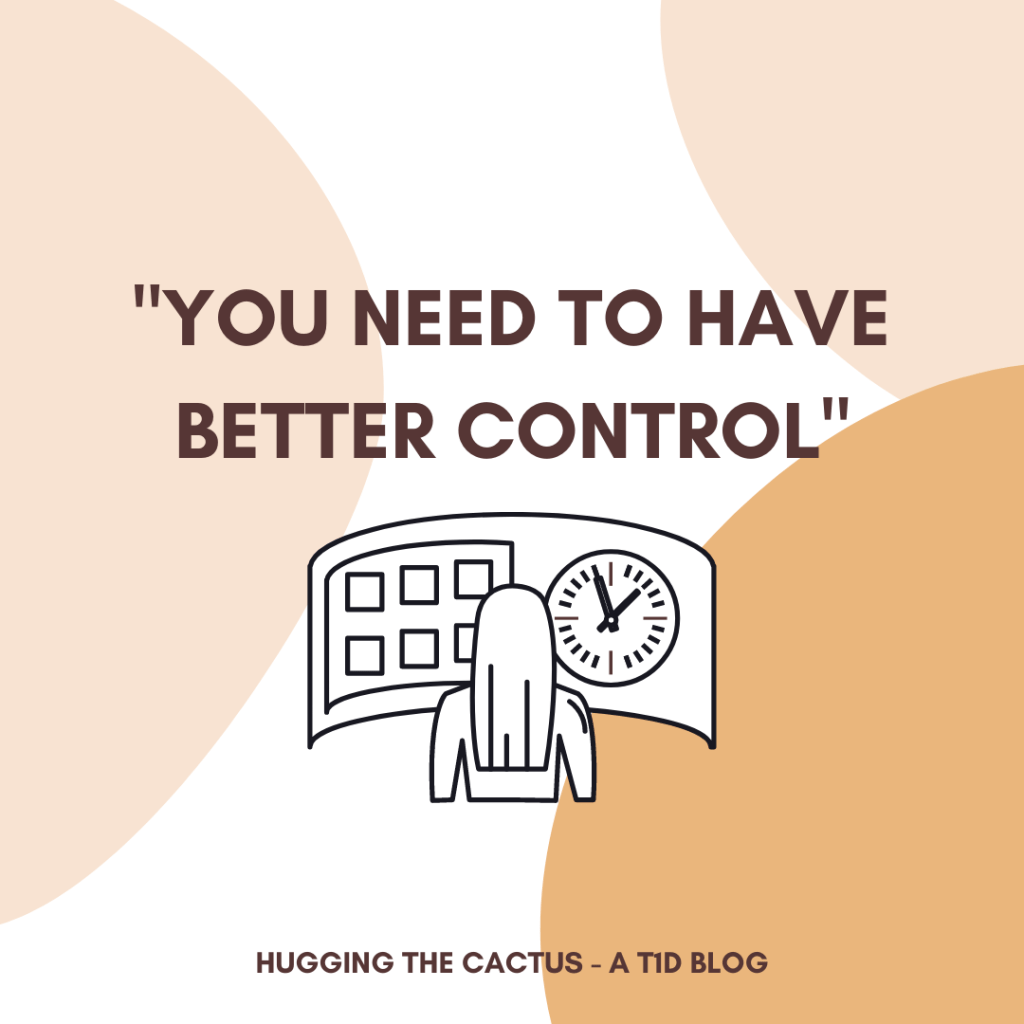
Life with diabetes often feels like this image – like you’re the only one in the control room of a command center that dictates whether or not you live. And yep, it’s exhausting.

I couldn’t believe what I’d just read, for multiple reasons. For starters, I’d mentioned in my first message that I *think* my A1c was right around 7, but I couldn’t be sure because it’s been a bit since I last had my A1c checked. So clearly, by reading the response from my doctor, nobody had gone in to check my records or look up my historical A1c – which may or may not have provided them with better context so they could answer my question better, but that’s besides the point. What had me most irate was the fact that I’ve been told – time and time again – that I’m doing a great job with an A1c around 7. I’ve had endos and nurse practitioners alike tell me that I don’t need to make any major changes and that I’m too hard on myself when I express a desire to get a lower A1c. So to have a completely different medical professional make a snap judgment right then and there that implies I do not have control over my A1c is obviously in direct conflict with what I’ve heard from others. How maddening is that?

Furthermore…I’m sorry, but A1c does not paint a complete picture of my “control”. I believe, along with many other people in the diabetes community (including medical professionals) that time in range is where it’s at. The amount of time I spend in range is leaps and bounds better than where I was in college – and honestly, so is my A1c.

This is why it’s incredibly frustrating to me that this person handled my health issue as though it was directly related to my diabetes and their perception of my lack of control. The three-sentence, curt reply to my initial message didn’t exactly help matters either, though I’m trying to not read too much into that…after all, you can’t gauge tone via written message.

I’ve decided the best way to handle this whole exchange is to bring my issue up again when I see this doctor later in the year. I’m not going to reply in the message thread, because I don’t see how that would cause any good, but I will bring this up when I go to see the nurse practitioner at my endocrinologist’s office at the end of this month. While she likely can’t fully help me address my health concern, she’s bound to provide me with some insight and some actual helpful advice that won’t involve her jumping to conclusions about my control. We’ll see how it goes.

For now, I will just have to try to keep my head held up high by taking control of the situation, if not my diabetes.

The Best (and Worst) Insulin Pump Infusion and CGM Sensor Sites

This blog post was originally published on Hugging the Cactus on April 1, 2020. I’m sharing it again today because it’s actually one of – if not THE – most popular blog post I’ve ever written. Maybe folks find it helpful as they ponder trying new sites or maybe they’re simply curious to learn what has and has not worked for me. Don’t worry, I spill all the details on everything – read on to get the full scoop!

Add a heading

Like many other people with diabetes, I wear two devices on my body at all times: my insulin pump (my pod) and my continuous glucose monitor (CGM). And I’m often asked whether or not these little gadgets are painful.

Fortunately, the answer is that most of the time, they aren’t. I rarely feel it when my CGM sensor or my insulin pod’s cannula pierce my skin, which makes the whole experience of wearing them a lot more comfortable – and much less dreadful when it’s time to rotate sites.

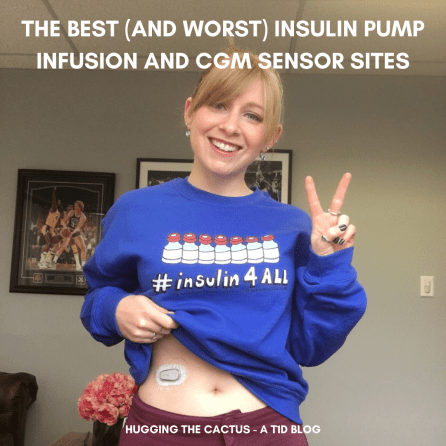
Speaking of sites and pain, though, I admit that there are some sites that, for me, tend to work better than others. The following are the different locations I use for my pod and CGM sensors, in order of what tends to be best to the worst. My stomach is my preferred spot for my pod AND my sensor.

Stomach: This is the site at which I have the best insulin absorption, so it’s a clear winner for me when it comes to my pod placement. I also find that it almost never hurts when I press up against the pod (e.g., when I roll over in bed in the middle of the night) when it’s on my belly. The same is true for my CGM sensors, which also seem to be the most accurate when they’re placed on my abdomen. I guess there’s a reason why the stomach site is the only one recommended by the FDA for the Dexcom CGM (which is what I use)!

Lower back: I have yet to try my CGM here, but I often place my pod on my lower back without issue. This site can be trickier to navigate because if I forget that my pod’s there when I’m getting dressed in the morning, I can come precariously close to accidentally knocking it off – and I have in the past. Plus, the pod can rub up against me in an unpleasant way when I’m working out; specifically, doing any sort of abdominal exercise on the ground. But it’s not something I can’t tolerate, and the insulin absorption in this location is just too good in general for me to pass over it altogether.

Upper arm: I wear my pod and CGM on my upper arms sometimes, but they don’t always adhere well for some reason. Getting dressed can be even more problematic for me if I forget that my sites are on my arms – I’ve totally ripped off pods and sensors when I’ve been taking off and putting on clothing. And for a long time, my CGM sensors would make me bleed when I inserted them in my upper arm. I never figured out why, and the problem seems to have gone away, but it definitely made me a little more wary about using my arms as a site (PLUS any devices I wear on my arms are highly visible, and I don’t always like it when people stare at them).

Thigh: Hands-down, the worst site for my pods are my thighs. For starters, wearing denim jeans – especially if they’re skinny jeans – are such a feat when wearing a thigh pod. The fabric pushes up against the pod in such a way that I prefer wearing dresses, skirts, or leggings for the three days that I have a thigh pod just so I can be more comfortable. And speaking of comfort, it’s tough for me to get into a cozy sleeping position when I have a thigh pod because I like sleeping on my stomach sometimes, and there’s just too much pressure up against my pod when it’s on my thigh. And for me, it seems that insulin absorption just isn’t great on my thighs (maybe because they’re on the muscular side). BUT, I will say…I recently tried a CGM sensor on my thigh for the first time and I didn’t hate it! The accuracy was good and it wasn’t in the way as much as a thigh pod (I keep wanting to type “tide pod”) would be. I’ve only had it on my leg for a few days now so I don’t know yet how the adhesive will hold up, but I’ll find out.

Spots I haven’t tried yet (but want to): On social media, I’ve seen people wear Dexcom sensors on their forearms (eek), upper butt cheek (tee-hee), and even on their calves. And pod placement can get even wilder with spots in the center of the back (HOW can people reach back there) and, um, the upper-breast area (one word: ouch). While I don’t think I’ll ever work up the courage to try some of those spots, I am curious about others.

The bottom line is, though, that the sites that work best for me might not work as well for you. (The same thing can be said for my worst sites.) But it is important to remember, above all, the importance of rotating sites…even though I’m clearly not a huge fan of pods on my legs, I’ll still suck it up and place them there because I know that I should be careful of scar tissue buildup.

It just makes the pod-and-sensor-change days that much more pleasant when I can move them from a disliked site to a favorite site, anyways.

T1D and “What If?”

For me, my type 1 diabetes, anxiety, and the phrase “what if” go hand-in-hand. Or maybe in this case, it should be sweaty-nervous-palm in sweaty-nervous-palm.

In the past, I’ve written about how I believe there is a direct connection between the way my anxiety manifests itself and my diabetes. There’s no denying that the two are related. But another thing that ties the two together in a neat, worried package are these two simple words…”what” and “if”.

Of course, those two words are often followed by a series of other words that turns everything into a full question that is born from my anxiety. The questions all follow the same formula: What if X, Y, or Z happens? Questioning whether something will or will not happen will inevitably trigger me to convince myself that a less-than-desirable scenario will occur, leading me to slowly spiral as I ponder how I can possibly handle said less-than-desirable scenario.

Not following me here? I’ll give you an example. Take my incident last week when I mistakenly gave myself 10x more insulin than I intended to take (10 units versus 1 unit). When I was processing the gravity of that mistake, I asked myself, “What if I’d given myself 100 units? What if I’d been alone when all this happened?”, causing me to think about how much more dire that situation would’ve been and sending chills down my spine. It’s not fun to go down a path like that, yet for much of my life I’ve forced myself to face many “what if” scenarios that have never even happened because my anxiety lead me to that line of thinking.

After 24 years of T1D, though, and living all of my years with anxiety paralyzing me every now and then, I’m trying harder to challenge the “what ifs” and stop allowing them to rule my life, not just my perception of my diabetes.

“What if…”

I guess this is my public declaration, or vow, or affirmation, or whatever you’d like to call it that I want to be better about knocking those “what ifs” out of my way when I feel as though T1D or my anxiety are limiting me. I’m hoping to stop thinking about diabetes as a condition in which I’m held back by “what if” scenarios or one that aggravates my anxiety; instead, I want to have it be more autonomous and separate it from the negative thinking that all too often interferes with my everyday life. I’m just tired of thinking about diabetes with a “worst-case” mindset, so what if…what if I take back control of the “what if” and say “what if I have a really great diabetes day today? or “what if I know more about managing diabetes than I previously thought I did?”

Changing the overall tone of those what ifs sounds like hard work, but it also sounds like worthwhile work. So I’m challenging myself to do it, stick to it, and think…what if I could change how I feel about my diabetes and anxiety, and grow to love them for how they’ve made me stronger, more independent, and brave?

What if, indeed.

The Major Diabetes Mistake I Made

I recently experienced a diabetes first: I bolused myself for 10 units of insulin instead of the one, single unit that I had intended to give myself.

Whoops.

Major whoops.

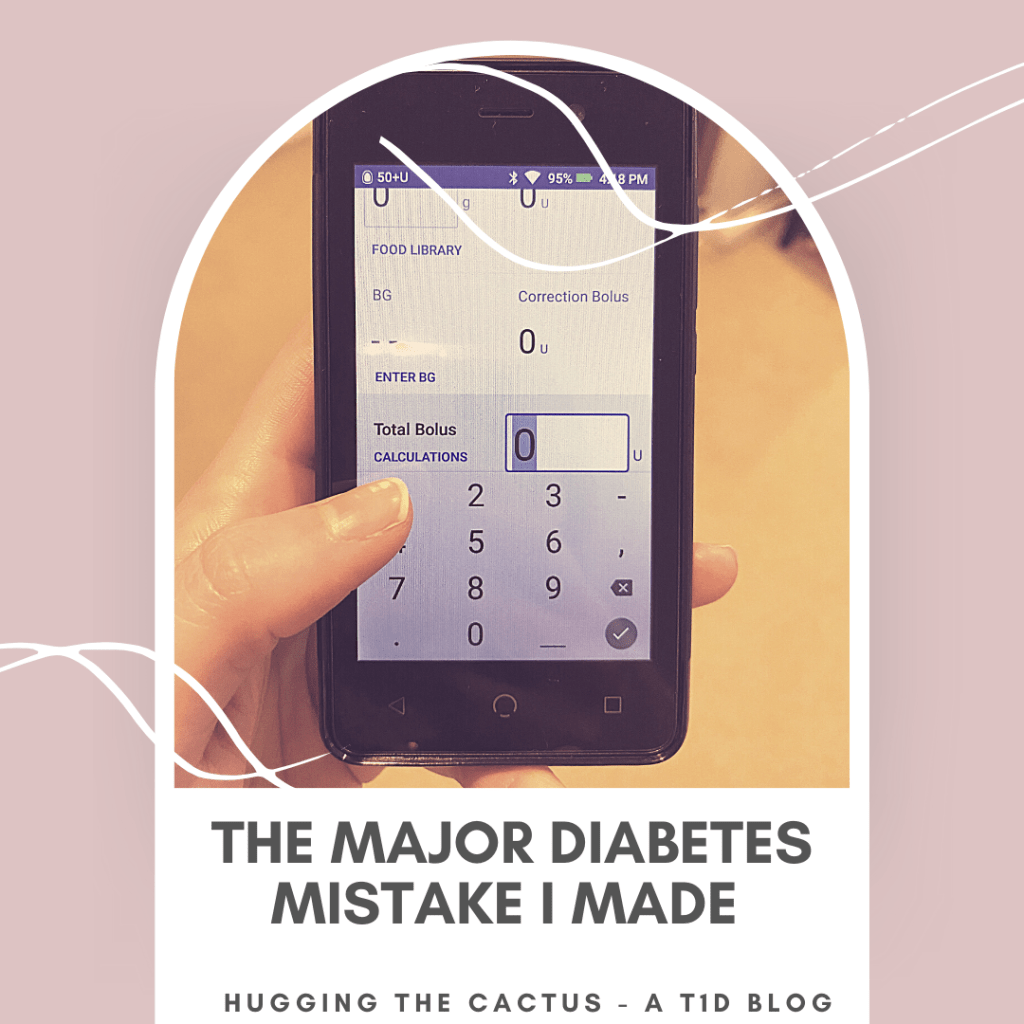
This careless mistake occurred because I simply wasn’t paying attention when I was inputting numbers into my PDM. I thought I had entered “10” as the amount next to the number of carbs I was about to eat when in reality, I overrode my PDM’s suggestion from 1 to 10 in the total bolus calculator. And I didn’t even realize this until I heard my pod beep randomly several minutes after I’d fiddled around with my PDM. Thank goodness I did notice that beep; otherwise, I would’ve been alerted to my mistake about an hour later when my blood sugar would inevitably start to plummet.

Upon hearing that beep, I decided to check my PDM to see what was up – I assumed that maybe I had a temp basal running that I’d forgotten about, and my pod was just letting me know that it was finished. Obviously, this was not the case. When I saw that I’d bolused 10 units, a wave a panic crashed over me and I immediately started crying. My poor mother, who witnessed me making this discovery, started inquiring what was wrong and I explained to her what I’d done while I brushed angry, frustrated tears off my face. I was in disbelief that I’d done something so stupid. My mom, though, brought me back to reality and redirected my attention to the fact that I should prioritize finding food to eat that would ensure that my blood sugar wouldn’t crash any time soon. I remember taking a breath, then scanning the kitchen for something high-carb that would kick in sooner rather than later.

My eyes landed on cereal, which is notorious for causing blood sugar spikes but also incredibly easy to eat lots of…especially when you aren’t overly hungry but desperately need to eat in order to avoid a scary situation.

See my finger hovering over the digital touchscreen of my PDM? It’s pretty dang easy for said finger to slip and hit a number when I didn’t mean to do so.

So I poured myself a big bowl of Life cereal mixed with Cheerios – not my first choice when it comes to cereal, but that’s what was in my parents’ pantry and this beggar really couldn’t afford to be a chooser, given the circumstances. I sat there and stewed as I ate what was probably the least enjoyable bowl of cereal of my life because I was too busy cursing myself for making such a stupid mistake and wasting insulin that I didn’t really need. Why didn’t I check my inputs before starting my bolus? How could I have ignored my ticking pod as unit after unit of insulin pumped into my body? What kind of idiot does that to herself?

I can’t answer the first two questions, but I can take a stab at that last one – the kind of idiot who is a human who’s had diabetes for most of her life and errs from time to time, just like any other human being with or without diabetes.

Sure, I was furious with myself for screwing up like this, but all things considered…it was bound to happen eventually. We all make mistakes and it’s impossible to double-check every action taken in life. I’ve had some time and space to process this incident, and I’ve forgiven myself for this reason coupled with the fact that I’ve never done anything like this before in two dozen years of life with diabetes. That’s a significant amount of time to go without an incident like this!

Plus, with that forgiveness comes the value of an important lesson learned, which is to be more mindful when I’m taking a bolus. It’s so easy to mistype something on a computer keyboard or when texting someone and this scenario is no different from that. I need to be better about being my own autocorrect, but balance the weight of that responsibility with the knowledge that I’m a human who is managing diabetes 24/7, which is exhausting, and that perfection is a myth.

Major diabetes mistake made, lesson learned, and time to move onward and upward.

8 Things About Diabetes That Make Me Want to Rip My Hair Out

This post was originally published on Hugging the Cactus on June 5, 2020. I’m sharing it again today because I’ve had my fair share of moments lately in which I’ve genuinely felt like ripping out my hair (or punching the wall) over my diabetes! Read on and find out if you agree with this list – and leave a comment to let me know what you’d add!

Life with diabetes can be the opposite of a cakewalk. In fact, it can be so frustrating at times that I seriously consider ripping my hair out due to sheer agitation.

When thinking about the things that drive me nuts about diabetes, I came up with a list of 8 occasions in which I come this CLOSE to losing my freakin’ marbles:

1. When low blood sugars refuse to come up…

2. …And when high blood sugars refuse to come back down.

I’m considering these first two as separate list items because the scariness of a lingering low and the frustrating nature of a stubborn high can be two very different types of “GAAAAAAAAHHHH!” But both can be especially suck-y when you feel and know that you’ve been doing everything right to treat them without experiencing the expected results.

3. Pod and CGM sensor failures.

Oooh, any sort of device failure can be so exasperating any time of day. But they’re worse when they happen at inconvenient times, such as in the middle of the night or during an important conference call. All diabetes technology should work flawlessly at all times, but that’s not always the reality that we live in.

4. Inaccurate results.

I can’t stand when my blood sugar meter or my CGM report false readings. Sometimes, I’ll check my blood sugar two times in a row just to see how close both readings are to one another, and it makes me want to throw my meter across the room when I see that they’re off by 20+ points. Once, I had a reading that was off by more than 50 points! That makes a major difference in how much insulin I give myself in that moment in time, so inaccurate results can really derail my blood sugars for hours after.

When I first found this illustration, I could’ve sworn the lady was flipping the bird…which would also be an accurate depiction of what these 8 things make me feel like doing!

5. Folds in the adhesive.

Whenever I apply a fresh sensor or a pod, I try to be super careful and make sure that the adhesive sticks smoothly…but despite my best efforts, that doesn’t always happen. Folds in the adhesive are far from the worst thing in the world, but they do make it more difficult for my devices to stick on for the full length of time that I need to wear them, and I usually end up having to add tape around them to reinforce the hold. More tape = more folds = more irritation!!!

6. Unexplained blood sugars.

Anyone with diabetes has been there, done that. You could follow the exact same routine from one day to the next, even eating the same foods at the same times, and get totally different blood sugar results. Or maybe you thought that you bolused perfectly for a meal, only to find out hours later that you’re much higher or lower than you anticipated. Whatever the reason behind them may be, unexplained blood sugars are just obnoxious.

7. Screeching alarms.

Speaking of things that are obnoxious, let’s talk about wailing OmniPod or Dexcom alarms for a hot second. There’s nothing like a resounding BEEEEEEEEEEEEEEEEEEEP to ruin your day!

8. The INSANE costs of our supplies.

Undoubtedly, the thing that most makes me want to rip my hair out when it comes to diabetes is the cost of supplies. I’ve blogged more and more recently about the criminal cost of insulin – since the 1990s, the cost of insulin has increased over 1,200% (!!!) – and I’ll continue to do so until EVERYONE with diabetes can afford this life-saving medication. We never asked for diabetes to happen to us. But it did. And the fact that many people with diabetes have to make sacrifices in order to, well, survive, is simply not okay, and the most infuriating thing about living with this chronic illness.

The Diabetes Rule I Always Disobey

If there was a rulebook devoted to the do’s and don’ts of life with diabetes…it would be quite the tome. I imagine it to be as long as the fifth Harry Potter book, which had 766 pages and weighed just shy of 3 pounds, though it would certainly not be as engaging of a read.

As I started to visualize a diabetes rulebook, I started thinking about the actual rules it would list out. It would cover the basics, for sure, of life with diabetes, like “count carbs at every meal” and “remember to take your insulin”. But it would also get into the minutia – the things that aren’t so obvious, even to those who are fairly well-versed in diabetes. Things that I didn’t know until adulthood, like how glycemic index, alcohol, caffeine, dawn phenomenon, and so much more can affect blood sugar levels.

Yeah, it would definitely be a boring-ass read.

The diabetes rulebook would probably resemble this and look completely, utter unremarkable (otherwise known as BORING).

But as I was coming up with a seemingly endless mental list of diabetes rules, it stuck out to me that there’s one that I don’t follow. In fact, I’m not sure that I ever followed it. And that rule pertains to insulin.

The rule is about how if you open a vial of insulin, it’s best to use it within a 30-day (or maybe it’s 28-day) window. I think it’s because manufacturers claim it loses its potency after that timeframe passes, but to me, it’s a bunch of BS.

Maybe I do go through whole vials of insulin in a one-month period, or maybe I don’t. I have no clue, I don’t keep track of my supplies to that extent. But what I do know is that “expiration dates” and “best by” labels aren’t always based on exact science. I’ve totally eaten my fair share of “expired” foods (things like granola bars or cans of soup, definitely not wilted spinach leaves or moldy yogurt) because I use my common sense when making judgment calls about consuming those items. For me, it works kind of the same way with insulin. As long as an insulin vial has been properly stored since opening it (in a refrigerator’s butter compartment, because of course), then I feel safe using it beyond a 30-day period – again, within reason, using logic (I doubt that I’d use insulin dated YEARS ago).

I’ve even heard of folks using insulin that’s past it’s expiry date, and while I haven’t done that myself, I can’t say I blame anyone for trying to use up every last drop of the stuff when it’s in possession and it’s necessary to take. It’s too expensive to waste.

So if by breaking this “rule” makes me or other people rebels, I’ll don the title with pride…and smirk to myself as I think about other diabetes rules (ahem, pertaining to prolonging CGM sensor life, or using sites other than the abdomen for my Dexcom, or hardly ever remembering to change my lancets…) that I’ve broken over the years.