Hugging the Cactus Turns 6…And Evolves

In early October 2017, I took several deep breaths before hitting the “publish” button for this blog, officially making its existence known to the world. I was terrified to share my diabetes story in a more intimate, personalized format, but also excited to see what I might be able to do with a website of my very own.

Turns out, I could do a lot. In the last six years, I’ve shared more than 800 (!!!) blog posts, mostly written by me, a handful of which were written by some all-star guest authors. That’s a whole lot of words (literally hundreds of thousands) and time put into developing new content. Besides writing regular blog posts, I’ve tried my hand at being a website curator – not an easy task, and that’s putting it lightly – as I’ve done the best that I could to keep this blog looking fresh and easy to navigate. I’ve used a few different social media platforms to engage with the broader diabetes community and share my blog posts in the hopes that writing about my diabetes struggles and triumphs would resonate with at least one person out there. To my surprise and utter delight, I’ve been able to connect with lots of people who may have stumbled across this blog by accident, or were brought here by a friend who recommended it.

It felt very fitting to recreate the picture that became the Hugging the Cactus “logo” of sorts 6 years ago.

It’s been incredibly humbling. I never would have guessed that writing this blog, which I’ve described before as a sort of diabetes coping mechanism for me, would have actually meant something to anyone else besides me. Hugging the Cactus resulted in friendships near and far, a few fun podcast opportunities, and even my appearance in a Dexcom commercial. Needless to say, this blog has been worth all the effort I’ve put into it for the last 2,000+ days.

But that’s a lot of days to continue running a passion project like this without getting a little burnt out. Or a lot burnt out. I have to admit that my spark for Hugging the Cactus began to fade in the last year, and upon reflection, it makes a lot of sense. After all, I’ve been a diabetes blogger since I was 19 years old. I started out writing for another website, and then felt so encouraged from that experience that I wanted to create my own website so I could continue sharing my story in a way that felt the most authentic to me and my diabetes journey. That’s when Hugging the Cactus was born, and my identity as a “diabetes blogger” was solidified.

I’m proud to wear that title, but I’m also exhausted. I’ve spent nearly my entire adulthood thus far as a diabetes blogger, and I’m not sure that it serves me in the same way that it did when I first started over a decade ago. For some reason, it feels more like a chore than an act of joy when I sit down to write new blog posts each week. Perhaps as I’ve gotten older, the ways in which I think and feel about my diabetes have changed, and I’m just in a phase of figuring out whether writing about it is really what I want to do in my spare time. And that’s okay – I never anticipated this blog to go on forever, but I also don’t expect it to just completely end. That feels too final.

So as Hugging the Cactus celebrates turning 6 years old, it also enters its next evolution as I take a step back from it. I’m not sure how often I’ll post here, but it’s comforting to know that it’s available to me whenever the desire strikes for me to revisit it. And how wildly wonderful it is to know that I have 6 full years of my life with diabetes captured here for me to reflect on, and for others to discover and hopefully feel a little less alone as a result.

Thank you, dear reader, for joining me along for the ride – whether you’ve been here since the beginning or showed up somewhere in the middle or near the end, your support means everything to me. Until we meet again, remember to hug the cactus in your life (whether it’s diabetes or not) every so often.

Love,

Molly

A Passive Aggressive Email to My Diabetes

Ah, emails. They’re an effective way to communicate with colleagues, but just like text messages or any other written bit of information, it’s almost always impossible to gauge the tone of an email; thereby, making it really easy to misconstrue the meaning behind some of them.

Some, but not all.

In those other scenarios, it’s obvious what the sender was intending to convey if the email is peppered with particular language that is best characterized as passive aggressive. This language is polite and direct, but maybe said with a little bit of an attitude depending on the context. And almost everyone is guilty of sending an email with passive aggressive language within it, myself included.

There’s scarcely been a single time in which I actually wanted to come across as aggressive, or worse, disrespectful. But by the same token, it can be difficult to mask frustration when something was clearly conveyed in a prior communication or when you’re seeking feedback that nobody is providing to you.

So as I contemplated passive aggressive emails, and the phrases that typically comprise them, it dawned on me that there is definitely an email recipient that I’d love to send a fully charged, passive aggressive communication to…and that is, of course, my diabetes. Without further ado, here’s what I’d say in it:

Dear diabetes,

I wanted to circle back and ask you for an update. Sorry to bother you again, but I’m looking for feedback on how I could improve our working relationship.

As per my last email to you, I want to work smarter, not harder with you. As we discussed, your disruptions throughout my day affect more than just my productivity; moreover, they make it difficult for me to maintain a positive attitude. We both have a shared goal to maintain in-range blood sugars and in order to make that happen, I want to better understand your approach. What kinds of changes, if any, do you need me to make so I can help you thrive? Please advise. I’d be happy to escalate this issue to management, but in order to use time and resources more effectively, I wanted to follow up with you again first.

In order to maintain clarity, it’s important for you to reply at your earliest convenience. This is just my friendly reminder to you that I’d greatly appreciate your input or suggestions. Should you need further clarification, please don’t hesitate to contact me.

Thanks in advance,

Molly

Oooh, just merely crafting that pretend email made my fingertips tingle with the sarcasm as I typed. I’m not sure I’ve ever written something that was so clearly dripping with frustration and scorn, but I gotta say, it felt kinda nice.

And genuinely, I would greatly appreciate getting some type of response from my diabetes. It’s not like I’m going through burnout right now, but there have been some truly head-scratching moments in my life with diabetes lately that make me go “whyyyyyyyyyyy thoughhhhhhhhhh” in my most whiny tone of voice. Its unpredictability can get a little old, and I just want to know what I could or should be doing differently in order to handle it better.

Guess I’ll just have to find some solace in at least capturing my feelings here, and knowing that the periods of unpredictability will come and go, just as my blood sugar will rise and lower.

3 Reasons Why I Tell Most People I Meet About My Diabetes

There’s a running joke in my family that I don’t shut up about diabetes.

This is partially true. I do talk about it an awful lot, whether it’s via this blog or at family gatherings when my devices are alarming (or when the other 2 T1Ds in my family have their tech going off, as well – it’s a downright symphony of sound that’s tough to ignore). While it’s definitely not my go-to discussion topic in most situations, it is something I tend to mention when I’m meeting new people. As I thought about why, exactly, I do this, I realized it came down to three reasons:

  1. It promotes safety. I feel so much safer knowing that the people around me are aware of my diabetes. They know that the sounds emitting from the devices that I’m wearing on my body are for a medical reason, and it’s not me being rude/inconsiderate with disruptive noises. They know that there may be times in which I need to take a few minutes to address my blood sugar, whether it’s high or low, and that it’s not something they should take personally. And it gives me a chance to let them know what, if anything, they should do in certain scenarios. So it’s not just a matter of looking out for my own safety, it’s also about the people that I’m with and empowering them with the information they need to know about my condition.
  2. There’s less mystery. Humans are curious by nature. So curious, in fact, that I’ve had dozens of perfect strangers approach me over the years and ask me what “that thing” on my arm is. While this behavior is far from charming, it at least resolves any curiosity someone might have about what it’s like to live with type 1 diabetes and gets a conversation going about it.
  3. I have an opportunity to defeat diabetes stigma. The best case scenario when I meet someone new and they’re wanting to talk about my diabetes is that it isn’t just a “one-and-done” type of conversation. It evolves into an ongoing one as they ask me increasingly thoughtful questions and discover that what they thought they knew about type 1 diabetes is actually just stigmatized or downright incorrect. It’s a good learning opportunity for new people in my life, as well as a reminder for myself that I likely will always need to be prepared to explain type 1 diabetes to anyone I meet who doesn’t realize what it means to have it.

While some might find it burdensome to bring up diabetes over and over again as jobs change, social circles expand, and living situations evolve, I truly believe that the pros outweigh the cons here. I’ve wracked my brain the entire time while writing this blog post in search of a memory of a time that it didn’t go well, but truthfully I can’t recall a single time in which me bringing up diabetes was met negatively. So from my point of view, why not continue to share it with new people that I meet? As long as I’m not kicking off every introduction with “Hi, I’m Molly and I have type 1 diabetes” (which I absolutely DO NOT do and wouldn’t recommend anyone doing, as it brings to mind a certain character from South Park), then I think it’s good to be upfront about it and let conversations around it flow naturally for the reasons above, at the very least.

Diabetes: Where’s the Off Button on This Thing?!

So many things in this world come with an “off” button or switch – just about all electronic devices, that obnoxious toy that your child loves playing with, and pretty much anything else that could be considered loud, disruptive, or downright annoying.

I wish diabetes was one of those things that came with an “off” button.

I suppose that technically would be a cure, but since we’re already talking about things that are purely imaginary at this point in time…

Think about it, though. Diabetes is 24/7/365. Even when I’m sleeping, it sure as hell is not, and despite my Omnipod 5 making it so that my overnight blood sugars are more stable than ever, it’s still disheartening to wake up to a low or high blood sugar alarm that I have to immediately do something about. So having an “off” button for my diabetes throughout the night, at the very least, would do so much for me.

But it’s also during times of interaction with others – in the workplace, at a bar/restaurant, in my pole classes, and so forth – that I find myself sometimes really longing for a diabetes “off” button. It’s not so much when my devices are alarming in those settings, because I’ve found that most people don’t even notice them. It’s more so when I’m having a low or a high that’s preventing me from being fully present in the moment.

Take, for example, the time that I was in my office and experiencing the symptoms of an oncoming low. This just so happened to coincide with lunchtime, but that was also when my coworkers decided to get up for an afternoon stretch/walk. They invited me to join them but I had to turn them down, as I knew that walking would only drive my blood sugar lower and potentially create a situation that I definitely didn’t want to subject my colleagues to. I hated having to say no on a particularly beautiful mid-September afternoon; alas, I don’t have an “off” button for my diabetes so I couldn’t just ignore what I needed to do at that moment in time.

Before I get too caught up in pessimism here, I’ve got to remind myself that it’s not like diabetes makes every social situation difficult or awkward for me. Far from it. There are even some occasions in which diabetes enhances the quality of interaction I have with others.

But this knowledge isn’t enough to make me stop wanting (yearning) for a diabetes “off” button, even if it only means that I get to utilize it for a short stint of time.

The Best Time to Change CGM and Insulin Pump Sites

There IS a definitive best time to change a CGM and/or insulin pump site. It’s rare, but when the stars align and both sites need to be changed around the same time on the same day, then that is the magical occasion that allows for a device-free shower. So for me, syncing up pod and Dexcom sensor changes with the time that I plan to take a shower is by far the most wonderful and ideal time to go out with the old, in with the new.

Think about it. These two devices are meant to be worn 24/7, 365. The only time they ever come off my body is so I can rotate sites and put fresh sensors/pods on. This means that I’ve got two medical devices attached to my body at (just about) all times. And I’m totally used to that, except for the times that I somehow forget about my pod and CGM and manage to knock them off my body while changing clothes or, you know, just walking around – and apparently into – doorways/gates/etc.

So when a pod change coincides with a CGM sensor change, I embrace this as an opportunity to enjoy being free from my devices for a short window of time – and for me, the length of time it takes for me to shower is just perfect for taking a break and not having to worry about 1) cleaning around my devices, 2) bumping them into my shower door, or most importantly of all 3) rising blood sugar levels as this short time span isn’t long enough for me to face any consequences of not having an active bolus.

These might seem like trivial reasons to relish a device break so much, but it really is the only time that I am reminded that my body is aided by the devices, not defined by them. It’s nice to see my skin free of them both, even if it’s only for a short while.

What Is That Ticking Sound?!

Tick, tick, tick…

It was approximately 8 A.M. on a weekday. I was in my kitchen, figuring out what I should eat for breakfast. I begin to take out all the things I usually put into a fruit smoothie – almond milk, protein powder, frozen fruit – when I noticed the ticking.

Tick, tick, tick…

My eyes wandered over to the clock affixed to my kitchen wall; certainly, that was the source of the sound. I walked up to it and held my ear close before remembering that said clock has not functioned properly since the day it was put up (that’s a long story, one that hopefully ends in me repairing it eventually). I could rule out the clock.

Tick, tick, tick…

It sounded like a small winged insect, maybe one that was drawn to light, repeatedly flying into my overhead kitchen light. I squinted up, trying to avoid getting blinded by the brightness, as I attempted to locate a flying insect. I couldn’t see anything.

Tick, tick, tick…

I was getting annoyed now. Where was this coming from? Was I imagining it? I felt like a character from the old Harry Potter Puppet Pals YouTube video that was popular when I was a teenager. If you haven’t seen it, it’s worth a watch for a little giggle, but basically it features main characters from the Harry Potter series goofing about and singing their names while Professor Snape attempts to identify what is making a mysterious ticking noise in the background.

It was only after this silly video popped into my mind that it dawned on me…

…the ticking was coming from my pod. I’d picked up my PDM and started a bolus before I went into the kitchen. I just completely forgot that I’d done so.

Tick, tick, tick…beep!

Soon after this realization struck me, I started laughing at myself, and then my pod declared that the bolus was finished delivering with a single “beep”. I found it funny how something that I do multiple times each day still has the ability to confuse all common sense out of me. My pod makes ticking sounds, sometimes one or two at a time, and other times a series of dozens, all the time. More often than not, I’m oblivious to the sound, and I really only ever tune in to ensure that a bolus is getting delivered or whenever it’s reaaaaaaally quiet all around me and it’s the only sound to be heard. But apparently, it can still catch me off-guard to the point that I forget it exists.

At least I found out the source of the ticking, though.

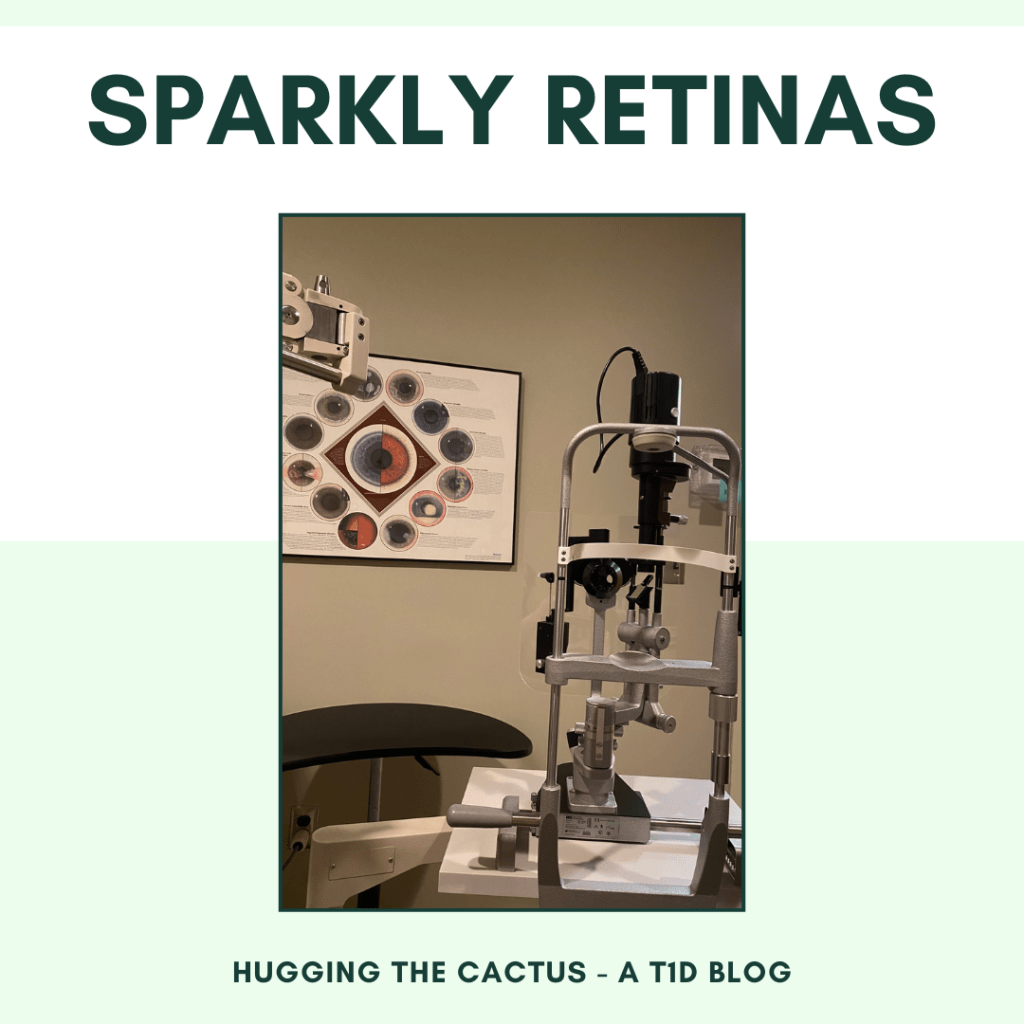
Sparkly Retinas

23 minutes.

That’s how long my annual appointment with my ophthalmologist lasted this past week. I think we may have set a record in eye doctor appointment efficiency, as it was only such a short visit because there wasn’t a whole lot to talk about other than my “sparkly retinas”.

Yup, that was indeed the exact phrasing my doctor used to describe the state of my eye health upon dilation and examination. She went on to add several other gushing exclamations about my eyes, most of which I can’t recall because I was laughing at her comments.

It might sound like the appointment was rushed or that my doctor was less than thorough, given how short it was, but I was asked more than once if I had any eye concerns that I wanted to discuss with the doctor before I left. And I genuinely couldn’t think of anything worth mentioning, as my eye health has been stable in the last year and I haven’t had any noticeable vision changes. So we didn’t need to prolong my visit by any means. We probably spent a collective 7 or 8 minutes together before I was given a clean bill of eye health and asked to make my appointment for next year before leaving the building. It was that easy-peasy.

And I am extremely grateful for that.

Almost 26 years of living with diabetes and so far, it hasn’t impacted my eye sight. I don’t take that for granted. I know that may not always be the case. But for now, I’m more than happy to give up a measly hour of my day (I would’ve said 30 minutes, but I had to factor in the drive time to and from the doctor, naturally), once a year just to have that reassurance that I’m doing something right when it comes to my overall health. And maybe to hear that I have “sparkly retinas”, because that is quite a unique compliment.

Read Between the Lines

I’ll never forget seeing the movie School of Rock for the first time.

When the movie came out 20 years (yes, somehow, some way, it’s already a two-decades-old film) ago, my dad took me and my older brother to see it in theaters. I didn’t know it at the time, but it was truly such an iconic movie that still holds up. It had the best rock ‘n roll music, cheeky and clever dialogue, and a fair few dozen references that I didn’t fully appreciate until I was a little older. But one that I understood right away, at the tender age of 10, was the moment in the movie in which Dewey (played effortlessly by Jack Black) mouthed off to another character by telling them to “read between the lines” and holding up three fingers. I knew immediately that he was telling the other person to ignore the two fingers and focus solely on the one in the middle, and my adolescent self thought this was hysterically funny and a totally brilliant way to give someone the finger without, well, actually doing it.

I’m not sure what prompted me to think about this scene randomly just a few minutes before I sat down to write this post, but naturally I started thinking about how life with diabetes is quite literally reading between the lines. We read in between the lines of our Dexcom or other CGM graphs constantly. Reading in between those lines can dictate whether we are having a good, bad, or somewhere-in-between diabetes day. Reading in between those lines often informs the next decision we make in terms of what we choose to eat, what we choose to do, and so forth. Reading in between those lines can contribute to an overwhelming amount of exhaustion, burnout, anger, frustration, relief, defeat, success, and sadness. No wonder the phrase (and intended meaning of) “read between the lines” inspires such passion!

So it shouldn’t be surprising that reading in between the lines makes me want to do my very best Dewey Finn/Jack Black impression and yell out to my diabetes itself, “read between the LINES!” and then kick a drum set aggressively before I storm out a room. But then I’m reminded that when you living with diabetes means that I’m hardcore. And as we learn in School of Rock, you’re not hardcore unless you LIVE hardcore.

So thanks for that reminder, School of Rock, that I’m hardcore and that just because having diabetes means that I do read between the lines often, it doesn’t mean that I can’t tell my diabetes to do the same.

The Unexpected Blood Sugar Buster, Part 2

This past June, I wrote a blog post about how cleaning is an unexpected blood sugar buster for me – meaning that my levels are guaranteed to start dropping after a prolonged period of tidying.

And just today, I realized that there’s another (perhaps even more unanticipated) blood sugar buster for me…and that would be…

Trying on clothing. Yup! An innocent, well-intentioned act meant to improve my wardrobe resulted in a low blood sugar, and reminded me why I hate shopping for clothes so much.

Before you jump in and say, well of course her levels dropped, she was walking around a store, let me tell you that this store really wasn’t even that large. There were so many racks of clothing strewn about haphazardly that I felt more like I was stumbling my way slowly through a maze as opposed to the laps I can easily take by walking around a Target or a grocery store. My pace was positively snail-like, and I got more and more dragged down over time by the weight of the clothing items I was carrying in my arms.

By the time I got to the dressing room, my energy was going downhill as it had mentally worn me out to search for clothing even remotely close to the style I was looking for. I only had 9 items to try but the prospect of putting on each piece felt daunting. (Let alone doing so while maneuvering around the matchbox-size dressing room; seriously, it was so small that if I spread my arms wide then I would be touching both sides of the room.) With impending senses of claustrophobia due to the teensy room and dread at the notion of trying on new clothes, I also registered that I was getting very, very warm. And a little dizzy.

Was I blacking out from my latest endeavor in clothes shopping, or was it just my blood sugar going low?

Naturally, it was the latter. Something about hauling a haphazard collection of clothing around the store, then trying said clothing on (and getting increasingly frustrated as my “no” pile grew) triggered a low that I wasn’t anticipating, and suddenly my desire to leave the store hit its peak as I knew it was more important for me to take care of myself than to score big on new wardrobe additions.

With a heavy sigh, I paid for the couple of items that I ended up liking enough to want to buy, and made my way to my car where a low snack in privacy was waiting for me. I also walked away musing over this unexpected blood sugar buster and how to prevent it from happening again and again in the future – perhaps with a nice mall snack? A treat from the food court?

Sounds like a nice way to put the fun back into clothes shopping, that’s for sure.

Molly and the Terrible, Horrible, No Good, Very Bad Diabetes Day

(Gotta give credit where credit is due on inspo for this blog post’s title – Judith Viorst authored the children’s book Alexander and the Terrible, Horrible, No Good, Very Bad Day in 1972 and a movie that was loosely based on it came out in 2014. I admit that I’ve seen neither but as someone who has appreciation for books and movies, I can at least claim an awareness of both and a deep appreciation for such a memorable title.)

At the end of July, I had my worst 24 hours of diabetes in literal years.

I’m being a little dramatic, but really, everything that could go wrong pretty much did. And what made it that much worse is that it just happened to coincide with my girls’ weekend with my college friends.

It all started after dinnertime. I had flatbread from a local restaurant that I frequent, and I substituted traditional crust in favor of cauliflower crust – my hope being that this would have less of an impact on my blood sugar levels.

No such luck. In the 3-4 hours post-dinner, my blood sugar steadily climbed, reaching a peak of the low 300s at its highest. It just didn’t make sense! I had 4 pieces of flatbread. They weren’t massive. Veggies were the only topping. Maybe it was my pod? When I went to check my PDM to see how much insulin I had on board for what felt like the fiftieth time that evening, I discovered that I’d been burning through so much insulin that I only had a few units left in the pod, meaning that I’d definitely have to change it before I went to bed to ensure I didn’t run out of insulin overnight.

I was super annoyed as a result of my hyperglycemic state and the need to do a premature pod change, but apparently also exhausted by the ordeal as I lapsed into an early sleep in my armchair while my friends stayed up. By the time I snapped out of my slumber, I was groggy, thirsty, and upset that my diabetes was affecting my ability to hang out. When we all turned in for the evening around midnight, I went to bed hoping that my mood and blood sugars would be turned around by the time I woke up in the morning.

Except they didn’t. I woke up in the middle of the night with not one, but two separate low blood sugars. My broken sleep combined with the wild oscillations of my blood sugar caused me to roll out of bed with a stinging pain in my eyes and a defeated spirit that I tried my best to hide from my friends, but to no avail. In fact, I ended up in a heap on the floor, crying to them as I apologized for my grumpy mood and attempted to explain to them what had gone wrong in the last 12 hours. They were all very understanding and supportive, but I felt horrible for being so temperamental and curt with them; after all, none of this was their fault. I promised them that I’d cry it out, wash my face, get dressed, and spend the rest of my time with them with an adjusted attitude.

This mostly worked – we were able to enjoy bagels and lattes for breakfast, as well as a long walk in the first truly gorgeous morning of weather we’ve had since May. My attention was absolutely still partially focused on my diabetes, especially since bagels are notoriously tricky to bolus for, but my resulting spike from indulging in one wasn’t too bad since it was offset by the walk.

By the time my friends departed, my blood sugar was mostly back under control. This must be when things started turning around for me, right? Wrong! As I cleaned up my condo, I ripped my pod – the one that I had just applied the previous evening – clean off my leg. Cursing, I tried to calm myself down because this was something I could easily fix. I decided to call my boyfriend while I did the pod change routine, which was yet another mistake on my part as I accidentally deployed the cannula before the pod was even on my body.

It was like a comedy of errors. I shouted – yes, legitimately yelled – to my bemused boyfriend that I had to go. I needed to get this pod change done and over with, distraction-free. So I repeated the process, only to find that pod #2 was unusable because the cannula was poking out.

Was the universe laughing at me at this point? It sure felt like it.

Third time’s the charm, I told myself as I audibly sighed out of frustration. And thank goodness that it really, truly was – the third attempt at putting a new pod on was the one that did the trick. I remember falling back in my chair after the pod was securely attached on my body. The rollercoaster blood sugars and the unpredictable technology demands truly drained me, and this was just one 24-hour window of dealing with diabetes.

Thank goodness most days aren’t like this terrible, horrible, no good, very bad diabetes day!