Four Signs of Diabetes in the Summertime

 MOLLYT1D3 COMMENTS

This blog post was originally published on Hugging the Cactus on June 19, 2020. I’m sharing it again today because truth be told, I needed to hype myself up a bit about having my diabetes devices be a lot more visible during the summer months. As I’ve gotten older I’ve grown less comfortable having them on display, but it’s inevitable when I’m wearing short sleeves, shorts, or a bathing suit. Read on to learn about the other things that make diabetes a little less invisible in the summertime…

Sun’s out, guns pumps out, amirite guys?

The summertime season is in full swing, and now that it’s here I’m thinking of the various ways my diabetes is more pronounced in the warmer weather. It’s much more visible, leading to many more questions, but what are the cues that give it away to others? I thought of four…

Visible sites. Shorts-and-t-shirts weather makes it much harder to place pods or CGM sensors in discrete locations. And if I’m going to the beach? There’s no way that I can even attempt to hide my devices. That’s probably why I make them even more obvious with…

…Pump and sensor art. I’ve written about Pump Peelz and GrifGrips in the past – they make adhesives and skins that are specially designed to fit pods, PDMs, pumps, meters, and more. The products they make are truly little works of art for diabetes devices, and I like to make sure all of mine are decked out in the summer months so I can show off tech that’s not only functional, but also stylish.I’m looking forward to donning my best beach-y Pump Peelz on what I hope will be many trips to the beach this summer.
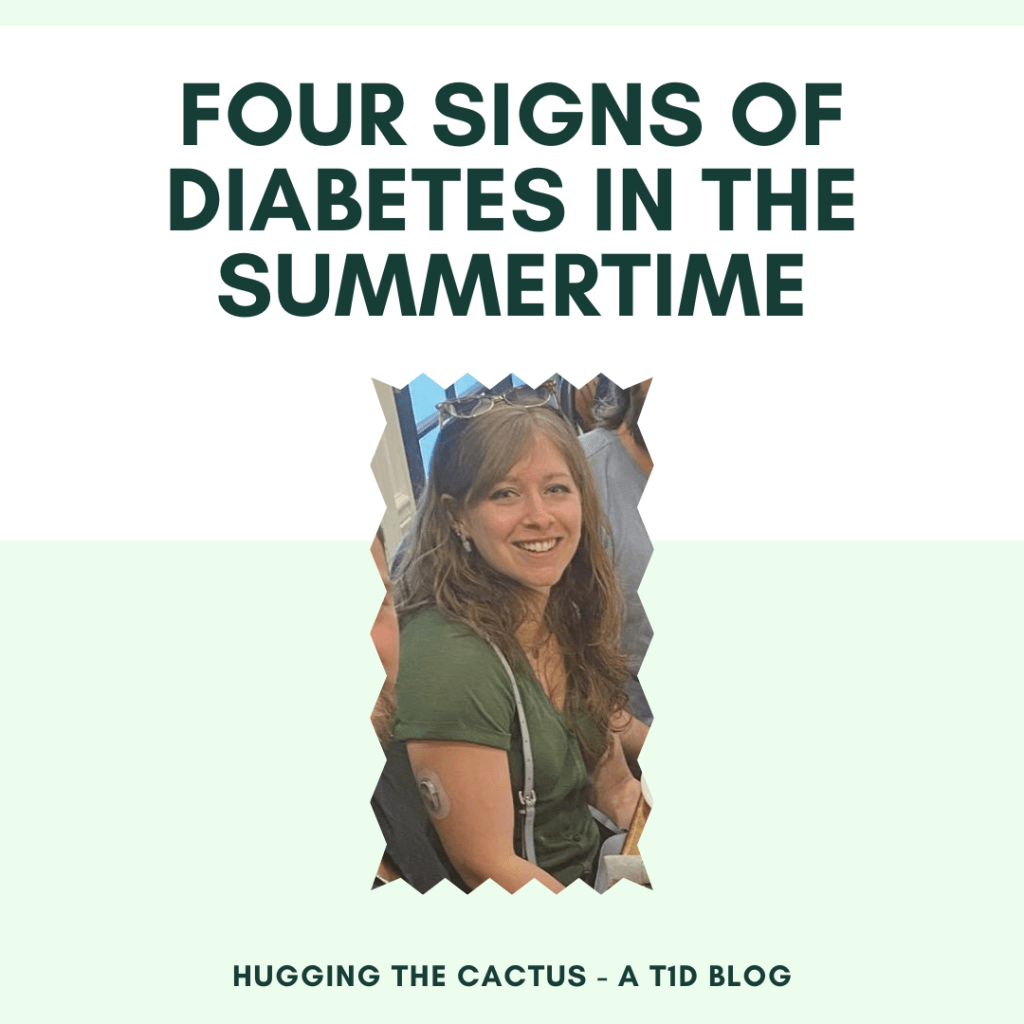
It’s tough to “hide” diabetes in the summer when short sleeves and tank tops become wardrobe staples.

Gadget tan lines. Or if you’re like me, it’s more like sunburn lines. That’s because each summer, without fail, I somehow manage to neglect the space around my pod or my sensor, so when it’s time to remove it, there’s a huge red circle around the perimeter of where the device was situated. Maybe this year I’ll actually learn my lesson and take the time to apply sunscreen properly so I can avoid the very not-cute sunburn circles.

Travel coolers. This is probably the least obvious sign of diabetes in the summertime, but to those in the know, coolers meant to protect insulin are pretty recognizable compared to regular coolers. Whether it’s a Frio cooling pouch or another brand of insulin cooler, people with diabetes tend to carry these throughout the summer months in order to prevent insulin from spoiling due to heat exposure.
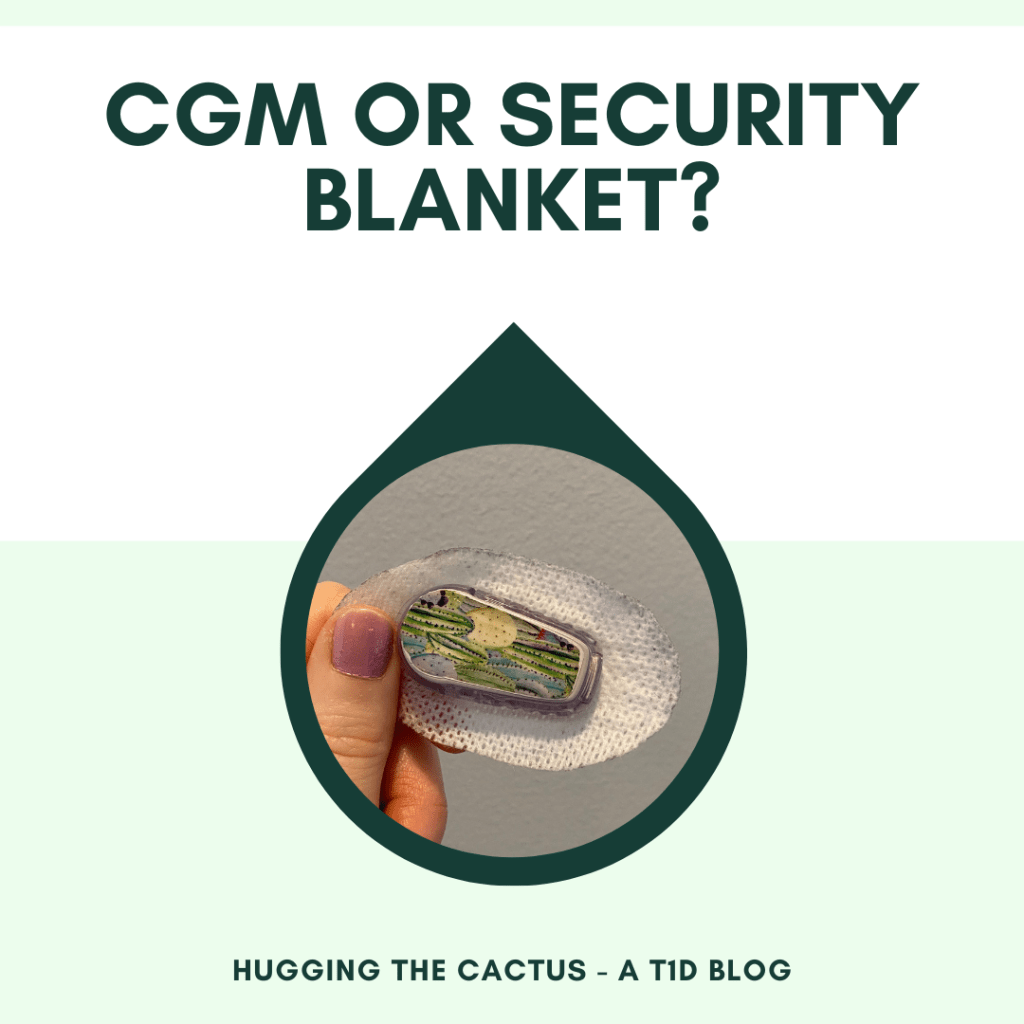
CGM or Security Blanket?

So…remember all the times on this blog that I wrote about how important it is, as a person with diabetes, to be prepared at all times? And how it’s vital to have a back-up in case something unexpected happens with technology?

Well, apparently I don’t take my own advice. I mean, I usually do, but once in a blue moon, I am forgetful. Or negligent. In this particular scenario, I was both, because I simply didn’t pay attention to the fact that my CGM sensor was due for a change…and I was stuck at my workplace office, roughly 45 minutes from home, without my meter or a backup sensor in my bag. So when my CGM sensor expired at 1:48 in the afternoon, I realized that I wouldn’t have a means of checking my blood sugar until I returned home for the day. And I was a bit freaked out about that.

My biggest concern was that my blood sugar levels would run high and I wouldn’t know for certain or be able to do anything about it. I’d eaten more carbohydrates at lunchtime than usual, and had low confidence that I’d guessed the carb count accurately.

Instead of losing my cool or deciding to head home early, though, I impressed myself by choosing to ride it out. I felt sure that I’d be able to pick up my body’s signals if my blood sugar began to run low (which is definitely scarier than it running high for too long, anyways), and if it were high? Well, then, I’d just have to cut my losses and correct for it as soon as I got home. It’s never fun to have high blood sugar when it can be so easily fixed with an insulin dose, but given my options in this particular scenario I decided that I’d make peace with it, should that end up being my outcome.

It was a long 3ish hours, flying blind without my security blanket I mean, CGM, but I made it through and checked my blood sugar with my meter the moment I arrived home. And guess what? All that worrying about being high was for nothing because I was sitting pretty at 82 – a stellar blood sugar level in ordinary circumstances, but one that felt especially victorious after this less-than-ideal situation I got myself into.

The whole experience opened my eyes to the fact that my CGM is more than just a piece of diabetes technology to me, it’s a security blanket. It makes me feel that much more confident in making the majority of my diabetes-related decisions on a daily basis. And while it’s great that I have my CGM’s data available to me most of the time, it’s also an indication that maybe I could stand to be a little less reliant on it and trust myself and my own body a bit more. Maybe I could stand to check my graph 50% less than I do each day (believe me, I glance at it frequently, definitely more than I need to) to build a healthier boundary between me and my CGM. Or maybe I can do a better job at keeping tabs on my back-up supplies so I don’t run into this again.

Or…maybe I can totally do both of those things to do a better job of becoming my own source of security when it comes to my diabetes. I like the sound of that.

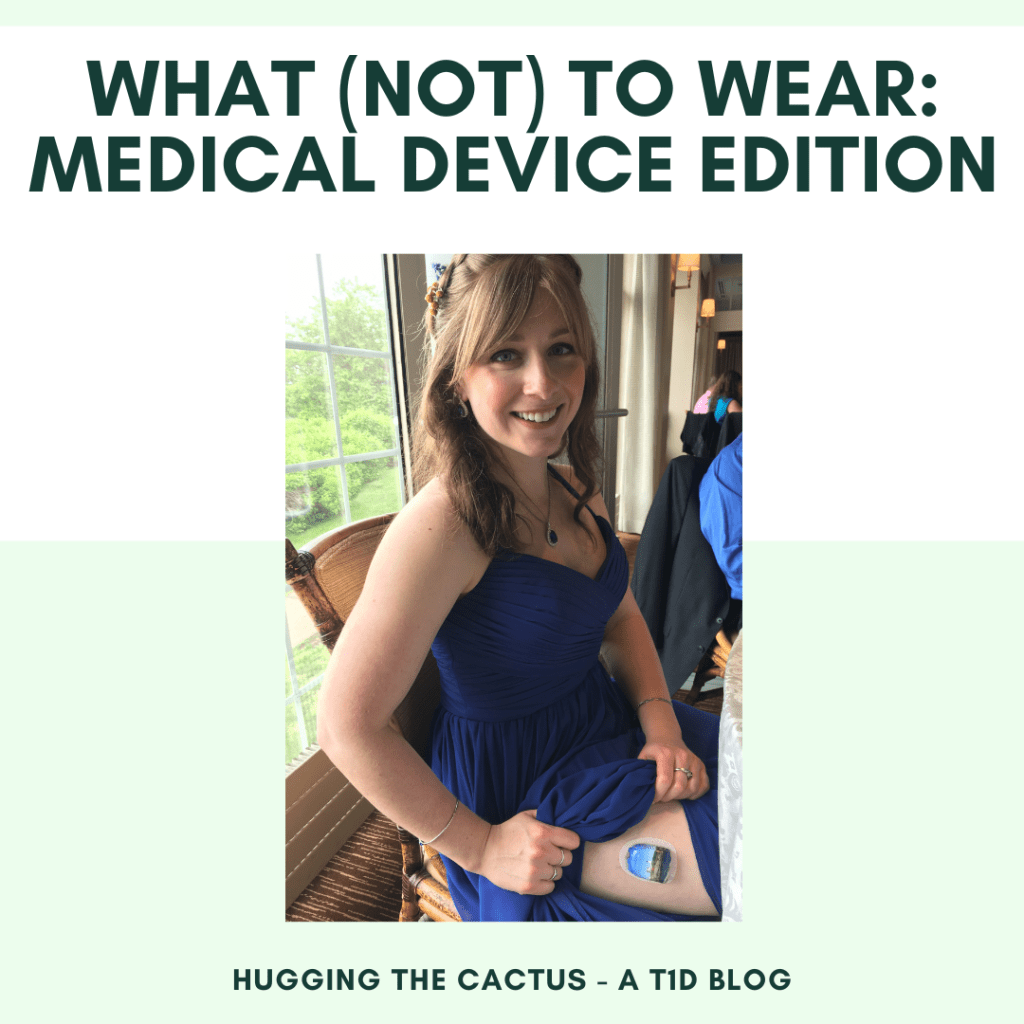
What (Not) to Wear: Medical Device Edition

I’m going to two weddings this spring and summer and rather than stressing about which dress I’ll wear to each, I’m finding myself more focused on where I’ll wear my insulin pump and my CGM.

It might sound like I’m making a mountain out of a molehill, but truly, I’m having a hard time deciding whether or not I want to make an effort to hide my devices or don them proudly along with my formalwear. Now when I say “hide”, I don’t mean that I want them out of sight because I’m ashamed of them or anything negative like that. It couldn’t be further from the truth. I’m proud of and grateful for my pump and CGM, but that doesn’t mean that I want them to be front and center on a special occasion. I’d rather let my style – my dress, my make-up, and my jewelry – shine because they’re more reflective of who I am as a person. My diabetes is also a part of my identity, but I don’t want to showcase it if it can be avoided. I also don’t want to attract stares, because whether I like it or not, people will always look and wonder what my pod and CGM are and why I have to wear them.

At a family wedding a few years ago, I was proud to showcase my cute pod sticker…but these days, I’m not so sure that I want to go about advertising my diabetes so boldly at a couple of upcoming weddings!

So based on that logic alone, I’m leaning towards wearing my pod and CGM on sites around my abdomen or legs, keeping them neatly tucked away underneath my wedding attire. But I also need to take into account my site change days. My pod is changed every 3 days, and my CGM sensor is replaced every 10 days. I could plan backwards from the wedding dates and figure out where I need to place my pod and sensor according to that, but let’s be real here: I don’t always have the mental bandwidth to plan that far in advance. Pod and sensor site changes are so routine to me at this point that I just kind of go through the motions every time that I change them, and don’t give much thought to their particular placement beyond making sure that I’m properly rotating my sites. Maybe I’m just being lazy by claiming it’s too much extra work, but honestly, there’s so much work that already goes into diabetes on a daily basis that I just don’t want to give in and plan out a site change timeline that guarantees covered-up diabetes devices.

We’ll see what happens, but one thing is for sure: Whether I showcase my sensor and pod in visible spots or if I choose to keep them covered up, I won’t let my diabetes spoil any aspect of having a great time celebrating at both weddings.

Girl, Interrupted (by Diabetes)

A packed conference room. A Dexcom alert due to a low blood sugar. A girl, interrupted as she tries to reconcile what her diabetes demands and what her professional responsibilities required her to do.

A girl, interrupted by diabetes.

Oh hey, I am that girl, and I found myself in this precise scenario when I attended in-office training for my job.

It was just after noon and I was rebounding from a high blood sugar that I’d dealt with earlier in the day. We were going to break for lunch at any moment, and it wasn’t like my blood sugar was tanking – it was holding steady around 65-70 mg/dL. But it was enough to disrupt my concentration on the work presentation and throw me off-guard.

It’d been quite some time – years, honestly – since I found myself dealing with the stress of a low blood sugar in a room filled with people, most of whom I didn’t know. Likely, it hadn’t occurred since I was at my last office job. But it didn’t really matter how long ago or when, precisely, it happened – all I could think about was, how the heck did I manage lows before in workplace meetings that I couldn’t easily excuse myself from?

It might sound like I was overcomplicating matters – I could just get up and excuse myself from the room while I found a snack to treat the low – but one shortcoming that’s followed me about my diabetes and my professional journey is that I like to keep all diabetes matters as low of a priority as possible during the workday. Of course, I take care of myself by making sure I eat regularly and keeping extra supplies on-hand, but I don’t always correct my blood sugar as quickly as I might normally when I’m somewhere else, such as home. I don’t know if it’s my determination to prove to my colleagues that diabetes doesn’t interfere with my workflow or some factor that gets in my way, but I know enough that I’m able to admit that it’s a slight issue for me that I ought to work on.

So when I began to feel the shakes of an oncoming low blood sugar, that was confirmed by a buzzing Dexcom, I found myself toying between two choices: 1) Either I could excuse myself from the conference room and grab a snack, or 2) I could power through, as there was likely 20 minutes or less remaining in the session. As I deliberated, anxiety slowly crept in as I started imagining nightmare scenarios in which I passed out in front of my colleagues. That’s when *ding* the lightbulb went off over my head: I remembered the hard candies I’d pocketed earlier in the day, which I’d intended to be a bit of a post-lunch treat but then realized they’d work great as a smaller-scale low treatment just when I needed it.

I popped one in my mouth and spent the next 15 minutes doing my best to immerse myself back into the training, while also taking a moment to acknowledge that I’d made a mountain out of a molehill in this situation. I don’t need to feel so self-conscious when minor diabetes-related issues happen, whether I’m at work or anywhere else. The most important thing is that I take action in a timely manner, so I can prevent more severely disruptive scenarios from happening.

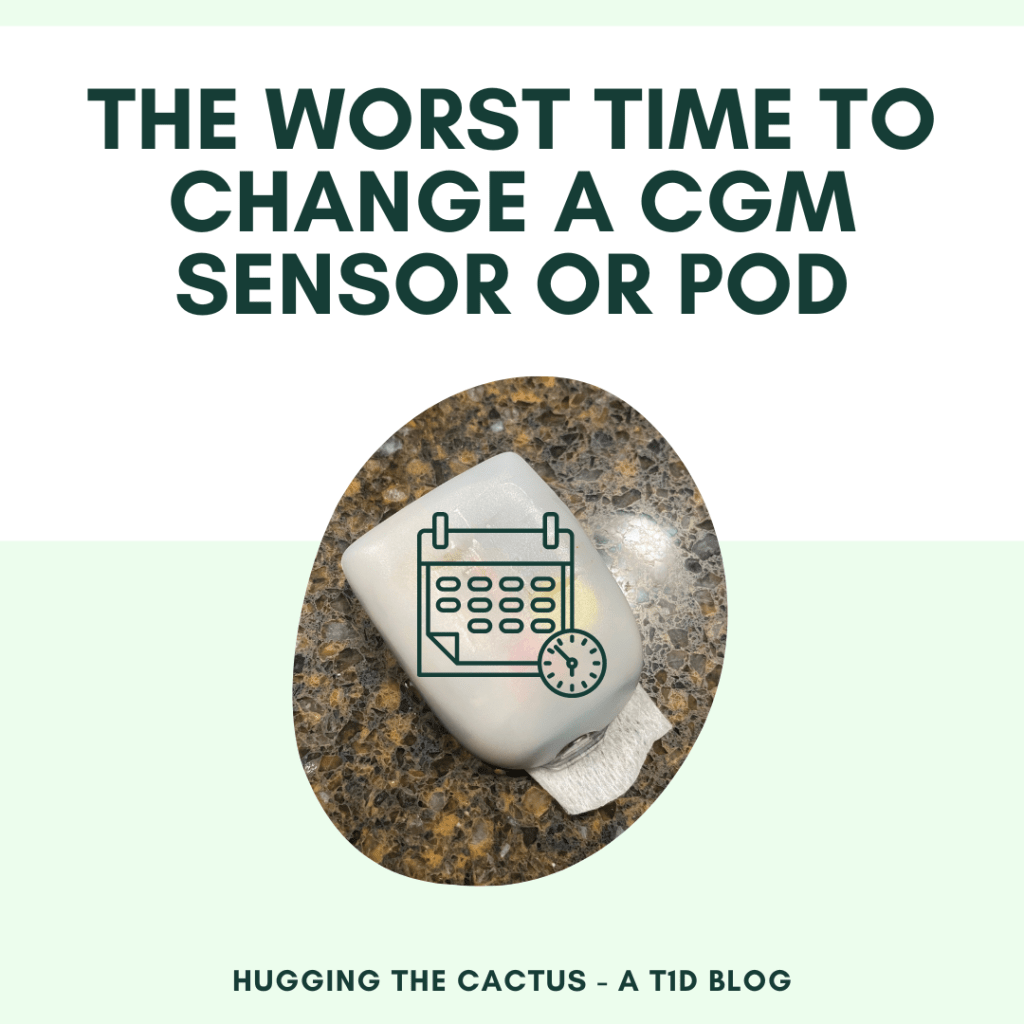
The Worst Time to Change a CGM Sensor or Pod

I’m not kidding when I say I think I’ve definitively identified the worst possible time to change a CGM sensor or pod – of course, I can only speak to a Dexcom CGM sensor and an Omnipod, so it’s probable that the worst time to do a site change may vary depending on the specific piece of equipment being used.

But I’ve learned from my own experiences that the worst time to do a site change is within a one-hour window of taking a shower.

Unless you want your pod to fall off and look sad like this one, maybe avoid changing it before taking a shower.

This is because I’ve found that the sensor or pod adhesive needs a solid block of time to firmly adhere to my skin. If I shower soon after completing a site change, I can almost guarantee that the heat and steam from the shower will be enough to dissolve the adhesive and cause the sensor or pod to fall off.

I’ve played around with the timing, too, and I’ve discovered that the more time I put in between a site change and shower, the better – an hour seems to be the absolute minimum. It can be a little inconvenient in the times that I have to forgo my CGM data for a longer period than I’d like, but my goodness, is it wonderful when the stars align and I can take a completely device-free shower. This doesn’t happen often as my sensor and pod change days don’t usually happen on the same day, but it’s undeniably a nice break when it does.

So, there you have it – a word of caution from me, a semi-pro CGM and pod wearer with about a decade’s worth of experience wearing both devices – the worst time to undergo a site change. A pod or CGM failure almost always can’t be helped, but I think it’s worth knowing how to prevent the likelihood of one or both of them needing to be replaced sooner than expected.

Constantly Learning

As I approach my 25th diabetes diagnosis anniversary (coming up this Christmas Eve), I marvel over how much I continue to constantly learn about my chronic condition.

You might think that I should be an expert after all this time, but that’s definitely not true. Sure, there are many predictable aspects about diabetes by this stage in the game. I’ve learned how to read my body’s signals. I’ve got a good grip on the mundane parts of diabetes management (e.g., changing my sites, reacting and treating various blood sugar levels, exercising with diabetes without wild blood sugar oscillations, and so forth). I know quite a bit about diabetes technology, even the kinds that I’ve never used before (and I attribute much of this knowledge to my friends and coworkers with diabetes, as well as the fact that I have an inside scoop on a lot of this stuff because I work in the diabetes sector).

But this doesn’t mean I’ve learned all there is to know about diabetes, the terminology that defines it, the research that is being conducted about it, or the innovations that are consistently occurring when it comes to technologies and therapies.

Little “cartoon me” likes to learn best with a book in one hand and coffee in another – hmm, maybe ACTUAL me should adopt this strategy!

A good example of this? I heard the acronym “FNIR” for the first time the other day when I was at work. A clinician was breaking it down as standing for “flat, narrow, and in range”, which is a pattern that can be visible on a CGM device that indicates tight control over blood sugar levels. My mind was kind of blown when I heard this; while the concept itself isn’t revolutionary, I had no idea that doctors had actually defined the phenomenon. This might seem like an insignificant example about learning something new; but on the contrary, it’s major to me because it’s something I hope to achieve on a daily basis (literally) – I just didn’t have the words myself for it. Now that I know it, I’d like to be able to use it during my upcoming endocrinology appointment as a tool to describe to my doctor that I want her help getting an FNIR graph more often.

Constantly learning can be tiresome at times, but it just goes to show that it’s good for me because all roads point down a better understanding of my diabetes – something that I will always want and always shoot for.

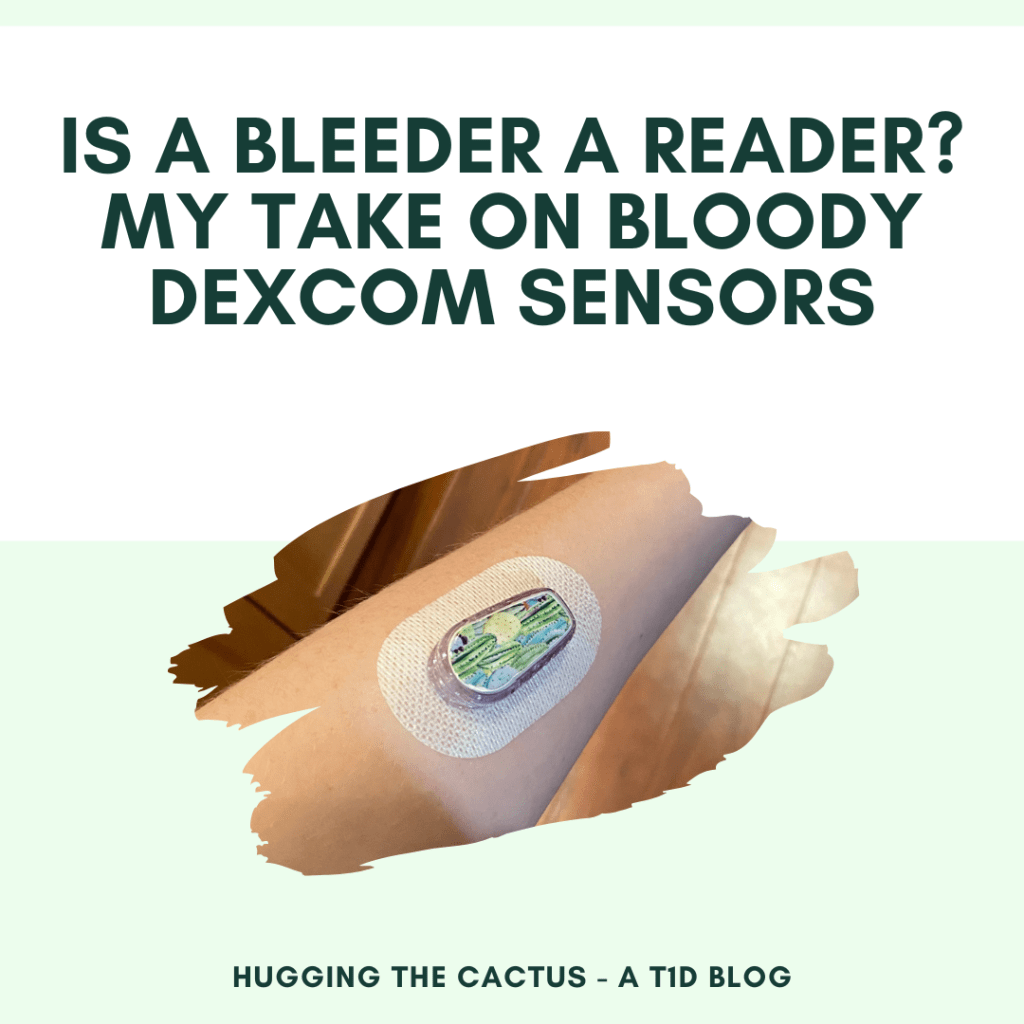
Is a Bleeder a Reader? My Take on Bloody Dexcom Sensors

This blog post was originally published on Hugging the Cactus in 2019, and again in 2020. I’m sharing it for a third time because 1) it’s one of the most popular posts I’ve ever written and 2) it’s STILL an issue debate among the diabetes community! My opinion on bleeders being readers hasn’t changed. Read on for more (and be warned that the topic might make you a little squeamish, if you wince when talking about blood).

I placed the new Dexcom G6 sensor on my abdomen, hovering my index finger above the large orange insertion button. I pressed it, exhaling as I felt the minute needle pierce my skin’s surface. I looked down, and started to rub the adhesive in circles to make sure it was stuck, when I saw blood. Not just a drop, but a decent-sized pool forming beneath the sensor. Before long, just about the entire surface of the white adhesive was soaked in red.

Yeah, this was going to be a no-go.

Previous iterations of this post featured some kinda gnarly bloody Dexcom imagery. This time around, I’m sparing you (and me) from that.

It’s pretty rare for me to experience blood at the site of a Dexcom sensor. If I had to put a number on it, I would say less than 10% of my insertions draw blood. An even smaller amount – like, 2% – have caused me to bleed as much I did in the scenario described above. But I know I’m not alone in my bloody sensor experiences – it’s something that many other T1Ds who use a Dexcom have gone through.

There’s a bit of debate, though, that I’ve noticed in the past on Twitter threads and Instagram posts. What to do with a bleeder? Keep it and assume that it’ll read blood sugars normally? Or change it immediately and call Dexcom for a replacement?

Are bleeders readers? Or does it depend?

I’m going to go with…it depends.

Obviously, in that situation I described in the opening of this post, I decided that it wasn’t a good idea to keep the sensor on my body. There was too much blood and I didn’t trust that it would adhere well to my body. I didn’t know how long it would take for the blood to stop (only a few minutes, but still), and I couldn’t be sure that it wouldn’t mess up my readings. On top of that, I wasn’t trying to stain my clothing, if I could help it.

So in that circumstance, I did change my sensor right away, and was glad that the second try resulted in a much cleaner, blood-free insertion. I called Dexcom, explained what happened to the customer support representative, and got a replacement sensor mailed to me.

However, just about any other time I bleed upon a sensor insertion, it tends to be a minuscule amount of blood. I usually don’t even notice until it’s time to replace the sensor, and there’s a bit of dried blood left on the site. Other times, I’ll see small beads of blood forming underneath the spot where the transmitter snaps in. And there’s been a couple of occasions that I’ve bled a fair amount and been totally unaware of it until I caught my reflection in the mirror and noticed the blood staining the white adhesive. And in all of those cases, I’ve kept the sensor on for the full ten days, without noticing any discrepancies in my readings.

All that considered, in my inexpert opinion, I think that bleeders usually are readers and that they’re safe to continue wearing. Of course, there will be exceptions, like when there’s just too much blood to salvage the sensor. But every time I’ve kept using a bloody sensor, I’ve had the same amount of success with its functionality…so yes, I think that for me, bleeders are indeed readers.

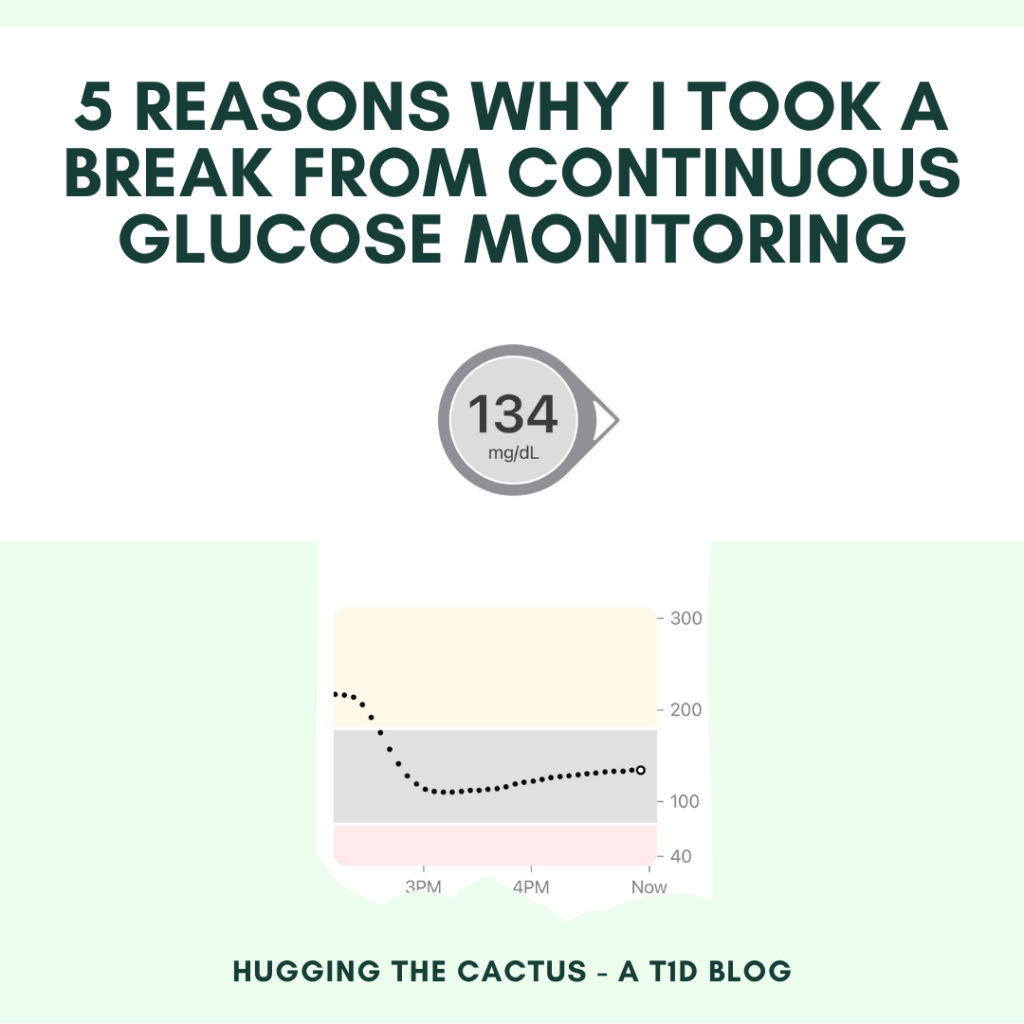
5 Reasons Why I Took a Break from Continuous Glucose Monitoring

today because it’s a great reminder that diabetes isn’t a static condition – what works for a person with diabetes one day might not work the same way the next. So when I decided to take a Dexcom break, it was a much-needed change in my diabetes care routine that worked wonders for my mental and physical health. I just might take another one after reading this post again…read on for the full story.

I’ve decided to take a break from continuous glucose monitoring. This means that for an undefined period of time – maybe 3-4 days, a week, or a few weeks – I’m not going to wear my Dexcom G6 CGM.

Initially, I wanted to give myself a break because I was just burnt out from wearing it all the time and feeling so dependent on it. But as I started thinking about more, I realized that there were some other really great reasons for me to take a break from my CGM:

1 – I wanted to wear one less device. It can be tough to wear two medical devices 24/7. Sometimes I get super self-conscious of them. Other times they just aren’t comfortable to wear, such as when I roll over one the wrong way when I’m sleeping at night. So it’s nice to feel a little more free with one less device stuck to my body at all times.

2 – I was sick of the constant data feed. All those alarms going off whenever I cross my high or low threshold are straight up annoying!!! I know I could just turn them off on my CGM receivers, but the point of them (for me) is to try to maintain as tight of a control on my numbers as possible. But now that I’m intentionally not wearing my CGM, I’m realizing how much I appreciate the reprieve from all that buzzing and beeping. There’s lots of reasons to take a break from continuous glucose monitoring, but sometimes one is enough.

Taking a break from my Dexcom was a much-needed change in my daily diabetes care routine.

3 – I have some new blood glucose meters to try. The only way that I can really put my new meters to the *test* (lol) is to use them – and goodness knows that I have very little desire to do manual finger stick checks when I’m wearing my CGM.

4 – I’d like to hold myself more accountable. I rely on my Dexcom heavily at all times. I look to it before I start exercising, before I eat something, before I do anything, really. I bolus using the data it provides and trust it implicitly. But I’ve recognized that by developing this habit, I’ve become lazy. I don’t measure out food as much because I figure that if I bolus too much or too little for it, I can just watch what my Dexcom tells me and treat from there. It’s kinda sloppy, in my humble opinion, so I’m trying to put more of the trust back in myself for my diabetes monitoring.

5 – I’m trying to reacquaint myself with my body’s cues. Before CGM technology, I was really good at recognizing high and low blood sugar symptoms…but then I started using a CGM and found myself reacting to highs and lows (e.g., treating them prematurely), even if I didn’t feel those high/low symptoms. So I want to retrain myself so I can make sure I never lose that ability, because I think it’s important to know exactly how my body alerts me to various blood sugars, rather than depending solely on a piece of technology to do it for me.

A Rookie Mistake

You’d think that 24 years of living with diabetes would turn anyone into a seasoned veteran of the condition, but even the most experienced people with diabetes slip up and make mistakes every now and then…

Case in point? Me, because I neglected to make sure I had a way of monitoring or checking my blood sugar when exercising…and then experiencing a scary low that I probably could have caught sooner, or maybe even avoided, if I hadn’t been so careless.

This all happened because I inserted a new Dexcom sensor just before taking off for my 3-hour self-defense class. I knew that the sensor’s warm-up period would end and that my continuous blood sugar readings would begin partway through class, so I felt fairly comfortable going without a blood sugar meter as a back-up. After all, my Dexcom sensors almost always start up without any issue, so I was trusting that this one would follow suit.

And that was my biggest mistake: trusting my technology.

Any time I make a rookie diabetes mistake, my palm goes straight to my face in embarassment.

When the warm-up period was complete and the class was taking a quick water break, I decided to check my Dex to see what my first blood sugar readings were. I was surprised (and instantly annoyed) to see that instead of a number, my Dexcom was displaying a request for a blood sugar calibration – just like the old G5s used to ask for upon insertion of a new sensor. I couldn’t understand why this happened, but I knew that pondering the matter wouldn’t make any difference…the only thing that would get my Dexcom running normally again was the finger stick checks, which wouldn’t be possible for me to do until I got home from the class because I was without my meter.

So I had no choice but to rely on nothing but my instincts and sensations in order to get a sense of where my blood sugar was headed for the remainder of the class.

And let me tell you, I can’t remember the last time I felt so vulnerable in terms of my diabetes. I was running on zero information, other than the fact that I typically can feel oncoming low blood sugars and that I tend to feel thirstier when my numbers are on the upswing. It was disconcerting – even more so when a little while later I started to feel shaky and dizzy, like I was starting to go low.

I knew I could either 1) treat what I thought was a low blood sugar and deal with the potential consequences (high blood sugar) when I got home, or 2) take a chance and ignore the low symptoms because I couldn’t confirm whether or not I was actually low. I hate to admit it, but I let a good 15-20 minutes pass before I decided it was better to correct what felt like a low rather than run the risk of passing out in front of the entire class. Turns out that I made the right call to treat my low: I felt much better after I ate some fruit snacks, and my blood sugar when I got home that evening was in the low 80s, indicating that I probably avoided a pretty nasty low in class.

While the whole incident could’ve been easily avoided, it did remind me that I ought to take some of the trust that I have in my technology and distribute it a little more evenly between it and my instincts. I proved to myself that in emergency situations, I don’t need a meter or a CGM to pick up on low blood sugars (though I obviously would prefer to have that equipment at my disposal at all times). Instead, I need to trust my instincts more and procrastinate less when it comes to taking an action – because if I had waited longer than those 15-20 minutes, the situation could’ve escalated and then I would’ve really been kicking myself for leaving my meter at home.

Rookie mistakes suck when they happen, but at least the silver lining is that there’s always a lesson to be learned (or reinforced) when they do.

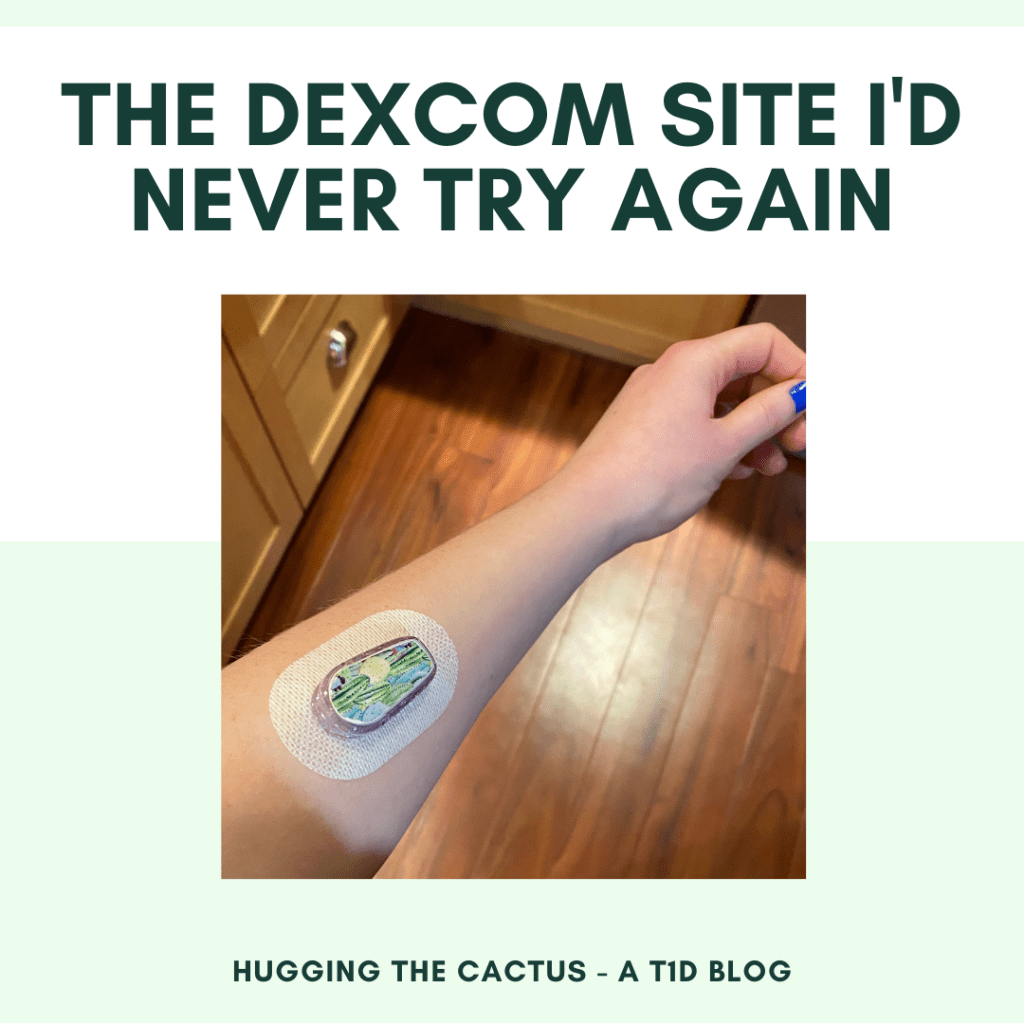
The Dexcom Site I’d Never Try Again

This blog post was originally published on Hugging the Cactus on February 26, 2021. I’m sharing it again today because I see folks trying new Dexcom sites all the time, usually with a lot of success! I thought it was worth it to share my experience with the forearm site because it was the polar opposite of a win for me – read on to learn why.

I don’t usually regret trying new sites for my Dexcom and OmniPod.

But recently, I discovered the one area that I wish I hadn’t tried…and that is my forearm.

The forearm Dexcom site gets a big old NOPE and OUCH from me.

For a couple years now, I’ve seen forearm Dexcom sites all across social media. People lauded the location for how comfortable it is and the accurate readings it produces, so I figured, why not give it a shot? (LOL diabetes humor.)

Plus, I wanted to give my stomach and the backs of my arms a break. I put both pods and sensors in those locations and while I like them a lot, I’m wary of scar tissue building up.

So with little fanfare, I tried putting my Dexcom on my left forearm (my non-dominant arm). And I knew immediately after hitting the orange button to insert the sensor that it was a bad choice because it STUNG. It stung something fierce! I remember wincing the moment it pierced my skin, and fortunately, the pain did go away…but resurged with a vengeance about half the time I made any arm motions. It didn’t matter if I was flexing it up or down or twisting it to reach for something – any movement could trigger varying degrees of pain. Nothing incredibly intolerable, but enough to make this site uncomfortable.

My face says exactly how I feel about this site: It’s not a winner.

And this pain didn’t altogether disappear one day: I still felt stings 24 hours after I put the sensor on. Maybe I hit precisely the wrong spot (I noticed a very small amount of blood discoloring the white adhesive of the sensor), but I asked the diabetes online community and it seems that the general consensus is that this location sucks. The half-dozen or so people who messaged me said that either the pain was too much and they took the sensor off early, or they toughed it out for a full 10 days and never used the site again.

What’s more is that this site wasn’t as out-of-the-way as I wanted it to be. I roll up my sleeves dozens of times each day for different tasks, and each time I went to roll up my left sleeve, I had to go about it gingerly so I didn’t risk bumping into the site and prompting ripples of pain. This was straight-up annoying because my diabetes devices don’t usually inhibit my movements so much.

The one plus-side of trying the new site, and the only thing that motivated me to keep it on for the full 10 days, is that it was just as accurate as any other Dexcom site I’ve tried. My readings matched up pretty closely with how I felt and with what my blood sugar meter reported, so that was a saving grace. And I have to admit that even though I was worried that sleep would be impossible with the sensor in such a tender spot, it really didn’t interfere with my slumbers, which was a relief.

All in all, though, the accuracy wasn’t enough to convince me to want to keep forearm sites in my regular rotation. I’ll stick with abdomen and upper arm sites for now, with the occasional thigh site to further prevent scar tissue.