A Temporary Diabetes Cure

I always envied people who experienced a diabetes “honeymoon” period. I used to think, how nice it must be to have some extra time to prepare for fulltime life with diabetes and not quite rely on insulin injections right off the bat! I also always assumed that, after 25 years living with diabetes, that the honeymoon phase had absolutely skipped over me, and I was positive I’d never get to experience it.

Turns out, my diabetes – that saucy little minx – likes to keep me on my toes as it recently surprised me with an abrupt 48-hour window of time in which it seemed like my diabetes was cured.

That’s the only way I can describe what transpired. It was the strangest thing. One day, I woke up, ate breakfast, and took insulin for it – just as I always do. Except instead of my blood sugar spiking or even leveling out after eating, it started to drop, which was strange because I ate a fairly typical meal that morning. At the time, I thought nothing of it and just ate some extra carbs before my blood sugar went too low.

No big deal, right? But this phenomenon happened again, following both my lunch and dinner. It was especially inconvenient in the evening, as I had a volleyball game and wanted my number to be up so I could play. I had some fruit snacks before the game to keep my levels up, but was surprised when even after that, I was dropping by the tail end of our third and final match. I remember being out on the court, trying to track the ball as my team bumped it back and forth over the net with the other team, knowing full well that my blood sugar was going low but feeling determined to stay in the game until it was over. The moment the final whistle blew, I ran to grab even more fruit snacks, and felt both annoyed and confused by the whole situation.

The following day, I decided I wasn’t going to mess around anymore. I wanted to cut my mealtime insulin doses in half to see if that helped me at all. It was a solid idea, but it didn’t prove to do much to help as I again dropped after breakfast and lunch. Okay, so clearly that course of action wasn’t enough. Maybe I could try switching from automated mode to manual on my Omnipod 5 PDM and put myself fully in control, rather than leaving it up to technology. I set a temp basal decrease to ensure I was getting very little basal insulin, and resolved to enjoy my pizza dinner that evening with friends.

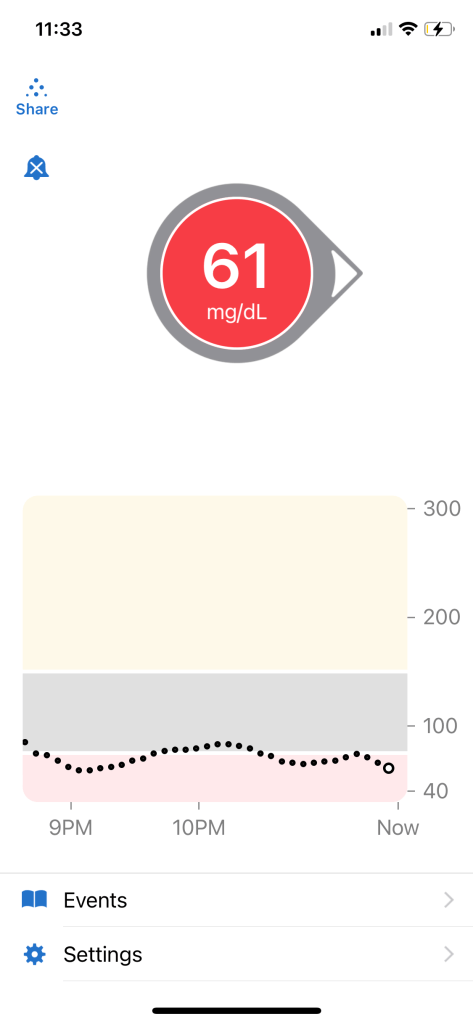
Of course, pizza is notoriously difficult to bolus for, so I knew I’d have to do even more extra work in order to prevent my blood sugar from dipping. So not only did I take half the amount of insulin than normal, but I also did an extended bolus so that I wouldn’t get it all upfront. I ate two fairly large slices of pizza and also had a generous serving of chips that I technically didn’t include in my bolus calculations. So imagine my bewilderment when, 2-3 hours post-pizza, I was still going low. I poured myself a glass of regular soda, and it became my companion for the remainder of the evening. I’d take sips as I saw my graph report blood sugars that never went higher than 110, but fluctuated for the most part between 60 and 90.

It was wild, and I was actually getting pretty worried about the whole situation. I couldn’t make sense of it. I ran through all the variables that could’ve caused this to happen – was I wearing my pod in a strange site? Was it because of my period? Could it be due to my activity levels or changes in the weather? I weighed so many possibilities in my mind and came up with nothing definitive, so I went to my next best resource for input…the diabetes online community.

I asked around for input and was – as always – so grateful to the folks who reached out and served as thought partners with me. Based on what I learned, the most likely culprit is hormonal changes. In fact, perhaps it was a bit of a birthday gift from my diabetes as I ushered in a new age/phase in life. It’s still totally bizarre that it happened, but a friend reassured me of her own experiences with the same temporary phenomenon as she’s experienced menopausal shifts. So, maybe…just maybe this was the explanation I was looking for, and perhaps the whole thing happened to signify the start of my upcoming cycle.

I won’t ever know for certain if that was indeed the cause of my temporary reprieve from diabetes, but at least I can find a little comfort in knowing that I got through it (as my blood sugars and insulin needs bounced back with a vengeance the following day) and that I had the support and feedback from friends and strangers alike the whole time.

Flatbread Failure

Any type of pizza, plus diabetes, usually equals one giant headache in terms of nailing a correct insulin dosage.

Nine times out of ten, my blood sugar ends up high in the hours following a pizza meal. This is a fairly common phenomenon for people with diabetes, because even though pizza contains high amounts of carbohydrates, it also contains a large amount of fat that ends up delaying the digestion of pizza – resulting in a belated blood sugar spike. My go-to workaround for this is to do an extended insulin bolus, meaning that I take part of my insulin dose at mealtime and my pump will deliver the remaining dose later on, but it can be tricky to nail the timing of it.

So imagine my surprise when, after enjoying an evening out with my boyfriend in which we split a very tasty flatbread pizza (half buffalo chicken, half brussels sprouts and bacon), my blood sugar didn’t spike even a little bit post-meal. In fact, it actually ended up tanking – so much so that over the course of 2 hours, I had to eat 3 packs of fruit snacks and a handful of leftover Easter candies in order to keep it from dropping too much.

My mind was blown. I had actually eaten more flatbread slices than I normally do during this meal – the two of us nearly demolished a large-size flatbread, which is quite a feat – and so I bolused for 60 grams of carbs, using the manual mode on my Omnipod 5 PDM to enable an extended bolus in which I gave myself half my insulin dose upfront with the remaining half to follow 1 hour later. I actually thought I was underestimating the total carbs I’d consumed, especially considering I had two cocktails with my meal. But nope, I had completely missed the mark on this one and paid the price as I did whatever I could to keep my blood sugar up in the hours before I planned to go to bed. You can see from my CGM graph below that this was a bit of a prolonged struggle, one that kept me up much later than I would’ve liked.

But, oh well. That’s just how it is with diabetes sometimes, and I remain optimistic that I can nail the pizza bolus next time. After all, I’ve done it before, so I can do it again. And this is the kind of bolus experiment that’s kind of enjoyable – any excuse to have some delicious pizza.

A Diabetes First

Forget “a diabetes first” as the title for this blog post – “a first” would suffice. That’s because I experienced *drumroll please* my very first stomach bug this past weekend! (At least, the first one that I can remember; most certainly, the first of my adulthood.)

I don’t know how I caught it and honestly, as I sit here and write this, it’s taking the very little energy I have to summarize what I dealt with over the weekend. But here’s the short version: I was out shopping with my partner on Friday evening. On our drive home, I grew increasingly nauseous and essentially bolted it to the bathroom when we made it home. I won’t cover all the gory details here, but basically, I was pretty ill for many hours. Food and drink quickly became out of the question for me, and even though my stomach was churning relentlessly, I still had enough mental bandwidth to check my blood sugar every so often to make sure it wasn’t climbing or falling.

Much to my relief, my blood sugar was the only thing that remained stable all weekend long. As I fought through waves of nausea, I was grateful that I didn’t have any insulin on board as an additional factor to contend with. It seemed like my diabetes knew I was going through enough, so the least it could do was play nice while my body dealt with the bug as best as it could.

I’ve slowly reintroduced foods into my diet today – I never would’ve thought I’d be so simultaneously excited and nervous to eat saltine crackers, rice, or plain chicken – and I’m still amazed at how my diabetes seems to be cooperating as I continue to recover. Granted, this could be because I’m eating very simple carbohydrates and not many at one time, but still. I’m appreciative of the fact that I can rest up without worrying as much about my blood sugar levels.

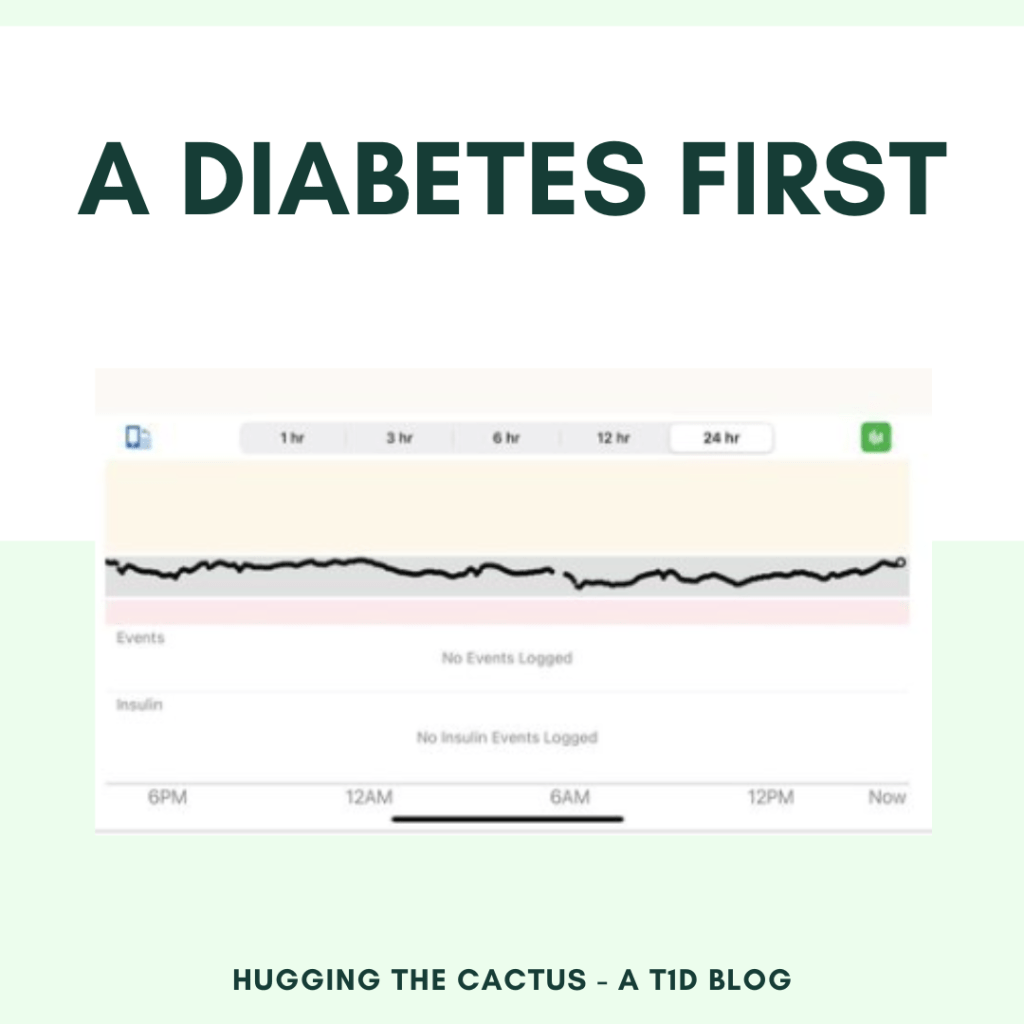
Don’t get me wrong, though…as nice as it was to have approximately 48 hours of in-range blood sugars (above 80 and below 150 on my own Dexcom graph), I definitely wouldn’t trade them in favor for a stomach bug. I’d much rather put in a little more effort on my own to obtain in-range readings than have to go through that whole ordeal again.

Sudden as Lightning

It was as sudden as lightning, when it streaks across the sky just before the rain begins to fall, signs of a storm that that refuses to go unseen or unheard.

“It” being the sweat that began to bead on my forehead, then trickle down fast and furious as I grew more and more aware of a low blood sugar episode.

One moment, I was sitting cool, calm, and collected. I was alert and engaged in the conversation happening around me. And then boom, the sweat started and my concentration on my surroundings ended. Voices grew more distant as I honed in on my outward appearance. Panic struck – could others see how sweaty I was getting? Were they noticing my incessant fidgeting, a coping technique I have when my blood sugar drops and I get paranoid about maintaining an air of everything being just fine? My foot, already jiggling up and down as part of my fidget routine, seemed to pick up the pace as I began to get a grip on the reality that I needed to do something about this low before I further deteroriated.

The door to the room opens. I dart out, walking briskly down the hallway to where my low blood sugar supplies sat waiting for me. I gobble down a pack of fruit snacks as quickly as possible, and then force myself to sit. The sweat’s gotten worse and I worry about it being visible on my clothing. Seconds melt into minutes, somehow, though I pay them little attention as all I can think about is having this low blood sugar episode end, please please please, as soon as possible. I desperately want to escape to a restroom for privacy (and to mop the sweat off my body), but I’m immobilized by the low and also slightly nervous that it’s major enough that I might need help from someone in the vicinity so it’s a terrible idea to isolate myself from others. I push that thought out of my mind – I just need to give the fruit snacks some more time to work, that’s all. Keep it together, you’ve got this, stop freaking out so mu-…

…and just as suddenly as it had struck, the sweat dissipates. My shaky hands steady themselves. I regain an awareness of my environment. I exhale, relief flooding throughout my body as I realize that I’m recovering from the low.

Sudden as lightning, both in how it had struck and then how it had disappeared, leaving hardly any trace that it’d been there at all.

Tingly

I knew something was wrong when my tongue inexplicably began tingling.

It was a sudden, prickly sensation – almost like I had pins and needles on my tongue. (This is a sensation I get in my feet when I’ve had them in a certain position for too long and I need to get the blood flowing properly again. A quick Google search taught me that just about anyone can experience this, so odds are you already know what I’m talking about.) And it lingered for a solid 20 minutes, making my entire mouth feel as though it was simultaneously numb and on fire from the unrelenting feeling.

This is my new(ish) low symptom: tongue tingling.

And I hate it.

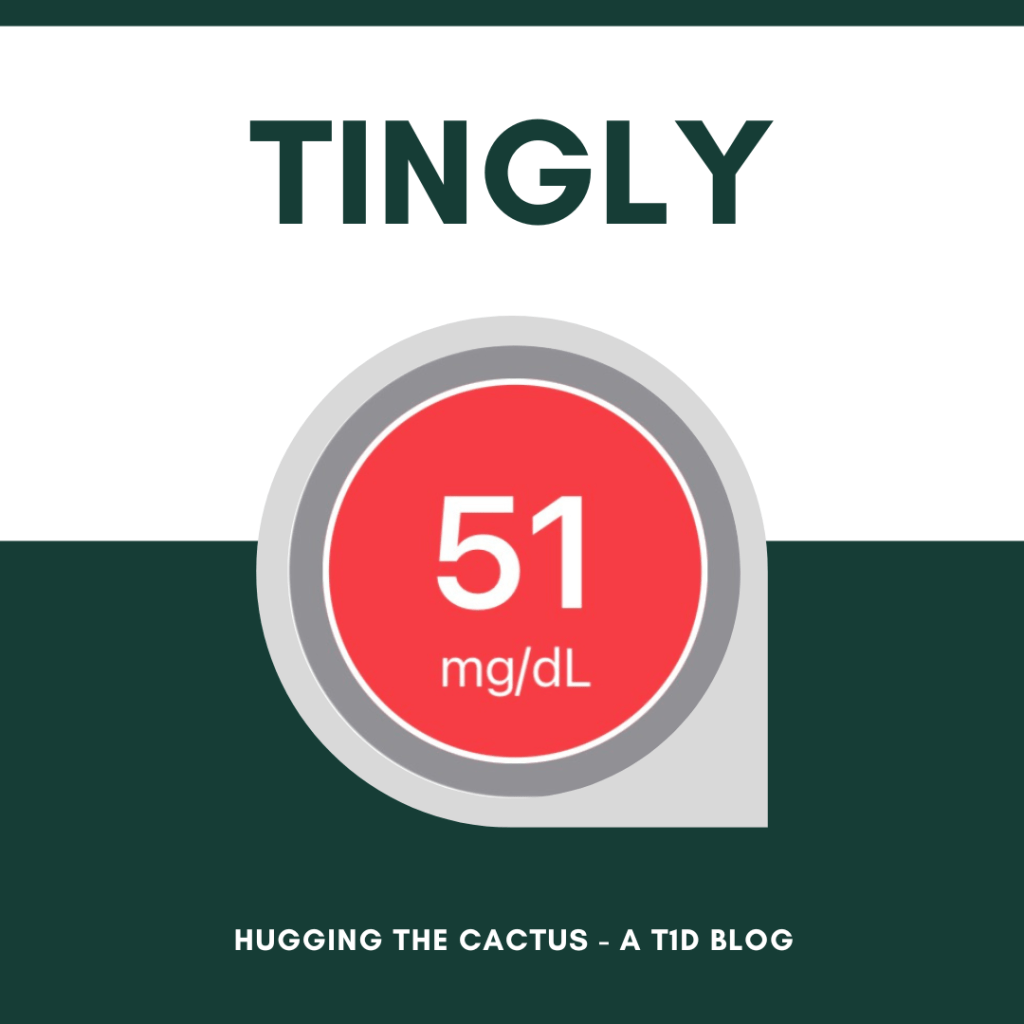
It only seems to occur when my blood sugar hits the 50s or 60s, which doesn’t happen too often. But when it does, it hits me so abruptly that it catches me off guard every time. It’s an unpredictable phenomenon – usually, my first sign of a low blood sugar is feeling shaky/sweaty/dizzy. Once I feel those initial signs of a low, I’m pretty good about being quick to do something about it by grabbing something sugary to eat…and when tingly tongue strikes, it can make the entire eating experience unpleasant because it almost feels like I’m having an allergic reaction to my low snack. And it lasts longer than it takes for my Dexcom to pick up on a recovering low blood sugar.

I’ve genuinely been worried that I was having an anaphylactic reaction in addition to a hypoglycemic event, prompting me on more than one occasion to run over to the closest mirror to check and make sure that my mouth and face aren’t swelling up or turning red. Let me tell you, it’s enough to deal with the low blood sugar sensation – feeling like I’m having an allergic reaction on top of that makes a normally easy-to-deal-with low that much, well, suckier, to be blunt about it.

I classify it as only sorta, kinda new because I’ve dealt with something similar in the past. In fact, roughly 4 years ago, I wrote about “a fuzzy towel tongue” feeling that I experienced after a low blood sugar. It’s funny that I wrote about it because I think at the time, I only ever felt that a handful of times, and the symptom seemed to disappear. But now, it’s apparently back with a vengeance, as the tingling feels much worse now than the numbness I’d felt a few years back.

At least I know that I’m not alone. I’ve talked to my fellow T1D mother about this and she’s also experienced it, in addition to the folks I’d interacted with in the context of my original post on the matter. It might not be fun, but there’s (quite literally) strength in numbers.

Sluggish

Pasta for lunch. I knew it was a gamble, but on a snowy Friday afternoon when I had a bowl of leftover spinach-stuffed ravioli in the fridge that was begging to be heated up, I simply couldn’t resist it.

I took a larger-than-usual lunchtime bolus to account for the heavy carbs. Or at least I thought it’d account for the carbs. But I was way off. Roughly 45 minutes after I gobbled up my meal, my blood sugar was beginning to take off – with no sign of a smooth landing in sight.

Not that I noticed. Rather, I found myself feeling…slow. My eyes felt droopy with a gradual drowsiness that I couldn’t fight off. Normally, this would feel quite pleasant, especially if I was about to take a nap. But on a Friday afternoon, when I had some work items to wrap up, it was far from a welcome sensation.

As I sat there, staring blankly at my monitor and pretending I couldn’t hear my buzzing CGM that was trying to alert me to the current state of my blood sugar, I was falling deeper and deeper into a state of utter sluggishness. I craved the warmth emitting from my space heater by my desk, relishing how the heat lulled me into listlessness.

In that moment, I was the human equivalent of a happy little slug, oblivious to the realities around it and going about life at my own passive pace, without a single other care in the world.

A representation of me as a slug in a high blood sugar stupor, complete with pod.

I don’t remember what caused me to snap out of my stupor – perhaps I’d heard my CGM vibrate one too many times, or maybe common sense jolted me into realizing that I had stuff to do and couldn’t afford to be overcome by this sensation. But I did find myself peeking at the number that my Dexcom was reporting to me and being somewhat appalled by my hyperglycemic state, as well as being almost grateful for having a logical explanation for why I’d turned into a slow-moving shell of a person. It’s funny how even after 25 years of diabetes, a high blood sugar can still throw me off my game in such a dramatic way. Luckily, a solid correction bolus, change of scenery from my overly cozy desk in my bedroom to the cooler comfort of my downstairs setup, and a large bottle of water brought me back down to where I needed to be – maybe a bit more slowly than I would’ve liked, but hey, a slug can’t complain about swiftness (or lack thereof).

3 Tips for Going Back to an Office with Diabetes

As anyone who lives with diabetes knows, it’s a condition that dislikes disruptions to a daily routine.

This was one of my main concerns when it came to starting my new job last week. The position is hybrid, meaning that I can work from home and in an office as it suits my needs. The prospect of returning to an office again after more than three years of working remotely positively excited me, but I’d be lying if I said that it also terrified me. I was anxious about my first day back in an office environment (in addition to all the jitters associated with starting a new job), and more than anything, I was worried about how my diabetes would be affected by this change.

This is because I’d settled into a fairly standard routine after all this time working from home. I have a workout regimen, eating schedule, and built-in breaks throughout my day that have greatly benefited my day-to-day blood sugar levels, and I knew that returning to an office setting would prevent me from maintaining these habits.

So that’s why I entered what I’m calling “diabetes hyper-prepare mode” the night before my first day in the office so I could try and think about all the ways my day would differ working in this setting versus my own home. And thus, I came up with these three tips that resulted in a very successful diabetes (and work) day:

Tip #1: Get ready as much as possible the night before. The week that I started my new job, I did my best to recall the routines that had worked well for me when I was regularly working in an office. The first thing that came to mind was the amount of preparation I typically did each weeknight so that I could get out the door as soon as possible in the morning. This included laying out my outfit, making breakfast ahead of time, putting together a lunch, and packing my bag. This extra work the night before really paid off the following morning and meant that I hit the road at exactly the time I had planned to; plus, the food prep worked wonders as I didn’t have to waste brain power in the morning trying to think about what I might eat throughout the day. The food was all set and ready to go, and I knew its carbohydrate contents, which resulted in phenomenal blood sugar levels all morning leading up to lunchtime.

Tip #2: Maintain movement. As it turns out, a 40-minute commute combined with lots of sitting in meetings means that my movement patterns in the office are minimal. I did my best to combat this by getting up a few times throughout the day to explore my new building in 10- or 15-minute intervals. Not only did this give my eyes a break from my dual monitors, but it allowed me to stretch and get familiar with the environment. It also helped to curb my post-lunch upward sloping blood sugar, so it was definitely beneficial to my body and mind to make sure I maintained semi-regular movement during the workday.

Tip #3: Have back-up supplies on hand. When I was packing my bag the night before, I made sure to slip a meter, test strips, and fingerstick device, as well as some fruit snacks, into one of the compartments as I didn’t want to run the risk of something going awry with my CGM or needing a low snack and not having it. Of course, I didn’t experience either scenario in the office that first day, but knowing that I had these items close by went a long way in reassuring me that I was prepared to handle any diabetes scenario that might crop up during the workday. And it turned out to be fodder for reminding me that I should also have an extra pod and insulin in my bag at all times, too – next time, I’ll make sure to bring those items with me so I can have even more diabetes bases covered.

These tips might seem pretty obvious, but I was kind of awestruck by just how weird it felt to be back in an office space after a long hiatus away from one. So I think that following these tips truly did help to ground me so I could stay focused on learning my new job and meeting my colleagues, rather than letting my diabetes take center stage for the day.

What Happened When My Blood Sugar Crashed in the Grocery Store

I knew something was wrong when the walls of the soda and seltzer aisle felt like they were closing in on me, Star Wars-trash-compactor style.

You would think a blood sugar is no sweat (pun intended) in a place where food is so easily accessible, but this experience was far from it.

On a recent trip to the grocery store, I went low. And when I say low, I mean low – I wasn’t just shaky, I was sweating literal bullets and having a hard time seeing straight in front of me.

My boyfriend – thank goodness he was there – knew something was wrong just by looking at me. He suggested that I grab some fruit snacks from my backpack and I heeded, tearing open the small foil packet and tossing the contents back as quickly as I could. I chewed, grimacing as I tasted the strangely saccharine, perfume-y gummies, but I barely cared about the taste. I just wanted to feel better. That’s when my boyfriend placed a hand on my back, noting my clammy state, and escorted me over to the dining area at the front of the store.

“Just stay here, I only have a few things left to grab. Maybe you’ll be feeling better by checkout time,” he said, before asking me if I was okay to be left alone.

I was. I hated that he was seeing my like this, in this vulnerable, sweaty state that seemed impossible in the chilly air of the grocery store. I told him I would sit and wait there for him, fighting the feeling that I was a small child waiting for a parent to finish up some boring adult task. As I nearly collapsed onto a chair, all I wanted to do was shrink so nobody could see me: It seemed as though all sets of eyes in the vicinity were locked on me, the perspiring wonder who looked quite unwell.

I was only on my own for about 5 minutes, but time dragged as I anxiously awaited my boyfriend’s approach to the checkout line. I thought I’d wanted to be alone as I let the fruit snacks kick in, but turns out the opposite was true. I clung to his side as I slowly registered that I felt safer around someone who knew exactly what was wrong with me and how to handle it if things got worse.

As we exited the store and loaded the groceries into the car, I noted that my shakiness was dissipating, as was the beads of sweat on my body. This low episode was over and I was relieved to be on the other side of it. I was also relieved that I didn’t have to go through it alone: turns out lows are a bit more bearable when you have someone else with you to help you through them.

A Weekend of Bagels, Pizza, Ice Cream, and…Good Blood Sugar?

Would you believe me if I told you that last weekend, I ate mostly carbs for 36 hours straight and totally avoided high blood sugars the whole time?

I looooove carbs. Almost as much as Oprah Winfrey loves bread.

It sounds wild, but it’s the truth! I went on my annual weekend getaway with my college besties and it was the loveliest time filled with sunshine, conversation, and tons of delicious food. I can’t remember the last time I ate that much in such a short window of time, but it was all worth it, especially because my blood sugars didn’t pay the price for it for once.

Here’s the breakdown of what I ate:

  • Friday:
    • 2 slices of Mediterranean-style pizza and 3 chicken tenders for dinner, the first official meal of the weekend trip
    • 2 glasses of wine
    • Handfuls of crackers and cheese because who doesn’t love that with wine
  • Saturday
    • 1 blueberry bagel accompanied by 1 fried egg for breakfast
    • Salad and heaping scoop of ice cream for lunch
    • Pita chips for a snack
    • Panko-crusted haddock with jasmine rice and veggies for dinner
    • 2 cans of cider (and maybeeeee a glass or two of bubbly)
  • Sunday
    • 1 everything bagel slathered in goat cheese plus 1 fried egg for breakfast
    • 2 slices of leftover pizza for lunch, which is also when I arrived home from the trip

It definitely wasn’t my healthiest, most balanced weekend of eating, but I’m more than okay with that because it was about enjoying my time with my friends and indulging a little rather than stressing the whole time about bolusing and blood sugars. And you know what, I think that my laidback, let’s-just-savor-this approach is partially the reason why I had such stellar weekend blood sugar levels. That, coupled with extended boluses for most of my meals (you know that pizza and bagels contain alllll the slow-acting carbohydrates), really helped me achieve the relaxing weekend that I wanted.

Now if only I could get away with this on a regular basis – as I write this, my blood sugar is coasting from a peak of 248 back into the low 190s after I dared to consume a bagel at lunch in the middle of my busy workweek. But it’s all good, and maybe just evidence that I should try to remember to live in the moment on weekends of fun like this one and prevent diabetes/blood sugar from taking center stage. Perhaps that’s the key to more stable numbers.

If nothing else, this serves as a reminder to me that even with diabetes, I can still enjoy a sh*t ton of carbs every now and then.

Tricky Timing and the Power of the Pre-Bolus

Pre-bolusing: It’s the term that describes taking insulin before eating food. The “before” part in the definition is key, because the amount of time that “before” is can and will vary among people with diabetes. It depends on a few factors, including the amount and type of insulin being used, the amount and type of food to be consumed, current blood sugar levels, and so forth.

It’s one of those things that’s tricky to nail the timing of, but boy, when it works it’s so worth it.

Pre-bolusing works well, but only when the timing of it is perfect.

I have two examples to complement that belief, one in which pre-bolusing almost lead to a disastrous outcome and the other in which everything turned out ideally. I’ll start with the more chaotic scenario first.

In this situation, my boyfriend and I spent the night in New Hampshire to attend a friends’ wedding and had a pretty late night, which meant we slept in a little later than we had intended the next day…actually, a lot later. We only had about 20 minutes to race around our room, pack up our belongings, and get ourselves looking presentable before we had to check out of the hotel. Luckily, our scrambling paid off and we made it out in time, but sleeping in cost us the opportunity to enjoy a complimentary hotel breakfast. We decided that it made sense to stop for brunch on our drive back home to Massachusetts, so we Googled a diner that was on our route home and stopped there for a meal.

When we got there, the restaurant was pretty crowded, but we were seated and able to place our brunch orders almost immediately – a good sign. I assumed this meant we wouldn’t have to wait more than 20 minutes or so (that feels like a restaurant standard) for our food to be ready, so I went ahead and pre-bolused my mealtime insulin. After all, I’d ordered a hearty omelet that would come with breakfast potatoes and toast, so I wanted to be proactive about avoiding high blood sugar and get my insulin in system sooner rather than later.

Unfortunately for me, our food ended up coming out later rather than sooner. In fact, we waited nearly 45 minutes for our dishes to finally come out. In that period of waiting, I was getting more and more anxious about my decision to pre-bolus with each minute that passed without food in front of me. By the 30-minute mark, I was close to full-on panic. Even though my Dexcom wasn’t indicating that my blood sugar was low (it held out steady the whole time), I was worried that the system delay in reporting my blood sugars would fail to catch a serious low in a timely manner. I told my boyfriend what was going on, and without hesitating he went to his car to grab some packs of honey that he’d stored in his glove compartment in case of emergency. We talked it over, and decided that it was probably best for me to consume at least one pack of honey because we couldn’t possibly know when our food was going to come out, and at this rate, we wanted to play it safe rather than be sorry. That didn’t exactly lessen the sorrow and stupidity that I felt for taking a pre-bolus (even though I couldn’t have possibly known that our food would be so delayed, I still felt badly about the whole thing), but it was what it was. And ultimately, I felt like I paid the price several hours later, when I was dealing with the very same high blood sugars that I’d hoped my pre-bolus would prevent. So much for making the pre-bolus grade that time…

But that doesn’t mean pre-bolusing always fails! This brings me to my other example. My mom and I had a nice lunch together last week. Before we left to go to the restaurant, I noticed my blood sugar was a little high. I decided to give myself a correction dose, plus one extra unit of insulin, because I knew we’d be eating foods that aren’t typical for me to consume at lunchtime that could result in highs later in the day. So again, I was aiming to be proactive and prevent prolonged high blood sugar.

And this time, the strategy worked great! At the restaurant, I stacked that pre-bolus with my actual meal bolus (not always a recommended tactic, but it was useful here) and rounded out my afternoon with a blood sugar in the 120s – a win in my book. Thanks to my pre-bolus, I didn’t experience any pesky blood sugar spikes and still landed in range, which in turn showcases the power of the pre-bolus perfectly.

So just like anything in life with diabetes, when pre-bolusing works, it’s wonderful…but it definitely requires a little finesse to learn exactly when/how/where to use it.