The Unexpected Blood Sugar Buster, Part 2

This past June, I wrote a blog post about how cleaning is an unexpected blood sugar buster for me – meaning that my levels are guaranteed to start dropping after a prolonged period of tidying.

And just today, I realized that there’s another (perhaps even more unanticipated) blood sugar buster for me…and that would be…

Trying on clothing. Yup! An innocent, well-intentioned act meant to improve my wardrobe resulted in a low blood sugar, and reminded me why I hate shopping for clothes so much.

Before you jump in and say, well of course her levels dropped, she was walking around a store, let me tell you that this store really wasn’t even that large. There were so many racks of clothing strewn about haphazardly that I felt more like I was stumbling my way slowly through a maze as opposed to the laps I can easily take by walking around a Target or a grocery store. My pace was positively snail-like, and I got more and more dragged down over time by the weight of the clothing items I was carrying in my arms.

By the time I got to the dressing room, my energy was going downhill as it had mentally worn me out to search for clothing even remotely close to the style I was looking for. I only had 9 items to try but the prospect of putting on each piece felt daunting. (Let alone doing so while maneuvering around the matchbox-size dressing room; seriously, it was so small that if I spread my arms wide then I would be touching both sides of the room.) With impending senses of claustrophobia due to the teensy room and dread at the notion of trying on new clothes, I also registered that I was getting very, very warm. And a little dizzy.
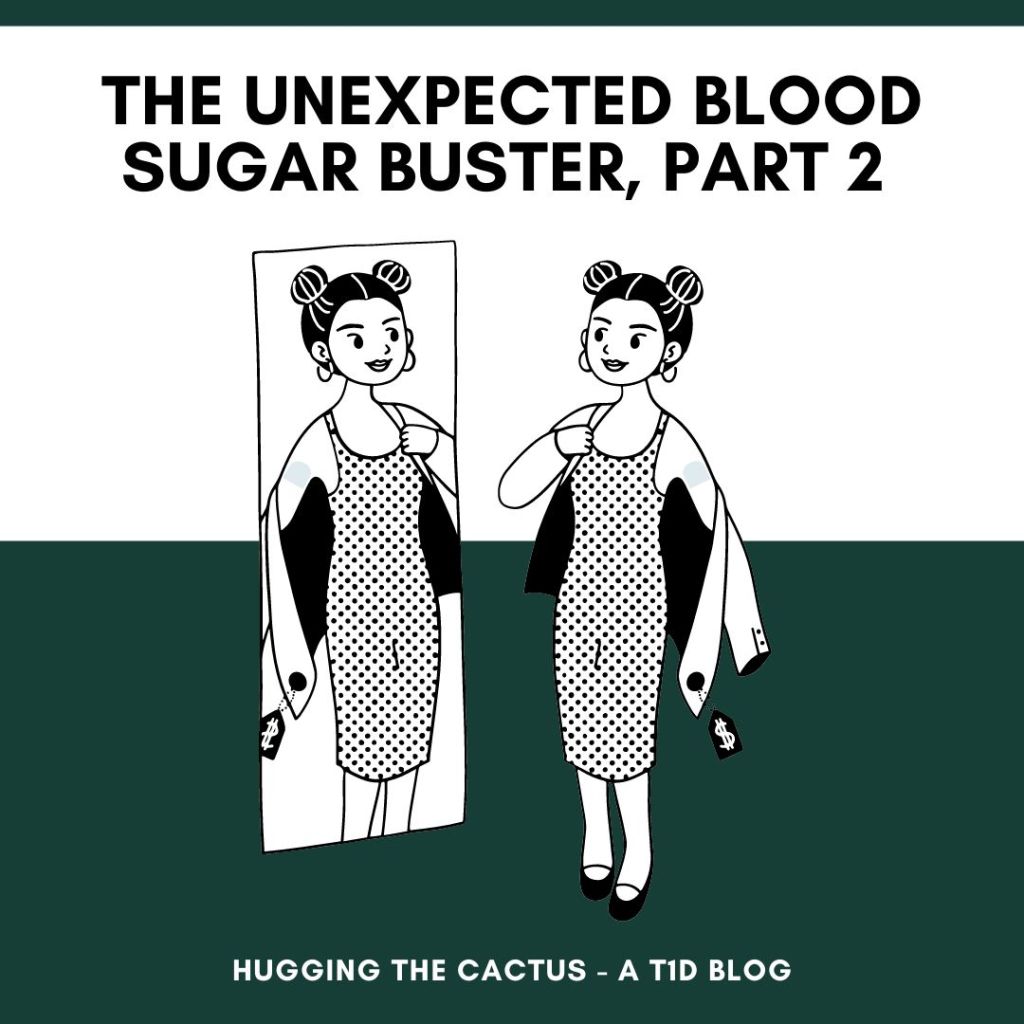
Was I blacking out from my latest endeavor in clothes shopping, or was it just my blood sugar going low?

Naturally, it was the latter. Something about hauling a haphazard collection of clothing around the store, then trying said clothing on (and getting increasingly frustrated as my “no” pile grew) triggered a low that I wasn’t anticipating, and suddenly my desire to leave the store hit its peak as I knew it was more important for me to take care of myself than to score big on new wardrobe additions.

With a heavy sigh, I paid for the couple of items that I ended up liking enough to want to buy, and made my way to my car where a low snack in privacy was waiting for me. I also walked away musing over this unexpected blood sugar buster and how to prevent it from happening again and again in the future – perhaps with a nice mall snack? A treat from the food court?

Sounds like a nice way to put the fun back into clothes shopping, that’s for sure.
10,000 Steps a Day to Keep Blood Sugars at Bay?

Without a doubt, insulin injections are primarily responsible for keeping my blood sugar levels in range.

But I’d be remiss if I didn’t also consider how movement factors into the equation.

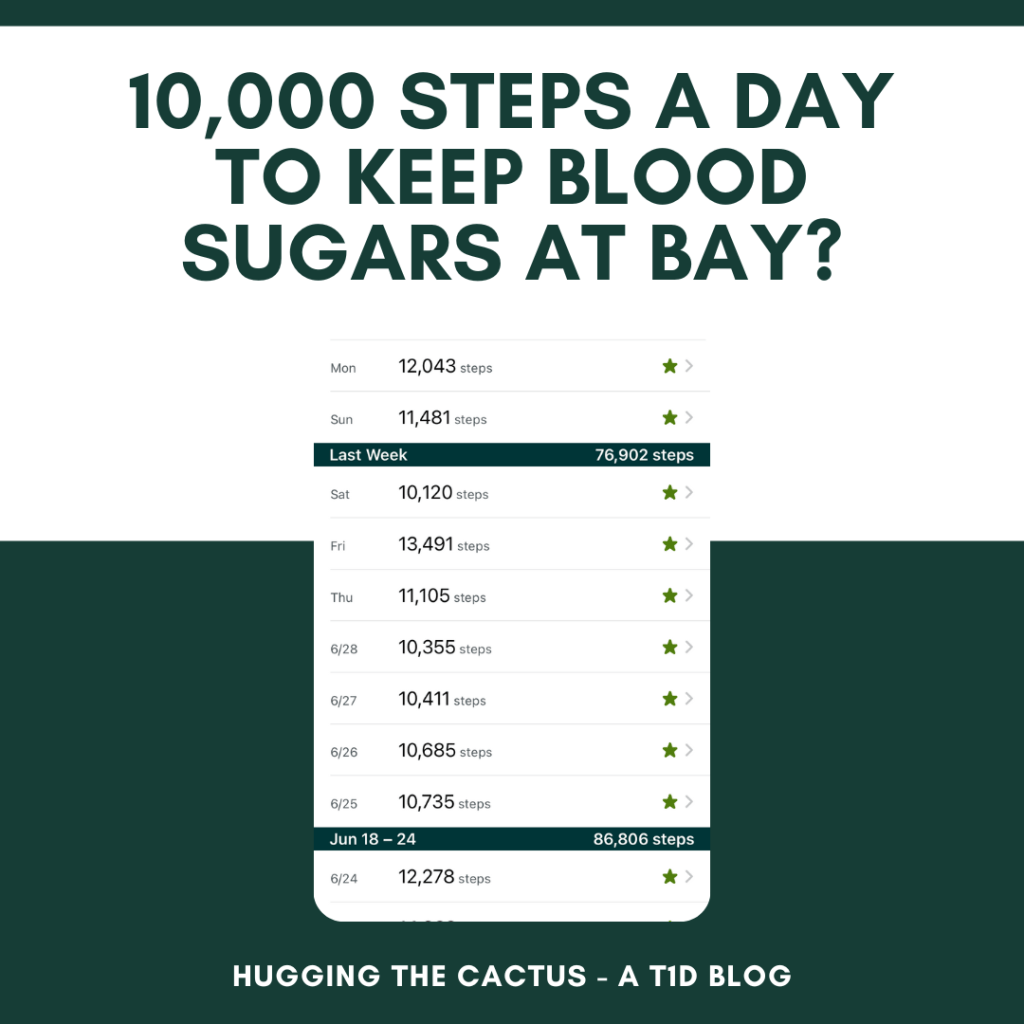
Yup, gettin’ steppin’ is key in helping me maintain tighter control over my blood sugars. If my levels start spiking after a meal or a snack – and I didn’t pre-bolus my insulin – then I start walking for as little as 15 minutes as a surefire means of getting my number back down. If I need to get up during my workday for a quick stretch and blood sugar level-set, I start stepping. If my blood sugar is higher than I’d like it to be before I go to sleep at night, then you guessed it: I get those steps in, whether it’s just marching in place or literally doing laps around my tiny condo.

I don’t always get 80,000+ steps per week, but when I do, it’s a terrific feeling!

All this movement not only means that I hit my daily step goal of 10,000 steps, but it has also obviously proven successful in helping me deal with high blood sugars (the kinda, sorta high ones and the really, super-duper high ones). In the case of the latter, I’ve found that coupling a dose of insulin with 10-20 minutes of movement is really effective in bringing me back within range in about 45 minutes, whereas I might have to wait an hour or more if I rely on the insulin alone. That shows how powerful – and so stinkin’ simple – it is to get those 10,000 steps in on a given day.

The added bonus? It feels good to get all that movement in a day, especially considering I spend 40+ hours a week sitting at a desk for my job. My body, my mind, and my diabetes benefit so greatly from it, and it’s been part of my routine for so long that I know that I can consider my 10,000 steps a day a permanent part of my diabetes management toolkit.

Adapting Viral Recipes to My Diabetes’ Taste

Butter boards. TikTok ramen noodles. A McDonald’s McFlurry and hash brown sandwich. Something called a “Jennifer Aniston salad” that I’m pretty sure Jennifer Aniston herself denied ever eating and claimed it was instead a type of Cobb salad (though who really cares, I’m sure either iteration is tasty).

What do the above foods have in common, besides sounding vaguely like fever dreams cooked up by someone with an insatiable (or maybe, possibly some-type-of-high-induced) appetite?

Why, these are all viral recipes that have been trending online in the last year or so, largely thanks to TikTok…a platform that I try to avoid because of things like this that make me insanely hungry.

Have I tried any of the aforementioned “recipes” or food combos? No, even though the Jennifer Aniston salad sounds pretty good, and actually quite healthy. I tend to steer clear of the trends because a lot of them are a little too out there for me to be remotely interested in (sorry, but I’d take a traditional cheese board over an icky-sounding butter board any day of the week), or they’re so laden with carbohydrates that just aren’t bolus-worthy to me that my taste buds aren’t even tempted.

But the one that did pique my interest recently is cottage cheese cookie dough – both in the form of ice cream and non-frozen form.

Cottage cheese? Cookie dough? Together??? This duo also sounded really bizarre to me, but it was getting so hyped up on my Instagram feeds that I knew I had to try it for myself. The first recipe I made consisted of four simple ingredients: cottage cheese, honey, peanut butter, and chocolate chips. Easy enough. I tossed everything but the chocolate chips into my blender and whipped it all together until the consistency was smooth, then poured it into a container, added the chocolate chips in, gave it a good stir, and then put it into my freezer overnight. I tried it the next day and couldn’t believe how delicious it tasted! As someone who is generally repulsed by cottage cheese, I was most pleasantly surprised by how it instantly became more appetizing in appearance once all the curds were blended out of it.

But I was less impressed by how much honey I needed to use in this particular recipe: 1/3 cup, which contains roughly 90 grams of carbs! I knew it was a key ingredient to help sweeten up the concoction, but I also knew that since I found it so yummy it would be difficult to resist eating it in large quantities…making it tricky to bolus for and causing unwanted blood sugar spikes. So I figured the next batch I put together would need some modifications.

I went to one of my favorite healthy foodie Instagram accounts, @eatingbirdfood, for some inspiration. This is one of the places that lauded the benefits of protein-packed cottage cheese cookie dough in the first place, so I figured she’d have a recipe I could adapt to suit my needs. Sure enough, she had one that I decided to make over. Here was her original ingredient list:

  • 1 cup of cottage cheese, any kind
  • 2 tbsp maple syrup
  • 1 tsp vanilla
  • 1 cup almond flour
  • 1 tbsp natural peanut butter or almond butter
  • 1/4 cup vanilla protein powder
  • 1/2 cup chocolate chips

Not a bad starting point for my own take, considering the ingredient with the most carbs was the easiest one for me to sub out. I replaced the 2 tablespoons of maple syrup with sugar-free syrup, and I decided to use 2 scoops of my own low-carb vanilla protein powder instead of measuring with a full quarter-cup (sometimes, you just have to measure with your heart…as I did with the chocolate chips, pouring in a generous amount of semi-sweet ones instead of more-sugary milk chocolate ones). I also skipped the vanilla because I figured my protein powder would add enough of a vanilla-y punch to my recipe.

I combined everything and immediately fell in love with my version of cottage cheese cookie dough. It really did resemble real cookie dough, only my version contained only a few grams of carbohydrates and way more protein. It’s been a long time since I genuinely enjoyed something sweet that wasn’t so bad for me, and that wasn’t a boring old serving of fruit. And it had a minimal impact on my blood sugar levels, making this recipe a genuine keeper all around. Maybe it’s a sign that I should play around more with some of the more interesting-sounding viral recipes that are out there – I’m looking at you, dunkaroo dip – and adapt them to suit my (and my diabetes’) tastes!

Sweat, Tears, and Blood (Sugar)

I ran a marathon the other day.

Okay, okay, I didn’t – but I sure looked like I did. Isn’t that close enough? One moment, I was sitting at my desk and the very next, I registered beads of sweat forming and dripping down my forehead, back, and chest.

It was pretty disgusting, but also pretty alarming as I knew almost immediately that this was a blood sugar-induced sweat.

In my haze of hypoglycemia, I started reaching for anything and everything that would bring me back up. A leftover Reese’s egg from Eastertime, a handful of Wheat Thins crackers, and a whole bunch of Lucky Charms marshmallows (and I’m serious when I say just the marshmallows, my boyfriend knows how much I love them and bought me a bag of the colorful shapes sans oat pieces not too long ago) were among the items that I ate in hasty desperation, as if the faster I downed them, the sooner it would be for the sweat to evaporate off my body.

The whole episode couldn’t have lasted longer than 10 minutes, but it was an absolute frenzy as I hunted down and devoured each carbohydrate separately. By the time I decided I had eaten enough, I was exhausted, so I collapsed onto my bed in a gross, sweaty heap. I guess that the low blood sugar and the subsequent snacking really took a toll on me, because within minutes, my eyes were drifting shut and I flat-out fell asleep for an unexpected 20 minute catnap.

I woke up to my CGM buzzing, signifying to me that my blood sugar was coming back up. I silenced the alarm, doing my best to snap out of my haze, and felt a little emotional about the ordeal. Tears stung the corners of my eyes, but I did not let them fall as I registered what had just happened. I was embarrassed about the excessive amount of food I’d just eaten to fix a fairly run-of-the-mill low blood sugar. I was mad at myself for losing control. I was stunned that it had knocked me off my feet, literally, and lulled me into an afternoon nap that I wouldn’t have otherwise taken.

Sweat, tears, and blood (sugar)…all within 10 minutes or less. Just like running a marathon, except much, much faster. Guess that makes me some sort of athlete!

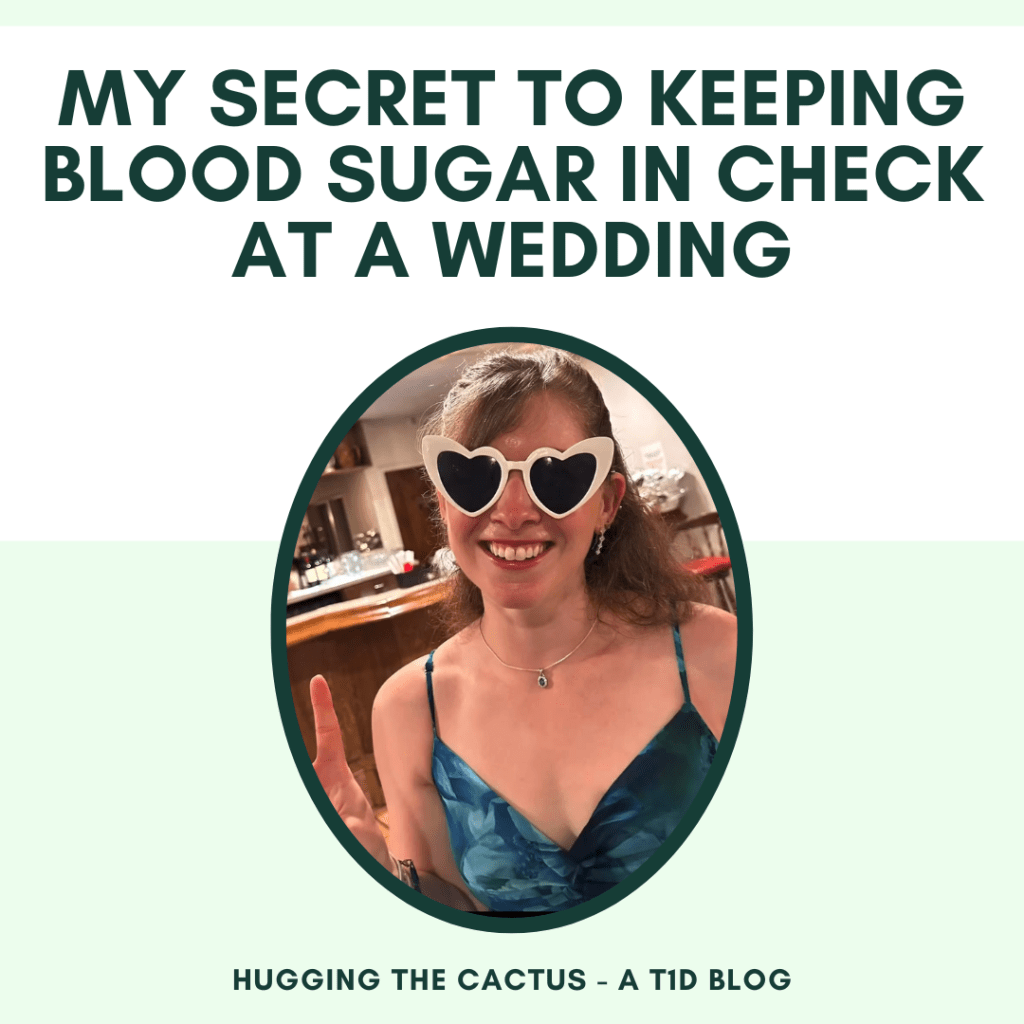
My Secret to Keeping Blood Sugar in Check at a Wedding

Who doesn’t love a wedding? I love the opportunity to witness family and friends come together to celebrate the marriage of a couple. I like getting all dressed up and sampling a little bit of everything at cocktail hour. And I have a blast on the dance floor and always eagerly await that slice of wedding cake.

But wait a second, I just thought of someone – or rather, something – that doesn’t love weddings as much as I do. Yup, you guessed it, my diabetes (or more specifically, my blood sugar levels).

At just about every wedding I’ve attended in my adulthood, I’ve dealt with some sort of blood sugar issue. There was the time that I went sky high after eating one too many hors d’oeurves and had to spend the entire rest of the evening rage bolusing. There was the time that I accidentally ripped off my pod at the rehearsal dinner the night before a wedding, causing whacky blood sugar levels and major frustration. And there was the time that I decided it was wise to eat a humungous blueberry muffin in the hours before making the waltz down the aisle as a bridesmaid in my cousin’s wedding, causing my blood sugar to go high then low then high again as I figured it would be better to be running on the higher side rather than run the risk of an “urgent low” alarm going off in the middle of the vows.

In a nutshell, my diabetes tends to throw curveballs at me when I’m partaking in wedding festivities.

But the good news is that I think I’ve finally figured out the secret to keeping blood sugar well-behaved for the full duration of a wedding! Besides monitoring blood sugar levels early on in the day and often, and making sure to make wise food choices pre-wedding, I think the trick is…

…dance like a damn FOOL at the reception.

Sweaty selfie at the reception (yes, I did the best I could to filter the sweat off my face in this photo. I’m unashamed to admit that!)

I’m not kidding. Most weddings follow the same structure in which you arrive, attend the ceremony, transition into cocktail hour, sit down for dinner, and then spend the rest of the evening enjoying the reception by dancing and socializing. I’ve been to plenty of weddings in which the vibe wasn’t super dance-y, and those weddings almost always ended with me having a higher-than-ideal blood sugar level because I’d spent them mostly stagnant in my seat. Other weddings, though, I’ve danced from the very first song to the last, and this was exactly my strategy at my cousin’s wedding earlier this month. Post-dinner buffet, I knew that I needed to curb some of my carbohydrate consumption with a little activity, so I was ready to go when the DJ cued up the music. This attitude paid off the rest of the night, too – a surprise Ben and Jerry’s ice cream truck, followed by a cake-and-cannoli dessert spread (major props to Matt and Janet for appealing to my sweet tooth by serving up some of my all-time favorites), meant that I was doubling down on dancing and insulin intake. My dancing, which was flat-out jumping up and down to some songs, resulted in stellar blood sugar levels that I’d be happy with any day of the week, but especially on a day filled with lots of food and drink that I don’t consume on a regular basis.

So even though I was a sweaty mess by the end of the night, that was a price worth paying in order for the peace of mind I had by the time I went to bed, knowing that I’d finally been able to play nice with my diabetes and my blood sugar levels for a wedding.

An Ode to Log Books

This was originally published on Hugging the Cactus on December 11, 2017. I’m sharing it again today because of all the outdated diabetes tools that I used to rely on, log books are something that I find myself wishing I still used, or at least kept to look back on, because they held me accountable. It’s funny how much that opinion contrasts with how I felt about them when I wrote this post! Read on for my full reflection…

Remember when log books were a THING that PWD used to track blood sugars?

Log books were pocket-size diaries (of a sort) designed for PWD to keep track of blood sugars, insulin and carb intake, mealtimes, etc. Basically, it was the old-fashioned way of recording blood sugars so that you could bring it with you to your endo appointments so your doctor could review the book for patterns.

I remember HATING having to write down my numbers. I felt like those little log books were contraptions put in place to judge me and my numbers. Imagine an eight year old who felt judged by something like that? It’s just wrong. But I get that they had a purpose to serve, and even when I was little, I knew it was important to write everything down even if I resented doing it.

That’s why I made it more fun by drawing doodles next to certain blood sugars – a frowning face would appear when I was high, and a mini burst of fireworks would find their way next to a blood sugar of 100 (which I now refer to as a unicorn bg, along with much of the rest of the DOC). I also distinctly remember using the log book to keep track of where I was injecting my insulin: “RL” would appear on the page if I was due to give a shot into my right leg, or “LA” for my left arm. These days, I’m really good about swapping sites, mainly because it’s easy to remember, thanks to my pods. But as a kid, it was more challenging, so writing it down helped.Thankful that my meter tracks my blood sugars for me now (also, that 230 mg/dL would’ve totally gotten a frown-y face back in the day).

Thank goodness for modern meters and insulin pumps that keep track of my blood sugars for me now. It’s so much easier to show up to an endo appointment and hand over my meter for the nurses to download. Plus, doing so means that my doctor and I get to review all sorts of colorful charts showing my blood sugars over a certain period of time, which is more telling and helpful than a doctor thumbing through my log book and murmuring, “I see,” every few moments.

Log books are such an archaic artifact of my diabetes history that I don’t even own any nowadays. I trashed them all, years ago, when I realized that my blood sugars from 2001 were sort of irrelevant to now. Do you still have any of your log books lying around?

An A1c Achievement

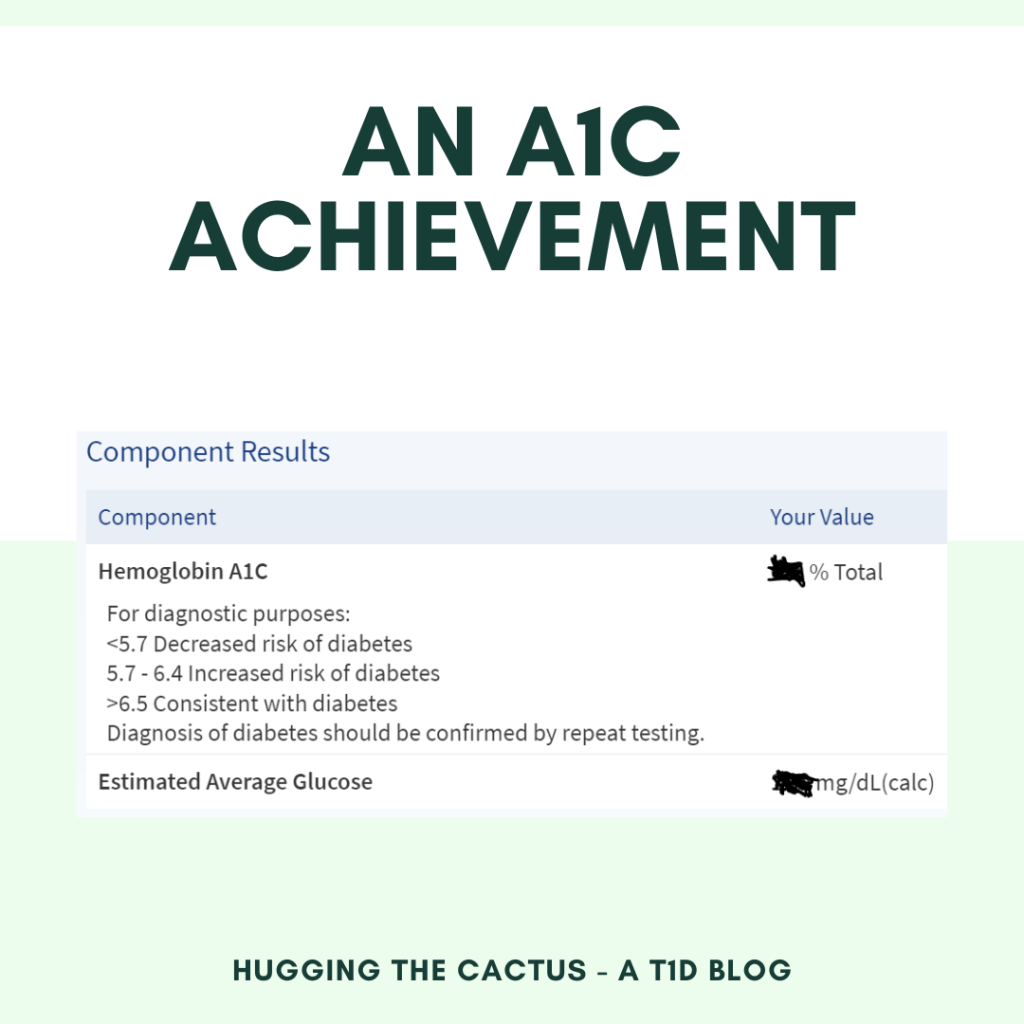
Since transitioning to the Omnipod 5 roughly 8 months ago (and obtaining a deeper understanding of how the algorithm works), I strongly suspected that I would be pleased by the results of my next A1c reading. What I did not expect that it would be my best reading in four years – maybe even longer than that, if only I could see my results dating further back!

While I’m not going to share the exact number here, for reasons I’ve written about in this past blog post, I am writing about this little victory of mine because I needed to take a moment and reflect on how far I’ve come in my diabetes journey. For many, many years, I rejected the notion of diabetes technology. I was stubbornly resistant to exploring it whatsoever, likely out of fear that the change would have negative consequences on my health or standards of living. While I wish I could go back in time and encourage my younger self to give it a chance or explain how it would benefit me, I’m just grateful for the fact that I did eventually come around to trying it and realizing how much it changed my diabetes care and management for the better.

Don’t get me wrong, I’m still very much a proponent of time in range compared to A1c – and I’m thrilled to report that my time in range has also significantly improved since I switched to the 5. But for me, I can’t help but attach some extra value to my A1c, maybe because it was the standard measurement of diabetes “control” for most of my life with diabetes so far. So it feels really good and natural to celebrate my latest A1c achievement.

A Temporary Diabetes Cure

I always envied people who experienced a diabetes “honeymoon” period. I used to think, how nice it must be to have some extra time to prepare for fulltime life with diabetes and not quite rely on insulin injections right off the bat! I also always assumed that, after 25 years living with diabetes, that the honeymoon phase had absolutely skipped over me, and I was positive I’d never get to experience it.

Turns out, my diabetes – that saucy little minx – likes to keep me on my toes as it recently surprised me with an abrupt 48-hour window of time in which it seemed like my diabetes was cured.

That’s the only way I can describe what transpired. It was the strangest thing. One day, I woke up, ate breakfast, and took insulin for it – just as I always do. Except instead of my blood sugar spiking or even leveling out after eating, it started to drop, which was strange because I ate a fairly typical meal that morning. At the time, I thought nothing of it and just ate some extra carbs before my blood sugar went too low.

No big deal, right? But this phenomenon happened again, following both my lunch and dinner. It was especially inconvenient in the evening, as I had a volleyball game and wanted my number to be up so I could play. I had some fruit snacks before the game to keep my levels up, but was surprised when even after that, I was dropping by the tail end of our third and final match. I remember being out on the court, trying to track the ball as my team bumped it back and forth over the net with the other team, knowing full well that my blood sugar was going low but feeling determined to stay in the game until it was over. The moment the final whistle blew, I ran to grab even more fruit snacks, and felt both annoyed and confused by the whole situation.

The following day, I decided I wasn’t going to mess around anymore. I wanted to cut my mealtime insulin doses in half to see if that helped me at all. It was a solid idea, but it didn’t prove to do much to help as I again dropped after breakfast and lunch. Okay, so clearly that course of action wasn’t enough. Maybe I could try switching from automated mode to manual on my Omnipod 5 PDM and put myself fully in control, rather than leaving it up to technology. I set a temp basal decrease to ensure I was getting very little basal insulin, and resolved to enjoy my pizza dinner that evening with friends.

Of course, pizza is notoriously difficult to bolus for, so I knew I’d have to do even more extra work in order to prevent my blood sugar from dipping. So not only did I take half the amount of insulin than normal, but I also did an extended bolus so that I wouldn’t get it all upfront. I ate two fairly large slices of pizza and also had a generous serving of chips that I technically didn’t include in my bolus calculations. So imagine my bewilderment when, 2-3 hours post-pizza, I was still going low. I poured myself a glass of regular soda, and it became my companion for the remainder of the evening. I’d take sips as I saw my graph report blood sugars that never went higher than 110, but fluctuated for the most part between 60 and 90.

It was wild, and I was actually getting pretty worried about the whole situation. I couldn’t make sense of it. I ran through all the variables that could’ve caused this to happen – was I wearing my pod in a strange site? Was it because of my period? Could it be due to my activity levels or changes in the weather? I weighed so many possibilities in my mind and came up with nothing definitive, so I went to my next best resource for input…the diabetes online community.

I asked around for input and was – as always – so grateful to the folks who reached out and served as thought partners with me. Based on what I learned, the most likely culprit is hormonal changes. In fact, perhaps it was a bit of a birthday gift from my diabetes as I ushered in a new age/phase in life. It’s still totally bizarre that it happened, but a friend reassured me of her own experiences with the same temporary phenomenon as she’s experienced menopausal shifts. So, maybe…just maybe this was the explanation I was looking for, and perhaps the whole thing happened to signify the start of my upcoming cycle.

I won’t ever know for certain if that was indeed the cause of my temporary reprieve from diabetes, but at least I can find a little comfort in knowing that I got through it (as my blood sugars and insulin needs bounced back with a vengeance the following day) and that I had the support and feedback from friends and strangers alike the whole time.

Sudden as Lightning

It was as sudden as lightning, when it streaks across the sky just before the rain begins to fall, signs of a storm that that refuses to go unseen or unheard.

“It” being the sweat that began to bead on my forehead, then trickle down fast and furious as I grew more and more aware of a low blood sugar episode.

One moment, I was sitting cool, calm, and collected. I was alert and engaged in the conversation happening around me. And then boom, the sweat started and my concentration on my surroundings ended. Voices grew more distant as I honed in on my outward appearance. Panic struck – could others see how sweaty I was getting? Were they noticing my incessant fidgeting, a coping technique I have when my blood sugar drops and I get paranoid about maintaining an air of everything being just fine? My foot, already jiggling up and down as part of my fidget routine, seemed to pick up the pace as I began to get a grip on the reality that I needed to do something about this low before I further deteroriated.

The door to the room opens. I dart out, walking briskly down the hallway to where my low blood sugar supplies sat waiting for me. I gobble down a pack of fruit snacks as quickly as possible, and then force myself to sit. The sweat’s gotten worse and I worry about it being visible on my clothing. Seconds melt into minutes, somehow, though I pay them little attention as all I can think about is having this low blood sugar episode end, please please please, as soon as possible. I desperately want to escape to a restroom for privacy (and to mop the sweat off my body), but I’m immobilized by the low and also slightly nervous that it’s major enough that I might need help from someone in the vicinity so it’s a terrible idea to isolate myself from others. I push that thought out of my mind – I just need to give the fruit snacks some more time to work, that’s all. Keep it together, you’ve got this, stop freaking out so mu-…

…and just as suddenly as it had struck, the sweat dissipates. My shaky hands steady themselves. I regain an awareness of my environment. I exhale, relief flooding throughout my body as I realize that I’m recovering from the low.

Sudden as lightning, both in how it had struck and then how it had disappeared, leaving hardly any trace that it’d been there at all.

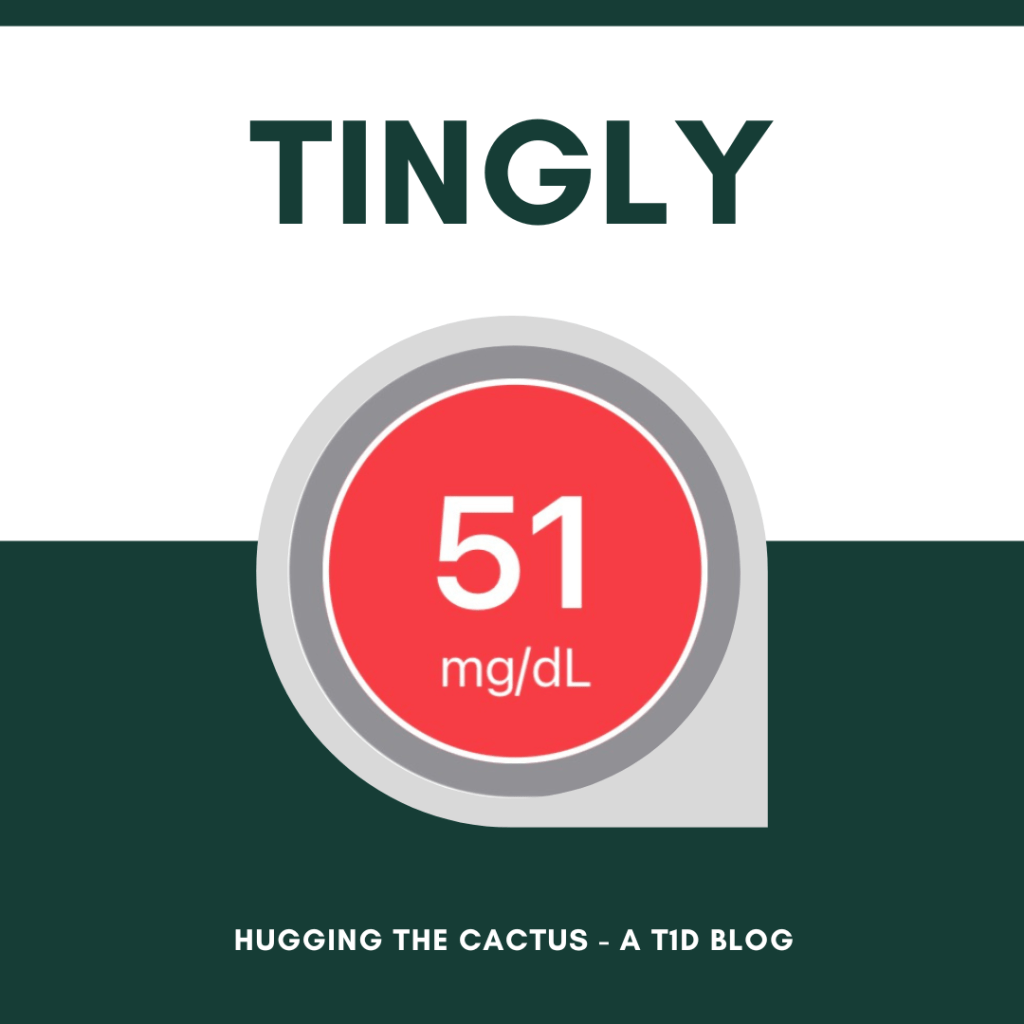
Tingly

I knew something was wrong when my tongue inexplicably began tingling.

It was a sudden, prickly sensation – almost like I had pins and needles on my tongue. (This is a sensation I get in my feet when I’ve had them in a certain position for too long and I need to get the blood flowing properly again. A quick Google search taught me that just about anyone can experience this, so odds are you already know what I’m talking about.) And it lingered for a solid 20 minutes, making my entire mouth feel as though it was simultaneously numb and on fire from the unrelenting feeling.

This is my new(ish) low symptom: tongue tingling.

And I hate it.

It only seems to occur when my blood sugar hits the 50s or 60s, which doesn’t happen too often. But when it does, it hits me so abruptly that it catches me off guard every time. It’s an unpredictable phenomenon – usually, my first sign of a low blood sugar is feeling shaky/sweaty/dizzy. Once I feel those initial signs of a low, I’m pretty good about being quick to do something about it by grabbing something sugary to eat…and when tingly tongue strikes, it can make the entire eating experience unpleasant because it almost feels like I’m having an allergic reaction to my low snack. And it lasts longer than it takes for my Dexcom to pick up on a recovering low blood sugar.

I’ve genuinely been worried that I was having an anaphylactic reaction in addition to a hypoglycemic event, prompting me on more than one occasion to run over to the closest mirror to check and make sure that my mouth and face aren’t swelling up or turning red. Let me tell you, it’s enough to deal with the low blood sugar sensation – feeling like I’m having an allergic reaction on top of that makes a normally easy-to-deal-with low that much, well, suckier, to be blunt about it.

I classify it as only sorta, kinda new because I’ve dealt with something similar in the past. In fact, roughly 4 years ago, I wrote about “a fuzzy towel tongue” feeling that I experienced after a low blood sugar. It’s funny that I wrote about it because I think at the time, I only ever felt that a handful of times, and the symptom seemed to disappear. But now, it’s apparently back with a vengeance, as the tingling feels much worse now than the numbness I’d felt a few years back.

At least I know that I’m not alone. I’ve talked to my fellow T1D mother about this and she’s also experienced it, in addition to the folks I’d interacted with in the context of my original post on the matter. It might not be fun, but there’s (quite literally) strength in numbers.