
Sweat, Tears, and Blood (Sugar)

I ran a marathon the other day.

Okay, okay, I didn’t – but I sure looked like I did. Isn’t that close enough? One moment, I was sitting at my desk and the very next, I registered beads of sweat forming and dripping down my forehead, back, and chest.

It was pretty disgusting, but also pretty alarming as I knew almost immediately that this was a blood sugar-induced sweat.

In my haze of hypoglycemia, I started reaching for anything and everything that would bring me back up. A leftover Reese’s egg from Eastertime, a handful of Wheat Thins crackers, and a whole bunch of Lucky Charms marshmallows (and I’m serious when I say just the marshmallows, my boyfriend knows how much I love them and bought me a bag of the colorful shapes sans oat pieces not too long ago) were among the items that I ate in hasty desperation, as if the faster I downed them, the sooner it would be for the sweat to evaporate off my body.

The whole episode couldn’t have lasted longer than 10 minutes, but it was an absolute frenzy as I hunted down and devoured each carbohydrate separately. By the time I decided I had eaten enough, I was exhausted, so I collapsed onto my bed in a gross, sweaty heap. I guess that the low blood sugar and the subsequent snacking really took a toll on me, because within minutes, my eyes were drifting shut and I flat-out fell asleep for an unexpected 20 minute catnap.

I woke up to my CGM buzzing, signifying to me that my blood sugar was coming back up. I silenced the alarm, doing my best to snap out of my haze, and felt a little emotional about the ordeal. Tears stung the corners of my eyes, but I did not let them fall as I registered what had just happened. I was embarrassed about the excessive amount of food I’d just eaten to fix a fairly run-of-the-mill low blood sugar. I was mad at myself for losing control. I was stunned that it had knocked me off my feet, literally, and lulled me into an afternoon nap that I wouldn’t have otherwise taken.

Sweat, tears, and blood (sugar)…all within 10 minutes or less. Just like running a marathon, except much, much faster. Guess that makes me some sort of athlete!
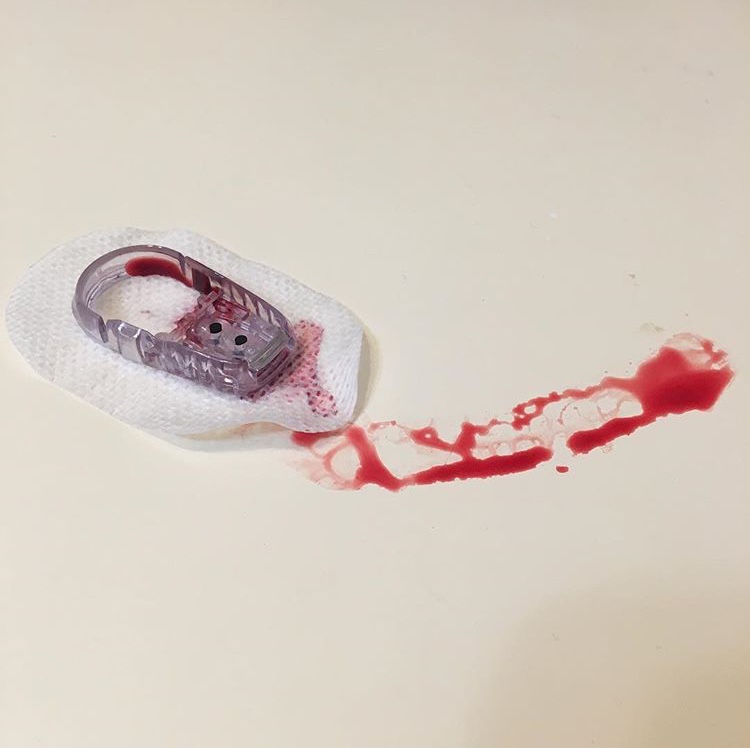
Is a Bleeder a Reader? My Take on a Bloody Dexcom G6 Insertion

This blog post probably shouldn’t be read by anyone who gets squeamish when discussing blood or when viewing photos that show any amount of it…my apologies in advance for a bloody gross blog post, but I thought this was a good topic for discussion. 

I placed the new Dexcom G6 sensor on my abdomen, hovering my index finger above the large orange insertion button. I pressed it, exhaling as I felt the minute needle pierce my skin’s surface. I looked down, and started to rub the adhesive in circles to make sure it was stuck, when I saw blood. Not just a drop, but a decent-sized pool forming beneath the sensor. Before long, just about the entire surface of the white adhesive was soaked in red.

Yeah, this was going to be a no-go.

It’s pretty rare for me to experience blood at the site of a Dexcom sensor. If I had to put a number on it, I would say less than 10% of my insertions draw blood. An even smaller amount – like, 2% – have caused me to bleed as much I did in the scenario described above. But I know I’m not alone in my bloody sensor experiences – it’s something that many other T1Ds who use a Dexcom have gone through.

There’s a bit of debate, though, that I’ve noticed in the past on Twitter threads and Instagram posts. What to do with a bleeder? Keep it and assume that it’ll read blood sugars normally? Or change it immediately and call Dexcom for a replacement?

Are bleeders readers? Or does it depend?

1B278EF4-8498-4968-81F9-9134870F3C1E
Do you think that bleeders are readers?

I’m going to go with…it depends.

Obviously, in that situation I described in the opening of this post, I decided that it wasn’t a good idea to keep the sensor on my body. There was too much blood and I didn’t trust that it would adhere well to my body. I didn’t know how long it would take for the blood to stop (only a few minutes, but still), and I couldn’t be sure that it wouldn’t mess up my readings. On top of that, I wasn’t trying to stain my clothing, if I could help it.

So in that circumstance, I did change my sensor right away, and was glad that the second try resulted in a much cleaner, blood-free insertion. I called Dexcom, explained what happened to the customer support representative, and got a replacement sensor mailed to me.

However, just about any other time I bleed upon a sensor insertion, it tends to be a minuscule amount of blood. I usually don’t even notice until it’s time to replace the sensor, and there’s a bit of dried blood left on the site. Other times, I’ll see small beads of blood forming underneath the spot where the transmitter snaps in. And there’s been a couple of occasions that I’ve bled a fair amount and been totally unaware of it until I caught my reflection in the mirror and noticed the blood staining the white adhesive. And in all of those cases, I’ve kept the sensor on for the full ten days, without noticing any discrepancies in my readings.

All that considered, in my inexpert opinion, I think that bleeders usually are readers and that they’re safe to continue wearing. Of course, there will be exceptions, like when there’s just too much blood to salvage the sensor. But every time I’ve kept using a bloody sensor, I’ve had the same amount of success with its functionality…so yes, I think that for me, bleeders are indeed readers.