Have you ever ordered a diet soda, sipped it, and immediately doubted whether it was truly diet? Then you might find this little tip useful.
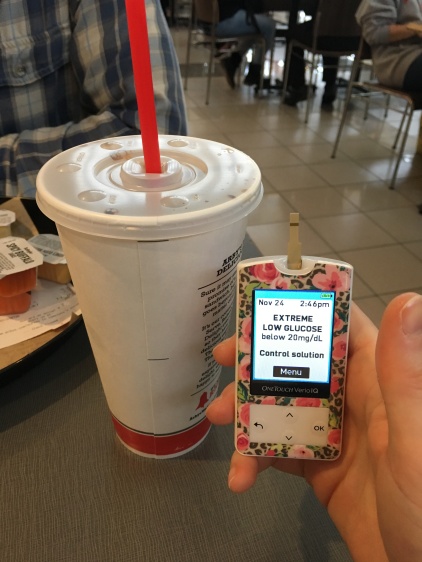
Whenever you’re not certain that your drink is diet or regular, try grabbing your glucometer, putting a test strip in it, dipping your finger in the drink, and wiping it onto the strip – just like you would do when checking your blood sugar. If the drink is diet, then you’ll know because your meter will display an “extreme low” result, or something to that effect. The key is to not panic and remember that it isn’t your blood sugar you’re looking at, it’s the sugar levels in the drink! It’s just the opposite in the case that your drink is regular/sugary – you’ll get a “high” reading that’ll make it obvious that your beverage isn’t what you ordered.
Photographic evidence of my soda test results.
This trick has come in handy several times for me. Most recently, I was doing some Christmas shopping at the mall with my boyfriend when we decided to stop at the food court for some lunch. We split a chicken tender meal from Arby’s, which came with a medium soda that we could fill on our own.
I took on the task while he waited for our food, and was excited to see that they had Diet Dr. Pepper on tap (seriously, that’s rare for most fast food joints). I filled up the cup, fitted a lid on top, stuck a straw in, and took a sip. Hmm…it tasted sweeter than I thought it should. I mentioned this to my boyfriend as he picked up our food and we made our way to a table. I told him that I definitely got it from a tap that was labeled “diet”, but we both knew that just because the label says it is, it doesn’t guarantee that the right soda bib is hooked up to the proper line. (Our shared experience working at a movie theater several years ago clued us in to the fact that employees can make mistakes with this.)
He expressed his doubts, as well, and then it occurred to me to do the old soda test strip check. So I did, snapping a picture of the results and feeling reassured by the factual evidence that I was drinking a sugar-free – not sugary – beverage.
“It’s better to have it and not need it, than to need it and not have it.”
Growing up, this mantra was frequently repeated by my mother regarding my diabetes supplies. More often than not, I’d roll my eyes at the saying – not because I was annoyed with her, but because the prospect of carrying extra supplies “just in case” felt very inconvenient. My purse/backpack/overnight bag would already be crammed to maximum capacity, so squeezing in backup needles or insulin was practically impossible. But typically, I’d cave and make it all work somehow, because the fear of not having something essential when I was away from home was strong enough.
I’ve kept up this practice in my adulthood, as overnight travel and increased distance from home have become more common. And I was reminded why it’s a good idea very recently.
I was staying at a friends’ place for the night. They live about 45 minutes away from my house, which isn’t far, but it was far enough for me to want to make sure I had extra supplies. I definitely did not want to have to make that drive twice in one night, and I knew it wouldn’t even be a realistic option, because chances were good that I’d be drinking alcohol – it was game night, after all.
If you have T1D, always be prepared.
Pizza, beers, and laughs were had, and before we knew it, it was one in the morning. We all headed off to bed, and just as I do every night, I checked my blood sugar before I got totally settled.
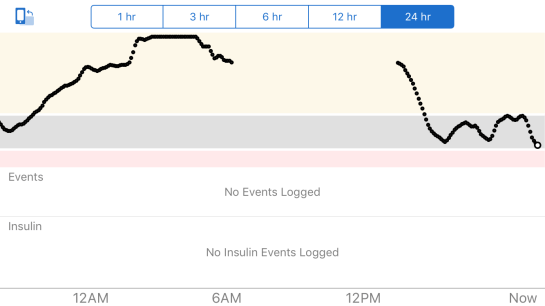
I was wicked high – the mid-300s, actually.
I was worried, because I thought I’d been on top of my blood sugar for most of the night. I gave myself an extended bolus for the three slices of pizza I ate, limited my beer intake (too many carbs), and kept a watchful eye on my CGM. While I did know that my blood sugar was climbing, I thought that I was staying on top of it with correction doses. Apparently not.
No matter, I figured. The best I could do was take more insulin, drink some water, and try to relax a bit before bed. I didn’t want to sleep until I knew my numbers were coming down, but I also knew that my willpower to stay awake was fading. So I set an alarm on my phone to wake up in an hour and check my blood sugar again.
When I did, I was 377! I couldn’t believe it. I followed the same process again – bolused, drank water, set an alarm to wake up in another hour – and hoped for the best. But when my alarm blared again at 3 A.M. and I discovered that I was STILL stuck at 377, something told me that there was more to the story here. I lifted up my shirt to check my pod, which should’ve been securely stuck to my belly…except it wasn’t. The end with the cannula was sticking up, revealing that the cannula was not underneath the surface of my skin.
I felt simultaneously pissed off and relieved. I was mad because I’d just changed my pod earlier that day, so it should not have come off so easily. But I was relieved because finally, I had an explanation behind the super-high, super-stagnant blood sugars.
And I was seriously relieved that I’d thought to pack my insulin, a spare pod, and an alcohol swab in my overnight bag.
So there I was, changing my pod at 3 A.M. Far from fun, but it was necessary. I even wound up giving myself an injection with a syringe – yet another diabetes supply that I don’t really need to carry but had stowed away in my kit (just in case) – to ensure that my system had insulin in it to bring my blood sugar back down.
From there, it was a long night (morning!) as I set numerous alarms for the next few hours to wake up, check my blood sugar, and bolus more as needed. I couldn’t rely on my CGM for readings, because guess what? It got torn right off my arm as I tossed and turned in bed. Go figure, right? (I didn’t have a backup sensor because the CGM is one thing that isn’t exactly necessary. It makes life a helluva lot easier, but for a single overnight trip, an extra sensor wasn’t needed.)
What a long night…
I probably only got three hours of sleep that night, and I was pretty damn defeated looking at a shitty CGM graph the next day. But you know what? The whole incident serves as a stark reminder that it’s important to ALWAYS have backup supplies: You never know when you might depend on them.
This November, I participated in the #HappyDiabeticChallenge on Instagram. This challenge centered around daily prompts to respond to via an Instagram post or story. I’ve decided to spread the challenge to my blog for the last couple days of National Diabetes Awareness Month. As a result, today’s post topic is beyond diabetes.
I can’t believe that today is the final day of November, A.K.A. National Diabetes Awareness Month. In a way, I’m relieved. After all, diabetes advocacy can be exhausting. I’ve kept up daily Instagram posts, in one way or another, in response to the #HappyDiabeticChallenge. I’ve tried to keep all of my blog posts this month on theme. I even participated in a fundraising live stream on YouTube, which was an anxiety-provoking yet exhilarating event all on its own.
Needless to say, I’m looking forward to dialing it back down, temporarily, for the month of December. I won’t stop advocating, but I will take a small step back from it so I can recover and process everything from the month in my own time.
It’ll be a good way of reminding myself that I’m more. More than just this stupid chronic disease. There’s so much more to me than diabetes: I’m a daughter, a sister, a girlfriend, a best friend. I’m a dog lover (despite being allergic to most of them). I’m a young professional. I’m a millennial (who proudly owns the moniker). I’m a Disney fanatic and Harry Potter obsessive. I’m a creative and passionate person who cares about a lot of different people, things, and projects.
I am more than my diabetes.
I’m beyond my diabetes. I prove that to myself each day by living my life unencumbered by it. When it knocks me down, I always get back up to remind it that I’m the boss.
Beyond National Diabetes Awareness Month is a broader realization that I’m a bit burnt out by this hardcore advocacy. And that’s okay. I’ll take a breather and remember to enjoy life more, because I know that I’m beyond diabetes.
This November, I participated in the #HappyDiabeticChallenge on Instagram. This challenge centered around daily prompts to respond to via an Instagram post or story. I’ve decided to spread the challenge to my blog for the last couple days of National Diabetes Awareness Month. As a result, today’s post will be about diabetes and technology.
Diabetes and technology: a pair as iconic as peanut butter and jelly, Lucy and Desi, and Han Solo and Chewbacca. I can’t imagine managing my diabetes without all the technical tools and devices I have in my arsenal.
I’m grateful for all the tools we have at our disposal these days, because I know that this wasn’t always the case. I didn’t have to experience a time without a test kit. I didn’t have to deal with checking my blood sugar only once or twice daily using a complicated urinalysis system. Though I chose to take insulin via manual injections for many years, I had the option to try an insulin pump whenever I was ready. And when the CGM came around, approximately ten years after my diagnosis, I was able to start using this new technology.
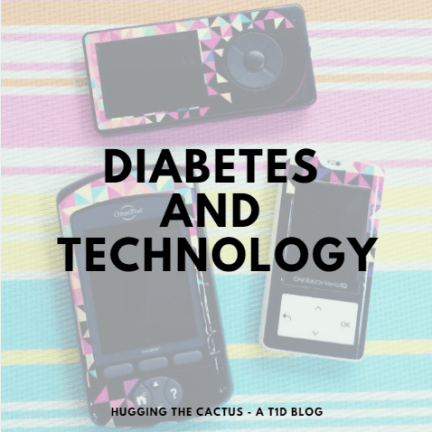
Just a few of the key technological components in my diabetes toolkit.
So I guess that diabetes and technology makes me think of two, somewhat contradictory, concepts: privilege and freedom.
It’s a privilege that I have a wide array of technology available to me. I’m lucky that I’m able to use it, because I know that many people with diabetes in this world cannot afford it or do not have access to it. It makes me upset to think about how diabetes might be harder for these individuals due to a lack of treatment and care options, but in that way, it reinforces how freeing diabetes technology has been for me. I have the freedom to bolus quickly and easily as needed. I’m free from annoying tubing, thanks to my OmniPod pump. I’m free to live a life less interrupted by diabetes, because my technology helps me manage it with greater finesse than if I were doing it 100% on my own.
That being said, I won’t ever take my access to diabetes technology for granted.
I can only hope that, as technology innovations continue to improve the quality of life for people with diabetes, technology accessibility becomes more widespread, as well.
One Monday per month, I’ll take a trip down memory lane and reflect on how much my diabetes thoughts, feelings, and experiences have unfolded over the years. Today, I remember…
…that one time in college when some random kid sitting near me in class said that having diabetes means “you’re screwed”. In other words, you can’t live with it, it’s a death sentence.
Before I talk about how I responded to that, I’ll provide some context. It was my freshman or sophomore year of college. I was in a discussion group for my Nutrition 101 seminar. It was early enough in my college career that I still felt painfully shy around most of my classmates, unless they happened to live in my dorm or I had known them in high school (even though I went to a college with an undergraduate population of more than 20,000, I’d still occasionally encounter a high school classmate – it’s a small world after all).
But when it comes to diabetes…well, I have a reputation for not being able to shut up about it. So when it inevitably came up over the course of the Nutrition class, and the teacher’s assistant asked us to define it, I felt a natural impulse to say everything I knew about it. I had to suppress it, though, because my fear of raising my hand in class was stronger than my desire to spew out an overly in-depth definition of diabetes.
So I let someone else answer the question, noting what was right and wrong about the response. As the T.A. launched into her notes on diabetes and nutrition, I overheard a muttered, ignorant comment from the kid next to me:
If you have diabetes, that means you’re screwed!
As you might imagine, I didn’t take too kindly to his words.
While the dude sitting next to him laughed, I felt instant rage surge throughout my body. Without even thinking, I blurted out loud, just audibly enough for him to hear, “No, having diabetes does not mean you’re screwed. Whether you have type 1 or type 2, you can live a perfectly normal life with it. I would know, I have type 1.” I felt my face flush as I turned my attention back to the oblivious T.A. in the front of the room. In the corner of my eye, I saw that the kid was sitting there, mouth slightly agape, probably surprised that the quiet girl in discussion group spoke up to shut down his idiotic way of thinking.
It’s been several years since I was in this particular class, and I don’t remember much of the materials that were taught in it. But I do remember this exchange. It stands out to me because it’s a reminder of how far we’ve got to go as a society to defeat diabetes stigma and prove that you can do more than survive with diabetes – you can thrive with it.
One Friday per month, I’ll write about my favorite things that make life with diabetes a little easier for me.
For most people with diabetes, there’s no such thing as traveling light.
It doesn’t matter if we’re packing for a vacation or taking a brisk afternoon stroll – we’ve got to have a certain amount of supplies on hand in order to be prepared for any number of scenarios that could occur while we’re “away”.
As you can imagine, this can be pretty annoying, especially when it comes to simple matters like leaving the house for 20-30 minutes. It’s not like we can go out empty-handed. We need to stash our purses/backpacks/bags with the appropriate diabetes supplies, and it can get pretty bulky. I used to find it especially cumbersome if I was just trying to go for a walk in the neighborhood and had no choice but to carry a purse with me the entire way, which slowed me down and frustrated me.
Then I got my SPIBelt.
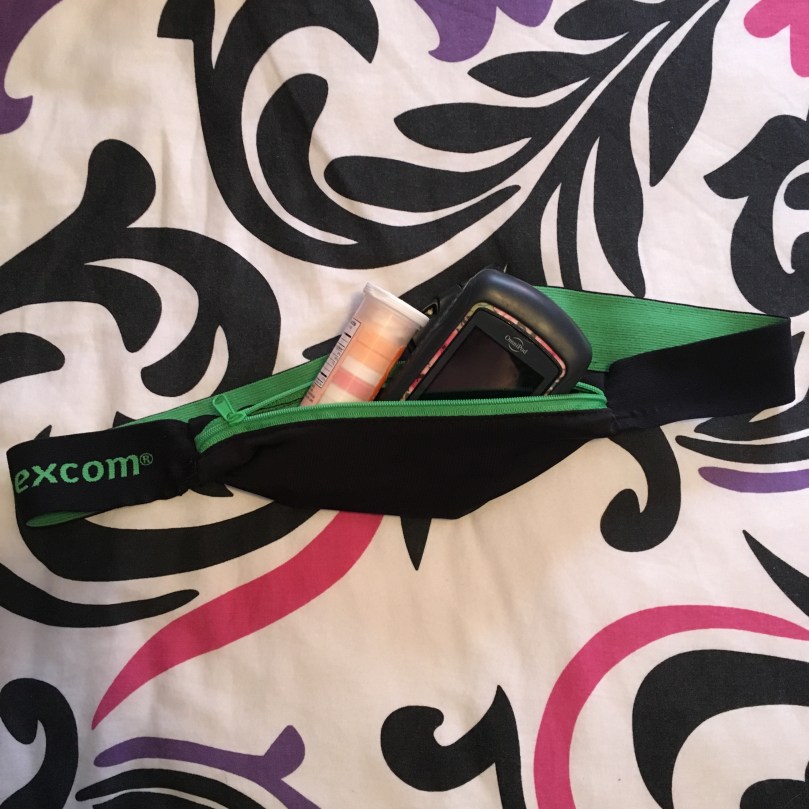
My Dexcom SPIBelt
This miniature fanny pack changed everything for me! It looks small, but stretches to hold all of my essentials for when I head out on runs or longer walks. I can fit my cell phone, glucose tablets, and OmniPod PDM in the tiny pouch. There’s even enough room leftover for my dog’s treats and poo bags, leaving my arms and hands free to hold his leash when we go on walks together.
Other features of my SPIBelt include a slit in the pouch for earbuds, a secure clip in the back, and adjustable waistband so it can fit snug to the body, no matter how many layers of clothing I’m wearing. And unlike other armbands, pouches, and drawstring bags I’ve used in the past, my SPIBelt is actually comfortable. It stays in one place, so I’m not distracted by constant movement around my waist. I was definitely impressed by it the first time I took it on a run and didn’t have to keep on adjusting it as I moved. It’s much more discreet and doesn’t look quite as “old-school” as fanny packs or other similar bags.
This particular SPIBelt was given to me by Dexcom as a thank you for participating in their G6 ad campaign, but as I’ve come to find out, SPIBelts are widely available online and in stores.
This post originally appeared on my blog at ASweetLife.org on November 26, 2013. It’s hard to believe that I wrote it nearly five years ago, but with Thanksgiving occurring tomorrow, I thought it would be appropriate to revisit it since it captures my feelings about diabetes this time of year. Of course, life has changed quite a bit in the last five years, so I’ve made a couple amendments (below, italicized) to the original…
Each year around Thanksgiving, I think about the things that I am thankful for in life. Some obvious answers come to mind: my parents. My brother, my boyfriend, my dog. The fact that I am able to attend an amazing college. The roof over my head and the food on my plate. The list could go on and on. I’m sure most of my answers are unsurprising.
But is it weird that I’m thankful for diabetes, too?
Don’t get me wrong here. Oftentimes, I resent that I have to deal with the burden that is diabetes on a daily basis. I cry about it, I get angry about it, I curse about it. I wish that it didn’t impact me or my loved ones the way that it does. I’m all too aware, however, that I cannot change the role diabetes plays in my life. All I can do is accept it. When I did that and truly thought about what acceptance means, I began to think of why I might feel blessed in some bizarre way to have diabetes.
For starters, my diabetes has brought me closer to my family. My mom and I are able to relate to each other on a different level because of it. My dad and my brother show concern and unrelenting support for us that might not be the same if Mom and I did not have diabetes.
Sometimes, I think about how even though my diabetes seems to have a mind of its own, it adds a certain degree of control regarding some aspects of my daily life. It helps me get into a routine that is pretty static. It relies on what I choose to feed myself; in this way, it motivates me to make the right choices when it comes to my diet.
And it has brought some amazing opportunities my way. Without diabetes, I would not have become president of the UMass Amherst chapter of the College Diabetes Network. I would not have discovered the Children with Diabetes: Friends for Life conference that I attended in Disney this past summer, where I made some awesome friends who keep in touch with me. And I certainly would not have begun blogging for ASweetLife.org. This experience itself has allowed me to get in touch with my feelings regarding diabetes to a greater extent. I have been able to explore my interests as an individual who loves to write. I have the pleasure of speaking with a wider variety of people within the diabetic community and hearing individual stories that I might not have ever heard.
I never would have guessed that a mere five years after writing this post, I’d be writing content for my very own diabetes blog. The creation of Hugging the Cactus is a huge diabetes-related accomplishment itself, but I’m reflecting on other diabetes changes I’ve experienced and how I’m thankful for them…so many come to mind. My OmniPod insulin pump, my improved A1c levels, new friendships formed…I’ve come a long way, and I’m grateful for every single positive experience that diabetes has brought into my life.
That’s why I’m seeing diabetes as something to be thankful for this Thanksgiving. I long for the day where diabetes is cured and I no longer have to think about it. But for now, I want to make the best out of something that could be perceived as the worst.
With all that said…enjoy your Thanksgiving holiday! No matter how you choose to celebrate it, remember that you are loved, you matter, and there’s people in your life who are endlessly thankful for your love and light.
I’ve been lucky enough to have the Dexcom G6 CGM in my life for just over six months now. In that time, many people in my life – both T1Ds and non-T1Ds – have asked me countless questions about my experience with the device. I thought it’d make sense to address some of the most commonly asked questions here, in the hopes that I can provide some insight to those who are curious about the Dexcom G6.
Question: Can the Dexcom G6 be restarted?
Answer: In my experience, no. I cannot get the G6 to restart like I could get my G5 to restart. But take my “no” with a grain of salt, here, because I know of other people who HAVE had success restarting their G6 sensor, making its life extend much longer than the 10 days guaranteed by Dexcom. I have only tried to restart the G6 once, with absolutely zero success, following the process outlined here. My advice to those who want to try to restart their G6 is to do so cautiously, and make sure you’re not trying to do so with the last sensor in your stockpile.
Question: Is it actually safe to take acetaminophen (Tylenol) on the Dexcom G6?
Answer: Yes! I’ve noticed that acetaminophen can be taken safely on the G6. I did not anticipate for it to be unsafe, seeing as it was advertised as one of the big improvements Dexcom made from the G5 to the G6. I’ve taken Tylenol a handful of times without noticing any issues with my CGM readings, but as always, be sure to monitor your blood sugar carefully and perform a manual finger stick check if your symptoms don’t match up with your CGM.
Question: I can’t get my Dexcom G6 sensor to stay put for the full ten days. How do you make it last?
Answer: There’s tons of ways you can help ensure your G6 sensor stays stuck on for the entire ten-day duration. I always make sure that my skin is completely dry before the sensor makes any contact with the site. Avoiding any excess moisture is key in helping it stay put. If I notice the sensor starting to peel around the edges after a few days of wear, then I use a Pump Peelz CGM adhesive to keep it in place. Those tend to work really well for me. In times of serious adhesive doubt, I also use Skin Tac wipes, which basically glue that sucker down. One last tip I recommend is to avoid sites that come into contact with a wide variety of surfaces. In other words, a sensor that’s placed on the abdomen may fare better than a sensor on the leg, because the odds of the sensor getting accidentally knocked off due to contact with clothing or other objects are lesser. You know your own body better than anyone, though, so trust your own judgment when it comes to CGM placement.
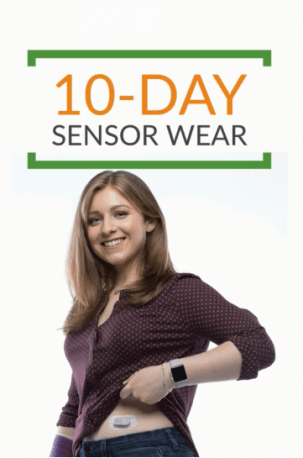
Modeling my G6.
Question: Is sensor insertion truly painless?
Answer: For me, G6 insertion has been pain-free approximately 85% of the time. It’s stung slightly a handful of times, but I’ve found that it only hurts when I choose a site that’s not particularly fatty. That’s why I generally stick with my abdomen – either side of my navel – or the back of my arms for G6 insertion.
Question: Is the G6 really that much more accurate compared to the G5, or any other CGM on the market?
Answer: Yes and no. That may not be a very satisfactory answer, but I’ll explain why that’s my belief. Overall, the G6 seems to be more accurate for me than the previous Dexcom CGM models I’ve worn. Are the number always on point compared to what appears on my meter? No. Do I wear the Dexcom CGM to have an accurate picture of what my exact number is at a given moment in time? Kind of, but I also know that this isn’t totally realistic. After all, users of the Dexcom CGMs know that it measures blood sugar levels in five-minute intervals. It can’t give me a clearer picture of what my blood sugar changes are minute-to-minute. So with that in mind, I find that the G6 is really excellent for monitoring trends – seeing how rapidly my blood sugar is falling or rising, or seeing how it changes gradually over time. The patterns are more important to me than the precise numbers; at least, that’s how I feel in my current stage of diabetes management.
I can’t really speak to other CGMs on the market, such as the Freestyle Libre or Medtronic’s CGM. But what I can say is that I’ve heard less-than-stellar reviews about both. It’s important to remember, though, that they’re not meant to be the exact same as the Dexcom CGM. The Libre itself isn’t really continuous and can’t provide users with information until they chose to wave the receiver over the sensor. And as far as I’m aware, the Medtronic CGM communicates directly with Medtronic pumps, and I’m not sure how seamlessly the systems work together.
Bear in mind that when it all comes down to it, I’m answering these questions with my experience, and my experience alone, in mind. Dexcom is and will always be the number one resource to go to with any questions regarding their CGM devices. But hopefully, the information I’ve shared here will at least help someone who is curious about the G6 feel more motivated to seek additional information. I stand by the fact that it has revolutionized my own diabetes care and management, and though it’s far from being flawless, it’s still an invaluable tool to have incorporated into my daily routine.
This blog post is a response to a prompt provided by my friends at the College Diabetes Network, who are celebrating College Diabetes Week from November 12-16. Even though I’m no longer in college, I like to participate in CDW activities as much as possible to show my support for the CDN!
Recently, I’ve asked myself, “Am I doing enough?”
I want to make meaningful contributions to the diabetes community. I think that I make a slight ripple by writing this blog, but to me, a ripple isn’t enough. I want to do more.
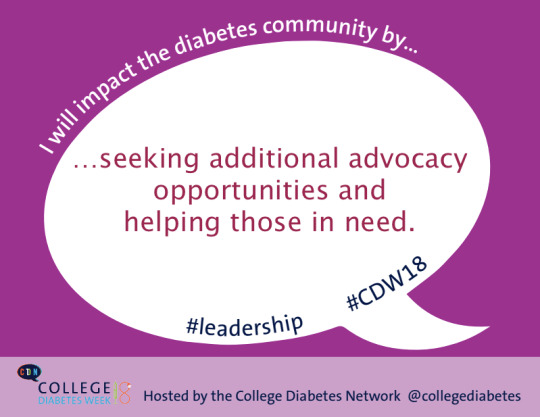
That’s why I want to put more effort into seeking additional advocacy opportunities. I haven’t defined those yet, but I know that there has to be more ways in which I can make my voice heard in a way that has a greater impact. Perhaps I can do more to further the #Insulin4All initiative, which, if you’re unfamiliar with, is explained on the Insulin Nation site in the following terms:
T1International is a global nonprofit that works to improve life-saving access to insulin, supplies, and healthcare for individuals with Type 1 diabetes around the world. Their mission is to support local communities by giving them the tools they need to stand up for their rights so that access to insulin and diabetes supplies becomes a reality for all. The organization helped to launch the #insulin4all hashtag and campaign, which has recently gained a lot of traction in the United States, where diabetes costs have grown especially exorbitant. Note: T1International is not limited to #insulin4all and vice versa, although both are discussed here.
I admit that it’s an effort that I’m only vaguely acquainted with, and I’d like to change that because it’s massively important. It goes without saying, but diabetes is difficult enough. Anyone who lives with it or cares for someone with it should be able to afford the insulin they need to survive, or to help a loved one survive.
If you’re someone who’s worked on this campaign, or if you know a way that I can step up and do more as a leader in the T1D community, please feel free to let me know. We’re in this together, and the more people we’ve got chipping in on various efforts, the more impact we’ll make.
This blog post is a response to a prompt provided by my friends at the College Diabetes Network, who are celebrating College Diabetes Week from November 12-16. Even though I’m no longer in college, I like to participate in CDW activities as much as possible to show my support for the CDN!
Most people who know me understand that I have a bit of the Peter Pan syndrome going on – I don’t want to grow up. I’d rather embrace my inner child and shun the responsibilities associated with adulthood. That’s what I’d like to do, anyways.
But the harsh reality is that I’m a woman in her mid-20s who does, indeed, have quite a few responsibilities in life. In addition to the gamut of obligations that most other adults have on their shoulders, I have an extra-special one – yup, you guessed it: diabetes.
I didn’t realize just how much my parents managed my diabetes until I got to college. Suddenly, it was on me to make sure I had enough supplies at all times, to make doctor’s appointments for myself when I wasn’t feeling well, and to do basic things like feed myself regular meals. It doesn’t sound like much, but when you’re adjusting to college life, meeting new people constantly, and making your own choices as to how you spend your spare time…then it becomes a big deal that can feel overwhelming at times.
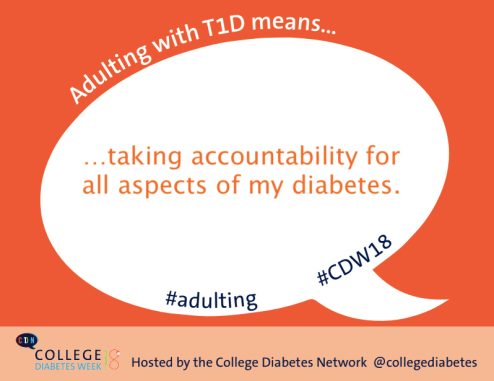
The shift in responsibility was tough at times, but I made the adjustment and learned to hold myself and myself alone accountable for all aspects of my diabetes care and management. And I’m starting to prepare myself for yet another big change coming in about six months. On my 26th birthday, I’m going off my parents’ healthcare coverage and will need to enroll in my company’s plan. There’s going to be a learning curve there as I discover what will and what won’t be covered under my new plan, and I’m teaching myself to accept it. After all, it’s unavoidable, so like everything related to diabetes, I’m just going to choose to embrace the challenge with a smile on my face.


 Hugging the Cactus