The Top Three Things my Diabetes Devices Get Mistaken For

When I started using an insulin pump and a Dexcom CGM – and even when I switched to a more modern glucometer – I never really anticipated what other people might have to say about these devices. Yes, I figured that people would notice them, and they’d probably occasionally stare out of curiosity (and sometimes, rudeness).

But I never thought that people would think that they were anything but medical devices. I shouldn’t have so much faith in people.

3623CC31-9681-499D-9EB2-3F019B98F6BC
Can I see the confusion between my old iPod and my glucometer? Um, sure!

Over the years, I’ve noticed a pattern when it comes to what people think my devices are…here are the top three things that my various gadgets are mistaken for:

  1. My OmniPod PDM is typically confused for a beeper. A freakin’ beeper? Helloooo, we’re not in the 90s anymore! Honestly, I can’t even remember the last time that I saw a legitimate beeper/pager device…so it really cracks me up when people ask if I’m carrying around such an old-school piece of technology.
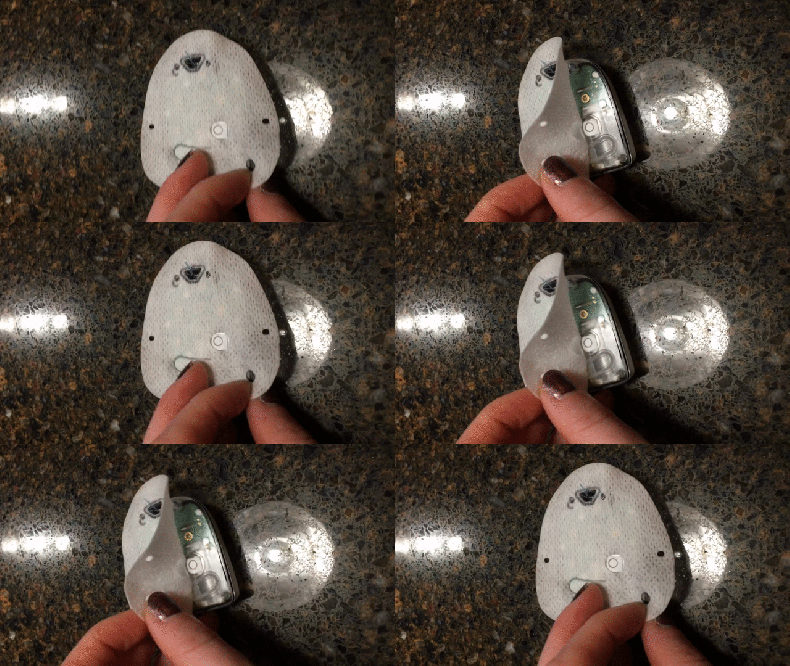
  2. My pods and Dexcom sensors look like cigarette patches, apparently. The first time someone asked me if my pod was a cigarette patch, I asked them, “Do I look like a smoker?” (Not that smokers are supposed to “look” a certain way.) I was more amused than offended, but also kind of awestruck that somebody would confuse a patch that from my understanding is fairly discreet/sleek in design with a lumpy pod or sensor.
  3. My glucometer seemingly resembles an iPod nano. Once, a person asked me why I was wiping blood on my iPod. I wish I was kidding. I’ll allow that my Verio IQ meter and iPod nano are similar in shape and size, but the similarities end there.

Truth be told, it’s actually pretty funny when people think my devices are something other than medical gadgets. And whenever a comment is made and I have to gently tell whoever it is that they’re incorrect in their assumptions about the device(s), I can almost always guarantee that they will end up feeling foolish for what they said. I almost feel bad, but…not really. For the most part, at least I can say that all’s well that ends well, because these interactions usually lead to a valuable teaching moment that the other person won’t forget.

And clearly, I won’t ever forget these moments, either!
 

More Adventures in Low-Carb Snacking

Snacks are one of the great joys in my life.

I refer to myself as a “grazer” – I’m constantly nibbling on food in between meals and I’m definitely no stranger to nighttime snacking while relaxing/watching television. If there are snacks in a room, I won’t ever be too far away from them.

I’m shameless when it comes to my love for snacks, but I can also admit that it’s not the healthiest habit. That’s because most snacks, at least the ones that appeal to me, contain carbohydrates that require me to take a bolus. Sounds like no big deal, right? It’s not, but for some reason, I usually neglect bolusing for snacks. I know better, but I can justify it to myself by saying, “Oh, it’s just a small handful,” or “Take a 15-minute walk when you’re done to burn off the carbs.” Most of the time, my blood sugar doesn’t go up too alarmingly high, but I’ve definitely experienced a few 250+ readings that shouldn’t have happened or could have been avoided if I had just bolused.

So I’ve made it a mission to track down the yummiest low-carb snacks out there (that aren’t cheese, deli meats, nuts, or celery, to name a few staples of mine that have become boring).

I’m happy to report it’s been a (mostly) tasty experiment.

Capture
These snacks are so good and low-carb. Now if only they could make delicious, zero-carb cheesecake. And chocolate. And pizza. And…

I wrote about my success with pork rinds – the name still makes me cringe, but dammit, they’re good – over the summer. And I’m here today to share three more snacks that I’ve discovered are total wins.

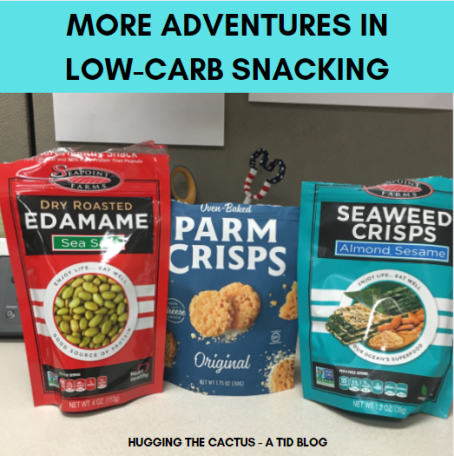
Let’s start with the roasted edamame. These are fantastic. One serving has 9 grams of carbs, but 6 grams of fiber. Since I always subtract fiber count from carb count, this means there are 3 net carbs in one serving of edamame – such a win! I also love that they’re high in protein. Besides boasting enviable nutrition facts, they’re salty and satisfy in the same way as a handful of peanuts – just with significantly less fat and more protein.

Next, there’s the parmesan crisps. I know what you’re thinking: cheese! I just said above that cheese was getting boring for me as a snack, so what are these doing here? Well, they’re different from the old cheese stick or standard slice of American. These crisps are just like chips. But instead of tasting like potatoes, they taste like crunchy discs of cheese. What’s not to like about that? Oh yeah, they also have 0 carbs in an entire bag. Yaaaaaas!

Lastly, there are the seaweed crisps. I hope you didn’t just cringe when you saw “seaweed”. I was skeptic at first, too. How could anything containing that stringy algae that always gets wrapped around your legs when you venture into the ocean possibly be considered tasty? These might be an acquired taste for some, but I was surprised when I discovered right away that I liked these. The seaweed is somehow both salty and sweet at the same time, and combined with the sesame seeds, they’re lightly crispy and quickly become addicting the more you eat. These have 3.5 carbs in a serving of 12 crisps, but there’s fiber in these, too, so the overall carbohydrate content is minimal.

While higher-carb snacks like crackers, trail mix, and the occasional piece of bite-sized candy won’t be leaving my lineup any time soon, it is nice to know that there are some low-to-no-carb options out there that are actually delicious.


A Distant Memory: T1D Through the Teen Years

High school is a time in most people’s lives that is not fondly remembered.

I am not most people.

Generally speaking, I really liked high school. Sure, I overloaded my schedule with too many A.P. classes and extracurriculars, but I was a young overachiever in those days (now I’m just a slightly older overachiever).

Academics-wise, I enjoyed taking a variety of classes, from A.P. Psychology and Statistics to Anatomy/Physiology and Cold War Era Film (we got to watch a bunch of awesome movies in that class, everything from Them! to Dr. Strangelove). And I was lucky enough to have teachers over the years that I got along with well – I even keep in touch with some of them to this day.

I had a blast playing field hockey from 8th grade through senior year. I had very minor roles that I nevertheless fully embraced in a handful of plays. And though it was a headache at times, I was happy to be an editor of my senior yearbook.

And it might or might not be surprising to you to discover that I was one of those nerds who actually liked staying after school. My two best friends and I spent many extra hours staying in school later to better prepare ourselves for our upcoming exams, and we had an absolute ball snacking on Sociables crackers and gossiping with a select few of our teachers.

I wasn’t a total angel, though – a Friday habit that my best friend and I developed on senior year was to leave our allotted 30-minute lunch break 10 minutes early so we could sneak out down the street to buy large iced coffees to get us through the final class of the day. I know what you’re thinking: SUCH REBELS!!!

A Distant Memory_ T1D Through the Teen Years (1)
I played field hockey, attended prom, and graduated high school – all while dealing with diabetes. If I can do it, anyone can.

So it goes without saying at this point that I have lovely memories from the high school days. But you know what sticks out to me more than anything about those times?

I can’t remember a single instance in high school where my diabetes got in the way.

Diabetes didn’t, and couldn’t, stop me from doing anything in high school. I just…handled it. I participated in sports teams, clubs, and classes without it ever truly interfering in a way that sticks with me to this day.

Sure, I went everywhere with all of my supplies at all times. And yes, I injected my lunchtime insulin right in the middle of the cafeteria (and I was so damn discreet about it, AND my diabetes was common knowledge, that not one student ever commented on it…at least, not to my face). Diabetes was just a part of me, but it didn’t define me. Honestly, it was often easier to balance my blood sugars and boluses than it was to handle my heavy homework load!

I wonder whether my experience would have been different had I decided to go on a Dexcom and a pump in high school, rather than wait until early adulthood. Would the devices have made it easier to balance homework with extracurricular activities, hangouts with friends, and my weekend shifts at the movie theater? Maybe, but I don’t see the point in speculating on it now. All I know is that I did things the way that worked for me back then, and I was more than fine as a result. In fact, it’s one of the few times in my life that diabetes feels like a distant memory – it didn’t occupy as much of my brain space as it does now; rather, it was just something that was always in the background, not quite my first priority because I was too busy living the life of a normal American teenager.


Two Different Lists Lead to the Same Conclusion

I like lists. I like them so much because I like to pretend to be an organized person who always has tasks to complete (the former is definitely false, while the latter is pretty much absolutely true). I also like lists because making one feels like an accomplishment in itself, and who doesn’t like feeling accomplished?

Freedom is the atmosphere in which humanity thrives. Breathe it in.
What can I say, I’m a list girl. (But not a hand model; that’s definitely not my perfectly manicured hand in the above photo.)

So I must admit that I felt pretty damn good about myself after making these two diabetes-related lists, because not only do they pull weight as blog post material, but they also help me understand something about me and my diabetes. So here they are:

List of things I should do on a daily basis for my diabetes:

  • Check my blood sugar using my meter 6-8 times per day (upon waking up, before I go to sleep, before I eat a meal, and in-between meals to make sure I’m on track)
  • Change my lancet (LOL)
  • Look up carb counts for every meal using apps and/or nutritional facts
  • Monitor my Dexcom carefully and do fingerstick checks when I disagree with it
  • Take a correction bolus for every blood sugar that’s over 150 mg/dL
  • Eat plenty of fruits and veggies AND drink plenty of water

List of things that I actually do on a daily basis for my diabetes:

  • Check my blood sugar whenever the heck I feel like it; after all, my Dexcom is usually accurate
  • Change my lancet only when I remember, which is like…once or twice a month
  • Eyeball my plates of food and make “educated guesses” on carb counts
  • Monitor my Dexcom OBSESSIVELY – sometimes even every 5 minutes, depending on the situation – and freak out when it doesn’t match my fingerstick checks
  • Take a correction bolus for blood sugars that are 200+ only
  • Eat what I’d like (which, in addition to fruits and veggies, is a wide variety of things) and drink probably not quite enough fluids

When I compare these two lists, I come to the same conclusion: I am lazily in control of my diabetes. I know exactly what my current routines are and just because they aren’t the “right” ones, it doesn’t necessarily mean I’m doing anything “wrong” in terms of my diabetes care and management. Sure, I’m not doing anything the textbook way, and I admit that I’ve gotten a little lazy with things like carb counting and correction bolusing, but so what? The important thing here is that I can recognize the areas where I need and want to improve.

For starters, I’d like to stop depending so much on my Dexcom. I want to learn to check it less – maybe take it out half as often as I do now – so I can strengthen my ability to recognize low and high symptoms. I’m also hoping to use measuring cups and nutritional information more often to make better informed decisions when it comes to how much insulin I give myself at mealtimes. It’ll add a few extra steps to my day, but these are habits that I followed for a long time and that are worth reintroducing to my routine.

As far as everything else goes, I’m not going to sweat them too much…of course, it will be nice if I remember to change my lancet more frequently and be more proactive about correcting high blood sugars, but really, these are matters of minor concern. I think I make my best diabetes progress when I take things one step at a time, so that’s just what I’m going to do.

Precarious Pods and Pure Paranoia

Here’s another previously published blog post from October 5, 2018. What nugget of useful information can you find here? Well, it all has to do with trusting your gut when it comes to an insulin pod that’s dangling precariously off your body and the subsequent paranoia that happens when you’re not sure whether it’ll still work properly…

I’d only been wearing my new pod for about an hour when my arm brushed up in exactly the wrong way against a chair. Riiiiiiiip!

My pod tore right off – not from my arm, but it lifted up from the adhesive that it was glued to and dangled precariously from the still-intact adhesive stuck to my arm.

9121BF44-6E91-4DCE-865A-5401B59A7CA5
Would you have kept the pod on, or changed it?

After cursing loudly, I asked my mother for her opinion. I wanted to know if she could see the cannula, because that was the component that made me most concerned. As long as the cannula was still stuck under my skin and delivering insulin, it shouldn’t matter that my pod was a little loose – right?

She tried to peek under and around my site, but it was virtually impossible to tell whether the cannula was where it should be. I thought about it for a few moments, and decided that it would be wise to just change out the pod. The notion of tossing one that had only been in use for an hour was unappealing to me, but I know myself pretty well, and I know for damn sure that I would’ve been super paranoid about the pod functioning properly for the following 72 hours. I also figured that it couldn’t hurt to try calling Insulet to see if they would replace the kaput pod. The odds were slim, but why not try?

So after I changed my pod, I dialed up Insulet and described the situation to the customer support representative. And…I got a replacement! I was pleasantly surprised by the rep’s empathy towards the situation and how easy it was to get my replacement. She reaffirmed that I did the right thing, noting that if she’d been in my shoes, she would have called it in, too. It goes to show that when in doubt, change the pod – and don’t hesitate to call for a replacement.

How to Find Out Whether Your Soda is Diet or Regular

Life is a little crazy for me at the moment and I’m unable to publish new content, which makes me sad! But until things slow down, please enjoy posts I’ve written previously and chose to share again because they contain useful information.

Have you ever ordered a diet soda, sipped it, and immediately doubted whether it was truly diet? Then you might find this little tip useful.

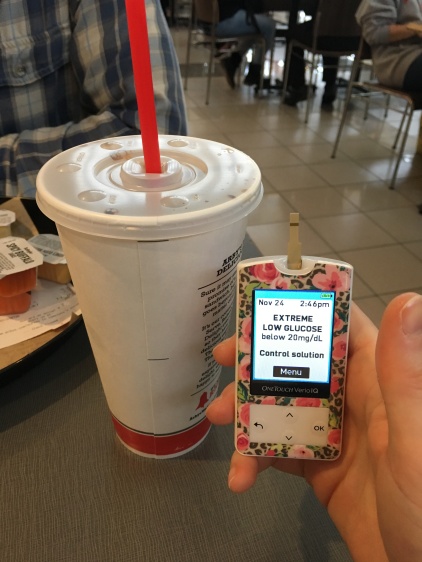
Whenever you’re not certain that your drink is diet or regular, try grabbing your glucometer, putting a test strip in it, dipping your finger in the drink, and wiping it onto the strip – just like you would do when checking your blood sugar. If the drink is diet, then you’ll know because your meter will display an “extreme low” result, or something to that effect. The key is to not panic and remember that it isn’t your blood sugar you’re looking at, it’s the sugar levels in the drink! It’s just the opposite in the case that your drink is regular/sugary – you’ll get a “high” reading that’ll make it obvious that your beverage isn’t what you ordered.

IMG_0313
Photographic evidence of my soda test results.

Whenever you’re in doubt, remember this helpful hint as the perfect way to make sure your beverage is sugar-free instead of sugary.

The Holy Grail of Glucose Tabs

I feel a desire to share with the world that I’ve found it.

Erm…what is “it” though?

Why, glucose tablets, of course. Not just any old glucose tabs. I’m talking about glucose tabs that are actually delicious. The kind that are obviously effective and can quickly raise low blood sugar, but that are also so tasty that I sort of want to eat them by the handful out of the jar.

I’ve got your curiosity piqued now, don’t I?

Well, then, I’ll let you in on the secret “holy grail” glucose tabs that I’ve been enjoying…

The holy grail of glucose tabs.png
I never thought I’d do a mini photo shoot for glucose gummies, but then again, I never thought I’d do a lot of the weird things I’ve done in my life so far.

Spoiler alert: They’re not technically tabs; in fact, they’re gummies.

I’ve written about glucose gummies in the past and it’s safe to say I was fairly underwhelmed by them. They had flavor and texture issues, and ultimately, they were pretty disappointing. I’d counted on them to change the glucose game, but this rendition of Walgreens-brand glucose gummies totally failed to do that.

So a few months ago, when I noticed that Walgreens had given their glucose gummies a makeover, I figured I’d give them one last chance to impress me.

And SWEET SUCCESS, THEY DID IT!

There are some similarities between the old and new gummies; namely, three gummies has 10 carbs…just under the amount of carbs that are usually in three standard glucose tabs. The old and new gummies are both also covered in sugar crystals (I’m not sure if that’s intended to make them look appetizing?). Otherwise, they couldn’t be more different from one another in terms of color, shape (old gummies were ring-shaped, new gummies are kind of gumdrop-shaped), and obviously, palatability.

What’s different about the gummies this time is that they improved on every major complaint I had about the previous version. The best, biggest improvement had to do with texture. Previously, the gummies were stale and difficult to chew quickly. These new gummies are very soft and don’t leave you with that sticky teeth feeling that’s typical of most gummy candies.

The flavors are also much better. Before, the gummy flavors were super artificial tasting. The grape, orange, and apple flavors were almost medicinal and hardly tasted like their genuine counterparts. Now, the gummies still come in three different flavors, but they’re all of the same variety: blueberry, raspberry, and strawberry. The mixed berry combination just works here. There’s no odd after taste and, when eaten together, a three or four gummies at once just tastes like a small handful of conventional gummy candy. Not my personal favorite kind of confection, but it definitely is much more appealing than regular old glucose tablets.

Maybe I’m overselling Walgreens’ glucose gummies version 2.0, but really, after 22 years of diabetes, there are just some things that are worth getting excited about…even if they seem insignificant in the grand scheme of things.

The Surprise A1c

I started out 2020 with an A1c that surprised me. It was a good surprise: Anything under 7 is a win in my book.

I won’t specifically say what the number was, because I don’t really believe in doing that and I fear that it will invite unwelcome judgment and/or comparisons. But I will celebrate that achieving this A1c was far from easy. It’s required a lot of work from me in the last few months, which have generally been a very turbulent period of time for me.

It seemed like the “diabetes gods” were really testing me in the latter half of 2019. From a month of unexplained highs to random incidents of technology failing me, I felt like I was being put through the wringer. I felt like a failure on just about all diabetes fronts, and it seemed like my efforts to maintain my desired blood sugar levels were fruitless.

Hey, Handsome
More than one surprise came with an unexpected A1c result.

So that’s why I could hardly believe my current A1c reading. Maybe it seems even more impossible to me because I didn’t even get to discuss it with an endocrinologist. In fact, I never got to talk to my new endo (the one I may or may not continue to see) about any of my A1c goals. Doesn’t that seem kind of effed up? Shouldn’t my doctor want to know what I hope to accomplish, in terms of my diabetes, in the next 3-6 months?

In that regard, this A1c has surprised me in more than one way…it’s not just that I’ve managed to get here (really, I’ve managed to stay here, my A1c in the last 2-3 years has been right around this number), it’s also about how it’s more than just a measurement of my average blood sugars in a 90-day period…it’s a marker of how I feel, emotions-wise, about my diabetes. I never thought about it much before, but as I’ve grown older, it’s really become a sign for me as to whether or not I have my shit together with my diabetes. It can signify how I’ve felt about my diabetes in a given period of time, from the lowest of the low burnouts to the highest of the high determined and motivated.

Kind of crazy and yes, surprising, how a single reading can mean this much.

The Expired Test Strip Experiment

Nearly every diabetes supply I own comes with an expiration date. Insulin vials, pods, ketones testing strips, and Dexcom sensor/transmitters are among the items that I’m always closely monitoring to ensure they’re still fresh and usable, but test strips? They’re basically the last thing that I worry about.

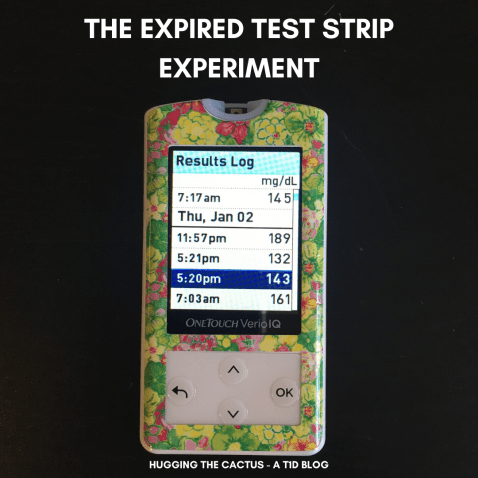
So I was curious when I recently noticed that my current test strip vial has an expiration date of 12/31/19. Would these strips still measure my blood sugar accurately, or was the New Year’s Eve expiration hard and fast?

I wanted to find out.

The Expired Test Strip Experiment
An introductory blog post to a potentially ongoing experiment.

My experiment design was rudimentary: I’d simply continue to use the 12/31/19 test strips until the vial was empty. I’d check any blood sugar results that I was unsure about against my Dexcom readings, and in cases that I deemed necessary, I’d use test strips with a far-off expiration (July 2020) to see how they matched up with the expired strips.

To my slight surprise, though it’s only been about a week since the old strips expired, it doesn’t seem to affect things much at all. They’re just as accurate as newer strips and my Dexcom.

In fact, in many cases, the old strips were only off (according to my measurements) by no more than 9 points. Not bad. I’ve had a wider spread in results between strips from the exact same vial, so the fact that the old strips were so close to new ones was interesting to me. And four days after the strips expired, I checked my blood sugar (I was 263) and used a new strip to double check that (it read 262). A single point difference is pretty impressive.

So now I know that I’m safe if I use test strips a week after they’ve expired…which is great! But now I’m sort of curious to see just how far out from the expiration date I can use them. I might hang onto this vial of test strips for a few more weeks and continue to test them against newer test strips. I might not (because really, when it comes to diabetes, there are just more important things to be worried about…and I might not want to push my luck and end up wasting strips). We’ll see what I end up doing.

I think that the more compelling questions to stem from this experiment are 1) how many other diabetes supplies are safe (up to a certain limit) to use after expiring and 2) why are supplies labeled with expiration dates if, in the grand scheme of things, they seem to function just fine after expiring? Could it just be a nasty trick played on people with diabetes by prescription drug companies…?

Those are the kinds of questions that really make me wonder.

The Peanut Butter and Chocolate Punishment

loooooove peanut butter (frequent visitors of this blog are very aware of this fact) and chocolate. It’s the perfect combination of salty and sweet. And Reese’s cups of all shapes and sizes are definitely the most delicious snack in the entire world – though I have a special affinity for Reese’s pumpkins for having the ideal chocolate-to-peanut butter ratio.

Despite my unwavering adoration for peanut butter and chocolate, the dynamic duo doesn’t always love me – or my blood sugars – back…especially when I neglect to bolus accordingly.

It was a lazy Sunday afternoon. I’d just woken up from a brief cat nap on the sofa and felt hunger pangs. I checked my CGM and noticed that my blood sugar was going a little low, so I yawned, stretched, and ambled into the kitchen for a snack.

That’s when I remembered I had a tasty treat in the fridge – crunchy peanut butter chocolate squares I’d whipped up the night before to bring to a friend’s apartment. They were made from, obviously, crunchy peanut butter, but also crushed graham crackers, butter, confectioner’s sugar, and a silky, smooth layer of melted dark chocolate. The squares were chock-full of carbs, but cut small enough and on the thin side…so I naively assumed I could eat a couple without doing any real damage to my blood sugar levels.

The Peanut Butter and Chocolate Punishment.png
The crime? The existence of these peanut butter and chocolate squares. The punishment? High blood sugar for unknown length of time. Cruel.

So I dove in, helping myself to some additional crumbs at the bottom of the bag that had broken off from roughly cut squares. After a couple of minutes of totally pigging out, I made myself stop because I could practically feel my blood sugar begin to rise. I even took a couple of units of insulin (not at all calculated, just two off-the-cuff units) to offset any high blood sugar.

Unfortunately, two units wasn’t exactly enough. Within an hour, I saw my blood sugar go from the 80s to somewhere in the 280s. Not at all what I wanted! I began bolusing and stacking my doses like crazy while I fixed dinner and fretted over how long it might take for my blood sugar levels to come back down so I could eat a real meal. By the time dinner was ready, though, I was still high but confident that the insulin on board would do its job. But it took nearly five hours for everything to stabilize, from when I first gave into the peanut butter and chocolate squares to a couple hours after dinner.

Not my finest moment in life with diabetes since everything could’ve been prevented from the beginning. But maybe it goes to show one of the reasons why people start out each new year with the hopes of eating clean and cutting out sweets – junk food tastes so wonderful when it’s being consumed, but the long-term effects are too much of a punishment to make it worth it.

Now, if you’ll excuse me, time to evacuate the apartment of all carb-y confections…