A Shout-Out to Fathers of Children with Diabetes

Yesterday was Father’s Day, but today I’d like to take the opportunity to give a shout-out to my dad – and all fathers – who care for children, young, fully grown, or any stage in between, with diabetes.

All dads, generally speaking, don’t get enough credit for all that they do for their families. I know that I am fortunate enough to say that growing up, and to this day, my dad (and mom) provided me with everything a child could ask for: a loving home, plenty of food to eat, and endless support, to name a few.

But on top of that, my dad took care (and continues to take care) of both his child and his wife with diabetes. He does everything in his power to make sure that we want for nothing and has dealt with alllllll the highs and lows – and everything in between – over the years.

Thanks for everything!

My dad has always been the “fixer” in the family. When a problem pops up, he just wants a solution to it. So it’s no wonder that he’s felt helpless on the occasions that there’s literally nothing he can do to help with diabetes except wait for the insulin or sugar to kick in (depending on whatever the case may be).

But the other thing you should know about my dad is that he gives everything in his life 110%. Professionally and personally, he never half-asses anything. And I’ve always found that extremely inspiring. He’s a role model for me in that his give-it-your-all attitude and work ethic has taught me to give my diabetes my all. For that, and so much more, I’m thankful.

My dad – just like my mom – is the real MVP. He has done so much for the both of us during this stay-at-home situation, between picking up groceries each week and running all of our errands for us in order to limit our time out of the house. My dad deserves credit, and so do all other T1D dads: You’re doing great. As you help us navigate this new normal, we realize that there’s already so much you do for us. You’re doing your best in these weird times and your loved ones see that and appreciate it more than you could ever know.

Thank you to all the dads out there, but particularly mine: Thank you for helping to keep me grounded during this “challenging time”, and for, well, everything else you’ve done for me in my 27 years (both the non-diabetes things and the diabetes-related things).

Four Signs of Diabetes in the Summertime

Sun’s out, guns pumps out, amirite guys?

The summertime season is in full swing, and now that it’s here I’m thinking of the various ways my diabetes is more pronounced in the warmer weather. It’s much more visible, leading to many more questions, but what are the cues that give it away to others? I thought of four…

Visible sites. Shorts-and-t-shirts weather makes it much harder to place pods or CGM sensors in discrete locations. And if I’m going to the beach? There’s no way that I can even attempt to hide my devices. That’s probably why I make them even more obvious with…

…Pump and sensor art. I’ve written about Pump Peelz and GrifGrips in the past – they make adhesives and skins that are specially designed to fit pods, PDMs, pumps, meters, and more. The products they make are truly little works of art for diabetes devices, and I like to make sure all of mine are decked out in the summer months so I can show off tech that’s not only functional, but also stylish.

Four Signs of Diabetes in the Summertime
I’m looking forward to donning my best beach-y Pump Peelz on what I hope will be many trips to the beach this summer.

Gadget tan lines. Or if you’re like me, it’s more like sunburn lines. That’s because each summer, without fail, I somehow manage to neglect the space around my pod or my sensor, so when it’s time to remove it, there’s a huge red circle around the perimeter of where the device was situated. Maybe this year I’ll actually learn my lesson and take the time to apply sunscreen properly so I can avoid the very not-cute sunburn circles.

Travel coolers. This is probably the least obvious sign of diabetes in the summertime, but to those in the know, coolers meant to protect insulin are pretty recognizable compared to regular coolers. Whether it’s a Frio cooling pouch or another brand of insulin cooler, people with diabetes tend to carry these throughout the summer months in order to prevent insulin from spoiling due to heat exposure.


Conference Calls and Low BGs

Some things in this world simply belong together.

Peanut butter and jelly. Batman and Robin. Mickey and Minnie. Name an iconic pair, and…

…I can guarantee that it won’t be conference calls and low blood sugars.

Indeed, I can attest to how much the two DON’T belong together because I faced a rather annoying one the other day.

It happened during one of the many weekly meetings that I now attend virtually along with the rest of my department at work. Not only do I have to dial into these meetings, but there is a video component, as well. Fortunately for me, all that I’m doing is listening during these meetings instead of talking, so I can stay on mute for the duration of most of them, and occasionally make various facial expressions that show I’m listening.

So I was, indeed, on mute when the shrill BEEEEEEEEEEEEP BEEPBEEPBEEPBEEP of my CGM receiver started. And thank goodness I was, because that sound is enough to derail anyone’s line of thought.

But rather than address the low right away, I was a little stupid about it.

rld
I turned off my webcam for approximately 30 seconds just so I could capture how agonizing the wait for my blood sugar to come back up was.

I decided to wait as long as possible before I corrected it.

I know, I know – that’s a dangerous game to play. But hear me out! My meeting was running from 12:30 to 1:30. I planned on having lunch right after the meeting, and it was already 1 o’clock when my CGM started shrieking. I thought I could wait to treat it with my lunch food…but that’s not what ended up happening.

I started feeling low, low. Like, shaky, sweaty, unable to focus on anything that my group was discussing, and ravenously hungry.

So I did what any person with diabetes would do when their blood sugar is that low – the only thing to be done, of course, was to whip off my head phones, turn off my camera, sprint into the kitchen, wolf down a handful of raisins, and jump back onto the call.

Oh, and turn off the camera again for another 30 seconds or so (in the 15 minute window of time it took for my blood sugar to stabilize) to capture a picture of myself on the struggle bus that is the recovery process from a low.

The whole ordeal stood out to me because it’s very different from the last low that I remember experiencing during a work meeting. That one happened when we were all still in the office, and I had to get up and dismiss myself from the conference room so I could grab a package of fruit snacks from the office kitchen.

That one was much more disruptive, but I handled it much more promptly than this one.

This one wasn’t even noticed by a single person on the conference call (and if someone did see me pop off camera for a moment, I’m sure they just assumed I was having connectivity issues).

This one I didn’t react to immediately, and I ended up being punished for it because I missed out on some meeting information due to my inability to concentrate and the need to finally treat it.

This one and that one do have one thing in common, though: Low blood sugars absolutely do not complement meetings, conference calls, or any sort of work-related task, ever.

Why Does Everything Have to Be so Complicated? (Musings on Diabetes and Emotions)

I hope that the moment you read the title of this blog post, Avril Lavigne’s smash hit from 2002 got stuck in your head (sorry, not sorry).

On a related note, it felt like it was the right phrase to use as a title for this post.

In the past, I’ve written how diabetes has turned me into a bit of a control freak (meaning that I don’t do well with the curve balls it sometimes launches into my path). I prefer a schedule – nothing too regimented, just enough to know what to expect in terms of diabetes issues in a day. And that’s not always possible; hence, I have some control-freak tendencies.

Lately, I’m also wondering if diabetes has made me more emotional.

The thought occurred to me when I was deep in self-reflection mode, a place I’ve found myself going to again and again throughout my quarantine. I started thinking about instances in which I let my blood sugar influence my mood, and I realized that it happens more often than I care to admit.

White and Blue Emojis Animated Social Media Graphic
Life with diabetes sometimes means reacting like all of these emojis within a matter of moments.

I wonder if the tie between my emotions and my diabetes exists because my diabetes requires me to be so attentive to my body at all times that it’s also caused me to have a heightened awareness of my emotions and what may be causing them. I definitely allow blood sugars, both high and low, to affect how I feel when they happen. I let the successes and failures of diabetes technology influence my mood. And when I start to get down in the dumps about non-diabetes things, it often turns into full-blown diabetes burnout.

Diabetes is complicated on its own.

But to think that it interferes with my emotions, too?

Isn’t it enough for diabetes to impact me just physically and leave my mental state out of it?


Have You Signed the Type 1 Diabetes Access Charter?

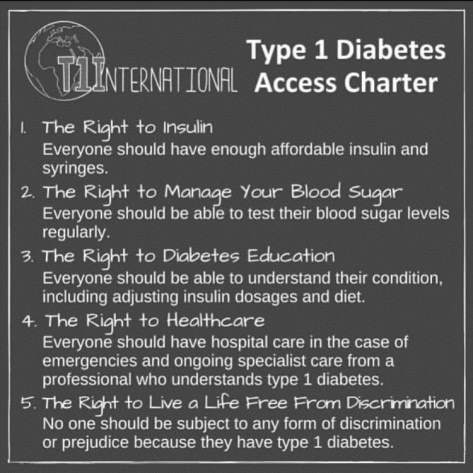
On Wednesday afternoon, I signed a charter intended to bolster worldwide diabetes advocacy. The charter was launched by T1International and I’m sharing it here with you to encourage you to sign it, too. Here’s some more information on it, pulled directly from the T1International website:

Around the globe today, people with type 1 diabetes are dying because they cannot afford or get ahold of insulin, supplies, education and treatment.

To survive and live a full life, everyone with type 1 diabetes has the right to the following:

1. The right to insulin
Everyone should have enough affordable insulin and syringes.

2. The right to manage your blood sugar
Everyone should be able to test their blood sugar levels regularly.

3. The right to diabetes education
Everyone should be able to understand their condition, including adjusting insulin dosages and diet.

4. The right to healthcare
Everyone should have hospital care in the case of emergencies and ongoing specialist care from a professional who understands type 1 diabetes.

5. The right to live a life free from discrimination
No one should be subject to any form of discrimination or prejudice because they have type 1 diabetes.

In addition to magnifying diabetes advocacy efforts globally, the charter is also used to influence the actions of governments and organizations so that policies can be changed and the rights of people with type 1 diabetes can be prioritized.

It took me fewer than 30 seconds to sign the charter, and I put this blog post together in under 10 minutes. Join me by signing and spreading the word about it to help people living with type 1 diabetes have access to vital insulin, supplies, healthcare, education, and freedom that are necessary in order to survive and live full lives.

Haste Makes Waste (of Pods)

Have you ever been in such a hurry to do something within a certain period of time that it works to your disadvantage?

I guess there’s a reason why they say haste makes waste…

…especially when haste results in accidentally whacking your insulin pump off your arm.

I was reminded that this can happen the other day when I had my friend over for some socially distant hang time. Just because we had to stay six feet apart during her whole visit didn’t mean that I had to be a bad host, though, and I was in a rush to bring some Goldfish for us to snack on while we sat in the sun outside. I flitted about the kitchen, grabbing the bag, a plate, and some napkins to bring out with me. When I went to open the sliding door that would take me from the kitchen to the porch, I gave myself just enough room for my body to slip through it sideways.

I should’ve walked through the opening slowly; rather, I dashed through it like I was about to cross the finishing line of a race – and my pod was suddenly, a bit violently, ripped off my arm in the process.

“ArrrrrRRRRRRRggggHHHH!” (I think that’s a pretty good approximation of the sound that I made when it happened.)

Green Yellow Paint Strokes Birthday Instagram Post
I wish I had a picture of how absurd it looked to have my pod dangling from my arm; alas, taking photos wasn’t a priority of mine in this situation.

My friend, alarmed by my animalistic emanation, asked if I was okay. I came to my senses and calmly explained that I’d just knocked my pod off my arm, and she looked on in horror as she saw it dangling by an adhesive’s thread on the site.

“Doesn’t that hurt?!” she asked in dismay.

I reassured her that no, while the actual sensation of the pod ripping off my skin didn’t hurt, it definitely stung that I was now forced to replace it even though it had only been in use for less than a full day. It sucks when I can’t use my supplies to their fullest extent because each time something like this happens, there’s a dollar amount attached to what I’m wasting, and what’s worse is that I can’t blame it on anyone or anything except myself.

Ah, well…a fresh pod was applied and no harm was done in the end. But next time I try to enter or exit that sliding door, you can bet I’ll be a lot more careful when I do so.

A Source of Toe-tal Stress

I don’t like horror stories.

I’m not big on scary things, in general (besides Halloween…I love dressing up)…but horror stories, in the form of tales told ’round the campfire or in media such as television or film, have never been my cup of tea. Probably because I’m a giant scaredy-cat, but I digress.

My disdain for horror doesn’t mean I’ve been able to successfully avoid it over the years. I’ve traipsed through my share of haunted houses, watched countless scary movies (with my hands over my eyes for a good portion of all films), and listened to spooky ghost stories.

The scariest story of all that I’ve heard over and over again has to do with…

Diabetes. And feet. Without going into more detail – because I’m shuddering at the mere thought – diabetes complications could lead to, um, amputations.

I’m not trying to make light of a very serious subject here: Let me be crystal clear when I say that diabetes complications are real and terrible, I wouldn’t wish them on anyone. They also frighten me so much that I tend to avoid blogging or even talking about them altogether. The slightest blur in my vision or tingling in my toes can send waves of panic through my brain that are so intense that I convince myself that I’m experiencing my first diabetes complications.

So when I discovered a cut on my toe several weeks ago, I couldn’t help but totally freak out, especially when I noticed blood around the site.

Need help_ (1)
As a person with diabetes, you’d never catch me barefoot and surrounded by all those rocks. OUCH.

For most people, a cut on the toe sounds like no big deal – you just put some antibiotic cream on it, wrap a Band-Aid around it, and let it heal. But for someone like me who has diabetes, a little cut triggers fears of serious issues like cellulitis or other infections that could lead to major problems.

It might sound ridiculous, but in the first couple days after I noticed my cut (it was a bit like a split in my skin), I had horrifying visions of my toe turning black and falling off. I became hyper-aware of every sensation I could and couldn’t feel in that area, and when I felt a slight stinging around the area a few times, I imagined that it meant that my days with all of my toes were numbered.

Was it silly for me to jump to such dramatic conclusions? Probably. Was I being paranoid? Definitely. But my overactive imagination was enough to convince me to at least consult my primary care physician about the matter.

I’m glad that I did. Over a two-week span, I had two virtual appointments with my doctor who took my concerns seriously. I described the issues and he gave me advice as to how to treat the cut (stop putting Neosporin and a Band-Aid around it each day, let it breathe, use a nail file to very gently proximate the wound, make sure I wear socks and shoes for all forms of exercise to better protect my feet). He agreed with my overarching concern: to heal it in order to prevent it from getting worse.

My toe is doing much better now, and after all that, I feel a bit (okay, a lot) sheepish that I made such a big deal about it in my head when I initially spotted the split in my skin. But in life with diabetes, everything related to my health has to be taken seriously, even if it means dealing with an added source of toe-tal stress.


8 Things About Diabetes That Make Me Want to Rip My Hair Out

Life with diabetes can be the opposite of a cakewalk. In fact, it can be so frustrating at times that I seriously consider ripping my hair out due to sheer agitation.

When thinking about the things that drive me nuts about diabetes, I came up with a list of 8 occasions in which I come this CLOSE to losing my freakin’ marbles:

1. When low blood sugars refuse to come up…

2. …And when high blood sugars refuse to come back down.

I’m considering these first two as separate list items because the scariness of a lingering low and the frustrating nature of a stubborn high can be two very different types of “GAAAAAAAAHHHH!” But both can be especially suck-y when you feel and know that you’ve been doing everything right to treat them without experiencing the expected results.

3. Pod and CGM sensor failures.

Oooh, any sort of device failure can be so exasperating any time of day. But they’re worse when they happen at inconvenient times, such as in the middle of the night or during an important conference call. All diabetes technology should work flawlessly at all times, but that’s not always the reality that we live in.

4. Inaccurate results.

I can’t stand when my blood sugar meter or my CGM report false readings. Sometimes, I’ll check my blood sugar two times in a row just to see how close both readings are to one another, and it makes me want to throw my meter across the room when I see that they’re off by 20+ points. Once, I had a reading that was off by more than 50 points! That makes a major difference in how much insulin I give myself in that moment in time, so inaccurate results can really derail my blood sugars for hours after.

Need help_
I’m sure you can imagine how entertaining the search results were when I looked up images to go with this blog post.

5. Folds in the adhesive.

Whenever I apply a fresh sensor or a pod, I try to be super careful and make sure that the adhesive sticks smoothly…but despite my best efforts, that doesn’t always happen. Folds in the adhesive are far from the worst thing in the world, but they do make it more difficult for my devices to stick on for the full length of time that I need to wear them, and I usually end up having to add tape around them to reinforce the hold. More tape = more folds = more irritation!!!

6. Unexplained blood sugars.

Anyone with diabetes has been there, done that. You could follow the exact same routine from one day to the next, even eating the same foods at the same times, and get totally different blood sugar results. Or maybe you thought that you bolused perfectly for a meal, only to find out hours later that you’re much higher or lower than you anticipated. Whatever the reason behind them may be, unexplained blood sugars are just obnoxious.

7. Screeching alarms.

Speaking of things that are obnoxious, let’s talk about wailing OmniPod or Dexcom alarms for a hot second. There’s nothing like a resounding BEEEEEEEEEEEEEEEEEEEP to ruin your day!

8. The INSANE costs of our supplies.

Undoubtedly, the thing that most makes me want to rip my hair out when it comes to diabetes is the cost of supplies. I’ve blogged more and more recently about the criminal cost of insulin – since the 1990s, the cost of insulin has increased over 1,200% (!!!) – and I’ll continue to do so until EVERYONE with diabetes can afford this life-saving medication. We never asked for diabetes to happen to us. But it did. And the fact that many people with diabetes have to make sacrifices in order to, well, survive, is simply not okay, and the most infuriating thing about living with this chronic illness.

How Long Do OmniPods Really Last?

When people notice my OmniPod insulin pump, the first question that I’m asked is “what IS that?”

After I explain that it’s my insulin pump, and it’s called a pod, the second question I’m asked is some variation of “how long does it last?”

The canned answer that I provide is something about having to change it every three days, because that’s how the OmniPod is advertised.

But I’ve used this pump for years now and never bothered to really test this three-day limit. I’ve known for a long time that my pod works a handful of hours after the expiration alarm starts chiming, but I wasn’t sure about exactly how many hours I had before a pod expired for good.

So, the other day, I decided to find out.

Life's too short to have regrets
Have you ever made your pod last longer than 3 days? If so…are you a wizard???

My pod expired at 10:22 A.M. Since I prefer to change my pods in the evening, I figured it was the perfect time for this little experiment, assuming that the pod really would last me for the majority of the day.

And, well, it did! At 10:22 on the dot, the pod beeped at me to notify me that it was expired. And in the six hours after that, it would alarm every hour (on the 22nd minute) to remind me, time and time again, that it was expired. In the seventh hour – beginning at 5:22 P.M. – my PDM started chirping at me on and off every 15 minutes or so. First it was because I was running out of insulin, but then it was to really get the point across that my pod was expired!

I was determined to use every last drop of insulin in the pod, though, so I bolused for my dinner around 5:45 and I was pleased to discover that I got my full dose of insulin without any issues. As I was cleaning up after dinner, that’s when the signature OmniPod BEEEEEEEEEEEEEEEEEP went off as one blaring, unceasing alarm. I checked the time: 6:22 P.M.

So there was my answer. An OmniPod can last precisely 80 hours after you initially activate it for the first time (or in other words, 8 hours after you receive the first expiration message)…as long as it still has insulin in it. It’s definitely something good to know for sure now, because in the future, it might come in handy and help me avoid wasting precious insulin.

Do You Know How Shareholders Benefit from Insulin Price Increases?

This post was originally published on the T1International website on May 6, 2020, and was written by Rosie Collington. I am sharing it on Hugging the Cactus because to be quite frank, I never understood the many issues surrounding insulin price increases. After reading this post, I had an “aha!” moment as I finally began to understand how the profits from insulin price increases are distributed. It’s an important issue to understand: with increased awareness comes an increased drive to make change.

Patients living with type 1 diabetes have known for years that the list price of insulin in the United States has soared. They’ve paid the price – in insurance premiums, in upfront costs, and also, tragically, in some cases with their health.

But until recently, it has been difficult to prove just how much the list price of insulin has increased, and what proportion of the higher costs for patients have gone to the three main insulin manufacturers – Eli Lilly, Novo Nordisk, and Sanofi – versus other companies in the US prescription drugs supply chain, like insurance companies, pharmacies, and pharmacy benefits managers. Information about pricing negotiations is considered a trade secret, meaning that the actual data is difficult to access. Instead, researchers and patient groups have had to more or less rely on guesswork to estimate the value of price increases, or the highly selective data published by the companies themselves, which do not paint the full picture.

The lobby group representing pharmaceutical companies in the United States, PhRMA, has suggested that pharmacy benefits managers (PBMs) have been the primary beneficiaries of the sharp list price increases of many prescription medicines in recent years. The American Diabetes Association’s Insulin Access and Affordability Working Group similarly reproduced selective data released by the three insulin manufacturers on the differences between the list and net prices – the amount the manufacturer receives – of a few insulin medicines, suggesting that the additional profits accrued by the manufacturers was low relative to intermediaries like PBMs.


This slideshow requires JavaScript.

But in March of this year, researchers at the University of Pittsburgh provided evidence that the net price of insulin medicines in the United States had also soared – by 51% between 2008-2017. This indicates that while other intermediaries had benefited from list price increases, the manufacturers had too. This may seem obvious, but having data to prove it is important.

For my research with Bill Lazonick, funded by the Institute for New Economic Thinking, it has been key to mapping how the profits from higher insulin sales revenues have been distributed. We wanted to find out whether insulin list price increases in the United States had contributed to higher research and development (R&D) investment by the companies, as they so often claim is the case. What we discovered was that as the list price of insulin has increased in the past decade, the ratio of spending on R&D relative to what the companies distributed to shareholders had actually decreased. While over the period of 10 years, the companies spent $131 billion directly on R&D, crucially we found that during the same period, the companies had distributed $122 billion to shareholders in the form of cash dividends and share buybacks.

Cash dividends are the means used by all publicly listed companies to distribute money to shareholders as a reward for holding shares. Share buybacks work quite differently – companies can buy their own shares from the market, which inflates the value of existing shares on the market. Share repurchasing can also benefit company ‘insiders’, like executives, who often receive pay in shares, because they can decide to time when they sell their shares to get the most value. This is not technically illegal, though it was once upon a time. In the last year, some lawmakers in the United States, including Bernie Sanders and Elizabeth Warren, have called for stock buybacks to be banned.

Fundamentally, the system should not have permitted shareholders to profit in this way as diabetes patients were struggling to access their life-saving prescription medicine. As coronavirus continues to spread around the world, the pharmaceutical industry is facing more scrutiny than ever before of its financing and drug development processes. By understanding how value is extracted by shareholders in the pharmaceutical industry, and what relationship this has to patient access, we can, hopefully, create a better system.