Dungeons, Dragons, and Diabetes

Dungeons, dragons, and diabetes…one of these things is NOT like the other! And add “drams” into that mix, and you’re likely very confused and wondering what kind of bizarre, alliterated laundry list this is supposed to be – and why on earth I’m talking about it here on Hugging the Cactus.

Well, let me start by saying that one of the hobbies that I started to explore in the early pandemic days is Dungeons and Dragons! Yup, the fantasy role-playing game that’s been a staple of pop culture nerd-dom since the mid-70s. One day in Fall 2020, my boyfriend (who is extremely well-versed in DnD) invited me to play with a small group of his friends. I agreed to give it a try, though I admit that I went into it knowing nothing about it other than what I’d seen on the television show Stranger Things – which, quite frankly, is a highly stereotypical depiction of how a DnD campaign is run that resulted in me thinking that DnD was super limited in terms of gameplay.

Very quickly, every assumption that I had about DnD, who plays it, and how it works was shattered.
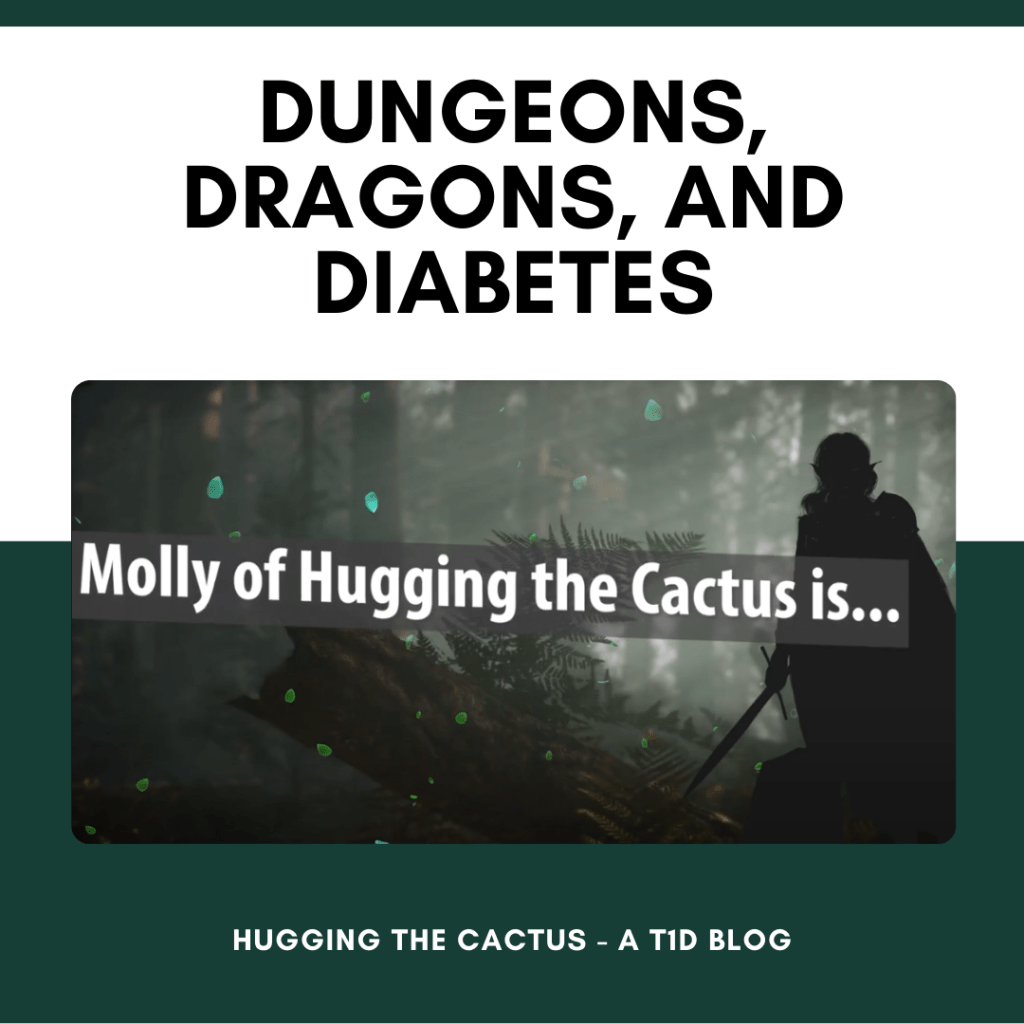
Click the image above to find out about the character I’ll be playing!

Over the course of the last year and a half or so, I’ve been involved in a handful of different DnD campaigns. All of these campaigns have varied drastically in terms of storyline, characters, and players, and to me, that’s the most exciting part about the game. Besides its ever-changing nature, I also enjoy that DnD allows me to explore my imagination – I get to come up with the entire backstory for original characters, and the creative writer within me is thrilled to be stretching those storytelling muscles that I’d long thought were atrophied.

But the best part of DnD, for me anyways, is how it’s brought me closer to friends and strangers alike. DnD has been a great way to meet new friends for the first time, as it’s something we can automatically talk about and refer to whether or not we’re actively playing a game. It has also strengthened my friendships with some of my coworkers from my last job who, like me, were newbies to DnD but willing to learn how to play during the pandemic because all of us generally like games and fantasy realms, and we were happy to have something to do virtually that wasn’t just another boring Zoom session.

And I can’t neglect to mention that DnD has been a wonderful escape from the reality of our world in the last couple of years. In DnD, the horrors going on in the real world don’t exist (unless you want them to, but nobody’s dared to do that in any of the games I’ve played). This means DnD is a nice mental break from not just the soul-sucking 24/7 news cycle, but it’s also a temporary vacation from diabetes. Any character that I’ve played in a campaign doesn’t have to worry about checking blood sugar or taking insulin injections before slaying bugbears, displacer beasts, or flameskulls. It might seem like an unconventional way to find reprieve from diabetes, but it’s a challenge to find something that can get me to stop thinking about my diabetes for even a short window of time. This is one thing that works for me and that makes me grateful for it.

So, coming full circle here and getting to the point of this blog post: I am participating in a new DnD campaign called Dungeons and Drams! The game runner (called the Dungeon Master) is actually an aforementioned former coworker and good friend of mine who delved deep into the DnD universe over the course of the pandemic. He’s combining his knowledge of the game with his extensive YouTube experience as a whiskey reviewer (hence the “drams” element to our game) to create the ultimate campaign that I’m honored to be part of. I’m joined by a few of his fellow whiskey YouTubers and I’ve got to say (shoving my obvious bias to the side here), the characters we’ve created are a thrilling combination of hilarious, badass, adventurous, and entertaining…so whether you’re a fan of DnD and/or drams of whiskeys, and the diabetes-related content that I feature here on Hugging the Cactus, you’re going to want to check this game and our channel out.

The adventure begins tonight, March 14, 2022 at 9:30 P.M. ET…looking forward to seeing you there.
Happy National Diabetes Awareness Month!

It’s that time of year again – National Diabetes Awareness Month!

Did you know that the blue circle is the universal symbol for diabetes? It represents the unity of the global diabetes community in response to the rising number of people affected by diabetes.

I’m not sure if it’s because I work for a diabetes organization now, but sheesh, this month seems to have arrived more suddenly than it ever has. I’d say it’s caught me off guard, but after literally months of preparing for it as part of my job, it’s really just got me marveling over how fast time flies.

It’s also got me reflecting on how I’ve participated in NDAM in the past. Previously, I’ve done daily postings on my Hugging the Cactus Instagram account and replied to various prompts throughout the four weeks here on the blog.

This year, I’m not so sure I have the bandwidth to dive so deeply into the spirit of the month – but that doesn’t mean I’m mentally checking out of it altogether.

Rather, I’m plan on being more intentional in my approach. Instead of replying to daily prompts (that, over the course of the month, start feeling like homework – in other words, an unenjoyable task), I’d like to post when I feel like I actually have something to say. I don’t want to post filler content, I want to post things that are meaningful and capture my feelings about diabetes, NDAM, and the broader diabetes community.

That’s not a knock on the everyday post inspiration that many members of the DOC take part in – I think it’s wonderful that they have fun with it and use it as a very effective way to raise diabetes awareness throughout the month. It’s just that for me, as someone who’s been part of digital NDAM activities for the better part of a decade (!!!) now, it’s time that I mix up my routine a bit and also step back so I don’t spend all of my mental diabetes energy on NDAM in lieu of my actual diabetes care.

Here’s to deliberate diabetes awareness and care this month!

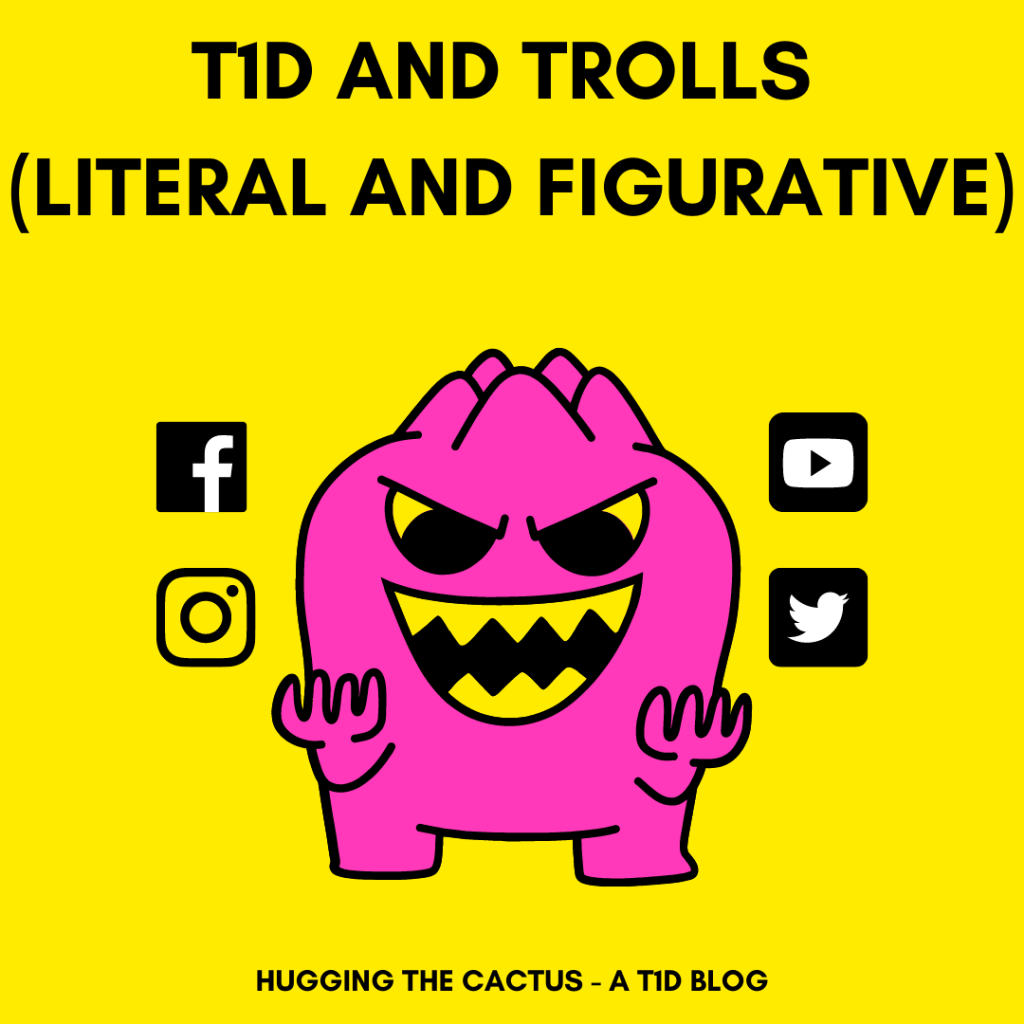
T1D and Trolls (Literal and Figurative)

Let’s talk about trolls.

No, not the cute ones from the 90s with the gems stuck in their bellybuttons and wild, vibrant hair.

I’m talking about two specific types: Internet trolls and in-real-life (IRL) trolls.

They’re not my favorite kind of people, I’m betting you’re not a fan of them, either.

This is what T1D trolls look like in my (admittedly strange) imagination.

I can’t tell you how many times trolls have made their presence known on my Instagram posts. It always goes a little something like this: I post a photo to my account and within 10 minutes, I’ve got some sort of comment on it that goes a little something like this (the following is an actual comment I got last week):

Just wanted to let you know that truly what people are posting about DIABETESTYPE1 cure is true. I write one of the doctors and got herbal medicine from him and truly I’m cured from DIABETESTYPE1. It’s real. Message the doc @herbalist.ebho

There are so many things obviously wrong with this comment that I almost don’t want to deign to explain it, but let’s go over them real quick. 1) Diabetes can’t be cured from freakin’ herbs. 2) No matter how many times someone puts “truly” into a comment, it doesn’t make it TRUE! 3) Why on earth does this person think I’d want to seek help from some random Instagram doctor that probably isn’t even a real doctor? And 4) Obviously, this person – or bot, because I’m sure it’s a bot account – is simply plugging type 1 diabetes into this comment. I can only imagine how many other accounts it trolls that focus on various other chronic conditions…

I deal with most of these comments by deleting and/or reporting them immediately, but this time, I decided to respond to the claims that some generic herbs could cure my diabetes. This is what I said:

“Oh yeah? Is it? Wow I can’t believe I never thought to message some random person to get cured from T1D! Thanks for your completely inaccurate message and typos, have a nice life! ๐Ÿ™‚

And of course, I never got a reply…because that’s how trolls operate.

But what to do when trolls come creepin’ into real life?

You know, the people who tell you that their distant relative cured their diabetes by consuming cinnamon? Or the people who assume that you caused your diabetes by eating too much sugar?

I wish there was a delete/report option for those comments, but instead, I try to turn them into educational opportunities. My initial approach is always gentle when I explain that these myths are not only incorrect, but they increase the stigma and misunderstanding of type 1 diabetes. More often than not, trolls turn into apologetic students who walk away with the facts…but every now and then, you encounter a stubborn one who just doesn’t seem to get it.

As frustrating as that can be, it’s okay. Trolls are gonna troll and you can’t always slow their roll (ugh, I know that was lame, please forgive me). So even though I feel like I’m going to hit the roof if I see one more stupid troll comment on my IG posts or encounter one other troll spewing diabetes myths, I can take solace in knowing that I can take back control of the comments by explaining why they’re wrong or (more satisfyingly) removing them altogether.

The Comparison Culture and How I Tune It Out

We all know that social media can be…damaging.

Scroll through Facebook, Instagram, or any other social network and 99% of what you see is the idea of “perfection”: Beautifully dressed and made-up individuals showcasing their gorgeous homes or families or possessions. Usually, some sort of caption will accompany the post and it might say something like “so blessed to do life with my dream partner” or “we just bought our first home, can’t wait to fill it with joyous memories” or some other gushing, effusive language that is followed by a series of exclamation points and emojis.

There’s nothing wrong with this…except for the fact that, obviously, people’s lives aren’t as “perfect” as they seem.

Life is messy, but we don’t get to see that side for many people on social media.

This is true not just about life events, but something as specific as life with diabetes.

I think that our community has gotten a lot better about it, but I used to see so many posts that showed “perfect” blood sugar graphs and “perfect” A1c readings.

And I used to obsess over these posts.

I’d wonder why I wasn’t achieving the same levels of success as these other individuals. I’d convince myself there was something wrong with me, and that I’d never have blood sugar graphs or A1c levels that were “good enough” to share online.

Between diabetes perfectionism and real-life perfectionism (Why aren’t I married yet? When will it be my turn to start a family? What’s wrong with me that I haven’t met all the other adult goals that so many of my friends have met?), I was starting to drive myself insane.

Social media was breeding a culture of comparison for me.

I couldn’t log onto an account without immediately comparing myself to the images I saw and the stories they told.

It’s taken time, and I’m not always good about it, but I’m learning to tune out the noise on social media and how to stop comparing myself so much to others.

So how did I start to unsubscribe to that culture of comparison?

For starters, I came to terms with the fact that I didn’t want to leave social media altogether. I like how it keeps me connected with family and friends on top of connecting me with individuals all around the world. I like how it functions as a support system when I need to consult my diabetes online community for wisdom and guidance.

But I knew that I needed to take a step back. So I started slowly and gradually: I removed the Twitter and Facebook apps from my phone, telling myself that if I really wanted to check the feeds for either, I could do so using my Internet browser. I also spent less and less time scrolling, a habit that was addicting to me because I wanted to see as much content as possible, but also one that I recognized as damaging because more content meant more comparisons to others.

The most important thing that I did, though (and continue to try to do) is repeat a few mantras to myself:

This is just one page of this person’s story.

You don’t know the whole picture.

You don’t want to be anyone other than yourself because you truly do love the people and things in your own life.

It might sound silly, but reminding myself that social media is designed to show off the “best” parts of our lives really did help me come to terms with the fact that I needed to stop comparing myself to everyone. Just like I have plenty of bad things that happen in my life, I have a hell of a lot more good, and just because I don’t choose to showcase everything on my feed doesn’t mitigate the good.

And one last thing that I’m trying to do? I’m simply trying to be happy for others who revel in their successes and choose to share them online. I’m also trying to pay closer attention to those who are brave enough to showcase their failures online, diabetes-related or not. In fact, it’s not uncommon for me to open up my Instagram app, scroll through my feed, and see the most “perfect”, straight-lined Dexcom graph followed by an “imperfect” topsy-turvy Dexcom graph. I’m training myself to react to the former graph not by comparing myself, but by feeling good for the person who posted it. And in terms of the latter graph, I also don’t want to compare myself to it (I’m not proud of it, but I’ve taken a look at “bad” graphs before and said OMG, my numbers are sooo much better), but instead offer words of encouragement or commiseration – because we’ve all been there.

The comparison culture is toxic. It’s taken time for me to realize just how much it was affecting me, but now that I have, I’m glad because removing myself from it will help enrich the relationships I have online and in real life. When it comes to diabetes specifically, it’s difficult enough managing my own, and that much harder when I compare how I take care of it to how other people with diabetes live their lives. Learning to appreciate our diabetes differences instead of stressing over them makes it so much easier to support and uplift one another when we need it most.