You have a new message in MyChart! Please sign in to read your message.”
Whenever this notification pops up in my inbox, I’m filled with a sense of dread because it usually means one of 3 things: 1) I owe money to one of my doctors’ offices, 2) I have an upcoming medical appointment that I forgot about, or 3) There’s a problem with one of my prescriptions and my doctor’s office needs more information from me.
I never would’ve accounted for a fourth possible scenario, one that makes me feel good as a patient, being remotely likely…until it actually happened to me.
The message in question was from my diabetes nurse practitioner, and she wrote to me asking if I could recommend any diabetes support groups to another patient with T1D who was roughly my age. She explained that she thought to ask me because she knew that I have this blog/platform and remembered that I’ve spoken about how the diabetes community has greatly helped me over the years.
Upon reading the message, I immediately felt flattered that she thought to ask me. I typed up a thoughtful reply, including several different resources that might meet the patients’ needs, and sent it, feeling totally awestruck over how trust was definitely a two-way street in this particular HCP/patient relationship. It means a lot to me that my NP trusted my recommendations enough to not only want to pass them along to another patient, but to reach out and ask me for them in the first place. While my current overall healthcare team is lacking in some major ways – I won’t get into details on that, but let’s just say the search for a couple of new physicians is one that I’ll reluctantly embark on soon – this is reassurance that I do still have allies working for (and with) me. And that’s a really great feeling.
This blog post was originally published on Hugging the Cactus on December 4, 2020. I’m sharing it again today because while it may not seem obvious, diabetes can make relationships of any type difficult. Get my advice on how to help friends and loved ones better understand diabetes and your needs below.
Diabetes can interfere with so many aspects of daily life…including friendships and relationships with others.
I’m an extremely fortunate person: I’ve never had my diabetes be a “deal-breaker” for a friendship or a relationship. I’ve never had much difficulty in explaining it to others or receiving support from friends when I’ve needed it. Of course, the level of support that I get from people in my life with T1D is much different compared to the support I get from people in my life without it, but both types of support are invaluable.
Recently, I had an Instagram follower ask me for my advice on how to help friends understand T1D: what it’s like and what’s appropriate to do/say to a person with diabetes. She expressed her frustration with a friend who doesn’t seem to understand that just because she has diabetes it doesn’t mean that she can’t enjoy sugary treats from time to time. So in response to her anecdote, I decided to round up my five best tips on how to navigate T1D and friendships/relationships in which there’s a lack of understanding and a little too much judgment.
#1: Be open, honest, and willing to answer questions. In almost two-and-a-half decades of life with diabetes, I’ve learned that this is the most important thing I can do when meeting new people and forging friendships/relationships. It’s not like my diabetes is the very first thing I say to people (“Hi, I’m Molly and I have diabetes” sounds like a South Park gag)…but it is something that I make sure to casually cover early on in the relationship. Opening the door to communication about diabetes from the get-go seems to have helped me avoid tricky situations in which I have to spend too much time correcting misunderstandings about life with diabetes and not enough time on fostering my connection with an individual.
#2: Show all aspects of life with T1D. My philosophy is to never hide any part of my diabetes from friends. I let them watch me when I do fingerstick checks, site changes, and more. I involve them when I need help correcting a low blood sugar or need to take a moment to do a bolus calculation. I’ve found that this really helps my friends feel included and they tend to show more interest and genuine curiosity when I do my “diabetes stuff” around them. It creates natural learning experiences for my friends and they get to see firsthand just how much work it can be to take care of my diabetes.
about:blank
#3: Tag along to endocrinologist appointments. I understand that this might not be possible right now in this “new normal”, but in the past, I’ve had my significant other come with me to endocrinology appointments. The most memorable experience was seeing a diabetes educator with my significant other so I could be retrained on how to use an emergency glucagon kit, and so he could learn for the first time. It was really eye-opening for my partner, and ever since then, I’ve encouraged others to invite their loved ones or the person/people they live with to attend appointments every now and then. And hey, since so many doctors’ visits are virtual these days, maybe it’ll be even easier for more people to tag along to these appointments than before.
#4: Make an introduction to the DOC. Some of my friends are more social media savvy than others, so for those who have shown interest, I’ve introduced them to the diabetes online community on Instagram. There are sooooo many profiles there ALONE – forget Facebook/Twitter/other diabetes blogs – that do an incredible job of shedding light on the significant and mundane (and everything in between) parts about daily life with diabetes. These accounts have helped them truly get diabetes in a way they hadn’t previously and I think it’s made my friendships stronger, healthier, and judgment-free.
#5: Correct misconceptions – gently. Even my closest friends, or the ones with the best of intentions, have slipped up now and then and said something to my face that is simply not true about diabetes. And that’s okay, they’re not perfect (and they certainly know that I am not). When this happens, I use it as a teaching opportunity and let them know why what they said is wrong or factually incorrect. I find that the gentle, patient approach helps to reinforce whatever it is that I’m telling them, so at the end of the day, it’s a win-win for all parties.
Growing up, I had a pretty normal (and lovely) childhood, despite my diabetes. My parents always made me feel supported and equipped with the tools I needed to advocate for myself, even at a young age. They played an instrumental role in educating my relatives, teachers, friends, and friends’ parents as to what my diabetes looked like and the ways it might make me different from the other kids – different, but never excluded from anything because it didn’t necessitate that.
Thanks to my parents’ help and the fact that they fostered self-advocacy skills for me early on, I almost never had a problem with my peers when it came to my diabetes. In fact, I’m lucky that just about all of my friends were very understanding and accommodating of my diabetes, even at young ages. It’s not often that I think about the ones that weren’t, but when I do, I can’t help but label them as my childhood “dia-bullies”.
You might be surprised to learn what I wish I’d said to my dia-bullies.
I dealt with two of those kinds of kids growing up: Once in elementary school, and again in eighth grade. In both scenarios, these dia-bullies were cruel about my condition. They often told me the things that I couldn’t and couldn’t do – whether it be participate in gym class, eat a shared classroom treat for a birthday, or maintain any semblance of a conventionally healthy lifestyle. These comments were infrequent, but when they were vocalized, they hurt…and obviously had quite the impact on me as I remember them all these years later.
Back then, I “dealt” with these comments by not responding to them in any way, shape, or form. I didn’t tell my teachers or my parents what was said and even though I knew how to talk about diabetes by then, I didn’t quite have the voice to stick up for myself and tell these dia-bullies that they were wrong.
But now? I have a voice. A powerful one, at that. So as I reflect on what was said to me when I was younger, I can’t help but wish I’d said this very simple phrase to my dia-bullies:
You’re wrong.
I wish I’d told them that there judgments were not only incorrect, but harmful. I wish I could tell them to just watch as I moved throughout elementary, middle, and high school at the same pace as everyone else, participating in the same sports, extracurriculars, and honors classes, seldom missing out on anything due to diabetes. And I wish I could’ve told them that those words would stick with me for years to come, motivating me to prove to myself and the world that diabetes does not mean living within limits.
Most interestingly of all, a small part of me does wish I could tell them…thanks, I guess, for being an unexpected source of inspiration to conquer my diabetes. Isn’t it funny, the strange places you can get encouragement from?
Last week, I shared that I was going on my first overnight trip since being fully vaccinated. I also explained that it was a very special trip that I was taking: It was my childhood best friend’s bachelorette weekend!
Fun fact: We took hundreds of photos this weekend and my diabetes devices aren’t visible in any one of them. This was done on purpose: I just didn’t feel like having my devices out on display for all to ogle at.
As much as I was looking forward to it, I was also a little apprehensive because packing for trips with diabetes can be tricky. I’ve learned, courtesy of too many mistakes made over the years, that it’s extremely important to pack not just back-up supplies, but back-ups for the back-ups, and maybe even then some extra extra extra back-ups. It involves lots of careful thinking and planning to ensure that nothing is accidentally left at home.
And somehow, I managed to remember basically everything! I had plenty of supplies on me at all times and was more than adequately prepared to treat any scary high or low blood sugars.
But while I’m pleased to share that I didn’t need any single one of my back-ups over the weekend, I’m less than thrilled to divulge that my blood sugars were pretty rotten the entire time. I’m mostly to blame for this…it’s because of the food and beverage choices that I made. For example, foods like quesadillas and pizza are rare indulgences for me, and I not only consumed both, but I ate them in the same day. What was I thinking?! They can be tough enough to bolus for on a normal basis, but throw alcohol into the mix (I confess that I was, indeed, drinking) and I basically set myself up for failure.
In hindsight, I should’ve opted for lower carb drinks like vodka with seltzer water or whiskey mixed with diet soda. But I wanted to be like everyone else and enjoy a margarita or two and have the pretty pink drinks that we made at the Airbnb. And maybe I could’ve made smarter food choices, but truly, I didn’t have many options because we chose to eat at one restaurant with a limited menu and order takeout from a pizza joint that didn’t have anything like cauliflower crust.
To be fair to myself, I was carefully watching my blood sugar all weekend long. I was running temp basal increases. I was stacking insulin to bring my high levels down. I was drinking plenty of water and I was avoiding snacking on the delicious, tempting treats that all of the girls brought – I didn’t even eat one of the chocolate mocha cupcakes that I’d baked. And I did have great blood sugars overnight, which I had been really worried about. I was nervous about my CGM alarming and waking up everyone when we were all trying to sleep, but that never happened because I was in the low 100s for most of the night…much to my relief. (Side note: Even if I had gone low, I wouldn’t have been worried about getting support/help if I needed it. Basically, three-fourths of the guests are medical professionals so…I couldn’t have been in better hands!)
So yeah, my blood sugars could’ve been better this past weekend. But you know what? There are hundreds of times in my life that my blood sugar could’ve been better. It could, pretty much, always be better! For me, though, diabetes just wasn’t my main focus. My friend was my focus all weekend long. I wanted to celebrate her and this next chapter in her life and put my diabetes on the backburner.
And I know for a fact that the bride-to-be had an incredible time. We laughed as we told stories, we played games, we enjoyed yummy food, we visited a beautiful winery, and most importantly, the other ladies and I honored my friend and made memories together. That’s what matters, and as hard as it might try to interfere, diabetes can’t take that away from me.
This blog post was originally published on Hugging the Cactus on March 20, 2019. I’m sharing it again today because as tough as diabetes can be for me, it can be even harder on my loved ones who can’t do anything about it – especially when diabetes struggles turn into emotional struggles. Read on for my opinion on how you can help your loved one with diabetes overcome difficulties.
If you have a partner/spouse, relative, or friend with type one diabetes, it can be difficult to know how to best support that person when they’re experiencing struggles related to diabetes. You might try to offer a shoulder for your loved one to lean on, but that might not always work. Your loved one might push you away or continue to internalize their issues. It can create turbulence in your relationship with one another, and it’s frustrating all around.
So what can you do?
Emotional support is incredibly important when it comes to helping a loved one with diabetes get through a difficult time.
As someone who both has T1D and loves others with T1D (my mom, my aunt, many good friends), I believe that the best way to react is to just listen. Whenever I’ve faced serious struggles or emotional turmoil due to diabetes, nothing has helped me quite like a person who spares time for me to listen to me. Whether I just need to spew out an angry diatribe (LOL at the pun), cry about my problems, talk through issues, or seek advice, it’s worked wonders on me to know that I have individuals in my life who are willing to listen to me. Let me emphasize the listen part once again – listen, not tell me that I’m right or wrong, or offer advice (unless I specifically ask for it).
I get it; sometimes, it’s easier said than done to just listen. A few people I know are so determined to help me fix the problem that they can’t help but react emotionally along with me when I’m dealing with diabetes drama. But trust me, that usually heightens (rather than alleviates) the tension.
It’s all about teamwork. Give and take is involved. Often, enormous amounts of patience are required. Sometimes, it takes awhile for the struggles to subside. But one thing that is certain is that your loved one with diabetes will always thank you and be grateful for your support in their time of need. It’ll strengthen your relationship as well as function as proof that diabetes can’t break your bond, no matter how hard it might try.
Diabetes can interfere with so many aspects of daily life…including friendships and relationships with others.
I’m an extremely fortunate person: I’ve never had my diabetes be a “deal-breaker” for a friendship or a relationship. I’ve never had much difficulty in explaining it to others or receiving support from friends when I’ve needed it. Of course, the level of support that I get from people in my life with T1D is much different compared to the support I get from people in my life without it, but both types of support are invaluable.
Recently, I had an Instagram follower ask me for my advice on how to help friends understand T1D: what it’s like and what’s appropriate to do/say to a person with diabetes. She expressed her frustration with a friend who doesn’t seem to understand that just because she has diabetes it doesn’t mean that she can’t enjoy sugary treats from time to time. So in response to her anecdote, I decided to round up my five best tips on how to navigate T1D and friendships/relationships in which there’s a lack of understanding and a little too much judgment.
Some of my favorite conversations about diabetes with my friends have taken place on a comfy couch with a good glass of wine, making this a great photo for this post.
#1: Be open, honest, and willing to answer questions. In almost two-and-a-half decades of life with diabetes, I’ve learned that this is the most important thing I can do when meeting new people and forging friendships/relationships. It’s not like my diabetes is the very first thing I say to people (“Hi, I’m Molly and I have diabetes” sounds like a South Park gag)…but it is something that I make sure to casually cover early on in the relationship. Opening the door to communication about diabetes from the get-go seems to have helped me avoid tricky situations in which I have to spend too much time correcting misunderstandings about life with diabetes and not enough time on fostering my connection with an individual.
#2: Show all aspects of life with T1D. My philosophy is to never hide any part of my diabetes from friends. I let them watch me when I do fingerstick checks, site changes, and more. I involve them when I need help correcting a low blood sugar or need to take a moment to do a bolus calculation. I’ve found that this really helps my friends feel included and they tend to show more interest and genuine curiosity when I do my “diabetes stuff” around them. It creates natural learning experiences for my friends and they get to see firsthand just how much work it can be to take care of my diabetes.
#3: Tag along to endocrinologist appointments. I understand that this might not be possible right now in this “new normal”, but in the past, I’ve had my significant other come with me to endocrinology appointments. The most memorable experience was seeing a diabetes educator with my significant other so I could be retrained on how to use an emergency glucagon kit, and so he could learn for the first time. It was really eye-opening for my partner, and ever since then, I’ve encouraged others to invite their loved ones or the person/people they live with to attend appointments every now and then. And hey, since so many doctors’ visits are virtual these days, maybe it’ll be even easier for more people to tag along to these appointments than before.
#4: Make an introduction to the DOC. Some of my friends are more social media savvy than others, so for those who have shown interest, I’ve introduced them to the diabetes online community on Instagram. There are sooooo many profiles there ALONE – forget Facebook/Twitter/other diabetes blogs – that do an incredible job of shedding light on the significant and mundane (and everything in between) parts about daily life with diabetes. These accounts have helped them truly get diabetes in a way they hadn’t previously and I think it’s made my friendships stronger, healthier, and judgment-free.
#5: Correct misconceptions – gently. Even my closest friends, or the ones with the best of intentions, have slipped up now and then and said something to my face that is simply not true about diabetes. And that’s okay, they’re not perfect (and they certainly know that I am not). When this happens, I use it as a teaching opportunity and let them know why what they said is wrong or factually incorrect. I find that the gentle, patient approach helps to reinforce whatever it is that I’m telling them, so at the end of the day, it’s a win-win for all parties.
They didn’t say that to me, but they didn’t have to…it was written in bold all over their faces.
Recently, I dined outside with people who are close to me (I’m not going into specifics as to who exactly they were to maintain some level of discretion). I was explaining to them that come the winter season, I probably won’t be dining out much out of COVID concerns.
I wish people would spend less time judging others and more time taking the proper precautions to help protect themselves and their loved ones.
I’m just not ready to dine indoors yet. In fact, since March, I’ve only set foot into a physical store, dwelling, or other establishment a dozen times. For me, the risk associated with spending time inside when it’s completely avoidable just isn’t worth it.
But what sucks about this is the judgment I receive from others. Just like I did in this scenario, the looks on their faces make me feel like I have to defend myself. I wanted to scream at them, “you try having a chronic illness and dealing with it during a global pandemic!”…but of course, I’d never do such a thing, and I’m very glad that they don’t have to worry about that.
I do wish, though, that they – as well as other people who are quick to judge individuals like me who are scared and overly cautious these days – would use a little more grace and humility when conversing with those of us who are high risk.
Please try to put yourself in my shoes.
Please understand that not only am I considered high risk, but I’m in direct contact with loved ones who are also considered high risk.
Please know that, yes, I do have a desire – a very strong one – to get back out there and do “normal” things.
But think about the things holding me back…a chronic condition that requires a lot of my time and energy, for starters.
And think about how there are millions of other people like me who share this great responsibility for an underlying health condition that they didn’t ask for on top of a great fear.
This blog post was originally published on December 17, 2018 at Hugging the Cactus. I decided to repost it today because this is something that will ALWAYS be relevant – in fact, someone just said to me earlier this month that they are sorry I have diabetes!I wish people would stop apologizing for something that nobody can change, and something I accepted long ago…read on for more about why I never want people to feel sorry for me because I have diabetes.
Today’s blog post is going to be short and sweet, and about a subject that I think every person with diabetes deals with whenever they tell someone new about their diabetes.
It doesn’t matter how diabetes comes up in conversation. Whether it’s in a joking, serious, educational, happy, sad, or angry manner, the person I’m talking to almost always says…
“I’m sorry.”
I’m not sorry that I have diabetes, so you shouldn’t be, either.
Sometimes, I think it’s because society has instilled this weird reflex in people to apologize for something that they didn’t do. Other times, I think it’s because people just don’t know how else to respond to something that may be sobering or grounded in reality. But the simple fact of the matter is…
People need to stop apologizing to me, and other people with diabetes, for having it.
Here’s why:
It doesn’t make sense.
We weren’t given a choice – it’s a simple truth that we’ve learned to accept.
It makes me feel strange, because it’s almost like the other person is taking accountability for my diabetes.
I believe that human beings apologize too much, in general, and it diminishes apologies when they matter most or are most sincere.
I’m not sorry that I have diabetes, so why should someone else be?
While I genuinely empathize with and appreciate people who apologize as a knee-jerk response, I’m just here to gently tell them that it isn’t necessary. Save “I’m sorry” for times that it’s warranted, and not for something like having diabetes, a matter in which no one has a choice.
“Full disclosure: I have diabetes, so I have to be extra careful and wear a mask and gloves.”
“Full disclosure: I have diabetes and it can be tricky for me to handle it when I’m drinking alcohol.”
“Full disclosure: I have diabetes but I love baking treats using regular sugar instead of sugar substitute.
“Full disclosure” – what is it about this phrase that has made me utilize it several times when meeting new people in the last couple of months?
The term itself means to reveal the complete, factual truth to an individual or individuals regarding a particular matter. But why have I associated it with my diabetes? Why has it become a conversation crutch for me in which I rely on it to introduce my diabetes?
Hey, Cactus Huggers…did you know that I have…DIABETES?!
I guess that’s because I’m trying to let the person or people that I’m talking with know that my diabetes is something that I feel I have to reveal to them in my own time. I want others to know that a lot of the time, my diabetes makes my decisions for me, particularly in cases that my blood sugar might be directly affected because I did or did not do something.
I also depend on the phrase as a bit of a segue – it transitions the topic of conversation to diabetes for at least a couple of minutes as I answer any questions that someone might have for me about it. It’s casual enough to reassure the other person that it’s no big deal, but it’s also a contextual clue that I’m about to disclose an important tidbit of information about myself.
I’ve always been interested in the language of diabetes – the words and terminology that are innately part of this chronic condition – and I’m well aware of the power of using certain words over others (e.g., I try to use “person with diabetes” instead of “diabetic” because it’s important to separate an individual from the condition). So I’m adding “full disclosure” to my personal diabetes dictionary because of my realization that it’s become a mechanism for me in conversation that I can use to smoothly introduce my diabetes.
Six years and one day ago, my maternal grandfather passed away. He was 87 years old and lived a very full life, but his passing felt sudden to all of his family members who simply believed that we had more time with him.
In the immediate days following his death, my parents, brother, aunts, uncles, and cousins experienced a wide array of emotions, as well as physical side effects from overwhelming grief. I had some of the highest blood sugars of my life during this time, and I also came down with some sort of fever that left me boiling hot one minute and head-to-toe shivering the next.
I remember that getting myself ready for his wake was a real process – I was collapsed on the floor just outside of the bathroom, waving a hair dryer not just on my head, but also all over my body because I felt so frigidly cold. Little did I know, my blood sugar was also well over 400, but even if I’d known that fact sooner, I probably wouldn’t have cared very much.
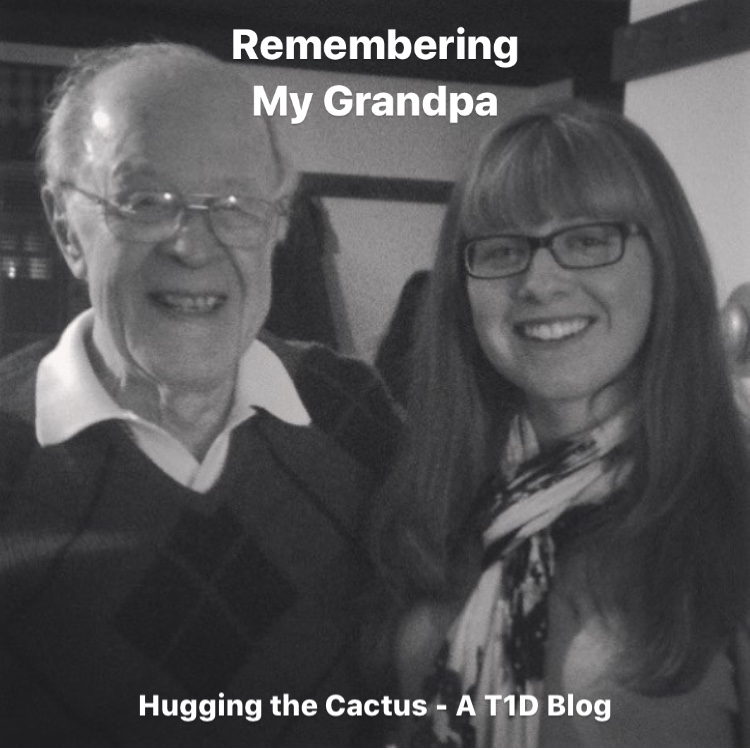
A photo from my Grandpa’s last birthday with us.
Anyways, the intent of this post isn’t to remember a truly heart-wrenching period of my life. It’s to help me remember my grandpa, and catch him up on everything that’s happened since he left us. I thought it’d be most appropriate to do this in the form of a letter.
Dear Grandpa,
I have so much to tell you. But let me start with an apology. I’m sorry that I didn’t appreciate you more when I was younger. I’m sorry that I didn’t try harder to talk to you and hear your many stories firsthand. I always respected you throughout my youth and teenage years, as my parents instilled upon me early on to respect my elders. And even in childhood, I knew you were the elder to respect; after all, I was convinced that you single-handedly ended WWII. What’s more respectful than that? Anyways, I digress – the point is that I wish I made more of an effort to learn more from you and I’m sorry that I’ll never get a chance to make up for that.
You probably already know most of what I’m going to tell you. We lost Zuzu the same year we lost you, and I’m sure she’s with you in heaven now, but then we gained Clarence a couple of years ago and I think you would get such a kick out of him. There’s been a few more losses in our family, too, but many more gains of all kinds, and I know that in a way, you were there with us for those occasions and everything in between.
You also probably already know that since we lost you, I graduated college and started my career. Weird, right? I also started a blog about diabetes, and really, it’s become a much bigger part of my life than it ever was before. I would love to see your eyes widen in awe at our diabetes technology and how advanced it has become over the years. (I remember how amazed you used to be when we showed you our computers and early-model eBook tablets, I can only imagine your reaction to medical technology!)
As I sit here and type this and marvel at how much (and how little) has changed since you left, I remain grateful for the fact that you were a big part of our childhoods (“our” meaning my brother’s and my cousins’ childhoods, as well as mine). I also take comfort in the fact that just because you’re not physically here to witness all of this stuff, you’re here in our hearts and you’re with us in that manner for every step in our journeys. I know that when I’m having a tough diabetes day, you’re one of the guardian angels looking out for me and helping me recover from it.
And I also know that you’d be proud of me for what I’ve accomplished so far in life, and for me, that’s more than enough motivation to keep going, fighting, and working hard to beat diabetes and be successful in other arenas, too.




 Hugging the Cactus