I’m Proud of my Diabetes Story

“Pride” isn’t exactly the first word that comes to mind when I think of my diabetes. In fact, a whole slew of other nouns and verbs top my list of words that I associate with diabetes, including but not limited to: strength, resilience, acceptance, guilt, anger, worry, identity…

But I’m not writing this post to focus on those other words – pride is the one I want to talk about here, and I want to explain why I’m proud of my diabetes story.
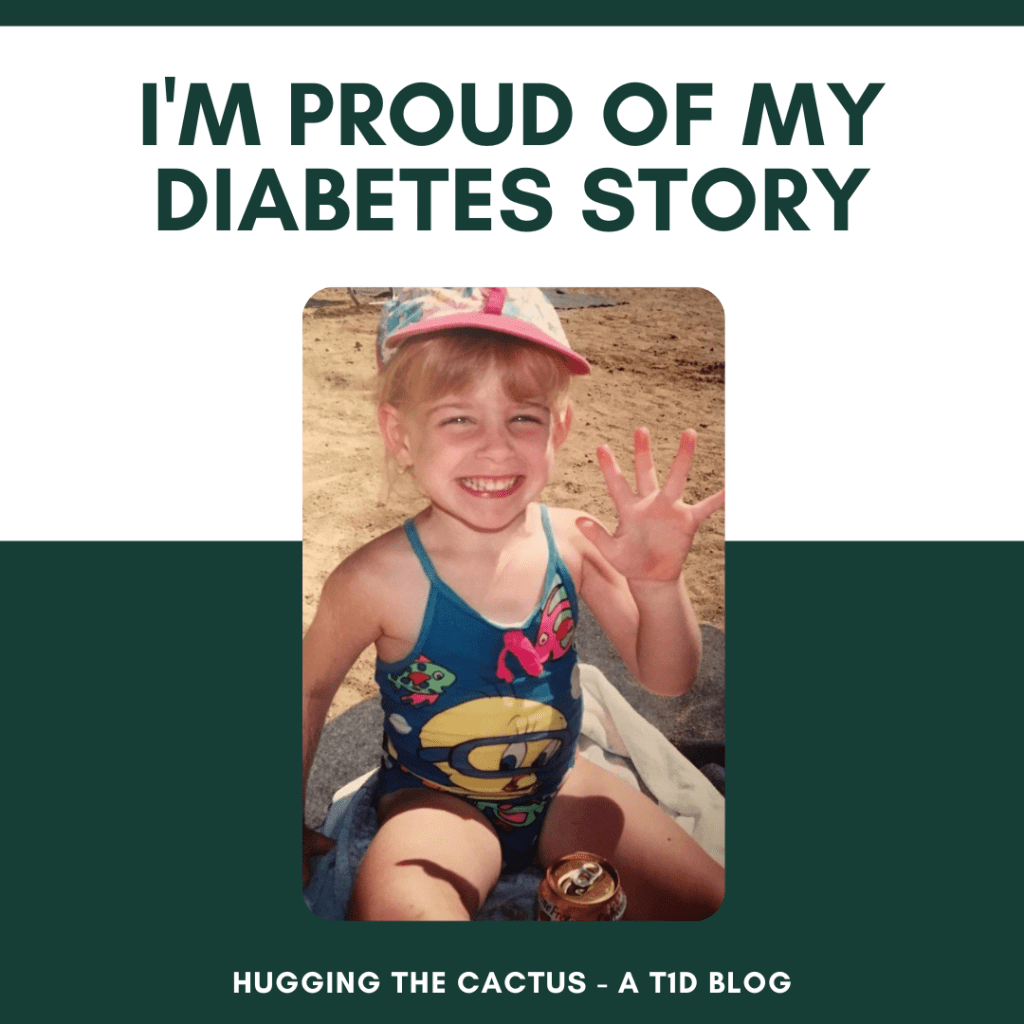
You can’t tell that the little girl (me about 23 or 24 years ago) in this picture has type 1 diabetes. The only clue, perhaps, is the Diet Coke can you can just barely see.

Diabetes has always been part of my life; actually, from the moment I was born. This is because I have family members who live with type 1 diabetes, just like me. I don’t really remember what life was like before my own diagnosis, and I’m grateful for that because I never felt like it made a dramatic disruption (well, besides for making its presence known within my body on Christmas Eve, but I was four years old at the time and the holidays were definitely never soiled for me because of diabetes).

As I reflect on what it was like to grow up with diabetes, I also find myself appreciative of the fact that I’m hard-pressed to find any actual evidence of it besides doctors’ records. I’ve flipped through my parents’ photo albums countless times over the years and there’s not one photograph of me laying in a hospital bed, injecting myself with insulin, or showing any signs of diabetes except for maybe the stray Diet Coke can or blood sugar meter in the background of a picture. That’s just further proof that my diabetes was never the focus, it was more so about me living and experiencing a totally normal, loving childhood.

All that makes my sudden entrée into the diabetes community, beginning in my young adulthood, that much more surprising. The transition from living under my parents’ roof to suddenly being on my own in college was, in a word, jarring – so peer support was crucial for me in order to navigate this change successfully. It didn’t happen overnight, I had heaps of help along the way, and it was far from easy, but in my mind I’ve done a good job of handling my diabetes and all the responsibilities that come with adulthood in the last decade.

And that’s what I’m proud of. I’m proud of myself for getting to this part in my journey, the part where I feel well-equipped to live a life uninhibited by my diabetes. I’m proud that I’m able to talk about my diabetes experience with a sense of confidence and capability. I’m proud that I’ve learned how to advocate for myself in various settings, whether it’s with my healthcare team or in the workplace. And I’m definitely proud of myself for the way I talk about my diabetes story: It contains chapters that are unfiltered and authentic to me, and I think that they illustrate how I came to accept my diabetes long ago and use it as a source of courage in my daily life.

I hope that other people with diabetes can also find a similar sense of pride in their own experiences with this chronic condition.
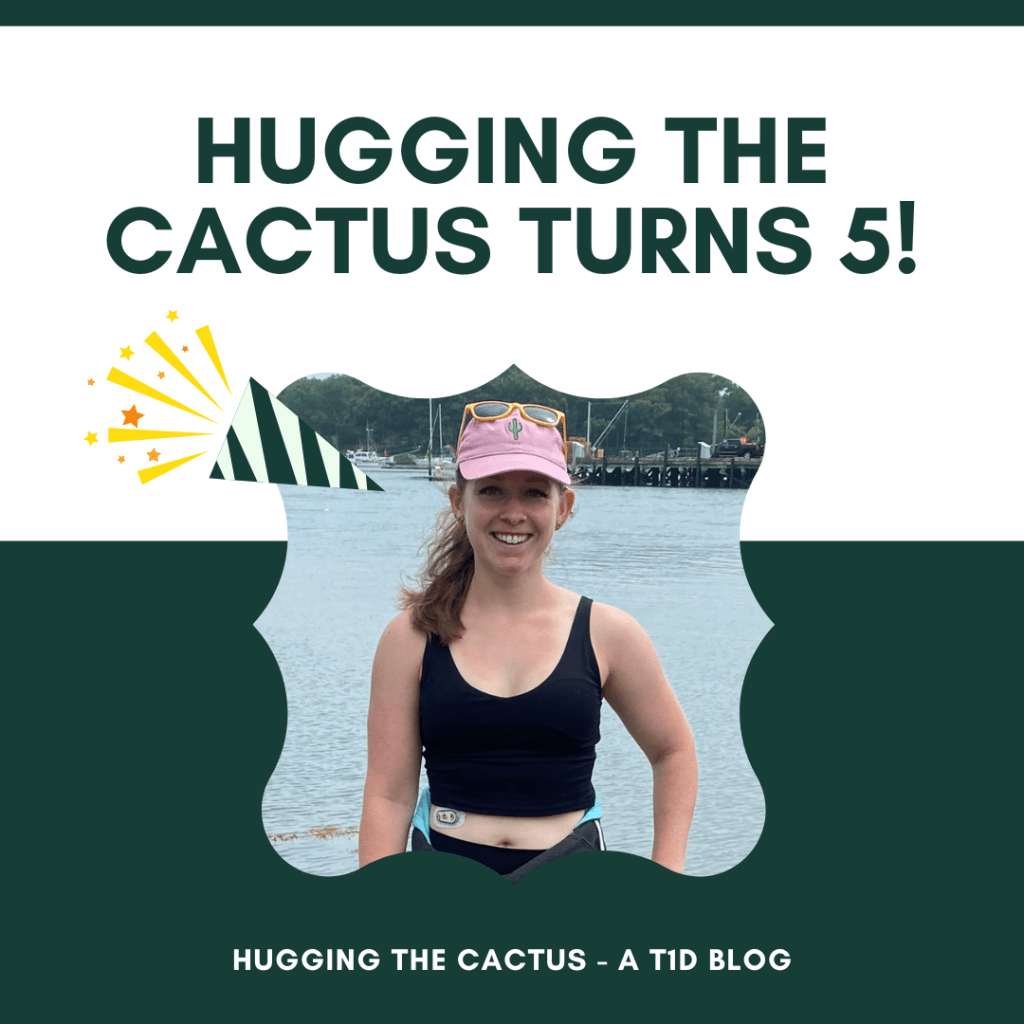
Hugging the Cactus Turns 5!

Yesterday, October 4, 2022, marked this blog’s fifth birthday.

How wild – five whole years of writing on this blog, connecting with the diabetes community at large, and gaining invaluable insights from fellow people living with diabetes.

Proudly donning my cactus cap and diabetes devices.

It’s a humbling experience. Any time someone tells me that they’ve read my blog, I’m truly honored that they’ve taken the time to check out my little passion project. And when someone visiting this site turns into a neat opportunity, such as appearing on a podcast, I’m beyond thrilled and appreciative that I get to use other media to reach out to our community.

When I think about where I was five years ago, I marvel over how much has changed not just for me, but for the world. We’ve experienced a global pandemic. We’ve undergone times of enormous celebration, as well as those of great contention. It’s kind of an imperfect metaphor for what it’s like to live with diabetes – it’s filled with ups and downs, triumphs and tribulation – and it takes strength, determination, and resilience to get through it all.

My plan today is to quietly celebrate that, as I reflect on my blog’s birthday as well as the true privilege I have to be able to work professionally within the diabetes space. I am proud of Hugging the Cactus. I am proud of the nonprofit I work for, which has recently experienced its own rebirth into The Diabetes Link. I am proud of all the people with diabetes in my life who live courageously and healthily with diabetes.

And I’m proud of myself for my blog’s milestone, as well as my nearly 25 years of life with diabetes.

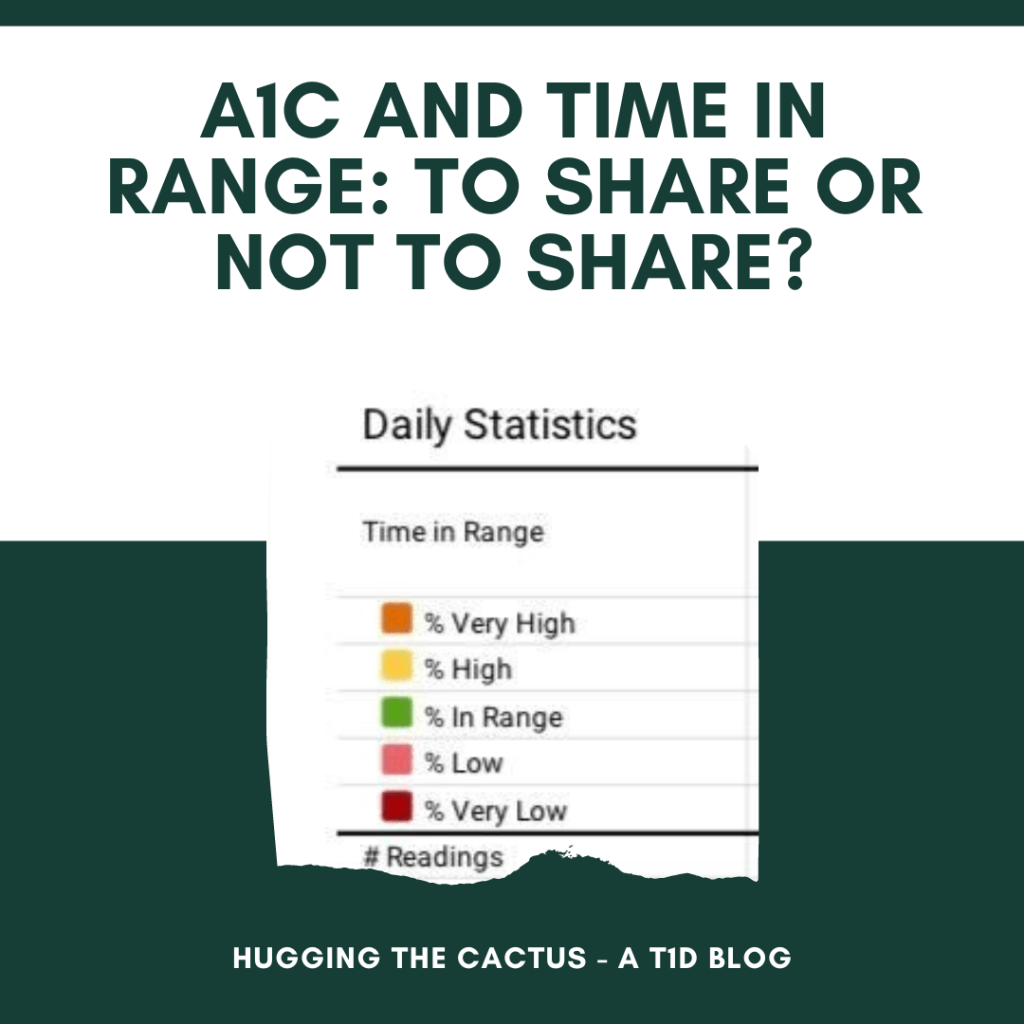
A1c and Time in Range: To Share or Not to Share?

“A1c: Also known as Hb1c or hemoglobin A1c, this is a test that is conducted every 3 months (or as requested) by an endocrinologist. A patient gets blood drawn to determine the average amount of glucose concentration in the blood during that 3 month period. The result of this test is a percentage amount, with 5% being an average result for a non-diabetic individual.”

This is the definition of A1c that I’ve shared in the diabetes dictionary section of Hugging the Cactus, and while of course the meaning and purpose of an A1c test will never change, one thing certainly has – and that’s the question of whether or not it’s the gold standard metric that indicates diabetes management.

That’s because A1c has a little competition called time in range. The concept is exactly what it sounds like: It’s an indicator of the amount of time a person with diabetes has their blood sugar within their preferred range, and it can best be captured by a percentage (e.g., I spent 70% of my day yesterday in range, with 30% of my readings either lower or higher than my ideal range).

While these two metrics vary from one another in how they are captured and analyzed, they do have one thing in common for a person with diabetes…is it a data point to share with others outside your healthcare team, or is it something to keep to yourself?

To share or not to share A1c and/or time in range…that is, indeed, the question.

Above is a screenshot from my Dexcom Clarity app. Note that you can see some of the information it captures, but you can’t see any of my personal percentages because I prefer not to share that with others.

The answer is personal and unique to every individual with diabetes, and for me, I keep it to myself in both cases. I’ve never felt comfortable opening up about my A1c or time in range online or in person. I think that’s mostly because I struggle with comparing myself to others. I do my best not to, but I can definitely turn diabetes into a competition that I internalize at all costs because I don’t want other people to know that sharing about these data points makes me deeply uncomfortable.

It’s how I am, how I’ve always been, and likely how I’ll be for quite some time. I’m curious to discover whether or not starting the Omnipod 5 will impact that at all, seeing as I have high hopes that the system will greatly increase my time spent in range as well as lower my A1c. But for now, I’m content with keeping these diabetes numbers to myself, and will aim to get better about telling people that I prefer not to discuss either.

Happy Mail

It arrived on a seemingly ordinary Wednesday, during a week in which I really needed a pleasant surprise.

I opened my front door to take my pup out to do her business when I noticed a large package on my front steps.

I wasn’t expecting anything to come in the mail, so I eagerly tore into it once my dog and I returned indoors.

And this sight was before me:

Violet is just as curious and excited about the Omnipod 5 as I am!

Yup, I’m the proud owner of an Omnipod 5 – finally!

I won’t be starting it until early next month, though. And I’ve got good reasons to delay it: 1) I’m traveling a decent part of August and I know from experience (or shall I say, my dear mom’s experience) to never try new diabetes technology when you’re out of routine, 2) I have about a month’s worth of old pods to use up before I officially switch over – I can’t imagine not using up my full supply just so I can get started on the new system faster. As I’m sure you must know by now, diabetes supplies are extremely expensive and I am diligent about using up every last pod, CGM sensor, and of course, insulin vial, before it goes into the trash.

While it’s a bit of a tease to know that automated insulin delivery is literally just feet away from me right now, it’s mostly very exciting to know that I have this to look forward to in the coming weeks. It’s nerve-wracking to go on new d-tech, yes, but the rave reviews of the Omnipod 5 have far outweighed any anxieties I have about starting the system.

And once I do, you can bet that I’ll be blogging about it!

What I Wish I’d Said to My Dia-Bullies

Growing up, I had a pretty normal (and lovely) childhood, despite my diabetes. My parents always made me feel supported and equipped with the tools I needed to advocate for myself, even at a young age. They played an instrumental role in educating my relatives, teachers, friends, and friends’ parents as to what my diabetes looked like and the ways it might make me different from the other kids – different, but never excluded from anything because it didn’t necessitate that.

Thanks to my parents’ help and the fact that they fostered self-advocacy skills for me early on, I almost never had a problem with my peers when it came to my diabetes. In fact, I’m lucky that just about all of my friends were very understanding and accommodating of my diabetes, even at young ages. It’s not often that I think about the ones that weren’t, but when I do, I can’t help but label them as my childhood “dia-bullies”.

You might be surprised to learn what I wish I’d said to my dia-bullies.

I dealt with two of those kinds of kids growing up: Once in elementary school, and again in eighth grade. In both scenarios, these dia-bullies were cruel about my condition. They often told me the things that I couldn’t and couldn’t do – whether it be participate in gym class, eat a shared classroom treat for a birthday, or maintain any semblance of a conventionally healthy lifestyle. These comments were infrequent, but when they were vocalized, they hurt…and obviously had quite the impact on me as I remember them all these years later.

Back then, I “dealt” with these comments by not responding to them in any way, shape, or form. I didn’t tell my teachers or my parents what was said and even though I knew how to talk about diabetes by then, I didn’t quite have the voice to stick up for myself and tell these dia-bullies that they were wrong.

But now? I have a voice. A powerful one, at that. So as I reflect on what was said to me when I was younger, I can’t help but wish I’d said this very simple phrase to my dia-bullies:

You’re wrong.

I wish I’d told them that there judgments were not only incorrect, but harmful. I wish I could tell them to just watch as I moved throughout elementary, middle, and high school at the same pace as everyone else, participating in the same sports, extracurriculars, and honors classes, seldom missing out on anything due to diabetes. And I wish I could’ve told them that those words would stick with me for years to come, motivating me to prove to myself and the world that diabetes does not mean living within limits.

Most interestingly of all, a small part of me does wish I could tell them…thanks, I guess, for being an unexpected source of inspiration to conquer my diabetes. Isn’t it funny, the strange places you can get encouragement from?

Listen to This is Type 1 Podcast, Episode 147!

Whoa, I feel like so much has happened since I last posted on this blog.

Usually, I plan and write blog posts about a week or two before they’re published here on Hugging the Cactus. But life last month made it pretty damn difficult for me to keep that schedule.

You see, I had covid (as I discussed here). And then…I had rebound covid. I’ll get into the details of what that looked like for me sometime in the near future, but I’m happy to say I’ve fully recovered. And thank goodness I did, because I was due to travel to New Orleans for the 82nd Annual American Diabetes Association’s Scientific Sessions conference at the beginning of June! Luckily, I was feeling better and testing negative just days before the conference, so I was still able to go and I had the most incredible time – more to come on that in another soon-to-be-written blog post.

As I write this particular post, I’m in a post-conference daze, trying to reflect on everything I learned, how it will apply to my job, and also attempting to decompress from 6 days of nonstop action, meetings, conversation, and travel.

But I’d be remiss if I neglected to mention something special I did prior to my conference and covid experiences: I was a guest on the wonderful This is Type 1 Podcast!

From episode 28 to 147, Colleen, Jessie, and I have each experienced so much personal and professional growth that we chat about in the new episode!

I’m honored to say I was hosts Colleen and Jessie’s first repeat guest. I’d recorded with them previously in January 2020, just a few short weeks before the whole world shutdown. They’d kept in touch with me and my activities via social media in the last couple of years and reached out for a follow-up interview because they’d recognized how much my career (and life, really) has changed since the onset of the pandemic.

So I’m pleased to share with my readers here the link to the recording! Please do check it out when you can – Colleen and Jessie are excellent and informed hosts who were genuinely so easy and fun to talk to. I am beyond grateful to them for asking me back on the pod and making a meaningful contribution to our diabetes community with all the information they share there!

You can listen to This is Type 1 on Stitcher, Apple Podcasts, Spotify, Google Podcasts, and generally, any other place you can find and listen to podcasts. Be sure to check out their website and follow them on Instagram @thisistype1pod, too!

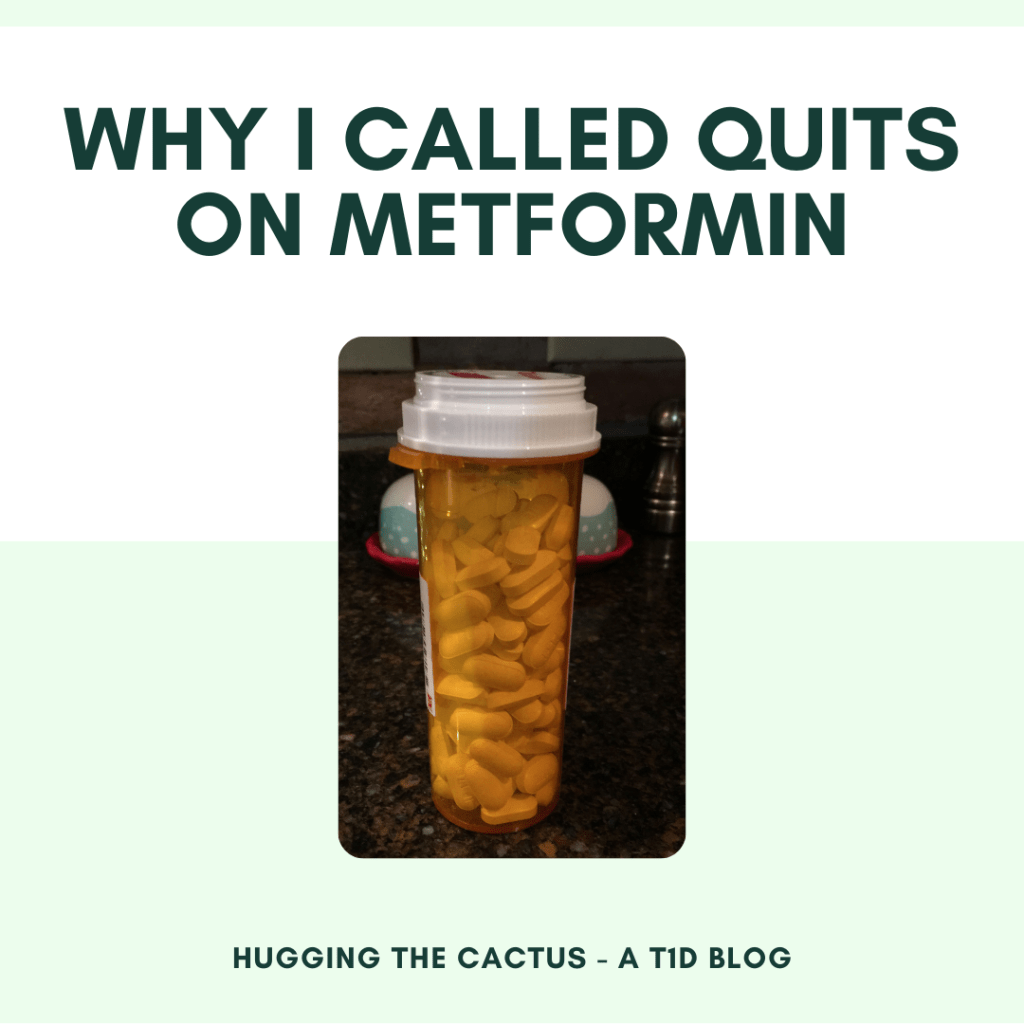
Why I Called Quits on Metformin

This post was originally published on Hugging the Cactus on December 6, 2019. I’m sharing it again today as a follow-up to Monday’s post, which explained how I was introduced to Metformin. This one covers why I decided to call it quits on my Metformin journey. Read on for the full scoop…

Well, well, well…looks like I’ve got another Metformin update for you all.

You’ve probably lost track of where I am in this long, twisting journey with the pill. (If you need a refresher, all you need to do is click here and read through my original posts.)

All caught up? Great. Now you really understand how complex my relationship with Metformin is.

There were times that I loved it. There were times that I hated it. And there were times when I simply couldn’t be sure if it was working for me the way that I’d hoped and needed it to.

I thought Metformin was right for me, but it turns out it definitely is not.

This last go-round represented the latter thought: Metformin simply wasn’t cutting it for me.

I’d been taking one pill daily for about a month when I decided to quit. The reason why I stopped taking it is simple: I wasn’t noticing a dramatic reduction in how much insulin I take each day. It was maybe a one or two unit drop, and that just doesn’t justify me taking a pill like this on a daily basis.

Now, you might be wondering why I didn’t amp up my dose. After all, it says right on the bottle that I can take up to four pills daily. Well, I chose not to take more for a few reasons: 1) I’m in between endocrinologists right now, and don’t really have anyone to consult regarding dosage, 2) At one point in time, I thought I noticed side effects of taking Metformin, and I’ve convinced myself that any possible side effects would intensify with a higher dose, 3) I wasn’t sure whether the higher blood sugars I was dealing with in the fall were due to stress or permanent changes that my body was experiencing.

So yeah, as you can see, it’s not a cut-and-dry answer when it comes to me increasing my Metformin dose.

I feel like I’m in a better place now with my blood sugars and daily insulin intake. Certainly, things have improved compared to how they were in September and much of October. Rather than fret over taking “too much” insulin every day, I’m going to focus on things that I have greater ability to control, such as the foods I choose to eat (that may or may not impact how much insulin I need) and the levels of exercise I get each week. I feel like that’s a healthier, better way to take care of myself.

So…farewell, Metformin. I won’t miss you. I know you do great things for other people with diabetes, but I’m not sure that you and I are a good match.

29 Feels Just Fine

Yesterday, I turned 29 years old. True to Hugging the Cactus tradition, I’m using today’s blog post as an opportunity to reflect on how I feel about this next year of my life.

29 feels just fine to me.

I’m feeling…just fine about 29. Before you think I’m just saying that because it rhymes, or because I’m not genuinely happy to be 29 (the rhyming is just a bonus and honestly, I’m happy to be any age because it means I’m living and that’s a wonderful thing), let me jump in and say it feels fine because…it just feels right for me, right here and right now. It’s not “just fine” in a sarcastic or curt way; rather, it’s “just fine” in the sense that it feels good and perfectly acceptable and something that I will embrace.

To tie it all back to diabetes, “good and perfectly acceptable and something that I will embrace” is kind of the attitude that I strive to maintain when it comes to how I feel about my diabetes. Of course, I have my days where everything is far from good, perfectly acceptable, or embrace-worthy. But generally speaking, I’ve worked hard to get to a place where I simply and peacefully coexist with my diabetes. I ride the waves of highs and lows and always find a way or means to overcome the unexpected ripples of randomness that my diabetes drifts my way.

So I’d like to carry that mindset into the last year of my 20s: a mindset in which I take comfort in knowing that I’m capable of riding the waves caused by diabetes, or anything else in my life, really. Arming myself with the knowledge that I grow through what I go through will help me thrive with diabetes and life, and it seems like an excellent nugget of wisdom to bring with me into year 29.

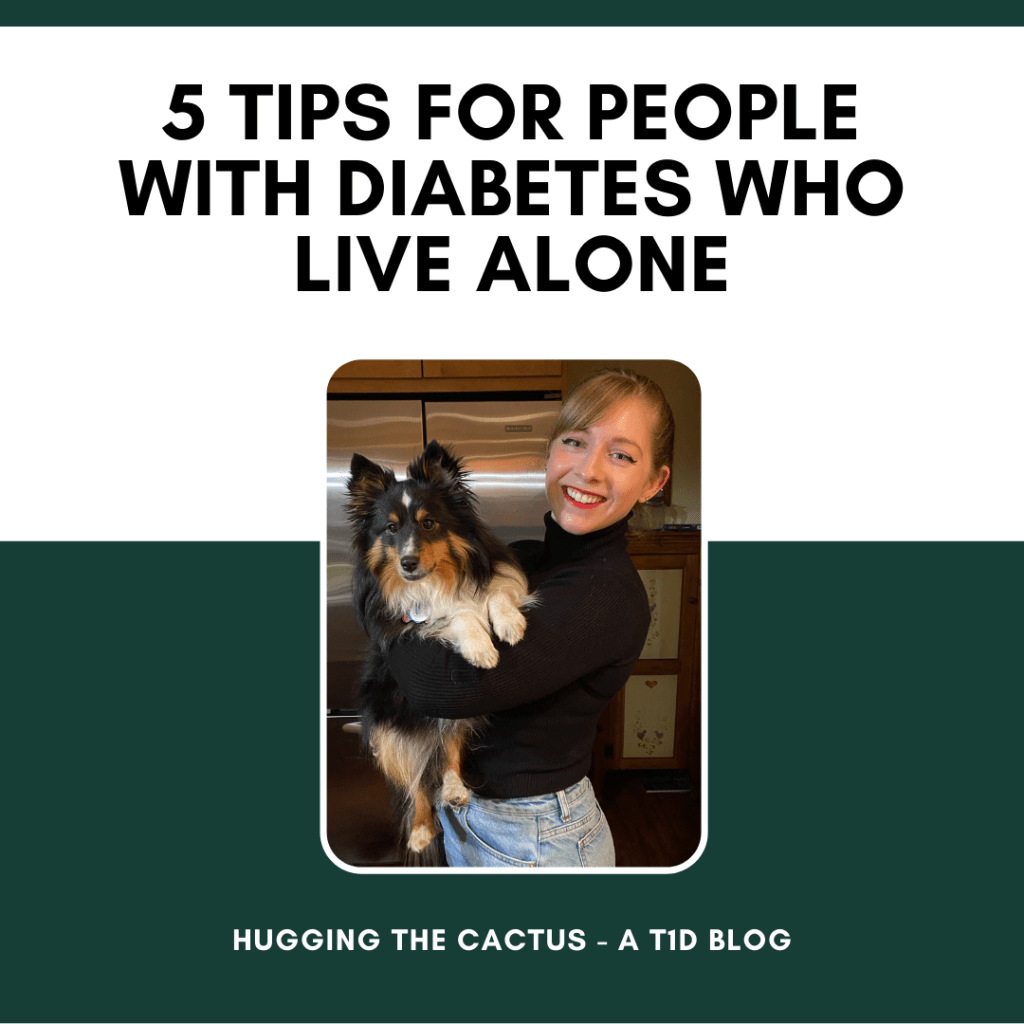
5 Tips for People with Diabetes Who Live Alone

This was originally published on Hugging the Cactus on January 6, 2021. I’m sharing it again today because there seems to be a lot of stigma about people with diabetes who live alone. I wrote this post because I wanted to reassure other people who live with diabetes and who might be nervous about living alone. I was definitely scared when I moved out of my parents’ home for good, but I’ve learned lessons along the way that really helped me become comfortable with it and enjoy it more. Read on for my perspective…

For the first time in my entire life, I’m living alone. (Well, I have my puppy Violet to keep me company, but no other humans.)

The prospect of living by myself always freaked me out a little bit, mainly because of the fears I have about diabetes and the “what ifs”: What if my blood sugar goes too low and I can’t get help? What if I’m sick or spilling ketones and need someone to assist me? What if “something bad” (pick any bad scenario here that you can think of) happens, and because I live alone, I can’t take care of myself?

With these questions lurking in the back of my mind, I decided to do something about my worries. I moved into my new place a couple of months ago and since then, I’ve come up with some strategies on how to manage my concerns about living alone with diabetes that have provided both peace of mind and confidence in my ability to thrive in my new home.

Tip #1: Utilize the Dexcom Share feature. This is the best thing that I have done since moving out of my parents’ home. I had a conversation with them after a particularly frightening middle-of-the-night low, and we all agreed that it would be wise for me to invite my dad to follow my blood sugars using Dexcom Share. My favorite part about this arrangement is that my dad and I discussed what we were both comfortable with in terms of data sharing – we decided that it wasn’t necessary for him to view my blood sugar graph at all times, but that he should get alerted when I’m below 50 or above 400. It makes me feel so much safer knowing that he will know if and when those situations should happen, and that he will be able to help me (albeit, from a slight distance) if I can’t help myself.

Tip #2: Keep low snacks all over the place. I keep low snacks on every floor of my condo (the main floor, upstairs, and in my basement) and right next to my bed on my nightstand. It might seem like overkill to have juice boxes, gummy snacks, and glucose tablets all over the place, but the point of that is I never know when a bad low blood sugar will strike, and it’s much easier to walk a few steps to get a low treatment than to walk up or down a set of stairs. I’m able to treat lows very quickly using this method, and since my fear of low blood sugars is one of my biggest concerns about living alone, this helps me make sure that I can handle them efficiently when they occur.

A bonus tip: Get a dog! Violet helps me manage loneliness and has a (mostly) positive impact on my mental health (I say “mostly” because my pup can be naughty).

Tip #3: Stay organized. It might sound strange that staying organized is a big help when it comes to living alone with diabetes, but I’ve found that it ensures that I’m able to access any of my supplies within seconds, if needed. I don’t have to rifle through drawers or cabinets to find out how many pods I have left, I simply have to walk into my bedroom closet and look at my shelf to see. I also have all of my medical paperwork – receipts, prescriptions, health plan information, etc. – stashed away in a clearly labeled folder in the filing cabinet by my desk, which again makes my life much easier when I need to find particular documentation at a moment’s notice.

Tip #4: Have emergency contacts identified and readily available. Nobody likes to think about something bad happening…least of all me. But I give myself peace of mind by having emergency contacts labeled in my iPhone using the Medical ID feature. If I needed to call one of them, it would simply take the push of a button (and a quick swipe).

Tip #5: Seek support over social media. When in doubt, I’ve had great success turning to my different social media platforms and chatting with others about issues surrounding living alone. Whether I add a story to my IG profile or send out a tweet when I have blood sugar concerns, I know that the diabetes online community will respond with guidance and insight to help me through whatever issue I may be experiencing. There’s something extraordinarily comforting about knowing that even though I’m living alone, I’m never truly alone because of the support I have.

Dungeons, Dragons, and Diabetes

Dungeons, dragons, and diabetes…one of these things is NOT like the other! And add “drams” into that mix, and you’re likely very confused and wondering what kind of bizarre, alliterated laundry list this is supposed to be – and why on earth I’m talking about it here on Hugging the Cactus.

Well, let me start by saying that one of the hobbies that I started to explore in the early pandemic days is Dungeons and Dragons! Yup, the fantasy role-playing game that’s been a staple of pop culture nerd-dom since the mid-70s. One day in Fall 2020, my boyfriend (who is extremely well-versed in DnD) invited me to play with a small group of his friends. I agreed to give it a try, though I admit that I went into it knowing nothing about it other than what I’d seen on the television show Stranger Things – which, quite frankly, is a highly stereotypical depiction of how a DnD campaign is run that resulted in me thinking that DnD was super limited in terms of gameplay.

Very quickly, every assumption that I had about DnD, who plays it, and how it works was shattered.

Click the image above to find out about the character I’ll be playing!

Over the course of the last year and a half or so, I’ve been involved in a handful of different DnD campaigns. All of these campaigns have varied drastically in terms of storyline, characters, and players, and to me, that’s the most exciting part about the game. Besides its ever-changing nature, I also enjoy that DnD allows me to explore my imagination – I get to come up with the entire backstory for original characters, and the creative writer within me is thrilled to be stretching those storytelling muscles that I’d long thought were atrophied.

But the best part of DnD, for me anyways, is how it’s brought me closer to friends and strangers alike. DnD has been a great way to meet new friends for the first time, as it’s something we can automatically talk about and refer to whether or not we’re actively playing a game. It has also strengthened my friendships with some of my coworkers from my last job who, like me, were newbies to DnD but willing to learn how to play during the pandemic because all of us generally like games and fantasy realms, and we were happy to have something to do virtually that wasn’t just another boring Zoom session.

And I can’t neglect to mention that DnD has been a wonderful escape from the reality of our world in the last couple of years. In DnD, the horrors going on in the real world don’t exist (unless you want them to, but nobody’s dared to do that in any of the games I’ve played). This means DnD is a nice mental break from not just the soul-sucking 24/7 news cycle, but it’s also a temporary vacation from diabetes. Any character that I’ve played in a campaign doesn’t have to worry about checking blood sugar or taking insulin injections before slaying bugbears, displacer beasts, or flameskulls. It might seem like an unconventional way to find reprieve from diabetes, but it’s a challenge to find something that can get me to stop thinking about my diabetes for even a short window of time. This is one thing that works for me and that makes me grateful for it.

So, coming full circle here and getting to the point of this blog post: I am participating in a new DnD campaign called Dungeons and Drams! The game runner (called the Dungeon Master) is actually an aforementioned former coworker and good friend of mine who delved deep into the DnD universe over the course of the pandemic. He’s combining his knowledge of the game with his extensive YouTube experience as a whiskey reviewer (hence the “drams” element to our game) to create the ultimate campaign that I’m honored to be part of. I’m joined by a few of his fellow whiskey YouTubers and I’ve got to say (shoving my obvious bias to the side here), the characters we’ve created are a thrilling combination of hilarious, badass, adventurous, and entertaining…so whether you’re a fan of DnD and/or drams of whiskeys, and the diabetes-related content that I feature here on Hugging the Cactus, you’re going to want to check this game and our channel out.

The adventure begins tonight, March 14, 2022 at 9:30 P.M. ET…looking forward to seeing you there.