My Thoughts on Moving from MA to VA

In the last few weeks, I’ve told most people in my life that I will be moving to Virginia (from Massachusetts) at the end of March. I have a lot of feelings about making the move: anxiety, excitement, anticipation, fear, optimism, and curiosity are chief among them.

And naturally, one of my top concerns is how my diabetes will adjust to my move. I imagine that the first week or so will be the most challenging. Between moving boxes and setting things up inside, I’ll be doing quite a bit of strenuous physical activity. It’s not that I’m not used to it (I exercise pretty much every day), or that I’ll have to do it alone (my boyfriend, who I’m moving in with, is going to help). It’s more so that I’m worried about the emotions I’ll be experiencing as I go through the moving-in process…and how those emotions will manifest themselves in my blood sugars. The “what ifs” keep running through my mind. What if I have trouble getting my prescriptions? What if I can’t find the right health-care team for me in Virginia? What if my diabetes struggles with the change? What if, what if, what if?

Succulent Sundays
Moving is an emotional process that can affect more than just mental health.

Don’t get me wrong – I really am excited to make this move. I’ve lived in the same small town my entire life, and though my love for it and the people who live there will never waver, it’s time to see what else is out there. And it’s really time to stop sustaining a long-distance relationship with my boyfriend. The last four years have been exhausting as we’ve traveled back and forth to visit each other for fleeting periods of time.

But I do know myself, and I remember quite clearly how I handled going off to college for the first time. I cried. For like, three days straight. I also marveled at the dining halls and the endless options available to me. Translation? I let my emotions drive my food choices and, in turn, my blood sugars suffered. But then…I started getting into a routine. I ate meals more regularly. I started exercising. I kept my mind occupied. And I started meeting new people and forming friendships that I cherish to this day. I grew from a naive teenager into a young adult with her shit *somewhat* together who started to accept a lot more responsibility in life. I finally became accountable for my diabetes in a way that I never was before, and even though it scared me initially, I recognize that it was ultimately exactly what I needed to do.

So I’m seeing the parallels here between my transition to college and my current transition with this move. I know that I’ll cry and be scared and miss my family and friends, but I also know that it’ll get easier as I establish my rhythm. The same can be said about my diabetes – it may protest in the beginning and be turbulent and unpredictable, but I’ll tame the savage beast…because I always find a way to.

Here’s to a new chapter in my life, one marked by more independence, self-growth, and positive change. And my goodness, here’s to frequent flier miles and the fact that home will always be one short plane ride away. Massachusetts can’t get rid of me that easily.

Why I’m Afraid to Turn 26

I’ve never been afraid of my birthday. In fact, I’ve looked forward to it every single year because of all the fun things that distinguish the occasion. I’m lucky to be able to say that each third of May of my life has been filled with celebration, gratitude, and cake – what’s not to like about that?

But this year is different for me. I’m turning 26, which means I’ll no longer be eligible for dependent coverage under my parents’ health plan. I’ll need to enroll in my employer’s plan and figure things out from there.

to my best buddy,
I don’t want a cake or presents for my birthday this year. I’d rather affordable health insurance.

This is terrifying to me. Why?

I’ve heard the stories.

Alec Raeshawn Smith’s story sticks out to me the most. He researched his insurance options and when he realized that the out-of-pocket costs for insulin were exorbitantly high, he decided to forgo insurance because it seemed more manageable to him.

He passed away just one month after going off his mother’s health insurance plan.

His family believes he was rationing insulin in order to survive until he could afford to buy some more.

There’s nothing about Alec’s story that isn’t tragic. It’s especially sad and frightening to someone who is about to begin navigating the confusing, expensive, and ruthless world of health insurance.

I’m hoping that I never get to a point where I need to pursue the dangerous “solution” of rationing insulin. But I’m also hoping that the biggies of insulin manufacturing – Novo Nordisk, Eli Lilly, and Sanofi – wake up and realize that they’re doing more harm than good. In 1996, just one year before I was diagnosed with diabetes, one vial of Humalog insulin (which I’ve used and continue to use since diagnosis) cost $21. Fast-forward 20 years, and Humalog costs skyrocketed to twelve times the cost at $255 per vial. Why? What could possibly justify this? How could anyone say that it is right for someone with diabetes who needs insulin to survive, and who didn’t ask for diabetes or do something to cause it, to pay that much on a regular basis to stay alive?

One thing is for sure: Insulin prices CANNOT stay as high as they are. There’s simply no reason for it, other than shameless, disgraceful greed.

And that is the simple truth of why I’m afraid to turn 26 this year.

My T1D New Year’s Resolutions

New Year’s resolutions are kinda tacky and silly, especially ones that are broken three weeks into a new year. Even so, I like to put a little thought into how I can better myself when a new year begins, so I guess I’m the sort of person who (somewhat grudgingly) tries to make a commitment to some form of self-improvement around this time each year.

Happy New Year!
Are you making any New Year’s resolutions?

While some of my resolutions are going to remain private, I’d like to share others – specifically, my diabetes-related ones – here because I think it’ll be the first step in making them a reality in 2019. Here’s what I’ve come up with so far, along with some explanations why they’re my goals so far:

  1. Improve my A1c – This is kind of a cop-out resolution, because let’s face it, a better A1c will never not be a goal of mine. I’m in a better range now than I was a few years ago, which is a huge accomplishment in itself. But I know I can do more, and I have the drive and desire to get myself below 6.5 this year.
  2. Make time for more IRL T1D hangouts/meet more T1Ds – I can’t be the only one who scrolls through Instagram and feels pangs of jealousy when I come across photos of large groups of T1Ds hanging out, right?? A significant percentage of these hangouts are the result of T1D conferences, which I’m rarely able to attend. They either cost too much money or take place at an inconvenient time, so I’m forced to miss out on some valuable face-to-face time with people who understand me in a unique way. It’s definitely a bad case of FOMO. As a result, I want to be proactive and try to arrange more meetups in my area in the next year.
  3. Incorporate more self-care into my routine – 2018 was such an insanely busy year. I felt that, at times, I was getting pulled into too many directions and had obligations to so many people that I could barely keep up, let alone make any time for myself to catch my breath. I had days here and there where I could sneak away for an hour or two and treat myself to a massage or exercise at the gym, but I really didn’t have a single mental health day in which I unplugged from everything and kicked back. Though I know 2019 will be just as hectic, if not more than 2018, I still want to be sure to make more time for myself, even if it is just for five or ten minutes a day.

Now that I’ve shared my resolutions, I feel like that will hold me accountable for making a good-faith effort in accomplishing them. And I also feel that they will be good things for me to write about throughout the next year, so I can keep both my audience and myself informed of my progress.

And with that, it’s my final blog post of 2018. Here’s to 2019, a year that will be filled with plenty more content from Hugging the Cactus. To you, my readers, I wish you a healthy and happy new year!

My 21st Diaversary

Today, Christmas Eve, is my 21st diaversary. That right, my diabetes is officially “legal”. You can bet that I’ll be celebrating with a special shot tonight – and no, I’m not talking about the insulin kind of shot.

Last year, I wrote about the sheer joy I felt as I hit my 20th diaversary. While I certainly do feel joyful this time of year as I greet another diabetes milestone (and because I’m wrapped up in the spirit of the season), I also can’t help but feel a pang of sadness.

The fact of the matter is, I’ve lived with diabetes for 84% of my life. And that’s a hard pill to swallow.

Happy birthday to you!
A birthday card to my diabetes.

I dream of a single day of normalcy. I want a day in my adult life in which diabetes isn’t at the forefront of my mind. Sure, I had just over a thousand days like that in my childhood…but the thing is, I don’t remember them. So they don’t count.

What I would give to have a solid, 24-hour stretch in which I don’t have to feel pricks from needles or hear buzzing, beeping devices. I wouldn’t have to feel as anxious about my blood sugars as I do on most days, and I would eat whatever the hell I wanted without a care in the world.

It sounds like a small ask, one day without diabetes, but at this stage in the game, it’d just be miraculous.

So on this day that is doubly special to me, I’m accepting that I feel a bit more negative than I did last year. There’s nothing wrong with that. In fact, it feels good to admit it, rather than force myself to write a bubbly blog post that simply celebrates 21 years of diabetes.

I’ll celebrate my own way today and enjoy the most wonderful time of the year, knowing that my little diabetes funk will pass on its own.

With that said, dear readers, I wish you a fantastic Christmas. Spend the day doing whatever brings your hearts happiness, and remember to take care of yourselves.

Don’t Feel Sorry About my Diabetes

Today’s blog post is going to be short and sweet, and about a subject that I think every person with diabetes deals with whenever they tell someone new about their diabetes.

It doesn’t matter how diabetes comes up in conversation. Whether it’s in a joking, serious, educational, happy, sad, or angry manner, the person I’m talking to almost always says…

“I’m sorry.”

Capture
I’m not sorry that I have diabetes, so you shouldn’t be, either.

Sometimes, I think it’s because society has instilled this weird reflex in people to apologize for something that they didn’t do. Other times, I think it’s because people just don’t know how else to respond to something that may be sobering or grounded in reality. But the simple fact of the matter is…

People need to stop apologizing to me, and other people with diabetes, for having it.

Here’s why:

  1. It doesn’t make sense.
  2. We weren’t given a choice – it’s a simple truth that we’ve learned to accept.
  3. It makes me feel strange, because it’s almost like the other person is taking accountability for my diabetes.
  4. I believe that human beings apologize too much, in general, and it diminishes apologies when they matter most or are most sincere.
  5. I’m not sorry that I have diabetes, so why should someone else be?

While I genuinely empathize with and appreciate people who apologize as a knee-jerk response, I’m just here to gently tell them that it isn’t necessary. Save “I’m sorry” for times that it’s warranted, and not for something like having diabetes, a matter in which no one has a choice.

Beyond Diabetes

This November, I participated in the #HappyDiabeticChallenge on Instagram. This challenge centered around daily prompts to respond to via an Instagram post or story. I’ve decided to spread the challenge to my blog for the last couple days of National Diabetes Awareness Month. As a result, today’s post topic is beyond diabetes.

I can’t believe that today is the final day of November, A.K.A. National Diabetes Awareness Month. In a way, I’m relieved. After all, diabetes advocacy can be exhausting. I’ve kept up daily Instagram posts, in one way or another, in response to the #HappyDiabeticChallenge. I’ve tried to keep all of my blog posts this month on theme. I even participated in a fundraising live stream on YouTube, which was an anxiety-provoking yet exhilarating event all on its own.

Needless to say, I’m looking forward to dialing it back down, temporarily, for the month of December. I won’t stop advocating, but I will take a small step back from it so I can recover and process everything from the month in my own time.

It’ll be a good way of reminding myself that I’m more. More than just this stupid chronic disease. There’s so much more to me than diabetes: I’m a daughter, a sister, a girlfriend, a best friend. I’m a dog lover (despite being allergic to most of them). I’m a young professional. I’m a millennial (who proudly owns the moniker). I’m a Disney fanatic and Harry Potter obsessive. I’m a creative and passionate person who cares about a lot of different people, things, and projects.

Capture
I am more than my diabetes.

I’m beyond my diabetes. I prove that to myself each day by living my life unencumbered by it. When it knocks me down, I always get back up to remind it that I’m the boss.

Beyond National Diabetes Awareness Month is a broader realization that I’m a bit burnt out by this hardcore advocacy. And that’s okay. I’ll take a breather and remember to enjoy life more, because I know that I’m beyond diabetes.

This Thanksgiving, I’m Thankful for…Diabetes?

This post originally appeared on my blog at ASweetLife.org on November 26, 2013. It’s hard to believe that I wrote it nearly five years ago, but with Thanksgiving occurring tomorrow, I thought it would be appropriate to revisit it since it captures my feelings about diabetes this time of year. Of course, life has changed quite a bit in the last five years, so I’ve made a couple amendments (below, italicized) to the original…

Each year around Thanksgiving, I think about the things that I am thankful for in life. Some obvious answers come to mind: my parents. My brother, my boyfriend, my dog. The fact that I am able to attend an amazing college. The roof over my head and the food on my plate. The list could go on and on. I’m sure most of my answers are unsurprising.

But is it weird that I’m thankful for diabetes, too?

Don’t get me wrong here. Oftentimes, I resent that I have to deal with the burden that is diabetes on a daily basis. I cry about it, I get angry about it, I curse about it. I wish that it didn’t impact me or my loved ones the way that it does. I’m all too aware, however, that I cannot change the role diabetes plays in my life. All I can do is accept it. When I did that and truly thought about what acceptance means, I began to think of why I might feel blessed in some bizarre way to have diabetes.

For starters, my diabetes has brought me closer to my family. My mom and I are able to relate to each other on a different level because of it. My dad and my brother show concern and unrelenting support for us that might not be the same if Mom and I did not have diabetes.

Sometimes, I think about how even though my diabetes seems to have a mind of its own, it adds a certain degree of control regarding some aspects of my daily life. It helps me get into a routine that is pretty static. It relies on what I choose to feed myself; in this way, it motivates me to make the right choices when it comes to my diet.

tgiving

And it has brought some amazing opportunities my way. Without diabetes, I would not have become president of the UMass Amherst chapter of the College Diabetes Network. I would not have discovered the Children with Diabetes: Friends for Life conference that I attended in Disney this past summer, where I made some awesome friends who keep in touch with me. And I certainly would not have begun blogging for ASweetLife.org. This experience itself has allowed me to get in touch with my feelings regarding diabetes to a greater extent. I have been able to explore my interests as an individual who loves to write. I have the pleasure of speaking with a wider variety of people within the diabetic community and hearing individual stories that I might not have ever heard.

I never would have guessed that a mere five years after writing this post, I’d be writing content for my very own diabetes blog. The creation of Hugging the Cactus is a huge diabetes-related accomplishment itself, but I’m reflecting on other diabetes changes I’ve experienced and how I’m thankful for them…so many come to mind. My OmniPod insulin pump, my improved A1c levels, new friendships formed…I’ve come a long way, and I’m grateful for every single positive experience that diabetes has brought into my life.

That’s why I’m seeing diabetes as something to be thankful for this Thanksgiving. I long for the day where diabetes is cured and I no longer have to think about it. But for now, I want to make the best out of something that could be perceived as the worst.

With all that said…enjoy your Thanksgiving holiday! No matter how you choose to celebrate it, remember that you are loved, you matter, and there’s people in your life who are endlessly thankful for your love and light.

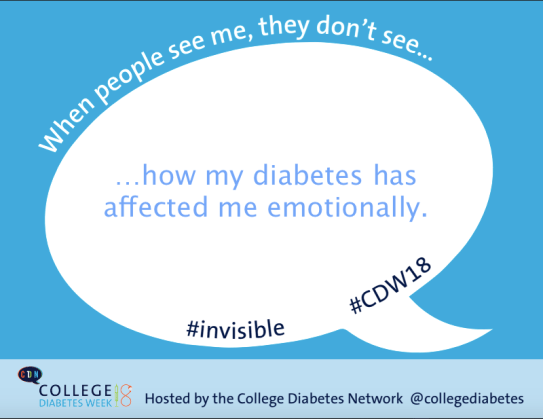
Type 1 Diabetes, an Invisible Illness

This blog post is a response to a prompt provided by my friends at the College Diabetes Network, who are celebrating College Diabetes Week from November 12-16. Even though I’m no longer in college, I like to participate in CDW activities as much as possible to show my support for the CDN!

Screen Shot 2018-11-04 at 7.52.43 PM

Invisible illnesses like diabetes can be difficult for healthy people to truly understand. Typically, they only see bits and pieces of it; for instance, when someone performs a blood sugar check or injects insulin. There’s so much that they don’t see: doctor’s appointments, late/sleepless nights, complex calculations, careful monitoring, and so forth.

But what’s really difficult for anyone to see is the emotional impact of diabetes.

Unless I choose to open up to someone about it – which is easier said than done – then there’s no way for another person to grasp the magnitude of the emotional side of diabetes. There’s no way for someone to feel the incredible amounts of anxiety, fear, and anger that cycle through me as I deal with diabetes. While I don’t experience these emotions every single day, I DO have to experience diabetes daily, and it’s impossible for someone to know what that’s like unless they either have T1D or care for someone with it.

I don’t wish for anyone in the world who’s unfamiliar with the (literal and emotional) ups and downs of diabetes to actually learn what it’s like. But I do wish for a world that’s a little more understanding, accepting, and educated when it comes to all things related to diabetes – and that’s why I advocate.

An Incident I Won’t Forget

Low blood sugars are funny. Not ha-ha funny, but peculiar in how they affect me physically and mentally.

A few weeks ago, I had an experience with a particularly scary low. It frightened me so much that I’m only just getting around to writing about it now, because I needed some time to gather my thoughts on what happened.

I’ll set the scene: I was home alone. I had eaten a carb-heavy dinner and decided to do a 30-minute, high-intensity workout. This was definitely far from my best idea ever, because due to the high-carb intake, I had a lot of insulin on board. That, coupled with the exercise, meant that my blood sugar was bound to crash soon after completing the workout.

And it sure did.

16E24606-06FB-447B-90B5-BEF2FA19E4CA
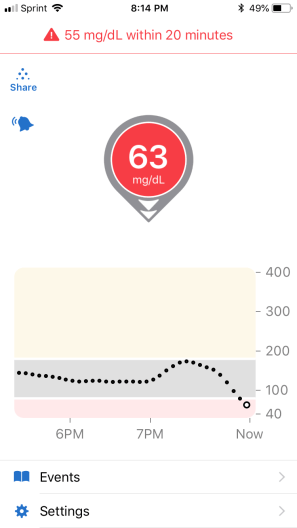
Falling rapidly.

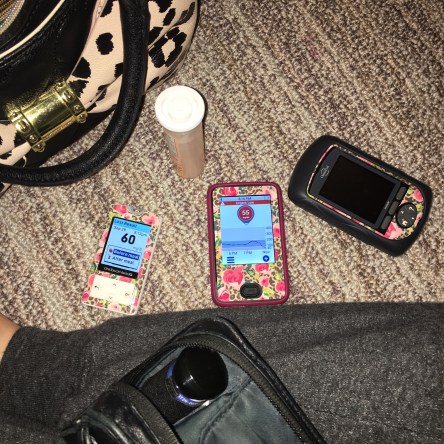
I had just stepped out of the shower and wrapped myself in a towel when I began to feel it. That sudden wave of weakness, shakiness, and dizziness. I walked to my bedroom, grabbed all of my diabetes supplies and my cell phone from my purse, and sank down to the floor with everything in front of me. I knew it would be wise to just sit there for as long as I needed, because I was afraid to go down the stairs (and possibly fall down/hurt myself in the process) in that state.

I checked my CGM, which confirmed that I was dropping quickly. I stared at the screen, panic flooding throughout my body. It occurred to me that I should probably do a finger stick check to make sure I was really that low, so I did, and saw that I was 60 mg/dL.


4219504D-CA13-4224-B5BA-9C90BB58F79D
The scene of the incident.

Now, I’ve absolutely been lower than 60 before. It’s never a pleasant experience. But rather than using that as a comforting thought, I couldn’t help but dwell on how terrible I felt and how frightened I was to be home alone with at least four more units of insulin still working in my system.

All I could do was chew four glucose tablets, suspend my insulin delivery, and wait.

In that period of time, I was totally immobilized.

I’ll never forget how alone I felt, how out of control I felt.

I felt powerless against my diabetes. My own body.

I’ll never forget the fear that consumed me, that nearly prevented me from helping myself in this situation.

I’ll never forget texting my mother and my boyfriend, telling them what was happening, and expressing how scared I felt.

I’ll never forget bursting into tears when they didn’t reply quickly enough.

I’ll never forget turning to my T1D Twitter buddies for help by sending a tweet about what was happening, or how swiftly and comfortingly they responded to me.

And I’ll never forget how I let my mind drift as I wondered whether I’d be okay.

It sounds totally dramatic, especially for a low that, in the grand scheme of things, could’ve been much worse. I can admit that.

But I can also admit that this is one of the few times in my life that I felt truly terrified of my diabetes, and swept up in the fact that things can change so quickly with this condition that it can quite literally knock you off your feet.

Obviously, I recovered just fine that night. The glucose tablets did their trick and my low symptoms subsided. It took longer for me to calm myself down, to breathe normally, non-panicky breaths. At least my puppy was around to soothe me.

I was fine, I will be fine. But I won’t forget this incident, ever.

A Diagnosis of LDM

What is LDM? According to my mother, it stands for Lovely Diabetes Mystery. The “lovely”, of course, is sarcastic, whereas the “diabetes” and “mystery” relate to a random, unforeseen diabetes medical incident – which occurred to me on Sunday, October 7th.

I woke up that morning with some abdominal pain. I rolled over soon after waking to check my CGM, and was startled to see that I’d be in the 300s for most of the night as I was sleeping. I quickly bolused for it using my PDM, and shut my eyes, hoping to get some more rest and to wake up again without stomach discomfort.

No such luck. About an hour later, I opened my eyes and looked at my PDM again, and I had barely come down. I tested to confirm, and sure enough, I’d only gone down a few points. I was worried, which was exacerbated by the weird nausea I was having. Could this be a sign of something more serious?

My mother convinced me to do a manual injection with a syringe. We both figured that that would help bring my numbers down faster, and that if I started coming down quickly, then it could mean that the pod I had just applied the day before was not working properly. We agreed that I should probably change it, to err on the side of caution.

However, I didn’t get to change my pod until much later in the day. That’s because of what happened soon after I took my manual injection.

I went to use the bathroom, certain that the churning of my stomach meant that I was about to be sick. I was standing in front of the toilet when I started sweating – profusely. On top of that, my vision went all fuzzy, and I felt totally disoriented. I knew something was wrong, so I called out for help.

My mom raced into the bathroom to find me seated on the floor, dripping in sweat. I placed myself on the floor deliberately because I was worried I might pass out and injure myself. She started cooling me down with a wet facecloth, and searched through the drawers to find a thermometer to check my temperature. She also grabbed her test kit and my lancing device, because naturally, we both assumed that perhaps my blood sugar was dropping rapidly from the insulin injection, and it might be a hypoglycemic event.

But when we checked my blood sugar, I was still in the high 200s. I was pretty scared at this point and just wanted the sweating to stop and for my vision to clear. That’s when my dad came in and made the executive decision to call an ambulance for me.

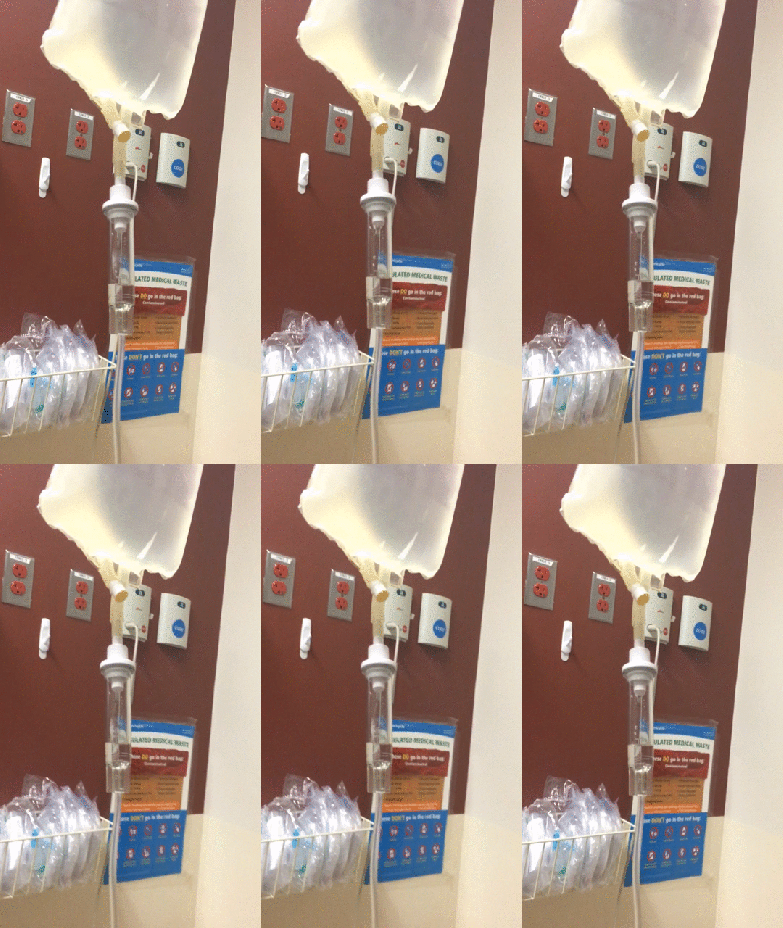
A police officer, three firefighters, and two EMTs showed up my house. I answered questions in my confused state. My vision restored and the sweating stopped, but I still felt weak and woozy. They put me into the ambulance. I was given an IV bag and medication for the nausea. It was my first time in an ambulance and it was not exciting, just weird. I didn’t like riding backwards or experiencing the twists and turns along the way.

91045270-BB56-4755-AC8C-3CDE532AF6B6
I was bored in the hospital; so naturally, I created this boomerang of my IV drip.

We arrive to the hospital. I’m whisked away into the ER. I answer a series of questions from various medical students and nurses and doctors. They draw blood for tests. I give them a urine sample for more testing. I keep on explaining the concept of my OmniPod to each one of them. No one seems to have seen it before, besides one med student who has a sister who works for Insulet. Small world!

We monitor my blood sugar closely. My tests come back normal. I eat my first foods for the day around 2 P.M.: sugar-free jello and two hard-boiled eggs. Yum…

I get an injection of insulin at the hospital. We don’t have a vial of Humalog with us – it was the one thing we forgot to grab from the house. But my dad drives home to retrieve it so I can change my pod at the hospital. My mom does it for me. I feel helpless.

The old pod comes off and we notice a definite bend in the cannula. Okay. One thing explained. I wasn’t receiving my full insulin dosages due to the bend, and unfortunately, I have no way of knowing how much insulin I was truly receiving. All I know is that it wasn’t enough, and that’s why I was running high.

I receive a diagnosis: vasovagal syncope, or pre-syncope. It’s explained to me, but I still don’t really get it. So I text my best friend, who is also a nurse. She tells me that it’s very common and can be triggered by a variety of things. The pre-syncope aspect makes more sense to me, seeing as I never truly passed out.

I’m discharged and feel so very tired. It was a long day. The following days are filled with follow-ups and message exchanges between myself, my endocrinologist, and my primary care physician. My healthcare team and I think that we come up with a plausible explanation for the hullabaloo: My body knew something was wrong. It knew that my blood sugar was abnormally high, and it knew to send signals to me that I needed to take care of it. Hence, the abdominal pain. My dehydrated state exacerbated things, and when I started sweating and lost more fluids, it was a lot for my body to experience.

Sheesh. What an ordeal. Like any diabetes-related experience, it taught me a lot, but I certainly don’t want anything like that to happen again. Shout-out to the healthcare professionals, but especially my parents, for taking damn good care of me throughout the whole episode. You’re the bomb diggity.